“From the end spring new beginnings.” (Pliny the Elder)

This week I thought I’d look at the endings of novels, as a companion piece to my last blog post, which looked at beginnings.  Doing this without giving away huge spoilers may be a bit of a challenge but I’ll do my best!

Firstly, Brokeback Mountain by Annie Proulx (4th Estate, 1999). I’m going to assume a certain amount of knowledge here as there was a hugely successful film made of this short story, but I’ll still try not to tell you exactly what happens.  The ending is this:

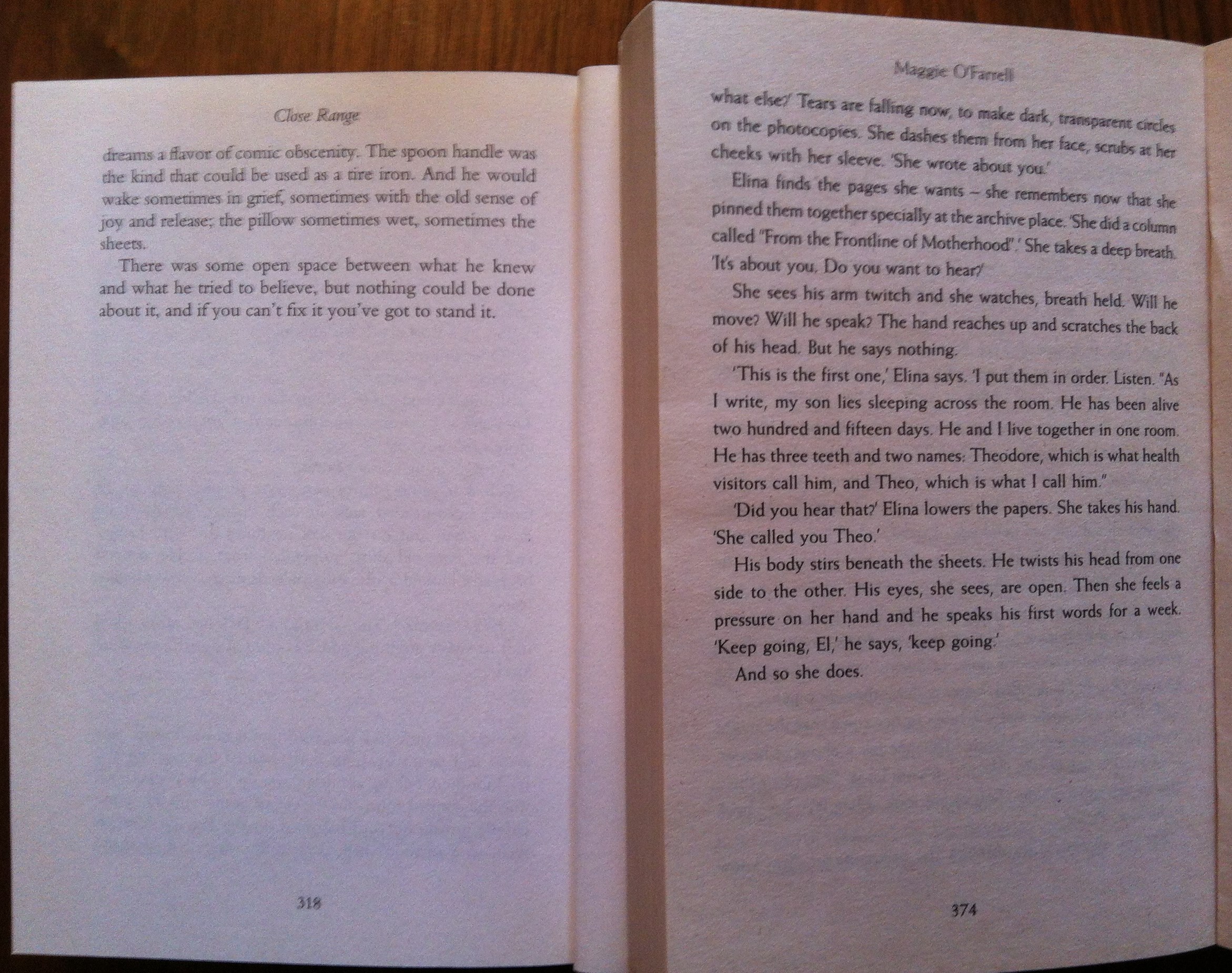
“There was some open space between what he knew and what he tried to believe, but nothing could be done about it, and if you can’t fix it you’ve just got to stand it.”

This is from the point of view of Ennis, a cowboy in 1960s America, who falls in love with his co-worker, Jack, when they are ranchers on the titular mountain.  The two of them are emotionally illiterate, they have no words with which to try and understand their experience.  This end line is just perfect for their story; Proulx’s sparse writing style with simple imagery like “open space” portrays their terse love affair (conducted mainly outdoors)and Ennis’ contained character exactly.  The language is all the more powerful for its simplicity “you’ve just got to stand it” capturing the heart-breaking stoicism of someone who ultimately feels powerless to lead an authentic life, to close that gap between what he knows and what he tries to believe.

It’s a story of a romance, but it’s determinedly unromantic:

“The room stank of semen and smoke and sweat and whiskey, of old carpet and sour hay, saddle leather, shit and cheap soap.  Ennis lay spread-eagled, spent and wet, breathing deep, still half tumescent, Jack blowing forceful cigarette clouds like whale spouts…”

Reading Proulx is often like this, a multi-sensory, unflinching experience. She also has a great ear for dialogue, adding to the sense of her stories’ authenticity.  Proulx has spoken about how highly she values the short story form, and so what you get in Brokeback Mountain is a perfectly crafted gem, where not one word is wasted.

Proulx has spoken warmly of the film adaptation of the story, particularly Heath Ledger’s portrayal of Ennis. Here is how that ending was interpreted in Ang Lee’s sensitive 2005 film version of the story:

Secondly, The Hand that First Held Mine by Maggie O’Farrell.  I read this fairly recently, and I found the last lines quite moving, so I thought I’d include them here.  They are:

“ “Keep going, El,” he says, “keep going.”

And so she does.”

These simple phrases capture a lot.  The story is one of families, the secrets and lies that can make up the relationships people hold with their nearest and dearest.  It’s a dual narrative, telling the story of Lexie Sinclair who leaves home to be with the worldly Innes Kent in London in the 1950s, and Elina, living in contemporary London, trying to hold on to a sense of self in the disorienting aftermath of having a baby:

“Elina jerks awake.  She is puzzled by the darkness, by the way her heart is fluttering in her chest.  She seems to be standing, leaning against a wall of surprising softness.  Her feet feel a long way away from her.  Her mouth is dry, her tongue stuck to her palate.  She has no memory at all of what she is doing here , standing in the dark, dozing like this against a wall.  Her mind is blank, like a ream of unmarked paper.  She turns her head suddenly, with a great heaving, everything swerves on its axis because she sees the window, she sees Ted next to her, she sees that she is not in fact standing.  She is lying.  On her back, hands clasped over her chest, a stone lady on a tomb.”

Elina’s partner is Ted, and as Elina finds her way back into the world it gradually emerges that Ted’s parents have not told him the whole truth about his life.  As Elina and Ted attempt to unravel the mystery, the two narratives converge.

I don’t want to say too much more for fear of spoilers, but what I will say is that THTFHM is a highly readable examination of the absolute havoc families can wreak on each other; of how powerful the truth can be, and its forceful drive towards exposure no matter what.  All the pain and turmoil often sits alongside love, and in the end all we can do is keep going.  The last few lines are an understated, realistic and hopeful ending.  The novel details the complexities of the ties that bind within a well-paced plot that ensures the reader keeps going until the last line.
Image

“Beginnings are always messy.” (John Galsworthy)

This week I started my final year at uni.  Things could get a little patchy on the blog front from here on in, but I really want to try and keep it going on a regular basis, so hopefully service will be uninterrupted by essays, tutorials, presentations, deadlines, exams….eek.  In honour of the new term, I thought I’d look at beginnings in books.  Not that this is a great new beginning for me – as a mature student I’ve been here many, many times before, so much more than is necessary.  But a beginning it is, and so on we go!

Firstly, Behind the Scenes at the Museum by Kate Atkinson (Black Swan, 1995).  This was Kate Atkinson’s first novel; nowadays she is well-known as the author of the Jackson Brodie novels (Case Histories, One Good Turn, When Will There Be Good News, Started Early Took My Dog) but this was before she turned her hand to detective fiction.  Let us just pause for a minute to consider the BBC trailer for their excellent adaptation of the Brodie novels:

Was that just an opportunity to gratuitously observe the craggily gorgeous and highly talented Jason Isaacs without his top on?  Yes it was.  (But I do recommend both the books and the TV series). Now back to books.  BTSATM is told from the point of view of Ruby, from the moment of her conception.  The novel begins:

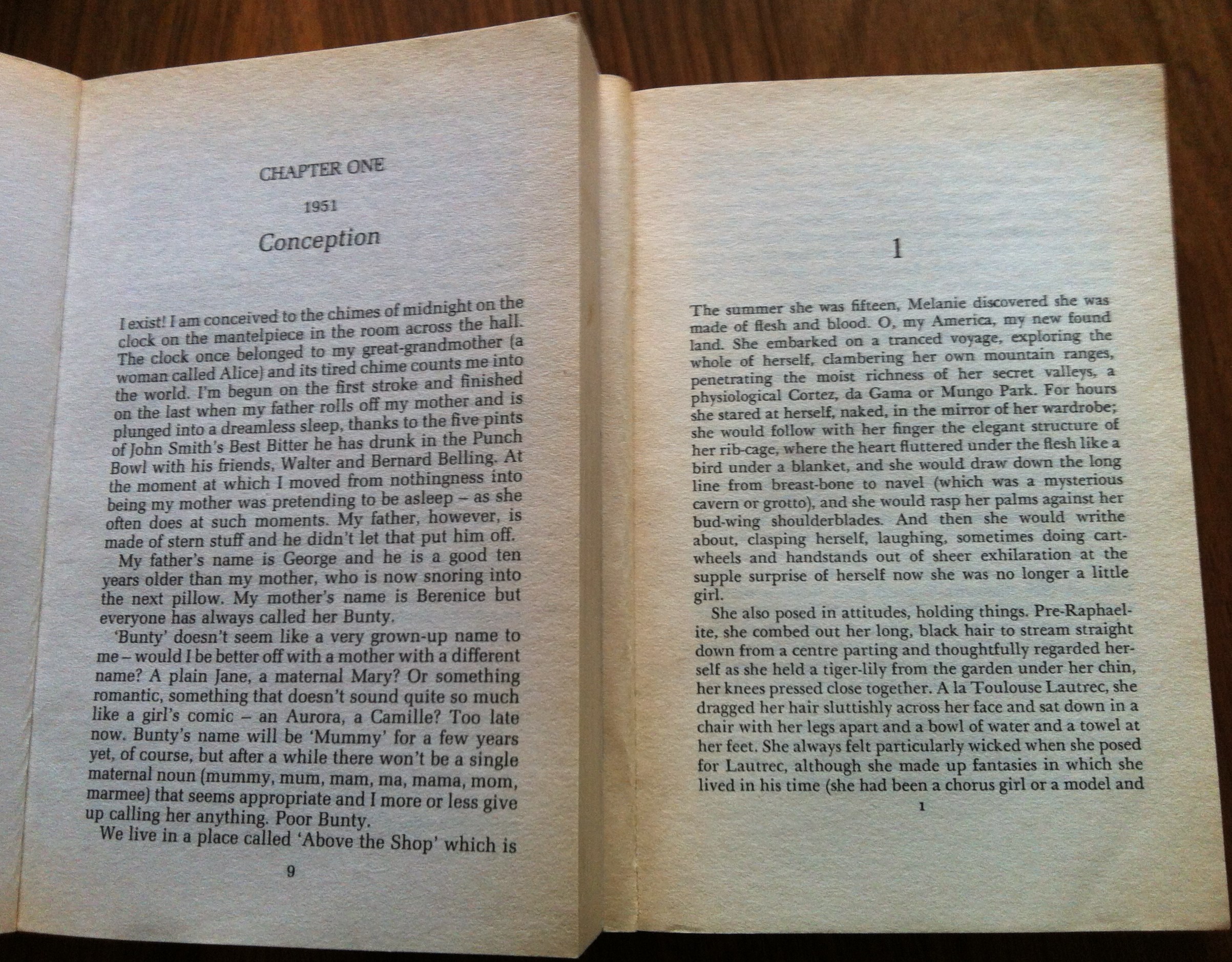
“I exist!  I am conceived to the chimes of midnight on the clock on the mantelpiece in the room across the hall.  The clock once belonged to my great-grandmother (a woman called Alice) and its tired chime counts me into the world.  I’m begun on the first stroke and finished on the last when my father rolls off my mother and is plunged into dreamless sleep, thanks to the five pints of John Smith’s Best Bitter he has drunk in the punchbowl with his friends, Walter and Bernard Belling.  At the moment at which I moved from nothingness into being my mother was pretending to be asleep – as she often does as such moments.  My father, however, is made of stern stuff and he didn’t let that put him off.”

When I was thinking of books to write about for this theme, this is the passage that immediately sprung to mind.  I think it’s just brilliant, and such a confident debut.  The two word opening sentence is really bold and creates a lively, engaging voice for Ruby.   The rest of the paragraph introduces so much about the rest of the story; it’s an enormously skilled piece of writing.  Firstly, the fact that it’s narrated from conception, that the foetal Ruby will be able to hear her mother’s thoughts, tells you that the story is not conventional.  Secondly, two of the women from Ruby’s family are already introduced, and the story will tell Ruby’s life but also be interwoven with the stories of other women in her family: her mother, grandmother and great-grandmother will all feature in third-person narratives alongside Ruby’s first person tale.  Thirdly, although the tale is highly inventive, it is not whimsical, and instead grounded in an earthy realism, as evidenced by Ruby’s unromantic beginnings.  And finally, as the end sentence shows, there’s a good dose of humour in there too.

BTSATM won the Whitbread book of the year in 1995, and I hope this beginning has given you a taste of why.  As Ruby takes you through the story of her life up to present day (around 1993), her unique voice creates vivid portraits of her family, and why and how things got to be the way they are.  All of Kate Atkinson’s novels are highly readable and expertly plotted, I urge you to give her a go.

Secondly, Angela Carter’s second novel, The Magic Toyshop (1967, my copy Virago 1994). Carter was a truly unique, arresting voice in fiction and I don’t always find her writing comfortable, but then I don’t think I’m supposed to.  The novel begins:

“The summer she was fifteen, Melanie discovered she was made of flesh and blood.  O, my America, my new found land.  She embarked on a tranced voyage, exploring the whole of herself, clambering her mountain ranges, penetrating the moist richness of her secret valleys, a physiological Cortez, da Gama or Mungo Park.  For hours she stared at herself, naked, in the mirror of her wardrobe; she would follow with her finger the elegant structure of her ribcage, where the heart fluttered under the flesh like a bird under a blanket…”

While the opening to BTSATM told you a lot about the novel, I think this opening tells you more about Carter as a writer.  She had a skill for making the everyday somewhat disconcerting, and I think the opening line shows this.  It states a truism, but you know there’s more happening than is immediately apparent.  Carter was concerned with women’s sexuality, but in a way that her characters are not necessarily sexual in response to other people – when others become involved, things become complicated and the sexual response less clear (her novel Love brutally details this type of experience). She often wrote in a magic realist style, and while this isn’t evident in this paragraph, the simile “like a bird under a blanket” demonstrates her odd approach to images, and how unsettling she can be.  Although the paragraph appears celebratory, a bird under a blanket is a horrible image of unnatural surroundings, containment and probably death.  To put this alongside a 15 year old girl who goes on in the paragraph to laugh “out of sheer exhilaration” at herself is disturbing, and hints at the violence that often lurks in Carter’s worlds.

Needless to say, this adolescent idyll doesn’t last long.  That night, Melanie finds out her parents have died in a plane crash, and she and her brother and sister have to move to London to live with her uncle Philip and her aunt Margaret, the latter of whom never speaks. Philip is a tyrant, and owns the toyshop of the title, where he works on puppet shows.  Despite the title, this is not a fairytale: “She turned over some of the stock.  Repelled yet attracted by the ferocious masks, she finally tried on one or two, but there was no mirror where she could see herself, although she felt peculiarly feline or vulpine according to the mask she wore.  They even seemed to smell of wild animals.” Creepy.  Carter is not an easy writer, but her inventiveness and intelligence make the challenge worthwhile.  If you fancy giving her a go but want something less intense, I recommend her picaresque later novels, Nights at the Circus and Wise Children.  There’s no-one like her.

003 (2)


“Autumn is a second spring when every leaf is a flower.” (Albert Camus)

Despite it being unseasonably warm here in London right now, the nights are drawing in and today I stepped on a conker, so I’ve decided officially that autumn is here.  I love autumn: the colours of the trees, the crispness of the air, the crispness of the apples…

Usually I try and make my choices not too obvious, but I’m going totally obvious with my first choice this week, Keats’ Ode to Autumn (1819).  You can read the whole poem here.  It begins with one of the most famous lines in English literature:

Season of mists and mellow fruitfulness, 
        [… ]to load and bless
        With fruit the vines that round the thatch-eves run;
    To bend with apples the moss’d cottage-trees,
        And fill all fruit with ripeness to the core;
          To swell the gourd, and plump the hazel shells
        With a sweet kernel…

I’ve mentioned before that I’m not a really a fan of the Romantics, and while this is an idealised, bucolic portrait of autumn, the beauty of the writing is undeniable. I love the fecund imagery: loading, bending, filling, swelling, plumping.  It gives a dynamism to the imagery but also a heady sense of autumnal bounty.  Keats builds on this headiness in the next stanza, personifying autumn as a soporific state:

 Thy hair soft-lifted by the winnowing wind;
  Or on a half-reap’d furrow sound asleep,
      Drows’d with the fume of poppies,

[…]by a cyder-press, with patient look,
          Thou watchest the last oozings hours by hours.

This is such a brilliant piece of writing, I feel quite sleepy just reading it.  “soft-lifted”, “drows’d” and “oozing” layer dreamy, slow motion action to great effect.  In the next stanza this motion is slowed down further, as autumn moves into winter, effectively dying:
   

Hedge-crickets sing; and now with treble soft

      The red-breast whistles from a garden-croft;
          And gathering swallows twitter in the skies.

The sound of the grasshoppers (“hedge-crickets”), robins and swallows heralding the coming winter is in keeping with the gentle imagery that has gone before, and creates an effective sense of how the death of a season is a slow fade, not a sudden change.  Keats takes us through the whole season, and while he may present an autumn that doesn’t really exist, it is still immediately recogniseable.  And it makes me want to drink scrumpy…

For my second choice I thought I’d choose a book based around academia, as for lots of people this is what the change in season at this time of year symbolises.  On Beauty by Zadie Smith (Penguin, 2005) is set in a fictional New England university town, Wellington. It follows two families, the Belsey’s and the Kipps, and their impact on each other’s lives, in a loose reworking of Howard’s End by EM Forster. Howard Belsey is a liberal art history professor, his nemesis the conservative Sir Monty Kipps.  When Sir Monty is given a visiting post at Wellington, the two families collide; the wives becoming friends, the children already romantically intertwined.  I’ll be honest, I didn’t much rate Smith’s first novel, the much-hyped White Teeth, but by On Beauty (despite the verging-on-pretentious title) she’s really getting into her stride.  She captures perfectly the pragmatism that constantly invades the high-minded idealism of academia:

“by next Tuesday these kids would have already sifted through the academic wares on display in the form of courses across the Humanities Faculty, and performed a comparative assessment in their own minds, drawing on multiple variables including the relative academic fame of the professor; his previous publications up to that point; his intellectual kudos; the uses of his class; whether his class really meant anything to their permanent records or their grad school potential; the likelihood of the professor in question having any real-world power that might translate into an actual capacity to write that letter that would effectively place them – three years from now – on an internship at the New Yorker or in the Pentagon or in Clinton’s Harlem offices or at French Vogue…”

However, the novel is not just a satire on academia.  Smith uses the setting to consider themes of identity, race, art, aging, love, all bound together by a strong intellect and comic sensibility:

“At this distance, walking past them all, thus itemizing them, not having to talk to any of them, flaneur Howard was able to the love them and, more than this, to feel himself, in his own romantic fashion, to be one of them.  We scum, we happy scum! From people like this he had come. To people like this he would always belong.  It was an ancestry he referred to proudly at Marxist conferences and in print; it was a communion he occasionally felt on the streets of New York and in the urban outskirts of Paris.  For the most part, however, Howard liked to keep his ‘working class roots’ where they flourished best: in his imagination.”

As Howard’s life unravels around him, the various members of the two families are each going on their own journeys towards realising who they are and who they will become. On Beauty is a big novel that considers big themes, I hope Smith’s observation of “a sprinkle of mirthless intellectual laughter, the kind one hears at bookshop readings” is not a proleptic reference to the reception the novel received – I somehow doubt it.

Just a little footnote point of interest: On Beauty is a family affair, with Smith’s husband, Nick Laird, providing the poetry, her brother Doc Brown, MCing a spoken word night some characters attend, and Smith herself appearing briefly as a “feckless novelist on a visiting fellowship”. For intelligent rap/comedy with something to say, I highly recommend Doc Brown’s YouTube channel.

To end, here is a photo that ties the two together, New England in autumn:

Image

(Photo credit: http://www.boston.com/travel/explorene/specials/foliage/galleries/reader_fall_photos/ )


“My books are like water; those of the great geniuses are wine. Fortunately everybody drinks water.” (Mark Twain)

Today is National Poetry Day, and the theme is Water.  I’ve chosen two contemporary poets who wrote on this theme (one poem and one collection of poems).  Mainly because I really like both the poets and they were who immediately sprang to mind, and also because I felt a bit bad about getting all Renaissance on your asses in my previous post.  Twentieth/twenty-first century language only this week, I promise!

Firstly, “Swimming to the Water Table”, from Neil Rollinson’s first collection A Spillage of Mercury (Cape Poetry, 1996).  Rollinson is famed for his unashamedly sexual poetry, but the theme of this poem couldn’t be more different.  “Swimming to the Water Table” deals with the modern day echoes of the Moors Murders.  I’m not sure how well-known these brutal, tragic events are outside Britain, so if you don’t know, there’s a link to the Wikipedia page here.  This is not a pleasant subject matter, but I think Rollinson treats it with sensitivity.  If you’d rather not approach such things, do give it a miss and scroll down to my second choice of poems.  The poem begins:

“After hours of silence and the velvet

of peat cloughs, the road

from Manchester cuts the moor

like an act of violence.”

I think this is hugely clever.  Rollinson is not going to write about the murders themselves – that would be hideous and entirely inappropriate.  Instead he creates the bleak, eerie atmosphere on the moor where the children are buried, and a sense of attack.  The noise of the main road, the assault on the person and senses, the sudden impact of it, manages to evoke the violence without in any way glamorising it.  The sound of the language, with the hard ‘c’ of “cuts” and “acts” creates for the reader the same sense of jolting into harshness that the speaker has experienced with the road, as we are forced away from the softness of “velvet” and “peat”.

The speaker is told where he is and reminded of what has taken place there:

“…I can picture

the gaunt, blonde murderess, smoking

a cigarette, watching the road,

Brady unrolling the carpets, cracking

puns with every strike of the spade.”

Again, I think Rollinson is so skilled here at evoking without explicitly detailing:  the shocking indifference of Hindley as she smokes and watches elsewhere,  the “cracking” and “striking” of Brady, enactor of the most sickening violence imaginable.  Rollinson is not shying away from what they did, and the verbs in this passage do not allow the reader to shy away either.  At the same time, we’re not in the midst of the brutal acts themselves; this is all we need, gory details would be sensationalist and intrusive. 

So where is the water?  In these final lines:

“…The bleached

rib of an animal curls from the ground

like the heart of a flayed orchid.

Under my feet, the bodies of children

swim to the clear, sweet water table.”

I find this ending incredibly powerful.  The animal rib shows the death that surrounds the moor, and a strange beauty that exists in the place – a flayed orchid is such an oddly violent, unsettling image.  The idea of the bodies in the water table is both haunting and deeply upsetting, but at the same time, by having them swimming, not floating, the children are granted an independent agency. I think Rollinson uses the water imagery to reclaim for the children something they were denied in life: a final peace and tranquillity.

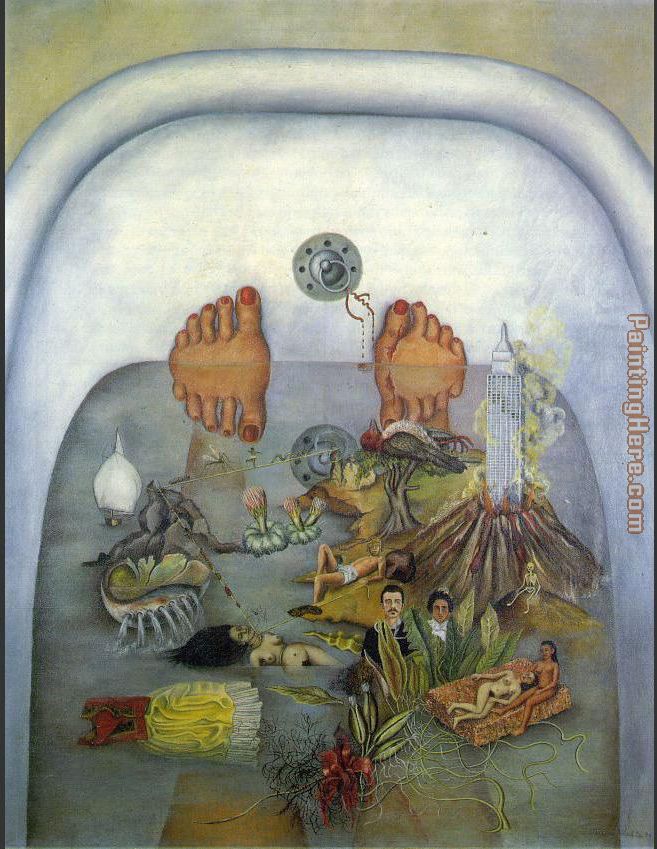
Secondly, a whole collection with a recurring theme of water, What the Water Gave Me: Poems After Frida Kahlo by Pascale Petit (Seren Books, 2010).  For this collection, Petit took on the voice of the artist Frida Kahlo, and created poems around her paintings.  There are six poems throughout the collection named “What the Water Gave Me”. The painting by Kahlo of this title looks like this:

Image

(Image from:  http://www.paintinghere.org/painting/what_the_water_gave_me-7293.html)

In “What the Water Gave Me IV” Petit layers image upon image to capture the multitude of scenes in the picture; it is 34 lines long but only one sentence.  It begins:

“The bath I lie in like a sarcophagus,

the water that’s about to become kerosene

the surface I have to keep absolutely still

so my body can slip through it

like a reflection passing out of a mirror”

You can have a look at the picture and see what you think Petit is doing here, I don’t want to kill the poem by insisting the meaning I see is absolute.  But I will say I think she captures the surrealism of Kahlo’s pictures with the notion of kerosene and the escaping reflection, and the odd, visceral yet detached relationship Kahlo has with her body.  The kerosene also moves towards the underlying violence in Kahlo’s work.  When she was 18 Kahlo had a severe accident when she was travelling on a bus.  The severity of her injuries left her in agonising pain her entire life:

“the ulcers and craters, the giant

one- legged quetzal pierced by a tree,

my toes and their doubles, their blood-red nails,

the ex-votos to give thanks for surviving

twenty-two fractures, the miniature parents

on their atoll far off as my thigh,

the Empire State Building spewing gangrene

over my shin, that no perfume can mask

so no-one will visit

the life led dying”

I think Petit does a great job of capturing one form in another here, giving words to visual art.  The shortening of the last two lines creates an emphasis to demonstrate the impact on the person of all the extreme imagery, and I think they are lines of real pathos.  The layering of image upon image without a break creates a momentum that drives towards the final line:

“a steel handrail breaks off and hurtles towards me.”

This effectively evokes how for Kahlo, the accident is lived over and over, forever in the present tense.  Its repercussions sent ripples through her entire life, and the impact of that steel handrail was devastating: it pierced through her abdomen and womb, meaning that although she wanted children, she could never carry one full term.  As she lies in the bath, as she lives her life, she lives the accident.

You can read some more examples of the poetry in the collection on Petit’s website, here.

Well, this wasn’t the most cheery subject matter, but I think both the poets are huge talents and their poetry is really powerful, so I hope this post wasn’t too depressing!  Do check out their other poems/collections, they’re well worth a look.

Here are the poems with a glass of water (sorry to be so prosaic, but hey, it represents the theme, right?)

Image

“I must have wanton Poets” (Edward II/Christopher Marlowe)

Oh dear, I’ve been very slack with regard to writing this blog lately.  I’ve been beavering away trying to prepare for my final year at uni, and have not managed my time properly – this does not bode well for the mania of finals.  Anyway, my pending exam failures aside,  I was wracking my brains trying to think of a theme for this post, when all I’ve been doing is studying.  Very dull, and does not make for lots of choices for a theme that relates to my life in any way.  But then I thought of something that happened recently and I want you stick with me when I tell you the theme of this post: its Renaissance theatre.  Wait!  For those of you groaning and having flashbacks to sweating over Shakespeare at school, let me say this: you were taught badly.  Renaissance drama can be the best drama there is, from a golden age of theatre when some of the greatest minds were so engaged with the art form they produced lively, innovative, downright entertaining plays.  Then generations of schoolchildren were tortured into trying to unpick it all bit by bit, whilst being told it was good for them.  I hope if that was your experience you’ll finish reading this post, and let me try and persuade you back into the theatre, because I love it.  The reason I’ve made it the theme of this post is because I went and saw Edward II at the National, and it was fantastic.  For those of you with ease of access to the South Bank, I highly recommend you try and catch it.  The production was so innovative and fresh (actors in the audience, multimedia approach, ad-libbing) but it still didn’t lose sight of Marlowe’s brilliant language.  Its iconoclastic approach may not be everyone’s cup of tea, but for me it was one of the best adaptations I’ve seen.

So I thought I’d look at two more Renaissance plays, neither by Shakespeare, because there’s an abundance of stuff on him, no?  (This doesn’t mean I won’t opt to write a post on him at another time, he was a genius after all).  Firstly, Dr Faustus by Christopher Marlowe.  I last saw this performed in 2011 at The Globe, and it was a great production.  I’m not always so keen on The Globe’s approach to things, but this worked well, and Arthur Darvill (Rory in Dr Who according to the excited audience members that surrounded me) was a perfect Mephistopheles.  Here’s the final scene from that production (filmed theatre is always a bit odd I think, and often does the production no justice, but hey ho):

Dr Faustus is about an academic who sells his soul to the devil, asking him to “Resolve me of all ambiguities”.  Ultimately however, Faustus does not use his devilish power to find the answers to anything, but instead uses his time to enjoy prestige and wealth.  This is the first time he and Mephistopheles (Lucifer’s servant) speak:

MEPH. Now, Faustus, what wouldst thou have me do?

FAUSTUS. I charge thee wait upon me whilst I live,

To do whatever Faustus shall command,

Be it to make the moon drop from her sphere,

Or the ocean to overwhelm the world.

 MEPH. I am a servant to great Lucifer,

 And may not follow thee without his leave:

 No more than he commands must we perform.

 FAUSTUS. Did not he charge thee to appear to me?

 MEPH. No, I came hither of mine own accord.

FAUSTUS. Did not my conjuring speeches raise thee? speak.

MEPH. That was the cause, but yet per accidens;

For, when we hear one rack the name of God,

 Abjure the Scriptures and his Saviour Christ,

 We fly, in hope to get his glorious soul…

This first conversation shows so much about the rest of the play.  Firstly, Faustus is a pompous idiot.  He’s just muttered all these complex Latinate incantations, entirely unnecessarily.  When Mephistopheles arrives it’s because he was hanging around, and dropped in “of his own accord”.  Faustus has not conjured  Lucifer, who would not concern himself with such a weasel.  Faustus asks for silly things, the moon to drop, a servant to obey his commands. Secondly, he has no real understanding of what he’s done, it is Mephistopheles who knows the true price paid with his “glorious soul”.  This devil explains:

MEPH. Unhappy spirits that fell with Lucifer,

Conspir’d against our God with Lucifer,

And are for ever damn’d with Lucifer.

FAUSTUS. Where are you damn’d?

MEPH. In hell.

FAUSTUS. How comes it, then, that thou art out of hell?

MEPH. Why, this is hell, nor am I out of it:

Think’st thou that I, who saw the face of God,

And tasted the eternal joys of heaven,

Am not tormented with ten thousand hells,

In being depriv’d of everlasting bliss?

 O, Faustus, leave these frivolous demands,

 Which strike a terror to my fainting soul!

That line: Why, this is hell, nor am I out of it, to me is the killer line of the whole play.  It shows just how little Faustus understands of what he has forfeited, and makes Mephistopheles the most complex character in the play.  He is both malevolent, and deeply, tragically sad, a fallen angel.  It shows how the person you are enables the power you have, to create a heaven or hell of your own making.  Marlowe was a controversial figure in his time; a government informer claimed the playwright was an atheist, an extreme and dangerous view to hold in the late sixteenth century.  (The informer also claimed Marlowe said “All they that love not tobacco and boys are fools”, a slightly less contentious view at the time).  Atheism was equated with immorality at the time, but I would argue Dr Faustus is a highly moral play whether or not you believe in God.  It asks the questions: what do you worship? and what price are you paying for that worship?  In this way, I would argue it still has plenty to say today, whether you are religious or not.  And if that all sounds a bit heavy, well, the full title is The Tragical History of Dr Faustus, but there are plenty of comic scenes and the play is so artfully written that you never feel like you’re being preached at.

Secondly, a comedy after all that tragedy, by Shakespeare’s frenemy, Ben Jonson: The Alchemist.  Jonson is rarely performed compared to his peers, and I think that’s a real shame.  This play is fast, frenetic, has plenty of physical and verbal comedy and is hugely entertaining.  It’s set in London during the plague, when all those who can afford it have fled to the country.  A servant, Face, takes advantage of his master’s absence to team up with an alchemist, Subtle, and a prostitute, Doll Common, to con people out of their money.  Cue lots of scenes with the three in various disguises, spinning ridiculous stories and scenarios to a succession of gullible idiots.  One of the most colourful of these is Sir Epicure Mammon, who desires the Philosopher’s Stone, for the following dubious reasons:

MAM. For I do mean

To have a list of wives and concubines,

Equal with Solomon, who had the stone

Alike with me; and I will make me a back

With the elixir, that shall be as tough

 As Hercules, to encounter fifty a night.—

 Thou’rt sure thou saw’st it blood?

 FACE. Both blood and spirit, sir.

 MAM. I will have all my beds blown up, not stuft;

Down is too hard: and then, mine oval room

Fill’d with such pictures as Tiberius took

From Elephantis, and dull Aretine

But coldly imitated. Then, my glasses

Cut in more subtle angles, to disperse

And multiply the figures, as I walk

 Naked between my succubae. My mists

 I’ll have of perfume, vapour’d ’bout the room,

 To lose ourselves in; and my baths, like pits

 To fall into; from whence we will come forth,

 And roll us dry in gossamer and roses.—

 Is it arrived at ruby?—Where I spy

 A wealthy citizen, or [a] rich lawyer,

 Have a sublimed pure wife, unto that fellow

 I’ll send a thousand pound to be my cuckold.

Jonson was scathing of those who practiced alchemy (attempting to turn base material into gold) and the greed of both the tricksters and their tricks is scathingly skewered.  However, it is a comedy, and (SPOILER) no-one is severely punished.  Of course, nowadays we’re far too savvy to believe in such things as alchemy – now, where did I put that lottery ticket…..?

Here’s an example of sixteenth-century alchemical experiments in action:

“Procrastinate now, don’t put it off.” (Ellen DeGeneres)

The Guardian newspaper has a series it runs on Saturdays, called The Q&A, short interviews with celebrities.  One of the regular questions is: “What is the trait you most deplore in yourself?”  I don’t even have to pause for thought to answer this one.  Having lived with myself all these years there are plenty of things I deplore in myself, but far and away is my enormous capacity for procrastination.  Since I’ve started this blog, my procrastination has developed two-fold: I use the blog to procrastinate from whatever else I’m meant to be doing, and the blog also provides something else I procrastinate over.  Let’s just say there’s some reading for next term not getting done right now, and certain members of my household facilitate my procrastination by indulging their favourite pastime of sitting on my laptop – how can I possibly work in these conditions?

Image

If you are fellow procrastinator, take heart from the fact that you are in great company.  Famous procrastinators include Leonardo da Vinci, Douglas Adams, Franz Kafka and Samuel Taylor Coleridge. The last of these is who I turn to now, with The Rime of the Ancient Mariner.  You can read the full poem here. This famous long poem tells the story of a mariner cursed after he shoots an albatross that had brought a warm wind to his ship:

And I had done a hellish thing,

And it would work ’em woe:

For all averred, I had killed the bird

That made the breeze to blow.

Ah wretch! said they, the bird to slay,

That made the breeze to blow!

As a result of his actions, he has to wear the albatross around his neck (hence the phrase for a guilty burden) and the ship is taken into new waters by vengeful spirits where the crew begin to die.

Day after day, day after day,

We stuck, nor breath nor motion;

As idle as a painted ship

Upon a painted ocean.


Water, water, every where,

And all the boards did shrink;

Water, water, every where,

Nor any drop to drink.


The very deep did rot: O Christ!

That ever this should be!

Yea, slimy things did crawl with legs

Upon the slimy sea.


About, about, in reel and rout

The death-fires danced at night;

The water, like a witch’s oils,

Burnt green, and blue and white.

As these lines show, there is an eerie, hallucinatory quality to the imagery that really evokes a feeling of desolation and disquiet on a vast expanse of ocean. The atmosphere of the poem is deeply unsettling.

When the mariner begins to appreciate the natural life around him, he prays, and the albatross falls from his neck, lifting the curse.

Beyond the shadow of the ship,

I watched the water-snakes:

They moved in tracks of shining white,

And when they reared, the elfish light

Fell off in hoary flakes.


Within the shadow of the ship

I watched their rich attire:

Blue, glossy green, and velvet black,

They coiled and swam; and every track

Was a flash of golden fire.


O happy living things! no tongue

Their beauty might declare:

A spring of love gushed from my heart,

And I blessèd them unaware:

Sure my kind saint took pity on me,

And I blessed them unaware.


The self-same moment I could pray;

And from my neck so free

The Albatross fell off, and sank

Like lead into the sea.

However, the Mariner is left to wander the earth, telling his story. It is not a comfortable resolution, and apparently Coleridge was in some sort of spiritual crisis when he wrote this poem.  But although it’s an uncomfortable read, it’s also Coleridge at his best, and the imagery is beautiful and arresting.  Definitely worth a read, and as a procrastination tool it should use up about an hour.

Secondly, back to the twenty-first century with Where’d You Go, Bernadette by Maria Semple. Semple used to write for various television shows, including one of my all-time favourites, Arrested Development, so I approached this novel with high hopes.  I wasn’t let down.   The novel is funny, but not at the expense of the characters.  Semple manages to create people you really care about, even as you laugh at their foibles and delusions.  I chose it for this post because Bernadette is an architect who hasn’t created anything in years.  The novel is told from the point of view of her adoring 15-year-old daughter Bee, but also multiple viewpoints as we read letters, emails, notes and even a transcript of a TED talk.  Bernadette lives with her husband and daughter in a crumbling building:

“All day and night it cracks and groans, like it’s trying to get comfortable but can’t, which I’m sure has everything to do with the huge amount of water it absorbs any time it rains.  It’s happened before that a door all of a sudden won’t open because the house has settled around it.”

“I knew our blackberry vines were buckling the library floor and causing weird lumps in the carpet and shattering basement windows. But I had a smile on my face, because while I slept, there was a force protecting me.”

Bernadette hates living in Seattle, “this Canada-close sinkhole they call the Emerald city”.  She responds with antagonism bordering on aggression to the parents at Bee’s school who try and get her involved in the “community”.  Then one day she disappears.  As Bee tries to put together what’s happened and find her idiosyncratic, forceful mother, the various characters emerge through Bee’s impression of them and their own words in the various transcripts that make up the novel. They are all flawed, funny, recognisable and likeable.  Even the character I most wanted to throttle redeemed herself in the end.

Although it’s Bee looking for her mother, the title is Where’d You Go, Bernadette, not Where’d You Go, Mom.  Ultimately the novel is about Bernadette’s search for herself, because, as a friend of hers points out: “If you don’t create, Bernadette, you will become a menace to society”.  And funny though Bernadette’s menace is, you’re rooting for this eccentric and engaging character to find her way back to working again. Where’d You Go, Bernadette is a reassuring, feel-good novel about how we’re all trying to get through life and not lose ourselves along the way.

Normally I end with a photo of the books, but I thought it was apt to the theme of procrastination not to get round to it.  Instead here is Tim from The Office exploring his favourite way to procrastinate, by torturing Gareth:

“Walk on air against your better judgement.” (Seamus Heaney, Nobel Lecture, 1995)

I wasn’t planning on posting this week, as I have two exams on Thursday, and despite the fact that I am a major procrastinator I’m really trying to revise.  (And keep getting distracted by episodes of Cake Boss, of which there seem to be approximately twenty million.  If I end up answering a question with the phrase “Byron is prime example of poetry in the Hoboken style, baby!” I have only myself to blame.  A little in-joke there for anyone else who follows this extraordinary bake-fest.)

Anyway, I wanted to post to commemorate the work of Seamus Heaney, whose death was announced today.  This is a sad loss to the contemporary poetry scene.  Heaney was as extraordinarily sensitive poet, dedicated to his craft, alive to all the possibilities of language.  To see him interviewed was the opportunity to listen to someone intelligent, unpretentious and engaging.

I’ve picked two of his poems pretty much at random.  He was a prolific writer so even if you don’t think much of my choices do check him out, there’s bound to be something for you.

Firstly, Blackberry Picking.  I chose this poem because I’m pretty sure this was the first Heaney poem I ever read, at school.  My English teacher was a massive Ted Hughes fan, so Heaney (contemporary and friend of Hughes) wasn’t too much of a leap.  You can view the whole poem here.  I’m just going to look at the first ten lines, and then the end line.

Late August, given heavy rain and sun
for a full week, the blackberries would ripen.
At first, just one, a glossy purple clot
among others, red, green, hard as a knot.
You ate that first one and its flesh was sweet
like thickened wine: summer’s blood was in it
leaving stains upon the tongue and lust for
picking. Then red ones inked up and that hunger
sent us out with milk-cans, pea-tins, jam-pots
where briars scratched and wet grass bleached our boots.

I love his imagery here.  I grew up with blackberries at the bottom of my garden and to me this vividly evokes that memory, but also his use of language is so accessible.  Sometimes contemporary poetry (or any poetry) can seem so impenetrable.  Heaney is great communicator, and I think this poem is easy to understand.  That’s not to say it’s simple – there’s a violence to this childhood memory, created through the visceral imagery (clot/flesh/blood/lust/scratched) that unnerves me, and stops it being a straightforward nostalgia trip.   Heaney’s last lines are often powerful and punchy endings.  In Blackberry Picking it’s this:

Each year I hoped they’d keep, knew they would not.

I think this is so simple and beautiful.  It succinctly captures the sadness that tinges childhood memories, and the way we learn that the world is not always as we want it to be, or something we can control. I don’t want to go on too much because I think poetry is an intensely personal experience, and everyone sees and gains different things from it.  I hope its enough of a taster to encourage you to check out the full poem.

Secondly, Two Lorries.  This is quite a famous poem of Heaney’s, from his Whitbread Award winning collection The Spirit Level, published the year after he won the Nobel Prize.  I chose it because there’s a recording of Heaney reading the poem available online, here.  What better way to experience the poem? This is one of the poems where Heaney looks at the Troubles that have been the enduring political experience of his country in his lifetime.  Here are the first two stanzas:

It’s raining on black coal and warm wet ashes.
There are tyre-marks in the yard, Agnew’s old lorry
Has all its cribs down and Agnew the coalman
With his Belfast accent’s sweet-talking my mother.
Would she ever go to a film in Magherafelt?
But it’s raining and he still has half the load

To deliver farther on. This time the lode
Our coal came from was silk-black, so the ashes
Will be the silkiest white. The Magherafelt
(Via Toomebridge) bus goes by. The half-stripped lorry
With its emptied, folded coal-bags moves my mother:
The tasty ways of a leather-aproned coalman!

This shows Heaney’s great skill at capturing life experience: the voices of his mother and the coalman are so clear and direct, despite being indirectly quoted.  Once again, I find his imagery so beautiful, and disturbing.  The idea that the coal turns from one extreme to the other (silk-black to silkiest white) is an image that has so much to say, and the extremity is evoked within a resolutely domestic scene gives it an extended context that makes it personal and political.  The second lorry of the title is the one that blows up the bus station in Magherafelt.  Here’s the end of the poem:

So tally bags and sweet-talk darkness, coalman,
Listen to the rain spit in new ashes

As you heft a load of dust that was Magherafelt,
Then reappear from your lorry as my mother’s
Dreamboat coalman filmed in silk-white ashes.

I’ve said before that I find it hard to write about things I really love.  This is one of those times.  The end of that poem is incredibly powerful and moving, I think I’ll just let it speak for itself.

Seamus Heaney 1939-2013.

Seamus Heaney

Image taken from: http://www.laobserved.com/archive/2013/08/seamus_heaney_nobel_prize.php

“The apparition of these faces in the crowd;/Petals on a wet, black bough.” (Ezra Pound, In a Station of the Metro)

This week’s post was prompted by an elastic band.  But first let me confess to a bad habit: I make up stories about people.  I’m sure lots of people do.  I sit on the train/in the café/bored out of my mind in the supermarket queue and I’ll notice someone and start concocting a whole story about them.  Half the time I don’t even realise it’s what I’m doing.  A lot of the time I forget this means I can end up staring quite intently at someone, and it’s frankly somewhat of a miracle that I’ve reached my ripe old age without getting my face punched in. If you suffer from this affliction and live in the UK, may I recommend the National Portrait Gallery?  A safe space where you are actively invited to go round staring at faces, it’s a haven for the fantasist of this type.  So, with my anti-social habit established, let me rewind to the elastic band…

I was on the train to Brighton (hence the title quote about Metro passengers, and an excuse to highlight one of my favourite poems).  The man across the aisle from me, facing away, was reading a book whose cover I couldn’t see, and on the little pull down table in front of him he had a bag of crisps.  This was a mammoth bag of crisps, and he’d eaten about half, folded over the top of the packet, and secured it with an elastic band wrapped round the packet.  After I’d admired his restraint – because if I open a big bag of crisps the entire contents of that bag is getting eaten – I became mesmerised by this elastic band.  Where had it come from?  Had he brought it with him, planned in advance for just such an eventuality?  Or did he carry round bits of stationery (is an elastic band stationery?) just in case events took a turn and he would be called on to secure something? Did he buy the elastic band having eaten half the packet and deciding the crisps needed better containment that just folding the top over?  How the hell had this circumstance arisen? He didn’t appear to have any bags with him, just the book and the crisps, so it wasn’t like he had an elastic band conveniently buried in a capacious man bag.

I realise thinking about almost anything other than this elastic band would have been a better use of my time, but I couldn’t help it.  This coupled with the man’s appearance – shoulders so big he was halfway in the aisle despite sitting fully in his seat, and a shaved head – convinced me he must be some ultra-capable marine/secret agent type.  I was certain the book he was reading was by Andy McNab.  And now a shoddy visual representation to keep you going through this long, waffly post:

Image

When he got up to leave I saw the front cover of the book and I couldn’t have got it more wrong. Most unexpected.  It was a book the BBC adapted for a Sunday night TV programme, that’s how cosy it was.  As my visions of him as MacGyver (or a more recent reference for the youngsters, Michael Weston from Burn Notice) crumbled to dust, I realised that I am rubbish at judging people.  I’d either got it totally wrong, or he was some hardcore daredevil marine, who just happened to like cosy reading. Either way my ideas about him based on elastic band usage and reading matter were entirely false.  By way of recompense I offer this book recommendation, which I think someone who is fastidious enough to wrap his crisps in an elastic band might enjoy (and yes, I realise this is still me being judgemental – and probably getting it wrong again – sorry, sorry, sorry):

So Many Ways to Begin by Jon McGregor (2006, Bloomsbury) tells the story of David, a museum curator.  Working in museums is his vocation, he has loved them since childhood:

“He liked the smell of museums, the musty scent of things dug from the earth and buried in heavy wooden store cupboards.  He liked the smell of the polish on the marbled floors, and the way his shoes squeaked as he walked across them.  He liked the way people’s voices would drift up and be lost in the hush of the high-ceilinged rooms.  He liked the coldness of the glass cases when he pressed his face against them.  He liked looking at the dates of the objects , and trying not to get dizzy as he added up how long ago that was.  He didn’t understand why people had to ask, why they didn’t enjoy museums as much as he did…”

A friend of his mother’s accidently exposes a family secret, one which sends David into free-fall.  As he struggles to comprehend his present in light of his altered past, he curates his own belongings.  Each chapter has a heading which refers to an object in David’s life: “handwritten list of household items c.1947”, “pair of cinema tickets annotated 19 May 1967”, “cut fragments of surgical thread, in small transparent case, dated July 1983”.  As we learn the meaning these objects hold, we understand David and the life he leads, alongside his mother, wife and daughter.  David fully realises the meaning of the minutiae in our lives when he curates an exhibition on the immigrants arriving in Coventry after the war:

“He wasn’t surprised by the interviewees eagerness to loan him their few treasured keepsakes –the watches, the framed photographs, the religious artefacts – trusting him to keep their last attachments to a lost home safe, pushing them gladly into his arms.  But what he hadn’t quite been expecting was just how readily people held these things to hand, arranged together in the alcoves of their front rooms, or across a chest of drawers in a bedroom, or filling a glass-fronted cabinet in a kitchen, like miniature museums of their own.”

So Many Ways to Begin is a sensitive portrayal of the intensely personal nature of the physicality of lives, how we ground ourselves in objects and are keepers of our own histories.  It is also about the shifting nature of those histories, and how relationships with others, the intangible, is what gives meaning to the tangible.

My second recommendation I give to the man who was sitting directly opposite me, (facing me) on the same journey.  You, sir, are beautiful.  This adjective is overused, applied with alarming regularity to people who simply have capped teeth and a good blow-dry.  But you are beautiful: you look like Henry Cavill and Toby Stephens had a baby together, then got Michelangelo in to complete the job.  (Seriously, why are you on a train in south London?  Shouldn’t you be in a convertible in the south of France?) Shoddy visual representation to keep you going through this long, waffly post:

Image

While I’m on this judgemental trip, I’ll assert that I think you owe it to the world to ensure your mind is as beautiful as your face.  Stop reading the free newspapers that litter every train compartment.  Yes, that’s what you were doing.  It only serves to sully you.  I know they’re free, I know everyone does it, but do you know the free paper is owned by the same group as the Daily Mail?  And frankly there isn’t a blog post long enough for me to tell you all that’s wrong with that newspaper.  So here is my recommendation for reading matter as lovely as your face:

The God of Small Things by Arundhati Roy (1997, Flamingo) is novel that takes joy in language and is beautifully written.  I know some people found it a bit over the top in this regard, but I really enjoyed losing myself in this lyrical novel.  It tells the story of a family through the eyes of twins, Estha and Rahel.  Roy is a political activist (this is her only novel so far) and there are strong political themes running through the novel, around India’s caste system, economics, and communism.  She considers the effect these large forces can have on families and individuals:

“it was a skyblue day in December sixty-nine (the nineteen silent).  It was the kind of time in the life of a family when something happens to nudge its hidden morality from its resting place and make it bubble to the surface and float for a while. In clear view. For everyone to see.”

The conflict between the family morality and societal constructs results in tragedy that tears the family apart. The twins are separated at age 7 and only reunited at age 31, where the damage that has been done continues to exert its power.  It’s difficult to go into details without giving away great swathes of plot, so I’ll just give you a few little bits.  Estha reacts to the events by becoming increasingly silent:

“A raindrop glistened on the end of Estha’s earlobe.  Thick, silver in the light, like a heavy bead of mercury.  She reached out. Touched it. Took it away.  Estha didn’t look at her.  He retreated into further stillness.”

The Kerala setting is vividly evoked, such as in the opening paragraph to the novel:

“May in Ayemenem is a hot, brooding month.  The days are long and humid. The river shrinks and black crows gorge on bright mangoes in still, dustgreen trees. Red bananas ripen. Jackfruits burst. Dissolute bluebottles hum vacuously in the fruity air.  Then they stun themselves against clear windows and die, fatly baffled in the sun. The nights are clear but suffused with sloth and sullen expectation.”

The God of Small Things takes controversial issues shows the impact on individuals bound up in circumstances they cannot control.  The beauty of the prose emphasises the drama rather than disguises it, making a powerful and highly readable novel.

Here are the novels with a scene from Strangers on a Train:

Image

“Many people, myself among them, feel better at the mere sight of a book.” (Jane Smiley)

Hello you gorgeous creature.  Yes, you.  I’m talking to you.  You’re lovely.  Thank you for visiting my blog, I really appreciate it.  And I’m confident in my assertion that you’re lovely, because in the short time I’ve been blogging, I’ve been struck by what a great community the blogosphere (as I’ve encountered it) is.  Recently there’s been a lot of attention in the media given to trolls, and the very real havoc they can wreak.  While this atrocious, it’s also true that “Two Bloggers Disagree – Lively & Respectful Debate Ensues” is not a headline you’ll see anytime soon.  People behaving well is just not newsworthy.  So this week I thought I’d make the theme of my post comfort reading.  A cosy corner to celebrate the niceties of life, with you, my fellow bibliophiles and general all round good-eggs.  Pull up an overstuffed chair, wrap yourself in a quilt, keep the hot chocolate and cake within arm’s reach – let’s get cosy and settle down to some books!

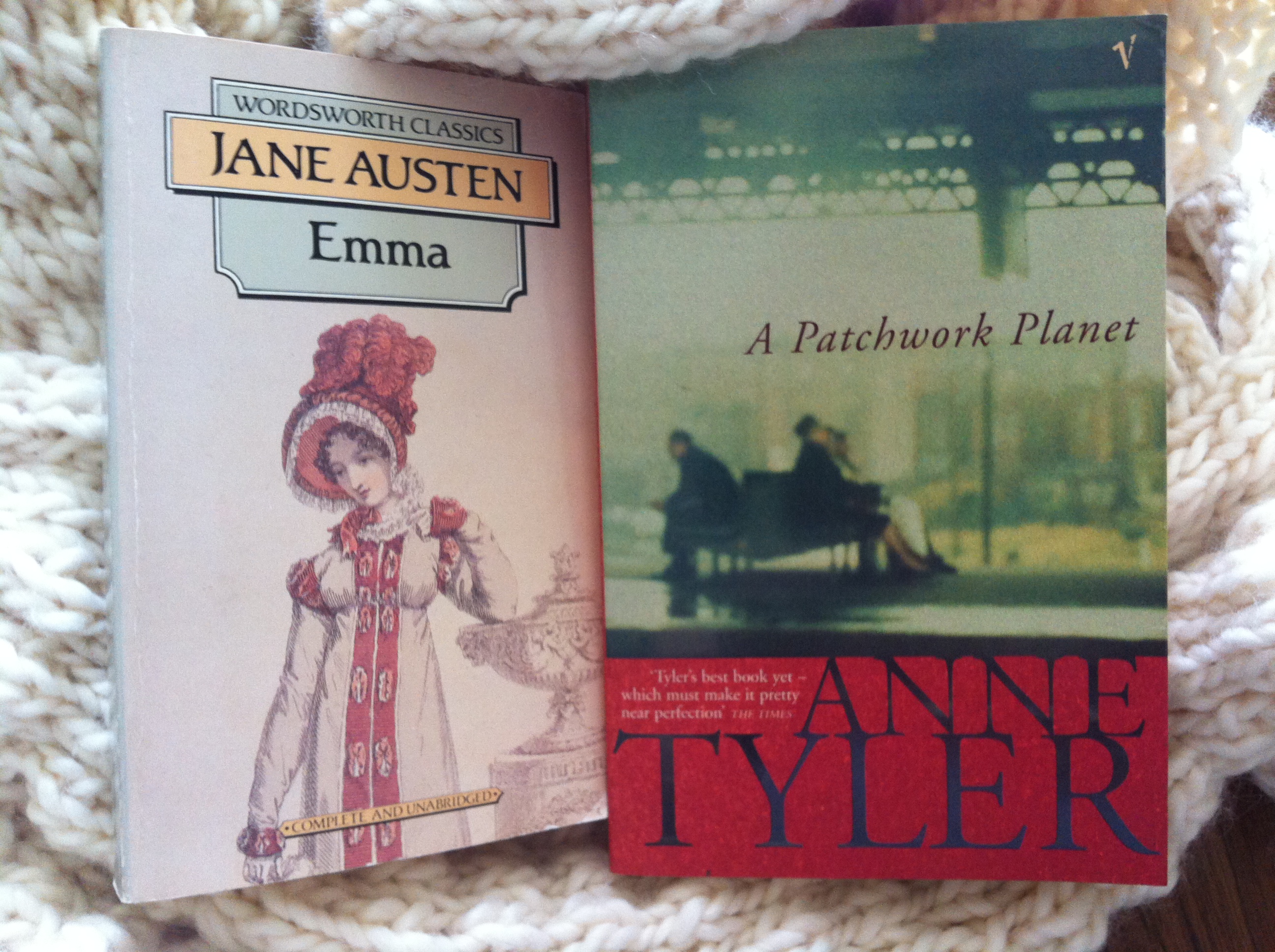
Firstly, Emma by Jane Austen (1815, my edition  Wordsworth, 1992).   I chose this novel because I remember the first time I read it, once all the characters were introduced, thinking “well, I can see exactly how this is going to play out”.  And I don’t think I’m particularly clever or insightful, I think most readers would experience the same.  It’s not that it’s a badly written book, far from it, but just that nowadays we’re used to these sorts of plotlines (romantic story arc, some misunderstanding and confusion, resolution leading to reunited lovers) and I think there’s comfort to be gleaned from that predictability.  I’m not a big reader of crime fiction, but I imagine it’s a similar sort of deal – you get to walk away from the novel with the ends nicely tied up and equilibrium restored.  And that can be very comforting.  So let me introduce you to:

“Emma Woodhouse, handsome, clever, and rich, with a comfortable home and happy disposition, seemed to unite some of the best blessings of existence; and had lived nearly twenty-one years in the world with very little to distress or vex her.”

Emma is not necessarily all that likeable – she’s a spolit snob who thinks she knows what is best for people.  But Emma grows and matures throughout the novel and becomes more humble, and fundamentally has her heart in the right place, so it’s difficult not to warm to her.  The novel is resolutely domestic, as Emma concerns herself with her neighbours and plots to arrange romantic attachments.  The plot is slight, but Emma sees Jane Austen writing as a confident and accomplished author, and the story is delivered with great verve.  There are plenty of Austen’s aphorisms to enjoy:

“It was a delightful visit;-perfect, in being much too short.” 

“I always deserve the best treatment because I never put up with any other.” 

“One half of the world cannot understand the pleasures of the other.” 

I had a tutor who specialised in Austen, and told me she enjoyed her because she was such an absolute bitch, at odds with her rather twee image.  Certainly the portrayals of the vain, boorish characters pull no punches:

“Emma was not required, by any subsequent discovery, to retract her ill opinion of Mrs. Elton. Her observation had been pretty correct. Such as Mrs. Elton appeared to her on this second interview, such she appeared whenever they met again,—self-important, presuming, familiar, ignorant, and ill-bred. She had a little beauty and a little accomplishment, but so little judgment that she thought herself coming with superior knowledge of the world, to enliven and improve a country neighbourhood”

Ouch.  So if you fancy losing yourself in the domestic and romantic concerns of Regency England, just beware that all is not as cosy as it appears.  But Emma is still a comforting read, and one that is huge fun.

Secondly, A Patchwork Planet by Anne Tyler (Vintage, 1999). I haven’t read much by this prolific and much-loved author, only this novel and Breathing Lessons, so forgive me if I seem to be saying very obvious things to established Anne Tyler fans out there. I chose it because I found it comforting read, suggesting there is hope for all of us and people are capable of giving a great deal to one another as we all muddle through life.  Anne Tyler has observed in an interview that “very small things are often really larger than the large things” and this is what she concerns herself with, the small things that hold great meaning in our lives.  A Patchwork Planet tells the story of Barnaby Gaitlin, a man whose life is not where he wants it to be, but he’s not sure what he does want.  His family struggle to forgive him after he was caught in high school breaking into peoples’ homes to go through their things and read their mail.  His ex-wife has moved away and taken their rabbit-faced daughter with her.  He works for Rent-a-Back, providing odd jobs for the elderly in the neighbourhood. He feels he is not the good person others think he is:

“Oh, what makes some people more virtuous than others? Is it something they know form birth? Don’t they ever feel that zingy , thrilling urge to smash the world to bits? Isn’t it possible, maybe, that good people are just luckier people? Couldn’t that be the explanation?”

A Patchwork Planet is peopled with eccentric characters, Barnaby’s co-workers, clients and family. Tyler writes with warmth and acceptance for people in all their guises:

“Then Mrs Alford started sorting her belongings.  That’s always a worrisome sign.  For a solid week she had three of us come in daily – me, Ray Oakley, and Martine. (“Two men for the real lifting,” was how she put it, “and a girl so as to encourage the hiring of women.”) […] Half the time she called Martine “Celeste” which was the name of our other female employee, and I was “Terry”.

“It’s Barnaby, Mrs Alford,” I said as gently as possible.

“Oh! I’m sorry! I thought your name was Terry and you played in that musical group.””

The humour in A Patchwork Planet is gentle, and never at the expense of the characters. As Barnaby muddles his way through another year of his life, you’re left with the feeling that nothing’s perfect but it’s OK.  Sometimes it’s better than OK.  And we may all be alone, but we’re all in this together.  What’s more comforting than that?

Here are the books getting cosy, wrapped in a chunky woollen scarf I knitted (and got completely carried away with, it’s about 8 feet long, good job I’m tall):

Image

“Oh, brothers! I don’t care for brothers. My elder brother won’t die, and my younger brothers seem never to do anything else.” (Oscar Wilde)

According to a skincare company trying to get me to spend more money, Friday was International Sisters Day. I don’t have a sister so my spending on moisturiser was limited, but I do have a brother. (And he buys his own moisturiser).  I have no idea when International Brothers Day is, so I thought I would theme this post around male siblings and just ignore the fact that it was supposed to be a celebration of sisterhood.  I should just point out that I chose the title quote because I love Oscar Wilde and it was about brothers, not because I’m waiting for my brother to die.  Without him in my life I would lose the one person who manages to simultaneously ridicule the things I say and do, whilst being unconditionally, unwaveringly supportive.  It’s a seemingly paradoxical combination that I’m sure many of you with siblings will recognise.  The texts I’ve chosen both feature brothers, but admittedly not a sibling relationship I found familiar. This is hardly surprising – I consider having a brother one of the great blessings of my life, and this doesn’t make for a very dynamic narrative. So the relationships depicted are dysfunctional and bordering on destructive, but this makes for two powerful tales of familial drama.

Firstly, a classic of modern American theatre, Death of a Salesman by Arthur Miller (1949, my copy Penguin 2000).  The play tells the story of Willy Loman, the salesman of the title, as he loses his grip on his life.  He is aging, always a threat to a salesman’s career, and his sanity is wavering, he is subject to flashbacks and unable to distinguish between past and present at times.  The play is a damning indictment of a consumerist culture, and written in 1948, it sadly hasn’t aged at all:

LINDA: And Willy, don’t forget to ask for a little advance, because we’ve got the insurance premium. It’s the grace period now.

WILLY: That’s a hundred… ?

LINDA: A hundred and eight, sixty-eight. Because we’re a little short again.

WILLY: Why are we short?

LINDA: Well, you had the motor job on the car…

WILLY: That goddam Studebaker!

LINDA: And you got one more payment on the refrigerator…

WILLY: But it just broke again!

LINDA: Well, it’s old, dear.

WILLY: I told you we should’ve bought a well-advertised machine. Charley bought a General Electric and it’s twenty years old and it’s still good, that son-of-a-bitch.

LINDA: But, Willy…

WILLY: Whoever heard of a Hastings refrigerator? Once in my life I would like to own something outright before it’s broken! I’m always in a race with the junkyard! I just finished paying for the car and it’s on its last legs. The refrigerator consumes belts like a goddam maniac. They time those things. They time them so when you finally paid for them, they’re used up.

Within the pressures of consumerism, Willy and his sons struggle to make the money the need to buy the things they’re convinced they need, and still create a life of meaning.  The sons of the play, Happy and Biff, are close brothers, but very different.  Happy is a ladies man, working in the commercial sector, but lonely without fully knowing why.  Biff struggles under the weight of his father’s expectations, only knowing what he doesn’t want – to follow his father into sales:

BIFF: Why does Dad mock me all the time?

HAPPY: He’s not mocking you, he…

BIFF: Everything I say there’s a twist of mockery on his face. I can’t get near him.

HAPPY: He just wants you to make good, that’s all. I wanted to talk to you about Dad for a long time, Biff. Something’s — happening to him. He — talks to himself.

BIFF: I noticed that this morning. But he always mumbled.

HAPPY: But not so noticeable. It got so embarrassing I sent him to Florida. And you know something? Most of the time he’s talking to you.

BIFF: What’s he say about me?

HAPPY: I can’t make it out.

BIFF: What’s he say about me?

HAPPY: I think the fact that you’re not settled, that you’re still kind of up in the air…

BIFF: There’s one or two other things depressing him, Happy.

HAPPY: What do you mean?

BIFF: Never mind. Just don’t lay it all to me.

HAPPY: But I think if you just got started — I mean — is there any future for you out there?

BIFF: I tell ya, Hap, I don’t know what the future is. I don’t know — what I’m supposed to want.

Arthur Miller has a great reputation for good reason.  As the Loman family implodes under the weight of failure and disappointment, the play powerfully demonstrates the forces modern life can exert to a tragic extent.  Not a light read, but sixty-five years later, still a vital one.

Secondly, and with a title that gives two sibling types for the price of one, The Sisters Brothers by Patrick de Witt (Granta, 2011).  This novel was published to great acclaim and was shortlisted for the Booker in 2011.  I found it a strange read. Apparently there were suggestions that the Coen brothers buy the film rights (something which John C. Reilly has apparently done) and that fact should give you a good idea of the tone of the novel.  Like a Coen brothers film it is full of peculiar characters and situations, viscerally real yet oddly surreal, with a dry, deadpan humour.  The novel tells the tale of Charlie and Eli Sisters, brothers  who are murderers for hire amongst the gold rush of the 1850s. They are in the pay of the sinister Commodore, who has charged them to hunt down and kill the muppetly-named Hermann Kermit Warm.  The story is narrated by Eli, the more sensitive of the two brothers who longs to leave the life and open a trading post.  He and Charlie are bound by blood and deep understanding, a shared violent history and the fact that they work effectively as a murderous team.  Charlie is an alcoholic and the more violent of the two, but at times Eli sees him anew:

“He then located a deep spot in the stream, stripped down, and leapt in, shrieking loudly at its coldness.  I sat on the bank and watched him splashing and singing; he had not had anything to drink the night before and there had been no other people around to upset his volatile nature, and I found myself becoming sentimental by this rare show of happiness. Charlie had often been glad and singing as a younger man, before we took up with the Commodore, when he became guarded and hard”

The story has an episodic nature and short chapters, but the plot gains momentum as the brothers gain on their prey and realise all may not be as it seems.  It turns out these two seemingly immoral characters have a line they will not cross, but discovering this does not help them:

“He exhaled through his nostrils. “What do you think we should do?”

“What do you think we should do?”

But neither of us knew what to do.”

As the Sisters Brothers continue on their path, not knowing where it will lead, they struggle, similarly to the Loman family, to work out a vocation for themselves that will give their lives meaning. Although their circumstances may be more extreme – and downright weird – than most of us will ever know, the fundamental need for meaning and acceptance makes their struggles recogniseable.

Here are the books with a present my brother gave me a few years back, in memory of our childhood; Gabriel the folk-singing toad from Bagpuss, my favourite character from my favourite kids programme:

Image

And as a P.S.: Those of you interested in management leadership/self-improvement/self-leadership do check out my brother’s blog here.  He hasn’t updated in ages but he assures me he’s got lots of good posts planned soon.