“I’m leaving because the weather is too good. I hate London when it’s not raining.” (Groucho Marx)

As a companion piece to my last blog post where I looked at the London Underground in novels, this time I’m looking at alternative portrayals of the London Underground.  Those of you who know the London Underground may feel its alternative enough in itself – I certainly think the experience of using it is most accurately represented by David Shrigley’s map:

tube-map-cover

Fantasy is sometimes the best way to capture reality, and certainly the two novels I’m going to look at capture the same  experience as Shrigley’s map. Firstly, Neverwhere by Neil Gaiman. I am soooo late to the party on this one.  Neil Gaiman is a hugely popular writer who is adored by his readers.  I knew he was wise and engaging because I’d watched this:

but I’d never read his novels because I thought I didn’t like fantasy. Neverwhere appealed due to the London setting and now I’m a total convert. I now know what Gaiman’s legions of fans know: that he is a wonderful writer, funny and perceptive, with something to say. Richard Mayhew moves from Scotland to London – a perfectly recogniseable, ordinary London:

“It was a city in which the very old and the awkwardly new jostled each other, not uncomfortably but without respect; a city of shops and offices and restaurants and homes, of parks and churches, of ignored monuments and remarkably unpalatial palaces…a noisy, dirty, cheerful, troubled city, which fed on tourists, needed them and despised them…a city inhabited by and teeming with people of every colour and manner and kind”

However , when Richard helps a slumped figure on the pavement in front of him, he finds himself in the alternate universe of London Below:

“Understand this: there are two Londons. There’s London Above – that’s where you lived – and then there’s London Below – the Underside – inhabited by the people who fell through the cracks in the world. Now you’re one of them.”

The idea of ‘people who fell through the cracks’ is the most pervasive idea in Neverwhere. These people are ignored and marginalised in London Above, barely recognised and overlooked by the inhabitants they come into contact with. London Below is a warped reflection of London Above, a violent place where the warning to ‘Mind the Gap’ on the Underground is ignored at your peril, for the gap will drag you under:

“It erupted over the side of the platform. It was diaphanous, dream-like, a ghost-thing, the colour of black smoke, and it welled up like silk under water, and, moving astonishingly fast while still seeming to drift almost in slow motion, it wrapped itself tightly around Richard’s ankle.”

Gaiman has great fun with this, taking the everyday in London Above and twisting it slightly, like the random empty carriages you sometimes see: “from time to time Richard had noticed carriages like this, locked and shadowy on Tube trains, and had wondered what purpose they served”; in this instance the carriages hold Earl’s Court (other characters include the Angel Islington and the Black Friars), a medieval court complete with log fires, bugle players and  jester.

Richard offers to help the Lady Door, a young woman who can open any door to any place, and whose family have all been murdered, while she tries to evade capture. His learning curve is steep, as London Below is filled with the familiar, and the deeply disconcerting:

“there are little bubbles of old time in London, where things and places stay the same, like bubbles in amber…there’s a lot of time in London, and it has to go somewhere – it doesn’t all get used up at once”

Smog, fogs, alley ways, cobbled streets…all fall between the cracks and end up Below.  Probably the most terrifying characters are the hitmen for hire who track Richard and the Lady Door through London Below:

“there are four simple ways for the observant to tell Mr Croup and Mr Vandemar apart: first, Mr Vandemar is two and a half heads taller than Mr Croup; second, Mr Croup has eyes of a faded, china blue, while Mr Vandemar’s eyes are brown; third, while Mr Vandemar fashions the rings he wears on his right hand out of the skulls of four ravens, Mr Croup had no obvious jewellery; fourth, Mr Croup likes words, while Mr Vandemar is always hungry. Also, they look nothing alike.”

There are some utterly beguiling characters too, and the Marquis de Carabas may have succeeded in usurping Will Ladislaw as my literary-crush- of-choice.  He’s brave, loyal, charming, self-serving, untrustworthy and a master of ironic detachment.


(Rufus Sewell as Ladislaw and Patterson Joseph as the Marquis in the BBC adaptations of Middlemarch and Neverwhere. Yep, it’s safe to say I have a bit of a type, which I like to call Byronic kitsch. Images from here and here.)

Neverwhere is perfectly paced, emotionally affecting and politically engaged without being didactic. Highly recommended.

Secondly, Whispers Underground by Peter Aaronvitch (tagline: “Using the Underground is a killer…”). This is the third in Aaronvitch’s Peter Grant series, about a detective constable seconded to the Folly, the division of the Met which deals with supernatural occurrences.  Grant isn’t the most accomplished apprentice wizard:

“I barely knew four and a half spells and you couldn’t have got me to give it up and that’s despite close brushes with death by vampire, hanging, malignant spirit, riot, tiger-man and the ever-present risk of overdoing the magic and getting a brain aneurysm”

His mentor Nightingale despairs, but Grant is a good police officer and by following vestigium “a pocket of residual magical effect” he is able to recognise crime scenes that may have a slightly broader cause-and-effect than usual.  The novels are essentially police procedural, but with an extra dimension:

“Nightingale can put a fireball through ten centimetres of steel armour and I can singe my way through a paper target nine times out of ten but really, in the interests of community policing, it’s better to have something a bit less lethal in your armoury”

So it’s not magic galore – Grant identifies suspects, follows up leads, takes part in stakeouts, it’s just that these activities might lead him into weirder circumstances than his Met peers. In this instance, the murder of a young American with a piece of magical pottery leads him deep below London, into the abandoned tube network and sewers:

“In a film you would be able to open the door by pushing a false brick. I picked a brick at convenient waist height and pushed it, just to get that stupid notion out of the way. The brick slid smoothly in, there was a click, and the door cracked open.”

Whispers Underground is a light, easy read, well-paced and with much humour derived from the intersection between magical phenomena and the demands of modern policing:

“Six whole days on the Murder Team and I’d only managed to fulfil about two and a half actions. Not only was it not going to look good on any performance review, but I also doubted that being engaged in a supernatural sewer battle with an underground Earthbender was going to serve as much of an explanation.”

To end, the song which gave the title to my previous post.  Well, it is a classic, and I’m terminally unimaginative:

“Going underground, going underground” (The Jam)

There were a few blissful weeks over the summer when everyone took their kids on holiday and my commute to work was almost bearable, because it was done with approximately two-thirds less people than usual.  Now those halcyon days are well and truly behind us and everyone’s back at work, I thought I’d try reading about public transport to see if it fills me with new-found affection for my early morning travel.  Given that I’m reading during said commute, with my book touching my nose and my head wedged into someone’s armpit, there’s still some way to go, despite the efforts of some wonderful staff.

tumblr_mrdrouoRed1r09qfio5_r2_250

Firstly,  Murder Underground by Mavis Doriel Hay. This was the first of Hay’s three crime novels, and is part of the British Library Crime Classics re-issues, which I completely adore. I love these so much I even bought one full-price the other day, rather than waiting for them to turn up in charity bookshops, which is something I never do.  This could be the start of a slippery slope….

book-tunnel-11287160032j7BO

The wonderfully-monikered Miss Euphemia Pongleton is found strangled by her own dog leash on the stairs of Belsize Park station (for those of you who know the Misery Northern line – see, it can get worse – you could be dead).   Suspicion falls on her wastrel nephew Basil Pongleton, whom she was constantly inheriting and disinheriting:

“It’s awfully difficult to explain and I had a ghastly time with the police yesterday. Wonder they didn’t arrest me right away, but they’re keeping an eye on me. I noticed a fishy-looking fellow with police-feet lounging opposite my window in Tavistock Square this morning”

The dialogue is definitely part of the appeal of golden age detective fiction for me, it’s just wonderful. While Basil is dithering around making matters worse, his eminently more sensible cousin Beryl tries to unravel the mystery.  Miss Pongleton lodged at the Frampton Hotel, and each of the eccentric fellow boarders has their part to play.  My favourite was Mrs Daymer:

“a middle-aged lady who liked to accentuate the gaunt strangeness of her appearance by unfashionable clothes. She would explain proudly that they were of hand-woven material…perhaps their intimate connection with the sheep justified their particular unwieldiness”

Mrs Daymer, who gives off a smell of wet sheep in the rain, is unperturbed by the murder as she writes crime fiction and likes to “suck [people] dry” for her novels. Between her and Beryl, they manage to piece together what happened.  This being the golden age, there is a missing will, confusion over some pearls and an obese terrier (ok, so that last one isn’t really a trope but I had to give him a mention). Murder Underground is not the most taxing mystery (I’m useless at guessing who done it, and even I got this one quite early) but it’s a great example of this period in detective fiction, and very readable.
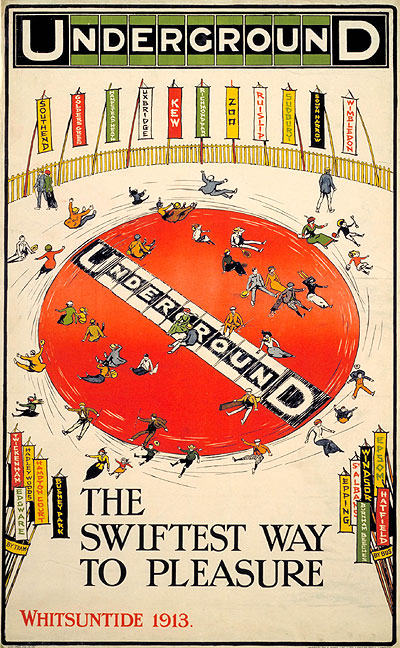
Swift2_2108266i

If only this poster was right… unfortunately I find it the swiftest way to passive-aggressive tutting, both given and received.

Secondly, Metroland by Julian Barnes. I don’t always get on with Julian Barnes.  I can see he’s a highly accomplished writer, but I find him coldly intellectual and distancing.  However, in Metroland I think he does capture something about a certain time in late adolescence and the wish for a brave new world. Christopher and his friend Toni live in the suburbs at the tail end of the Metropolitan line, and wish they didn’t:

“Toni and I prided ourselves on being rootless. We also aspired to future condition of rootlessness, and saw no contradiction in the two states of mind; or in the fact that we each lived with our parents, who were, for that matter, the freeholders of our respective homes.”

Yes, Christopher and Toni are hugely pretentious snobs.  They desperately wish to be French, which leads them into unintentionally hilarious scenarios like trying to be flaneurs along Oxford Street.  They also talk about art with a capital A:

“Art was the most important thing in life, the constant to which one could be unfailingly devoted and which would never cease to reward; more crucially it was the stuff whose effect on those exposed to it was ameliorative.”

Oh dear.  But in case you’re wondering why on earth you would want to spend any time in this idiot’s company,  I do think it’s worth it.  As I said, I find Barnes can be cold, but actually his portrait of Christopher is quite affectionate, and although you laugh at his pretentions, he’s not contemptible, just young and striving for something different to that with which he has grown up.  Christopher gets his wish and moves to France, but of course he doesn’t quite end up living the life he imagined. Metroland is about how its not always a disaster to not achieve your dreams, and how ordinary can also equal happy.

To end, a wonderfully British reaction to an unusual happening on the tube (for those of you not of these isles, rest assured that the response from passengers at the end is actually a huge outpouring of unconditional enthusiasm, I promise you):