Novella a Day in May 2023 – No.15

Nightwood – Djuna Barnes (1936) 153 pages

Nightwood was not at all what I was expecting. Having never read Djuna Barnes before I had no preconceptions, and the blurb on the back described it as ‘the lives of Americans and Europeans in Paris in the decadent Roaring Twenties’. Yes please! But that was not the novel I got.

What I did get was very striking, and an intriguing piece of writing. I would describe it as a series of interconnected portraits and musings, very much in the modernist style. The characters are barely more than sketches, the plot is there but almost needn’t be. Instead we have glimpses, shattered shards that belong together but are as much about the gaps between them as trying to piece them all together.

Baron Felix has a background of secrets and lies. He falls in love with Robin and they have a child together, but she is constantly abstracted, given to disappearing for days on end:

“Felix found her presence painful, and yet a happiness. Thinking of her, visualizing her, was an extreme act of the will to recall her after she had gone, however, was as easy as the recollection of a sensation of beauty, without its details.”

Robin begins a long relationship with Nora Flood, an American who holds a salon, apparently based on the author:

“To ‘confess’ to her was an act even more secret than the communication provided by a priest. There was no ignominy in her; she recorded without reproach or accusation, being shorn of self reproach or self-accusation. This drew people to her and frightened them; they could neither insult nor hold anything against her, though it embittered them to have to take back injustice that in her found no foothold. In court she would have been impossible; no one would have been hanged, reproached or forgiven, because no one would have been ‘accused’. The world and its history were to Nora like a ship in a bottle; she herself was outside and unidentified, endlessly embroiled in a preoccupation without a problem.”

They are split up through Robin’s involvement with Jenny Petherbridge:

“She had a fancy for tiny ivory or jade elephants; she said they were luck; she left a trail of tiny elephants wherever she went; and she went hurriedly and gasping.”

Nora becomes the interlocutor for Dr Matthew-Mighty-grain-of-salt-Dante-O’Connor, who likes a drink and to lecture. There are long passages of discourse and the tone, voices and style reminded me at various points of Joyce, Eliot and Brecht. But Nightwood is definitely its own world too, and Barnes voice is strong and individual, and not trying to be anyone else.

I would definitely re-read Nightwood now I feel more prepared for it rather than expecting a more traditional prose novella. It’s one of those pieces with striking images or phrases that stay with you, independent of the story. I have a collection of Barnes short stories in the TBR somewhere and I’m definitely encouraged to dig them out, as I think her style will suit that form really well.

“None of us suffers as much as we should, or loves as much as we say. Love is the first lie; wisdom the last.”

“The pollen count, now that’s a difficult job. Especially if you’ve got hay fever.” (Milton Jones)

Normally I celebrate the end of June thusly:

Unfortunately due to the weird summer we’re having (unseasonably hot/unseasonably cold on repeat) the scourge of my life, the devil’s seed, aka grass pollen, is still in abundance and I am refusing to go anywhere that isn’t made of concrete/steel/brick, or some combination thereof.

Well, I’ll tell you, Leo. You live through books of course, same as always. So this week I’m visiting my favourite London park, Regent’s, via two wonderful novels.

Firstly, The Heat of the Day by Elizabeth Bowen (1948), where protagonist Stella lives near Regent’s Park and where the opening scene sees counterspy Harrison flirting with Louie, an ordinary young woman who is open to affairs while her husband is away fighting the war.

“The very soil of the city at this time seemed to generate more strength: in parks outsize dahlias, velvet and wine, and the trees on which each vein in each yellow leaf stretched out perfect against the sun blazoned out the idea of the finest hour. Parks suddenly closed because of time-bombs – drifts of leaves in the empty deckchairs, birds afloat on the dazzlingly silent lakes – presented, between the railings which still girt them, mirages of repose.”

This eerie quality pervades the whole novel. While there is a plot – Harrison wants Stella to spy on her lover Robert, who is spying for the Germans – I felt this was not the driving force of what Bowen is writing about. Instead I think what she is considering is a very specific generation of people at an extraordinary moment in time.

 “Younger by a year or two than the century, [Stella] had grown up just after the First World War with the generation which, as a generation, was come to be made to feel it had muffed the catch. The times, she had in her youth been told on all sides, were without precedent – but then so was her own experience: she had not lived before.”

There is a sense throughout the book of things left unsaid, sentences unfinished, and yet a deep understanding that exists between everyone living through the war.

“So among the crowds still eating, drinking, working, travelling, halting, there began to be an instinctive movement to break down indifference while there was still time. The wall between the living and the living became as solid as the wall between the living and the dead thinned. In that September transparency people became transparent, only to be located by the just dark flicker of their hearts.”

People behave in ways that they wouldn’t normally, but they can barely remember what normal is, or why they would behave that way in the first place. Bowen tends to overwrite, but as with the other novels of hers that I’ve read, this quality didn’t bother me as much as it does usually, and I felt it particularly apt here. I just let the writing and the atmosphere wash over me. Thankfully, I’ve not lived through that type of war, but to me Bowen seemed to have done an incredible job at capturing the heightened yet oddly detached experiences that would have occurred:

“But they were not alone, nor had they been from the start, from the start of love. Their time sat in the third place at their table. They were the creatures of history, whose coming together was of a nature possible in no other day”

The Heat of the Day is about the tragedy of war in the widest sense, where no guns go off and people carry on whilst feeling torn apart. Sad, desperate, quiet, and beautifully evoked.

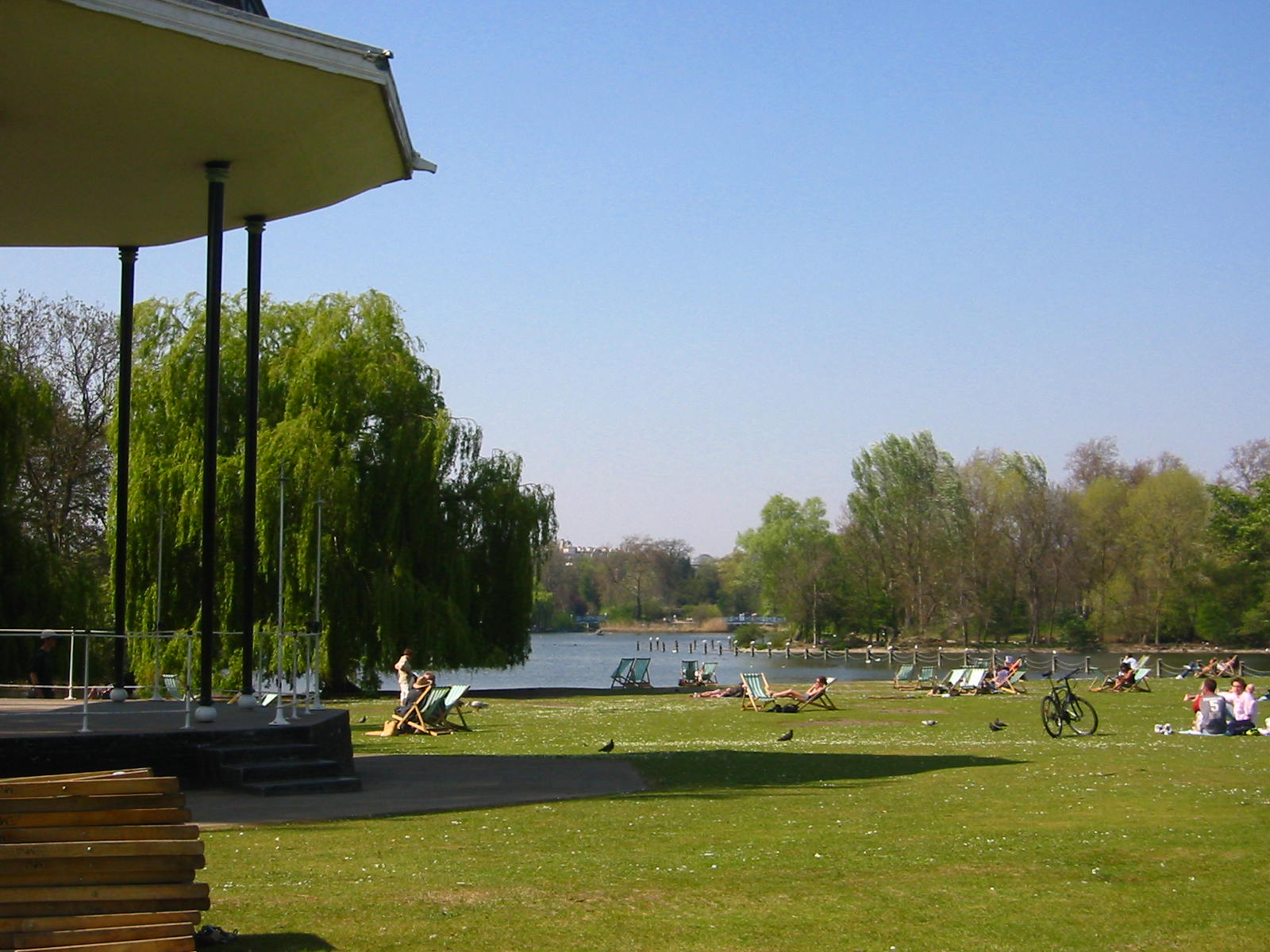
Regent's_Park_bandstand

Next, Mrs Dalloway by Virginia Woolf (1925) and my shortest review ever. Here it is: Virginia Woolf is a genius and Mrs Dalloway is pretty much a perfect novel. That is all.

I really don’t think I can review Mrs Dalloway. I find Woolf’s writing so rich, multi-layered and complex I feel I can’t possibly do it any kind of justice. Woolf’s treatment of a day in the life of society hostess Clarissa Dalloway and shell-shocked Septimus Smith is so sensitive and sophisticated, I feel like a gibbering idiot.  Instead here are some passages:

Clarissa: “She could see what she lacked. It was not beauty; it was not mind. It was something central which permeated; something warm which broke up surfaces and rippled the cold contact of man and woman, or of women together.”

Septimus in the park with his wife: “Happily Rezia put her hand with a tremendous weight on his knee so that he was weighted down, transfixed, or the excitement of the elm trees rising and falling, rising and falling with all their leaves alight and the colour thinning and thickening from blue to the green of a hollow wave, like plumes on horses’ heads, feathers on ladies’, so proudly they rose and fell, so superbly, would have sent him mad. But he would not go mad. He would shut his eyes; he would see no more.”

The recurring motif of the chiming of Big Ben: “The leaden circles dissolved in the air.”

Finally: “It was a splendid morning too. Like the pulse of a perfect heart, life struck straight through the streets.”

*Sigh* Even if you’ve already done so, please read Mrs Dalloway. And then read it again.

To end, the most wonderful cinematic ending: Withnail and I, and the wolves of London Zoo viewed from Regent’s Park.