“It was not a bad life, while things happened fast. And they usually did.” (Ursula Parrott, The Ex-Wife)

When I saw The Ex-Wife by Ursula Parrott (1929) in my local charity bookshop I snapped it up, remembering JacquiWine’s review. Faber Editions are always reliable too, and it’s great that they’ve brought this back into print (as have McNally in the US.) It evokes a young woman navigating independence during Jazz Age New York so vividly.

Pat is twenty-four when her marriage to Pete falls apart, with extra-marital dalliances on both sides, aided by alcohol and parties.

“In the three weeks we had been to six parties, three first nights, five speakeasies, four night clubs, two operas, and a concert”

These young people are so inexperienced and naïve, and the collapse of their marriage seems inevitable as neither have the first clue how to save it:

“I thought: “I will try to make it up to Pete by being good tempered always, and looking as pretty as possible, and following all his stories, and not being extravagant anymore.” I felt very grown up.”

From my twenty-first century view I wouldn’t want to save a marriage to someone who pushed me through a plate-glass door because he wasn’t happy about the pregnancy he was equally responsible for, but Pat is very attached to her husband and wants him back.

She moves in with her friend Lucia, five years older and also divorced, who tries to persuade Pat of the advantages of their situation:

“‘We are free. Applesauce! Free to pay our own rent, and buy our own clothes, and put up with the eccentricities of three to eight men who have authority over us in business, instead of having to please just one husband.’”

We follow Pat as she navigates single life as woman in the Roaring Twenties: working, socialising, happy and unhappy. She is attractive and young, and men are interested in her. Parrott has some wonderful turns of phrase and a way of crafting sentences that is so arresting.

“Hoping sometime to wake and find I had slept beside a lover and friend, I slept to wake beside a stranger exigent, triumphant, or exasperated, or perhaps as bored and polite as I.”

Pat enjoys parties and manages a successful career. She also has genuine friends both male and female, but there is an undercurrent of sadness with some of her male friends who are older than she is, and so fought in the war.

“Kenneth looked as if he would understand about Peter, and the men one kissed cure one of the memory of Peter, and the little hope one cherished about Peter, in spite of judgement and the common sense and the well-meant advice of one’s friends.”

Pat is a fashion copywriter who enjoys spending money and there are some gorgeous descriptions of clothes throughout The Ex-Wife. New York is obviously another love, and this passage made me wonder if it inspired the opening scene of Woody Allen’s Manhattan:

“Sam gave Lucia an Orthophonic Phonograph for a birthday present. Gershwin’s ‘Rhapsody in Blue’ was almost the only record we ever played on it. We turned that on, about once an hour when we were at home.

‘That tune matches New York,’ Lucia said. ‘The New York we know. It has gaiety and colour and irrelevancy and futility and glamour as beautifully blended as the ingredients in crepes suzette.’

I said, ‘It makes me think of skyscrapers and Harlem and liners sailing and newsboys calling extras.’

‘It makes me think I’m twenty years old and on the way to owning the city,’ Lucia said. ‘Start it over again, will you?’”

Apparently the novel was a scandalous sensation on first appearance and had to be published anonymously. There is much in it that feels very modern and I was surprised that a 1929 novel was so open in discussions of sex, domestic violence and abortions. The difference in grief responses from Pat and Pete regarding their young child felt very real and heartbreaking, despite Parrott not overly exploring it.

There are also some pithy observations about what increased freedom for women at this time really means:

“The principal thing that relieving women from the dullness of domesticity did, was to relieve men from any necessity of offering stability in return for love, fidelity and so on.”

Yet really what makes The Ex-Wife still so readable after nearly a century is the closely-observed characterisation of Pat. She is so endearing: young in many ways, older in others. She is frank about her loneliness and vulnerabilities; unapologetic about her enjoyment of bars, dancing and shopping. She is wise and naïve and she really grows throughout The Ex-Wife.

“Enclose with that decree a complete assortment of young illusions, a beatific confidence, an entertaining lack of common sense, and an innocent expression—and I shall be—just as if I had never married.”

To end, a scene from the film adaptation made just a year later, which won Norma Shearer an Oscar:
Novella a Day in May 2025: No.29

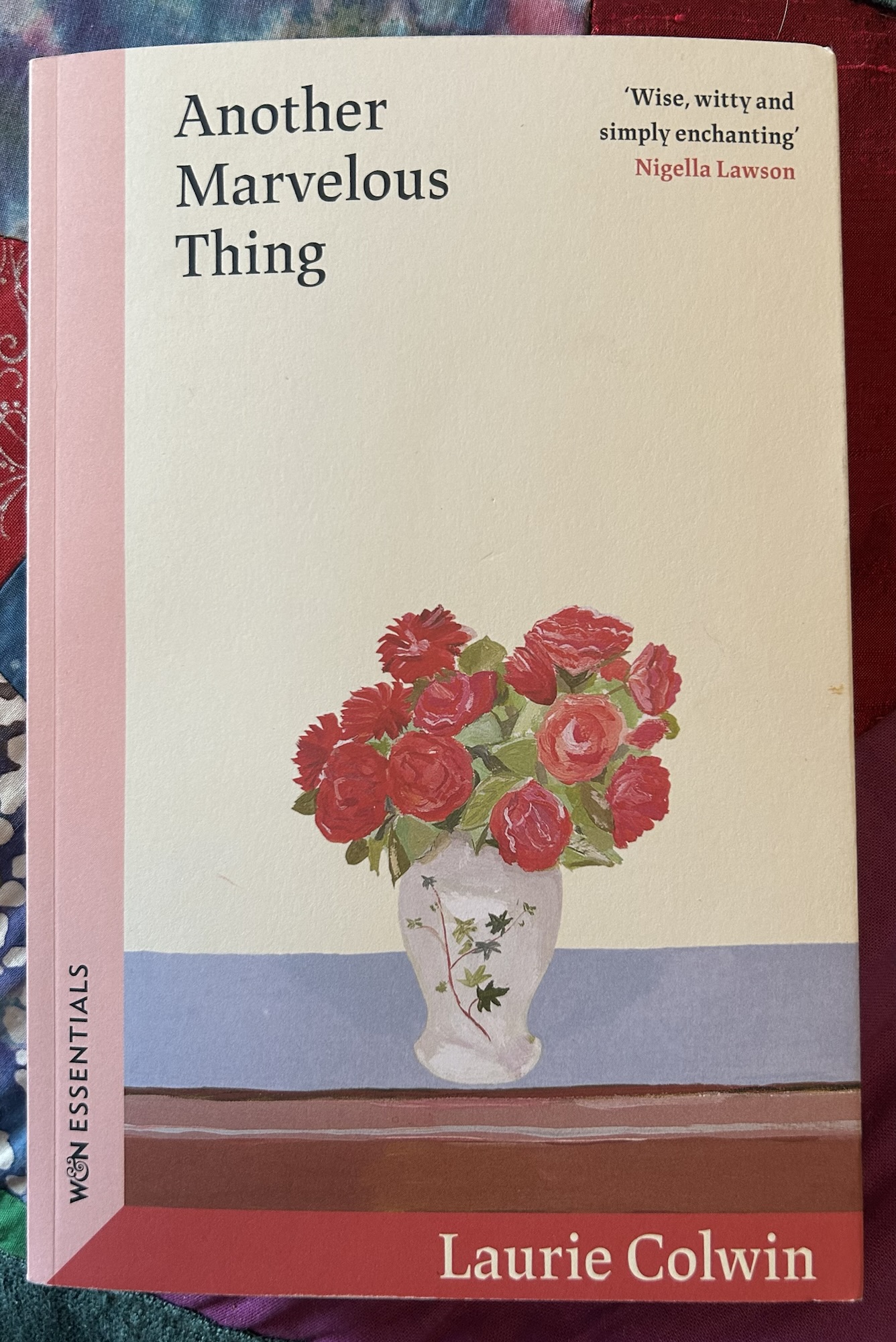
Another Marvellous Thing – Laurie Colwin (1986) 130 pages

Last year a Waterstones opened up a few minutes walk from where I live. I try and ration my visits but you can probably guess how that’s working out 😀 Browsing there was how I found out about Laurie Colwin, who until now had somehow passed me by. I tend to treat jacket blurbs with a mountain of salt, but anyone described as “The Barbara Pym of 1970s New York” (Jonathan Lethem) was going to have me snatching their work from the shelf.

In Another Marvellous Thing Billy and Francis have an affair, despite both being married to other people. Francis is quite a bit older than Billy, though we’re never really told their ages. Both are involved in the field of economics but have wildly different views. They are wildly different in just about every way.

“It would never work. We both know it. She is to relentlessly dour, and too fond of silence. I prefer false cheer to no cheer and I like conversation over dinner no matter what.”

The first chapter is narrated in the first person by Francis, before shifting to a third person narrator for the remainder:

“In movies men have mistresses who soothe and pet them, who are consoling, passionate, and ornamental. But I have a mistress who is mostly grumpy. Traditional things mean nothing to her. She does not flirt, cajole, or wear fancy underwear.”

Despite the bafflement they both have for why they are involved with one another, their affair is rooted in love.

“We are as faithful as the Canada goose, more or less. She is an absolute fact of my life.”

“She did not want to have these feelings: she had been so much happier when she had been unaware she had them.”

Billy and Francis are also markedly different to each other’s spouses:

“Billy, unlike my gregarious party-giving wife, thinks that there is no hell more hellish than the hell of social life.”

“He has the body of a young boy in the air of a genius or someone constantly preoccupied by the intense pressure of a rarified mental life. Together he and Billy look not so much like husband and wife as co-conspirators.”

In other words, they are both much better suited to those they are married to. This means that Another Marvellous Thing avoids the pitfalls of a will-they-won’t-they get together plotline, and instead is more interested in these two disparate characters, and a year or so of their lives together.

“The topic of her dissertation turned Francis glassy-eyed: his passion for Billy did not mitigate his indifference to the medieval wool trade.”

Despite Billy’s interiority keeping her somewhat unknown to Francis, as a reader I loved her character. She was so idiosyncratic and believable, with her refusal to conform to societal expectations:

“‘A vision of radiant loveliness,’ Francis said.

‘I’m so sorry,’ Billy said. ‘The laundry ruined my filmy peignoir.’”

Unlike Francis who is quite equanimous about being unfaithful, Billy feels horribly guilty. Later in the book the affair has finished and the chapters focus on her life afterwards, where we see much more vulnerability than she allowed Francis to witness.

“In one of her snootier moments, my mistress said to me: ‘My furnishings are interior. I care about what I think about.’”

All in all I enjoyed my first experience of Colwin’s writing. There were so many great one-liners and it did feel very New York. But the wit didn’t stop emotional truth being fully realised, particularly with Billy and her husband Grey in the later chapters. I’ll look forward to exploring her further.

Being in love, he often felt, was like having a bird caught in his hair.”

“Being the owner of Dachshunds, to me a book on dog discipline becomes a volume of inspired humour.” (EB White)

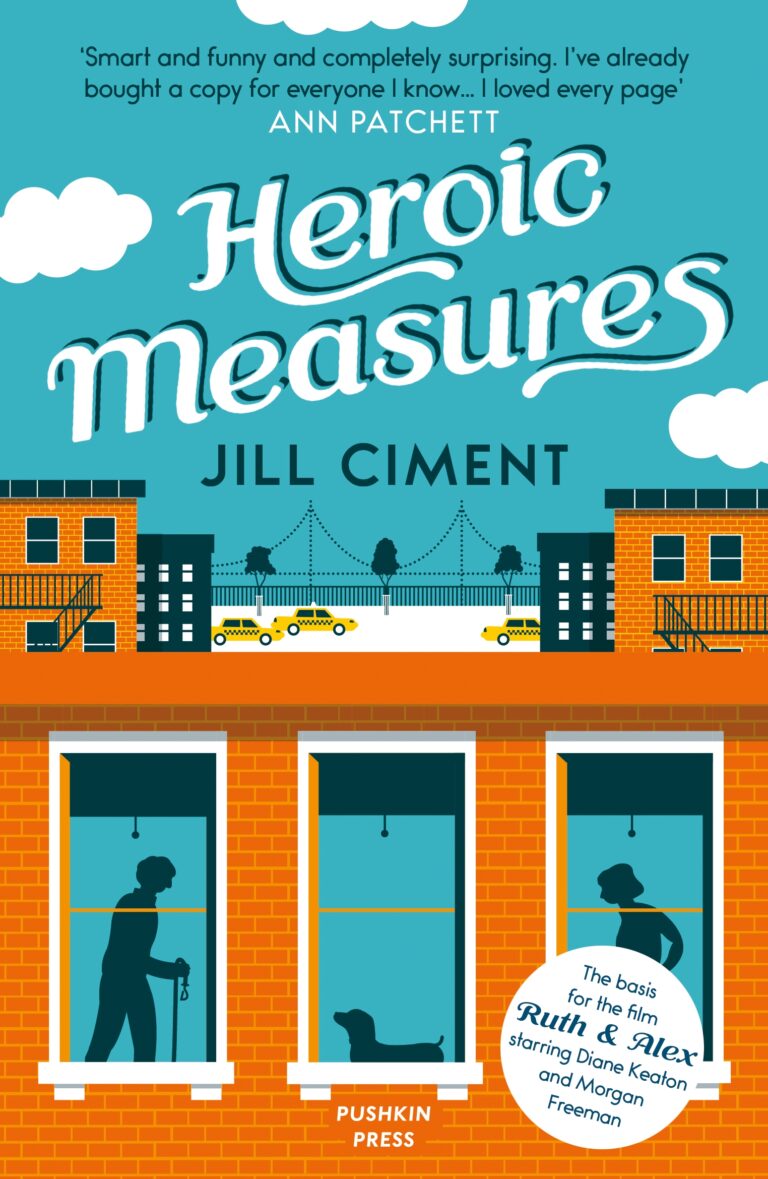
I might not have picked up Heroic Measures by Jill Ciment (2009) ordinarily, but it is published by the marvellous Pushkin Press and they’ve never done me wrong so far 😊 It turned out to be a nice book about nice people, gently humorous and engaging. It wasn’t overly sweet or sentimental, and I enjoyed it immensely. The right book at the right time.

Ruth and Alex Cohen are an older couple looking to sell their East Village apartment for a million dollars (I suspect the intervening fifteen years since publication have seen the relative price rocket even further). They can currently manage the five flights to their front door but they’re aware this is likely to change. Alex is an artist and Ruth a retired teacher; they live with their beloved dachshund Dorothy.

“Alex brought Dorothy home the day Ruth retired after three decades as a public school English teacher. Those first few nights tending to Dorothy’s mystifying needs and constant demands had reminded Ruth of a Victorian novel in which the husband acquires an orphan for his greying childless wife to raise.”

We follow their potential sale over a weekend where Dorothy is in the animal hospital. She is also advanced in years and she suddenly can’t move her back legs. We are privy to her thoughts as well as those of her humans.

The scenes where Alex and Ruth are managing a sick Dorothy were really moving. They weren’t over-the-top deliberately heartrending, but they were very affecting in portraying the deep upset when an animal is ill.

“Alex touches her sleeve: he’s found the source of the alarm, the metal buckle on Dorothy’s faux leopard collar. Ruth had bought the collar because she thought it gave Dorothy a risque, haughty look, an old dominatrix, say, whose specialty was biting. Ruth watches as Alex unclasps the buckle at the nape of Dorothy’s neck with an intimacy and caution, a husband removing his ill wife’s necklace.”

Over the weekend Ruth and Alex will have to deal with their ambivalence about the move – neither afraid of change, but unsure if this is a change they really want to push for:

“He’s been covering these walls with his imagery for almost half a century, as methodically as a clam secretes its essence to make its shell. When Lily had first peered into his studio during the appraisal, she proclaimed it would make a perfect nursery.”

“She can almost see the spines of her library arranged alphabetically, floor to ceiling. Finding a home for her books is no less important to Ruth than finding a museum for his paintings is to Alex.”

There is humour alongside these more melancholy aspects, making the novel seem very real. Lily the realtor and the various people who attend their open house provide some respite from their worries about Dorothy. In the background there is also the unease of a possible terrorist at large in the city, which Alex and Ruth are concerned will affect their apartment price. They also struggle with pushing buyers for more money. Neither of these considerations endear them to themselves.

They are deeply principled people, monitored during the McCarthy era, and their struggles with these materialist considerations lightens their characterisation and stops them seeming priggish.

“His wife – whose ethics has been his bedrock and his muse and his shackles, who wouldn’t lie about her beliefs to the house Un-American Activities Committee even when it cost them friends, passports, his first retrospective, almost her beloved teaching job”

I thought Ciment beautifully evoked the love between these two people in old age too. They have been together forever and they still like one another. Ruth compensates for Alex’s poor hearing, he compensates for her poor eyesight.

“He has loved her for so long that he can no longer distinguish between passion and familiarity. He slips off her glasses, puts away her book, douses the light, and returns to the living room.”

Heroic Measures is also about the love of a city, and New York is portrayed as fondly as the human and animal characters. A lovely read throughout.

To end, Heroic Measures was adapted as Five Flights Up in 2015. It looks a faithful adaptation, although the location of the apartment and Dorothy’s breed has changed. I guess EB White is right about dachshunds’ temperament and the filmmakers needed a more amenable doggy actor:

“I regret profoundly that I was not an American and not born in Greenwich Village.” (John Lennon)

The 1962 Club, hosted by Simon and Kaggsy, starts today and is running all week which I am very excited about 😊 The Club weeks are always great and I’m really looking forward to seeing the posts. This is the first of  what I hope will be three contributions, but as I never blog as much as I mean to, failure is almost inevitable!

The Golden Spur was Dawn Powell’s last novel, and it’s a humorous look at the bohemian arts scene of late 1950s New York, specifically Greenwich Village. This was a world Powell was very much a part of and my edition features an effusive introduction from Gore Vidal who was one of her close friends.

We are introduced to the artists and writers – both up and coming, and those very much faded and failing – their hangers-on and their varied associates through the outsider view of Jonathan Jaimison. He is in his late twenties and recently discovered that his father isn’t the domineering tyrant he grew up with, but someone from this scene, back when his mother was hanging out with Prohibition-era flappers.

So Jonathan leaves his Ohio home and soon makes his way to the titular bar, at the start of his quest to find his biological father:

“Through a gap in the plum velvet cafe curtains he could see the bar … He breathed deep of the heady New York air, that delirious narcotic of ancient sewer dust, gasoline fumes, roasting coffee beans, and the harsh smell of the sea that intoxicates inland nostrils. Then he pushed open the door.”

He’s quickly adopted by Lize and Darcy, two frenemies who sleep with the same male artists, although it’s not entirely clear why, as they seem to have no great fondness for men or for art:

“The girls never asked questions about a man’s private interests or listened when he tried to tell them. For them it was enough that he was a man and that he was there. Who needs a talking man?”

“That his newest canvas was gone should have told her something, but she wasn’t sure which was the new one because all his pictures looked alike to Lize. Great lozenges of red and white (‘I love blood,’ he always said), black and grey squares (‘I love chess,’ he’d say), long green spikes (‘I love asparagus’). All Lize had learned about art from her life with painters was that the big pictures were for museums and the little ones for art.”

As Jonathan makes his way in New York, he moves between two generations: the young artists and the fading interwar generation. There is a nostalgia for the Prohibition period and what New York was then which is beautifully evoked, alongside a recognition that New York is a city that continually makes itself and its inhabitants anew:

“Jonathan recognised New York as home. His whole appearance changed overnight, shoulders broadened, apologetic skulk became swagger; he looked strangers in the eye and found friendship wherever he turned. With the blight of Jaimison heritage removed, his future became marvellously incalculable, the city seemed born fresh for his delight. He took for granted that his mother’s little world, into which he had dropped, was the city’s very heart.”

Although The Golden Spur is described as a comic novel, I didn’t find it laugh-out-loud funny. Rather I’d describe it as affectionately satirical. It ribs the 1950s arts scene and the vacuous people drawn to it, but it never has a bitter or nasty tone:

“Anybody with a tube of paint and a board was an artist. But writers were not writers unless decently unpublished or forever muffled by a Foundation placebo.”

“‘I just want to be overestimated,’ Earl shouted, ‘like everybody else, goddammit.’”

Despite the overarching plot being Jonathan’s search, this really isn’t a plot-driven novel. Rather, the question of his paternity is a device to introduce the various characters and their world. It’s a novel to read for the evocation of the city, of a particular society found within it, and for the characterisation and the wit. In the way that Tales of the City was serialised in the San Franciso Chronicle, I felt The Golden Spur could have worked similarly in The Village Voice. It’s almost a series of sketches, albeit well realised ones.

I can’t say I loved this quite as much as Gore Vidal clearly did, but then he probably recognised a lot of the characters and situations within the novel. I still found a great deal to enjoy, and Powell certainly has a way with words:

“She was making more and more passes at the wrong men, then trying to recoup with stately cultural pronouncements in her refined Carolina accent, which she kept polished up like her grandfather’s shotgun, ready to bring recalcitrant suitors into line.”

To end, I was going to go with the song Little Lize because that’s the only other time I’ve come across the name. I thought it would be easy to get a good quality version as the massively successful Fisherman’s Friends have recorded it. But I couldn’t find a decent one so here they are instead singing about never leaving home. New York isn’t for everyone…

“Nature is commonplace. Imitation is more interesting.” (Gertrude Stein)

Last month Kaggsy wrote about enjoying Pistache by Sebastian Faulks. It sounded good fun, do head over to her Bookish Ramblings & read Kaggsy’s excellent review. In this year of my book buying ban (still in effect & being adhered to, much to my utter amazement) I’ve put my name on the waiting list for Pistache at the library, and managed to hunt down two pastiche novels in my TBR mountain.

When I was doing my English degree, there was much talk of post-structuralism, post-modernism, post-lots of things I didn’t really grasp (which I would mention in essays hoping my tutors didn’t question me too closely on them – a flawed strategy as it turned out). How I wish I had read Paul Auster’s New York Trilogy then, because he takes notions of post-whatever, such as the instability of meaning, the non-specificity of language, the fragmented self, and uses them to weave a fascinating pastiche of the hard-boiled detective novel. I realise I’m not doing him any favours in this summary but trust me, it does work.  It’s done in a humorous way, and there’s enough of a narrative to pull you along, although at times my brain hurt trying to think through all that Auster was discussing.

In the first story, City of Glass, Auster begins by questioning his role as author:

“ ‘Is this Paul Auster?’ asked the voice. ‘I would like to speak to Mr Paul Auster.’

‘There’s no-one here by that name.’

‘Paul Auster. Of the Auster detective agency.’

… ‘There’s nothing I can do for you,’ said Quinn. ‘There’s no Paul Auster here.’”

There is of course a ‘Paul Auster here’ – his name is on the cover – but exactly where is a matter of debate. Quinn, the writer in City of Glass, is mistaken for Paul Auster and finds himself impersonating a private eye:

“Private eye. The term held a triple meaning for Quinn. Not only was it the letter ‘i’, standing for investigator, it was ‘I’ in the upper case, the tiny life-bud buried in the body of the breathing self. At the same time, it was the physical eye of the writer, the eye of the man who looks out from himself into the world and demands that the world reveal itself to him. For five years now, Quinn had been living in the grip of this pun.”

So, multiple identities, multiple meanings, utter confusion. Quinn locates the man he has been asked to find, someone who spends his days wandering the streets, picking up junk and re-naming things:

“I have come to New York because it is the most forlorn of places, the most abject. The brokenness is everywhere, the disarray is universal. You only have to open your eyes to see it. The broken people, the broken things, the broken thoughts….I find the streets an endless source of material, an inexhaustible storehouse of shattered things”

Throughout this and the two stories that follow, Ghosts and The Locked Room, Auster explores how people are ‘shattered things’, how easily identity and the language used to construct it fall apart. For him, unsurprisingly, this is all bound up in the storyteller’s art:

“We all want to be told stories, and we listen to them in the same way we did when we were young. We imagine the real story inside the words, and to do this we substitute ourselves for the person inside the story, pretending that we can understand him because we understand ourselves. This is a deception. We exist for ourselves, perhaps, and at times we even have a glimmer of who we are, but in the end we can never be sure, and as our lives go on, we become more and more opaque to ourselves, more and more aware of our own incoherence. No one can cross the boundary into another – for the simple reason that no one can gain access to himself.”

The trilogy was originally released separately but I think it works best read together. The stories interweave and reflect each other, and so build on the sense of a ‘fractured whole’ being reflected in the structure of the book we hold in our hands. It may be that “these three stories are finally the same story”, but they are different enough to enrich each other and at no time did I feel my attention wavering. It’s a great achievement: stories that deconstruct the very thing they are made out of – language – and yet still hold together.

“Each sentence erased the sentence before it, each paragraph made the next paragraph impossible. It is odd then, that the feeling that survives from this notebook is one of great lucidity.”

Secondly, The Yiddish Policeman’s Union by Michael Chabon (2007), an alternative history detective novel. Chabon takes the idea that a settlement for Jewish refugees is provided in Alaska during the Second World War (an idea was proposed but rejected in 1940) and this has developed into the metropolis of Sitka. Policing this city is Meyer Landsman:

“According to doctors, therapists, and his ex-wife, Landsman drinks to medicate himself, tuning the tubes and crystals of his moods with a crude hammer of hundred-proof plum brandy. But the truth is that Landsman has only two moods: working and dead.”

The first of those two moods is under threat: Sitka is going to become part of the USA again and no-one is sure what will happen when it does but they’re fairly sure it won’t be good (reading this in post-Brexit Britain, it took on a whole new resonance):

“On the first of January, sovereignty over the whole Federal District of Sitka, a crooked parenthesis of rocky shoreline running along the western edges of Baranof and Chichagof islands, with revert to Alaska. The District Police, to which Landsman has devoted his hide, head, and soul for twenty years, will be dissolved. It is far from clear that Landsman or Berko Shemets or anybody else will be keeping his job. Nothing is clear about the upcoming Reversion and that is why these are strange times to be a Jew.”

“Strange times to be a Jew” is a recurring refrain throughout the novel. Landsman lives in a seedy hotel and is investigating the murder of fellow resident Mendel Shpilman. Spilman was a drug addict and also the son of the most powerful organised crime boss and local rebbe, from whom he was estranged. As he undertakes the investigation Landsman manages to annoy absolutely everyone, from the powerful crimelords to his ex-wife and boss, Bina. Chabon has fun with the form, but doesn’t go overboard on the pastiche of hardboiled crime. He employs colourful turns of phrase:

“The space recently occupied by his mind hisses like the fog in his ears, hums like a bank of fluorescent tubes. He feels he suffers from tinnitus of the soul.”

But The Yiddish Policeman’s Union is always its own story and not a gimmick-laden creative writing exercise. Chabon is exploring ideas of identity, home, belonging and justice alongside an appreciation for Raymond Chandler.

“For the first time the traditional complaint, tantamount to a creed or philosophy, of the Sitka Jew – Nobody gives a damn about us, stuck up here between Hoonah and Hotzeplotz – strikes Landsman as having been a blessing these past sixty years, and not the affliction they had all, in their backwater of geography and history, supposed.”

I don’t rate this quite as highly as other novels by Chabon that I’ve read – it was a bit overlong and I think it could have been 100 pages lighter, but still an ambitious and interesting work and I’m glad to have novelists like Chabon are around, attempting to do something different.

To end, trying to come up with a pastiche song that’s bearable was a tough call. In the end I chose The Divine Comedy, who offer pastiche of several things all at once. I opted for Something for the Weekend as I think it references Cold Comfort Farm with the repeated reference to ‘something in the woodshed’ and so is the obvious choice for a book blog: