“Summer, summer, summertime.” (Jazzy Jeff and The Fresh Prince)

On Monday this week the weather forecasters seemed fixated on the fact that it was the start of something they called ‘meteorological summer’.  If you live in the UK & looked out of the window at that point, there was only one sane reaction to such news:

531

Because frankly, even by British standards, the weather’s been a total washout. (btw, this week’s GIFs are dedicated to fellow book blogger Lady Fancifull 🙂 )  However, it has brightened up considerably throughout the week and as I write this I can smell my neighbour’s barbeque, so it looks like maybe the weather forecasters’ optimism wasn’t so misplaced after all. I like to imagine the meteorologists are now running round the studio thusly:

tumblr_inline_n3h730aMNJ1s5jo86

So here is a post to celebrate the start of the meteorological summer. Which in the UK should be good for at least, ooh, another 5 days or so 😉

Firstly, The Summer Book by Tove Jansson (1972, my edition 2003 Sort Of books trans.Thomas Teal) which I won from a giveaway hosted by the lovely bookarino at Dawn of Books.  Apparently this was Jansson’s favourite of her novels for adults (she is best known for the Moomin series) and it’s a wonderful read.  The premise is simple: a series of vignettes detailing how a grandmother and her granddaughter Sophia spend a summer together on an island in the gulf of Finland.

“When the southwest wind was blowing, the days seemed to follow one another without any kind of change or occurrence; day and night, there was the same even, peaceful rush of wind.. ..They all moved about the island doing their own chores, which were so natural and obvious that no one mentioned them, neither for praise nor sympathy.  It was just the same long summer, always, and everything lived and grew at its own pace.”

Nothing hugely dramatic happens, but Jansson evokes real meaning through the layering of small moments to create fully realised portraits of two complex, stubborn, loving, life-embracing women.

““Listen,” Sophia said. “I don’t have time to stay here with you – I’ve only been swimming twice today.  You won’t be sad now, will you?”

“I want to go too,” Grandmother said.

…They helped each other climb out of the canyon, and then they circled around the hill…off to one side of the channel marker, there was a large, deep pool.

“Is this alright?” Sophia sked.

“It’s fine,” Grandmother said.  She bared her legs and stuck them in the pool.  The water was warm and pleasant.”

There is a wonderful gentle humour running through the book, and also sadness  – Sophia’s mother has died, the elderly grandmother is aware her time is short.

““What are you doing?” asked little Sophia.

“Nothing,” her grandmother answered.  “That is to say,” she added angrily, “I’m looking for my false teeth.”

The child came down from the veranda.  “Where did you lose them?” she asked.

“Here,” said her grandmother.  “I was standing right there and they fell somewhere in the peonies.”  They looked together.

“Let me,” Sophia said. “You can hardly walk, Move over.””

Bookarino’s enthusiasm for Jansson is infectious, as is Kaggsy’s, and I definitely plan on reading all her books for adults (and maybe a Moomin or two too…)

If, like me, you live in a city, summer may not immediately bring to mind the heady waft of night blooming jasmine and the soothing chirp of crickets.  So I’m eschewing pastoral evocations of summer in favour of a short poem about London in summer, ‘August’ by Tobias Hill (from Nocturne in Chrome and Sunset Yellow, 2007):

when pigeons like dei ex machina

descend improbably out of the air


wobble like airships skimming through the tops

of trees which sink under their tea-pink weights


until each grandee bungee-jumps or bellyflops

downwards in great soap-operatic terrifying swoops


into the sweet dark shining feather-bedness of the fruits

When the first sunny days appear, those of us used to greyer climes seem to behave with the mania of the pigeons in this poem.  It’s a glorious sight to behold, as city-dwellers sunbathe on patchy grass verges next to dual carriageways, pale blue skin gradually glowing vermilion; lager and sausage rolls sweating in plastic carrier bags beside them. Ah, the summer idyll….

I got my hair cut today (moulting in the warm weather) and the titular song from this post started to play on the radio.  My hairdresser pronounced it a classic but said her favourite summer song was this:
“When a man is tired of London, he is tired of life” (Samuel Johnson)

So, to start I thought I’d look at my home city.  I am Londoner born and bred – that’s the truth, people.  Sometime in the last few years perceptions of London seem to have got confused with those of LA, and taxi drivers don’t believe any one is born here, they only move here.  Tedious conversations regarding my birthplace are the price I pay for one the best things about London: the constant ebb and flow of people from just about everywhere. Anyone of these people who live in London will tell you that this great city (for great it is, far from perfect, but still great, like Battersea Power Station) suffers in its portrayals.  Actually that’s not true.  I suspect a lot of Londoners haven’t given a second thought as to how their city is portrayed.  They don’t give a shit.  And that, that is what makes them Londoners.  How I miss it when I’m away.

I digress…. as I was failing to say, rarely am I presented with a London I recognise (Michael Winterbottom’s Wonderland aside, which I truly recognised, given that it was partly shot in my local supermarket.  Don’t let that banal detail put you off, it’s a very good film, you should watch it). Yet there are a few examples of London literature that Madam Bibi recommends.

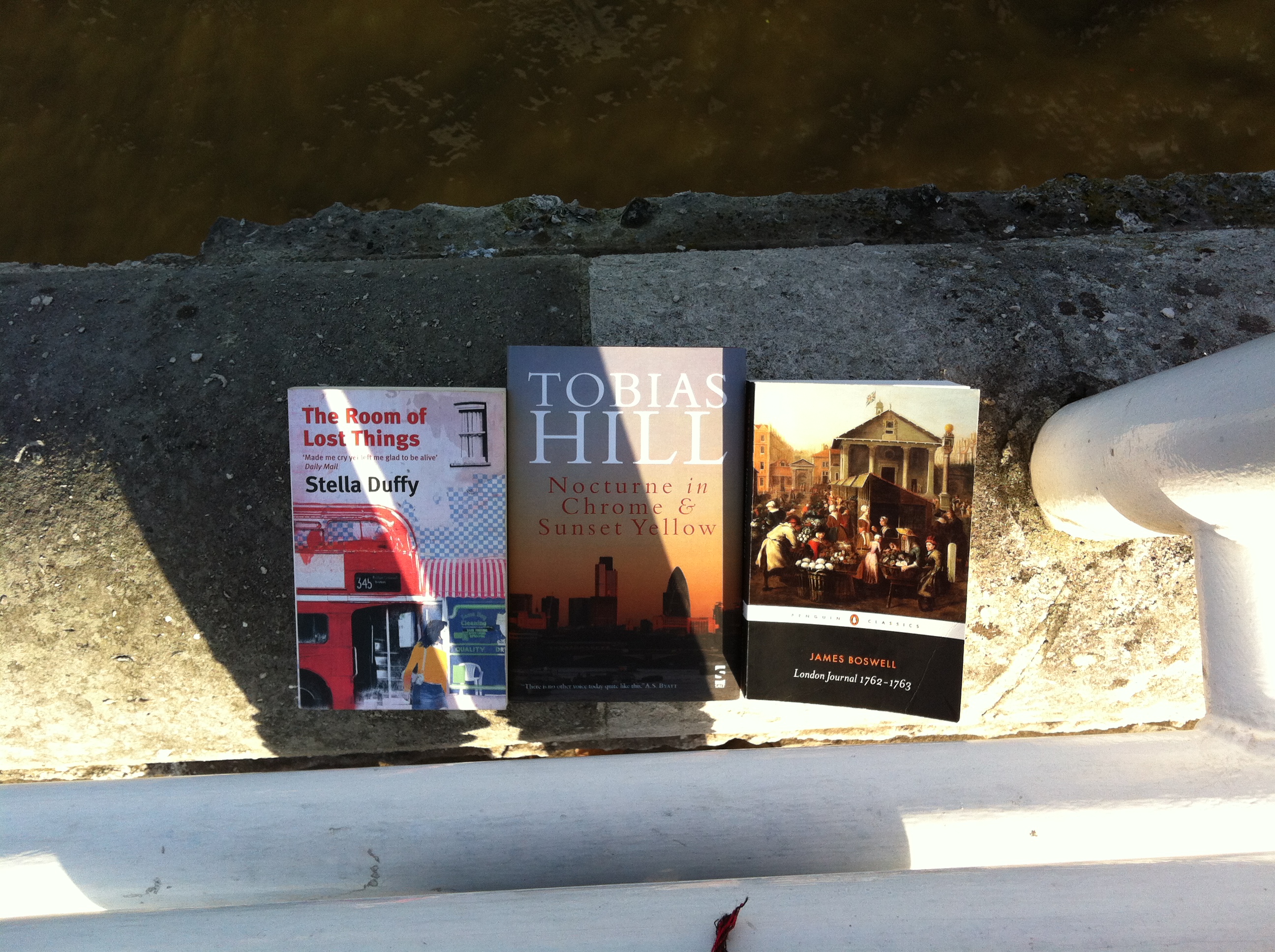
Firstly, The Room of Lost Things, by Stella Duffy (Virago, 2008).  Robert teaches Akeel the ropes of the dry cleaning business in Loughborough Junction.  Over a cup of tea they shake hands in contract: “They hardly know each other.  It’s a beginning.”  This beginning leads to a delicate, unspoken understanding between two very different characters. The men are the protagonists of the novel, but South London is the hero.

“Robert hears a shout from below and turns round to look back up Coldharbour Lane to where Dan is whooping and Charlie grinning from their perch on his old settee, the one he dragged out two nights ago. They lift their Special Brew cans like hand weights and belch belly laughs as one after the other, and slowly, half a dozen crates of carefully stacked tomatoes and red peppers and potatoes fall from their perfect positioning outside the halal shop and flow into the road, a guilty skateboarder racing off, the mix of brown and clashing reds running into the gutter.”

Beautiful, right?  And so completely London. Stella Duffy looks at people and the city with an entirely unsentimental eye, and yet still shows the beauty that exists in places where it’s not usually looked for or expected.

As a proud south Londoner (we are a beleaguered people, yet secure in the knowledge that the great advantage of our part of the city is a distinct lack of smug north Londoners) it pleased me to see the bus I caught to work for 4 years on the cover of this artfully written, closely observed novel.  The 345 even has a supporting role in the story.  If you want to know the breadth of South London (and why wouldn’t you?) catch this bus for the duration of its route.  From the sterile squares of South Ken to the not-so-sterile streets of Peckham, it’s a most unlikely journey.  One time I caught the 345 at a bus stop littered with a lobster carcass, and I got off at a bus stop littered with chicken bones.  I’ll leave it to you to guess which direction I was travelling in. Back to The Room of Lost Things: “A regular river crossing is the gift of South London.”

Secondly, the poetry of Tobias Hill. If you find contemporary poetry off-putting but fancy giving it a chance, there are worse places to start than this accessible poet who looks unflinchingly at the isolation that exists within the crowds of cities, and casts a unique perspective through inventive language.  In his second volume Midnight in the City of Clocks (Oxford University Press, 1996) there are poems about Japanese cities and Rio as well as London.  For Zoo (Oxford University Press, 1996), Tobias Hill was the inaugural Poet for Zoos, and writes about London Zoo in particular. Nocturne in Chrome and Sunset Yellow (Salt, 2006, 2007) is his most recent collection and includes A Year in London, with a poem for each month.  Here is the first stanza of November:

London – there’s a rhythm to the name,

its ending an echo of its beginning,

as if London were the name of somewhere

full to the brim with its own echoes.”

This is what Tobias Hill does so well – points out something you can’t believe you hadn’t noticed before, and makes the wholly familiar newly unsettling.

Finally, James Boswell’s London Journal (Penguin).  Unlike my previous examples, I can’t claim for the veracity of the portrayal of London, seeing as how it was written in 1762-3. What I can vouch for is that it’s a brilliantly entertaining read.  James Boswell is 22, arriving in London for the second time in his life, and completely in love with the city and all it offers.  He evokes London in vivid detail: the people in high society, the prostitutes in the parks, chestnut sellers, his nights at the opera and theatre, visits to exhibitions, and his restaurant meals.

“The conversation was on indifferent common topics.  The Peace.  Lord Bute. Footmen & Cookery. I went to Douglasse’s & drank tea. I next went & called in Southampton Street Strand, for Miss Sally Forrester my first love.  Who lived at the blue Periwig.  I found that the People of the house were broke & dead & could hear nothing of her.  I also called for Miss Jenny Wells in Barrack Street Soho, and found that she was fled and they knew not whither & had been ruined with extravagance.”

It’s unintentionally funny; Boswell wants to be so much better than he is, and that remains timeless.  “Since my being honoured with the friendship of Mr Johnson [Samuel, who provided the title of this entry], I have more seriously considered the dutys of Morality and Religion, and the dignity of Human Nature.  I have considered that promiscuous concubinage is certainly wrong…. Notwithstanding of these Reflections, I have stooped to mean profligacy even yesterday.”

Oh James, we’ve all been there, led astray by the city.  I haven’t slept with a prostitute in ages (that’s a joke, promise), but my own internal struggle is usually along the following lines: “I need to lose weight.  I’m going on a diet…. But if God wanted me to be thinner, he wouldn’t have invented cheese…..or wine……or France……or Europe….or the Middle East.  I’m hungry. That’s it, I’m off to Edgware Road.”  Damn you, Edgware Road.

And so to finish, I choose neither North nor South London, but directly in between, and one of the greatest ground level (OK, slightly elevated, otherwise you’d get wet) views you can find in the city –immortalised by Ray Davies for a reason.  Here are my books on Waterloo Bridge. (We caught the 345 to Battersea Bridge and walked east along the river to get there).  I had hoped to capture the books in front of the view (that would have made a decent photo), but I couldn’t work out how to do this safely – leaping into the Thames in a failed rescue attempt of my rapidly disappearing books would not impress the river police, I fear.  So instead a poor photo of the view, and a picture of my books precariously balanced on the bridge, much to the bemusement of the Scandinavian tourists just out of shot, who watched my every move without offering to help.  Maybe they thought it was a weird English thing, which I suppose it sort of was.   I hope they enjoyed their trip to London, and that they read a book that captures the atmosphere for them as they remember it.

Image

Image

Maybe if you squint, turn your head sideways and jiggle the screen a little, you’ll get the photo I was aiming for….