Novella a Day in May 2022 No.26

Heartburn – Nora Ephron (1983) 179 pages

Earlier in the month, Simon, my fellow Novella a Day in May-er, reviewed Heartburn by Nora Ephron. When I subsequently saw a copy in my favourite charity bookshop I decided it was A Sign. (Admittedly I’ll decide practically anything is A Sign if it means I get to buy a book off the back of it 😀 )

I’ve never read Nora Ephron because I’m not a huge fan of rom-coms (I especially don’t understand You’ve Got Mail. Tom Hanks essentially plays Jeff Bezos, who destroys Meg Ryan’s lovely family bookshop, yet apparently that’s all OK and they get together anyway???) But the quotes Simon pulled were so entertaining that I thought I’d enjoy her novel more, which was a correct assumption.

Heartburn is a fictional account of the breakdown of Nora’s second marriage to her husband Carl Bernstein (as in Woodward and Bernstein, as in Watergate). Her alter ego in this novel is Rachel, a cookery writer who is seven months pregnant and married to Mark:

“Every afternoon, Mark would emerge from his office over the garage and say he was going out to buy socks, and every evening he would come home empty-handed and say, you would not believe how hard it is to find a decent pair of socks in this city. Four weeks it took me to catch on! Inexcusable, especially since it was exactly the sort of thing my first husband said when he came home after spending the afternoon in bed with my best friend Brenda, who subsequently and as a result became my mortal enemy.

[…]

It is of course hideously ironic that the occasion for my total conversion to fidelity was my marriage to Mark, but timing has never been my strong point.”

This matter-of-fact, self-deprecating style continues throughout the novel. Rachel takes us through the painful aftermath of discovering her husband cheating as she sees friends, returns to her beloved New York from the decidedly unloved Washington, catches up with her therapy group and shares recipes with the reader.

Rachel is not remotely self-pitying but then nor does she pity anyone else:

“Show me a woman who cries when the trees lose their leaves in autumn and I’ll show you a real asshole.”

“Beware of men who cry. It’s true that men who cry are sensitive to and in touch with feelings, but the only feelings they tend to be sensitive to and in touch with are their own.”

This sometimes goes too far and there are some discriminatory comments, thankfully very few but still surprising in a book from the 1980s.

Ephron’s humour stays the right side of pithy, and doesn’t descend into bitterness. Ultimately, I think she wanted to make the reader laugh and through doing so change the story from one of anguish and pain.

“That’s the catch about betrayal, of course: that it feels good, that there’s something immensely pleasurable about moving from a complicated relationship which involves minor atrocities on both sides to a nice, neat, simple one where one person has done something so horrible and unforgivable that the other person is immediately absolved of all the low grade sins of sloth, envy, gluttony, avarice and I forget the other three.”

There’s very little plot here, and I think the main enjoyment is not from the story (which is pretty ordinary) or the characterisation (which isn’t complex) but from a strong authorial voice, so distinct and entertaining.

“It has a happy ending, but that’s because I insist on happy endings.”

Heartburn was adapted by Nora Ephron into a screenplay for this 1986 film, which I find surprising as this trailer seems to bear only a passing resemblance to the book. Two strong leads though…

Novella a Day in May 2022 No.25

Freetown – Otto de Kat (2018, trans. Laura Watkinson 2020) 142 pages

At first I thought Freetown by Otto de Kat was going to be a very different novella, and I wasn’t sure about it. It opens with Maria talking to ex-lover Vincent about the disappearance of Ishmaël, a refugee from Sierra Leone who delivered her papers and subsequently became like a son to her.

This beginning made me think the novella was likely to be description of the search for Ishmaël and an exploration of his life. I wasn’t sure that such a story could be adequately told in such a short form. But instead, Ishmaël’s disappearance serves as the motivator for Maria and Vincent to reconsider their shared history.

Maria approaches Vincent as a confidant partly because of their previous intimacy, partly because of his work as a psychotherapist. The chapters are labelled with the two characters names and each serves as silent interlocutor to the other. Maria explains how Ishmaël came into her life:

“The conversation didn’t exactly flow, not that first time. He just nodded and gave me a hint of a smile. All that rain made it look more like crying. I gave him 10 euros, and thanked him for delivering our newspaper ….

I told him to come back if he was ever out of work. And that maybe I could help him. I’ve often wondered why I said that.”

When Vincent takes over the narrative we realise he is still very attached to Maria, and that he’s not really got over their separation:

“That is why I kept going. I am hoping they will find something new, go and do something else. I never managed that myself. I just ended up in a vague fog. I live by touch, doing everything by half measures in a state of semi consciousness.”

As the story progresses we learn more about Vincent and Maria’s relationships, with each other and with their spouses. Ishmaël however, remains elusive. Although at the beginning of the story Maria proclaims him family, we don’t really get to know him and it is questionable how much Maria did:

“All the time I knew him, he was always waiting… Always ready to go, to keep on running. That too.”

This doesn’t mean her grief is any less though, and there is a sense of grieving throughout Freetown. Both Vincent and Maria seem to carry a lot of sadness for times past. Ultimately, they seem to be telling one another stories of loss.

The theme is emphasised through what is missing from the narrative. Ishmaël initially seems to be established as the central character, but remains an absent presence throughout. Maria and Vincent rarely speak within one another’s narratives despite being spoken to.

“He’s been gone a year now, and I simply cannot explain who he really was. But whenever I attempt to characterise him, I just end up saying something about myself.”

Freetown is about the stories we tell ourselves, our need for personal narratives and how we constantly reconstruct these. It shows how we try and make sense of the world when it doesn’t always make sense, and how unknowable even the closest people in our lives can be.

It also suggests that despite these limitations we keep on trying, because human connection – however fleeting and flawed – is worth it even with the pain of its loss.

“He nearly always succeeded in telling me a story I understood.”

Novella a Day in May 2022 No.23

The Country of the Pointed Firs – Sarah Orne Jewett (1896) 158 pages

There’s been a few tough reads this NADIM, and The Country of the Pointed Firs was definitely an antidote to that. Telling the story of a writer’s summer spent in coastal Maine, it’s essentially a series of character sketches that form a love letter to the people and the place.

The writer lodges with Mrs Todd, a kind-hearted woman at the centre of the local community of Dunnet, due to her trade in herbal remedies:

“Sometimes I saw a pale young creature like a white windflower left over into midsummer, upon whose face consumption had set its bright and wistful mark; but oftener two stout, hard worked women from the farms came together, and detailed their symptoms to Mrs Todd in loud and cheerful voices, combining the satisfactions of a friendly gossip with the medical opportunity.”

The writer finds solace and companionship in the area, both from her welcoming landlady and the environment:

“The tide was in, the wide harbour was surrounded by its dark woods, and the small wooden houses stood as near as they could get to the landing. Mrs Todd’s was the last house on the way inland. The gray edges of the rocky shore were well covered with sod in most places and the pasture bayberry and wild roses grew thick among them. I could see the higher inland country and the scattered farms.”

Very little happens in The Country of Pointed Firs, but among others we meet Mrs Todd’s elderly and sprightly mother who lives with her son on a nearby island; the affectionate local doctor; a grieving elderly fisherman; a Captain telling tales of spiritual experience; and hear the story of a heartbroken anchorite…

All the characterisation is affectionate and believable and Maine is beautifully evoked. A lovely read.

To end, I’ve mentioned before my enduring love of undemanding tv detective shows. For me, the thought of a writer in Maine conjures up one person in particular:

Novella a Day in May 2022 No.22

Troubling Love – Elena Ferrante (1992 trans. Anne Goldstein 2006) 139 pages

Although the popularity of Elena Ferrante’s Neapolitan quartet baffled me a bit, I had better luck with her stand-alone novella The Lost Daughter.  This meant I was keen to try Troubling Love, and having finished it I did think that maybe I should give the quartet another try…

Delia’s mother Amalia has died in odd circumstances – drowned, found wearing only her bra, a glamourous one that Delia thinks it out of keeping with her mother’s style. As she returns home to Naples from Rome for the funeral, Delia finds herself reflecting on her past and trying to piece together what happened with her mother, both then and more recently.

“The streets of topographic memory seemed to me unstable, like a carbonated drink that, if shaken, bubbles up and overflows. I felt the city coming apart in the heat, in the dusty grey light, and I went over in my mind the story of childhood and adolescence that impelled me to wander along the Veterinaria to the Botanic Gardens, or over the cobbles of the market of Sant’Antonio Abate, which were always damp and strewn with rotting vegetables.”

Delia reflects on her childhood and her abusive father, who possessively and violently guarded his attractive wife. Delia’s memories of her painful home life are conflicted and contradictory. She despises her father but also harbours a lot of anger and resentment towards her mother.

“We, on the other hand, thought that our father, because of everything he did to her, should leave the house one morning and be burned to death or crushed or drowned. We thought it and hated her, because she was the linchpin of these thoughts.”

The past and present become overlaid as Delia visits her (still violent) father and meets a childhood friend she hasn’t seen in years. She chases a man through the streets thinking he has the answers as to what her mother was doing before she died. As she explores further, memory and identity become confused and less clearly delineated.

“Sometimes that place, which belonged to a less reliable memory, consisted of a dimly lighted staircase and a wrought-iron banister. At other times it was a patch of light striped by bars and covered by a fine screen, which I observed crouching underground, in the company of a child named Antonio, who held me tightly by the hand. The sounds that accompanied it, like the soundtrack of a film, were pure commotion, sudden banging, as of things formerly in order that abruptly collapse.”

Troubling Love isn’t so much a mystery story as an exploration of grief, memory, identity, and the slippery nature of all of these things. It doesn’t offer easy answers. It looks at how so much of this is bound up with family, and how this can be difficult to reconcile.

“Childhood is a tissue of lies that endure in the past tense: at least, mine was like that.”

Troubling Love was adapted to film in 1995. I’ve not seen it, but the trailer looks faithful:

Novella a Day in May 2022 No.21

Mr Fox – Barbara Comyns (1987) 175 pages

Having read Barbara Comyns recently for the 1954 Club, I was delighted to pick her up again for this reading project. How I loved Mr Fox – there is no-one with a voice quite like Barbara Comyns.

The novella opens with Caroline and her small daughter living in a flat with Mr Fox. They are not romantically involved, but the pragmatic Mr Fox suggests it would work as a financial arrangement. His work is sporadic, varied, and not always entirely legal:

“It wasn’t always holidays Mr. Fox was enjoying when he went away. Sometimes he went to prison, not for crime but because he didn’t pay his rates to the borough council. He thought it a pity to waste money on rates and preferred going to prison – it was Brixton he went to. He once suggested I went to prison instead of paying my rates, but I didn’t like the thought of being shut up and when I made a few enquiries about Holloway I heard it was perfectly beastly there and not to be compared to Brixton.”

I really enjoy Comyns’ characters which she somehow manages to make guileless yet never fey. They are survivors but never in a remotely aggressive or self-pitying way.

Caroline’s husband has left and she’s not sorry. She is caring for her small daughter Jenny and worried about money. Mr Fox is a savvy and useful friend, but can also be moody and unreasonable.

“I hoped Mr. Fox didn’t think I’d runaway and left Jenny on his hands; he might even put her in an orphanage and it would take months to get her out again.”

This is the end of the 1930s, and so we know times are going to get much more difficult for these London-dwellers. Comyns captures the bombing in her own inimitable way:

“So I had to spend the day wandering about without any shoes. I passed some of the time filling sandbags in the street; heaps of people were doing it and it seemed a fashionable thing to do.”

Of course, the war brought opportunities for people like Mr Fox, and essentially he is a spiv. Caroline seems both aware and entirely unaware of what Mr Fox is up to, and helps him in the unlikely trade of second-hand pianos. After a time in the suburbs which makes them miserable, they return to the city:

“I began to enjoy an almost empty London. Shopping became almost a pleasure and sometimes we would go to the theatre and there would be hardly anyone there; and it was the same in restaurants. Often in the evening we would take the dogs for a walk in Hyde Park and it would be deserted and lovely. Once when we were walking home a flying bomb stopped right over our heads, and as we turned and ran in the opposite direction a great explosion came and then an enormous amount of dust. The dogs were more upset than we were.”

Comyns has such a unique and unlikely view on things I’ve no idea how typical the experiences in Mr Fox are, but I understand it was based on her real-life situation during that time. She doesn’t shy away from the difficulties of life but presents them in such a surprising way I’m often astonished rather than saddened. Mr Fox was still an emotionally affecting novel though, and such an entertaining one. I was sorry to reach the end.

“Perhaps it was just as well to get the sad part of my life over at one go and have all the good things to look forward to.

Novella a Day in May 2022 No.20

Sphinx – Anne Garréta (2015, trans.Emma Ramadan 2015) 121 pages

Sphinx is a novella which details a young protagonist falling in love with A***. Anne Garréta is a member of the OuLiPo and the particular constraint that she writes to in Sphinx is for both for lover and beloved to be genderless.

The narrator is taken to a club on Place Pigalle where they immediately fall for the charms of the dancer A***. Garréta evokes a seedy and glamorous nightlife that is both enticing and repellent:

“The wheezing of the ceiling fan, the rumble from the nearby stage, the sight of the red velvet sofa covered in holes, burned through buy cigarettes, and the feeling of exile between blue walls defiled with the imprints of dirty hands, brought me all the closer to that single, splenetic feeling so difficult to define: melancholia. I relished it to the point of drunkenness.”

Sphinx is a love story which I felt engages the mind rather than the emotions of the reader. This is because the narrator – although currently working as a DJ – is an academic and seems to approach documenting affairs of the heart in the same way as they would writing a research paper.

“I can’t define A*** as being anything other than both frivolous and serious, residing in the subtle dimension of presence without insistence.”

This includes some overblown, tortured sentences at times:

“Is there anything more vertiginous than gustative reminiscence?”

In her fascinating translators note at the end of the novella, Emma Ramadan explains how the constraints around gender (which is much more demanding for a French writer than an English-language writer) means that this tone needs to be adopted, and then:

“It becomes part of the narrator’s identity – he or she is a rather pretentious bourgeois(e) scholar who does not shy away from praising his or her own intelligence”

So although not overt, there is a thread of humour running through Sphinx, whereby we are not supposed to take the narrator nearly as seriously as they take themselves. And it is a novella that is definitely all about the narrator, not about A***. While limiting the characterisation of A*** serves the constraints around which Sphinx is written, it also succeeds in capturing the self-obsession that can be projected onto a supposed loved one.

“Perhaps I had only ever delighted in my own suffering, which I considered the purification of passions that, deep down I judged as absurd.”

Although Sphinx made me think more than it made me feel, and generally I hope for a reading experience that does both, I did find myself drawn into the narrator’s story, in spite of their distancing voice. I also thought the night-time scene was captured beautifully.

“I was about to turn 23, and for the three years the night crowd had passed before my eyes, I had seen reputations be made and dismantled. I had seen temporary passions transport places and individuals to the apex, and then, burning what they had once adored, those notorious night owls who make up the club scene would abandon them for no apparent reason for other idols destined for glory just as brief.”

Novella a Day in May 2022 No.19

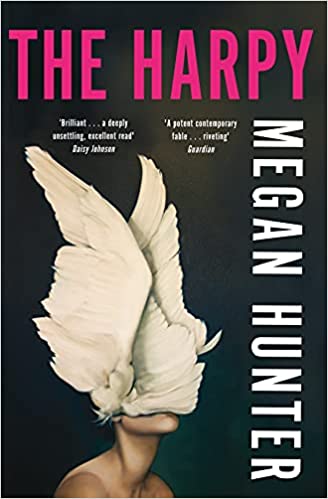
The Harpy – Megan Hunter (2020) 194 pages

I really enjoyed Megan Hunter’s The End We Start From when I read it for Novella a Day in May back in 2019. I have a bias towards novels written by poets, as I always assume they will be precise, with inventive imagery. This was certainly my experience with The Harpy.

Lucy lives with her husband Jake in a rented house with their two sons Paddy and Ted. She has a job to pay the bills, giving up her PhD to write technical information in layman’s language. She isn’t especially resentful of this and her main focus running the house and raising their boys.

“That afternoon he was being kind to his little brother, his gentleness a relief like a blessing. Ted so keen at every moment to stay in his good light, the almost mystical clearness of it, like sunshine at the bottom of a swimming pool.”

Then she finds out but her husband has been having an affair with his older married colleague. She remembers the woman, Vanessa, from a party.

“A raised eyebrow, plucked to a wisp, the tail of a tiny animal. I notice that I felt sick; I notice this as you would notice a book fallen from a shelf: impartially at a distance.”

Lucy’s anger at Jakes betrayal is felt on a deeply visceral level.

“Something became untethered inside me, as I had often feared it would, one organ seeming to break free from the rest, left to float, uprooted, around my body.”

Her fury is such that the two of them make an unorthodox arrangement: Lucy will be able to hurt Jake three times, without any warning in advance.

“There were no kisses, but there was something else, something that seemed better: a promise, a plan. A way to make things right.”

The affair and the plan for retribution cause Lucy to question everything. Her anger and her need to punish seem to surprise her, but at the same time it feels like a return to something essential, including her childhood obsession with the mythical harpy.

“I had become one of those women. The ones I’d read about, who have slipped away from the world, who exist on their own plane of scorn.”

The Harpy is a powerful exploration of women’s roles, choices and conditioning in contemporary society. It demonstrates how close domestic violence can be, how fragile family can be, and how easily the identities of those within can shatter.

Novella a Day in May 2022 No.18

Explorers of the New Century – Magnus Mills (2005) 184 pages

I remember really enjoying Magnus Mills’ debut novel The Restraint of Beasts when it was published to great acclaim at the end of the 1990s. I know I read some of his work after that, but then lost track. Explorers of the New Century reminded me of what I had enjoyed so much previously: the dry deadpan humour, the unnerving slightly surreal setting, the feeling that anything could happen, among a group of men brought together by work.

Much in Explorers of the New Century is left unexplained. As we follow two expeditions attempting to reach the “Agreed Furthest Point” first, we have no idea when or where this is. It is very reminiscent of the Antarctic explorations in the early 20th century; one group have resolutely English-sounding names, led by Johns who speaks in the most English of ways:

“Now it’s far too cold to stand here making speeches. I’ve no time for such flummery, so without further ado I think will make an immediate start.”

The other group have names that sound more Scandinavian, led by a man called Tostig. Mills is drawing on our knowledge of Scott and Amundsen but there’s nothing to suggest that this is alternative history, or taking place in any known geographical location.

“The sun was already part way through its slow crawl along the southern horizon. It appeared as a dull red orb offering little in the way of warmth, and providing light for only a few short hours.”

Initially the descriptions of the two expeditions seem fairly familiar, despite an unnerving, unknowable quality that Mills is so good at. The setting up of camp, the annoyances and friendly gestures shared by the men, the rationing and struggles with the terrain, are all reminiscent of imperialist exploration narratives.

“Johns is a true man of enterprise, but like other great explorers he is also fragrantly self-seeking. In his case, I’m afraid ambition has achieved the upper hand.”

However, just over halfway through the story features a significant twist, bringing the darkness of colonialism to the fore. This twist means I can’t say much more about the novella, but I greatly enjoyed reacquainting myself with Mills’ unique vision. Although Explorers of the New Century is a bleak tale, there is a lot of dry humour too.

“Suddenly Medleycott sat up and peered through the slit of the tent flaps.

‘It’s pitch blackout there now,’ he announced. ‘Yet what sights we’ve beheld since our journey began! Think of them! The leaden moon floating on a shimmering sea! Sunrise and sunset rolled together into one fiery hue! The burnished skies! The majestic beams spreading over the dip of the hill! Don’t they make a wonderful spectacle?’

‘Can’t say I’ve ever noticed,’ replied Sargent.”

Mills never allows the humour to let his characters off the hook though. Explorers of the New Century could be read as a fable, and like a fable it has a strong moral core. It isn’t heavy-handed in the telling, but remains challengingly elusive.

Novella a Day in May 2022 No.17

Don’t Look At Me Like That – Diana Athill (1967) 187 pages

I was aware of Diana Athill’s incredible career at Andre Deutsch but it wasn’t until Granta re-issued her only novel in 2019 that her fiction work was on my radar. I have a bias in favour of editors writing novels due to my love of William Maxwell, and Don’t Look at Me Like That is certainly an interesting exploration of character.

It opens with Meg Bailey, daughter of a clergyman, nearing the end of her school career in the 1950s. As she explains: “When I was at school I used to think that everyone disliked me, and it wasn’t far from true.”

Athill brilliantly captures the trials of adolescence and how the clever and pretty Meg is “aggressively self conscious”, convinced simultaneously of both her inferiority and superiority to everything around her.

It is a time on the brink of huge social change and the difference is between generations is coming into sharp relief. Meg’s parents lead an ordinary life, making the best of their privations.

“Rationing and austerity in general deprived my father of nothing he valued… And my mother who had suffered because of their poverty, hating the drab life they were compelled to lead, felt a release of tension when everyone’s life became equally drab.”

But Meg wants something more. Roxane is probably her only friend and seems to lead a much more glamorous life with her widowed mother, Mrs Weaver. At first entranced by Roxane’s mother, Meg later sees beyond the façade, when she lives with them while studying art.

“There was something feverish in the energy she devoted to her play-acting, and without understanding what longings drove her to it I could feel their uncomfortable presence.”

Mrs Weaver is a brilliant piece of characterisation, a beguiling and somewhat menacing mix of vulnerability and pretention.

Things change when Roxanne marries the man her mother wants her to, family friend Dick. Athill portrays the shifting sexual mores in this time before the 1960s sexual revolution so well. While there is sex before marriage for some, there is still a great deal of naivety, and limited awareness that women are entitled to sexual pleasure. As such, Roxane does not have the best start to married life.

“Roxane had accepted something which I had never before thought of: that life could be as it ought not to be, and that one still had to live it.”

Meg meanwhile begins carving out a successful career in London and starts seeing Dick without Roxane.

“Without knowing it, I had learned what Dick was really like, and he was like me.”

Inevitably they begin an affair. Athill’s subtle writing means that while neither Meg nor Dick are particularly likeable, they are very believable. They are both selfish and weak but also young, naive and a bit lost.

We see the rest of their affair play out within the setting of Meg’s 1950s bedsit London life, and Dick and Roxane’s suburban family life.

“There was no change in my feelings for Roxanne: she was still the girl I knew best and whom I loved for her innocence, affection, and vulnerability. And there was no doubt in my mind about me: I was betraying her. These two facts simply coexisted, without seeming to affect each other. I was appalled by myself, but of course I could meet her.”

Don’t Look at Me Like That is so evocative of a particular time and place. I thought the characterisation was complex but done with a light touch. While I didn’t particularly care for any of the characters in the love triangle, I found myself very affected by Meg’s kind and bewildered parents. The following passage broke my heart:

“When my father got a book on abstract painting out of the library so that he could talk to me about modern art I was so embarrassed that I let some milk boil over on purpose to end the conversation.”

A very readable novella that is brave enough to show its characters with all their flaws and without judging them harshly.

Novella a Day in May 2022 No.15

Where Reasons End – Yiyun Li (2019) 170 pages

Trigger warning: mentions suicide

Where Reasons End is a novella without a driving plot. It is written from the point of view of a grieving mother in dialogue with her dead son.

“I was a generic parent grieving a generic child lost to an inexplicable tragedy.”

The mother is a writer and is trying to make sense of what has happened in the only way she knows how.

“It was not a world of gods or spirits. And it was not a world dreamed up by me; even my dreams were mundane and landlocked in reality. It was a world made up by words, and words only. No images, no sounds.”

She does this with the full knowledge that she will never make sense of such an immense tragedy. Her son Nikolai died by suicide aged 16. In the space they occupy together on the page he is just as argumentative and contrary as any other teenager. It’s hard to know if Nikolai’s attitude is the mother/writer trying to convey how her son was in life, or if his harsh judgements are in fact the judgments and anger she feels towards herself.

“Since when have you become an avid consumer of inane analogies and inept metaphors? Nikolai said.”

As the title suggests, Where Reasons End does not aim for facile conclusions. There’s no way to reason out something so horrific that it is beyond all reason. This means that Nikolai is not a fully rounded character. We know certain facts of his life and we get a sense of who he may have been, but Li does not allow us the easy escape of trying to piece together why he would do such a thing. He remains out of reach to the reader in a reflection of how he was and is out of reach to those who love him.

“You cannot demand that everyone be perfect.

I can forgive everyone, he said, for being imperfect.

But not yourself.

I tried, Mommy, I did try.”

if I’ve made Where Reasons End sound a very heavy read I’ve done it an injustice. It concerns an immensely painful subject but there is humour in it too, such as the mother/child arguments between an exhausted parent and a petulant teenager. Nikolai’s unhappy that his mother has bought a real Christmas tree the first festive season after he died:

“Whatever, he said.

Oh, judgemental as ever, I protested in my thought. And unforgiving. And unyielding.

Yieldingly and forgivingly I inquire, he said, Did you decorate it?”

This is not the novella to read when you want a plot-driven story. But it is a sensitive and painfully real exploration of grief. Very sadly, from the in memoriam dedication at the start of the book, I believe that it is also drawn from real life experience.

“There is no good language when it comes to the unspeakable, I thought. There is no precision, no originality, no perfection.”