Novella a Day in May 2022 No.14

Madame Verona Comes Down the Hill – Dimitri Verhulst (2006 trans. David Colmer 2009) 145 pages

Madame Verona Comes Down the Hill has been on my radar since Kate’s review four years ago – I’m slow but I get there in the end, hopefully 😉

It’s a fable, but a recognisably real one. The titular beauty lives with her husband “in a house that could have been lifted from a biscuit tin” on top of a hill on the outskirts of the remote town of Oucwègne, where there has only been one female baby in recent generations.

When her husband dies, the townsfolk – including the vet who doubles as the town doctor, the man who pays his local shop tab in full after decades, overseen by a cow who is mayor – expect Madame Verona to leave. Instead she stays, mourning her husband, waiting out her time and growing old with her memories.

“the trees had their rings; Madame Verona did not begrudge her skin its wrinkles, the signature of all her days.”

Until one snowy day, she burns the last of the logs her husband cut for her and descends the hill into the town, knowing she will not have the strength to return.

“She is counting on strength of will to die today”

Madame Verona Comes Down the Hill has its share of whimsy but it also has a spikiness to it and it isn’t remotely sentimental. It’s about the different ways we live alongside grief, and how a life with a lot of sadness does not mean a life of misery.

“The one characteristic element with which she would summarise her eighty-two years of existence was that dogs had always sought out her company.”

Novella a Day in May 2022 No.13

Love – Hanne Ørstavik (1997, trans. Martin Aitken, 2018) 136 pages

It’s been six years since I read Hanne Ørstavik’s powerful novella The Blue Room and I had high expectations when I picked up Love from one of my favourite publishers AndOtherStories.

Like The Blue Room, Love features a dysfunctional parent/child relationship, although not one as determinedly destructive as Johanne and her mother in The Blue Room. Whereas that was suffocating and controlling, Jon and his mother Vibeke are almost at the opposite extreme with a child at risk of neglect.

I don’t have kids but I would say that having your eight year-old son roam the snowy streets in northern Norway alone in the depths of the night with no gloves on, while you prevaricate over whether to sleep with a man who picked you up at a funfair, is probably not the best parenting style…

Jon is waiting for his mother Vibeke to return from work. Tomorrow is his birthday and he believes she is going to bake him a cake.

“And then she comes, and he recognises the sound in an instant; he hears it with his tummy, it’s my tummy that remembers the sound, not me, he thinks to himself.”

Although in the same house and having dinner together, they’re not overly communicative. Vibeke has a shower and makes herself look good should she bump into her attractive work colleague in town. Jon leaves the house, returns again, then leaves again, with Vibeke only vaguely conscious of his whereabouts.

The town is far north and it has been snowing. Jon wanders the dark streets:

“Sounds become weightless in the cold. Everything does. As if he were a bubble of air himself, ready at any moment to float into the sky and vanish into the firmament.”

Meanwhile Vibeke has found the library closed, so she wanders round the newly arrived fairground. An attractive fairground worker picks her up and takes her back to his caravan.

“She feels like they share something now. It feels like pushing a boat from the shore, the moment the boat comes free of the sand and floats, floats on the water.”

We know Vibeke had Jon when she was young and that it has been the two of them for a while. However, Vibeke seems pretty oblivious not only to the safety of her son but to the feelings and motivations of other people. Despite being attracted to one another, the situation between Vibeke and the man never really takes off. She keeps holding back because she thinks that talking too much has hampered previous relationships.

“My mistake is to think too much when I talk, it slows everything down, repartee just isn’t there for me.”

However, there comes a point where you do actually have to communicate in some way. When they go to a bar and he chats to the barmaid, then disappears back inside leaving Vibeke in the car outside, she thinks:

“Maybe he’s working on keeping a hold on himself, and the control he thereby achieves is something he needs to cling to.”

Um, no. He’s just lost interest and moved onto the next pretty and more available girl.

Meanwhile Jon has spent some time with a schoolfriend (whose parents are happy to have him leave and wander back home alone at midnight) and ends up getting into a stranger’s car, which at least offsets hypothermia for a while.

Although remarkably self-possessed and bright, Jon is clearly suffering from his mother’s lack of care. He is trying to stop himself blinking and people comment it.

“He wishes no one noticed and that what was wrong with him was under his clothes or inside him.”

Throughout, he clings to the idea that Vibeke is at home baking him a birthday cake which I found completely heart-breaking.

The narrative of Love alternates between Vibeke and Jon almost paragraph by paragraph. This isn’t nearly as confusing as it sounds, it works well as the two of them have evenings that echo and reflect each other in surprising ways. They also both put themselves in risky situations and the story is tense and very believable. It’s a novella that creeps under your skin and stays there.

“She wishes she could read all the time, sitting in bed with the duvet pulled up, with coffee, lots of cigarettes and a warm nightdress on.” 

Novella a Day in May 2022 No.12

Sweet Days of Discipline – Fleur Jaeggy (1989, trans. Tim Parks, 1991) 101 pages

Sweet Days of Discipline is told in a straightforward, clear style, as is evident from its opening line:

“At fourteen I was a boarder at a school in the Appenzell.”

The narrator is a loner at her 1950’s boarding school, full of the confusing, contradictory desires of someone on the brink of adulthood.

“I ate an apple and walked. I was looking for solitude, and perhaps the absolute. But I envied the world.”

She has to sleep in the part of the school for younger girls as there isn’t room for her. Her mother is in Brazil, her father is disinterested. She gets up at 5am every day to take long solitary walks. Then Frédérique, a banker’s daughter, arrives into this isolated and lonely life. Frédérique has a remote, unknowable quality. She is a nihilist and the narrator vows to dominate her: 

“I still thought that to get something you had to go straight for your goal, whereas it’s only distractions, uncertainty, distance that bring us closer to our targets, and then it is the target that strikes us.”

The story isn’t overtly sexual and the sado-masochism is burgeoning, implicit rather than explicit. The narrator is scarcely aware of the sexual drives that surround her “passione” for Frédérique. It’s a psychologically complex and unarticulated morass of feeling, and it stays that way as she looks back from adulthood.

“Even now, I can’t bring myself to say I was in love with Frédérique, it’s such an easy thing to say.”

Frédérique remains mysterious and unknowable. She has a quality which sets her apart from her peers, which is both compelling and disturbing.

“She already knew everything, from the generations that came before her. She had something the others didn’t have; all I could do was justify her talent as a gift passed on from the dead.”

Although the narrator is looking back, Sweet Days of Discipline is not remotely sentimental. It has a brittle clarity which means that although very little happens, reading it is an immersive experience.

“And perhaps they were the best years, I thought. Those years of discipline. There was a kind of elation, faint but constant throughout all those years of discipline, the sweet days of discipline.”

Novella a Day in May 2022 No.11

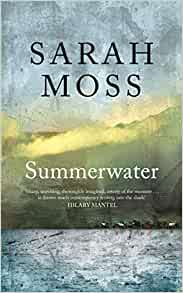
Summerwater – Sarah Moss (2020) 199 pages

I was keen to read Summerwater by Sarah Moss, as I’d been really impressed by Ghost Wall when I read it for NADIM back in 2020. For me Summerwater wasn’t as strong as Ghost Wall, but it was still impressive and a compelling read.

Set in a holiday cabin park on the side of a loch, the narrative moves between the various tourists, building a picture of different families, the individuals and their relationships to each other.

It won’t stop raining and the enclosed small spaces are causing tension between nearest and dearest:

“It’s a thin partition, she says, I can hear everything, it’s not nice. It puts you off, lying there listening to aggressive peeing from someone who could perfectly well just bloody sit down but won’t because in his head the masculinity police are watching even in the middle of the night, hiding, peering through windows or crouching in the laundry basket.”

There are families with frustrated adult children, families with young children, happy marriages, tense marriages, the older couple who have been coming for years and own their cabin:

“He pours, from higher than necessary, admires the shape of the falling liquid and the steam curling from it, an indoor imitation of the mist between the trees.”

Although there is a lot of foreboding in the novella – the rain, the lack of phone signal, a traumatised soldier living in the woods, people with serious health concerns – there is a lot of humour too. The young couple trying to achieve simultaneous orgasms while one of them self-censors her less-than-woke fantasies made me laugh:

“You can’t expect a man to give you an orgasm if you keep thinking about particulates and genocides.”

It is resolutely a novel of its time, with references to Brexit and the pandemic (which is why they are all holidaying in Britain) but these elements felt well-integrated and while they will place the story I don’t think they will date it.

I think my reservation about Summerwater was the ending. It felt unnecessarily dramatic, as if Moss didn’t have enough faith in the rounded portraits and complex relationships she’d expertly created to let them play out and be enough. Although foreshadowed lightly, the ending didn’t feel integrated within the rest of the story. But there was still so much to recommend this novella and I’m looking forward to catching up on the Sarah Moss novels I’ve yet to read.

“She’s always liked thinking about birds and stars more than actually looking at them”

Novella a Day in May 2022 No.10

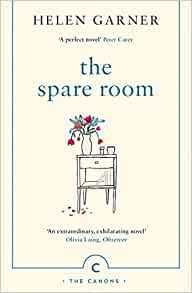
The Spare Room – Helen Garner (2008) 195 pages

The Spare Room was on my radar for a long time before I read it, as the themes are ones that mean a lot to me. I’ve spent nearly all my working life in cancer care and palliative care in one form or another, and so a novella about a friend caring for a dying person was always going to be of interest.

It also means I’m hard to please – anything vaguely sentimental or factually inaccurate is going to annoy me. I thought Helen Garner got everything spot-on.

The novel opens with Helen preparing her spare room for a friend to stay:

“I made it up nicely with a fresh fitted sheet, the pale pink one, since she had a famous feel for colour, and pink is flattering even to skin that has turned yellowish.”

She is still shocked by Nicola’s frail appearance when she picks her up. She knows her friend has terminal cancer and is with her in Melbourne to attend an alternative clinic. However, it quickly becomes clear that Helen will provide a more involved caring role than she anticipated.

An unspoken tension between the friends is that Helen is highly sceptical of the treatments Nicola is putting her faith in:

“ ‘Don’t worry,’ she said. ‘It’s the treatments causing the pain – that’s how I know they’re working. It’s just the toxins coming out.’

[…]

I held my peace. The ozone smelt delicious, very subtle and refreshing, like watermelon, or an ocean breeze. I sat on a chair in the corner and pulled the lid off my coffee.”

Garner brilliantly captures all the negotiations that take place, the bargaining between Helen and Nicola about what is acceptable and what will not change.Helen doesn’t try to talk her friend out of the treatments that she thinks are a total swizz, but she does try and get her to accept pain relief. Nicola flatly refuses to see the palliative care team – who would support Helen in such a physically and emotionally stressful situation – because she associates them with giving up.

“What was all this anger? I needed to be kinder to her. Dying was frightening. But it was easier to imagine being tender when I had a packet of slow-release morphine capsules in my bag.”

Nicola doesn’t recognise the immense pressure she puts on Helen, and on other friends, by expecting them to care for her as she refuses statutory care services. The story is compassionate to all involved, showing the immense love the women have for one another, and how this can sit alongside selfish actions. Neither Helen or Nicola are self-sacrificing angels, quietly enduring the unendurable. Instead they are kind, funny, angry, confused and scared – recognisably human.

“I longed to slip her shoes off, to draw a cotton blanket over her. But was scared to touch her. I was afraid of her weakness, afraid of her will. So I stepped out of the room and closed the door behind me.”

It’s such an impressive achievement by Garner to capture a complex emotional story without minimising it or retreating into cliché and sentiment. The Spare Room is a truly affecting exploration of death and dying. It shows how grief begins before the person dies, and the pain and joy that can exist alongside each other in such moments.

“Oh, I loved her for the way she made me laugh. She was the least self-important person I knew, the kindest, the least bitchy. I couldn’t imagine the world without her.”

Novella a Day in May 2022 No.9

The Bathroom – Jean-Philippe Toussaint (1985, trans. Nancy Amphoux & Paul De Angelis 1990) 102 pages

A young man decides he’s going to stay in his bathtub. Thankfully, his long-suffering girlfriend Edmondsson is happy to fund this indolent lifestyle. He leaves on occasion to talk to his decorators (who aren’t decorating as Edmondsson is vacillating between white and beige paint) and sit in the kitchen. Otherwise, he’s back in the bath:

“A friend of my parents was passing through Paris and came to see me. From him I learned it was raining. Stretching out an arm toward the washbasin, I suggested he take a towel […] I didn’t know what he wanted from me. When the silence had begun to seem permanent, he began to tell me about his latest professional activities, explaining that the difficulties he had to contend with were insurmountable since they were linked to incompatibilities of temperament among persons at the same hierarchical level.”

The novella is in three sections, each paragraph numbered. This unusual structure isn’t as irritating as it should be. It somehow emphasises the banality of his existence without becoming banal itself.

In the middle section, the narrator heads to Venice. In this beautiful and historic city, he mainly stays in his hotel room, taking up darts:

“When I played darts I was calm and relaxed. Little by little, emptiness would creep over me and I would steep myself in it”

We’ve seen that he can be socially awkward, guiding people into the toilet when showing them round the flat, mildly insulting the previous tenants, but later in the novella it seems this behaviour could be deliberate:

“I left the hotel and, in the street, asked a running man the way to the Post Office. I’ve always enjoyed asking people in a hurry for information.”

In the third section he heads back to Paris although I lived in hope Edmondsson was finally sick of him.

Apparently Touissaint is a fan of Beckett and The Bathroom definitely has the feel of Beckett: nihilistic, unreal verging on surreal, contained environments, experimental forms. It echoes itself and takes the reader in disorienting circles.

“Immobility is not absence of movement but absence of any prospect of movement.”

Not a novel for when you want a ripping yarn, but an interesting quick read.

“I would ask her to console me. Softly, she would ask, Console you for what? Console me, I would say”

Novella a Day in May 2022 No.8

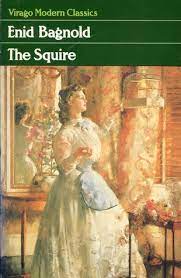
The Squire – Enid Bagnold (1938) 178 pages

The Squire is a novella I have two copies of – one in Persephone edition and one in VMC. Sometimes I wonder if having several copies of the same books in different editions is the sign of a problem – but I suspect readers of this blog are the wrong people to ask 😀

The Persephone edition has smaller print so meets my novella criteria at coming it at under 200 pages (the VMC is 270 pages but much larger print and wide margins). Either way, it’s a quick read!

The squire of the title is the privileged middle-class lady of Manor House, wife of a “Bombay merchant” who is away in India on business (aka ripping off traders in the name of white imperialism) while she awaits the birth of her fifth child.

“Drifting towards the birth of her baby with a simple and enchanted excitement she walked in radiance like a bride.”

The novel covers the last few hours before the birth, and after. This is a life of ease, albeit with servant worries and a best friend more concerned with her latest love affair. The squire drifts through it all:

“She who had once been thirsty and gay, square-shouldered, fair and military, strutting about life for the spoil, was thickened now, vigorous, leonine, occupied with her house, her nursery, her servants, her knot of lives, antagonistic and loving.”

The setting is resolutely domestic. There are no concerns for the squire outside of this sphere. Reading it now, the order, predictability and comfort struck me as particularly poignant, as we know that in just over a year the world would change irrevocably. It’s unlikely the squire’s staff of seven for her family of six would still be in place once war was declared. But for now:

“The last curtain was drawn, the parlourmaid had gone and the hall was empty. It smelt of greenery and flowers and polish, very still, folded for its evening, waiting for its night.”

There is some lovely characterisation in The Squire. My particular favourites were her son Boniface, who determinedly stays in his own world, refusing to pander to his mother’s feelings by saying he missed her when he didn’t; and Pratt the butler, grumpy and unyielding, but also very fond of his mistress:

“Pratt bent his tall figure over the library fire, fire-tongs in hand…Only the firelight lit his trousers. The lights on the circuit had fused. The circuit involved the squire’s bedroom above, the staircase and landing outside. He heard her calling for a candle. He stood still (a dignified, black figure, holding the fire-tongs) because his smouldering nature was accustomed to save itself by inaction. Let her mend her fuse.”

Thankfully for the squire, the more accommodating live-in midwife arrives, swelling her staff to eight. The midwife and the squire have known each other for years and speak intimately and frankly, as you’d expect considering what they have been through together:

“ ‘As I grow older I come to consider men…husbands of women, husbands of mothers…as hindrances to my work.’

‘You wouldn’t get your work without them.’”

The Squire was considered very frank for the time, apparently HG Wells, despite his liberal views, was shocked at Bagnold’s use of the word nipple 😀 What surprised me as a twenty-first century reader was the squire’s alcohol consumption (port in gravy, sherries before dinner) and the readiness of the doctor to prescribe a “quarter of morphia” to a woman who has just given birth as he considers her over-excited. Later, after the squire has breastfed, she observes “the morphia still drifting about her like evaporating wool” so presumably the newborn has just had a dose of controlled drugs too –  eek.

The Squire is beautifully written and very readable, capturing a particular experience of motherhood and birth at a very specific time.

Novella a Day in May 2022 No.7

The House on Mango Street – Sandra Cisneros (1984) 110 pages

The House on Mango Street is narrated by Esperanza Cordera, a young girl who tells us about her life in a San Francisco neighbourhood through a series of vignettes.

“They always told us that one day we would move into a house, a real house that would be ours for always so we wouldn’t have to move each year. And our house would have running water and pipes that worked. And inside it would have real stairs, not hallway stairs, but stairs inside like the houses on T.V. And we’d have a basement and at least three washrooms so when we took a bath we wouldn’t have to tell everybody. Our house would be white with trees around it, a great big yard and grass growing without a fence. This was the house Papa talked about when he held a lottery ticket and this was the house Mama dreamed up in the stories she told us before we went to bed. But the house on Mango Street is not the way they told it at all.”

The language is simple but the writing so skilled. Cisneros evokes so much about Esperanza’s situation as a girl growing towards adulthood, in a society that expects very little of her as she is a woman, Mexican-American, and poor.

From Bums in the Attic: “People who live on hills sleep so close to the stars they forget those of us who live too much on earth. They don’t look down at all except to be content to live on hills.”

Throughout the novella, Esperanza matures considerably. At the start she sounds quite child-like:

Boys and Girls: “Someday I will have a best friend all my own. One I can tell my secrets to. One who will understand my jokes without my having to explain them. Until then I am a red balloon, a balloon tied to an anchor.”

Meme Ortiz: “The dog is big, like a man dressed in a dog suit, and runs the same way its owner does, clumsy and wild and with the limbs flopping all over the place like untied shoes.”

I thought those vignettes were wonderful in capturing an older child’s voice, alongside some really arresting imagery.

As she grows up, Esperanza starts to desire a more adult life:

Sire: “Everything is holding its breath inside me. Everything is waiting to explode like Christmas. I want to be all new and shiny. I want to sit out bad at night, a boy around my neck and the wind under my skirt. Not this way, every evening talking to the trees, leaning out my window, imagining what I can’t see.”

She is sexually assaulted later in the novella, and this is dealt with sensitively but without minimising her experience in any way. Gradually, Esperanza recognises the futile hopes people live with, the promise of lottery tickets, of lovers who have left:

Marin: “Marin, under the streetlight, dancing by herself, is singing the same song somewhere. I know. Is waiting for a car to stop, a star to fall, someone to change her life.”

As the quote from Marin shows, this delusion is never judged harshly. Life is tough and people need something to cling to. By the end of the novel Esperanza begins to realise that she will not follow a predetermined path, she will find her own way and strive for something more – unlike her friend Sally who pays a high price for the financial security of marriage.

Linoleum Roses: “She sits at home because she is afraid to go outside without his permission. She looks at all the things they own: the towels and the toaster, the alarm clock and the drapes. She likes looking at the walls, at how neatly their corners meet, the linoleum roses on the floor, the ceiling smooth as wedding cake.”

The House on Mango Street is such an accomplished piece of writing. It is really accessible – it is taught in schools in the States – and yet it never speaks down to the reader. The images are startling and evocative and the themes are huge and complex. I haven’t remotely done justice in this post to a book entirely deserving of its classic status.

Beautiful and Cruel: “My mother says when I get older my dusty hair will settle and my blouse will learn to stay clean, but I have decided not to grow up tame like the others who lay their necks on the threshold waiting for the ball and chain.

Esperanza’s voice rings so clear and true, I was really rooting for her to successfully walk her own path.

A House of My Own: “My books and my stories. My two shoes waiting beside the bed. Nobody to shake a stick at. Nobody’s garbage to pick up after. Only a house quiet as snow, a space for myself to go, clean as paper before the poem.

Novella a Day in May 2022 No.6

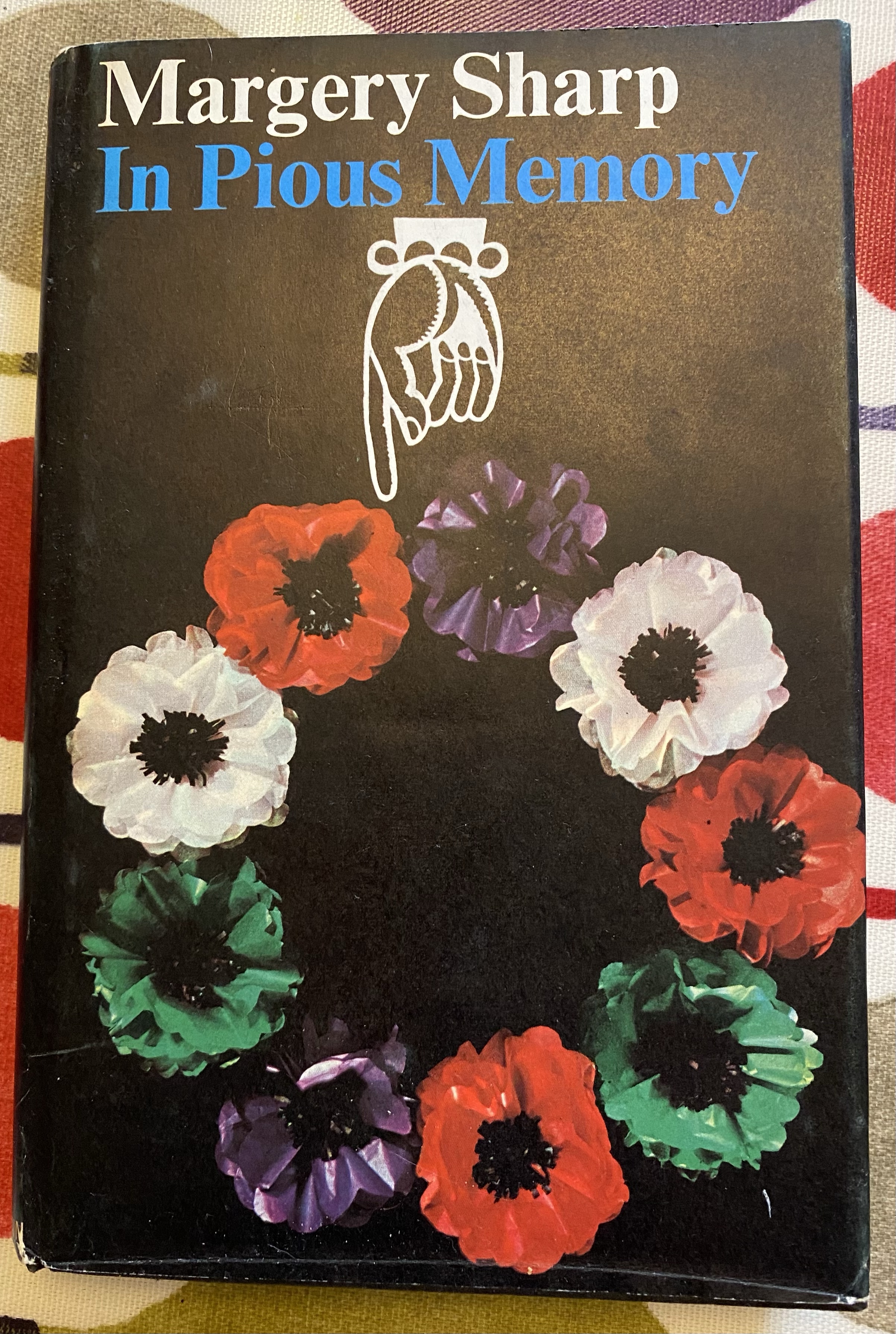
In Pious Memory – Margery Sharp (1967) 160 pages

Today Simon and I are both reviewing In Pious Memory by Margery Sharp, given that Simon had recently acquired a copy, and I’d been meaning to drag mine out of the TBR since Ali’s wonderful review for Novellas in November.

I’m a big fan of Margery Sharp and I enjoyed In Pious Memory a lot. It has her gentle sense of the ridiculous and her fond acceptance of human foibles to the fore, making it a solid comfort read.

It opens with the death of Arthur Prelude, a man who, while inoffensive, seems to have been a monumental bore to all who knew him personally, giving all his energies to his professional life.

“His giant intellect was housed in but an average body –  indeed rather below average; average only in the sense of being unremarkable: all the more startling therefore was the effect when on rostrum or at banquet board he suddenly rose to his feet and let his intellect loose like a line from a mouse-trap. Mrs Prelude naturally never witnessed this transformation herself, she was always at home in the hotel bedroom sterilising his inhaling-apparatus with water boiled over a portable methylated-spirit stove; but other wives told her about it.”

His wife was utterly devoted, his adult children a lot more clear-sighted:

“‘Well. of course,’ said Elizabeth. ‘Mother’s of her generation. She behaved quite marvellously, after the crash, and if she’s been crying ever since, it’s only natural.’

‘As it’s natural for us to remain dry eyed?’

‘I suppose so,’ said Elizabeth. ‘After all we didn’t know father very well.’”

Despite Elizabeth and William’s resolution that “‘We must all be very kind to mother, and find her that flat in Hove at once.’”, their younger sister Lydia – determinedly romantic, and set for a career on the stage – decides her father is wandering around the Alps and needs to be found. In this endeavour, she enlists the help of her cousin Toby, and they go biking off across mainland Europe.

Meanwhile, Arthur Prelude is becoming a lot more likable in death than in life, as fictitious memories of his warmth and affection grow and take on a life of their own:

‘We should have lied to mother sooner,’ said Elizabeth.

‘How could we, while father was still alive?’ countered William.

Will Mrs Prelude be able to see past the false memories of her crashing bore husband towards new romantic opportunities? Will Lydia and Toby find Arthur wandering round the mountains in amnesiac shock? Will William get married and will Elizabeth avoid marriage? Absolutely nothing of serious consequence occurs, thank goodness.

In Pious Memory gently ribs questionable veneration of the dead and reminds us all to appreciate the now, imperfect as it may be.

You can read Simon’s thoughts on this novella here.

Novella a Day in May 2022 No.5

The President’s Hat (2012 trans. Gallic Books 2013) 200 pages & The Readers’ Room (2020, trans. Gallic Books 2020) 172 pages – Antoine Laurain

Two novellas today, by Antoine Laurain, who I suspect writes of a France that doesn’t exist. Like Richard Curtis and the England he portrays, the stories evoke an undemanding version of a country, rather than the realities of life there. Still, Laurain provides some light, whimsical escapism which is very welcome at the right time.

In The President’s Hat, Francois Mitterand’s headwear changes the lives of everyone who comes into possession of it. The first is Daniel, who sits next to the President in a bistro:

“The important events in our lives are always the result of a sequence of tiny details. The thought made him feel slightly dizzy – or was it the fact that he’d drunk a whole bottle of Pouilly-Fuissé?”

When the statesman leaves his hat behind, Daniel takes it and finds wearing it gives him a new-found surety, particularly in work meetings:

“With unprecedented confidence, he watched himself negotiate the complex layers of diplomacy with the ease of a dolphin leaping through the waves.”

He is bereft when he leaves the hat behind and Fanny picks it up, subsequently finding herself able to break with her married lover Édouard for good:

“In the space of a few moments, the felt hat had emerged as the source of strength she had waited so long for.”

Perfumier Pierre recovers both himself and his olfactory flair:

“It was like bumping into an old friend he hadn’t seen for a long time. The mirror reflected back a well-known face, a man who looked like Pierre Aslan.”

And my favourite, Bernard, swops his morning read of Le Figaro to Libé and discovers an appreciation for street art:

“As he walked back under the archways of the Louvre, he could feel a profound change taking place within him. More than a change, a metamorphosis.”

Nice things happen to nice people, the less nice people suffer only marginally, and everything works out in the end. I really enjoyed the twist at the end too. A fun, witty read.

The Reader’s Room opens with book editor Violaine Lepage surrounded by the great and good of literature: Proust, Houellebecq, Perec, Woolf and Modiano. She’s been in a plane crash and lies unconscious in a coma. When she awakes the famous authors aren’t present but things remain unreal – she doesn’t recognise her own clothes, forgets that she smokes, and is entirely unaware that she used to steal compulsively.

On top of this disorientation, her publishers have had a novel nominated for the Prix Goncourt: Sugar Flowers by Camille Désencres. The problem with this is two-fold: no-one knows who Camille is, and the murders in the book are being enacted in real life, in a way that suggests a link to Violaine’s past:

“Camille, please be brave and reveal yourself. I don’t know who you are, but you know many things. Who on earth told you about sugar flowers.? What else do you know? How are you linked to Normandy?”

The Readers’ Room had a different tone to the other Laurain’s I have read. The murders are linked to a gang-rape in the past and there is a police procedural element running through the investigations of Rouen police officer Sophie Tanche, but overall the mystery element is pretty slight.

For me, the main enjoyment was the gently teasing portrayals of those in the book industry – the publishers, authors, editors and prize-givers.

At twenty-four, Marie was the youngest member of the readers’ room. She was still at university and was doggedly writing her thesis on ‘The Written Word or the Inert Vectors of Narration’. Marie had decided to identify all the inanimate objects which have played an important part in works of fiction across the last millennium – such as the specimens in Yoko Ogawa’s Ring Finger, the madeleine in Proust or the little golden key in Bluebeard. She had classified them all by material: fabric, leather, glass, metal, wood…”

So, a bit of departure but still plenty there for those wanting a brief escape into Laurain’s slightly fantastical, comic world.