The President’s Hat (2012 trans. Gallic Books 2013) 200 pages & The Readers’ Room (2020, trans. Gallic Books 2020) 172 pages – Antoine Laurain
Two novellas today, by Antoine Laurain, who I suspect writes of a France that doesn’t exist. Like Richard Curtis and the England he portrays, the stories evoke an undemanding version of a country, rather than the realities of life there. Still, Laurain provides some light, whimsical escapism which is very welcome at the right time.
In The President’s Hat, Francois Mitterand’s headwear changes the lives of everyone who comes into possession of it. The first is Daniel, who sits next to the President in a bistro:
“The important events in our lives are always the result of a sequence of tiny details. The thought made him feel slightly dizzy – or was it the fact that he’d drunk a whole bottle of Pouilly-Fuissé?”
When the statesman leaves his hat behind, Daniel takes it and finds wearing it gives him a new-found surety, particularly in work meetings:
“With unprecedented confidence, he watched himself negotiate the complex layers of diplomacy with the ease of a dolphin leaping through the waves.”
He is bereft when he leaves the hat behind and Fanny picks it up, subsequently finding herself able to break with her married lover Édouard for good:
“In the space of a few moments, the felt hat had emerged as the source of strength she had waited so long for.”
Perfumier Pierre recovers both himself and his olfactory flair:
“It was like bumping into an old friend he hadn’t seen for a long time. The mirror reflected back a well-known face, a man who looked like Pierre Aslan.”
And my favourite, Bernard, swops his morning read of Le Figaro to Libé and discovers an appreciation for street art:
“As he walked back under the archways of the Louvre, he could feel a profound change taking place within him. More than a change, a metamorphosis.”
Nice things happen to nice people, the less nice people suffer only marginally, and everything works out in the end. I really enjoyed the twist at the end too. A fun, witty read.
The Reader’s Room opens with book editor Violaine Lepage surrounded by the great and good of literature: Proust, Houellebecq, Perec, Woolf and Modiano. She’s been in a plane crash and lies unconscious in a coma. When she awakes the famous authors aren’t present but things remain unreal – she doesn’t recognise her own clothes, forgets that she smokes, and is entirely unaware that she used to steal compulsively.
On top of this disorientation, her publishers have had a novel nominated for the Prix Goncourt: Sugar Flowers by Camille Désencres. The problem with this is two-fold: no-one knows who Camille is, and the murders in the book are being enacted in real life, in a way that suggests a link to Violaine’s past:
“Camille, please be brave and reveal yourself. I don’t know who you are, but you know many things. Who on earth told you about sugar flowers.? What else do you know? How are you linked to Normandy?”
The Readers’ Room had a different tone to the other Laurain’s I have read. The murders are linked to a gang-rape in the past and there is a police procedural element running through the investigations of Rouen police officer Sophie Tanche, but overall the mystery element is pretty slight.
For me, the main enjoyment was the gently teasing portrayals of those in the book industry – the publishers, authors, editors and prize-givers.
“At twenty-four, Marie was the youngest member of the readers’ room. She was still at university and was doggedly writing her thesis on ‘The Written Word or the Inert Vectors of Narration’. Marie had decided to identify all the inanimate objects which have played an important part in works of fiction across the last millennium – such as the specimens in Yoko Ogawa’s Ring Finger, the madeleine in Proust or the little golden key in Bluebeard. She had classified them all by material: fabric, leather, glass, metal, wood…”
So, a bit of departure but still plenty there for those wanting a brief escape into Laurain’s slightly fantastical, comic world.
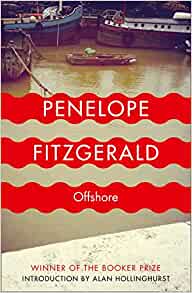
Penelope Fitzgerald won the Booker prize for this novella, in which she draws on her experience of living on a houseboat on the Thames at Battersea (which sank twice). She set it eighteen years earlier in 1961, at which point Battersea was not nearly as salubrious as it is now (cf: Up the Junction by Nell Dunn).
The houseboat inhabitants are all struggling in a way that gives rise to water-based imagery:
“The barge dwellers, creatures neither of firm land nor water, would have liked to be more respectable than they were. They aspired towards the Chelsea shore, where, in the early 1960s, many thousands lived with sensible occupations and adequate amounts of money. But a certain failure, distressing to themselves, to be like other people, caused them to sink back, with so much else that drifted or was washed up, into the mud moorings of the great tideway.”
Fitzgerald evokes the setting and the characters so well without wasting a word. Opening at a meeting of the barge dwellers we meet them all, including upright Richard, and savvy, kind Maurice:
“Richard was quite correct, as technically speaking they were all in harbour, in addressing them by the names of their craft. Maurice, an amiable young man, had realised as soon as he came to the Reach that Richard was always going to do this and that he himself would accordingly be known as Dondeschiepolschuygen IV, which was inscribed in gilt lettering on his bows.
He therefore renamed his boat Maurice.”
The portrait of Maurice surprised me in being more progressive than I would expect for the time. He is a sex worker and brings customers back to his barge, where he also allows a decidedly shifty friend called Harry to store stolen goods. Maurice is never judged harshly and in fact is probably the most sympathetic of all the characters, providing real friendship to the others.
Nenna is living on Grace, seemingly having half-left her husband, who is in north London. Her daughters have adapted to their new life well, mud-larking and flogging their finds.
“You know very well that we’re two of the same kind, Nenna. It’s right for us to live where we do, between land and water. You, my dear, you’re half in love with your husband, then there’s Martha who’s half a child and half a girl, Richard who can’t give up being half in the Navy, Willis who’s half an artist and half a longshoreman, a cat who’s half alive and half dead …’”
Offshore isn’t plot-heavy, although events do build towards a surprising denouement. Rather it is a snapshot in time of people trying to find a place for themselves beyond conventional safety. For each of them, there is a sense of desperation but it lives alongside resilience, hope, and friendship.
“There isn’t one kind of happiness, there’s all kinds.”
Maigret Mystified – Georges Simenon (1932, trans. Jean Stewart 1964) 139 pages
This is the first Maigret I’ve read, despite Simenon being such a prolific writer and despite my love of golden age detective fiction. I picked it up in a pleasingly battered old green Penguin edition and I enjoyed it greatly. I’m sure it won’t be the last time I accompany the insightful French detective in his ruminations 😊
This may well be the shortest post I ever write, given that it’s about a novella and a mystery, so I want to avoid spoilers!
Maigret is called to the scene of a murder in an office of a pharmaceutical company, Doctor Rivière’s Serums. Monsieur Couchet, the owner, has been shot dead. The mystifying element is that he was also robbed of 360,000 francs, but his chair was jammed against the safe. So did he face his murderous thief? Or did he not know of the theft? Did the same person carry out both crimes?
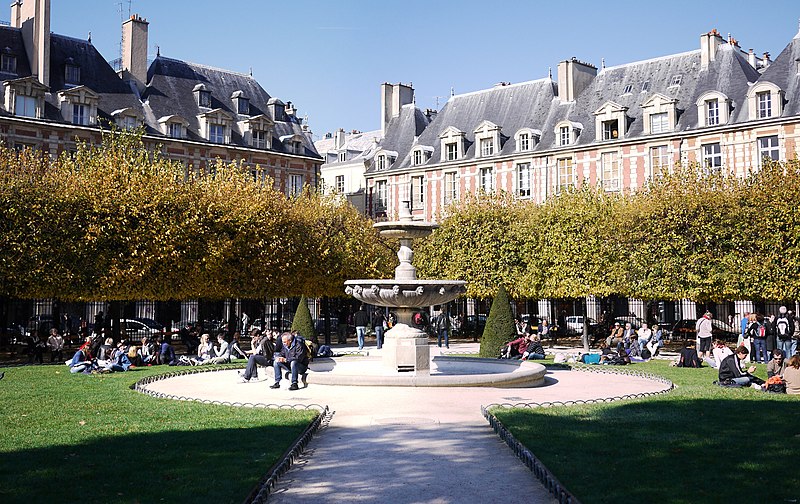
As the office is adjacent to a block of flats, Maigret must interview possible witnesses from the various homes in Place des Vosges.
There is the concierge who called the police; Madame Martin who seems to torture her husbands with their failure to live up to her expectations (the first of whom was the murdered man, their son now self-medicates with ether and lives close by); Mathilde who eavesdrops on everyone; new parents the de Sant-Marcs…
There are also the lovers of the victim to contend with: his second wife and his girlfriend Nine, a cabaret dancer, the portrayal of whom is pleasingly non-judgemental.
I suspect this isn’t the greatest Maigret offering, but it is a quick, entertaining and atmospheric read. I also found it a welcome antidote to the overly convoluted plot lines of many contemporary detective dramas – much as I enjoy those, it was a nice change to just see Maigret get on with it, in no time at all.
“ ‘You old rascal, Couchet!’
The words had sprung to his lips as if Couchet had been an old friend. And he felt this impression so strongly that he could not realise he had only seen him dead.”
A previous English title used for this mystery was The Shadow in the Courtyard, which to me is a much better. After all, at 139 pages, Maigret isn’t mystified for long…
“It was ten o’clock at night. The iron gates of the garden were shut, the Place des Vosges deserted, with gleaming car tracks on the asphalt and the unbroken murmur of the fountains, the leafless trees and the monotonous outline of identical roofs silhouetted against the sky.”
To end, this year sees a cinematic outing for Maigret:
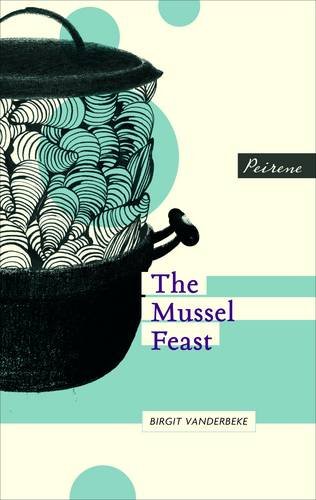
Peirene Press are one of my favourite publishers, with a focus on European contemporary novellas which so far have given me some wonderful reading experiences. The Mussel Feast is no exception, as it carefully and precisely builds a picture of a family tyrannised by the father, over the course of one evening.
Narrated by the teenage daughter of the family as she prepares the titular celebratory meal alongside her mother and brother, they await the return of their father who has bagged a promotion. The daughter doesn’t much like mussels, but it is how the family traditionally celebrates.
“Anyway, the noise came from the pot and as I glanced over I couldn’t help looking at the clock, too: it said three minutes past six. And at that moment my mood changed abruptly. I stared at the noisy pot […] it was a distinctly strange noise, which made me feel creepy; we were already twitchy and nervous, and now there was this noise.”
The father is late back, and the narrator reflects on what is happening that evening and on what has gone before:
“He couldn’t stand my mother’s knackered face, and so she switched to her after-work face, which she would paint on quickly in the bathroom at half-past five, before my father came home. But this after-work face only lasted for an hour and needed reapplying.”
Everyone in the family remains unnamed, fitting with thesense that they are all trying to fulfil a role for the father and that who they actually are is of secondary importance:
“We all had to switch for my father, to become a proper family as he called it, because he hadn’t had a family, but he had developed the most detailed notion of what a proper family should be like, and he could be extremely sensitive if you undermined these notions.”
The father is a deeply inadequate man, ashamed of his past in the GDR, and trying to convince his family of his superiority. His children don’t conform to gender stereotypes which annoys him. His wife isn’t pretty enough by his standards. The fact that he squanders their money and is fairly useless all round, is by-the-by:
“My mother earned money and did menial work, boiling the nappies in a huge pot, and cooking and shopping and children, all of which drove him nuts; my father was not cut out for such trivial jobs , and back then we would have frozen if my mother hadn’t lugged sacks of coal.”
By the time the following passage came I already had a clear idea of what was going on in this family, but I still found the matter-of-fact tone in describing such abuse truly shocking:
“He was extremely assured in his taste; he didn’t like his taste being questioned. I couldn’t bear the wall unit, as I told them that evening, due to my head having been smashed against it on a number of occasions.”
The tension in the novella builds expertly as, like the family, we wait for the father to return. The ending is ambiguous, but we know there are huge ramifications, because at the start of the novella the narrator tells us:
“what came in the wake of our abortive feast was so monumental that none of us have got over it yet”
Birgit Vanderbeke wrote this just before the fall of the Berlin Wall because “I wanted to understand how revolutions start.” In The Mussel Feast, it is a long time coming and also a matter of a few moments:
“Suddenly I no longer wanted him to come home, […] Mum looked at me, not as horrified as I’d expected, but with her head to one side, and then she smiled and said, well, we’ll see, and she didn’t sound as if she’d find it surprising or even terrible if he didn’t come home.”
The Mussel Feast has become a set text in Germany and deservedly so – the domestic setting is completely compelling but also has wider resonance which it carries lightly, the metaphorical never undermining the portrayal of abuse.
It’s always with some trepidation that I start a Novella a Day in May project. Last year I couldn’t face it at all (pandemic testing my resilience, work pressure, cat deaths taking a toll – even so I know I’ve been very lucky). But I seem to be able to read more now, so fingers crossed…
Also, I never run NADIM as an event because I never thought anyone else would want to undertake such a task, but I’m delighted that this year I will be joined by Simon at Stuck in a Book! So do join us for lots of novella love 😊
Away we go!
Without Blood – Alessandro Baricco (2002, trans. Ann Goldstein 2004) 87 pages
Without Blood is a short, sharp shock. It opens with a brutal, bloody and deadly attack on Nina’s family when she is a small child.
Men arrive at the remote farmhouse where she lives with her father and brother. Her father helps her to hide in the cellar, but she hears them accuse him of the torture of prisoners during the (unnamed) war.
“Nina closed her eyes. She flattened herself against the blanket, and curled up even tighter, pulling her knees to her chest. She liked to be in that position. She felt the earth, cool, under her side, protecting her – it would not betray her. And she felt her own curled up body, folded around itself like a shell.”
Her brother fires a gun at the men and is killed. One of the soldiers, a young man called Tito, sees Nina under the trapdoor and keeps quiet. Nina is taken in by a local man who then bets her away at cards when she is a teenager. Adult Nina devotes herself to revenging the death of her family.
Barrico raises a lot of big questions in this novella but wisely doesn’t attempt to find answers. The nature and purpose of war; who is guilty and to what extent; the brutalisation of humans; the justification and consequences of violence; revenge versus redemption…
“There were a lot of things we had to destroy in order to build what we wanted, there was no other way, we had to be able to suffer and to inflict suffering – whoever could endure more pain would win, you cannot dream of a better world and think it will be delivered just because you ask for it.”
When Nina finds Tito fifty-two years later, it is not easy to predict what will happen. They have both been irrevocably changed by the events of that night, events which have overshadowed the rest of their lives and bound them together throughout their separation.
“The man thought the way she spoke was strange. As if it was a gesture she wasn’t used to.”
It is a quick read in length but Without Blood invites longer consideration.
After bookish travels (sadly not actual travels) to Ireland and Wales in March, I thought I would start April with a visit to Scotland and a stop on my Around the World in 80 Books reading challenge. As with actual travels, things did not go entirely plan…
I have piles of Scottish authors in the TBR but my initial choices did not work out. The first novel I chose was excellent but brutal, so I just wanted to leave it behind at the end and not blog about it. My second choice I thought was safe; an established and accomplished author. Unfortunately I chose a novel she wrote at age 21, before she realised that sentences need a coherent structure. I got so sick of re-reading to try and work out which pronoun referred to which character that it was a rare DNF for me.
Given my reading pace is so slow at the moment, I then panicked and chose a novella and a short story to try and get something read. Thankfully these turned out to be enjoyable reads 😊
Firstly, Edinburgh-born Muriel Spark’s final novel, The Finishing School (2005). The titular institution is College Sunrise, on the shores of Lake Geneva, run by Rowland and Nina Mahler, although by Rowland in name only:
“To conserve his literary strength, as he put it, he left nearly all the office work to Nina who spoke good French and was dealing with the bureaucratic side of the school and with the parents, employing a kind of impressive carelessness.”
Feckless Rowland is thrown of kilter by the arrival of Chris Wiley at the school:
“His own sense of security was so strong as to be unnoticeable. He knew himself. He felt his talent. It was all a question of time and exercise. Because he was himself unusual, Chris perceived everyone else to be so.”
Chris is writing a novel about Mary Queen of Scots, unhindered by the actual facts of what happened. Although Rowland is tutor to the young artistic students, Chris keeps his writing progress secret, fully aware that this stokes Rowland’s obsession with him.
In this short novel, the other pupils and staff at the school are sketched in lightly but enjoyably, such as Mary: “her ambition was to open a village shop and sell ceramics and transparent scarves”.
Not a great deal happens, but the tension builds as Rowland becomes more fixated on Chris, and the two end up in a co-dependent relationship, as Chris observes:
“I need his jealousy. His intense jealousy. I can’t work without it.”
This being Spark, I couldn’t guess which way the novel would end as she mixes the very dark with a lightness of touch:
“ ‘Too much individualism,’ thought Rowland. ‘He is impeding me. I wish he could peacefully die in his sleep.’”
I wouldn’t say The Finishing School was Spark at the height of her powers – I found it a diverting read and an enjoyable one, but for me, Spark at her best is breath-taking, almost shocking. If you’re already a fan, there’s still much to enjoy here though. The askance view of human relationships, the morbid alongside the comic, the skewering of pretentious writers, and the arresting non-sequiturs.
Secondly, Until Such Times by Inverness-born writer Jessie Kesson (1985), which I had as part of the anthology Infinite Riches: Virago Modern Classics Short Stories (ed. Lynn Knight, 1993). It was a pretty good match for Spark although I didn’t plan it as such, with some darkly comic characterisation and a very unnerving ending.
The bairn is taken to live with her Grandmother and Aunt Edith:
“But you weren’t here to stay forever! Your Aunt Ailsa had promised you that. You was only here to stay… ‘Until Such Times’, Aunt Ailsa had said on the day she took you to Grandmother’s house…”
We join her with the house in a vague state of uproar trying to prepare for a visit from Aunt Millie and Cousin Alice. There is a suggestion that the visitors are respectable and admirable, whereas the bairn and Aunt Ailsa are somehow disreputable.
The narrative moves back and forth, showing the reader more than the bairn understands about her family situation and expertly drawing the dynamics between Grandmother, Aunt and child. The tension for a child living in a strict household and the manipulations and judgements of the Aunt (who is somehow unwell but never quite clear how; she is referred to by an old-fashioned term no longer used) was so well evoked.
At only 11 pages long, Kesson shows all that can be achieved in a short story: well-drawn characters, social commentary, narrative tension and a recognisable world. The final sentence was a perfect ending. I thought Until Such Times was really impressive and I’ll definitely look out for more of Kesson’s work.
To end, a Scottish treat for my mother, who is a big fan:
Well, it’s been another difficult year for everyone, but I hope that the festive season sees you getting some restorative fun in whatever way you choose. For this Christmas post I’ve chosen two books that aren’t ostensibly about Christmas but which I can still proclaim as such for the purposes of this post 😀
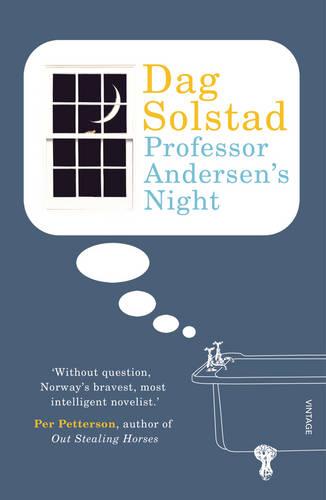
Firstly, Professor Andersen’s Night by Dag Solstad (1996, trans. Agnes Scott Langeland 2011). This novella (154 pages in my edition) is my first encounter with Solstad which is clearly a big omission, as he’s described as ‘Norway’s most distinguished living writer’ on the back cover. While I didn’t love this novella, I did find it a very readable exploration of complex themes and I’d be interested to read more by this author.
It begins with the titular academic enjoying Christmas Eve on his own:
“Professor Andersen felt at peace, tonight. He had this feeling of inner peace which was not of a religious but of a social kind. He liked to indulge these Christmas rituals, which in fact meant nothing to him.”
His tranquillity is disturbed when he witnesses a young woman being strangled in an apartment opposite. In response to this shocking violence, he does precisely nothing:
“He went over to the telephone, but didn’t lift the receiver. ‘What shall I say,’ he thought, ‘that I have seen a murder? Yes, that’s what I have say. And they will laugh at me, and tell me to go and lie down, and to call back when I have sobered up’”
But he doesn’t call back when he’s sobered up either.
”Something had happened, something he had witnessed. He couldn’t warn them about something irreversible.”
Instead he ties himself in existential knots, wondering about his life in middle age and what happened to his generation of self-appointed radicals (a dinner party includes discussion on whether to join the EC or not – plus ça change…) As an Ibsen scholar, he wonders if Ibsen (and by implication, his own work) has any relevance in the twentieth century.
Witnessing the murder seems to fix the professor irreversibly in the position of observer, or throw into sharp relief how this has always been the case. Having done nothing about the crime, his intellectual explorations demonstrate how little he is the protagonist of his own life. He is acted upon by various societal forces (such as the Christmas ritual that is meaningless to him) but enacts very little himself.
So despite starting with a murder, this is not a crime novel. Professor Andersen’s Night is a long dark night of the soul, rather than a whodunnit. How much you enjoy the novella might depend on your attitude to Hamlet. If you find yourself carried along with Hamlet’s crises to a heart-breaking denouement, you’ll probably have sympathy with the Professor. If you find Hamlet torturous rather than tortured, maybe give this a miss…
“Ever since the murderer had entered his life, he had had a tendency to get hung up on impossible abstractions, ones which quite simply made him feel a bit sick.”
Secondly, Small Pleasures by Clare Chambers (2020), another new-to-me author despite her six other novels. I’ve decided to claim this as a Christmas story because a virgin birth is a major plot point 😊
Jean is approaching middle-age and lives with her mother in south-east London. Her mother not an easy character and home can be a bit suffocating. Jean is able to escape to her job as a journalist on the North Kent Echo and takes her chances for reprieve where she finds them:
“Of all the various liberties available, her favourite was to unfasten her girdle and lie at full stretch on the couch with an ashtray on her stomach and smoke two cigarettes back to back. There was no reason why she couldn’t do this in her mother’s presence – lying down in the day might prompt an enquiry about her health, no more- but it wasn’t nearly so enjoyable in company. The summer variant of this practice was to walk barefoot down the garden and smoke her cigarettes lying on the cool grass.”
A woman called Gretchen Tilbury approaches the paper to explain that her ten-year-old daughter is the result of a virgin birth. The men on the team seem somewhat reluctant to investigate further, so the story is assigned to Jean as the only woman. For reasons of her own, Jean approaches the story with an open mind. Gretchen is glamorous, an accomplished seamstress and baker, and seems to Jean to have the perfect life.
“Jean felt the tug of friendship, but it would have to resisted. If it came to delivering unwelcome news in due course then it was essential to maintain a sensible, professional distance.”
It’s no great spoiler to say that Jean doesn’t manage to maintain that distance. She’s feels herself drawn into the lives of Gretchen, her husband Howard, and their daughter Margaret. Gretchen seems to have everything Jean barely admits to herself that she wants, but she senses a sadness in Gretchen that she can’t quite identify.
Jean has kept herself if not exactly happy, then ticking over, with her work and her small pleasures. Gradually her world begins to open up towards something broader.
“She wondered how many years – if ever – it would be before the monster of awakened longing was subdued and she could return to placid acceptance of a limited life.”
What I liked about Small Pleasures is that although there is a mystery and a romance to drive the plot along (although as with so many books, I would have preferred a more ruthless edit) it is fundamentally a story of friendship, of reaching out to people and of letting people in, thereby finding community and solace in unexpected places.
“It violated every code that she had been brought up to live by, but the urge to tell him was unstoppable. Decorum, secrecy, self-control were all blown away by the force of this need to confide.”
This is especially poignant given the 1957 setting, which is beautifully evoked. It’s a time after the war but before the rapid social changes of the 1960s. Things are shifting, but reticence and decorum inhibit authentic behaviour. People are forced to hide important aspects of their lives and experiences, and also hide the pain that these unspoken sacrifices cause.
“She hated being aligned with the forces of narrow-mindedness and conservatism, even though that was where she felt most at home… As a touchstone, she imagined her mother’s opinion – and rejected it.”
“She would collapse later, she promised herself, between seven and seven-thirty, when she had got home from work and done her chores.”
Small Pleasures doesn’t shy away from pain, but it doesn’t shy away from the joys of life either. It shows that the latter can be fleeting, but finding the small pleasures – and friends – can help us survive.
Looking at Goodreads, it seems lots of people hated the ending of this novel. I didn’t mind it but I did realise what it would be about halfway through (there is some pretty hefty foreshadowing). So I wouldn’t say that Chambers plays unfairly with the reader, but I did want to mention it as many seem quite annoyed!
To end, despite my long-held love of terrible twentieth-century Christmas pop tunes, I’ve only just found out that The Kinks made a Christmas record:
I would say my blogging this year has been a continual exercise in humility or humiliation, depending on my mood 😀 Once again, I have failed to realise my own expectations, this time that I would read The River (1946) and Breakfast with the Nikolides (1942) for Brona’s Rumer Godden Reading Week which ends today. I’ve really enjoyed the Rumer Godden novels I’ve read (The Greengage Summer, Black Narcissus, China Court, Kingfishers Catch Fire). Godden is a prolific author and I’ve barely scratched the surface so I was excited to see Brona’s event.
But sadly (predictably) yet again, I’ve ended up posting right up to the wire for a reading event. I’m just back from a weekend away in the New Forest with friends, and while I had a lovely time I got minimal reading done, so I’m not going to manage to squeeze in the second book. I have at least managed The River, which given that it’s only 111 pages cannot be taken as a sign my reading is recovering in any great way. Ah well…
In the preface to my edition, Godden describes how the novel was written following her passing-by her childhood home after many years, and the tone of the novella is elegiac, full of feeling for a time long past. It begins:
“The river was in Bengal, India, but for the purpose of this book, these thoughts, it might as easily have been a river in America, in Europe, in England, France, New Zealand … Its flavour would be different in each […]
That is what makes a family, the flavour, the family flavour, and no one outside the family, however loved and intimate, can share it.”
The family are a middle-class white family, living in India. Although told in third person, the point of view is that of Harriet, on the cusp of adolescence. Her family comprises her pregnant mother, father who runs a jute factory, older sister Bea and younger brother Bogey, toddler Victoria, and Nan.
Harriet is great character: strong-willed, stubborn, imaginative and inquisitive. She writes poems and it’s easy to assume that she is based on Godden. She’s struggling with changes in herself and her family. Bea is that bit older and drawing away from childhood, and therefore her younger siblings. Bogey is interested in local fauna and happy to be left to explore these alone. Harriet is left betwixt and between.
“ ‘You are always trying to stop things happening, Harriet, and you can’t.’
But Harriet still thought, privately, that she could.”
The short novel is full of gorgeous descriptions of India, from the bazaar:
“Harriet and the children knew the bazaar intimately; they knew the kite shop where they bought paper kites and sheets of thin exquisite bright paper; they knew the shops where a curious mixture was sold of Indian cigarettes and betel nut, pan, done up in leaf bundles, and coloured pyjama strings and soda water; they knew the grain shops and the spice shops and the sweet shops with their smell of cooking sugar and ghee, and the bangle shops, and the cloth shop where bolts of cloth showed inviting patterns of feather and scallop prints, and the children’s dresses, pressed flat like paper dresses, hung and swung from the shop fronts.”
To the plants and flowers:
“Soon the bauhinia trees would bud along the road, their flowers white and curved like shells. Now the fields were dry, but each side of the road was water left from the flood that covered the plain in the rains; it showed under the floating patches of water-hyacinth and kingfishers, with a flash of brilliant blue, whirred up and settled on the telegraph wires, showing their russet breasts.”
As a twenty-first century reader, I’m reading at a very different time to when The River was written, and I do approach Godden’s novels set in India with some trepidation. We know that imperialism and colonialism underpin this fictional family’s way of life. While Godden was definitely a product of this herself, I found the descriptions in this novella evocative rather than exoticising. I didn’t get a sense of othering in The River but maybe a more astute reader would. Harriet views India as home although she is aware she doesn’t wholly fit in.
The natural environment and Harriet’s developing identity come together when she has an almost mystical experience by the cork tree in the garden:
“She put her hand on the tree and she thought she was drawn up into its height as if she were soaring out of the earth. Her ears seemed to sing. She had the feeling of soaring, then she came back to stand at the foot of the tree, her hand on the bark, and she began to write a new poem in her head.”
Although Harriet is infatuated with Captain John – a man injured both physically and psychologically by the war – it is her love affair with words that comes through so strongly. It’s a profound portrait of a child who will grow into a writer and how deeply the vocation is felt within her.
I think even if I hadn’t read the preface, the sense of how Godden came to write this is so clear. It is someone trying to evoke a place and life close to their hearts, with an awareness it has gone forever. The River is a quick read, not plot heavy, but a distinctive and memorable portrait of the gains, pains, lessons and losses of growing up.
Jean Renoir adapted The River in 1951 but the trailer seemed to me to be taking a very different tone to the book. I don’t know if this is reflective of the film itself, but it means it’s back to 80s pop videos! Regular readers of my witterings will not be at all surprised at the song choice to finish this post:
It’s November, so ‘tis the season of many wonderful reading events. Margaret Atwood Reading Month is being hosted by Buried in Print; What’s Nonfiction is hosting Nonfiction November; AusReading Month is being hosted by Brona at This Reading Life. I’m hoping to join in with them all, but I doubt I’ll be able to because my reading and blog writing is still positively sloth-like.
Week 1 for German Literature Month is focussed on writing from or set in Austria, so I’ve picked two novels by Austrian authors who have also set their stories in Austria.
Firstly, The Tobacconist by Robert Seethaler (2012, trans. Charlotte Collins 2016) which at 234 pages is a short novel but a wee bit long to count for #NovNov. Set in 1937, teenage Franz leaves his lakeside home for the hustle and bustle of Vienna:
“the noise – there was an incessant roaring in the air, an incomprehensible jumble of sounds, tones and rhythms that peeled away, flowed into each other, drowned each other out, shouted, bellowed over each other. And the light. Everywhere a flickering, a sparkling, flashing and shining: windows, mirrors, advertising signs, flagpoles, belt buckles, spectacle lenses.”
He has a job as an assistant to old friend of his mother’s, working in the tobacconist’s shop. His boss Otto is non-smoker with a rather unique approach to his job:
“Reading newspapers was the only important, the only meaningful and relevant part of being a tobacconist; furthermore if you didn’t read newspapers it meant the you weren’t a tobacconist”
Despite this unpromising start, Franz’s horizons begin to widen. The newspapers give him a burgeoning political awareness, and the vibrant city offers opportunities for romance. Even the shop stock suggests vistas unknown:
“Each brand had its own particular smell, yet they all had this in common: they bore within them the aroma of a world beyond the tobacconist’s, Währingerstrasse, the city of Vienna, beyond even this country and the whole wide continent.”
Franz is a sweet and endearing character, but not sentimentalised or idealised. His earnestness and energy can be somewhat tiresome, if entirely believable. He even tests the patience of his most famous customer:
“Freud sighed. For a fraction of a second he considered yielding to the sense of anger that was welling up deep inside, and stubbing out his Hoyo on the brow of this impertinent country lad. He decided against it and puffed smoke rings into the air instead.”
I’m not usually a fan of fictionalised real people, but the friendship between the eminent psychoanalyst and the young Franz is subtly evoked and not remotely heavy-handed. Seethaler doesn’t try and shoehorn in loads of Freudian references to demonstrate how much research he’s done; Freud is shown as an aging man and very vulnerable as a Jewish person amongst the escalating political situation in Austria.
“the colossal difference between their ages automatically established the distance Freud found agreeable and which was, indeed, the thing that made close contact with the majority of his fellow humans tolerable”
The focus is primarily on Franz as he ricochets around the city, falling in and out of love, writing to his mother and growing up, all while Nazism tightens its hold. The insidious nature of this is brilliantly done through incidental details:
“In front of the town hall, children and youths were gathering in small groups. They were hanging around on corners, standing arm in arm, blocking the pavements or running across the square, laughing and shouting, waving hats and swastika flags.”
Until suddenly it’s not incidental anymore. Violence explodes, Franz has to deal with the Gestapo, people disappear, and Freud is persuaded to leave his home forever…
The Tobacconist is a tragedy that never portrays itself as such. It tells a deeply ordinary story – despite the famous person in its midst – and uses the reader’s knowledge of history to fill in the gaps. It’s a brilliant technique, because it takes a protagonist we all recognise, having all been teenagers discovering a wider world at some point, and places him inescapably within the brutality of a genocide, making historical events resonate on a personal level.
There is an ambiguity to the ending of The Tobacconist which rather than being frustrating I thought entirely apt. Under a brutal regime, so often people have to live with not knowing.
“For it was well known that waiting and seeing was always the best, perhaps even the only way to let various troubles of the times flow past and leave you unscathed.“
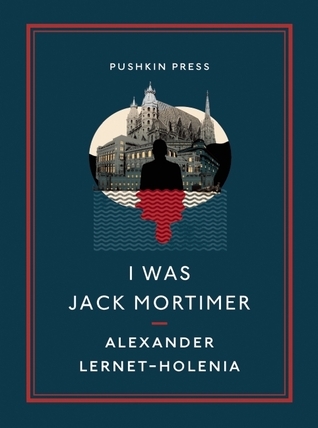
Secondly, I Was Jack Mortimer by Alexander Lernet-Holenia, (1933, trans. Ignat Avsey 2013) which in my Pushkin Press edition is 203 pages but they are not standard size, and when it was published in a Pushkin Vertigo edition it was 160 pages, so counts for Novellas in November – hooray!
A disclaimer to start, because although I enjoyed I Was Jack Mortimer a great deal, I thought the fundamental premise was completely silly.
Spooner is a young cab driver who at the start of the novel is stalking a young woman – so far, so yuck. Then a man gets into his cab, but by the end of the journey the passenger has been shot dead, without Spooner hearing or seeing a single thing.
“Spooner stood in the middle of the room, and the events of the past minutes raced through his mind, like short, randomly edited film clips; the dead man, the speeding cars, the news stand, the dead man, the carriageway, the blood, the dead man, the streets, the dead man.”
What would you do? I think almost entirely everyone would go to the police. But this wouldn’t make much of a thriller, as the police would take the story out of your hands and you’d have to go back to smoking with the other cabbies, boring them with the story, and being creepy towards women.
So instead, for reasons best known to himself, Spooner disposes of the body and starts to inveigle himself into the man’s life.
“he was pretty sure that as soon as the crime was discovered it’d be put at his door, so that in the end he began to feel as though he had in fact perpetrated it himself. And had he really been the murderer, in all probability he wouldn’t have been behaving any differently from the way he was now.”
I Was Jack Mortimer is a really enjoyable thriller, if you can get past the unbelievable set-up of Spooner’s decision-making. I just put that element to one side and allowed the pacy writing to carry me along as Spooner gets increasingly out of his depth. The 1930s and the city of Vienna are beautifully evoked with a wonderful sense of time and place.
The trouble with writing about thrillers is that you can say practically nothing for fear of spoilers. What I will say is that towards the end Spooner has the following epiphany:
“All I needed to do was go to the police and report I had a dead person in the car and didn’t know who shot him, and in the end they’d have had to believe me and I’d have been released. Instead, I’ve done just the opposite and have landed myself in no end of a mess.”
Well, quite.
“One doesn’t step into anyone’s life, not even a dead man’s, without having to live it to the end.”
To end, I tried to find a trailer for one of the film adaptations of I Was Jack Mortimer, but failed. So instead a chance for me to totally indulge myself with the trailer for my most favouritest-ever film, which is set in post-war Vienna:
August is Women in Translation Month, hosted by Meytal at Biblio. I’m hoping to post a few times this month but given my current blogging pace that may be a hope in vain! Anyway, I’m really pleased with the start I’ve made as it’s two authors I’ve not read before as well as two more stops on my Around the World in 80 Books challenge.
Trigger warnings for pretty much everything: mentions of violence, genocide, rape, incest, and animal cruelty although I don’t go into detail for any of these.
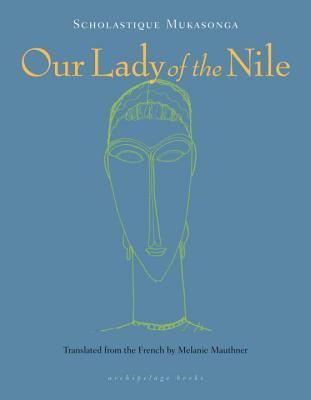
Firstly, Our Lady of the Nile by Rwandan author Scholastique Mukasonga (2012, trans. Melanie Mauthner 2014). Scholastique Mukasonga fled Rwanda for Burundi and has lived in France since 1992. 27 members of her family were killed in the Tutsi genocide in 1994. She set Our Lady of the Nile in 1979 and the future massacre haunts the story.
The titular school is in a remote region on a ridge of the Nile:
“There is no better lycée than Our Lady of the Nile. Nor is there any higher. Twenty-five hundred metres, the white teachers proudly proclaim […] ‘We’re so close to heaven,’ whispers Mother Superior, clasping her hands together.
The school year coincides with the rainy season, so the lycée is often wrapped in clouds. Sometimes, not often, the sun peaks through and you can see as far as the big lake, the shiny blue puddle down the valley.”
This opening immediately put me in mind of Rumer Godden’s Black Narcissus, and like Godden’s story there is a creeping oppression and tension amongst a group of women living together within an institution. Unlike Godden’s nuns though, the tension arises primarily from the wider political situation. Early in the story we meet class leader Gloriosa, who is wholly influenced by her father’s views on how to treat Tutsis.
“’The chiefs’ photos have suffered the social revolution,’ said Gloriosa, laughing. ‘A dash of ink, a slash of machete, that’s all it takes…and no more Tutsi.’”
That flippant mention of a machete is completely chilling. The girls are at that stage of adolescence where they are simultaneously naïve and aware of wider ramifications as they navigate one another, the attentions of men and the political situation.
As we follow the girls over the school year, the story is episodic and not told from one point of view, successfully building a picture of the remote community and the threats that exist within and without.
Two Tutsi girls, Veronica and Virginia have to manage Monsieur de Fontenaille, a coffee grower who idealises and objectifies their beauty; there is Father Herménégilde who is a paedophile in a position of power in the school; Gloriosa’s polemic about school quotas and Tutsis taking the place of Hutus is deeply disturbing and divisive.
The education of the girls also demonstrates the legacy of colonialism and how its brutality continues, how the genocide has its roots firmly in the past:
“History meant Europe, and Geography Africa […] it was the Europeans who had discovered Africa and dragged it into history.”
“Because there were two races in Rwanda. Or three. The whites had said so; they were the ones who had discovered it.”
The story builds towards a denouement that is horribly predictable, terrifying and shocking. As part of these events, Gloriosa encourages a truly despicable violent act on a classmate that I’ve decided not to detail here. It’s not remotely sensationalist but it demonstrates the total horror that human beings can enact on each other.
Our Lady of the Nile is a stunning piece of writing, managing to convey the immeasurable costs of political violence with great humanity.
“It’s time we remembered who we are and where we are. We are at the lycée of Our Lady of the Nile, which trains Rwanda’s female elite. We’re the ones who’ve been chosen to spearhead women’s advancement. Let us be worthy of the trust placed in us by the majority people.”
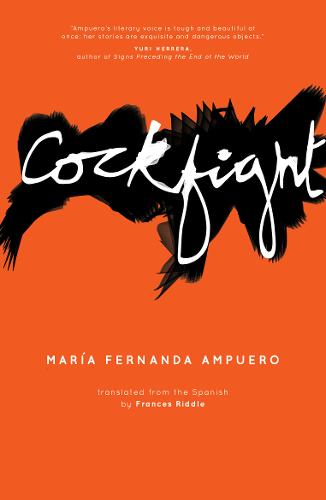
My second choice doesn’t offer any reprieve from these brutal themes, as Cockfight by Ecuadorian writer María Fernanda Ampuero (2018 trans. Frances Riddle 2021) is unflinching in its depiction of violence against women, animals, family members and of rape and incest.
I’m not going to go into too much detail from the stories as they are all such tough reads, but I’ll give an idea of a few of them. Ampuero is a compelling, precise writer and her stories pack a steely punch. If you feel able to read the stories I would urge you to do so, but they are definitely not for everyone and I certainly couldn’t have managed them last year when I was feeling a lot more fragile.
In the first story, Auction, a woman is kidnapped and offered up with others to the highest bidder. The situation reminds her of the cockfights she witnessed as a girl, having to clean up the remnants of the brutal sport.
“All these people, men and women alike, have been punched in the gut. I’ve heard them fall to the floor breathless. I focus on the cockerels. Maybe there aren’t any. But I hear them. Inside me. Men and cockerels. Come on, don’t be such a girl. They’re just cockfighters, dammit.”
The mutually reinforcing processes of patriarchy, misogyny, violence and commodification are drawn with ease, and played out in this situation in a visceral and degrading display.
Passion differs from the other stories in the collection, telling the story of (possibly) Mary Magdalen through a second-person narrative.
“You know, the only thing you know, is that you’re not going to be able to live without him. What you don’t know, and what you will never know, is that he loved you. That is something that can only be known by someone who has been loved before. You are not one of those people.”
In this story, Mary is the miracle-worker, abandoned by a man when she is no longer useful. Within the context of the collection, the story shows the long history of women being used and disregarded by those more powerful than they are.
Mourning was one of the most difficult reads, detailing the repulsive violence – physical and sexual – meted out by a brother on his sister. The brother dies and the two sisters rejoice:
“Marta said that at times like this – only at times like this – you need a man in the house, and Maria, who was standing on a chair with her skirts pulled up around her waist, started to laugh like a person possessed, and said no, that she preferred cockroaches, all the cockroaches in the world, over a man in the house.”
Ali and Coro are two linked stories that are incisive in detailing the hypocrisy and corruption that lies behind the moneyed façade of the rich.
“They grow up right there in the kitchen: eating with you until they get big, and then it seems weird to them that they love you so much, even though deep down they know you were their mother, and they see you one day in the future, once you’ve left, and they don’t know whether to cry or run into your arms like when they were little and fell down, or just nod their heads at you because now they’re little ladies and little gentleman of society who know you don’t greet the help with hugs and kisses.”
The collection ends with Other, which was probably the only story I read without flinching. The contents of a woman’s shopping basket distil the choices she has made, meaning she and her children constantly deny their own needs to meet those of an entirely selfish husband and father.
“He likes expensive fillets even though he won’t let go of one red cent for the rest of the month after buying them. So you grabbed three boxes of off-brand cereal instead, one for each child, and the worst brand of pads, the scratchy ones, the ones that come apart right away and cover your panties in little balls of fluff.”
Cockfight is fiercely feminist, urgent and unrelenting. Ampuero doesn’t waste a single word as she evokes everyday violence and degradation in non-sensationalist writing.
These are two brilliant works, stunning and important, but after I’d finished them I had to recover with a Golden Age mystery. I needed something where there was a guarantee that I wasn’t going to have to read graphic depictions of any sort of brutality. Having spent some time with Inspector Alleyn, I now feel ready to re-enter the fray!
As respite from my descriptions of two such harrowing works, here is a cheery number from an Ecuador-based band for you:










 madame bibi lophile recommends

