Novella a Day in May 2025: No.27

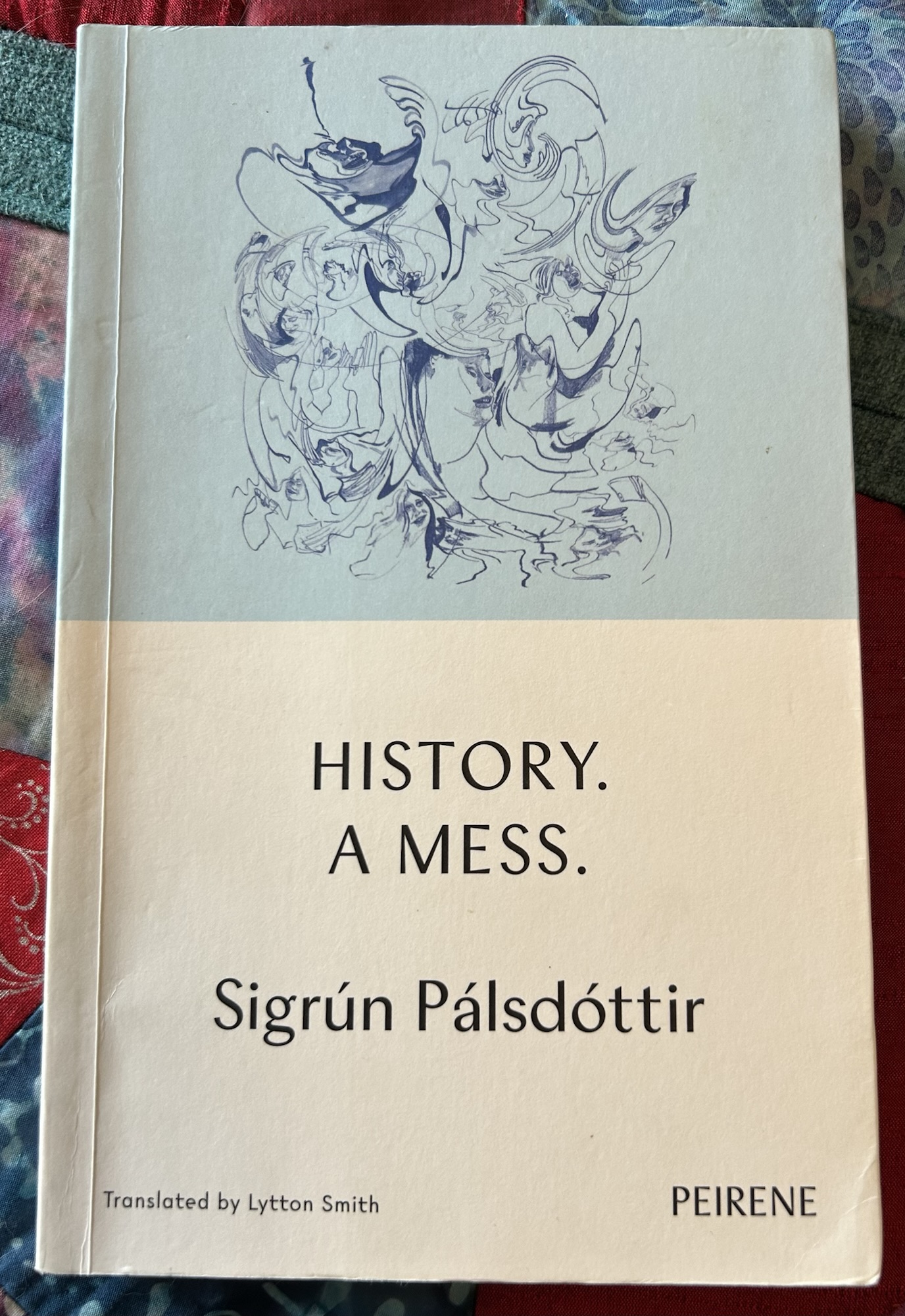
History. A Mess. – Sigrún Palsdóttir (2016 transl. Lytton Smith 2019) 173 pages

History. A Mess. Is narrated by a young unnamed PhD student. As the story opens, she is ecstatic as the research drudge job she had been given by her supervisor, transcribing the journal of a seventeenth-century artist known as SB, seems to have yielded a tremendous discovery: evidence of the first female artist in England.

“Frenzied jubilation thrilled through my body, words burst within me freighted with tremendous power, inside my head sentences and then pages formed one after the other so that by the time I stepped out of the building into the outside courtyard, my introduction was well underway.”

However, we soon learn that something went badly wrong. Five years on, she hasn’t handed in her thesis and she is back in Iceland with her husband Hans, barely leaving her house.

“Even if that person can seem occasionally distant, like Hans, so lost in his world that if you don’t reach out, grasp hold of him, he floats away, as he’s doing now, as I’m letting him do. I’m still trying to figure out what his reaction would be if I reached out for him and laid my cards on the table. Cards on the table. I suspect that his reaction would be sensible. And prudence is no use to me now. My problem calls for a radical solution.”

The fractured, repetitive quality to the sentences are indicative of the narrator’s struggles. The story becomes more hallucinatory and untethered as she seems to unravel further and further.

Some scenes are described that are so florid as to be clearly unreal. Others are grounded in the everyday so we don’t know whether have occurred or not – a skilled positioning of the reader alongside the narrator.

The story can be hard to follow at times, but from the hallucinations we’re able to unpick that she seems to be locking herself in a cupboard in her living room for much of the day. Her parents are around, and her mother is a major figure in her life.

Later in the novel she does leave her home to visit her mother for help in working out what to do about her thesis. Her walk there through the Reykjavik streets collapses reality and hallucination and seems never-ending, like a walk in dream.

“How often can you go over and over a dream in your mind until the scenario begins to crack apart, its images crumbling, their lifetime becoming nothing more than the moment it takes to call them up?”

History. A Mess. Is not an easy read. It is disorienting and confusing, but the writing is taut and so skilled that it never seems to be losing sight of itself. There also remains enough plot to keep pulling the story through, as well as a neat twist at the end.

A repeated refrain in the book is from Andre Breton, and summarises the novella succinctly:

“Everything leads us to believe that there exists a spot in the mind where the real and the imaginary will cease to appear contradictory.”

Novella a Day in May 2025: No.26

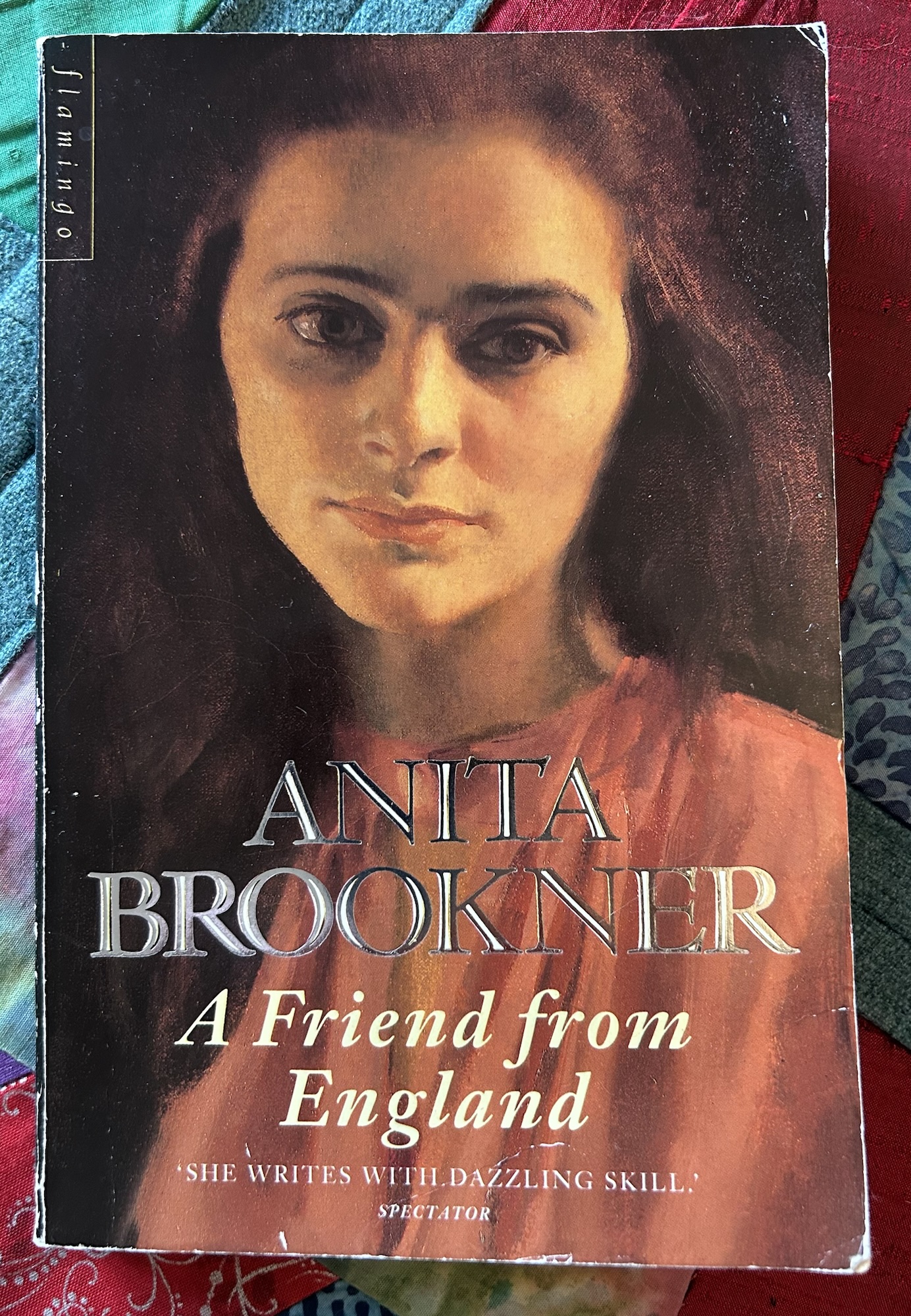
A Friend from England – Anita Brookner (1987) 172 pages

Anita Brookner is one of those authors I keep meaning to get back to. I was too young when I read Hotel du Lac; when I read Family and Friends for this project back in 2019 I knew the time was right. Despite this, I keep failing to pick her up! Hopefully A Friend from England signals the start of my more consistent reading of this striking and clear-sighted author.

The novella is essentially a character study of Rachel, a typical Brookner heroine.She is solitary and somewhat spiky, with the reader sensing more loneliness that she admits to.

She inherits her financial advisor Oscar from her deceased parents. When Oscar retires after winning a lot of money on the pools, Rachel visits him at home rather than his office.

“All the rooms seemed to repel both light and weather; they were designed to keep one’s thoughts indoors, resigned and melancholy.

[…]

I found it all very cosy. Although their life seemed to depress Oscar and his wife, both of whom had a vaguely disappointed air, I could see myself transformed into just such a virtuous member of just such a successful but melancholy family.”

Rachel starts attending Oscar and his wife Dorrie’s home regularly for dinner, and meets their daughter Heather, who it is clear the family are keen to see married and settled. (There was something oddly old-fashioned about A Friend from England, so much so that I went back to the beginning to double-check I hadn’t missed something about it being set in the early 1960s.)

No-one does a bitchy character summation like Brookner, and here is Rachel’s assessment of Heather:

“I could feel the force of her passive temperament, and I say temperament rather than personality, for there was little personality in evidence.”

Ouch!

Oscar and Dorrie seem keen for the two women to become friends, and Heather regularly drives Rachel home, but remains unknowable. This doesn’t particularly bother Rachel:

“I felt a genuine love for Heather’s parents, while feeling rather little for Heather herself. When I say rather little, I mean that I felt a full complement of boredom, irritation, tolerance, and reluctant affection for her.”

However, then Heather does what everyone expects, and gets engaged. Rachel is unsure of her choice:

“My first impression of Michael Sandberg was that he was blessed with, or consumed by, radiant high spirits. My second impression was that a man of such obvious and exemplary charm must be a liar.

[…]

Michael had a sort of sunniness about him which seemed to preclude any baffling depths of character: I thought that was probably just as well, for Heather, despite her shrewdness,  seemed to have very little curiosity and might not have much patience with a difficult or troublesome man.”

The “shrewdness” which Rachel frequently attributes to Heather is a masterstroke by Brookner. As readers we never see any evidence of such a trait. No-one else observes Heather as being shrewd. We are more aware than Rachel that she has proclaimed this motivation to Heather’s behaviour because it makes sense to her. This misjudgement has a significant fallout later.

“I felt a spasm of distaste for her and for all those women like her, women who work for fun and marry for status, and still demand compensation. The only excuse for such women is incurable frivolity. And Heather was not even frivolous.”

[Slight spoilers ahead]

Heather’s marriage does fall apart (again, for a reason I found somewhat out of keeping with its late 1980s setting, unless the reason we’re shown is supposed to be a signifier of a deeper incompatibility.) But it is Rachel who begins to unravel. She has been insistent all along that her solitary life suits her, but this seems grounded in pain and avoidance rather than a life choice which makes her happy and fulfilled.

“The process of thinking does not become me. I feel my face growing longer, my eyes sinking deeper. Thinking, for me, is accompanied by a wave of sadness. Therefore I try to avoid introspection. I long ago decided to live my life on the surface, avoiding entanglements, confrontations, situations that cannot be quickly resolved, friendships that lead to passion.”

When Heather’s subsequent decisions do not fit with Rachel’s judgements of who she is or what she should do, we witness Rachel behaving more and more extremely, despite her distaste for drama. This observant, clever, discerning woman has completely failed to recognise that others could have considered and reached different values and different aspirations from her. The destabilisation which occurs suggests that Rachel wasn’t as secure in her life choices as she liked to believe.

A Friend from England is such a cleverly paced novel. The acerbic, domestic everyday gradually becomes something much darker and more devastating, with all the fault lines set up to fracture from the very beginning.

Novella a Day in May 2025: No.25

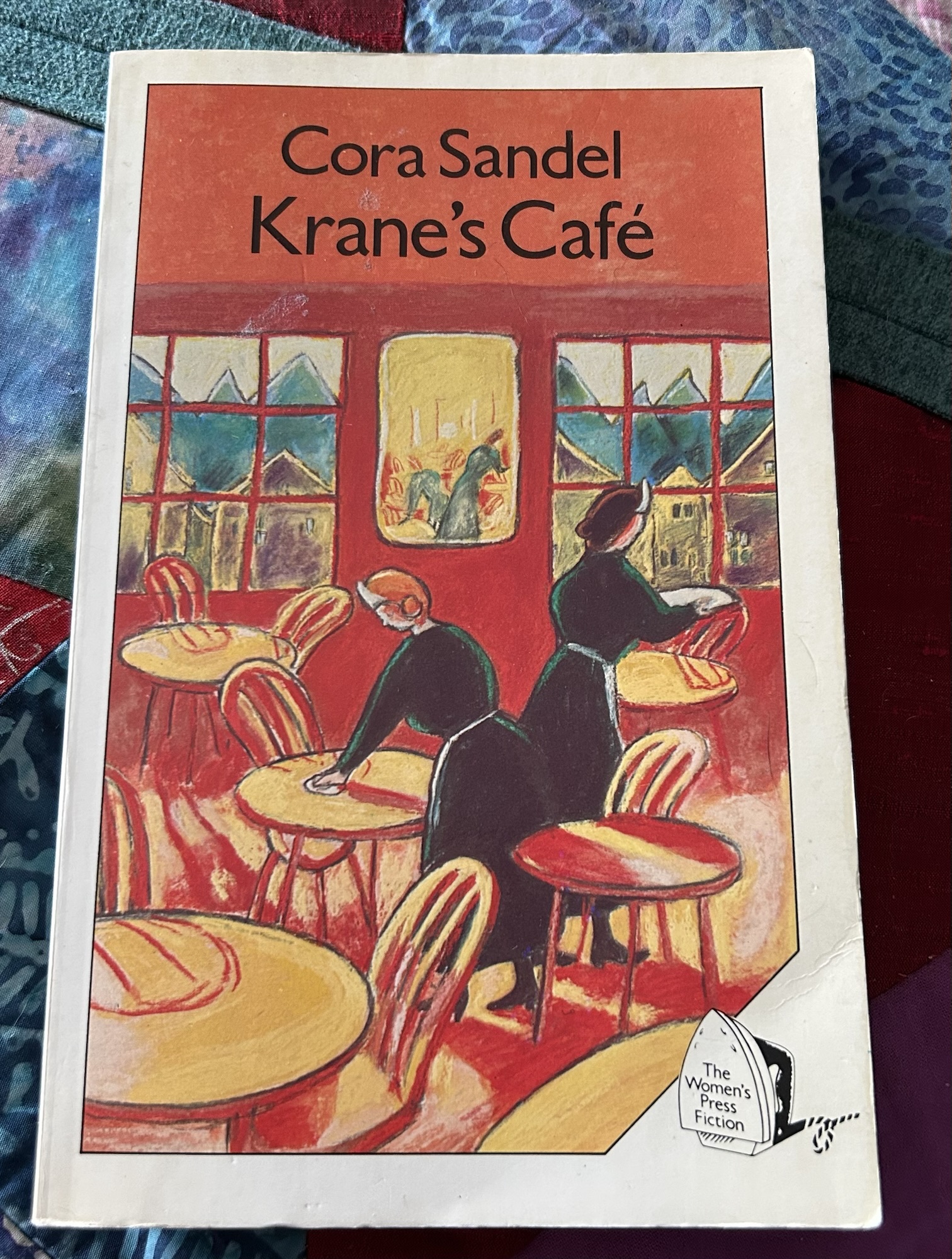
Krane’s Café – Cora Sandel (1946, transl. Elizabeth Rokkan 1968) 173 pages

Back in November Kaggsy reviewed some of Cora Sandel’s shorter writings and reminded me that I had Krane’s Café languishing in the TBR. I’m really pleased to have finally got to it, with its sly humour and incisive characterisation.

“There’s a lot to be heard before your ears drop off.”

Set just after the First World War, it opens with Katinka Stordal sitting in the titular café. She is the dressmaker in a small coastal town in northern Norway, and there is a big event coming up. Her orders are piling up, and Mrs Krane, the owner of the café with her husband, is trying to move Katinka on.

“’I’m going, I’m going,’ said Mrs Stordal. She looked up listlessly for a moment, and stayed where she was. It was one of those days when she looks much older than she really is.”

The narrative voice has this slightly bitchy, judgemental tone, which works so well. In implicitly proclaiming an alliance with the attitudes of the townsfolk, she draws attention to their pettiness and their lack of humane understanding.

People come in to try and chivvy Katinka along, with absolutely no interest as to why she is unable to move from the café or has her head in her hands. Their only concern is getting her back to work.

“As usual Mrs Brien was magnificently equal to the situation. ‘Now then, we mustn’t get hysterical, you know. We mustn’t give up. Everyone has worries. I don’t know anyone without worries. This really is naughty of you, Katinka.”

Then a man called Bowler Hat arrives…

“And he went over to Mrs Stordal and said in that low, one might almost be tempted to say melodious voice, if it were not so ridiculous, and offensive and bold into the bargain, ‘May I offer you something? Something you’d fancy? What about a little wine? The wine you’ve just been drinking? And then you can go on listening to me for a while? You mustn’t stop listening yet, you understand so well. I expect you know too how it feels to be lonely?’”

So the situation becomes scandalous. Katinka is in the back room of the café, drinking with a male stranger. She is complaining about her selfish family, her enduring fatigue with life, her lack of choices. Bowler Hat is an unnerving figure and I did wonder at times if he was a representation of the devil.

Mrs Krane feels overwhelmed without her husband to help her manage the situation, and her staff, Larsen and Sønstegård, are thoroughly enjoying the drama while pretending not to.

“Children and drunkards will tell you the truth. Both Larsen and Sønstegård admitted later that at that point they were almost afraid of more customers coming. For it was exciting to listen to Mrs Katinka, who scarcely ever gave you an answer in the normal run of affairs, sitting there giving rein to her tongue. Even though it was so dreadful to hear her gossiping like that about her own children. Throwing them to the wolves, you might almost call it.

And even though it was all a lot of nonsense.

What else could you call it?”

What emerges is a picture of real sadness. Katinka is lonely and disregarded by her family and by the town, while expected to fulfil their expectations of her. She is teased by the town’s children for her drinking, and in this small community no-one really truly acknowledges anyone else’s pain, despite how closely they all live together.

“And surely she couldn’t have thought of going and drowning herself, with all those orders, she the mother of two children besides? Nobody did that sort of thing in this town.

Suddenly it struck Mrs Krane that that sort of thing was just not written up in the paper about people in other places. Grieve the chemist had taken prussic acid in the cellar of his shop, though that had happened a long time ago and he was even scolded at his graveside by Mr Pio the curate […. ] and Iverson the tailor, who had such a spiteful wife, had walked out into the sea until it went over his head, and he never came up again, even though it was ebb tide and the sea was far out.”

In this way Sandel satirises society and its unthinking complacency towards others; the hypocrisy; and the self-interest. Yet unlike some satire, it doesn’t have a bitter edge. The characterisation is compassionate towards Katinka and Mrs Krane; and even Katinka’s daughter. The narrative voice is humorous and by aligning itself with the attitudes of the town, it avoids the superior tone of some satire.

I felt the ending was compassionate, though the town and its inhabitants remain largely unchanged…

“And all of a sudden Katinka shouted at the top of her voice, ‘Here comes the madness, the great, wonderful madness. The liberator from everything, who opens the gates and makes all spacious about you.’”

Novella a Day in May 2025: No.24

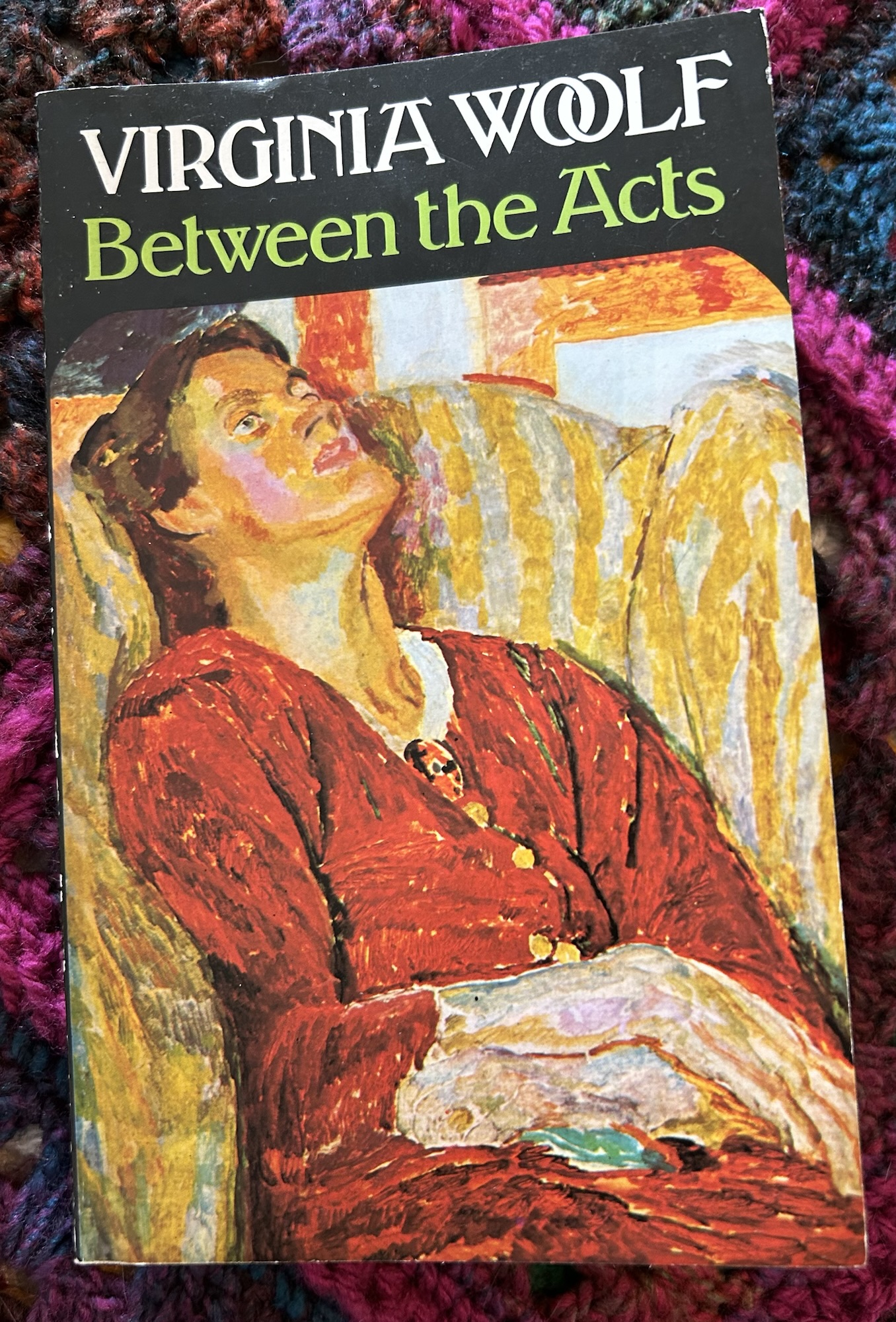
Between the Acts – Virginia Woolf (1941) 159 pages

Between the Acts is Virgina Woolf’s last novel and was published after her death. I’m a bit wary of posthumous novels; a note at the beginning from Leonard Woolf suggests it was pretty much as Virginia intended and only small corrections would have been made had she lived. This is somewhat contradicted by a letter she wrote to her publisher, so it’s impossible to know.

It is set over one day in 1939, before the war starts. It’s summertime, and at Pointz House somewhere in the middle of England, a pageant is taking place as it does every year.

The manor house belongs to the Oliver family: retired Bartholomew Oliver; his endearing, somewhat flaky widowed sister Lucy Swithin, his son Giles and Giles’ wife Isa.

A thread that pulls through the story is Isa’s attraction to gentleman farmer Rupert Haines. Woolf introduces this with startling synaesthetic imagery:

“Isa raised her head. The words made two rings, perfect rings, that floated them, herself and Haines, like two swans downstream. But his snow-white breast was circled with a tangle of dirty duckweed; and she too, in her webbed feet was entangled, by her husband, the stockbroker. Sitting on her three-cornered chair she swayed, with her dark pigtails hanging, and her body like a bolster in its faded dressing-gown.”

I so enjoy Woolf’s inventiveness, and this early passage also stood out, as she sets this tranquil, middle-class, midsummer scene:

“The nurses after breakfast were trundling the perambulator up and down the terrace; and as they trundled they were talking—not shaping pellets of information or handing ideas from one to another, but rolling words, like sweets on their tongues; which, as they thinned to transparency, gave off pink, green, and sweetness.”

But beneath the tranquillity, big emotions are brewing:

“”He is my husband,” Isabella thought, as they nodded across the bunch of many-coloured flowers. “The father of my children.” It worked, that old cliché; she felt pride; and affection; then pride again in herself, whom he had chosen. It was a shock to find, after the morning’s look in the glass, and the arrow of desire shot through her last night by the gentleman farmer, how much she felt when he came in, not a dapper city gent, but a cricketer, of love; and of hate.”

In true British stiff-upper-lipped style, love and hatred are subsumed by social convention and the need to host the pageant. The director Miss La Trobe arrives. My edition has a quote on the back suggesting this is self-portrait by Woolf, which if true is pretty startling:

“Rumour said that she had kept a tea shop at Winchester; that had failed. She had been an actress. That had failed. She had bought a four-roomed cottage and shared it with an actress. They had quarrelled. Very little was actually known about her. Outwardly she was swarthy, sturdy and thick set; strode about the fields in a smock frock; sometimes with a cigarette in her mouth; often with a whip in her hand; and used rather strong language—perhaps, then, she wasn’t altogether a lady? At any rate, she had a passion for getting things up.”

The pageant dramatises scenes from English history, and Elizabeth I is a sight to behold:

“Everyone was clapping and laughing. From behind the bushes issued Queen Elizabeth—Eliza Clark, licensed to sell tobacco. Could she be Mrs. Clark of the village shop? She was splendidly made up. Her head, pearl-hung, rose from a vast ruff. Shiny satins draped her. Sixpenny brooches glared like cats’ eyes and tigers’ eyes; pearls looked down; her cape was made of cloth of silver—in fact swabs used to scour saucepans. She looked the age in person. And when she mounted the soap box in the centre, representing perhaps a rock in the ocean, her size made her appear gigantic. She could reach a flitch of bacon or haul a tub of oil with one sweep of her arm in the shop. For a moment she stood there, eminent, dominant, on the soap box with the blue and sailing clouds behind her. The breeze had risen.”

Large portions of the novel are given over to the script of the pageant, written in verse. Yet astonishingly, Woolf still manages complex characterisation between the acts. There’s a small scene between two characters dismissed by those around them which I found so touching. Lucy Swithin is seen as something of an elderly fusspot; William Doge is a visitor subject to homophobia from Giles, in thought if not in deed but still recognised. At one point Lucy notices William is struggling with the company and takes him off for a tour of the house:

“Mrs. Swithin put her hands to her hair, for the breeze had ruffled it.

“Mr…” she began.

“I’m William,” he interrupted.

At that she smiled a ravishing girl’s smile, as if the wind had warmed the wintry blue in her eyes to amber.”

As always with Woolf, the text is so rich and multilayered and these are really just initial impressions. I’m sure I’d pick up so many other elements on a re-read, or even writing this post again. I just hope that however Woolf felt about Between the Acts, she judged her work more kindly than Miss La Trobe’s view of her pageant:

“She hadn’t made them see. It was a failure, another damned failure! As usual. Her vision escaped her.”

Novella a Day in May 2025: No.23

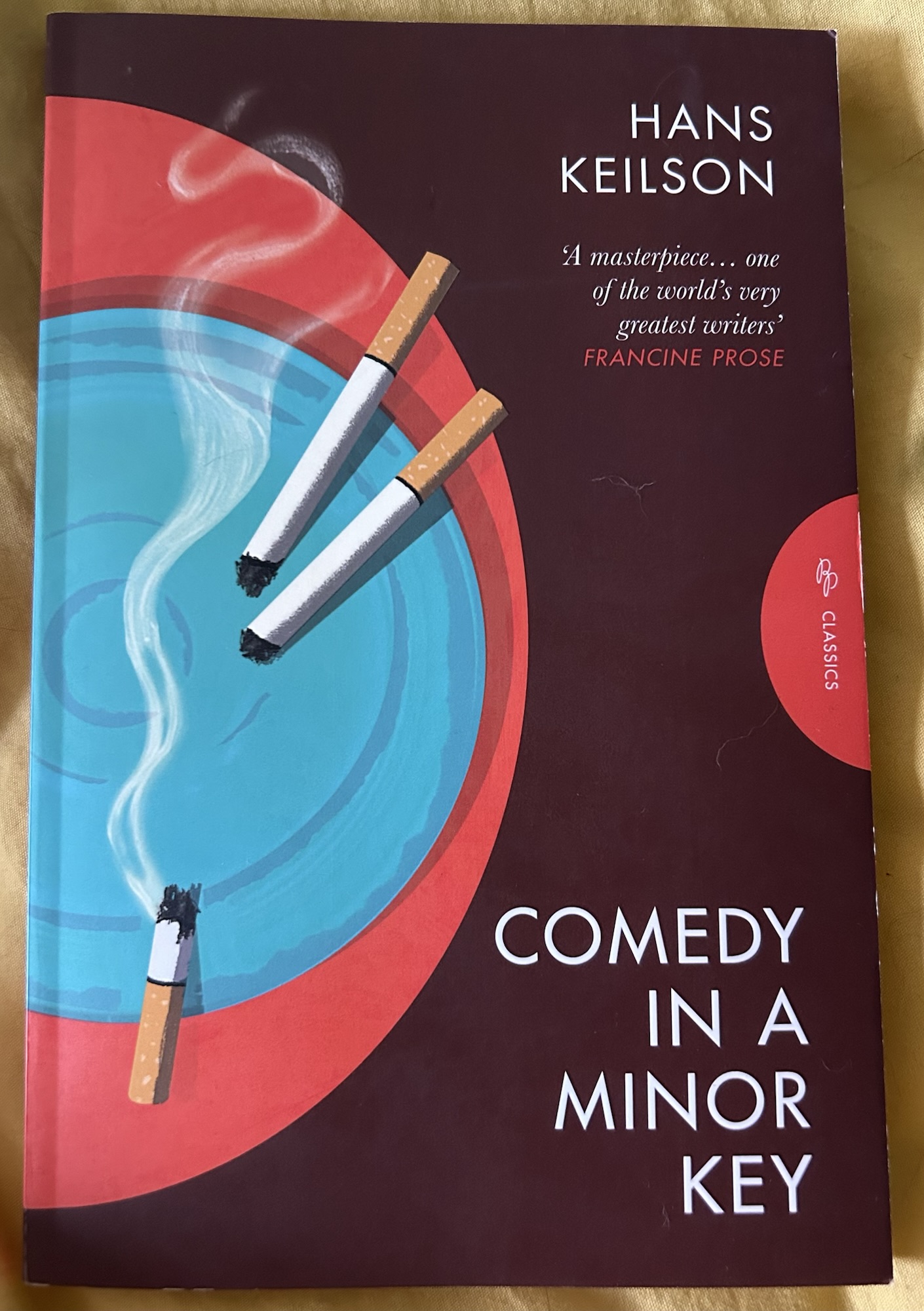
Comedy in a Minor Key – Hans Keilson (1947, transl. Damion Searls, 2024) 108 pages

Yesterday I posted on a German novella written just before the war, and today I’m looking a novella written just after the war but set during those years.

Hans Keilson was a remarkable man. His wiki page opens:

“German-Dutch novelist, poet, psychoanalyst and child psychologist. He was best known for his novels set during the Second World War, during which he was an active member of the Dutch resistance.

Keilson, having worked with traumatized orphans, mainly wrote about traumas induced by the war.”

Both his parents died in Auschwitz and Keilson had to go into hiding with a married couple for part of the war. In Comedy in a Minor Key, he explores this set-up, albeit primarily from the point of view of the couple.

Wim and Marie are a young Dutch couple who are approached to take someone into hiding in their house. Nico is older than them and the three of them live in restricted secrecy.

“The beginning was always exciting, no matter how many times a person had already lived through it.”

Wim and Marie are determined that no-one else will know about Nico. This doesn’t last long as they tell people, and others know already. For almost a year, the three of them live together in awkward domesticity.

What Keilson captures so well is the complexity of feelings around this living arrangement. So Nico isn’t unreservedly grateful; he’s also angry and scared and frustrated:

“Safe? Protected? Since they had taken him in? No, no, he was being unfair. But their house, their home, there things – their world – how it all had attracted him and soothed him at first. And now: how vain, how inflated, how worthless! For he measured things now with the cosmic measure, which gripped him tight and shook him back and forth. What trust in each other? What danger? And what a gulf between people! Consolation! Consolation?… was there any such thing?”

And for Wim and Marie there is bravery and kindness and also some vanity:

“You don’t get the chance to save someone every day. This unacknowledged thought had often helped them carry on when, a little depressed and full of doubt, they thought they couldn’t bear this complicated situation any longer and their courage failed them.”

The three of them muddle along together, and I found this description of their nightly snack and coffee very touching:

“There was gratitude in this habit, and a little tiredness, from the night to come that they were about to enter alone or as a pair, and a furtive, sad happiness in the smiling, incomprehensible futility.

But these scenes occur in flashback, as the novella opens with Nico having died of pneumonia, and Wim and Marie faced with what on earth to do now.

“How the neighbours and everyone on the street would look when he suddenly walked out of their house and strolled up and down the street with them. It would give them a little sense of satisfaction, and everyone who makes a sacrifice needs a little sense of satisfaction. And then you’d feel that you, you personally, even only just a little bit, had won the war.

It had all gone up in smoke. It wasn’t even a dream anymore. None of the three of them had any luck. But really, him least of all.

Poor Nico!”

Keilson never laughs at Nico’s death. What Comedy in a Minor Key shows is the enormity wartime in a domestic setting and how the mundane and silly can endure in the worst of circumstances. It shows how ordinary people can be so brave and also a little bit self-serving. It shows how the inbuilt hopes of a large gesture towards saving a life are entirely undermined when the person dies anyway.

I didn’t find this novella laugh-out-loud funny and I don’t think that’s what the title refers to. Rather I think the comedy refers to the ultimately comedic undermining of best intentions being a resistance in itself, as the war fails to destroy the ridiculous.

“Behind her curiosity there was a burning pain that cried out for more consolation than it was possible to give.”

Novella a Day in May 2025: No.22

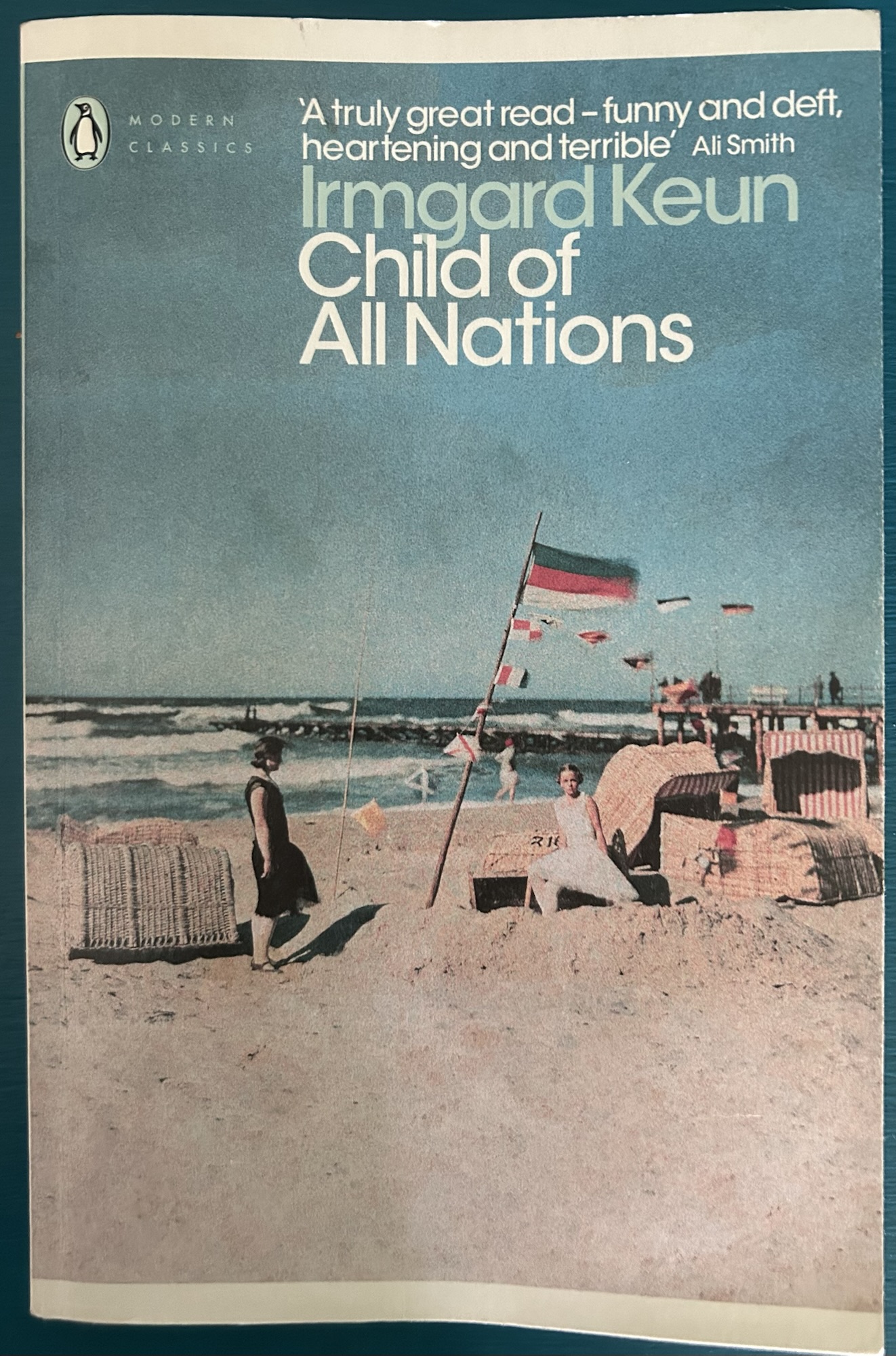
Child of All Nations – Irmgard Keun (1938 transl. Michael Hofmann 2008) 183 pages

I’m sticking with a child’s perspective with today’s novella, by an author I’ve been meaning to read for so long. Child of All Nations by Irmgard Keun is told from the point of view of nine-year-old Kully as she and her parents ricochet around immediate pre-war Europe.

“We left Germany when my father couldn’t stand it anymore, because he writes books and articles for newspapers. We emigrated to find freedom. We’re never going to go back to Germany. Anyway, we don’t need to, because the world is a very big place.”

There’s no doubt that Kully’s father is an important and talented writer, as we see from the responses he gets from other adults. However, he is also self-centred, feckless, and disregards his wife and child to the point of cruelty.

“Sometimes my father loves us, and sometimes he doesn’t. When he doesn’t, we can’t do anything about it, my mother and me. Nothing is any good when he doesn’t love us. Then we’re not allowed to cry in his presence or laugh, mustn’t give him anything, or take anything from him either. Any steps we might take only have the effect of delaying even more the time when he will love us again. Because he always comes back to us.”

From my twenty-first century perspective, they’d be better off without this man and his relentless need for the stimulation of the new, spendthrift ways and constant affairs with other women.

“I look a lot like my mother, only she has bluer eyes than me, and bigger legs, and she’s bigger all round. She wears her hair combed back, and in a knot at the back of her head. My hair is short and unruly. My mother’s much prettier than I am, but I don’t cry so much.”

However, the child’s perspective is so clever in the characterisation of the father, because he is never demonised. Thus, trailing round various countries; being abandoned as surety in various hotels and restaurants; and dragged into his schemes to get loans on promises of work which never appears; are not judged, because Kully just accepts things as they are.

He is also complicated in that his uselessness with money comes from a total material disregard. So while he gambles and drinks away their money, he also gives a lot of it away to people in a worse position than he is. This behaviour, and his writing, shows a compassion for others which unfortunately doesn’t extend to those closest to him.

My father often tells fibs to get a bit of peace and quiet… Sometimes, though, he performs miracles and everything he says comes true.”

What Keun also does well is presenting Kully’s voice directly, so that while it is unmediated and so distinct, adult readers are still able to pick out where she echoing what adults have said to her:

“We only eat once a day, because that’s cheaper, and it’s perfectly adequate. I’m always hungry anyway, even if I eat seven times a day.”

You just know that an adult, most likely her father, has told her that one meal is “perfectly adequate”.

Written in 1938, the shadow of war looms large. Unsurprisingly, Kully only just grasps some of it and her naivete is heartbreaking:

“I’m not afraid, because I’ve got my mother with me, the waiter who brings us our breakfast in the morning has said he’s not afraid either, and there isn’t going to be any war. And if there is, and we’re put in a camp, then he will continue to bring us our meals.”

What is apparent to the reader now, too, is that some of the countries Kully’s family head to as places of safety are not going to remain as such.

There’s a heartbreaking scene where just briefly, Kully’s mother gets what she wants: a small place with a kitchen where she can cook her own food. But inevitably, Kully’s father is bored within days and it is all taken away again.

What Kully recognises, which her father fails to understand, is that constant movement does not automatically mean freedom:

“Because we never have any money, we feel imprisoned by any hotel in any city, and from the very first day we think of our liberation.”

Child of All Nations documents an episodic, transitory life and the lack of plot is reflective of this, with the novella form suiting the story well. Kully’s voice was so clear from the first page and she remains resilient and with astonishing equanimity to the end. Knowing that the Europe in which Kully moves was about to change beyond all recognition gives it an extra resonance, and I think Keun already knew this too.

So, my first Keun read was a success, and I’m keen to read more!

Novella a Day in May 2025: No.21

Western Lane – Chetna Maroo (2023) 161 pages

I am not interested in sport of any kind. I’m not anti-sport either, it just completely passes me by. So a novel about squash is not one I’d leap on. But of course Western Lane isn’t about squash; I don’t really know any more about the game than I did before reading the novella. What it explores, against the background of 11 year-old Gopi’s squash playing, is grief, family relationships, and tentative healing.

“It was with a feeling of having been rescued that I raised my racket and served.”

Gopi lives with her widowed father and her two older sisters, beautiful Kush and angry Mona, whose rage is palpable as she tries to keep the home running after the death of their mother.

Their father takes them to the titular sports centre, seemingly at a loss as to how to provide support for his daughters when he is in so much pain himself. Of the three, it is Gopi who throws herself into the game.

“I began dreaming of Western Lane. I saw the white walls and the blossom outside. At night I got out of bed and went over to the windows where there was a bit of light coming through the curtains. I sat on the floor with my racket, my back against the radiator. It was silent now because it was no longer on. I fixed a new grip onto my racket inexpertly, then peeled the tape off and fixed it again.”

The characterisation is so well realised. Her father is distant and quiet, and yet still such a presence on the page. The adult reader understands more of his grieving that Gopi does, and his floundering underscored by deep love and kindness is so moving.

There is a restrained supernatural element which runs through the story. All the family at some times feel a sense of the person who is gone. This is never explained away, nor does it grow into a metaphysical/magic realist type story. Instead it serves to demonstrate how the absence of their mother/wife is a constant presence for them all:

“Maybe, I thought, she would arrive eagerly only to find that things were too solid, and that we – our bodies – were too hard for her. I wondered would our touch bruise her. Would our talk hurt her ears. When we moved would we seem to fly past her, causing her to fall back.”

They all struggle with well-meaning friends and relatives interfering at various points and the pain of this becomes deeper as it threatens Gopi’s friendship with Ged, a white boy, and her father’s friendship with Ged’s mother.

“While Ma was alive, whenever we did something we weren’t supposed to, our relatives would bring Ma’s feelings into it, as if she was easy to hurt. But she wasn’t. It didn’t matter now. Now she was gone, our capacity to hurt her seemed infinite.”

The novella builds towards a climax of a squash tournament, as Gopi tests herself for the first time against unknown players in an unfamiliar setting. But really I didn’t feel it needed this construct. The family relationships, the tensions and strains, and Gopi trying to manage huge feelings provided enough drive to the plot.

Maroo’s writing is beautifully restrained throughout the whole novella and so thankfully, Western Lane doesn’t end on a lifted-onto-shoulders-waving-the-cup moment, but something much more ambiguous and real. This wasn’t unsatisfying and the story felt whole. I was left hoping that things worked out for them all.

“The world seemed big and luminous with some secret that would soon be known to me.”

Novella a Day in May 2025: No.20

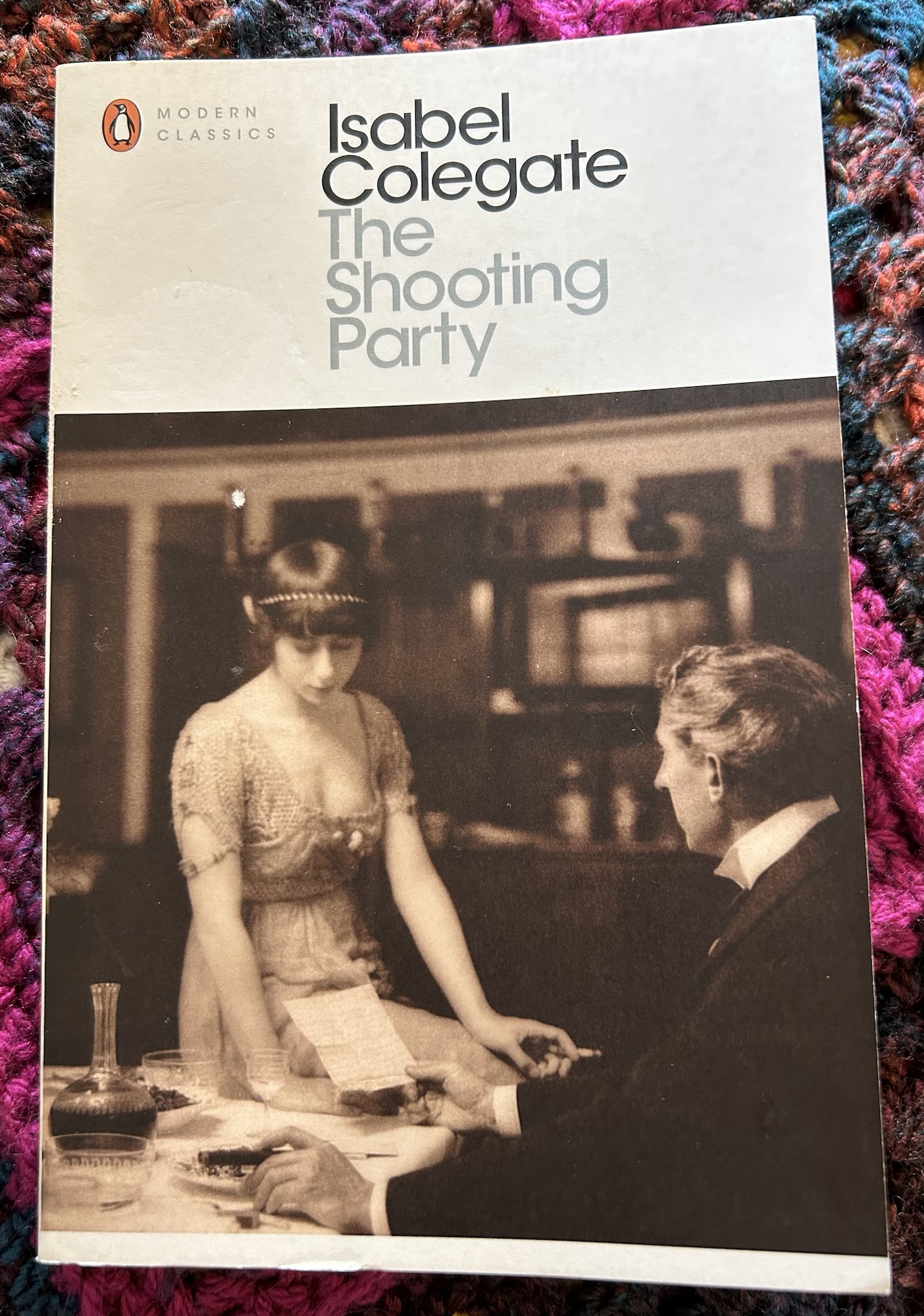
The Shooting Party – Isabel Colegate (1980) 191 pages

I’ll get my complaint about The Shooting Party out of the way first: there were about eleventy-million characters, far too many for a novella, and trying to keep them straight made my brain hurt. If ever a book needed a family tree/character list at the beginning it was this one. But other than that I really enjoyed it, so on with the post!

The Shooting Party was written in the latter part of the twentieth century but captures a bygone age just before the outbreak of World War I.  Colegate relies on our knowledge as readers that the lives she presents are on the brink of being changed irrevocably.

“I can’t say I positively want a war; and yet one gets the feeling sometimes – life is so extraordinarily pleasant for those of us who are fortunate enough to have been born in the right place – ought it to be so extraordinarily pleasant? – and for so few of us? And isn’t there sometimes a kind of satiety about it all – and at the same time greed?”

The titular event is taking place at Sir Randolph Nettleby’s Oxfordshire estate. Over the course of three days a group of privileged people will convene in the slaughter of hundreds of birds. It is absolutely grotesque, but thankfully Colegate spends very little time on the details of bloodsports, being more interested in the relationships between the characters. There were a few passages I skipped but it remained very readable.

Sir Randolph is aware that the world is changing. He despairs at the falling away of the old order as the world becomes increasingly mechanised and industrialised. The country estates are losing workers and he worries at the decline of the countryside.

He is quite a gentle patriarch in many ways, despite being so much a man of his time. Colegate doesn’t laugh at her characters, but there is humour throughout and I don’t think we’re supposed to take them entirely seriously all the time:

“Sir Randolph, unlike Minnie who aspired to it, considered cosmopolitanism a vice. It was alright to know your way around Paris, Sir Randolph thought, and to visit Italian picture galleries or the relics of the classical world, but generally speaking a man should stick to one country and be proud of it. If one wanted to travel there was always the Empire.”

His grandson Osbert doesn’t do well at school and the family are despairing at getting him ready for Eton, yet it is Sir Randolph who sticks up for him:

“Sir Randolph said, ‘Leave him alone. There’s no malice in him. Give him time and he’ll come along all right.’ He spoke as he might have spoken of one of his black, curly-coated retrievers, and like the retrievers Osbert in due course came along.”

Osbert has a pet duck named Elfrida Beetle and a source of tension throughout the novel is whether she will survive or get caught up with the wild ducks that the party are determined to shoot to pieces. There is also an impending sense of doom, beyond the war, as we know from the start of the novel that there is “an error of judgement, which resulted in a death”. Yet the final day of the shoot starts peaceably enough, as Sir Randolph reflects in his study:

“Freed from time, he felt influenced towards the familiar state of watchful calm, from which he was aroused by the slow crescendo and then rapid diminuendo of the breakfast gone being sounded by Rogers, an acknowledged master on the instrument.”

His wife Minnie was a favourite of the now-dead King, (another character reflects: “A pity English royalty was always so philistine.”) and like her husband she has a strong sense of duty and decorum. Unlike her husband she’s also quite a frivolous character, but this suits her role as hostess and she sees more than she says. She gets on well with her granddaughter Cicely, who shares her silliness, if not her circumspection.

“Olivia did not find Cecily boring. She liked her liveliness and suspected her of having more courage than she herself had ever had. Cecily might well choose to be unconventional; something to which Olivia had never aspired, in her actions at least. Her thoughts, generally speaking, she kept to herself.”

Olivia is Lady Lilburn married to Bob, a man so dull that even as I’ve just finished the reading the novella I can’t remember anything about him except a funny scene with him fussing over cufflinks. Another couple are Lord and Lady Hartlip, long married and quite prepared to indulge each other’s extra-marital dalliances. Where Lord Hartlip draws the line is Lady Hartlip’s compulsive gambling, which she has learnt to hide from him. Thus Colegate shows that privilege and comfort don’t equal happiness for all. In fact, happiness seems elusive to so many of these characters.

Apparently one of criticisms of The Shooting Party on publication was that it tried to shoehorn in all the Edwardian political issues and the characters were ciphers in service of these. I think this is a little unfair. As I mentioned at the start, there are soooo many characters that I can see where this criticism came from: a rich Jewish businessman subject to Anti-Semitism; a member of European aristocracy; bored wives; flighty debs; gamekeepers entrenched in the social order; a new generation coming up of self-made men… but I found them all believable and Colegate is interested in the person behind the type.

Colegate evokes the daily routines of life in a large country estate so well, and balances the inevitable elegiac quality with the practicalities of living; the sad desperation of some of the characters with humour. As the day moves on personalities are exposed and relationships change forever.

Novella a Day in Day 2025: No.19

Siblings – Brigitte Reimann (1963, transl. Lucy Jones 2023) 129 pages

Summarising Siblings makes it sound incredibly clunky. A brother and sister living in the GDR find themselves separated ideologically as one of them wants to leave for the West. However, Brigitte Reimann’s writing is so skilled that the relationship between the siblings is rounded. The novella never feels like a construct in order to explore two forms of government in opposition to one another.

We know from the start that there has been some sort of significant betrayal. It opens:

“As I walked to the door, everything in me was spinning.

He said, ‘I won’t forget this.’ He was standing very straight and not moving in the middle of the room. He said in a cold, dry voice, ‘I’ll never forgive you.’”

The story is told from the point of view of Elisabeth (Betsy/Lise) and each chapter opens with the current situation (1960, prior to the Berlin Wall being built) before looking back in time. We learn of her close relationship with her brother Uli.

“I trusted him in every way and was vain enough to think I knew everything or almost everything he thought and planned. But in truth, back then, which was only the day before yesterday, I didn’t have a clue about the person closest to me.”

They are young people from a previously privileged family (who voted for Hitler), although they no longer have access to their industrialist family’s assets or wealth. Elisabeth is an artist and has a job working in an industrial plant painting the workers and teaching, which she enjoys despite the frustrations of dealing with colleagues and pressures from the Stasi.

“As soon as I’ve warmed myself in the lap of my family for a few days, I feel homesick for its adventurous, daring atmosphere; and for the sight of the huge, white and yellow excavators; for the mountains of sand blown haphazardly by the wind, under which lies the dark brown, damp coal seam; and for the drivers up in their peaceful cabins, shields lowered, patiently shovelling tonnes of earth…”

Uli is an engineer but he is unable to get a job due to being blacklisted by association with a professor who defected, despite him knowing nothing about the defection. Unlike Elisabeth and her boyfriend Joachim who works for the Party, Uli struggles with the immense bureaucracy and lack of choices he has in the GDR.

The siblings’ brother Konrad went to the West with his wife, and Elisabeth sees this as a huge betrayal, despising the materialism she feels drove the decision.  He was part of Hitler Youth, while Elisabeth and Uli were both small children during the war. Hence her feelings about the West and her immediate family are bound up with and complicated by Germany’s recent past.

A further complication is that Elisabeth and Uli have stayed close throughout their lives and she describes Uli romantically, dwelling on his handsomeness and appealing qualities more than on those of Joachim. I found her response in this way to her brother odd and unnerving, but I don’t know if that is a cultural difference or a deliberate decision by Reimann to make the siblings’ bond overly intense.

Uli tries to explain to Elisabeth the difference between him and Konrad; why he needs to leave, despite still believing in socialism:

“‘Before I’m ground to pieces here,’ he added, not quite as loudly, not quite as confidently. ‘I’ll always stand up for the public ownership of industry over there.’

‘Even in your shipyard?’

‘Even in my shipyard.’ He paused then smiled uncertainly.

‘How come your shipyard?’ I said quickly. ‘You’ll have to stop using communist phrases, you know.’”

Having Uli still believe in the system of government but finding himself unable to live under it complicates the opposing views of the siblings and exposes the layers of experiences which can lead to vastly different life decisions.

Another clever decision is to not paint the GDR as a bleak wasteland. As well as Elisabeth’s romantic view of the plant, the natural environment is beautifully evoked:

“The morning sun had moved on, and the sky stood flat and pale blue above the trees lining the avenue; from the kitchen window, above the cottages, I could see stables and small courtyards nestling closely together in this bucolic area of town. Raindrops sparkled on the walnut tree branches and the tips of its leaves in the slanting sunshine.”

The narrative circles back to end where it began, perhaps indicating the circular nature of the political arguments that neither Uli or Elisabeth will win. By the time we return, the reader is fully aware of the various ambivalent, contradictory bonds which tie Elisabeth and Uli. Siblings is a heartbreaking portrait of how wider political pressures can fracture the closest of relationships, irretrievably.

“‘I can’t explain anything to you,’ he said after a while. ‘Because our views on freedom, among other things, are too far apart.’”

Novella a Day in May 2025: No.18

Across the Common – Elizabeth Berridge (1964) 186 pages

Back in 2023, I started off Novella a Day in May with Elizabeth Berridge’s The Story of Stanley Brent. I ended the post by saying I had Across the Common in the TBR and maybe I’d get to it later in the month 😀 Just two short years later…

Across the Common is told from the point of view of Louisa as she returns to her suburban childhood home, after leaving her artist husband Max.

“My grandfather had built the house in the eighties. It was tall and big and excelled in useless crenellations; in the front an immense stretch of holly hedge gave the house its name.”

Her two aunts, Seraphina and Rosa, still live in this Gothic pile and they are soon to be joined by Aunt Cissie:

“Since the war, which had robbed her of her second husband and her only son, something had shifted in her. A new, unbalanced cynicism revealed itself by a sarcastic twist of the mouth, a semiquaver of a shrug.”

Quite a contrast to Aunt Seraphina:

“it was all in her sigh: her lost opportunities for adventure, for love, for self-expression. She was more of a child than I had ever been, and I loved her again for her wild and illogical longings, her aching desire for drama.”

They live in an insular world. Cissie had left, so her worldliness means she wants a television on her return, but otherwise the aunts are preserved in a world long gone. The Hollies has always existed as a refuge for the women in the family, such as Louisa’s grandmother:

“She had merely withdrawn into the world of The Hollies, where unpleasant things like passion and unworthy emotions and reality were kept out by the high walls, lapped by the half tamed acres of the common.”

Louisa initially returned to her aunts for their familiarity and the need she feels to unravel who she is, based on experiences in her past which led to her leaving:

“I only wanted to remember it in order to remember something else, like turning the cut-glass top of a decanter bottle in the sun, to catch the sudden prismatic dazzle. This something lay with the aunts; it was an unease that spoiled relationships, a strange Braithwaite ambiance that lay like fallout over the family.”

However, she begins to realise that her past may be more complex than she realised, and there are secrets within the family to understand. The Gothic atmosphere is heightened when a solicitor passes on a sinister warning in a letter from her long-deceased father:

“Don’t, for your own sake, be misled by the cultivated exteriors of your aunts. They can smother, they can crush, they can exterminate.”

There’s also the fact that Louisa’s aunts are among the few people her husband struggles to tolerate:

“It was the Braithwaites, my mother’s family, who came outside Max’s indulgence. They filled him with a kind of detached horror. He was ruthless about them. Is ruthless. For he blames them for everything awry in me.”

Yet they are never caricatures of eccentric older women, but carefully drawn and fully realised. All three aunts were fabulous creations.

Berridge builds an atmosphere that feels both stifling and menacing, without being overtly threatening or devoid of love. There is humour here too, and I particularly enjoyed Aunt Seraphina’s habit of pilfering plant cuttings from Regent’s Park.

The Big Family Mystery is believable, providing enough plot to draw the story along, with Louisa’s growing understanding of her family history and herself being well-paced.

I have another Berridge in the TBR so hopefully it won’t take me two more years to get to it! She is so accomplished and her idiosyncratic characterisation is a joy.

“The Braithwaite way of life was a kind of anarchy that could scarcely be contained within one house.”