Novella a Day in May 2019 #16

A Whole Life – Robert Seethaler (2014, trans. Charlotte Collins 2015) 149 pages

After the traumas of The Blind Owl yesterday, lets all recuperate in a beautiful Austrian village😊 But that’s not to say that A Whole Life is a comfort read; it’s exactly what the title says – the tale of one man’s whole life, containing tragedy and joy.

Andreas Egger arrives in the village as a young orphan, at the start of the twentieth century. His uncle doesn’t really want him and he is bullied violently by him until he gets old enough to demand it stop, but not before his leg has been broken and badly reset, leaving him with a lifelong limp.

Nonetheless he is a strong and valued manual labourer in the village, later working for the cable car company, shinning up and down the mountains. Egger is a loner but not lonely; ultimately he is a man of the valley, mountains and meadow of his village.

“Sometimes on mild summer nights, he would spread a blanket somewhere on a freshly mown meadow, lie on his back and look up at the starry sky. Then he would think about his future, which extended infinitely before him, precisely because he expected nothing of it. And sometimes, if he lay there long enough, he had the impression that beneath his back the earth was softly rising and falling, and in moments like these he knew that the mountains breathed.”

From this small village Egger witnesses the many and rapid changes of the twentieth century. He participates in some – his only protracted period of time away is when he is a prisoner of war – but mostly he just observes. There are the major upheavals:

“The mayor was no longer a Nazi these days, geraniums hung outside the windows again instead of swastikas”

And also the social shifts, such as the quiet village becoming beset by tourists:

 “He had already been so long in the world: he had seen it change and seem to spin faster with every passing year, and he felt like a remnant from some long buried time, a thorny weed still stretching up, for as long as it possibly could, towards the sun.”

Egger also experiences some major changes in his personal life, but to avoid spoilers I won’t give details. I’ve seen A Whole Life compared to Stoner and while I do love Stoner I think this is quite different. Although both are about male, twentieth-century, somewhat isolated lives, I didn’t find this nearly so sad.

“Drops of water trembled on the tips of the blades, making the whole meadow glitter as if studded with glass beads. Egger marvelled at these tiny, trembling drops that clung tenaciously to the blades of grass, only to fall at last and seep into the earth or dissolve to nothing in the air.”

A beautifully written novella which demonstrates how a life can look quiet and small from the outside but be entirely rich and fulfilling. Above all, it’s about walking your own path.

“And in the mornings after the first snowmelt, when he walked across the dew-soaked meadow outside his hut and lay down onto one of the flat rocks scattered there, the cool stone at his back and the first warm rays of sun on his face, he felt that many things had not gone badly after all.”

Novella a Day in May 2019 #15

The Blind Owl – Sadeq Hedayat (1937, trans. DP Costello 1957) 106 pages

This was a really challenging read, and though an astounding work, I was grateful for the novella length as it was tough to take.

Sadeq Hedayat was an Iranian writer and is considered an innovative titan of Persian literature; he’s a best-selling author in his home country. This novel was initially banned on publication, and according to Wiki there is still censorship of his work (I’ve not linked to the Wiki page because much to my horror there’s a picture of his dead body on it). Sadly, he died by suicide, and The Blind Owl certainly feels authentic in its portrayal of someone losing all sense of reality and suffering mental ill health. I’m giving this post a trigger warning for some pretty disturbing imagery in the third quote, although I’ve not picked the worst in the novella, I wanted to give a true sense of it.

“Will anyone ever penetrate the secret of this disease which transcends ordinary experience, this reverberation of the shadow of the mind, which manifests itself in a state of coma like that between death and resurrection, when one is neither asleep nor awake?”

The unnamed narrator earns his living by painting pen cases. He may or may not have killed someone:

“How could I have resisted it, I, an artist, shut up in a room with a dead body? The thought aroused in me a particular sensation of delight.”

It’s a disorienting narrative. It’s not clear what is true or false: the events described could be entirely in the man’s head and what The Blind Owl describes is him lying on his bed, thinking/hallucinating. It’s a stream of extremely disturbed consciousness. Images and events recur and shift slightly, adding to a sense of disorientation and being witness to someone’s spiralling thoughts.

“A sensation which had long been familiar to me was this: that I was slowly decomposing while I yet lived. My heart had always been at odds not only with my body but with my mind, and there was absolutely no compatibility between them. I had always been in a state of decomposition and gradual disintegration. At time I conceived thought which I myself felt to be inconceivable.”

The narrator has no compassion for humanity and this is what adds to making The Blind Owl such a tough read. He is misanthropic, and so the coldly related details of violence, dead bodies and decomposition are truly horrifying.

I don’t want to put people off reading The Blind Owl because it is truly a brilliant piece of writing, but definitely one for when you’re strong enough to take it, with a comforting escapist read lined up for afterwards.

“Am I a being separate and apart from the rest of creation? I do not know. But when I looked in the mirror a moment ago I did not recognise myself.”

Novella a Day in May 2019 #10

The Hunting Gun – Yasushi Inoue (1949, trans. Michael Emmerich 2013) Pushkin Press 106 pages

Published by the wonderful Pushkin Press, The Hunting Gun tells of the fallout from an extramarital affair via three letters, from the daughter of the woman involved, the betrayed wife, and finally the woman herself when she knows she is going to soon die.

The letters are sent to a poet who has published the titular poem about a man he once saw.

“He had simply struck me, as he came along the path with his shotgun over his shoulder and a pipe in his mouth, as having a sort of pensiveness about him that one did not ordinarily see in hunters- an atmosphere that seemed, in the crisp early-winter morning air, so extraordinarily clean that after we had passed each other I couldn’t help turning back.”

The man, Misugi Josuke, recognised himself in poem and has sent three letters he received to the poet, in order to explain why he had that atmosphere about him.

The first letter is from Shoko, the daughter of Saiko, with whom Misugi had an affair. Shoko only learns about the affair from reading her mother’s diary.

“And then I heard, very distinctly, the sound of that stack of words I had seen in her diary the night before SIN SIN SIN, piled as high as the Eiffel Tower – crashing down on top of her. The whole weight of the building she had erected from her sins in the course of the past thirteen years, all those floors, was crushing her exhausted body, carrying it off.”

Shoko’s letter is full of anger and betrayal, at both her mother and Misugi, the family friend. In contrast, Misugi’s wife, Midori, is surprisingly measured and even funny. But she acknowledges she has known for many years, and the hurt is not as fresh as that first day.

“I am sure you have had the experience of going for a swim in the ocean in early autumn and discovering that each little movement you make causes you to feel the water’s chillness more intensely, and so you stand there without moving. That was precisely how I felt then: too frightened to move. Only later did I arrive at the happy conclusion that it was only right to deceive you the way you had deceived me.”

Finally we hear from Shaiko, mother to Shoko, best friend to Midori and lover of Misugi, writing a letter to be opened after her death.

“Even after I die, my life will still be waiting here hidden in this letter until it is time for you to read it, and the second you cut the seal and lower your eyes to read its first words, my life will flare up again and burn with all its former vigour, and then for fifteen or twenty minutes, until you read the very last word, my life will flow as it did when I was alive into every limb, every little corner of your body, and fill your heart with various emotions. A posthumous letter is an astonishing thing, don’t you think?”

The Hunting Gun is a short, simply constructed novel that manages to convey emotions and characterisation of real complexity. The affair is shown to involve so many more people than just the immediate couple, and how the fallout and hurt from such a betrayal cannot be anticipated. Inoue shows the capacity human beings have for causing deep, irreparable sadness in one another, but the tone is never judgemental. A beautifully observed novella.

“Why, when we had just formed a united front, so to speak, to battle for our love, why, at a moment that should have been the most fulfilling, did I tumble into that helpless solitude?”

Colette Week: Day 7 – The Last of Cheri (1926)

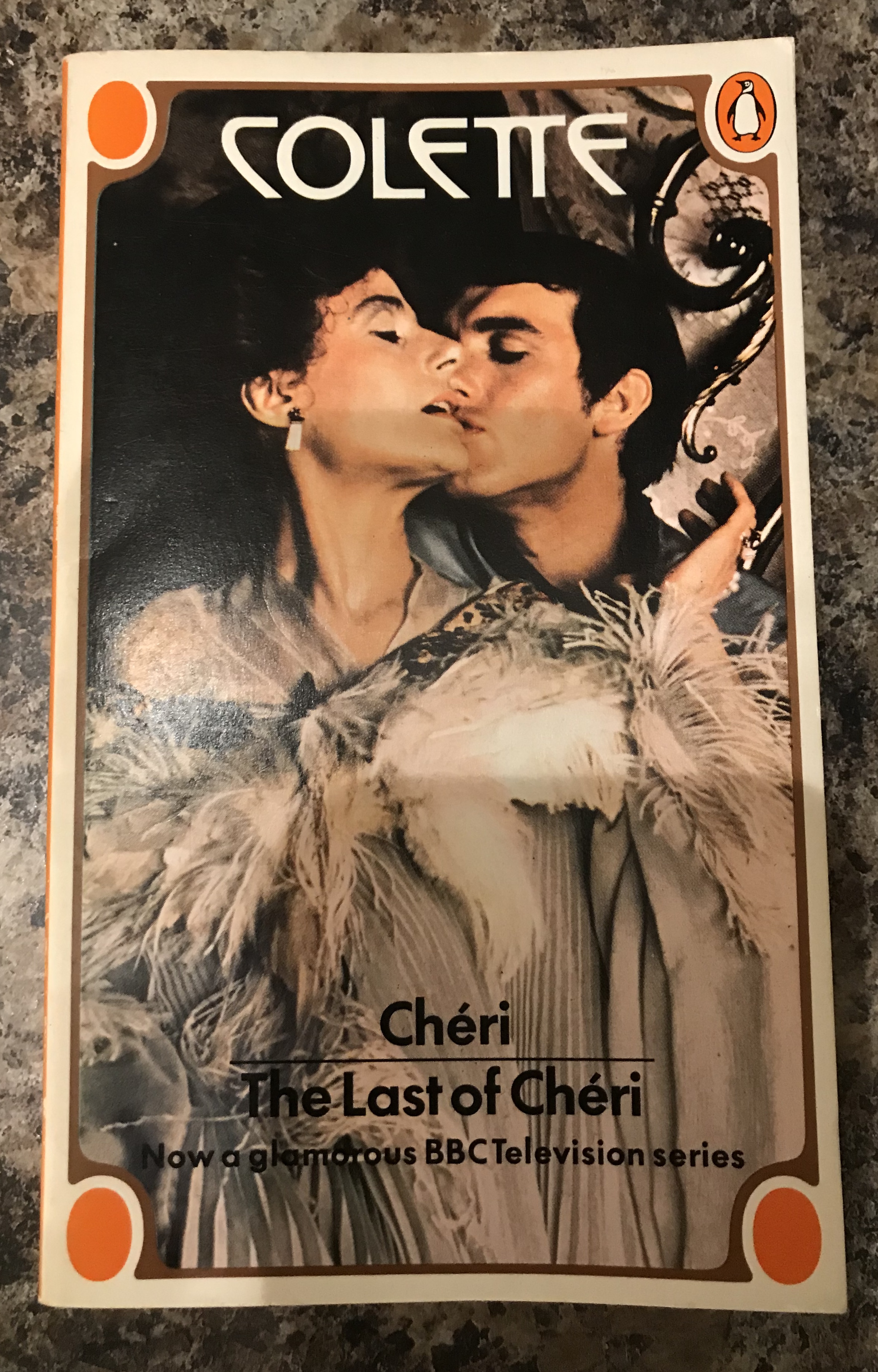
I thought it would be apt to finish Colette Week with a novel concerned with endings: The Last of Cheri (La Fin de Cheri). Here’s a reminder of my decidedly kitsch edition because it’s just so bad:

Thankfully I’m not quite so shallow as to let a hideous cover affect my enjoyment of Colette’s glorious writing (almost shallow enough, but not quite). The Last of Cheri is set 6 years later than Cheri, just after the end of World War I. He is no longer quite the callow youth he was: his affair with Lea and his experience of fighting in the trenches have left him cynical and damaged.

“he had come to scorn the truth ever since the day when, years ago, it had suddenly fallen from his mouth like a belch, to spatter and wound one whom he had loved.”

But, as the French wisely say, plus ça change, plus c’est la même chose. Cheri is still directionless, still without anything to live for beyond himself. Meanwhile his mother and wife have found purpose in war. Edmee is a nurse and consumed by her work at the hospital and extra-marital affairs, which Cheri agrees to.

“Cheri pulled out the small flat key on the end of its thin gold chain. ‘Here we go. In for another carefully measured dose of love. …’”

Cheri’s old friend Desmond is here too, still reprehensible, but like the women in Cheri’s life, having found purpose, setting up a popular nightclub where people try and forget what they and France have been through:

“They danced at Desmond’s, night and day, as people dance after war: the men, young and old, free from the burden of thinking and being frightened — empty-minded, innocent; the women, given over to a pleasure far greater than any more definite sensual delight, to the company of men: that is to say, to physical contact with them, their smell, their tonic sweat, the certain proof of which tingled in every inch of their bodies — the certainty of being the prey of a man wholly alive and vital, and of succumbing in his arms to rhythms as personal, as intimate, as those of sleep.”

If Cheri was told primarily from Lea’s perspective, The Last of Cheri is from Cheri’s perspective and Colette captures this wonderfully. Given that Cheri is so lost and directionless, the novella never appears so. The writing is insightful without being heavy-handedly psychological, and although set in town, Colette’s feel for the natural world remains:

“He noticed that the rosy tints of the sky were wonderfully reflected in the rain-filled gutters and on the blue backs of the low- skimming swallows. And now, because the evening was fresh, and because all the impressions he was bringing away with him were slipping back perfidiously into the recesses of his mind – there to assume their final shape and intensity — he came to believe that he had forgotten all about them, and he felt happy.”

This feeling of happiness is brief though, and occurs after a distressing meeting with Lea, so the reader knows Cheri is deluding himself. Like everyone else, Lea has moved on and is in a very different place, happy and fulfilled.

Poor Cheri. He is utterly lost and ricochets around without any idea as to how to remedy his emptiness. The crisis of meaning of a rich, good-looking playboy could test the reader’s patience, but Colette’s writing meant I had real sympathy for him. His life from the start meant he didn’t stand much of a chance:

“His childhood as a bastard, his long adolescence as a ward, had taught him that his world, though people thought of it as reckless, was governed by a code almost as narrow-minded as middle-class prejudice. In it, Cheri had learned that love is a question of money, infidelity, betrayals, and cowardly resignation. But now he was well on the way to forgetting the rules he had been taught, and to be repelled by acts of silent condescension.”

So, that’s the end of Colette week on the blog. I’ve really enjoyed submerging myself in her writing this week and I hope I’ve managed to convey just a tiny bit of how good she is. She has a deep understanding of people and a wonderful sympathy with the natural world. I find her evocative and capable of great artistry but with a real lightness of touch. Plus she wrote a lot of novellas, which always gets my vote 😊 She was a prolific writer so there’s plenty more to explore, which I’m really looking forward to.

Image from here

Colette Week: Day 6 – Cheri (1920)

I’m ending the week with Colette’s two novels about a beautiful young man, Cheri and The Last of Cheri (tomorrow). Before we go on, look at this awful book cover:

It’s the nearest I’ve come to being embarrassed to read a book in public (I still did it though 😀 )

My aesthetic qualms aside, let’s get back to Cheri. It’s a beautifully written, minutely observed novel and so the quotes are lengthy, as I inadequately attempt to give a sense of Colette’s mastery.

Fred Peloux, known to most as Cheri, is in his mid-twenties and his lover, Lea, is nearing 50.

“At the age of forty-nine, Leonie Vallon, called Lea de Lonval, was nearing the end of a successful career as a richly kept courtesan. She was a good creature, and life had spared her the more flattering catastrophes and exalted sufferings. She made a secret of the date of her birth; but willingly admitted — with a look of voluptuous condescension for Cheri’s special benefit — that she was approaching the age when she could indulge in a few creature comforts. She liked order, fine linen, wines in their prime, and carefully planned meals at home. From an idolised young blonde she had become a rich middle-aged demi-mondaine without ever attracting any outrageous publicity.”

They have been together for six years, since Cheri was 19. His mother, Charlotte, was also a courtesan and Cheri’s paternity is unknown. His beauty is astonishing but his personality is lacking.

‘Why is he so ugly when he laughs? — he who’s the very picture of beauty!’ She thought for a moment, then finished aloud: “It’s because you look so ill-natured when you’re joking. You never laugh except unkindly — at people, and that makes you ugly. You’re often ugly.”

Charlotte is determined to get Cheri married, and Lea claims she is at ease with this; she never anticipated her relationship with Cheri would be a long one. Charlotte and Lea have an antagonistic relationship but one of mutual understanding.

“They had known each other for twenty-five years. Theirs was the hostile intimacy of light women, enriched and then cast aside by one man, ruined by another: the tetchy affection of rivals stalking one another’s first wrinkle or white hair. Theirs was the friendship of two practical women of the world, both adepts at the money game; but one of them a miser, and the other a sybarite. These bonds count. Rather late in their day, a stronger bond had come to link them more closely: Cheri.”

Cheri marries a young woman named Edmée, but it is not a love match. He ends up listless and unhappy, disappearing for 3 months to live in Paris with his friend/hanger-on Desmond, denying his jealousy regarding the rumour that Lea has left the city with a new lover. It is an existence entirely empty and wholly unsatisfying to him. Cheri is worshipped for his looks and youthful energy but he is a deeply inadequate human being. His is an unexamined life, without purpose or meaning.

“For a moment he gave way to self-pity and self-contempt. How many good things had he missed by leading such a pointless life — a young man with lots of money and little heart! Then he stopped thinking for a moment, or possibly for an hour. Next, he persuaded himself there was nothing in the world he wanted, not even to go and see Lea.”

In this short novel Colette documents the evolving relationship between Lea and Cheri, and its sad conclusion. It is an insightful character study of the main protagonists, and an unblinking dissection of a relationship that is doomed to failure despite the deep love between Cheri and Lea. It will not survive societal pressures, nor the lack of humanity and compassion within Cheri.

“An undecipherable thought appeared in the depths of his eyes; their shape, their dark wallflower hue, their harsh or languorous glint, were used only to win love, never to reveal his mind. From sheets crumpled as though by a storm, rose his naked body, broad- shouldered, slim-waisted; and his whole being breathed forth the melancholy of perfect works of art.”

Cheri has been adapted quite a few times (hence my awful book cover). Here’s the trailer for the 2009 film directed by Stephen Frears:

Colette Week: Day 5 – Ripening Seed (1923)

I’ve a stinking cold Reader, please bear with me if this post is even more rambling and incoherent than usual…

Ripening Seed (original title: Le Ble en Herbe trans. Roger Senhouse 1955) has a subtitle on my old orange Penguin edition ‘An idyllic tale of a modern Daphnis and Chloe’, which I think is misleading. I didn’t find the tale idyllic; Colette is far too psychologically astute for that. So although its about a young couple discovering themselves and their love for each other over a long hot summer, its about pain as well as joys, and how the two can be hard to disentangle. It has similarities to Daphnis and Chloe, but departs from that story too.

Vinca “the Periwinkle, with eyes the colour of April showers” and Philippe who “radiated intolerance and a sort of traditional despair…for the period when body and soul are like buds ready to burst into flower” have known each other for years as their families holiday together in Brittany each year. Now Vinca is 15 and Philippe is 16, their feelings are starting to change toward one another. So far, theirs is a chaste romance, full of high adolescent feeling but without physical expression.

I’m not really in the market for teen romance – even Romeo and Juliet tries my patience – but Colette held me with this. Her evocative depictions of nature are to the fore as she captures a hot coastal summer:

“An offshore breeze wafted the scent of the new-mown after-crop, farmyard smells, and fragrance of bruised mint: little by little, along the level of the sea, a dusty pink was usurping the domain of blue unchallenged since the early morning […] the bleat of a goat and the tinkle of the cracked bell round its neck were enough to make the corners of his mouth quiver with anguish and his eyes fill with tears of pleasure. He did not let his eyes linger on the rocks where Vinca was roaming”

I also didn’t mind Vinca and Philippe’s contrariness towards one another. It seemed very believable for two young people who don’t know what to do with their feelings.

“There were still times when they could forget their love, despite the force that daily increased its tentacle hold and slowly but surely sapped their mutual trust and gentleness; and despite their very love itself, though it was changing the essence of their tender affection as coloured water changes the complexion of the rose that drinks it.”

Philippe is seduced by the older Mme Dalleray and so for the latter half of the novel the reader is waiting for the fallout from this sexual awakening away from Vinca. The title in French is from the phrase ‘manger son blé en herbe’/’to eat the wheat that has just sprouted’. In other words, people who are impatient end up denying themselves the benefit of a situation they should have let develop. As I mentioned at the start of this post, this is a story that deals with the pain of love as much as the joys…

Ripening Seed is a novella (122 pages in my edition) focused on building atmosphere and capturing a moment in time for two young protagonists. It’s beautifully written and Colette drew me into Vinca and Philippe’s world from the start.

Le Ble en Herbe has been adapted for the screen a few times (of course it has, young good-looking people in love a cinematic mainstay). Here’s a clip from the 1954 version:

Colette Week: Day 4 – Claudine and Annie (1903)

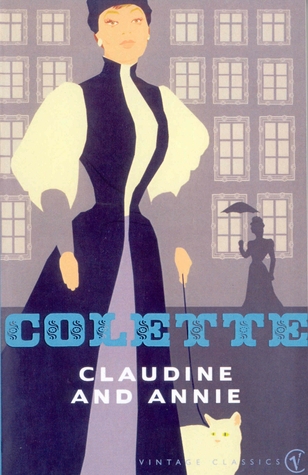
In Claudine and Annie, original title Claudine s’en va (trans. Antonia White 1962), we hear someone else’s impression of the free-spirited heroine, as the novel is told from the point of view of Annie, a very different woman to Claudine.

“I don’t know anything…except how to obey. He has taught me that and I achieve obedience as the sole task of my existence…assiduously…joyfully.”

He is her husband, Alain, who she has loved since childhood and has left her for many months in order to travel to Brazil and claim a legacy. We never meet Alain but he seems fairly repulsive, including saying that she shouldn’t take his rare compliments to heart, as:

“It is my own work I’m admiring; a lovable child, fashioned little by little into and without great difficulty into an irreproachable young woman and an accomplished housewife.”

He is controlling and has left her a list of instructions, including:

“Only one call on Renaud and Claudine, too fantastically unconventional a couple”

Thankfully, for those of us who are so fond of Claudine from the previous novels, Annie ends up disregarding this advice. She and Claudine get on well, spending time together as Claudine is part of Marthe’s, Annie’s sister-in-law, social circle.

“I was animated by an indiscreet curiosity, as if, by questioning Claudine, I was about to discover the secret, the ‘recipe’ of her lucky disposition that detached her from everything, and made her indifferent to gossip, petty quarrels, even to conventions.”

Claudine is attracted to Annie, but she and Renaud have an agreement to just have two people in their marriage since the Rezi drama, so nothing romantic occurs. From Annie we learn they are a devoted and very happy couple. Annie’s marriage, by contrast, is crumbling:

“Shattered, I searched obstinately for one memory in our past as a young married couple that could give me back the husband I believed I had. Nothing, I could find nothing – only my whipped child’s submissiveness, only his cold condescending smile.”

Marthe and her social set are not a happy bunch (apart from Renaud and Claudine). There are infidelities, relentless bitching, worries about money… and yet Annie has her eyes opened to the nature of her relationship with Alain and she cannot turn back.  Realistically, Annie is not ecstatic at her new life; she only knows it must happen.

“In those days which seem strangely far away I was more meek than terrified and almost happy in a timid, colourless way. Is my lot any better today, wandering hither and thither, demoralised yet more self-willed? It’s a very arduous problem for such a tired brain.”

Although I missed Claudine in this novella as the focus is very much on Annie, I still enjoyed this greatly. It was entertaining to see a character we know so well from a first-person point of view depicted through the eyes of Annie. I thought the voice of Annie was distinct from Claudine and of course I was rooting for her to leave Alain.

The story is fairly slight, but at just over 100 pages it is well-paced and suits its novella length. The final sentence was pitch perfect and such a satisfying ending to Annie’s story despite – or perhaps because of – many  unanswered questions.

And so I bid farewell to Claudine and I’m so sorry to see her go. Tomorrow, a stand-alone novella – is it any wonder I love Colette so much when her novels are so blissfully short? 🙂

Colette Week: Day 3 – Claudine Married (1902)

*This post contains spoilers for Claudine in Paris and Claudine Married*

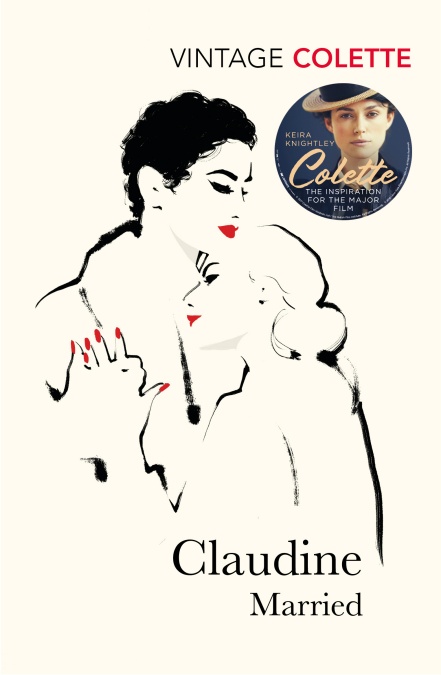
Claudine Married, original title Claudine en menage (trans. Antonia White 1960), continues the story of Claudine after she and Renaud return from honeymoon. It begins:

“Definitely, there is something wrong with our married life. Renaud knows nothing about it yet; how should he know?”

Claudine is finding it hard to adapt to married life, much as she loves her husband. It’s hardly surprising, given that she is young and inexperienced – though not naïve – and has married a man twice her age. She is growing up, and I found her more likable in this novel than the previous two, as she acknowledges her cruelty and disregard for others’ feelings in the past, particularly poor Luce. But she still has her childlike moments:

“Without listening to him, I suddenly put the ruby in my mouth, ‘because it ought to melt and taste like a raspberry fruit drop’! Renaud, baffled by this new way of appreciating precious stones, bought me sweets the following day. Honestly, they gave me as much pleasure as the jewel.”

The start of the novel has some particularly unsavoury scenes to my twenty-first century sensibilities, when Claudine and Renaud return to her old school and sexually tease/demand kisses from the young adolescents there. It was really unpleasant, but thankfully soon over, and Renaud’s voyeuristic enjoyment of Claudine’s lesbian encounters sets the scene for later in the novel.

Claudine has to learn to adapt to a shared life, and she struggles with this. Renaud is not quite what she hoped he would be:

“I hoped so ardently that Renaud’s will would curb mine, that his tenacity would eventually overcome my fits of rebellion; in short, that his character would match the expression of his eyes, accustomed to command and fascinate. Renaud’s will, Renaud’s tenacity! He is suppler than a flame, just as burning, just as flickering; he envelopes me without dominating me, Alas! Are you to remain your own mistress forever, Claudine?”

They are also temperamentally incompatible: Renaud is urbane and sociable and enjoys travelling while Claudine likes being at home in the country.

“There is nothing nomadic about me, except my mind.”

They enjoy their sex life, but even at these moments of closeness there are distances to be traversed:

 “To him [sexual] pleasure is something gay and lenient and facile, whereas it shatters me and plunges me into a mysterious despair that I seek and also fear.”

Colette is candid about sex in Claudine Married. It is not portrayed explicitly but it is dealt with directly. This includes when Claudine meets the charming Rezi:

 “All her movements, the turn of her hips, the arching of her neck, the quick raising of her arm to her hair, the sway of her seated body, all described curves so nearly circular that I could see the design of interlacing rings, like the perfect spiral of seashells, that her gentle movements left traced on the air.”

They begin an affair, fully endorsed by Renaud, who provides somewhere for them to go. This is partly because he is titillated by it, and partly because his view of sex is phallocentric and so he does not take same-sex attraction between women seriously (while he is homophobic towards his gay son):

“You women can do anything. It’s charming and of no consequence whatever…”

The change from menage to menage a trois with the shallow Rezi has disaster written all over it, and Claudine knows it:

“I know that common sense, because it is my own particular brand; it allows me, precisely one minute before fatal blunders, to enjoy the lucid pleasure of telling myself: ‘This is a fatal blunder.’”

When the inevitable blow comes, Claudine returns to her beloved Montigny and Colette’s beautiful depictions of nature are once more to the fore:

“I had been able to bathe my bear hands and trembling legs in thick, deep grass, sprawl my tired limbs on the dry velvet of moss and pine-needles, rest without a thought in my head, baked by the fierce, mounting sun…I was penetrated with sunlight, rustling with breezes, echoing with crickets and birdsong, like a room open on a garden”

Claudine Married is a witty novel about the ways we blunder about in our close relationships. Claudine loves Renaud but is bored in their marriage; she admits she doesn’t love Rezi but is in sexual thrall to her. How it all plays out is believable and sad, without being tragic or overblown. The ending wasn’t to my taste but is probably more in keeping with the early-twentieth century time of writing.

The novella also has plenty to say about gender roles and how male and female sexuality is treated differently by society, but does so lightly and I really enjoyed this aspect of the novel which seemed remarkably forward-thinking.

Colette is such a beautiful writer and Claudine’s voice was as distinct as ever. I’ll be sorry to leave her behind after Claudine and Annie, of which more tomorrow 😊

Colette Week: Day 2 – Claudine in Paris (1901)

As the title of Claudine in Paris (Claudine à Paris trans. Antonia White, 1958) suggests, Claudine has left Montigny for the capital. She is recovering from a severe illness which has seen her long hair chopped off due to matting, and she is finding it hard to adjust to her new looks and new home:

“I can’t conceive that people live in Paris for pleasure, of their own free will, but I do begin to understand that one can get interested in what goes on inside these huge six-surveyed boxes”

Some things haven’t changed: she and her father are still bonded by affection but talk at cross-purposes:

“No doubt he neglects Moliere as not being sufficiently concerned with slugs”

Claudine could be annoying: she’s precocious and pretty self-obsessed in the way teenagers can be, but I still liked her. She’s funny, she’s witty, and she’s aware of her own shortcomings:

“Claudine, old thing, will you never cure yourself of that itch to meddle in things that don’t concern you, that rather despicable little wish to show you’re artful and knowledgeable and understand heaps of things beyond your age? This urge to astonish people, this crave to disturb people’s peace of mind and upset too-placid lives will play you a nasty trick one of these days.”

Claudine finds her claims of broadminded libertarianism butting against her experience in Paris. Although she is fine with her cousin being gay, she is shocked to find an old school friend with very few prospects deciding to be kept by her old, overweight ‘uncle’.

“In your heart of hearts Claudine, you’re nothing but a common everyday decent girl.”

This short novel follows Claudine getting to know her extended family, gaining in confidence as she negotiates the city, and working out who she is growing into. It’s an affectionate portrait of someone on the brink of adulthood, showing how its possible to be childlike and a knowing adult at the same time, moving between the two in an instant.

Claudine falls in love in Paris, with someone who, as a reader, I thought wholly unsuitable. Was I right? Tomorrow I’ll let you know when I look at Claudine Married

Colette Week: Day 1 – Claudine at School (1900)

Last year I undertook to blog on a Novella a Day in May, which I really enjoyed. I’m hoping to do it again this year, but I fear I may end up delaying it until 2020. To tide me over I’m going to do a mini-version with a favourite writer who wrote short novels: Colette each day for a week, starting today as it’s her birthday.

Image from here

I’ll begin obviously, with Colette’s first novel, Claudine a l’ecole which I read in English translation, Claudine at School (trans. Antonia White 1956). Claudine is fifteen and in her final year at school. She lives in Burgundy with her father, who is distant but loving, interested mainly in slugs. As a result, Claudine is left to her own devices; her voice is strong and distinctive but she can also be something of a bitch, manipulating people and freely giving out slaps and other violence to her classmates.

“My name is Claudine, I live in Montigny; I was born there in 1884; I shall probably not die there.”

There are some lovely descriptions of the countryside which Colette clearly had great feeling for:

“The charm, the delight of this countryside composed of hills and valleys so narrow that some are ravines, lies in the woods – the deep, encroaching woods that ripple and wave away into the distance as far as you can see….Green meadows make rifts in them here and there, so do little plots of cultivation.”

A new teacher arrives at the school, Aimee Lanthenay, and Claudine is immediately entranced:

“My English mistress seemed adorable to me that night under the library lamp. Her cat’s eyes shone like pure gold, at once malicious and caressing, and I admired them, not without reminding myself that they were neither kind nor frank nor trustworthy. But they sparkled so brilliantly in her fresh face and she seemed so utterly at ease in this warm, softly-lit room that I already felt ready to love her so much, so very much, with all my irrational heart. Yes, I’ve known perfectly well, for a long time, that I have an irrational heart. But knowing it doesn’t stop me in the least.”

Claudine is aware of her own attractions and confident in them, including her appeal to the school’s District Superintendent Dutertre, who she sees clear-sightedly as something of a lech. Ultimately however, she loses Aimee to her Headmistress:

“The class was well-trained now. All the girls even down to those in the Third Division knew that, during recreation, they must never enter a classroom in which the mistresses had shut themselves up… we found them so tenderly entwined, or so absorbed in their whisperings, or else Madame Sergent holding her little Aimee on her lap with such a total lack of reserve that even the stupidest were nonplussed”

The treatment of sexual attraction between women is dealt with frankly in the novel. It is never apologised for, explained away as schoolgirl crushes, or treated as anything extraordinary. Claudine is at once inexperienced but wise and somewhat cynical beyond her years:

“In a week she will possess another fiancée who will leave her at the end of three months; she is not cunning enough to hold the boys and not practical enough to get herself married. And, as she obstinately insists on remaining virtuous, this may go on for a long time.”

The plot is minimal, the novel is Claudine’s diary of her final school year and all that entails. Yet Claudine’s distinctive voice propelled me along as I wanted to see what the precocious teenager would do next.

“Papa was sending me to Paris to a rich childless aunt… How should I do without the country; with this hunger for green, growing things that never left me?”

The answer to that question tomorrow 😊