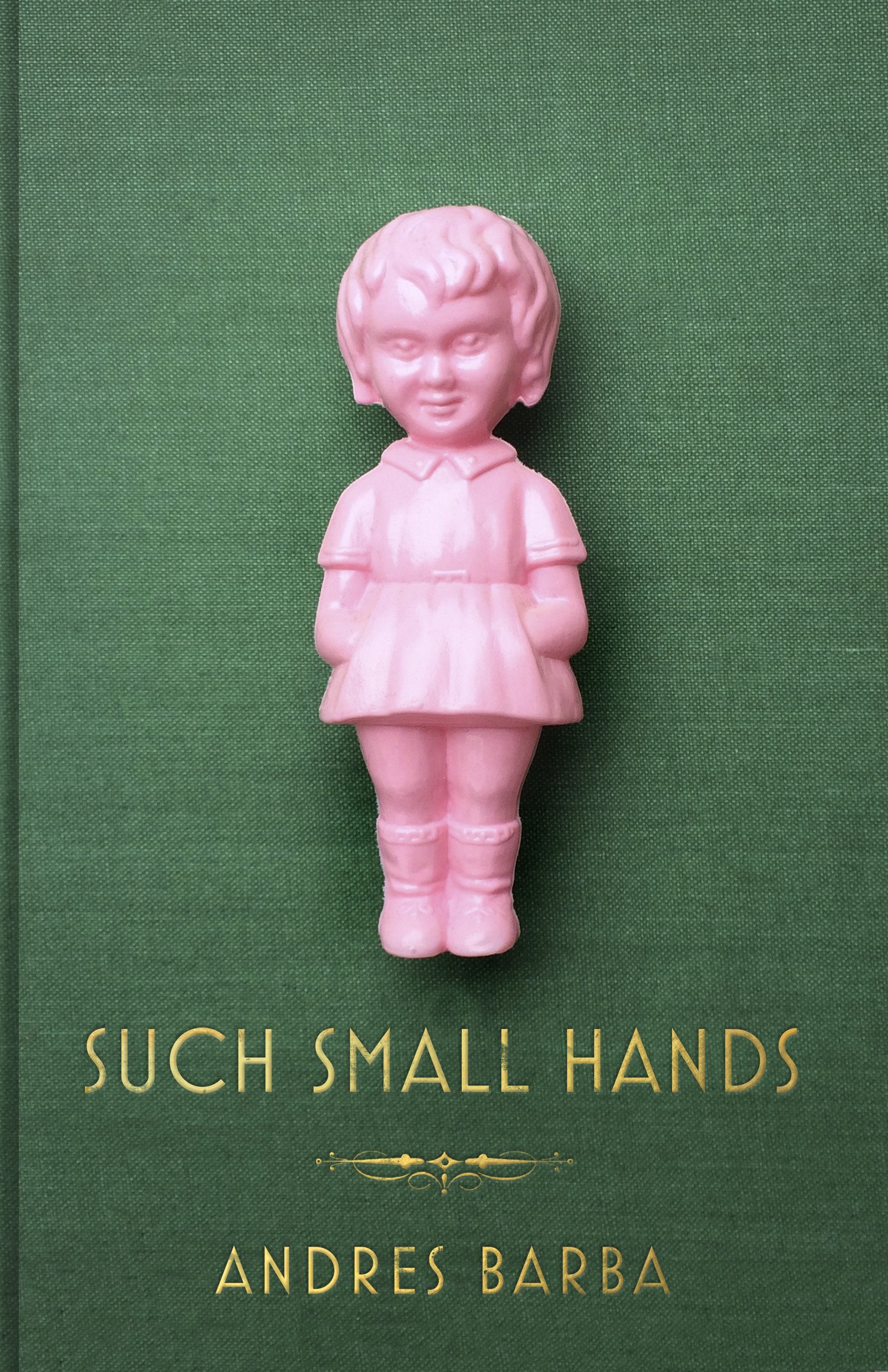
Such Small Hands – Andres Barba (trans. Lisa Dillman 2017) 101 pages
Well, this was super creepy. Institutionalised children *shudder*
Seven year old Marina is in a car accident.
“’Your father died instantly, your mother is in a coma.’ Lips pronounce them without stopping. Quick, dry words. They come in thousands of different, unpredictable ways, sometimes unbidden. Suddenly they just fall, as if onto a field. Marina’s learned to say them without sadness, like a name recited for strangers, like my name is Marina and I’m seven years old. ‘My father died instantly, my mother is in the hospital.’”
After her mother dies, Marina is sent to an orphanage, taking a doll given to her by the psychologist, which she has also called Marina. The other girls are both mesmerised and wary of Marina.
“Marina shrank and we grew. She stood alone, with her doll, by the statue of Saint Anne, watching us. Or was it the doll who was watching? We didn’t know who the doll really was. Because sometimes she looked like Marina, and she, too, seemed to have a hungry heart, and clenched fists close to her body, and she, too, was silent even when invited to join in; and she nodded her head back and forth, something we’d never seen a doll do before. And she seemed persecuted and excluded, too.”
Neither Marina or the girls understand the relationships they forge. There is fear and eroticism mixed in with tentative gestures towards friendship. Marina’s scar from the accident is a source of wonder.
“‘You can’t feel it?’
‘No. Well, only a little.’
Desire passed through the girl, too. Like stagnant water that suddenly begins to drain, imperceptibly.
And devotion mixed in with the desire.
‘Do you want to touch it?’
‘Yes.’
But the girl didn’t react right away.”
Barba gradually builds the tension and develops the girls’ games into something deeply disturbing and sinister, but wholly believable (there is an afterword which explains the real-life inspiration for the story). This tale will haunt me for a long time.
Journey into the Past – Stefan Zweig (1976 German publication; trans. Anthea Bell, 2009) 84 pages
Although I’ve since read and blogged about The Post Office Girl, this was the first Stefan Zweig I’d read and at first I wondered why everyone rated him so highly as a writer. Then I realised what he was doing in Journey into the Past was immensely clever.
It tells the story of a love affair between a student, Ludwig, and the wife of his employer, who is not named. The story begins with them on a train in the 1920s, and with Ludwig’s thoughts travelling back into the past to remember how they first met before the First World War separated them.
At first, I thought the description of the affair overblown and naïve.
“From that first meeting he had loved this woman, but passionately as his feeling surged over him, following him even into his dreams, the crucial factor that would shake him to the core was still lacking – his conscious realisation that what, denying his true feelings, he still called admiration,respect and devotion was in fact love – a burning, unbounded, absolute and passionate love.”
At this point I was thinking Zweig perhaps wasn’t for me 😉
But as the story developed – they admit their love but it remains unconsummated, he goes abroad and then war breaks out, separating them for longer than they ever anticipated – it dawned on me that this style choice was entirely deliberate and conscious. What Zweig shows us is a world before modern technological warfare, a world that was brutally torn apart. These naïve young lovers are part of a society, a life, that was utterly destroyed.
So although we know they are reunited, it is not with the same youthful self-obsession or indulgent love that they had previously.
“‘Everything is just as it used to be, don’t you think?’ she began, determined to say something innocent and casual, although her voice was husky and shook a little. However he did not echo her friendly, conversational tone, but gritted his teeth.
‘Oh yes, everything.’ Sudden inner rage forced the words abruptly and bitterly out of his mouth. ‘Everything is as it used to be except for us, except for us!’”
Journey into the Past is not a depressing book despite portraying losses that are glimpsed and barely articulated. It is about the impact of international conflict on the lives of individuals in the smallest, most profound ways. Zweig questions whether those loses can be overcome, and I still don’t know what I think.
I feel foolish for my initial impression of this novella: I hadn’t realised I was in the hands of a master.
First Love – Ivan Turgenev (1860, trans. Isiah Berlin, 1950) 106 pages
This short tale of thwarted first love, told by a man, Vladimir Petrovich, looking back on the summer of 1833 when he was 16, manages to be both moving and funny. I felt for the pain of the young boy, whilst simultaneously rolling my eyes at the self-importance of teenagers (a bit how I feel watching Romeo and Juliet these days – kids!)
A young man is on the brink of adulthood, having just said goodbye to is tutor, when Princess Zasyekin moves in next door. The princess is uncouth and her house shabby:
“She took snuff as noisily as ever, and fidgeted and turned about on her chair as much as before. It never seemed to have entered her head that she was a princess.”
However, her daughter Zinaida is beautiful and poised, and has suitors in abundance. She teases them all, keeping them in a state of anticipation whilst remaining just out of reach. The young Petrovich is no different:
“But through the tears and the melancholy, inspired by the music of the verse or the beauty of the evening, there always rose upwards, like the grasses of early spring, shoots of happy feeling, of young and surging life.”
Yet there is always the sense that things are happening with Zinaida that our protagonist is too green to recognise. She seems genuinely fond of him and at one point even tells him so after he nearly breaks his neck jumping from a high wall (told you – kids!) yet there is something worldly and slightly damaged about her which Petrovich cannot begin to understand.
“My arms were smarting from the nettles, my back ached, my head swam, but at that moment I experienced a sense of bliss such as I never again felt in the whole of my life. It flowed like a delicious pain through all my limbs and finally resolved itself in rapturous leaps and cries. Yes, indeed, I was still a child.”
First Love reminded me of The Go-Between and Great Expectations whilst being resolutely its own tale. In a short space it conveys a detailed, effective portrait of the awakening of a young person to both the love and corruption that the adult world has to offer.
The Disappearance of Signora Giulia – Piero Chiara (1970, trans. Jill Foulston 2015) 122 pages
The Disappearance of Signora Giulia was initially published in an Italian newspaper as a serial and is now available in English translation thanks to Pushkin, as part of their Vertigo imprint. It is a quick, snappy crime thriller that does not aim for trite resolution but rather an exploration beneath the surface of a life to the murky depths.
Corrado Sciancalelpre is “blessed with a special form of intuition, that peculiar mental agility that enables great policemen to delve into the minds of criminals.”
Thankfully, he is also happy married and liked in the town in northern Lombardy where he works – no tortured alcoholic with a secret past here.
A powerful lawyer, Esengrini, asks Sciancalelpre to investigate the titular vanishing of his wife. Every Thursday, Guilia has been going to Milan to visit their daughter at boarding school, but now she has failed to return and two bags of her things are missing too. Sciancalelpre agrees and what follows is essentially a police procedural, but the short length of the story ensures the pacing remains tight.
Sciancalelpre is resolutely unsentimental but not without sympathy. The more he investigates, the more he feels for the missing woman:
“He didn’t say ‘Poor Signora Giulia to Esengrini when he visited him in his office every few days towards evening. With Esengrini, he spoke only of the undeniably disappointing results of a search conducted throughout the whole of Italy with Signora Giulia’s photo.”
It’s impossible to say much more about a crime novella without including spoilers. Suffice to say there are plenty of red herrings, people and relationships who are not what they seem. The Disappearance of Signora Giulia is a diverting read, when you’re in the mood for a crime novel you’ll finish quickly. It is not a simple tale though, and the resolution is a complex one that leaves questions unanswered. This wasn’t a source of frustration but rather felt realistic.
I really enjoyed this, Chiara’s first novel to be translated into English despite his huge popularity in Italy, and I hope there will be many more translations to follow.
Cliffs – Olivier Adam (2005, trans. Sue Rose, 2009) 147 pages
Set over the course of a single night, Cliffs shows the enduring damage caused to the child – now a grown man – of a parent who dies by suicide.
The narrator is sitting on a balcony on the Normandy coast in the middle of the night, gazing at the cliffs where his mother died, while his partner and child lie sleeping in the room behind him. As he sits and smokes, he reflects on his life with his abusive father and his traumatised brother:
“We weren’t supposed to breathe move speak feel. We weren’t supposed to need anything, pocket money or comfort or affection or smiles or advice, we weren’t supposed to expect anything except the slaps, smacks or wallops he dealt out”
Later he meets other damaged souls, drawn together by a mutual recognition:
“We’ve grown up in fear of our fathers, the troubled silence of our mothers, the empty space formed by abstract, imaginary places, without edge or centre.”
Cliffs isn’t a depressing book; it is a story of survival, of endurance even when we are irrevocably damaged by experience.
“This way of life didn’t cure me of anything, it was merely possible when I couldn’t cope with any other kind of life, particularly the one I’d just left behind. It was a life of silence, space and absence, of maintaining an acute presence within objects, the shifting play of light, the still motion of water, the perfumes, the texture of the air. It was a life in which I finally found a niche, quiet but peaceful, a body filled with air and fog, a mind completely given over to the noise of the sea and the wind, the company of birds.”
Cliffs is beautifully written, but the beauty in no way detracts from the raw hurt experienced by narrator. It is an intense read, haunting and memorable.
Jamilia – Chingiz Aitmatov 96 pages (1957, tr. 2007 James Riordan although the publishers don’t say if this was from Kyrgyz or Russian – Aitmatov wrote in both)
Narrated by Seit, the brother-in-law of the beautiful titular protagonist, Jamilia is reminiscent of The Go-Between, in that it is told from the point of view of the young observer of an older person’s love affair, from a time in his life when he is looking back on his past.
Set during the war, Jamilia’s husband is away fighting. An injured soldier, Daniyar, returns to the village where he was born:
“ ‘We are content and so are the spirits of our ancestors. And now, God willing, we’ll finish off the Germans and live in peace and Daniyar will raise a family like the rest of us, his own smoke will rise from the hearth.’
By invoking Daniyar’s ancestors they were saying he was one of us. And that is how a new kinsman appeared in our village.”
Daniyar, Seit and Jamilia travel regularly by cart to take the grain from the harvest to the train station. Aitmatov writes with economy yet is able to evoke a vivid scene with few words. He captures the land of Kyrgyzstan with true sensitivity and the land is an integral part of the story:
“Eager to reach home, the horses trotted briskly, the stones scraping beneath their feet. The cool wind brought with it the bitter pollen of flowering wormwood, and the faint aroma of ripening wheat. Mingling with the smell of tar and horse sweat, it all made us faintly dizzy.”
During the journeys back and forth, the quiet, unassuming Daniyar is teased by the vivacious Jamilia and Seit. Then Daniyar starts to sing, and everything changes:
“If only I could recreate his song. It contained few words, yet even without words it revealed a great human soul. I have never heard such singing before or since. The tune was like Kirgiz or Kazakh, yet in it was something of both. His music combined the very best melodies of the two related peoples and had woven them into a single, unrepeatable song. It was a song of the mountains and the steppe, first soaring into the sky like the Kirgiz mountains, then rolling freely like the Kazakh steppe.”
What lifts this tale above the ordinary is Aitmatov’s beautiful writing, but also how the story expands a simple, almost fable-like, narrative into something broader. Jamilia is about romantic love, but told at a step removed by a man who grew up to become a painter; it also becomes about art, and the transcendental nature of love and art. Jamilia falls for Daniyar because of his voice. Seit becomes seized with a desire to create, and takes his first tentative steps towards his life’s vocation. Jamilia is about how love, in all its variety of forms and circumstance, unites us all:
“I felt it was not simply a love for another person, it was somehow an uncommon, expansive love for life and earth.”
For a while now I’ve been enamoured of the novella. I enjoy sparse writing styles (not so good at this myself 😉) and at its best a novella gives us a narrative distilled to its essence for maximum impact. To spread novella love I’ve decided to post about a novella each day for the whole month. There’s no fixed definition of a novella so for my purposes I’ve decided its longer than 70 pages and shorter than 200. This will definitely work! It won’t peter out and die in a heap by 5 May at all! Onwards…
The Game of Cards – Adolf Schroder (trans. Andrew Brown, 2008) 143 pages
The Game of Cards is not ostensibly gothic or a thriller, and yet it is both these things. The story of how student Markus Hauser is employed by Selma Bruhns for a week to put several trunks worth of letters into chronological order is truly creepy and suspense-filled.
Selma is a terse, uncommunicative employer, who lives in an old house with a vast number of cats at varying stages of disease. Markus is constantly at the point of leaving, unable to stomach the “stench” of the house, the feral occupants, his awkward employer and the seemingly pointless nature of his repetitive task:
“He squatted down between the piles of letters lying on the floor, but when her resumed his work…looking for the pile in which he was putting the letters from 1943, laying the pages of the letter on it and reaching out for the next one, he paused, as if he’d only just realised that he had absolutely no idea what he was doing”
Gradually however, Markus is drawn into the letters, all written to a woman named Almut. Very little is given away, but Markus finds himself compelled to continue, without really understanding why.
“Words from the letters that he had read came alive. He found himself in streets where he had never been, heard the shrieking and whistling of creatures that he could not see but whose presence he surmised, felt on his skin the burning sun whose strength he had never yet felt, saw a woman coming up to him who spoke in a language that he did not understand.”
This chronology is interspersed with the investigation being conducted by Superintendent Berger, who suspects Markus of having strangled Selma with her own scarf on his last day of work. Thus we are drawn into not only the mystery of who Almut is and why Selma is obsessively writing to her, but also who killed Selma and why. Schroder jumps between the two timelines without preamble and so the reader is drawn into the disorienting, imperfectly understood situation of the all the characters.
“With a sudden move that took Markus by surprise, she threw the animal towards him, it crashed into his chest, and only because Markus reacted quickly and caught the animal could he prevent I from falling onto the ground.
‘You are working slowly and without much concentration,’ said Selma Bruhns, turning round and stepping into the house.”
There is also the question of what happened – and what the stake was – in the titular match between Markus and Selma…
The Game of Cards is a deeply disturbing read, and a powerful portrait of enduring psychological trauma. It will stay with me for a long time.
This week’s theme stems from a very boring reason. But I try to pick themes that relate to my life or what’s happening in the world in some way, and my life is very boring. In fact, the most remarkable thing about it is just how dull it is. So brace yourself reader, and try & stay awake while I tell you that I am a leasehold flat owner.
I’ve always hated this because my managing agents are inept slimebags truly reprehensible human beings, but I spent an evening last week consoling a friend who is a share-of-freeholder and is engaged in a long dispute with her one of her neighbours/fellow freehold sharers, which has now turned vaguely medieval and who she refers to by a most unsavoury nickname.
If you’re still with me, you deserve a little treat. Here’s a trailer for one of my favourite ever films which is rather apt:
So as I spent a long time thinking about flats recently, the theme is novels set in apartment blocks. Firstly, Paradises by Iosi Havilio (2012, trans. Beth Fowler 2013). Apparently this is a sequel to the author’s previous novel Open Door, which I haven’t read, but it didn’t seem to restrict my understanding of Paradises, which I found compelling. Following the death of her partner, an unnamed woman leaves her country home with her small child, Simon, and moves to Buenos Aires. She gets a job at the local zoo:
“Something about the gloomy light, the small of the enclosure, the watchfulness of the snakes in captivity produces a hole in my stomach, an anguish that forces me to increase my pace. I skirt the large tank of water turtles, ignore the lizards walk past the door saying nursery and go outside.”
The janitor, Canetti, takes a shine to her. He used to be a bank treasurer before losing his job through fraud and is filled with bitterness. He shows the woman the el Buti squat, presided over by the obese, immobile, morphine-addicted Tosca. She moves in:
“And yet despite the filth, the heat, those intestinal noises, and the smell of shit that rises in waves, at some point in the early hours Canetti’s words from the first time he brought me here come to mind: We’re safe here. I even babble them to myself to confirm it. And so I relax and rest a bit, although still without sleeping. On the third day I cover the windows with black bin bags to prolong the night.”
The voice of the young woman is matter-of-fact and she presents her extreme circumstances almost indifferently (Paradises has been compared to L’Etranger). This, combined with the present-tense, captured the numbness of grief and the sense of just getting through each moment. Yet according to the introduction by Alex Clark, the narrator’s passivity and weird equanimity was present in Open Door too, so maybe it’s just her character. Either way, I found her voice distinct and engaging. We follow her through her life as she juggles motherhood, work, relationships with idiodyncratic but wholly believable characters: seemingly spiky Iris who cares for Simon; the unpredictable Eloisa who seems to have no boundaries at all and drags the narrator along with her; the various residents of el Buti.
“each of us has to devise our truth in relation to the other”
The squat is surrounded by paradise trees, whose berries are poisonous and whose bark holds the cure. This duality is repeated throughout the novel: alienation sits alongside connection, love and grief are side by side. Paradises is an unsettling novel but at no point did I feel alienated from the unusual, detached woman telling the story. A remarkable achievement.
Let’s take a Vincent Cassel break (that’s definitely a thing, isn’t it?)
Secondly, A Far Cry from Kensington by Muriel Spark (1988) is set at “14 Church End Villas, South Kensington, that rooming house, shabby but clean, that today is a smart and expensive set of flats, gutted and restructured, far beyond the means of medical students, nurses, and the likes of us as we were.”
Narrated by the young widow Mrs Hawkins, she describes her time at the rooming house in the 1950s. She moves between jobs in publishing with little respect for her employers:
“Sir Alec was thin and grey and his voice matched his looks. It sounded like a wisp of smoke wafting from some burning leaves hidden by a clump of lavender.”
“I had a sense he was offering things abominable to me, like decaffeinated coffee or coitus interruptus”
Spark’s satire of publishing and writers is a joy, but A Far Cry From Kensington is also about capturing a moment in time when society is on the cusp of change. Relationships between the sexes are changing, and Mrs Hawkins pushes against societal expectations of women in the mid-20th century. She is resentful of being characterised as a capable widow (she feels this is partly due to her size and begins determinedly losing weight).
Meanwhile, there is tension in the house as someone is sending threatening anonymous letters to Wanda, a European seamstress who rooms there. The different residents begin to suspect each other while landlady Milly is certain it’s an outsider:
“Milly was upset at the suggestion that it was someone in the house, to the point of being almost mesmerized by the idea. She also feared further letters. ‘These things happen in threes’ said Milly in her way of uttering bits of folk-wisdom; she was spooning tea into the heated teapot. She always mixed tea with maxims.”
Mrs Hawkins is a great narrator: matter-of-fact, funny, uncompromising.
“I enjoy a puritanical and moralistic nature; it is my happy element to judge between right and wrong, regardless of what I might actually do.”
The plot around the victimisation of Wanda is frankly a bit bonkers and easily the weakest point in the novel, but despite a weak plot A Far Cry From Kensington is full of Spark’s wit and razor-sharp observation. Not a word in this short novel is wasted.
To end, a video putting the brutalist architecture of the Thamesmead flats to good use:
I live on a tiny grey island. This year Spring has been even greyer than usual and it felt like winter had gone on for eleventy million years. Now the weather is overcompensating by being unseasonably warm for a few days (just in time for the London marathon – kudos to those hardy runners), and so I’ve decided to celebrate by looking at two novels set on warm islands. They are two more stops on my Around the World in 80 Books Reading challenge, hosted by Hard Book Habit, and I’m sure by the time I’ve posted this my home will be back to service-as-usual grey and we’ll all know where we stand.
Firstly, Salt by Earl Lovelace (1996), set in Trinidad where Lovelace was born and still lives. I read The Dragon Can’t Dance years ago and really liked it, but for some reason I hadn’t picked up a Lovelace since. Salt is primarily the story of Alford George, but it is also a story about Trinidad.
“Maybe that madness seized Columbus and the first set of conquerors when they land here and wanted the Carib people to believe that they was gods; but, afterwards. After they settle in the island and decide that, yes, is here we are going to live now, they begin to discover how hard it was to be gods.
The heat, the diseases, the weight of the armour they had to carry in the hot sun, the imperial poses they had to strike, the powdered wigs to wear, the churches to build, the heathen to baptise, the illiterates to educate, the animals to tame, the numerous species of plants to name, history to write, flags to plant, parades to make, the militia to assemble, letters to write home. And all around them, this rousing greenness bursting in the wet season and another quieter shade perspiring in the dry.”
Alford dreams of leaving the island and decides the way to do this is to speak ‘English’. Lovelace shows the legacy of colonialism and how the language of the colonisers is still associated with power and accomplishment.
“His thinking was in another language and he had to translate. He began to speak more and more slowly to make sure that his verbs agreed with his subjects, to cull out words of unsure origin and replace them with ones more familiarly English. Caribbean words like jook, mamaguy and obzocky all had to be substituted. He felt his meanings slipping away as he surrendered his vocabulary.”
However, as time goes on, Alford stays on the island, becomes a teacher, fights for his students rights and becomes embroiled in politics. His identity becomes more bound with contemporary Trinidad, and it’s then that he realises that emancipation has been a false promise:
“manoeuvre them into accepting not freedom but the promise of being set at liberty, with no more attention given to their years if degradation and captivity and abuse than if they had been dogs”
There is a plethora of other characters in Salt and I can barely scratch the surface here. They are drawn vividly and with affection, a cacophony of voices that pick up Lovelace’s themes of identity, home and meaning. They exist within a beautifully evoked Trinidad whereby Lovelace is able to explore his weighty themes without becoming overly didactic.
This post is ridiculously long and I don’t have time to explore Salt properly, but I did just want to mention this beautiful portrait of the elderly Miss May:
“And with the laborious delicacy choreographed by her pains eased herself down unto the step where the sun was brightest and rested there, her eyes shut, her breath inhaled, the metronome of her mind keeping time to the rhythm of her distress, trying to find within the music of her pain a space in which to breathe.”
I think that’s a stunning piece of writing. Lovelace writes with clarity and a unique voice, and he has important things to say:
“The tragedy of our time is to have lost the ability to feel loss, the inability of power to rise to its responsibility for human decency.”
Secondly, By Night the Mountain Burns by Juan Tomas Avila Laurel (2008, trans. Jethro Soutar 2014) who is from Equatorial Guinea, and whose parents are from Annobon Island. The island in the novel is unnamed but shares a location and a history of Spanish colonialism with Annobon.
“We were on our own out in the middle of the Atlantic Ocean. People had given up hope of the boat ever coming back – the boat from the place where our fathers were.”
The narrator recounts his experience of childhood on the island. He lives with his silent, remote grandfather.
“I can’t say for sure whether my grandfather was or wasn’t mad. I saw him through a child’s eyes and through such eyes it’s impossible to tell whether an adult man, who lives in your house and who you’ve been told is your grandfather, is mad or not.”
“The house was close to the beach. And not any old beach either but the big village beach. Yet despite being so close to the shore, grandfather had built the house with its back to the sea…everything faced the mountain.”
Women on the island own the land, while the men undertake the fishing. Things are not easy on the island – there is poverty at times, white people arrive and trade sex with women for cigarettes and kerosene – but things deteriorate significantly during the period the narrator is recalling. There is a bush fire, then cholera wipes out a huge proportion of the population, and there is a horribly violent instance of scapegoating.
“Today, looking back, I see, or understand, that the incident and the cholera were part of the same sickness. And the cure for that sickness was beyond the reach of our adults for it was a sickness that was greater than them, and so it was able to dominate them. And on that island out in the middle of the Atlantic Ocean, nasty episodes unfortunately had to be explained somehow; something to satisfy people’s need for a cause.”
The island may be out in the middle of the Atlantic Ocean, and the faith of the people may be a mix of their traditional beliefs and Catholicism, but I felt what the narrator is speaking about was far from remote from me as a UK-based reader:
“For I know now that all people are not treated equally when it comes to apportioning blame for bad things that happen in communities. I know that, in this world of ours, how facts are judged depends on who’s doing the judging.”
I’m making this novel sound depressing, and it isn’t. The point of view of a child enables the story to be told but with a degree of distance that enables the reader to keep reading. This is not to suggest that Laurel obfuscates or pulls his punches. The brutal scapegoating is repeatedly returned to and described in detail. It is horrific. The repetitions of the story enable it to effectively capture the sense of reminiscences, and also how defining moments are those we return to time and again, informing our understanding of the past and who we are.
Towards the end we learn how this story is embedded within colonialism, and how what we are reading exists within this history. The narrator learned Spanish at school, a language that existed detached from meaning for him:
“We learned everything by heart, and I think that’s why we did it singing. In fact, although we sometimes saw books with the letters and pictures, I didn’t know that amapola, burro, cochino and dado were Spanish words for poppy, donkey, hog and dice, or that poppy, donkey, hog and dice were things we were supposed to have heard of. I didn’t know what any of them were, so I didn’t know the words were supposed to represent the letters and I didn’t associate the letters with the pictures in the books.”
As a result of this, he is able to tell his story to Spanish-speaking researchers who have come to the island:
“If this story becomes known, it will be because of some white people.”
Laurel writes with unrelenting power in beautiful prose about huge issues: society, colonialism, legacy, blame, belief. His writing is stunning and his anger palpable without overwhelming the narrative. Another great edition from And Other Stories, who are rapidly becoming one of my favourite publishers.
I’m managing to squeeze in one final post for German Literature month, hosted by Caroline and Lizzy. Hopefully next year I’ll be better organised and able to participate some more, but for now I’m off to Austria, which is also another stop on my Around the World in 80 Books Reading Challenge, hosted by Hard Book Habit. Do join in with GLM next year or AW80Books, they’re great ways to read some wonderful books 😊
Firstly, The Post Office Girl by Stefan Zweig (trans. Joel Rotenberg 2008) which was found amongst his papers after he killed himself in 1942. This is a melancholy tale of the impact of war on individuals, in this instance the First World War. Christine is a titular provincial civil servant, who finds herself in her late twenties having only known penny-pinching and drudgery.
“The war stole her decade of youth. She has no courage, no strength left even for happiness.”
Christine is plucked out of her ordinary life by her aunt who is visiting the Swiss Alps. She invites Christine to stay and the naïve woman is enraptured by the whirlwind of new clothes, fine dining and bright young things of which she is suddenly in the midst.
“All the world’s sweetness might be in this one thin straw of scalding ice. Heart thumping, fingers trembling avidly, she looks about for someone or something to receive her overflowing gratitude.”
Christine is transformed from a drudge into a beautiful young woman that people want to be with.
“In this instant, shaken to her very depths, this ecstatic human being has a first inkling that the soul is made of stuff so mysteriously elastic that a single event can make it big enough to contain the infinite.”
Then, just as suddenly, it is all taken away. Back in her small Austrian town she finds herself unable to cope with the poverty of the people, her home and her job. She meets Ferdinand, a soldier whose war wound means he is unable to continue his work as an architect. He is cynical of governments and bitter regarding his experience:
“In our Tartar village we didn’t know if Vienna was part of Bohemia, or maybe Italy. And we didn’t give a damn. All we cared about was stuffing a crust of bread down our throats and getting the lice out of our hair and finding some matches or tobacco sometime in the next five hours.”
For Christine, this man is soulmate, but these two souls are so damaged, so hurt and isolated, that they can only offer one another the bleakest kind of companionship.
“Christine was taken aback. The man beside her had said just what she’d been thinking all this time; he’d expressed clearly what she’d dully felt – the wish to be given one’s due, not to take anything from anyone, but to have some kind of life, not to be left out in the cold forever while others were warm inside.”
Zweig is unblinking in his portrayals of people, showing them with all their flaws, vanities and foibles, but still with great compassion. You feel for the characters precisely because they are so believably imperfect. The tyranny they face from the ruling class – either elected or via money – is presented as inescapable. The Post Office Girl is a novel about desperation, and how financial poverty can wear people down to a poverty of spirit. It is beautifully written and absolutely devastating.
In the Afterword of my edition William Deresiewicz suggests the novel is unfinished. I’m not sure I agree. I don’t know enough about Zweig’s style to argue my point forcefully, but to me, the ending occurs exactly where it should. It is perfect: sad but defiant, with so much unknown.
Secondly, The Piano Teacher by Elfriede Jelinek (1983, trans. Joachim Neugroschel 1988). Marina Sofia reviewed Jelinek’s volume of 3 plays In den Alpen for German Lit Month, do read her fascinating post which explains how controversial the author is in Austria due to her critique of Austrian society. The Piano Teacher was the first of her novels to be translated into English and it was also adapted into a film in 2001, starring the wonderful Isabel Huppert and directed by Michael Haneke. I haven’t seen it but it looks a faithful adaptation:
I found The Piano Teacher an incredibly tough read. Jelinek does not pull her punches in any way. This tale of Erika, a woman living in a claustrophobic, abusive relationship with her mother, and her masochistic sexual desires seeking expression with one of her pupils is really hard going.
“They are enclosed together in a bell jar: Erika, her fine protective hulls, her mama.”
Jelinek creates the cruel, affectionate relationship between mother and daughter brilliantly. They are bound together in bitterness and a warped love.
“The daughter is the mother’s idol, and Mother demands only a tiny tribute: Erika’s life.”
Erika’s relationship with her mother and the abuse she suffers, and enacts, feeds into her sexual preferences, reminding me of The Blue Room. She is repressed (she shares a bed with her mother), and this expresses itself through the violence she metes out to her unsuspecting fellow commuters, and in one horrible instance, a pupil she is jealous of. She is a voyeur and attends peepshows and stalks couples in the park, but is incapable of becoming sexually aroused by what she witnesses. When a student, Klemmer, expresses an interest in her, the two begin a clumsy, stunted affair. It is no great love story:
“Klemmer is still concerned about that damned aged difference. However, he is a man, and that easily makes up for the ten years Erika has over him. Furthermore, female value decreases with increasing years and increasing intelligence. The technician in Klemmer computes all this data, and the bottom line of calculations reveals that Erika still has a wee bit of time before wandering into the tomb.”
The Piano Teacher is brutal. Jelinek’s imagery is disturbing, particularly around the sexual or body parts [the next quote is an example of this, don’t read if you think it will upset you, but I wanted to give a clear idea of a recurring theme in the novel]:
“Rot between her legs, an unfeeling soft mass. Decay, putrescent lumps of organic material. No spring breezes awaken anything. It is a dull pile of petty wishes and mediocre desires, afraid of coming true. Her two chosen mates will encompass her by crab claws: Mother and Klemmer.”
I was relieved to get to the end of The Piano Teacher, I don’t think I could have taken much more. Jelinek is a brilliant writer: her pacing and plotting are perfect and she has powerful things to say about the psychological warfare we wage on ourselves and others. But now I have to go and find a nice Golden Age crime novel with which to recover….
Regular readers will know that I do like to end on an 80s pop video and will shoehorn them into a post wherever possible. I’m delighted that my trip to Austria means I can end on this:









 madame bibi lophile recommends