“Make your mistakes, next year and forever.” (Neil Gaiman)

Happy New Year!  I’ve quoted the lovely Neil Gaiman to start off 2014, and do please check out the full context of the quote here, as I’m sure it will get your year off to a flying start.  Here’s to many more mistakes in 2014!

And now, I’d like to entirely ignore New Year.  This is a blog post for my brother.  His birthday is 1 January, and it’s a crap time to have a birthday.  It gets entirely subsumed in Christmas and New Year, and once you’re no longer a child, everyone you know spends your birthday with a monster hangover.  Rubbish.

Like Neil Gaiman, my brother is a lovely man, who despite reading very little fiction always reads my blog posts and likes them on Facebook.  That’s who we’re dealing with, people.  So what to write about? Well, he likes poetry and I think he has a really good feel for it, an innate understanding.  So this post will look at two poems that I think he’ll appreciate. This is for you, T.  Entirely for you with no thematic link to New Year at all.  Happy Birthday, brother of mine.

Image

(Image from: http://hdwallpaperspictures.com/birthday-cake/)

Firstly, The Door by Miroslav Holub (trans. from Czech by Ian Milner).  You can hear Joseph Fiennes read the whole poem here. This is a hugely clever poem, disguised in simple language.  The poet repeatedly urges the reader to “Go and open the door”, and speculates as to what is on the other side.  The first stanza is:

Go and open the door.

Maybe outside there’s

a tree, or a wood,

a garden,

or a magic city.

This is a poem you can read to a child: the idea and language is so simple, they will quickly relate to the opportunity to let their imagination run riot.  Yet it works on a variety of levels that adults can appreciate, and can be about the search for inspiration; the courage to take new, unexplored paths in life:

Go and open the door,

If there’s a fog

it will clear.

Go and open the door.

Even if there’s only

the darkness ticking,

even if there’s only

the hollow wind,

even if

nothing

is there,

go and open the door.

The images of “darkness ticking” and “hollow wind” are eerie, and add an unsettling quality to the poem.  They bring a sense of form to the formless, effectively creating how the unknown can still be scary. However, this door and what lays beyond is not entirely unknown; I think one of the really clever things about this poem is that the door is a definite article: “the door”, not the indefinite “a door”.  It’s a small thing, but by suggesting the door is specific one, Holub delicately reminds us that this door to new ideas and new ways of living is within reach, already identified, carried within ourselves.  And if nothing else, the final lines remind us:

At least

there’ll be

a draught.

A lovely, humorously deprecating end to an unpretentious poem that can follow you through life.

Secondly, A Glimpse of Starlings by Brendan Kennelly. You can read the full poem here.   This is an astonishing and powerful poem, full of intriguing imagery. It begins:

I expect him any minute now although

He’s dead. I know he has been talking

All night  to his own dead…

It’s not clear who “he” is, or if he is really dead, or only living among the dead.  Googling this poem tells you it is about the poet’s father, struggling to deal with the loss of his wife.   The struggle is beautifully and tenderly evoked through a variety of images:

Sipping a cup of tea, fingering a bit of bread,

Eating a small photograph with his eyes.

The questions bang and rattle in his head


[…]Daylight is as hard to swallow as food

Love is a crumb all of him hungers for.

How gorgeous, and heartbreaking, are those lines?  The frequent use of full-stops keeps the pace of the poem low-key and quiet, creating a sense of the poet’s careful approach towards the grieving man.  The transfer of images between food and the environment “eating a small photograph”, daylight being “hard to swallow”, skilfully shows how the sustenance of a man’s life has disappeared, affecting everything.  The hungering for a crumb of love is a beautiful way of evoking the yearning emptiness of grief that can never be sated.

The image of starlings is created in the last few lines:

…over his shoulder a glimpse of starlings

Suddenly lifted over field, road and river

Like a fist of black dust pitched in the wind.

This is an oblique image so I’ll leave it with you to find your own meaning.  I find this poem extremely powerful and the images truly haunting.

To end, here is a video of the astonishing display of a murmuration of starlings:

I hope you liked them, T. Have a great day one and all!

“Autumn is a second spring when every leaf is a flower.” (Albert Camus)

Despite it being unseasonably warm here in London right now, the nights are drawing in and today I stepped on a conker, so I’ve decided officially that autumn is here.  I love autumn: the colours of the trees, the crispness of the air, the crispness of the apples…

Usually I try and make my choices not too obvious, but I’m going totally obvious with my first choice this week, Keats’ Ode to Autumn (1819).  You can read the whole poem here.  It begins with one of the most famous lines in English literature:

Season of mists and mellow fruitfulness, 
        [… ]to load and bless
        With fruit the vines that round the thatch-eves run;
    To bend with apples the moss’d cottage-trees,
        And fill all fruit with ripeness to the core;
          To swell the gourd, and plump the hazel shells
        With a sweet kernel…

I’ve mentioned before that I’m not a really a fan of the Romantics, and while this is an idealised, bucolic portrait of autumn, the beauty of the writing is undeniable. I love the fecund imagery: loading, bending, filling, swelling, plumping.  It gives a dynamism to the imagery but also a heady sense of autumnal bounty.  Keats builds on this headiness in the next stanza, personifying autumn as a soporific state:

 Thy hair soft-lifted by the winnowing wind;
  Or on a half-reap’d furrow sound asleep,
      Drows’d with the fume of poppies,

[…]by a cyder-press, with patient look,
          Thou watchest the last oozings hours by hours.

This is such a brilliant piece of writing, I feel quite sleepy just reading it.  “soft-lifted”, “drows’d” and “oozing” layer dreamy, slow motion action to great effect.  In the next stanza this motion is slowed down further, as autumn moves into winter, effectively dying:
   

Hedge-crickets sing; and now with treble soft

      The red-breast whistles from a garden-croft;
          And gathering swallows twitter in the skies.

The sound of the grasshoppers (“hedge-crickets”), robins and swallows heralding the coming winter is in keeping with the gentle imagery that has gone before, and creates an effective sense of how the death of a season is a slow fade, not a sudden change.  Keats takes us through the whole season, and while he may present an autumn that doesn’t really exist, it is still immediately recogniseable.  And it makes me want to drink scrumpy…

For my second choice I thought I’d choose a book based around academia, as for lots of people this is what the change in season at this time of year symbolises.  On Beauty by Zadie Smith (Penguin, 2005) is set in a fictional New England university town, Wellington. It follows two families, the Belsey’s and the Kipps, and their impact on each other’s lives, in a loose reworking of Howard’s End by EM Forster. Howard Belsey is a liberal art history professor, his nemesis the conservative Sir Monty Kipps.  When Sir Monty is given a visiting post at Wellington, the two families collide; the wives becoming friends, the children already romantically intertwined.  I’ll be honest, I didn’t much rate Smith’s first novel, the much-hyped White Teeth, but by On Beauty (despite the verging-on-pretentious title) she’s really getting into her stride.  She captures perfectly the pragmatism that constantly invades the high-minded idealism of academia:

“by next Tuesday these kids would have already sifted through the academic wares on display in the form of courses across the Humanities Faculty, and performed a comparative assessment in their own minds, drawing on multiple variables including the relative academic fame of the professor; his previous publications up to that point; his intellectual kudos; the uses of his class; whether his class really meant anything to their permanent records or their grad school potential; the likelihood of the professor in question having any real-world power that might translate into an actual capacity to write that letter that would effectively place them – three years from now – on an internship at the New Yorker or in the Pentagon or in Clinton’s Harlem offices or at French Vogue…”

However, the novel is not just a satire on academia.  Smith uses the setting to consider themes of identity, race, art, aging, love, all bound together by a strong intellect and comic sensibility:

“At this distance, walking past them all, thus itemizing them, not having to talk to any of them, flaneur Howard was able to the love them and, more than this, to feel himself, in his own romantic fashion, to be one of them.  We scum, we happy scum! From people like this he had come. To people like this he would always belong.  It was an ancestry he referred to proudly at Marxist conferences and in print; it was a communion he occasionally felt on the streets of New York and in the urban outskirts of Paris.  For the most part, however, Howard liked to keep his ‘working class roots’ where they flourished best: in his imagination.”

As Howard’s life unravels around him, the various members of the two families are each going on their own journeys towards realising who they are and who they will become. On Beauty is a big novel that considers big themes, I hope Smith’s observation of “a sprinkle of mirthless intellectual laughter, the kind one hears at bookshop readings” is not a proleptic reference to the reception the novel received – I somehow doubt it.

Just a little footnote point of interest: On Beauty is a family affair, with Smith’s husband, Nick Laird, providing the poetry, her brother Doc Brown, MCing a spoken word night some characters attend, and Smith herself appearing briefly as a “feckless novelist on a visiting fellowship”. For intelligent rap/comedy with something to say, I highly recommend Doc Brown’s YouTube channel.

To end, here is a photo that ties the two together, New England in autumn:

Image

(Photo credit: http://www.boston.com/travel/explorene/specials/foliage/galleries/reader_fall_photos/ )


“My books are like water; those of the great geniuses are wine. Fortunately everybody drinks water.” (Mark Twain)

Today is National Poetry Day, and the theme is Water.  I’ve chosen two contemporary poets who wrote on this theme (one poem and one collection of poems).  Mainly because I really like both the poets and they were who immediately sprang to mind, and also because I felt a bit bad about getting all Renaissance on your asses in my previous post.  Twentieth/twenty-first century language only this week, I promise!

Firstly, “Swimming to the Water Table”, from Neil Rollinson’s first collection A Spillage of Mercury (Cape Poetry, 1996).  Rollinson is famed for his unashamedly sexual poetry, but the theme of this poem couldn’t be more different.  “Swimming to the Water Table” deals with the modern day echoes of the Moors Murders.  I’m not sure how well-known these brutal, tragic events are outside Britain, so if you don’t know, there’s a link to the Wikipedia page here.  This is not a pleasant subject matter, but I think Rollinson treats it with sensitivity.  If you’d rather not approach such things, do give it a miss and scroll down to my second choice of poems.  The poem begins:

“After hours of silence and the velvet

of peat cloughs, the road

from Manchester cuts the moor

like an act of violence.”

I think this is hugely clever.  Rollinson is not going to write about the murders themselves – that would be hideous and entirely inappropriate.  Instead he creates the bleak, eerie atmosphere on the moor where the children are buried, and a sense of attack.  The noise of the main road, the assault on the person and senses, the sudden impact of it, manages to evoke the violence without in any way glamorising it.  The sound of the language, with the hard ‘c’ of “cuts” and “acts” creates for the reader the same sense of jolting into harshness that the speaker has experienced with the road, as we are forced away from the softness of “velvet” and “peat”.

The speaker is told where he is and reminded of what has taken place there:

“…I can picture

the gaunt, blonde murderess, smoking

a cigarette, watching the road,

Brady unrolling the carpets, cracking

puns with every strike of the spade.”

Again, I think Rollinson is so skilled here at evoking without explicitly detailing:  the shocking indifference of Hindley as she smokes and watches elsewhere,  the “cracking” and “striking” of Brady, enactor of the most sickening violence imaginable.  Rollinson is not shying away from what they did, and the verbs in this passage do not allow the reader to shy away either.  At the same time, we’re not in the midst of the brutal acts themselves; this is all we need, gory details would be sensationalist and intrusive. 

So where is the water?  In these final lines:

“…The bleached

rib of an animal curls from the ground

like the heart of a flayed orchid.

Under my feet, the bodies of children

swim to the clear, sweet water table.”

I find this ending incredibly powerful.  The animal rib shows the death that surrounds the moor, and a strange beauty that exists in the place – a flayed orchid is such an oddly violent, unsettling image.  The idea of the bodies in the water table is both haunting and deeply upsetting, but at the same time, by having them swimming, not floating, the children are granted an independent agency. I think Rollinson uses the water imagery to reclaim for the children something they were denied in life: a final peace and tranquillity.

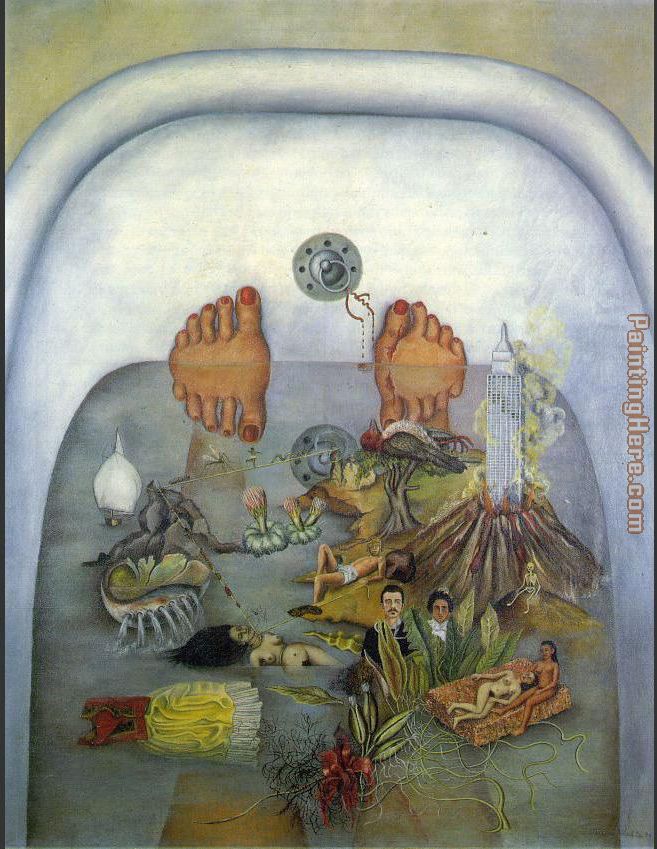
Secondly, a whole collection with a recurring theme of water, What the Water Gave Me: Poems After Frida Kahlo by Pascale Petit (Seren Books, 2010).  For this collection, Petit took on the voice of the artist Frida Kahlo, and created poems around her paintings.  There are six poems throughout the collection named “What the Water Gave Me”. The painting by Kahlo of this title looks like this:

Image

(Image from:  http://www.paintinghere.org/painting/what_the_water_gave_me-7293.html)

In “What the Water Gave Me IV” Petit layers image upon image to capture the multitude of scenes in the picture; it is 34 lines long but only one sentence.  It begins:

“The bath I lie in like a sarcophagus,

the water that’s about to become kerosene

the surface I have to keep absolutely still

so my body can slip through it

like a reflection passing out of a mirror”

You can have a look at the picture and see what you think Petit is doing here, I don’t want to kill the poem by insisting the meaning I see is absolute.  But I will say I think she captures the surrealism of Kahlo’s pictures with the notion of kerosene and the escaping reflection, and the odd, visceral yet detached relationship Kahlo has with her body.  The kerosene also moves towards the underlying violence in Kahlo’s work.  When she was 18 Kahlo had a severe accident when she was travelling on a bus.  The severity of her injuries left her in agonising pain her entire life:

“the ulcers and craters, the giant

one- legged quetzal pierced by a tree,

my toes and their doubles, their blood-red nails,

the ex-votos to give thanks for surviving

twenty-two fractures, the miniature parents

on their atoll far off as my thigh,

the Empire State Building spewing gangrene

over my shin, that no perfume can mask

so no-one will visit

the life led dying”

I think Petit does a great job of capturing one form in another here, giving words to visual art.  The shortening of the last two lines creates an emphasis to demonstrate the impact on the person of all the extreme imagery, and I think they are lines of real pathos.  The layering of image upon image without a break creates a momentum that drives towards the final line:

“a steel handrail breaks off and hurtles towards me.”

This effectively evokes how for Kahlo, the accident is lived over and over, forever in the present tense.  Its repercussions sent ripples through her entire life, and the impact of that steel handrail was devastating: it pierced through her abdomen and womb, meaning that although she wanted children, she could never carry one full term.  As she lies in the bath, as she lives her life, she lives the accident.

You can read some more examples of the poetry in the collection on Petit’s website, here.

Well, this wasn’t the most cheery subject matter, but I think both the poets are huge talents and their poetry is really powerful, so I hope this post wasn’t too depressing!  Do check out their other poems/collections, they’re well worth a look.

Here are the poems with a glass of water (sorry to be so prosaic, but hey, it represents the theme, right?)

Image

“Procrastinate now, don’t put it off.” (Ellen DeGeneres)

The Guardian newspaper has a series it runs on Saturdays, called The Q&A, short interviews with celebrities.  One of the regular questions is: “What is the trait you most deplore in yourself?”  I don’t even have to pause for thought to answer this one.  Having lived with myself all these years there are plenty of things I deplore in myself, but far and away is my enormous capacity for procrastination.  Since I’ve started this blog, my procrastination has developed two-fold: I use the blog to procrastinate from whatever else I’m meant to be doing, and the blog also provides something else I procrastinate over.  Let’s just say there’s some reading for next term not getting done right now, and certain members of my household facilitate my procrastination by indulging their favourite pastime of sitting on my laptop – how can I possibly work in these conditions?

Image

If you are fellow procrastinator, take heart from the fact that you are in great company.  Famous procrastinators include Leonardo da Vinci, Douglas Adams, Franz Kafka and Samuel Taylor Coleridge. The last of these is who I turn to now, with The Rime of the Ancient Mariner.  You can read the full poem here. This famous long poem tells the story of a mariner cursed after he shoots an albatross that had brought a warm wind to his ship:

And I had done a hellish thing,

And it would work ’em woe:

For all averred, I had killed the bird

That made the breeze to blow.

Ah wretch! said they, the bird to slay,

That made the breeze to blow!

As a result of his actions, he has to wear the albatross around his neck (hence the phrase for a guilty burden) and the ship is taken into new waters by vengeful spirits where the crew begin to die.

Day after day, day after day,

We stuck, nor breath nor motion;

As idle as a painted ship

Upon a painted ocean.


Water, water, every where,

And all the boards did shrink;

Water, water, every where,

Nor any drop to drink.


The very deep did rot: O Christ!

That ever this should be!

Yea, slimy things did crawl with legs

Upon the slimy sea.


About, about, in reel and rout

The death-fires danced at night;

The water, like a witch’s oils,

Burnt green, and blue and white.

As these lines show, there is an eerie, hallucinatory quality to the imagery that really evokes a feeling of desolation and disquiet on a vast expanse of ocean. The atmosphere of the poem is deeply unsettling.

When the mariner begins to appreciate the natural life around him, he prays, and the albatross falls from his neck, lifting the curse.

Beyond the shadow of the ship,

I watched the water-snakes:

They moved in tracks of shining white,

And when they reared, the elfish light

Fell off in hoary flakes.


Within the shadow of the ship

I watched their rich attire:

Blue, glossy green, and velvet black,

They coiled and swam; and every track

Was a flash of golden fire.


O happy living things! no tongue

Their beauty might declare:

A spring of love gushed from my heart,

And I blessèd them unaware:

Sure my kind saint took pity on me,

And I blessed them unaware.


The self-same moment I could pray;

And from my neck so free

The Albatross fell off, and sank

Like lead into the sea.

However, the Mariner is left to wander the earth, telling his story. It is not a comfortable resolution, and apparently Coleridge was in some sort of spiritual crisis when he wrote this poem.  But although it’s an uncomfortable read, it’s also Coleridge at his best, and the imagery is beautiful and arresting.  Definitely worth a read, and as a procrastination tool it should use up about an hour.

Secondly, back to the twenty-first century with Where’d You Go, Bernadette by Maria Semple. Semple used to write for various television shows, including one of my all-time favourites, Arrested Development, so I approached this novel with high hopes.  I wasn’t let down.   The novel is funny, but not at the expense of the characters.  Semple manages to create people you really care about, even as you laugh at their foibles and delusions.  I chose it for this post because Bernadette is an architect who hasn’t created anything in years.  The novel is told from the point of view of her adoring 15-year-old daughter Bee, but also multiple viewpoints as we read letters, emails, notes and even a transcript of a TED talk.  Bernadette lives with her husband and daughter in a crumbling building:

“All day and night it cracks and groans, like it’s trying to get comfortable but can’t, which I’m sure has everything to do with the huge amount of water it absorbs any time it rains.  It’s happened before that a door all of a sudden won’t open because the house has settled around it.”

“I knew our blackberry vines were buckling the library floor and causing weird lumps in the carpet and shattering basement windows. But I had a smile on my face, because while I slept, there was a force protecting me.”

Bernadette hates living in Seattle, “this Canada-close sinkhole they call the Emerald city”.  She responds with antagonism bordering on aggression to the parents at Bee’s school who try and get her involved in the “community”.  Then one day she disappears.  As Bee tries to put together what’s happened and find her idiosyncratic, forceful mother, the various characters emerge through Bee’s impression of them and their own words in the various transcripts that make up the novel. They are all flawed, funny, recognisable and likeable.  Even the character I most wanted to throttle redeemed herself in the end.

Although it’s Bee looking for her mother, the title is Where’d You Go, Bernadette, not Where’d You Go, Mom.  Ultimately the novel is about Bernadette’s search for herself, because, as a friend of hers points out: “If you don’t create, Bernadette, you will become a menace to society”.  And funny though Bernadette’s menace is, you’re rooting for this eccentric and engaging character to find her way back to working again. Where’d You Go, Bernadette is a reassuring, feel-good novel about how we’re all trying to get through life and not lose ourselves along the way.

Normally I end with a photo of the books, but I thought it was apt to the theme of procrastination not to get round to it.  Instead here is Tim from The Office exploring his favourite way to procrastinate, by torturing Gareth:

“Walk on air against your better judgement.” (Seamus Heaney, Nobel Lecture, 1995)

I wasn’t planning on posting this week, as I have two exams on Thursday, and despite the fact that I am a major procrastinator I’m really trying to revise.  (And keep getting distracted by episodes of Cake Boss, of which there seem to be approximately twenty million.  If I end up answering a question with the phrase “Byron is prime example of poetry in the Hoboken style, baby!” I have only myself to blame.  A little in-joke there for anyone else who follows this extraordinary bake-fest.)

Anyway, I wanted to post to commemorate the work of Seamus Heaney, whose death was announced today.  This is a sad loss to the contemporary poetry scene.  Heaney was as extraordinarily sensitive poet, dedicated to his craft, alive to all the possibilities of language.  To see him interviewed was the opportunity to listen to someone intelligent, unpretentious and engaging.

I’ve picked two of his poems pretty much at random.  He was a prolific writer so even if you don’t think much of my choices do check him out, there’s bound to be something for you.

Firstly, Blackberry Picking.  I chose this poem because I’m pretty sure this was the first Heaney poem I ever read, at school.  My English teacher was a massive Ted Hughes fan, so Heaney (contemporary and friend of Hughes) wasn’t too much of a leap.  You can view the whole poem here.  I’m just going to look at the first ten lines, and then the end line.

Late August, given heavy rain and sun
for a full week, the blackberries would ripen.
At first, just one, a glossy purple clot
among others, red, green, hard as a knot.
You ate that first one and its flesh was sweet
like thickened wine: summer’s blood was in it
leaving stains upon the tongue and lust for
picking. Then red ones inked up and that hunger
sent us out with milk-cans, pea-tins, jam-pots
where briars scratched and wet grass bleached our boots.

I love his imagery here.  I grew up with blackberries at the bottom of my garden and to me this vividly evokes that memory, but also his use of language is so accessible.  Sometimes contemporary poetry (or any poetry) can seem so impenetrable.  Heaney is great communicator, and I think this poem is easy to understand.  That’s not to say it’s simple – there’s a violence to this childhood memory, created through the visceral imagery (clot/flesh/blood/lust/scratched) that unnerves me, and stops it being a straightforward nostalgia trip.   Heaney’s last lines are often powerful and punchy endings.  In Blackberry Picking it’s this:

Each year I hoped they’d keep, knew they would not.

I think this is so simple and beautiful.  It succinctly captures the sadness that tinges childhood memories, and the way we learn that the world is not always as we want it to be, or something we can control. I don’t want to go on too much because I think poetry is an intensely personal experience, and everyone sees and gains different things from it.  I hope its enough of a taster to encourage you to check out the full poem.

Secondly, Two Lorries.  This is quite a famous poem of Heaney’s, from his Whitbread Award winning collection The Spirit Level, published the year after he won the Nobel Prize.  I chose it because there’s a recording of Heaney reading the poem available online, here.  What better way to experience the poem? This is one of the poems where Heaney looks at the Troubles that have been the enduring political experience of his country in his lifetime.  Here are the first two stanzas:

It’s raining on black coal and warm wet ashes.
There are tyre-marks in the yard, Agnew’s old lorry
Has all its cribs down and Agnew the coalman
With his Belfast accent’s sweet-talking my mother.
Would she ever go to a film in Magherafelt?
But it’s raining and he still has half the load

To deliver farther on. This time the lode
Our coal came from was silk-black, so the ashes
Will be the silkiest white. The Magherafelt
(Via Toomebridge) bus goes by. The half-stripped lorry
With its emptied, folded coal-bags moves my mother:
The tasty ways of a leather-aproned coalman!

This shows Heaney’s great skill at capturing life experience: the voices of his mother and the coalman are so clear and direct, despite being indirectly quoted.  Once again, I find his imagery so beautiful, and disturbing.  The idea that the coal turns from one extreme to the other (silk-black to silkiest white) is an image that has so much to say, and the extremity is evoked within a resolutely domestic scene gives it an extended context that makes it personal and political.  The second lorry of the title is the one that blows up the bus station in Magherafelt.  Here’s the end of the poem:

So tally bags and sweet-talk darkness, coalman,
Listen to the rain spit in new ashes

As you heft a load of dust that was Magherafelt,
Then reappear from your lorry as my mother’s
Dreamboat coalman filmed in silk-white ashes.

I’ve said before that I find it hard to write about things I really love.  This is one of those times.  The end of that poem is incredibly powerful and moving, I think I’ll just let it speak for itself.

Seamus Heaney 1939-2013.

Seamus Heaney

Image taken from: http://www.laobserved.com/archive/2013/08/seamus_heaney_nobel_prize.php

“And once he had got really drunk on wine, Then he would speak no language but Latin.” (Chaucer)

This post has been subject to a radical redraft.  I sat next to a monumentally annoying mother (not my own) on the train and came back and wrote an extremely ranty few paragraphs.  If I give you the first few lines, you’ll get the general idea:

Are you an aspirational, pretentious, and over-compensating parent?  Did you give up your career to raise children, and subsequently treat your offspring as a project management opportunity?  Did your own life lack meaning, and so you decided to add to our vastly over-populated planet through your own woefully mediocre gene pool?  Then this post is for you!

Oh dear. I promise I’m not a really horrible person.  I was driven temporarily insane by spending 20 minutes sat next to this woman.  I’ve decided to stick with the book recommendations I was going to make, but keep this post mercifully short so I don’t expose what a nasty, judgemental person I am any more than necessary.

Here are a couple of ideas for stories that kids might like which may not be the first to spring to mind.  They’re also established classics so if you are a certain sort of art-enforcing parent (a clue as to where my first draft rant continued to) you can gain kudos amongst your peers as you sit in your planet murdering off-road vehicles waiting for the Sushi-Making for the Under 5’s class to end (sorry, sorry, I promise I’ll stick to books from now on).

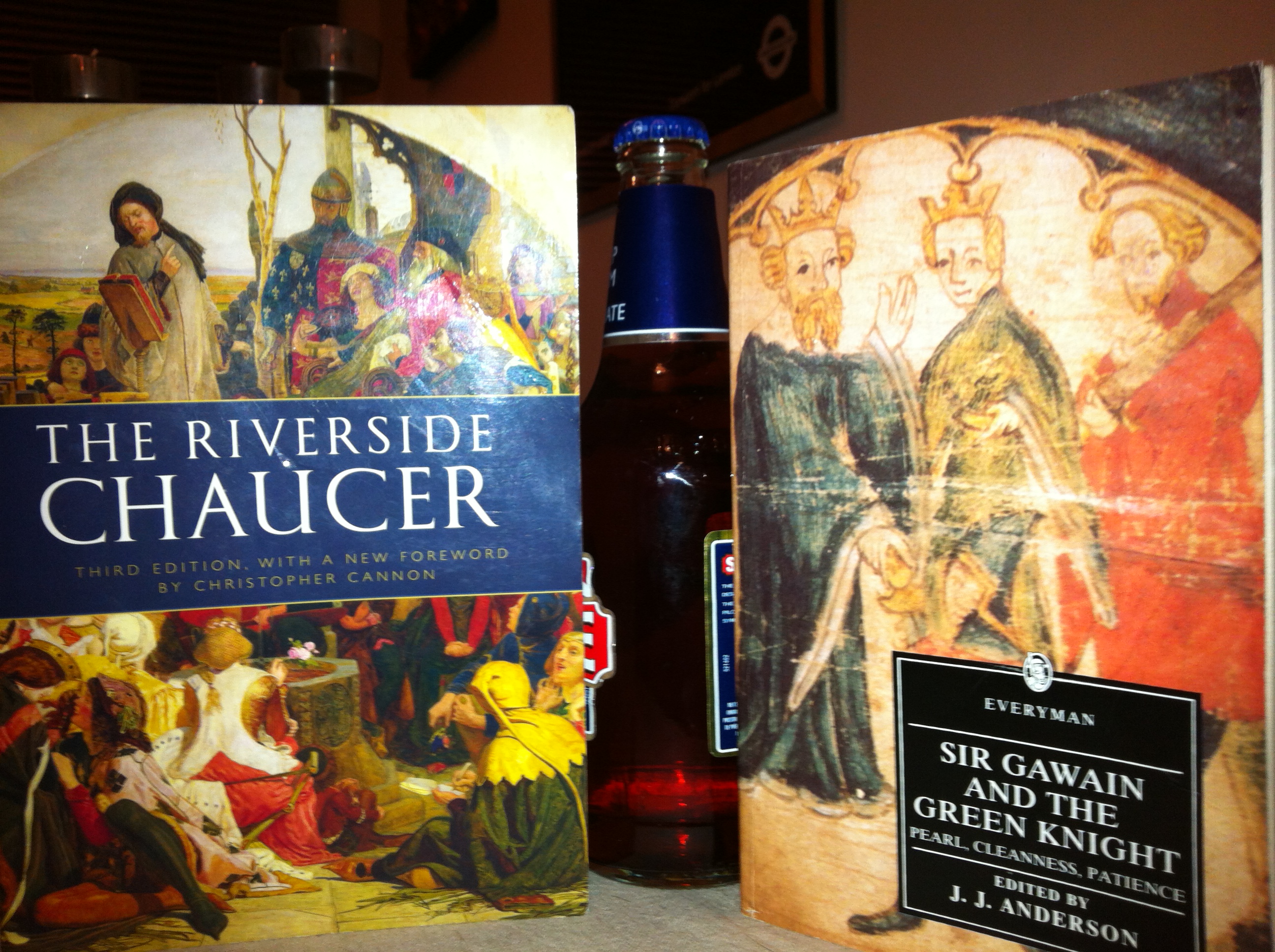
Firstly, Chaucer’s The Miller’s Tale.  Stay with me here, I’m not suggesting you get your child grappling with Middle English while they’re still learning to read and write the contemporary version.  Either do your own version or read it in translation (you’ll want to check it first, Chaucer can be pretty saucy). An older man marries a younger woman (it may be over 600 years old but will still offer your child an insight into contemporary celebrity culture) who then shags a younger model behind his back (obviously this is a point you may wish to gloss over with your young charges).  Meanwhile, a delicate type also has designs on our earthy young heroine.  Well, she is gorgeous: “fair was this yonge wyf, and therwithal/As any wezele hir body gent (delicate) and small”. Er….thanks Chaucer.  Every woman wants to think she has a body as good as any weasel.  For his troubles, the delicate suitor gets not one, but two bottoms shoved in his face.  Firstly he kisses his beloved’s “naked ers/ful savourly” whereupon he feels “a thyng al rough and long yherd (haired)” – apparently this comely lass really does have a body like a weasel, including a hairy backside.  Away runs our young suitor, only to return for her lover to “leet fle a fart/As greet as it had been a thunder-dent” in his face, for which the farter gets a red-hot poker shoved up his rectum in retribution.  Tell me what child isn’t going to love this?  Hairy arses being kissed, farting, and pokers up the bum.  There’s a reason Chaucer is proclaimed the greatest English poet.

Secondly, Sir Gawain and the Green Knight.  Seriously, Middle English literature is the place to go to, trust me.  If your child likes Merlin, they’ll love this.  If you’re one of those parents who doesn’t let their child watch TV, well, first off, stop that.  Stop it before they hate you forever.  But after that, even they don’t watch Merlin, they’ll still love it.  King Arthur has knight arrive in court  during Christmas celebrations (like the “family friends” you avoid all year but at the first sniff of turkey you’re exchanging recycled chocolate/soap gifts and making small talk over mulled wine, desperately wishing all the alcohol hadn’t evaporated so you could numb yourself to the whole stultifying experience.  Or is that just me?)  Unlike my unwelcome guests, he is a humongous green giant (no, not that one, although I suspect you still wouldn’t like him when he’s angry.  No, not the  maize-pimping one either.)  This one is a bit of snappy dresser, albeit like many fashion-types he sticks to a limited colour palette – I think you can guess which colour.  He wears a close fitting coat, an ermine trimmed cloak (how Dr Zhivago) green tights (men seemed to have abandoned that look for some reason) and gold spurs – quite some bling there.  What’s more, when Gawain (he’s the one in Merlin who always looks like he’s filming a shampoo commercial in between Round Table duties – and that’s not a criticism) chops his head off he recovers with apparent ease: smooooth.   He then challenges Gawain to the sort of endeavour that knights seem to get up to on a regular basis, in other words, it involves honour, a journey, and doesn’t exactly make a lot of sense.  At the end of it all it turns out Morgan Le Fay (Morgana in Merlin) was behind the shenanigans, as she normally is, the cheeky minx.  Everything works out in the end and happiness reigns, as well as King Arthur.  I haven’t quoted any of it here as the Middle English variant used is much harder to pick up than Chaucer, but it’s a ripping yarn and definitely worth looking out for in translation.

Happy reading!  I was going to illustrate this with a picture of the books in a playground, but my local one is always busy and I was concerned one of the feral youths would knife me if I delayed their turn on the swings (rather aptly for this post, some parts of south London really are quite medieval) so instead I’ve taken a photo of them with some Kentish ale, because firstly, I didn’t have any mead, and secondly, the pilgrims in The Canterbury Tales were on their way to, well, I think you know.  And the Miller was drunk so he probably would have partaken of a Kentish ale or ten at some point.

“When a man is tired of London, he is tired of life” (Samuel Johnson)

So, to start I thought I’d look at my home city.  I am Londoner born and bred – that’s the truth, people.  Sometime in the last few years perceptions of London seem to have got confused with those of LA, and taxi drivers don’t believe any one is born here, they only move here.  Tedious conversations regarding my birthplace are the price I pay for one the best things about London: the constant ebb and flow of people from just about everywhere. Anyone of these people who live in London will tell you that this great city (for great it is, far from perfect, but still great, like Battersea Power Station) suffers in its portrayals.  Actually that’s not true.  I suspect a lot of Londoners haven’t given a second thought as to how their city is portrayed.  They don’t give a shit.  And that, that is what makes them Londoners.  How I miss it when I’m away.

I digress…. as I was failing to say, rarely am I presented with a London I recognise (Michael Winterbottom’s Wonderland aside, which I truly recognised, given that it was partly shot in my local supermarket.  Don’t let that banal detail put you off, it’s a very good film, you should watch it). Yet there are a few examples of London literature that Madam Bibi recommends.

Firstly, The Room of Lost Things, by Stella Duffy (Virago, 2008).  Robert teaches Akeel the ropes of the dry cleaning business in Loughborough Junction.  Over a cup of tea they shake hands in contract: “They hardly know each other.  It’s a beginning.”  This beginning leads to a delicate, unspoken understanding between two very different characters. The men are the protagonists of the novel, but South London is the hero.

“Robert hears a shout from below and turns round to look back up Coldharbour Lane to where Dan is whooping and Charlie grinning from their perch on his old settee, the one he dragged out two nights ago. They lift their Special Brew cans like hand weights and belch belly laughs as one after the other, and slowly, half a dozen crates of carefully stacked tomatoes and red peppers and potatoes fall from their perfect positioning outside the halal shop and flow into the road, a guilty skateboarder racing off, the mix of brown and clashing reds running into the gutter.”

Beautiful, right?  And so completely London. Stella Duffy looks at people and the city with an entirely unsentimental eye, and yet still shows the beauty that exists in places where it’s not usually looked for or expected.

As a proud south Londoner (we are a beleaguered people, yet secure in the knowledge that the great advantage of our part of the city is a distinct lack of smug north Londoners) it pleased me to see the bus I caught to work for 4 years on the cover of this artfully written, closely observed novel.  The 345 even has a supporting role in the story.  If you want to know the breadth of South London (and why wouldn’t you?) catch this bus for the duration of its route.  From the sterile squares of South Ken to the not-so-sterile streets of Peckham, it’s a most unlikely journey.  One time I caught the 345 at a bus stop littered with a lobster carcass, and I got off at a bus stop littered with chicken bones.  I’ll leave it to you to guess which direction I was travelling in. Back to The Room of Lost Things: “A regular river crossing is the gift of South London.”

Secondly, the poetry of Tobias Hill. If you find contemporary poetry off-putting but fancy giving it a chance, there are worse places to start than this accessible poet who looks unflinchingly at the isolation that exists within the crowds of cities, and casts a unique perspective through inventive language.  In his second volume Midnight in the City of Clocks (Oxford University Press, 1996) there are poems about Japanese cities and Rio as well as London.  For Zoo (Oxford University Press, 1996), Tobias Hill was the inaugural Poet for Zoos, and writes about London Zoo in particular. Nocturne in Chrome and Sunset Yellow (Salt, 2006, 2007) is his most recent collection and includes A Year in London, with a poem for each month.  Here is the first stanza of November:

London – there’s a rhythm to the name,

its ending an echo of its beginning,

as if London were the name of somewhere

full to the brim with its own echoes.”

This is what Tobias Hill does so well – points out something you can’t believe you hadn’t noticed before, and makes the wholly familiar newly unsettling.

Finally, James Boswell’s London Journal (Penguin).  Unlike my previous examples, I can’t claim for the veracity of the portrayal of London, seeing as how it was written in 1762-3. What I can vouch for is that it’s a brilliantly entertaining read.  James Boswell is 22, arriving in London for the second time in his life, and completely in love with the city and all it offers.  He evokes London in vivid detail: the people in high society, the prostitutes in the parks, chestnut sellers, his nights at the opera and theatre, visits to exhibitions, and his restaurant meals.

“The conversation was on indifferent common topics.  The Peace.  Lord Bute. Footmen & Cookery. I went to Douglasse’s & drank tea. I next went & called in Southampton Street Strand, for Miss Sally Forrester my first love.  Who lived at the blue Periwig.  I found that the People of the house were broke & dead & could hear nothing of her.  I also called for Miss Jenny Wells in Barrack Street Soho, and found that she was fled and they knew not whither & had been ruined with extravagance.”

It’s unintentionally funny; Boswell wants to be so much better than he is, and that remains timeless.  “Since my being honoured with the friendship of Mr Johnson [Samuel, who provided the title of this entry], I have more seriously considered the dutys of Morality and Religion, and the dignity of Human Nature.  I have considered that promiscuous concubinage is certainly wrong…. Notwithstanding of these Reflections, I have stooped to mean profligacy even yesterday.”

Oh James, we’ve all been there, led astray by the city.  I haven’t slept with a prostitute in ages (that’s a joke, promise), but my own internal struggle is usually along the following lines: “I need to lose weight.  I’m going on a diet…. But if God wanted me to be thinner, he wouldn’t have invented cheese…..or wine……or France……or Europe….or the Middle East.  I’m hungry. That’s it, I’m off to Edgware Road.”  Damn you, Edgware Road.

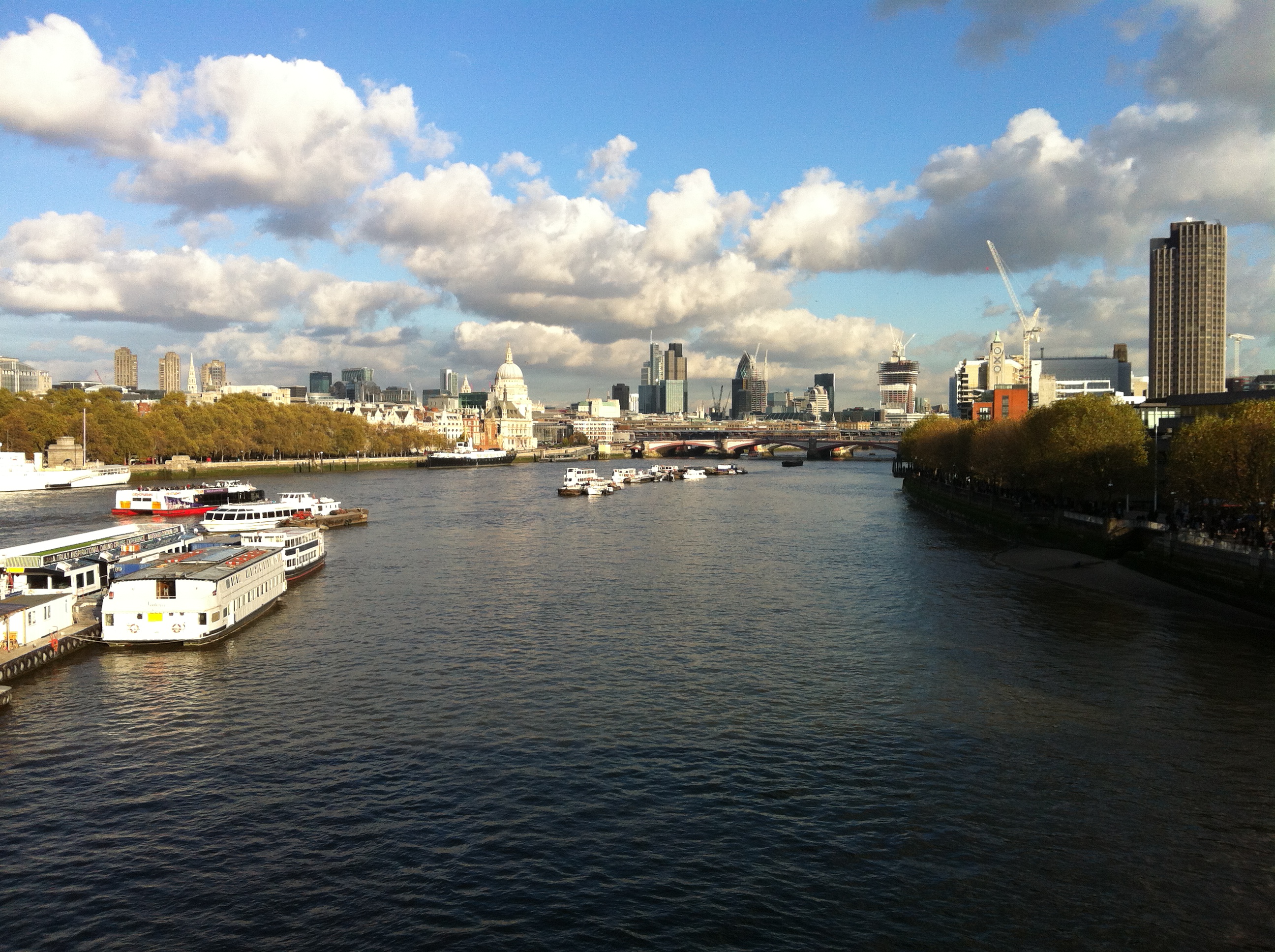
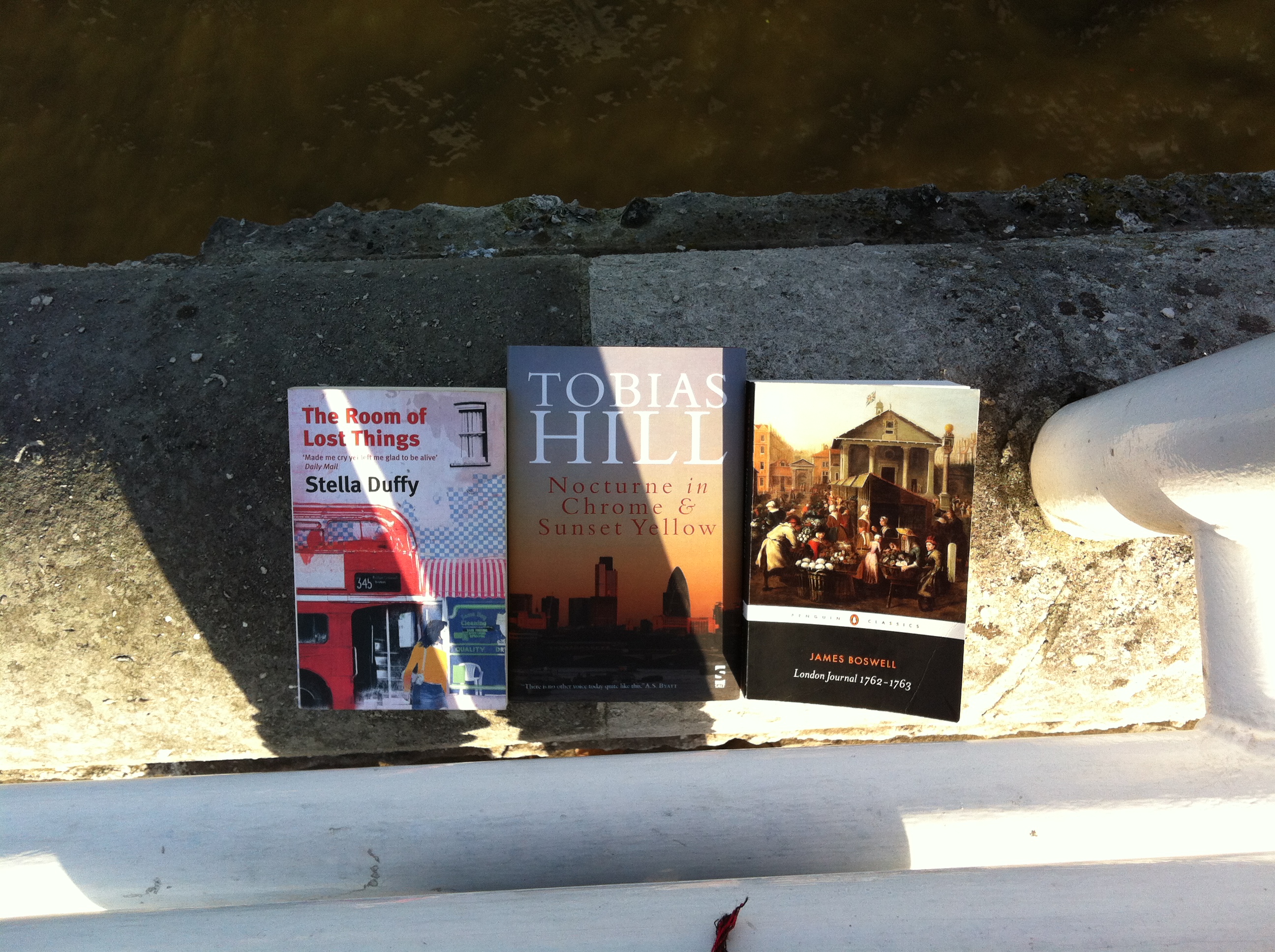
And so to finish, I choose neither North nor South London, but directly in between, and one of the greatest ground level (OK, slightly elevated, otherwise you’d get wet) views you can find in the city –immortalised by Ray Davies for a reason.  Here are my books on Waterloo Bridge. (We caught the 345 to Battersea Bridge and walked east along the river to get there).  I had hoped to capture the books in front of the view (that would have made a decent photo), but I couldn’t work out how to do this safely – leaping into the Thames in a failed rescue attempt of my rapidly disappearing books would not impress the river police, I fear.  So instead a poor photo of the view, and a picture of my books precariously balanced on the bridge, much to the bemusement of the Scandinavian tourists just out of shot, who watched my every move without offering to help.  Maybe they thought it was a weird English thing, which I suppose it sort of was.   I hope they enjoyed their trip to London, and that they read a book that captures the atmosphere for them as they remember it.

Image

Image

Maybe if you squint, turn your head sideways and jiggle the screen a little, you’ll get the photo I was aiming for….