It’s November, so ‘tis the season of many wonderful reading events. Margaret Atwood Reading Month is being hosted by Buried in Print; What’s Nonfiction is hosting Nonfiction November; AusReading Month is being hosted by Brona at This Reading Life. I’m hoping to join in with them all, but I doubt I’ll be able to because my reading and blog writing is still positively sloth-like.
However, with this post I’m managing to contribute to Novellas in November, hosted by Cathy at 746 Books and BookishBeck; and German Literature Month, hosted by Lizzy Siddal, and Caroline at Beauty is a Sleeping Cat. And I’m only cheating slightly by counting the same book for both 😀
Week 1 for German Literature Month is focussed on writing from or set in Austria, so I’ve picked two novels by Austrian authors who have also set their stories in Austria.

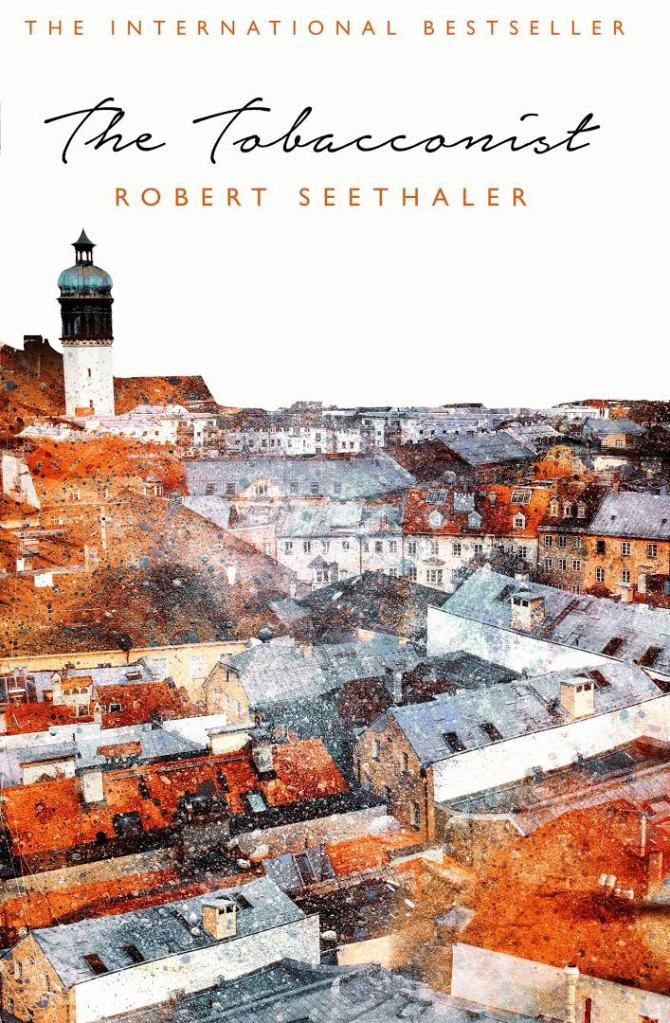
Firstly, The Tobacconist by Robert Seethaler (2012, trans. Charlotte Collins 2016) which at 234 pages is a short novel but a wee bit long to count for #NovNov. Set in 1937, teenage Franz leaves his lakeside home for the hustle and bustle of Vienna:
“the noise – there was an incessant roaring in the air, an incomprehensible jumble of sounds, tones and rhythms that peeled away, flowed into each other, drowned each other out, shouted, bellowed over each other. And the light. Everywhere a flickering, a sparkling, flashing and shining: windows, mirrors, advertising signs, flagpoles, belt buckles, spectacle lenses.”
He has a job as an assistant to old friend of his mother’s, working in the tobacconist’s shop. His boss Otto is non-smoker with a rather unique approach to his job:
“Reading newspapers was the only important, the only meaningful and relevant part of being a tobacconist; furthermore if you didn’t read newspapers it meant the you weren’t a tobacconist”
Despite this unpromising start, Franz’s horizons begin to widen. The newspapers give him a burgeoning political awareness, and the vibrant city offers opportunities for romance. Even the shop stock suggests vistas unknown:
“Each brand had its own particular smell, yet they all had this in common: they bore within them the aroma of a world beyond the tobacconist’s, Währingerstrasse, the city of Vienna, beyond even this country and the whole wide continent.”
Franz is a sweet and endearing character, but not sentimentalised or idealised. His earnestness and energy can be somewhat tiresome, if entirely believable. He even tests the patience of his most famous customer:
“Freud sighed. For a fraction of a second he considered yielding to the sense of anger that was welling up deep inside, and stubbing out his Hoyo on the brow of this impertinent country lad. He decided against it and puffed smoke rings into the air instead.”
I’m not usually a fan of fictionalised real people, but the friendship between the eminent psychoanalyst and the young Franz is subtly evoked and not remotely heavy-handed. Seethaler doesn’t try and shoehorn in loads of Freudian references to demonstrate how much research he’s done; Freud is shown as an aging man and very vulnerable as a Jewish person amongst the escalating political situation in Austria.
“the colossal difference between their ages automatically established the distance Freud found agreeable and which was, indeed, the thing that made close contact with the majority of his fellow humans tolerable”
The focus is primarily on Franz as he ricochets around the city, falling in and out of love, writing to his mother and growing up, all while Nazism tightens its hold. The insidious nature of this is brilliantly done through incidental details:
“In front of the town hall, children and youths were gathering in small groups. They were hanging around on corners, standing arm in arm, blocking the pavements or running across the square, laughing and shouting, waving hats and swastika flags.”
Until suddenly it’s not incidental anymore. Violence explodes, Franz has to deal with the Gestapo, people disappear, and Freud is persuaded to leave his home forever…
The Tobacconist is a tragedy that never portrays itself as such. It tells a deeply ordinary story – despite the famous person in its midst – and uses the reader’s knowledge of history to fill in the gaps. It’s a brilliant technique, because it takes a protagonist we all recognise, having all been teenagers discovering a wider world at some point, and places him inescapably within the brutality of a genocide, making historical events resonate on a personal level.
There is an ambiguity to the ending of The Tobacconist which rather than being frustrating I thought entirely apt. Under a brutal regime, so often people have to live with not knowing.
“For it was well known that waiting and seeing was always the best, perhaps even the only way to let various troubles of the times flow past and leave you unscathed.“
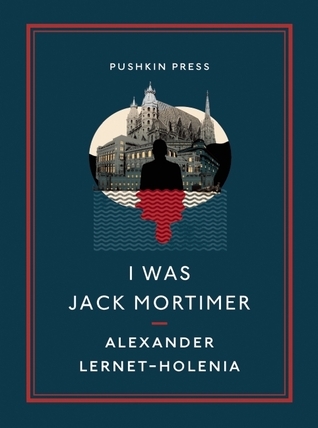
Secondly, I Was Jack Mortimer by Alexander Lernet-Holenia, (1933, trans. Ignat Avsey 2013) which in my Pushkin Press edition is 203 pages but they are not standard size, and when it was published in a Pushkin Vertigo edition it was 160 pages, so counts for Novellas in November – hooray!

A disclaimer to start, because although I enjoyed I Was Jack Mortimer a great deal, I thought the fundamental premise was completely silly.
Spooner is a young cab driver who at the start of the novel is stalking a young woman – so far, so yuck. Then a man gets into his cab, but by the end of the journey the passenger has been shot dead, without Spooner hearing or seeing a single thing.
“Spooner stood in the middle of the room, and the events of the past minutes raced through his mind, like short, randomly edited film clips; the dead man, the speeding cars, the news stand, the dead man, the carriageway, the blood, the dead man, the streets, the dead man.”
What would you do? I think almost entirely everyone would go to the police. But this wouldn’t make much of a thriller, as the police would take the story out of your hands and you’d have to go back to smoking with the other cabbies, boring them with the story, and being creepy towards women.
So instead, for reasons best known to himself, Spooner disposes of the body and starts to inveigle himself into the man’s life.
“he was pretty sure that as soon as the crime was discovered it’d be put at his door, so that in the end he began to feel as though he had in fact perpetrated it himself. And had he really been the murderer, in all probability he wouldn’t have been behaving any differently from the way he was now.”
I Was Jack Mortimer is a really enjoyable thriller, if you can get past the unbelievable set-up of Spooner’s decision-making. I just put that element to one side and allowed the pacy writing to carry me along as Spooner gets increasingly out of his depth. The 1930s and the city of Vienna are beautifully evoked with a wonderful sense of time and place.
The trouble with writing about thrillers is that you can say practically nothing for fear of spoilers. What I will say is that towards the end Spooner has the following epiphany:
“All I needed to do was go to the police and report I had a dead person in the car and didn’t know who shot him, and in the end they’d have had to believe me and I’d have been released. Instead, I’ve done just the opposite and have landed myself in no end of a mess.”
Well, quite.
“One doesn’t step into anyone’s life, not even a dead man’s, without having to live it to the end.”
To end, I tried to find a trailer for one of the film adaptations of I Was Jack Mortimer, but failed. So instead a chance for me to totally indulge myself with the trailer for my most favouritest-ever film, which is set in post-war Vienna:

 madame bibi lophile recommends