“All of my close friends are emotional train wrecks.” (Patrick de Witt)

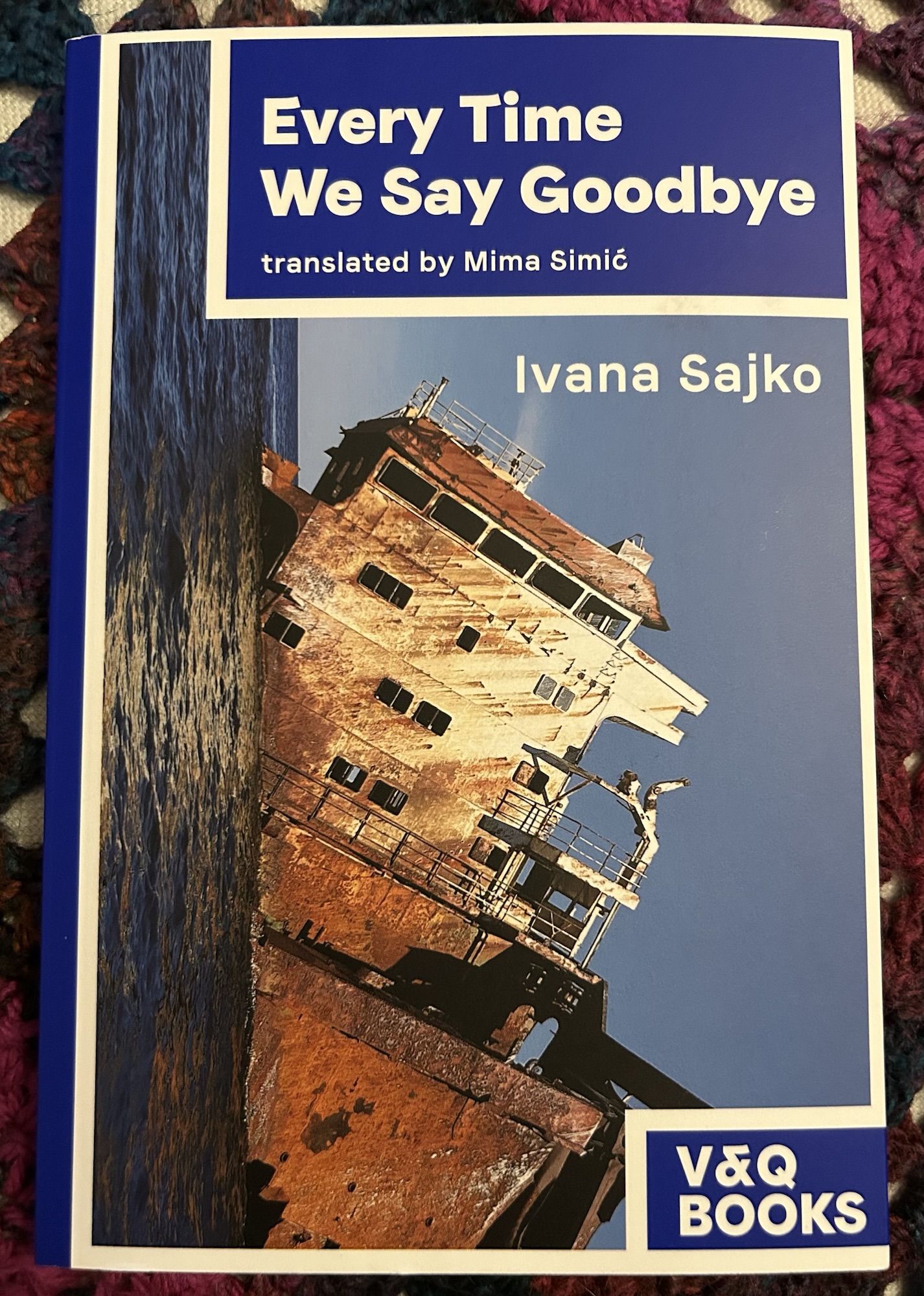
I don’t get many books sent to me by publishers, but I was really pleased to be offered Every Time We Say Goodbye from V&Q Books who specialise in writing from Germany. Ivana Sajko was born in Zagreb and her translator Mima Simić is Croatian, they both now live in Berlin. Back in 2023 I read Love Story from the same author, translator and publisher and found it powerful and unflinching.

With everything that’s been going on for me with work it’s taken me some time to get to it, but at 118 pages it’s a perfect Novellas in November read, hosted by Cathy and Bookish Beck.

A writer leaves his partner to catch a train from south-east Europe through to Berlin.

“Leaving nothing behind but the story of a man travelling through Europe hit by another crisis, boarding a train convinced that it doesn’t really matter why he’s leaving, as he has no reason to stay, the story of a man sinking into his notebook, grasping mid-descent at his messy notes, each of them opening a new abyss beckoning another fall, a man who still cannot bring himself to open the flat box of photographs from his mother’s drawer,”

Each short chapter is a single sentence, and while I know this sounds off-putting, I thought it worked brilliantly. The long, weaving sentences broken by commas perfectly captured the sense of memories surfacing back and forth against the physical rhythm of the train journey.

The narrator is not particularly likable but he is recognisable and believable. As he considers how his relationship failed and looks back on his life so far, his experiences are inextricably bound to the time and geography he lives within.

“Everyone left because they had to: my mother, my father, my brother, and all these goodbyes weren’t dramatic gestures but quiet moments of stepping onto a train or a bus, followed by long rides in uncomfortable seats with stiff legs, full bladders, a restless heart and the anticipation of the final stop, which meant a new beginning and facing expectations”

Twenty-first century Europe is shown as a place of dislocation, whether through wars, socio-economic pressures, or pandemics. The impossibility of the personal and political being distinct from one another is variously explored. The writer’s depression is at least partly due to what he witnessed as a journalist:

“I lay on the ground at Tovarnik station amid garbage and people now grown in distinguishable, on the filthy platform strewn with large stones, under the European Union flag that flapped ironically next to a border crossing sign that read ‘Croatia’ and ‘EU’”

And I particularly liked this observation about how international covid restrictions made explicit the shortcomings in his and his mother’s relationship:

“The plague was our internal standard, and now that it had also driven the rest of the world apart, our few metres gap became the global standard, the plague revealed the fatality of the smallest gestures and the significance of shortest distances, a single step towards or away from a person could help or harm them; gestures we’d used to hurt each other suddenly became protective, so we didn’t really need to make an effort to adopt the new regulations”

Grounded as it is the events and establishments of the day, Every Time We Say Goodbye still remains a slippery narrative, questioning the subjectivity and reliability of memory and how we understand our experiences:

“I’d like to write about him making faces and winking at me across the table, but none of that is true, I remember none of it, my brother has no face at all, he has no smile, no voice, no drops of sweat glisten on his skin, no scabs on his knees, he has no clear outline, there are no concrete details to him, every time I look in his direction, all I can see is a murky silhouette of a boy, he’s too far away”

There is a lot packed into this slim novella. It is undoubtedly a commentary on contemporary Europe; but it also portrays the inadequacy of human communication and understanding, and how this can wreak damage in our closest and most intimate relationships. Trauma is visited on large and small scales.

Not an easy read, but one I am glad to have read for its brave choices in style and subject matter. If, like me, you enjoy a Translator’s Note, there is a really interesting one from Mima Simić included.

To end, of course I was going to go with the obvious choice, an absolute classic:

Murder Tide – Stella Blómkvist (transl. Quentin Bates) Blog Tour

Today I’m taking part in a blog tour for Corylus Books, a lovely indie publisher with a focus on translated crime fiction.

Murder Tide (2017, transl. Quentin Bates 2024) is the third Stella Blómkvist mystery I’ve read as part of Corylus’ blog tours and I enjoyed reacquainting myself with her world: her daughter Sóley Árdís; the deepening relationship with Rannveig; her cousin Sissi; newshound Máki; and of course her antagonistic relationship with the local police.

Here is the blurb from Corylus Books:

“Left to drown by the rising tide at the dock by Reykjavík’s Grótta lighthouse, the ruthless businessman with a murky history of his own had always had a talent for making enemies.

The police have their suspect – who calls in Stella Blómkvist to fight his corner as he furiously protests his innocence. Yet this angry fisherman had every reason to bear the dead man a grudge.

It’s a busy summer for razor-tongued, no-nonsense lawyer Stella. A young woman looking for a long-lost parent finds more than she bargained for. An old adversary calls from prison, looking for Stella to   broker a dangerous deal with the police to put one of the city’s untouchable crime lords behind bars at long last.

Is the mysterious medium right, warning that deep waters are waiting to drag Stella into the depths?”

Murder Tide is grounded in the realities of Iceland in 2011. Grímúlfur, the murdered man, was nicknamed the ‘Quota King’ and made a lot of money out of Iceland’s financial crash in 2008. People who took out enormous foreign currency loans had to hand over their businesses to the banks, who then sold on the loans to their cronies who had the loans written off. Grímúlfur was one of the cronies and he bought fishing quota rights too.

“‘The quota system has split the country for the last two decades, as it has provided a chosen few with great wealth just as it has wrecked many rural communities and added to the inequality and injustice in Icelandic society,’ Máki writes.”

Stella’s client is a fisherman who suffered under this system, and she soon finds out that as well as the many who Grímúlfur ripped off, his family bear him some pretty significant grudges too.

At the same time she is helping a young woman called Úlfhildur find her birth father, who unfortunately for Úlfhildur seems to be a truly sinister man married to a threatening woman, who together run a cult.

Her third client is the decidedly dodgy Sævar whose case highlights police corruption and reinforces Stella’s cynical world view:

“Bitter experience has taught me that there’s nobody in this world who can be trusted. It’s all about uncertainty and coincidence.”

The three strands in Murder Tide are woven together well and even my poor brain managed to keep track of what was happening. The societal commentary felt intrinsic to the plot rather than slowing it down, and I whizzed through this pacy story.

Stella felt more likable in this book and the habit she has of referring to brand names and labouring over material possessions has eased off a bit. She’s leading a slightly more settled life as she and Rannveig continue the relationship which began in Murder Under the Midnight Sun. But Stella’s domestic life is generally in the background, as she tears around working just as hard as ever.

She really does need to stop sexually assaulting people though. This time it was for a different reason than her own gratification, but for a character who is supposed to follow her own moral compass in opposition to self-serving businessmen and corrupt police officers, I would really welcome her incorporating informed consent into her world view.

However, this isn’t a significant part of Murder Tide so please don’t be put off! What worked especially well was the menace of characters and genuine sense of danger, alongside humour. Chapters frequently end with a quote from Stella’s mother, a woman who seems to have had an aphorism for every occasion, ranging from the insightful to the clichéd, the incomprehensible to the remarkably plain-speaking. These really made me smile and kept the character of Stella grounded in a more recognisable reality, while she rode motorbikes at speed, visited career criminals in prisons and exposed corruption with the help of Sissi’s technical expertise.

The tone is also carefully balanced. There were some very dark aspects to Murder Tide, and Blómkvist is expert at conveying these clearly, without ever being gratuitous or voyeuristically gruesome.

As always with Stella’s stories, the pace and plotting worked seamlessly. But what I especially enjoyed in Murder Tide was the deepening characterisation of Stella, and I’m looking forward to seeing where she goes next.

Here are the stops from the rest of the tour, so do check out how other bloggers got on with Murder Tide:

Novella a Day in May 2025: No.28

The Lady and the Little Fox Fur – Violette Leduc (1965, transl. Derek Coltman 1967) 80 pages

I found this novella, only slightly longer than a short story, incredibly moving. It follows the daily life of a frail, impoverished woman, living in a dilapidated attic room in Paris which shakes every few minutes when the Métro passes overhead.

Violette Leduc is not an author I know, but in the Introduction to my edition Deborah Levy describes her novels as “works of genius and also a bit peculiar.” Certainly Leduc has a way of skipping between images and realities that continually pulled me up short. Despite its brevity The Lady and the Little Fox Fur can’t be read quickly; the sentences have to be considered.

“Her coat was turning green with age. So much the better: it was a proof that her verdigris candlesticks in the pawn shop had not abandoned her. When the sun came out, there were two torches to light her way, the sun itself and its reflection in the window of Joris’, the shop that accepted la Semeuse coupons.”

That strange logic about the candlesticks demonstrates the frayed reasoning of The Lady, but also Leduc’s skill in layering images to evoke scenes and draw elements of her story together so clearly.

Her stylistic skill never distances the characters. A long time is spent on the hunger of The Lady, both physical and psychological. She is desperate for food, and she is desperately lonely. Every day she roams around her home city, unseen and disregarded.

“Wheat pancakes, fifty francs. The batter was spreading across the hotplate, the woman was scraping away the drips and making the edges neater with the point of her knife. But she would draw her nourishment later on from the crowd in the Métro: one cannot have everything.”

“They were workmen whose job it was to keep the flagstones level, and they put up with her there because they didn’t know she was there. The bollard she was sitting on had such stability, the place itself was so historic that she became a peasant woman who had ridden in from the Perche country to sell a farmhorse many centuries ago.”

The second part of the novella sees her take out a raggedy fox fur, which she found in rubbish when hunting for an orange to eat, to sell for food.

“There were moments when she had no saliva left to remember with, not even the pale pink water ices that her parents used to eat.”

It is desperation which drives her, as the fox fur provides warmth and companionship. Like a child, she anthropomorphises the inanimate object (as she does bugs in the floorboards and some of her furniture), showering him with kisses and affection.

The Lady and the Little Fox Fur could have been unbearably sentimental, but Leduc’s way of writing meant it wasn’t so. The Lady doesn’t pity herself and the portrayal evokes compassion and empathy rather than sympathy. She endures, repeatedly, throughout the challenges of her daily life.

“Happily, she noted, it was still not six o’clock: she was the ribbon in a little girl’s hair, fluttering in the breeze. After six, the wind in Paris grows stronger and disarranges all our principles.”

Novella a Day in May 2025: No.27

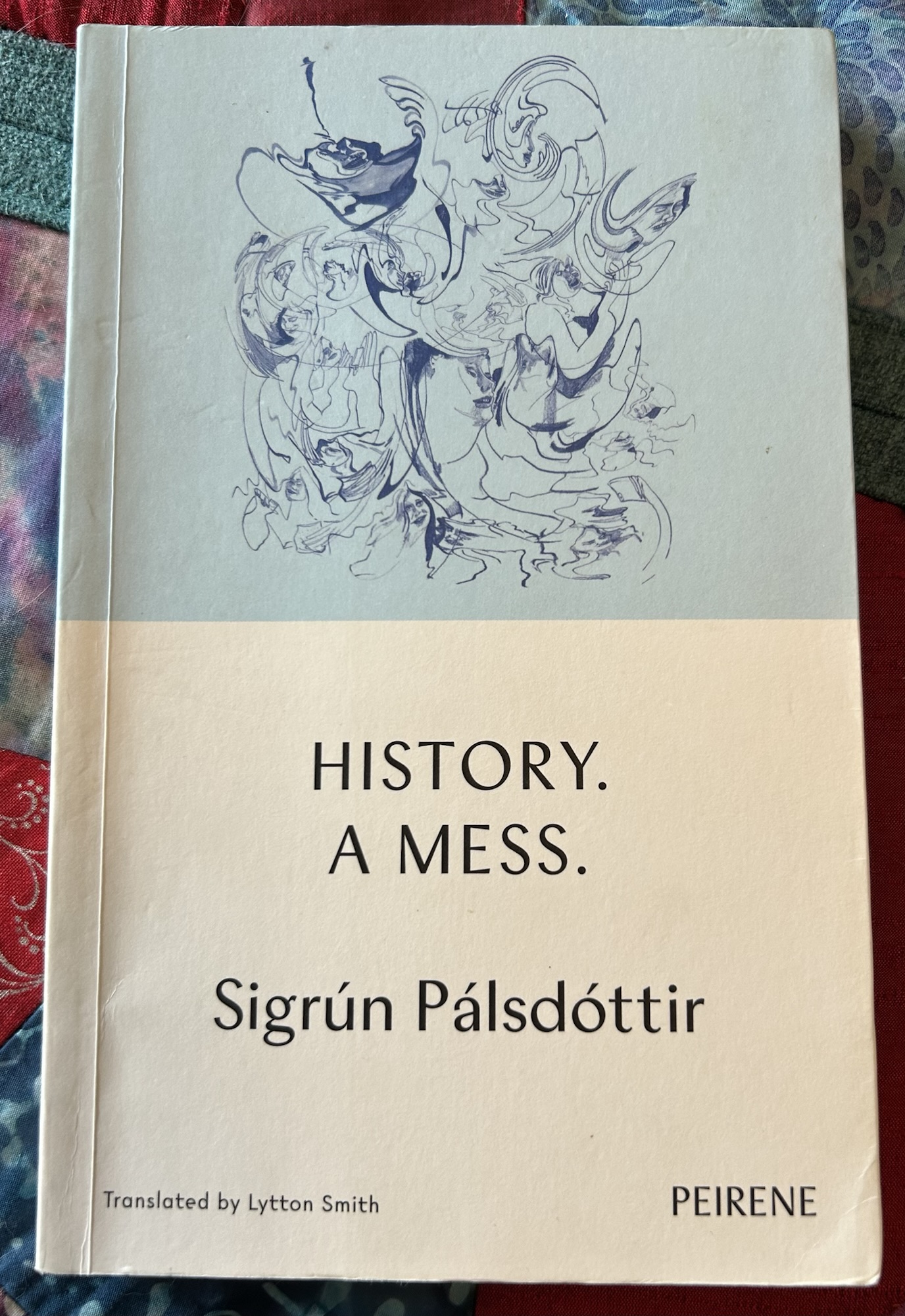
History. A Mess. – Sigrún Palsdóttir (2016 transl. Lytton Smith 2019) 173 pages

History. A Mess. Is narrated by a young unnamed PhD student. As the story opens, she is ecstatic as the research drudge job she had been given by her supervisor, transcribing the journal of a seventeenth-century artist known as SB, seems to have yielded a tremendous discovery: evidence of the first female artist in England.

“Frenzied jubilation thrilled through my body, words burst within me freighted with tremendous power, inside my head sentences and then pages formed one after the other so that by the time I stepped out of the building into the outside courtyard, my introduction was well underway.”

However, we soon learn that something went badly wrong. Five years on, she hasn’t handed in her thesis and she is back in Iceland with her husband Hans, barely leaving her house.

“Even if that person can seem occasionally distant, like Hans, so lost in his world that if you don’t reach out, grasp hold of him, he floats away, as he’s doing now, as I’m letting him do. I’m still trying to figure out what his reaction would be if I reached out for him and laid my cards on the table. Cards on the table. I suspect that his reaction would be sensible. And prudence is no use to me now. My problem calls for a radical solution.”

The fractured, repetitive quality to the sentences are indicative of the narrator’s struggles. The story becomes more hallucinatory and untethered as she seems to unravel further and further.

Some scenes are described that are so florid as to be clearly unreal. Others are grounded in the everyday so we don’t know whether have occurred or not – a skilled positioning of the reader alongside the narrator.

The story can be hard to follow at times, but from the hallucinations we’re able to unpick that she seems to be locking herself in a cupboard in her living room for much of the day. Her parents are around, and her mother is a major figure in her life.

Later in the novel she does leave her home to visit her mother for help in working out what to do about her thesis. Her walk there through the Reykjavik streets collapses reality and hallucination and seems never-ending, like a walk in dream.

“How often can you go over and over a dream in your mind until the scenario begins to crack apart, its images crumbling, their lifetime becoming nothing more than the moment it takes to call them up?”

History. A Mess. Is not an easy read. It is disorienting and confusing, but the writing is taut and so skilled that it never seems to be losing sight of itself. There also remains enough plot to keep pulling the story through, as well as a neat twist at the end.

A repeated refrain in the book is from Andre Breton, and summarises the novella succinctly:

“Everything leads us to believe that there exists a spot in the mind where the real and the imaginary will cease to appear contradictory.”

Novella a Day in May 2025: No.25

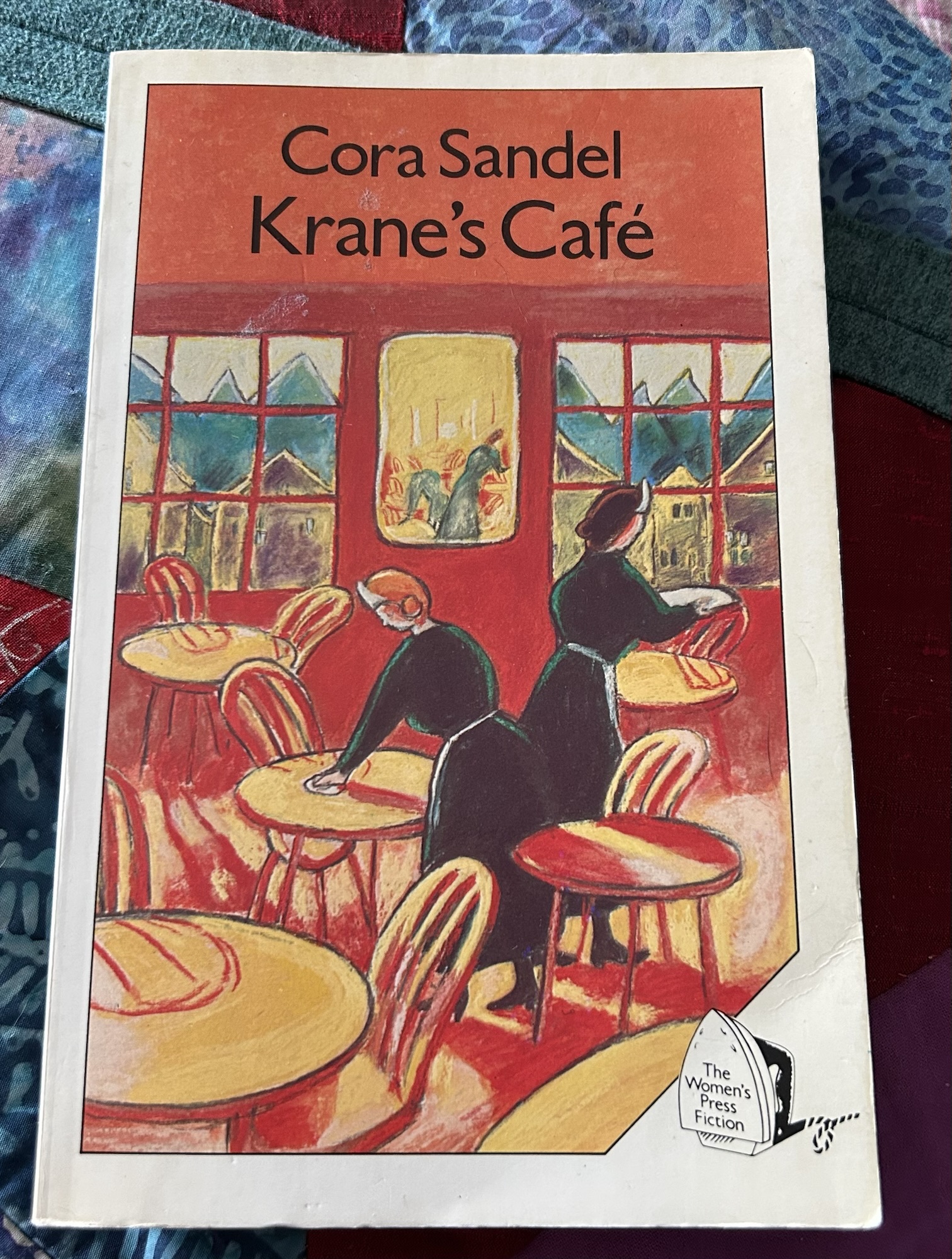
Krane’s Café – Cora Sandel (1946, transl. Elizabeth Rokkan 1968) 173 pages

Back in November Kaggsy reviewed some of Cora Sandel’s shorter writings and reminded me that I had Krane’s Café languishing in the TBR. I’m really pleased to have finally got to it, with its sly humour and incisive characterisation.

“There’s a lot to be heard before your ears drop off.”

Set just after the First World War, it opens with Katinka Stordal sitting in the titular café. She is the dressmaker in a small coastal town in northern Norway, and there is a big event coming up. Her orders are piling up, and Mrs Krane, the owner of the café with her husband, is trying to move Katinka on.

“’I’m going, I’m going,’ said Mrs Stordal. She looked up listlessly for a moment, and stayed where she was. It was one of those days when she looks much older than she really is.”

The narrative voice has this slightly bitchy, judgemental tone, which works so well. In implicitly proclaiming an alliance with the attitudes of the townsfolk, she draws attention to their pettiness and their lack of humane understanding.

People come in to try and chivvy Katinka along, with absolutely no interest as to why she is unable to move from the café or has her head in her hands. Their only concern is getting her back to work.

“As usual Mrs Brien was magnificently equal to the situation. ‘Now then, we mustn’t get hysterical, you know. We mustn’t give up. Everyone has worries. I don’t know anyone without worries. This really is naughty of you, Katinka.”

Then a man called Bowler Hat arrives…

“And he went over to Mrs Stordal and said in that low, one might almost be tempted to say melodious voice, if it were not so ridiculous, and offensive and bold into the bargain, ‘May I offer you something? Something you’d fancy? What about a little wine? The wine you’ve just been drinking? And then you can go on listening to me for a while? You mustn’t stop listening yet, you understand so well. I expect you know too how it feels to be lonely?’”

So the situation becomes scandalous. Katinka is in the back room of the café, drinking with a male stranger. She is complaining about her selfish family, her enduring fatigue with life, her lack of choices. Bowler Hat is an unnerving figure and I did wonder at times if he was a representation of the devil.

Mrs Krane feels overwhelmed without her husband to help her manage the situation, and her staff, Larsen and Sønstegård, are thoroughly enjoying the drama while pretending not to.

“Children and drunkards will tell you the truth. Both Larsen and Sønstegård admitted later that at that point they were almost afraid of more customers coming. For it was exciting to listen to Mrs Katinka, who scarcely ever gave you an answer in the normal run of affairs, sitting there giving rein to her tongue. Even though it was so dreadful to hear her gossiping like that about her own children. Throwing them to the wolves, you might almost call it.

And even though it was all a lot of nonsense.

What else could you call it?”

What emerges is a picture of real sadness. Katinka is lonely and disregarded by her family and by the town, while expected to fulfil their expectations of her. She is teased by the town’s children for her drinking, and in this small community no-one really truly acknowledges anyone else’s pain, despite how closely they all live together.

“And surely she couldn’t have thought of going and drowning herself, with all those orders, she the mother of two children besides? Nobody did that sort of thing in this town.

Suddenly it struck Mrs Krane that that sort of thing was just not written up in the paper about people in other places. Grieve the chemist had taken prussic acid in the cellar of his shop, though that had happened a long time ago and he was even scolded at his graveside by Mr Pio the curate […. ] and Iverson the tailor, who had such a spiteful wife, had walked out into the sea until it went over his head, and he never came up again, even though it was ebb tide and the sea was far out.”

In this way Sandel satirises society and its unthinking complacency towards others; the hypocrisy; and the self-interest. Yet unlike some satire, it doesn’t have a bitter edge. The characterisation is compassionate towards Katinka and Mrs Krane; and even Katinka’s daughter. The narrative voice is humorous and by aligning itself with the attitudes of the town, it avoids the superior tone of some satire.

I felt the ending was compassionate, though the town and its inhabitants remain largely unchanged…

“And all of a sudden Katinka shouted at the top of her voice, ‘Here comes the madness, the great, wonderful madness. The liberator from everything, who opens the gates and makes all spacious about you.’”

Novella a Day in May 2025: No.23

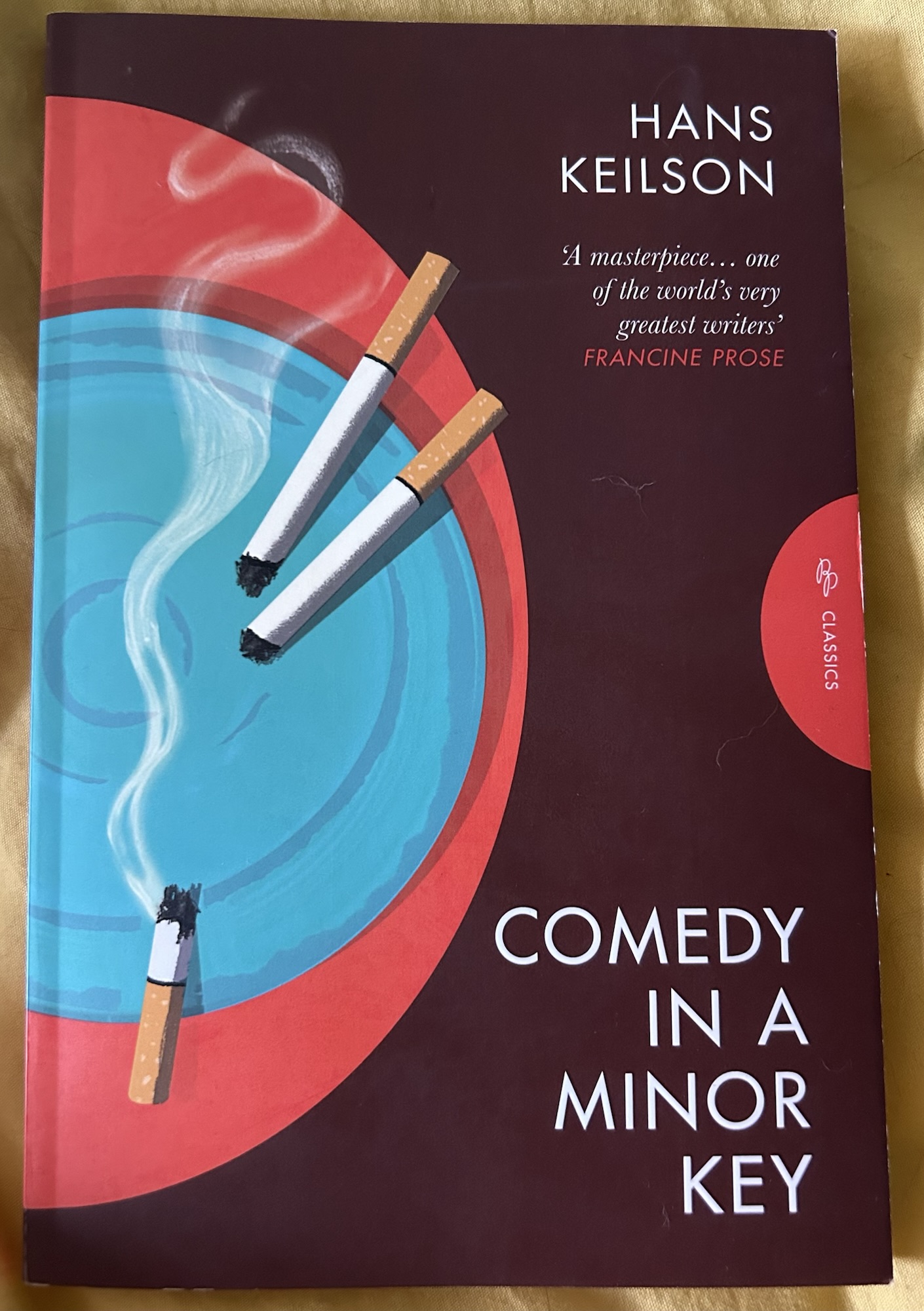
Comedy in a Minor Key – Hans Keilson (1947, transl. Damion Searls, 2024) 108 pages

Yesterday I posted on a German novella written just before the war, and today I’m looking a novella written just after the war but set during those years.

Hans Keilson was a remarkable man. His wiki page opens:

“German-Dutch novelist, poet, psychoanalyst and child psychologist. He was best known for his novels set during the Second World War, during which he was an active member of the Dutch resistance.

Keilson, having worked with traumatized orphans, mainly wrote about traumas induced by the war.”

Both his parents died in Auschwitz and Keilson had to go into hiding with a married couple for part of the war. In Comedy in a Minor Key, he explores this set-up, albeit primarily from the point of view of the couple.

Wim and Marie are a young Dutch couple who are approached to take someone into hiding in their house. Nico is older than them and the three of them live in restricted secrecy.

“The beginning was always exciting, no matter how many times a person had already lived through it.”

Wim and Marie are determined that no-one else will know about Nico. This doesn’t last long as they tell people, and others know already. For almost a year, the three of them live together in awkward domesticity.

What Keilson captures so well is the complexity of feelings around this living arrangement. So Nico isn’t unreservedly grateful; he’s also angry and scared and frustrated:

“Safe? Protected? Since they had taken him in? No, no, he was being unfair. But their house, their home, there things – their world – how it all had attracted him and soothed him at first. And now: how vain, how inflated, how worthless! For he measured things now with the cosmic measure, which gripped him tight and shook him back and forth. What trust in each other? What danger? And what a gulf between people! Consolation! Consolation?… was there any such thing?”

And for Wim and Marie there is bravery and kindness and also some vanity:

“You don’t get the chance to save someone every day. This unacknowledged thought had often helped them carry on when, a little depressed and full of doubt, they thought they couldn’t bear this complicated situation any longer and their courage failed them.”

The three of them muddle along together, and I found this description of their nightly snack and coffee very touching:

“There was gratitude in this habit, and a little tiredness, from the night to come that they were about to enter alone or as a pair, and a furtive, sad happiness in the smiling, incomprehensible futility.

But these scenes occur in flashback, as the novella opens with Nico having died of pneumonia, and Wim and Marie faced with what on earth to do now.

“How the neighbours and everyone on the street would look when he suddenly walked out of their house and strolled up and down the street with them. It would give them a little sense of satisfaction, and everyone who makes a sacrifice needs a little sense of satisfaction. And then you’d feel that you, you personally, even only just a little bit, had won the war.

It had all gone up in smoke. It wasn’t even a dream anymore. None of the three of them had any luck. But really, him least of all.

Poor Nico!”

Keilson never laughs at Nico’s death. What Comedy in a Minor Key shows is the enormity wartime in a domestic setting and how the mundane and silly can endure in the worst of circumstances. It shows how ordinary people can be so brave and also a little bit self-serving. It shows how the inbuilt hopes of a large gesture towards saving a life are entirely undermined when the person dies anyway.

I didn’t find this novella laugh-out-loud funny and I don’t think that’s what the title refers to. Rather I think the comedy refers to the ultimately comedic undermining of best intentions being a resistance in itself, as the war fails to destroy the ridiculous.

“Behind her curiosity there was a burning pain that cried out for more consolation than it was possible to give.”

Novella a Day in May 2025: No.22

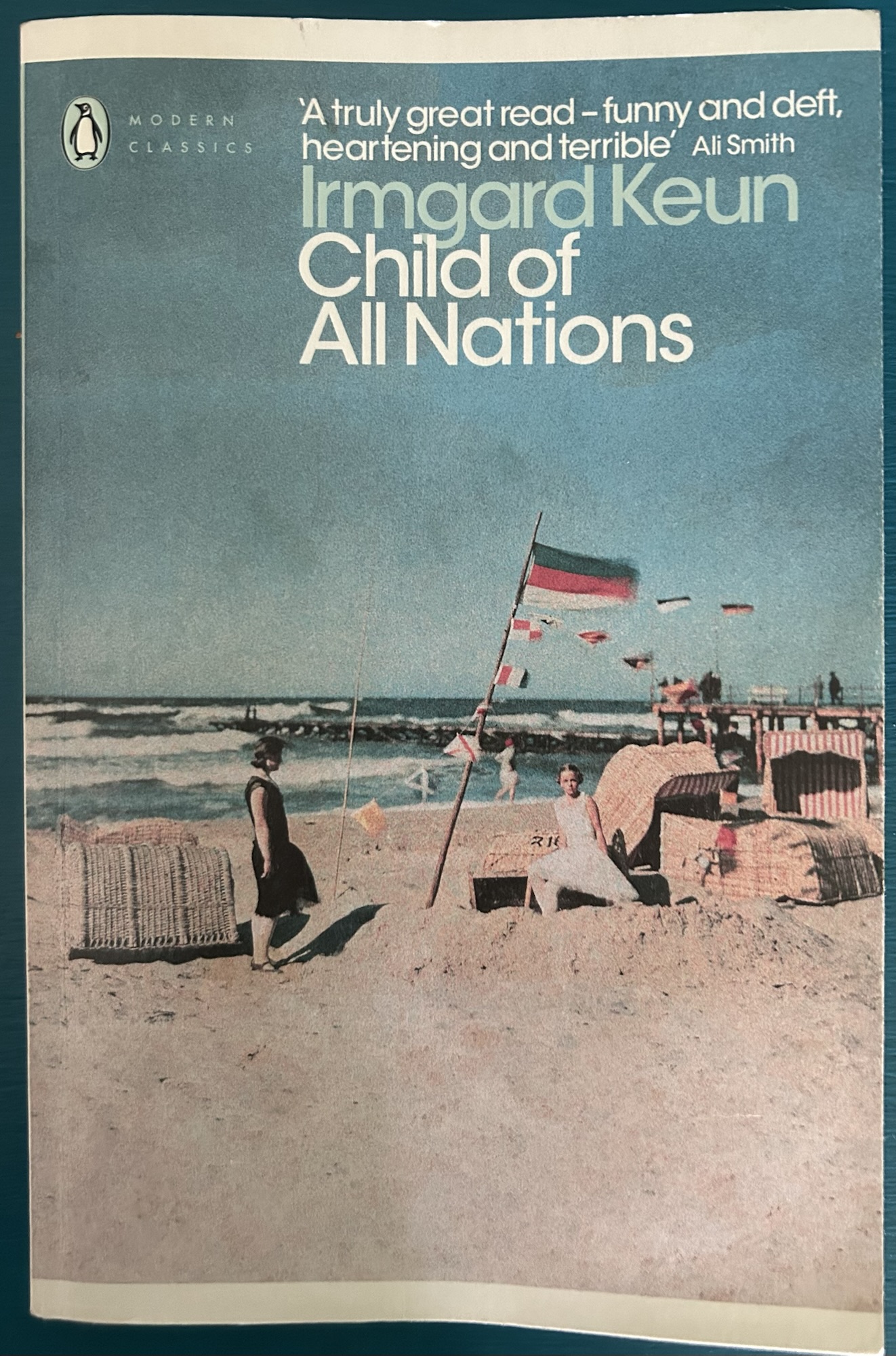
Child of All Nations – Irmgard Keun (1938 transl. Michael Hofmann 2008) 183 pages

I’m sticking with a child’s perspective with today’s novella, by an author I’ve been meaning to read for so long. Child of All Nations by Irmgard Keun is told from the point of view of nine-year-old Kully as she and her parents ricochet around immediate pre-war Europe.

“We left Germany when my father couldn’t stand it anymore, because he writes books and articles for newspapers. We emigrated to find freedom. We’re never going to go back to Germany. Anyway, we don’t need to, because the world is a very big place.”

There’s no doubt that Kully’s father is an important and talented writer, as we see from the responses he gets from other adults. However, he is also self-centred, feckless, and disregards his wife and child to the point of cruelty.

“Sometimes my father loves us, and sometimes he doesn’t. When he doesn’t, we can’t do anything about it, my mother and me. Nothing is any good when he doesn’t love us. Then we’re not allowed to cry in his presence or laugh, mustn’t give him anything, or take anything from him either. Any steps we might take only have the effect of delaying even more the time when he will love us again. Because he always comes back to us.”

From my twenty-first century perspective, they’d be better off without this man and his relentless need for the stimulation of the new, spendthrift ways and constant affairs with other women.

“I look a lot like my mother, only she has bluer eyes than me, and bigger legs, and she’s bigger all round. She wears her hair combed back, and in a knot at the back of her head. My hair is short and unruly. My mother’s much prettier than I am, but I don’t cry so much.”

However, the child’s perspective is so clever in the characterisation of the father, because he is never demonised. Thus, trailing round various countries; being abandoned as surety in various hotels and restaurants; and dragged into his schemes to get loans on promises of work which never appears; are not judged, because Kully just accepts things as they are.

He is also complicated in that his uselessness with money comes from a total material disregard. So while he gambles and drinks away their money, he also gives a lot of it away to people in a worse position than he is. This behaviour, and his writing, shows a compassion for others which unfortunately doesn’t extend to those closest to him.

My father often tells fibs to get a bit of peace and quiet… Sometimes, though, he performs miracles and everything he says comes true.”

What Keun also does well is presenting Kully’s voice directly, so that while it is unmediated and so distinct, adult readers are still able to pick out where she echoing what adults have said to her:

“We only eat once a day, because that’s cheaper, and it’s perfectly adequate. I’m always hungry anyway, even if I eat seven times a day.”

You just know that an adult, most likely her father, has told her that one meal is “perfectly adequate”.

Written in 1938, the shadow of war looms large. Unsurprisingly, Kully only just grasps some of it and her naivete is heartbreaking:

“I’m not afraid, because I’ve got my mother with me, the waiter who brings us our breakfast in the morning has said he’s not afraid either, and there isn’t going to be any war. And if there is, and we’re put in a camp, then he will continue to bring us our meals.”

What is apparent to the reader now, too, is that some of the countries Kully’s family head to as places of safety are not going to remain as such.

There’s a heartbreaking scene where just briefly, Kully’s mother gets what she wants: a small place with a kitchen where she can cook her own food. But inevitably, Kully’s father is bored within days and it is all taken away again.

What Kully recognises, which her father fails to understand, is that constant movement does not automatically mean freedom:

“Because we never have any money, we feel imprisoned by any hotel in any city, and from the very first day we think of our liberation.”

Child of All Nations documents an episodic, transitory life and the lack of plot is reflective of this, with the novella form suiting the story well. Kully’s voice was so clear from the first page and she remains resilient and with astonishing equanimity to the end. Knowing that the Europe in which Kully moves was about to change beyond all recognition gives it an extra resonance, and I think Keun already knew this too.

So, my first Keun read was a success, and I’m keen to read more!

Novella a Day in Day 2025: No.19

Siblings – Brigitte Reimann (1963, transl. Lucy Jones 2023) 129 pages

Summarising Siblings makes it sound incredibly clunky. A brother and sister living in the GDR find themselves separated ideologically as one of them wants to leave for the West. However, Brigitte Reimann’s writing is so skilled that the relationship between the siblings is rounded. The novella never feels like a construct in order to explore two forms of government in opposition to one another.

We know from the start that there has been some sort of significant betrayal. It opens:

“As I walked to the door, everything in me was spinning.

He said, ‘I won’t forget this.’ He was standing very straight and not moving in the middle of the room. He said in a cold, dry voice, ‘I’ll never forgive you.’”

The story is told from the point of view of Elisabeth (Betsy/Lise) and each chapter opens with the current situation (1960, prior to the Berlin Wall being built) before looking back in time. We learn of her close relationship with her brother Uli.

“I trusted him in every way and was vain enough to think I knew everything or almost everything he thought and planned. But in truth, back then, which was only the day before yesterday, I didn’t have a clue about the person closest to me.”

They are young people from a previously privileged family (who voted for Hitler), although they no longer have access to their industrialist family’s assets or wealth. Elisabeth is an artist and has a job working in an industrial plant painting the workers and teaching, which she enjoys despite the frustrations of dealing with colleagues and pressures from the Stasi.

“As soon as I’ve warmed myself in the lap of my family for a few days, I feel homesick for its adventurous, daring atmosphere; and for the sight of the huge, white and yellow excavators; for the mountains of sand blown haphazardly by the wind, under which lies the dark brown, damp coal seam; and for the drivers up in their peaceful cabins, shields lowered, patiently shovelling tonnes of earth…”

Uli is an engineer but he is unable to get a job due to being blacklisted by association with a professor who defected, despite him knowing nothing about the defection. Unlike Elisabeth and her boyfriend Joachim who works for the Party, Uli struggles with the immense bureaucracy and lack of choices he has in the GDR.

The siblings’ brother Konrad went to the West with his wife, and Elisabeth sees this as a huge betrayal, despising the materialism she feels drove the decision.  He was part of Hitler Youth, while Elisabeth and Uli were both small children during the war. Hence her feelings about the West and her immediate family are bound up with and complicated by Germany’s recent past.

A further complication is that Elisabeth and Uli have stayed close throughout their lives and she describes Uli romantically, dwelling on his handsomeness and appealing qualities more than on those of Joachim. I found her response in this way to her brother odd and unnerving, but I don’t know if that is a cultural difference or a deliberate decision by Reimann to make the siblings’ bond overly intense.

Uli tries to explain to Elisabeth the difference between him and Konrad; why he needs to leave, despite still believing in socialism:

“‘Before I’m ground to pieces here,’ he added, not quite as loudly, not quite as confidently. ‘I’ll always stand up for the public ownership of industry over there.’

‘Even in your shipyard?’

‘Even in my shipyard.’ He paused then smiled uncertainly.

‘How come your shipyard?’ I said quickly. ‘You’ll have to stop using communist phrases, you know.’”

Having Uli still believe in the system of government but finding himself unable to live under it complicates the opposing views of the siblings and exposes the layers of experiences which can lead to vastly different life decisions.

Another clever decision is to not paint the GDR as a bleak wasteland. As well as Elisabeth’s romantic view of the plant, the natural environment is beautifully evoked:

“The morning sun had moved on, and the sky stood flat and pale blue above the trees lining the avenue; from the kitchen window, above the cottages, I could see stables and small courtyards nestling closely together in this bucolic area of town. Raindrops sparkled on the walnut tree branches and the tips of its leaves in the slanting sunshine.”

The narrative circles back to end where it began, perhaps indicating the circular nature of the political arguments that neither Uli or Elisabeth will win. By the time we return, the reader is fully aware of the various ambivalent, contradictory bonds which tie Elisabeth and Uli. Siblings is a heartbreaking portrait of how wider political pressures can fracture the closest of relationships, irretrievably.

“‘I can’t explain anything to you,’ he said after a while. ‘Because our views on freedom, among other things, are too far apart.’”

Novella a Day in May 2025: No.16

Tokyo Express – Seichō Matsumoto (1958 transl. Jesse Kirkwood 2022) 149 pages

Tokyo Express is very much a howdunit and whydunit, as the whodunnit is seemingly fairly obvious from the start. This was my first time reading crime master Seichō Matsumoto and I was hugely impressed.

A young couple are found dead on Kashii beach near a shrine, having drunk cyanide. The local Fukuoka police are quick to decide a double suicide. There is nothing to suggest otherwise, but one of the team, Torigai Jūtarō, a long-standing and rather dishevelled detective, isn’t so sure.

“His overcoat was as battered as the clothes beneath it, his face unshaven, and his tie twisted and worn.”

Reminiscent of Lieutenant Columbo (whom he predates), Torigai is sharp-minded and unegotistical too. He starts trying to unravel how the couple came to be on the beach at that time. The young woman called Toki is dressed in a kimono and was a waitress at a restaurant in Akasaka; the man in Western clothes was Kenichi Sayama, an employee at Ministry X, currently under investigation for corruption. They were witnessed getting on the titular train by two of Toki’s colleagues, and it seems pretty clear that their bearing witness was engineered by a businessman called Tatsuo Yasuda.

Quicky Torigai establishes that a lot rests on that train journey and the timings of what happened when. He’s also baffled by a receipt from the buffet car found on Sayama’s body which recorded a food order for just one person.

“A scene formed in Torigai’s mind: the dark silhouette of a man, silently and briskly leading a woman to the beach, and the woman saying: What a lonely place.”

When Kiichi Mihara turns up from Tokyo, an outwardly very different detective takes over. The case is attracting attention due to the corruption in the Ministry, and Mihara works for the Second Division which investigates white collar crime.

“There was something in his cordial tone that reminded Torigai of an insurance salesman.”

The two investigators agree that the deaths are suspicious, and they also realise Yasuda is likely involved. However, trying to crack his alibi about where he was and when proves extremely difficult.

“Yasuda was always consulting the railway timetable. Did that perhaps mean he knew it secrets? In any case, his familiarity with the train times had to signify something. What if Yasuda’s entire alibi was built on it?”

This is one of the most procedural of police procedurals I’ve ever read. Everything hinges on the tight timing of trains, ferries and planes (a premise that would not remotely work in the UK as it depends on all the transport running to time, which as Magnus Mills pointed in out in my earlier read this month, will never occur). Torigai fades into the background, as Mihara tries to pick it all apart but keeps hitting brick walls.

“That crack in the wall had been nothing but a mirage. Mihara felt crushed. He held his head in his hands and, for a moment, could only stare at the piece of paper in front of him.”

I knew a bit about Tokyo Express before reading it, including that all the timings are based on the actual timetables of the time in the novel, and I wondered if it would be impossible to follow/bogged down in the logistics. But Seichō Matsumoto does a great job of carrying the reader along and there’s even a few surprises in store. The relationship between the two detectives is warm and endearing. I don’t know if they appeared in his subsequent novels, but even if not, I’d be keen to read more by this author.

“Mihara liked to ride the trams of Tokyo. Often, he would board without a specific destination in mind. Odd as it might seem, whenever he was at a loss for ideas, he would simply sit on the tram and allow his thoughts to roam. The tram’s steady trundle, its gentle swaying, induced in him an almost euphoric state of contemplation.”

Novella a Day in May 2025: No.10

Marzahn, Mon Amour – Katja Oskamp (2019, transl. Jo Heinrich 2022) 141 pages

Marzahn, Mon Amour is a novella I’d been meaning to read for a while and I’m delighted to have finally got to it. Based on the author’s experience of retraining as a chiropodist in her middle-age, it is essentially a series of character sketches of her clients.

Initially her training is a struggle and she’s unsure of her new career:

“We had reached a low point, at people’s feet, and even there we were failing.”

“From writer to chiropodist – what a spectacular come down. I had forgotten how much people, the looks on their faces and their well-meant advice, got on my nerves.”

But on qualifying she gets a job in a salon in the titular area of Berlin, and begins to find her vocation:

“As always, the weather here in Marzahn, once the biggest expense of plattenbau prefab tower blocks in the former East Germany, seems more intense than in the centre. The seasons have more of a smell about them.”

Her boss is Tiffy “a grandmother, albeit a non-practising one”; Flocke is the chaotic nail technician. The chapters take the names of her clients, and Oskamp expertly captures a sense of the person in very few words:

Herr Paulke: “whenever I laughed at something that Herr Paulke said in his matter-of-fact way, emotion almost imperceptibly flashed across his face, a mix of incredulity, pride and shame. He was no longer used to anyone paying him any attention.”

The Mon Amour affection the author feels for her clients shines through. Often these are elderly people, disregarded by society, and Oskamp gets to know them over a period of months and even years. The act of caring for their feet is intimate, especially for those who may now be alone and not have much gentleness in their lives.

They all have stories to tell, such as Gerlinde Bonkat, who arrived as a refugee:

“She formulates crystal clear, quotable sentences and speaks an accentless German, with a faintly Nordic hint to its melody.”

Which isn’t to say Oskamp likes all her clients. Herr Pietsch is a former government worker who fails to realise his days of power are over: “All your life you’ve mistaken your position for your personality.” And there’s a disturbing portrait of a mother and daughter who visit where there is a query of elder abuse.

But generally Marzahn, Mon Amour is a gentle read.

“Frau Frenzel is seventy years old. She views the world with a cheerful contempt and won’t let anything or anyone spoil her mood. She reminds me of a hedgehog, with her nose perkily pointing upwards, lively button eyes and grey spiked mullet straight out of the 80s […] Amy, with whom Frau Frenzel shares her life, is a short haired dachshund.”

A lovely read and a wonderful tribute to the writer’s clients.