“Let it snow!” (Dean Martin)

Or, you know, don’t.  A friend of mine from the east coast of America asked me last week why all the weather reports in the UK were focussing on snowmageddon when really, very little happened. A German colleague is baffled every year by our total inability to deal with anything above a flurry. I have no answers for them. What I do have, in honour of the snow that barely made an appearance last week, is novels where there is serious snow. Snow that means business. Snow you have to dig yourself out of. If only because then I get to include this gif:

199676-penguin-in-the-snow

Firstly Snowblind by Ragnar Jonasson (2010, tr.2015 Quentin Bates 2015). I’m not a huge reader of crime fiction set any time after the middle of the last century, but I was convinced by the enthusiastic reviews of FictionFan and Sarah from Hard Book Habit, and the promise that this was like a golden age crime novel but with a contemporary, Icelandic setting (the author translated Agatha Christie into Icelandic when he was 17).

Rookie copper Ari Thor Arason leaves Reykjavik and his girlfriend behind to take a posting in the remote town of Siglufjordur, in the far north of Iceland. A place so small you don’t need to drive to get around, and only accessible via a mountain pass.

“On the right were the snow white mountains, magnificent and formidable, while on the other side was a terrifying, sheer drop onto the expanse of Skagafjordur. One mistake on a patch of ice and there would be no tomorrow…he relaxed as the tunnel entrance finally approached. They had made it all the way in one piece. But his relief was short-lived. He expected a broad, well-lit modern tunnel, but what lay in front of him looked forbidding. It was a narrow single track. Ari Thor later learned it had been carved through the mountainside more than forty years ago when there were only a few tunnels in Iceland. It didn’t help that water dripped here and there from the unseen rock ceiling above. Ari Thor suddenly felt himself struck by a feeling he had never experienced before – an overwhelming claustrophobia.”

As Ari Thor settles into life in place where everyone knows everyone and no-one locks their doors, a local celebrity falls down some stairs whilst drunk and dies (or did he? or was he?) When a woman is found close to death, bleeding out in the snow in her garden, the police start to suspect that the two may be linked. As “every winter is a heavy winter in Siglufjordur”, the mountain pass is soon made unpassable through an avalanche, and so essentially what  Jonasson has done is use the snow to create a claustrophobic, tense, locked-room murder mystery (please commend me on my enormous restraint in avoiding snow-based puns like ‘chilling’ or ‘unsettling’, despite the fact it is both those things).

Snowblind is a short novel (252 pages in my edition) and so I can’t say much more without spoilers. What I will say is that it feels resolutely contemporary with references to the financial crash which devastated Iceland at the time (although for the once-busy port of Siglufjordur, “if there’s a recession here, it comes from the sea”) whilst at the same time being part of a tradition of non-gory, page-turning whodunits. Siglufjordur itself is wonderfully evoked, with a real sense of place created, whilst at the same time becoming a fictional other, and somewhat eerie.
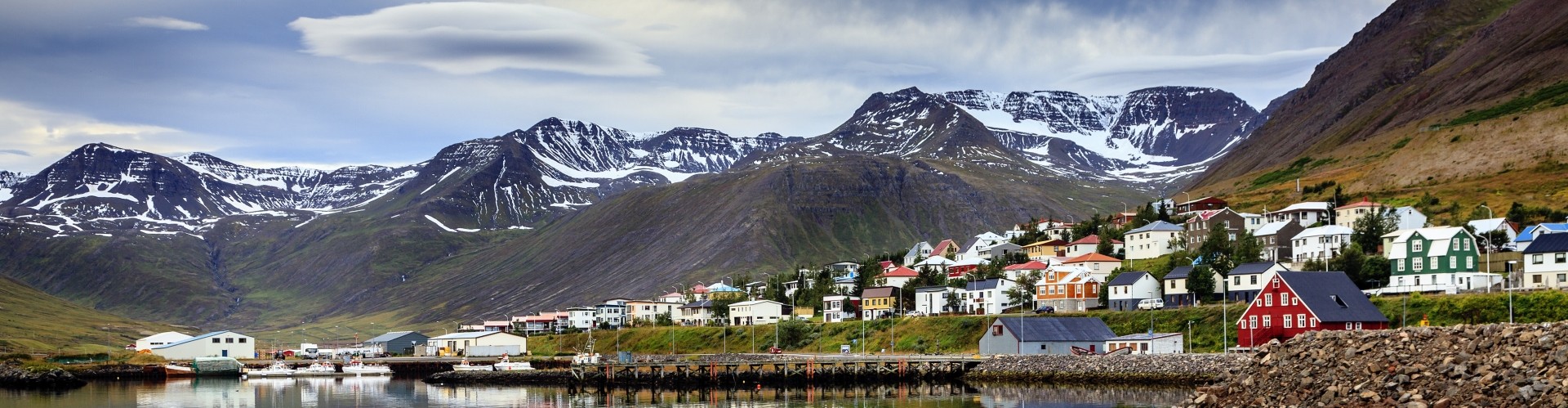
Siglufjordur

Siglufjordur

Image from here

“This peaceful little town was being compressed by the snow, no longer a familiar winter embrace but a threat like never before. The white was no longer pure, but tinged blood red.”

Secondly, Miss Smilla’s Feeling for Snow by Peter Hoeg (1992, tr. F David 1993) and one more stop on my Around the World in 80 Books Reading Challenge, hosted by Hard Book Habit (new year’s resolution from now on – stop being so euro-centric with this challenge). I distinctly remember all the hype around this novel when it first came out. Not that I’m slow on the uptake, but 24 years later, I’ve finally read it. These days we are awash with antisocial-genius detectives but back in the day Smilla Jaspersen may have been more of a novelty:

“I feel the same way about solitude as some people feel about the blessing of the church. It’s the light of grace for me.”

Smilla does need people, even if she doesn’t like to admit it, and when her neighbour, six year old  Isiah, falls to his death from a roof, she is galvanised to act:

“Isiah’s death is an irregularity, an eruption that produced a fissure. That fissure has set me free. For a brief time, and I can’t explain how, I have been set in motion, I have become a foreign body skating on top of the ice.”

Smilla, half-Greenlandic, can read the snow and she knows Isiah’s last footprints tell a different story to the one the authorities are spinning. This is a theme throughout the novel, which is as much a commentary on post-colonial power structures as it a detective story. Smilla has a history of far left political activism and is not easily cowed by those trying to silence her. I found her a believable, idiosyncratic heroine and really enjoyed her matter-of-fact voice:

 “The knives I keep in my apartment are just sharp enough to open envelopes with… I don’t need anything sharper. Otherwise, on bad days, it might easily occur to me that I could always go and stand in the bathroom and slit my throat. Against such a contingency it’s nice to have the added security of needing to go downstairs and borrow a decent knife from a neighbour.”

My quibble would be that I thought the story lost momentum a bit when Smilla left Denmark and journeyed towards Greenland; I think the return to the land of her childhood was inevitable so maybe it needed a heavier edit earlier in the novel. But overall, an intriguing premise for an intelligent mystery with a strong political message.

“Reading snow is like listening to music. To describe what you’ve read is to try and explain music in writing.”

To end, the unintentionally hilarious trailer for the film adaptation. So very earnest, so very heavy-handed 😀  (and yet still following the Hollywood tradition of whitewashing, unless Julia Ormond is part-indigenous Greenlander?)

“Whenever I think of the past, it brings back so many memories.” (Steven Wright)

I’m a month into my new job and the main effect it’s having is that my memory is shot to pieces. Trying to cram #allthefacts about one particular health condition into my head means all other knowledge has dribbled out of my ears. In fairness, my short and long-term memory has always been appalling and I used to claim I operated in a constantly shifting 3 hour window. This is currently down to about 30 minutes. Plus I got lost at Bank the other day, when I’ve lived in London MY WHOLE LIFE. And there’s a bloomin’ great building at Bank (guess which one) to help you orient yourself.

800px-Bank_of_England_Building,_London,_UK_-_Diliff

Where am I again? Oh, yeah…

So to console myself this week I’m looking at novels which explore memory. Its inherently unreliable nature means memory is a gift to novelists who want to consider how we construct reality and decide who we are. (At the moment I’m happy if I manage to construct a sentence, never mind reality and coherent sense of self).

Firstly, The Housekeeper and the Professor by Yoko Ogawa (2003, tr. Stephen Snyder 2008).I’m a huge admirer of Ogawa and her spare, stunning writing. In this short novel she details the relationship between a young housekeeper, her son, and the Professor she works for, who since a car accident in 1975 has a memory which lasts 80 minutes, though his memory from before the accident is intact.

“At the end of my first day, I noticed a new note on the cuff of his jacket. ‘The new housekeeper,’ it said. The words were written in tiny, delicate characters, and above them a sketch of a woman’s face. It looked like the work of a small child…but I knew instantly it was portrait of me. I imagined the Professor hurrying to draw this likeness before the memory had vanished. The note was proof of something, that he had interrupted his thinking for my sake.”

These notes cover the Professor’s suit and give him an eccentric experience which belies his brilliant mind. He is talented mathematician who sees numbers everywhere. His housekeeper became pregnant at 18 and needed to work to support her child; she is intelligent but not highly educated. Gradually though, he is able to convey the magic of numbers to her and her mind relishes the new challenge:

“With my finger I traced the trail of numbers from the ones the Professor had written to the ones I’d added, and they all seemed to flow together, as if we’d been connecting up the constellations in the night sky.”

Meanwhile Ogawa is able to convey the magic of numbers to the reader. There is no-one more resistant to mathematics than me – I won’t even play soduku. Yet the Housekeeper’s response to the discoveries the Professor opens up for her is so creative and joyful that I found myself carried along:

“I wondered why ordinary words seemed so exotic when they were used in relation to numbers. Amicable numbers or twin primes had a precise quality about them, and yet they sounded as though they’d been taken straight out of a poem. In my mind, the twins had matching outfits and stood holding hands as they waited in the number line.”

The titular characters and the Housekeeper’s son – nicknamed Root as his flat head reminds the Professor of the square root sign – form a tender alliance. The Professor cannot remember them from one day to the next, and yet he changes their lives forever, through his love of numbers and how he uses these to reach out to people.  The novel is a love story, but not a romance.  It is about the love of friends, of family, of vocation. It contains tragedy but also endurance beyond such, with Ogawa’s sparse style bringing the story a great delicacy. I adored it.

“I thought of the Professor whenever I saw a prime number – which, as it turned out, was almost everywhere I looked: price tags at the supermarket, house numbers above doors, on bus schedules or the expiration date on a package of ham, Root’s score on a test. On the face of it, these numbers faithfully played their official roles, but in secret they were primes and I knew that was what gave them their true meaning.”

Secondly, The Sea by John Banville, which won the Booker Prize in 2005. I’m still a bit conflicted about how I feel about this one, but it’s given me food for thought and is undoubtedly well-written, so I decided to add it to this blog where I only write about books I like. The Sea is narrated by Max Morden, coming to terms with the recent death of his wife. He returns to the holiday cottage which in his childhood was rented by a family, the Graces’, while Max and his family had a nearby chalet.

“I approached the Cedars circumspectly. How is it in childhood everything new that caught my interest had an aura of the uncanny, since according to all the authorities the uncanny is not some new thing but a thing known, returning in a different form, a revenant?”

The Sea is an effective exploration of memory as Max’s memories of the childhood holiday are jumbled alongside those of his marriage and especially his wife’s final illness. Chloe and Myles Grace are twins who never quite reveal themselves to Max, although he begins a tentative romance with Chloe.

“Her hands. Her eyes. Her bitten fingernails. All this I remember, intensely remember, yet it is all disparate, I cannot assemble it into a unity.”

As Max remembers the events of that summer he is forced to reflect on his wider choices and the man he is, particularly as he is now single again.

“Life, authentic life, is supposed to be all struggle, unflagging action and affirmation, the will butting its blunt head against the world’s wall, suchlike, but when I look back I see the greater part of my energies was always given over to the simple search for shelter, for comfort, for, yes, I admit, it, for cosiness.”

So… my reservations about this novel are weirdly some of its strengths. It is written in considered, careful prose, expertly structured overall to build to a conclusion that reconciles past and present. But for me it almost felt too considered, too artful. Then I wondered if Max, insecure about his social background, was supposed to be a slightly ponderous man out to prove his own cleverness? I’m not sure, I would have to read another of Banville’s novels to know. There are certainly moments of wry humour to lift the narrative at moments:

“these days I must take the world in small and carefully measured doses, it is a sort of homeopathic cure I am undergoing”

I’m undecided about Banville at present but I’ll certainly give him another try. If you’ve read him I’d really appreciate enlightenment as to his style and other novels that would be worth a read? The reason The Sea made it onto this determinedly positive blog was the final line of the novel, the final image. It was so powerful, such a perfect end, so moving and insightful: a moment of pure brilliance.

To end, it had to be either this or Elaine Paige dressed as a giant feline. Ultimately I decided to have my memories misty-water-coloured rather than alone in the moonlight. Take it away, Babs:

“It’s the end of the world as we know it” (REM)

Kate from booksaremyfavouriteandbest suggested this week’s title & theme  – I think we all know why.

http-%2f%2fmashable-com%2fwp-content%2fuploads%2f2013%2f06%2fjohnny-depp-panics

Starting with an obvious choice, Signs Preceding the End of the World by Yuri Herrera (2009, tr. Lisa Dillon 2015), published by the wonderful &Other Stories Press – I wrote about another of their Mexican novels here. Herrera looks at the illegal immigrant experience through Makina, seeking out her brother at the behest of her mother, and desperate to return home.

“You’re going to cross and you’re going to get your feet wet and you’re going to be up against real roughnecks; you’ll get desperate of course, but you’ll see wonders and in the end you’ll find your brother, and even if you’re sad, you’ll wind up where you need to be.”

Makina’s journey is both physical and mythical.  As she travels through her homeland she has to ask men with pseudonyms for different types of help to get her across the border. The places she visits have similarly folkloric names: ‘The Place Where The Hills Meet’, ‘The Big Chilango’, ‘The Place Where People’s Hearts Are Eaten’ and across the border ‘The Place Where The Wind Cuts Like A Knife’. By not grounding Signs Preceding the End of the World in recognisable names and places, Herrera expands the simple journey to something much larger. Any tale of illegal immigration is going to have particular political resonances, but Herrera makes his heroine an Odysseus character and her trials a quest. While the tale is not surreal, there is a sense, as in myths and fables, that anything could happen:

“She looked into the mirrors: in front of her was her back: she looked behind but found only never-ending front, curving forward, as if inviting her to step through its thresholds. If she crossed them all, eventually, after many bends, she’d reach the right place; but it was a place she didn’t trust.”

Herrera is a writer who invents neologisms (definitely worth reading the interesting Translator’s Note for this novel) and so is fascinated by language. Through Makina’s journey he tracks the way that boundaries of countries, self and language are all permeable, and how this creates a modern, constantly shifting society:

“Makina senses in their tongue not a sudden absence but a shrewd metamorphosis, a self-defensive shift. They might be talking in perfect latin tongue and without warning begin to talk in perfect anglo tongue and keep it up like that, alternating between a thing that believes itself to be perfect  and a thing that believes itself to be perfect, morphing back and forth between two beasts until out of carelessness or clear intent  they suddenly stop switching tongues and start speaking that other one.”

Signs Preceding the End of the World is a fascinating, multi-layered novel, at once a story for our times but also engages with enduring, expansive themes. Hugely impressive.

And now I pause for thought to wonder if there are enough pictures of kittens in barrels to get me through a single news bulletin right now:

Secondly, Our Endless Numbered Days by Claire Fuller (2015) which I was alerted to last year by the many bloggers who loved this debut novel (written when the author was in her 40s – I must remember to tell my friend C who is coming to terms with the fact that she’s missed her window for those ‘30 Under 30’ type lists). I’m not going to buck the trend on this – I found it a compulsive read which I whizzed through to its gut-wrenching conclusion.

Peggy lives with her parents in the kind of north London middle-class bohemia that keeps Mini Boden in business.  Peggy doesn’t wear Mini Boden though, as it’s 1976 and her mother is busy being a concert pianist while her father gets into arguments with his friends in the North London Retreaters group. This collection of (male) survivalists are convinced nuclear war is imminent. A personal crisis forces Peggy’s father to act on his rhetoric, and he takes her to Germany, to live entirely isolated in “Die Hutte”, in the middle of a forest.  We know this fairytale has unravelled horribly from the opening line, told 9 years later by Peggy who is back in Highgate after a long absence:

“This morning, I found a black and white photograph of my father at the back of the bureau drawer. He didn’t look like a liar.”

The lie Peggy’s father told is astronomical: that the rest of the world has disappeared and they are the only two left living.

“ ‘We’re not going to live by somebody else’s rules of hours and minutes anymore,’ he said. ‘When to get up, when to go to church, when to go to work.’

I couldn’t remember my father ever going to church, or even to work.”

What follows is a narrative that moves back and forth between Peggy’s life in Die Hutte and that in 1985 Highgate with her mother and brother she never knew, Oskar. Fuller handles this extremely well, and I didn’t find the chopping back and forth disruptive or gimmicky. While not a thriller, Our Endless Numbered Days is definitely a page-turner, as Peggy’s comments drip-feed us information about what has gone on: there has been a fire, she has no hair, part of her ear is missing, her teeth are rotten, there is a man called Reuben involved in some way… and her father is no longer around.

The writing style is simple, and I found this a quick read, but the ideas are complex. Fuller is interested in the fantasies we tell ourselves and others in order to survive and the dangers inherent in not questioning these (insert heavy-handed political parallel here). She is interested in the price paid by powerless members of society when the powerful seek fulfilment by disregarding the needs of others (insert… well, you get the idea) and she is interested in the psychological fallout from childhood and our parents.  I saw the twists a mile off, and sometimes Peggy’s voice wavered, but this may have been intentional and it really didn’t matter. Peggy’s complex fairytale was both extreme and subtle, quite a feat.

“Oskar rapped his knuckles on the thick white ice which had risen like a soufflé out of a bucket hanging on a nail beside the back door. I recognised it, it was the bucket my father and I had used…Oskar laughed and turned the handle twisting it hard; his mouth twisting too with the effort. The tap snapped off. And for the first time since I had come home I cried – for the music, for Reuben, but most of all for the waste of a bucket.”

To end, goodbye to a poet and musician whose work is bringing me some comfort – as always – in these troubled times:

“I don’t like to be out of my comfort zone, which is about a half an inch wide.” (Larry David)

Last week I wrote about dystopian novels, and Kaggsy commented that when things are bad, comfort reading is the thing, particularly golden age crime. A sage suggestion – it offers the escape of another time, and the reassurance of puzzles being solved, things being put right. So this week’s post is all about comfort. The comfort of people being stabbed in the back with knives, and left to freeze to death in the snow.

tumblr_nlgsgzTWmq1spq12ao1_400

Firstly, the golden age classic A Man Lay Dead by Ngaio Marsh (1934), the first of her novels featuring Chief Inspector Alleyn. I did enjoy this: a country house murder, a closed circle of suspects, class snobbery, unfounded paranoia about Bolsheviks; it was a perfect example of the genre 😀

Sir Hubert Handesley throws a party at his country house, to include a game of ‘Murder’ – you can probably guess what happens. During the time allotted to the game, a man who disappointingly, is never referred to as a cad or bounder though he is clearly both those things, is found stabbed in back, bleeding out next to the cocktail tray and the  dinner gong (love the incidental details of golden age mysteries!)  What’s more, the knife is Russian:

“‘Rum coincidence that the knife, your butler, and your guest should all be of the same nationality.’”

Enter Inspector Alleyn – dry of wit, Oxford of education, mysterious of background but suspiciously posh, not a man to be carried away by xenophobic paranoia, who sets about investigating the murder through an appealing mix of dogged attention to detail and flashes of flamboyance fuelled by his prodigious intelligence:

“‘As a rule,’ he observed, ‘there is much less to be gleaned from the clothes of a man with a valet  than from those of the poorer classes. “Highly recommended by successful homicide” would be a telling reference for any man-servant.’”

Ngaio Marsh’s authorial voice is similarly witty, making this novel a funny, entertaining puzzle.

“Mr Benningden was one of those small, desiccated gentleman so like the accepted traditional figure of a lawyer that they lose their individuality in their perfect conformation to type.”

A Man Lay Dead is perfectly paced (only 176 pages in my edition) and of course Alleyn gets his murderer, with a few red herrings along the way. I bought this as part of the perennially tempting collected sets from Book People, and I’m looking forward to working my way through the rest…

Patrick Malahide as Inspector Alleyn in the BBC adaptation

Patrick Malahide as Inspector Alleyn in the BBC adaptation

Image from here

Secondly, a novel I’m including as part of Women in Translation month – head over to Meytal’s blog to read all about WITmonth. Under the Snow by Kerstin Ekman (1961, trans. Joan Tate 1996) is not a golden age novel, but it offers much of the same appeal, being a straightforward, non-gory whodunit. Reading in the midst of a UK summer (such as it is) it also offered me an escape into a wintry Lapland landscape, far away from real life and the daily news which currently evokes this reaction in me:

LmY5p (1)

One winter’s night in a remote northern village in Lapland, a mah jong party gets out of hand (as they so frequently do, those crazy mah jong players) and the art teacher of the local school, Matti, is found frozen to death in the snow. Police officer Torsson is called into this small community:

“just like Torsson, the chief of police of this mining town had originally come from the south. Having carried out his duties for thirty-five years among a taciturn breed in a country where the winter is five thousand and sixty-four hours long, he had lost some of the animation in his speech and the cheerfulness he associated with brightly lit shopping streets and apple blossom. He did not like to be disturbed.”

Torsson feels something is not right with Matti’s death, but can’t prove it. The story then jumps forward to the summer, when Matti’s friend David arrives in the area:

“Occasionally the road seemed to be leading up to heaven, the car climbing in growling second-gear up kilometre-long hills towards the empty sky…this July day was clear, the sky blue. The mountains seemed to him to be the most immobile and largest objects he had ever seen. Top marks to you, old chap, he thought, for David Malm travels round the world, painting, and he’s seen a thing or two”

David and Torsson form an unlikely partnership as they start exploring the events of the winter night in the midst of the relentless daylight of summer within the Arctic Circle. The overweight, steady, unemotional Torsson has been underestimated by the villagers but alongside the more flamboyant David progress is made. The mystery itself is straightforward (the novel is only just over 200 pages) but the atmosphere evoked by the extremes of light in the different seasons is fully utilised by Ekman to create an eerie, unsettling atmosphere.

“there is infinite patience up here. This is due to time, which thanks to the sun’s strange behaviour exists here in different proportions. A year is one long cycle of cold night and blistering light day. The celestial clock turns rather majestically when you live right underneath the pendulum.”

To end, a cornucopia of comfort 🙂

Bagpuss, Michael Palin and ponies images from here, here, here

“Brevity is the soul of lingerie.” (Dorothy Parker)

Apparently you can have too much of a good thing.  This is not something I’ve experienced myself, but as it seems to be a truth universally acknowledged, I’ll go with it.  So even if you are an inveterate bibliophile there can be times when humungous, bicep-busting books can be off-putting, particularly if like me, you’re a non-Kindle using commuter.  You don’t want to be lugging The Count of Monte Cristo onto the train (or so my osteopath insists).  This week I thought I’d look at books that are small and perfectly formed: 1 novella and 1 short story collection that are little gems.

Firstly, Fair Play by Tove Jansson (1989 my edition trans. Thomas Teal 2007, 127 pages). Jansson is most famous for creating those weird hippo/mouse hybrid creatures the Moomins:

Recently I kept reading about how good her writing for adults is, so when I saw Fair Play in a bookshop I decided it was A Sign.  A Sign for me to spend money, which admittedly is what every bookshop says to me.  But Fair Play was worth every penny.  It is a beautifully observed, delicate portrait of two artistic women sharing a life together.  Jonna is a visual artist, Mari a writer:

“They never asked, “Were you able to work today?” Maybe they had, twenty or thirty years earlier, but they’d gradually learned not to.  There are empty spaces that must be respected  – those often long periods when a person can’t see the pictures or find the words and needs to be left alone.”

This is what Fair Play captures so well, the unspoken subtleties that exist in a long-term relationship, with the person you know better than anyone.  With a restrained lightness of touch, Jansson presents moments in time between the two women,  detailing events that seem simultaneously fleeting yet loaded with meaning.

“They hadn’t noticed the fog moving off….suddenly the sea was open and blue and they found themselves a long way out toward Estonia.  Jonna started the motor.  They came back to the island from a totally new direction, and it didn’t look the same.”

The novel has no ostensible plot, and there is no sense of time – each chapter could occur chronologically, or could be moving back and forth across the trajectory of their long relationship.  It doesn’t matter.  You finish the novel with the feeling of being allowed glimpses into two unique, intertwined lives, while understanding how we all essentially remain unknown.

“It’s gone so quiet,” Jonna said. “What did you think? Wasn’t that a good storm?”

“Very good,” Mari said. “The best we’ve had.”

Jansson’s writing is stark, yet beautiful. I will definitely be seeking out more by this writer.

Secondly, The Madman of Freedom Square by Hassan Blasim (2009, Comma Press, trans. Jonathan Wright, 90 pages). The cover of this collection includes a quote from The Guardian, proclaiming Blasim “perhaps the best writer of Arabic fiction alive”. Like Fair Play, this was the first time I’d read this author, and it seems like such an oversight as he has so much to say that is important.  Blasim is a deeply political writer, by which I mean not that he is polemical, but that he is engaged with how literature works within a wider society:

“Because literature in this country is literature that goes through phases. Since the fall of Saddam Hussein there have been incessant calls for writing to be intelligible, realistic, factual and pragmatic.  They are lamenting readers that don’t exist. They claim the writers of the past made the readers defect, whereas in fact for hundreds of years there were no readers in the broad sense of the word.  There were only hungry people, killers, illiterates, soldiers, villagers, people who prayed, people who were lost and people who were oppressed. Our writers seem to have grown tired of writing for each other.” (‘The Market of Stories’)

Blasim’s stories detail lives caught up in war: illegal immigrants, hostage experiences, propaganda- makers, asylum-seekers.  He is acutely aware of how stories are manipulated in this media-saturated world, and how there can be many truths held within the one story:

“This story took place in darkness and if I were destined to write it again, I would record only the cries of terror which rang out at the time and the other mysterious noises that accompanied the massacre. A major part of the story would make a good experimental radio piece.” (‘The Truck to Berlin’)

The short stories in The Madman of Freedom Square are all the more powerful for their brevity: there is a sense that in such unstable times, words are a luxury, and every one must count.  Certainly Blasim’s words count; his stories are powerful, extraordinary, bleakly funny on occasion, and deeply moving.

Back to frivolity: to end, a reminder that smaller is sometimes better (although frankly, when it comes to cookies, I’m still not entirely convinced…)