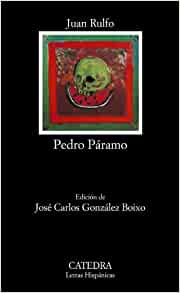
Pedro Páramo – Juan Rulfo (1987, trans. Margaret Sayers Peden 1993) 122 pages
I’m embarrassed to say I’d never heard of Pedro Páramo, as in the introduction to my edition Susan Sontag proclaims it “one of the masterpieces of twentieth century world literature”. Apparently it was huge influence on Gabriel García Márquez when he wrote 100 Years of Solitude. Eek, how have I not heard of it? I might have been intimidated had I known of its reputation, but as it was, I just picked it up because I thought it looked interesting and found all this out afterwards (I always read introductions at the end).
It opens with a man named Juan Preciado travelling towards an unknown town:
“I had come to Comala because I had been told that my father, a man named Pedro Páramo, lived there. It was my mother who told me. And I had promised her that after she died I would go see him.”
He meets a man who may be his brother, who tells him his father is both “living bile” and also dead, so he won’t be able to fulfil his mother’s wish to get what his father owes him.
Soon it becomes apparent that Pedro Páramo is not the only one who’s dead; Comala is a ghost town, filled with spirits of previous occupants. Juan can never be sure if anyone he meets is living or dead, and whether they are speaking of the present or the past.
As the various apparitions tell their stories the narrative moves back and forth across time and we learn of the events that led Comala to change from a thriving centre to a desolate no man’s land. Pedro is cruel and powerful, and that combination is devastating.
“the day you went away I knew I would never see you again. You were stained red by the late afternoon sun, by the dusk filling the sky with blood. You were smiling.”
I know a lot of people find magic realism off-putting, but I would urge you to give Pedro Páramo a try. The story of corruption and personal tragedy being acted out on the inhabitants of a town is grounded in a recognisable reality and the engaging story is easy to follow despite its complexity.
I know I’ve not said much about it here, but I really enjoyed discovering Comala alongside Juan so I don’t want to go into too much detail! The characters are intriguing and the story constantly surprising. Pedro Páramo is a richly detailed, mutli-layered novel that I’m sure will reward re-reading.
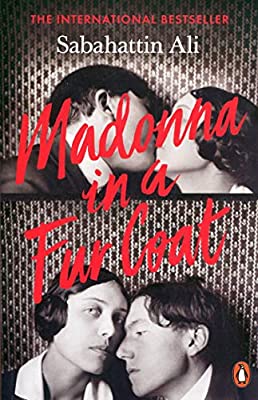
Madonna in a Fur Coat – Sabahattin Ali (1943, trans. Maureen Freely and Alexander Dawe 2016) 168 pages
Madonna in a Fur Coat is set mainly in Berlin, but is bookended by scenes in Ankara, so I’m counting it as another stop on my Around the World in 80 Books reading challenge, hosted by Hard Book Habit (who unfortunately don’t seem to be blogging any more). It feels a bit of a cheat to count it as Turkey but I’m so behind on the challenge that I’m taking a few liberties!
Continuing yesterday’s theme of an elegy for a young love affair, Madonna in a Fur Coat tells the romance of a Turkish man with a visual artist in 1920s Berlin. The novel begins in 1930s Ankara, where the narrator visits his unremarkable colleague at home, and is struck by the disregard his family show him.
“It seemed impossible that a man like Raif Efendi – what sort of man that might be, I had no idea, but I was sure he was not as he seemed – that a man like this would shrink away from those closest to him.”
He feels there must be more to his quiet colleague, who is fluent in German, than meets the eye.
“Why, when we are reluctant even to describe a wedge of cheese we are seeing for the first time, do we draw our final conclusions from our first encounters with people, and happily dismiss them?”
Raif knows he may die and so he asks the narrator to destroy a notebook, which of course the narrator reads. It was written ten years after the events it documents and describes how, as a young man, Raif stayed in Berlin to learn soap manufacturing, a career he is far from committed to. One day, visiting a gallery, he becomes mesmerised by a portrait of a woman in the titular garment:
“All I can say is that she wore a strange, formidable, haughty and almost wild expression, one that I had never seen before on a woman. But while that face was utterly new to me, I couldn’t help but feel I had seen her many times before.”
He visits daily to stare at the picture, and eventually meets Maria Puder, the woman who painted the self-portrait. They begin an intense, but largely platonic relationship. Raif is inexperienced and shy:
“If I ever met a woman I found attractive, my first thought was to run away.”
While Maria is determined and self-reliant:
“This all ends the moment you want something from me.”
My tolerance for young, earnest love affairs is pretty minimal, being old and sceptical myself 😀 Yet I was able to follow the relationship between Raif and Maria with interest because I wanted to see how it was that Raif ended up ill, poor and disregarded back in Ankara; and because Maria is a well-drawn woman rather than bland love object:
“I was only too aware that I still knew next to nothing about her. My judgements were formed of my own dreams and illusions. At the same time, I was absolutely sure they would not deceive me.”
Madonna in a Fur Coat is a sad tale of lives half-lived, of ill-advised restraint and missed opportunities. I didn’t find it depressing, but it’s certainly a melancholic and mournful read.
Kim from Reading Matters reviewed this novella back in January, you can read her excellent review here.
Lie With Me – Philippe Besson (2017, trans. Molly Ringwald 2019) 148 pages
(For those of you who have noted the translator’s name – yes, that Molly Ringwald!)
Lie With Me tells the story of a closeted gay love affair between two teenage boys living in small town called Barbezieux, in southern France. The narrator is looking back on his relationship with a slightly older boy called Thomas Andrieu (the novella is dedicated to a man of the same name, but Lie With Me is presented as fiction):
“I recently returned to this place of my childhood, this village that I hadn’t set foot in for years. I went back with S. so that he would know. The grid was still there with the ancient wisteria, but the lime trees had been cut down, and the school closed a long time ago.
[…]
‘It must have taken great determination to have lifted yourself out.’
He didn’t say ‘ambition’ or ‘courage’ or ‘hate’. I told him: ‘It was my father who wanted it for me. I would have stayed in this childhood, in this cocoon.’”
The narrator knows he is different to his schoolfriends, and he knows why. It isn’t because his father is the schoolteacher, or because he is physically awkward, although these things don’t help. It is because he is gay:
“In this one regard, I would stop being the model child. I wouldn’t follow the pack. Out of instinct, I despised packs. That has never changed.”
Thomas is older than him, a mysterious and much cooler boy who both fits in and holds himself aloof:
“He also likes his solitude. It’s obvious. He speaks little, smokes alone. He has this attitude, his back up against the wall, looking up toward the sun or down at his sneakers, this manner of not quite being there in the world.”
The narrator is interested in Thomas but he seems entirely unobtainable. It is Thomas who makes the first move:
“I feel this desire swarming in my belly and running up my spine. But I have to constantly contain and compress it so that it doesn’t betray me in front of others. Because I’ve already understood that desire is visible.
Momentum too, I feel it. I sense a movement, a trajectory, something that will bring me to him.”
Lie With Me follows their relationship from beginning to end. There is an elegiac quality from the older, now successful writer – openly gay, well-travelled and living a cosmopolitan urbane life – looking back, but there is no sentimentality.
Instead, there is a pervading sadness, even following the first time they sleep together:
“I should be able to stay in this state of ecstasy, Or astonishment. Or let myself be overwhelmed by the incomprehensibility of it all. But the feeling that prevails the moment he disappears is that of being abandoned. Perhaps because it is already a familiar feeling.”
In this Guardian article, Tessa Hadley felt Lie With Me suffered from not enough focus on Thomas. The characterisation of the lover is thin, but personally I felt this worked. The first throes of romantic love, especially teen romantic love, can be very much wrapped up in how exhilarating it is for the individual. The narrator is waking up to the possibilities of life, the possibilities of gay life, far away from his childhood town and its constraints, and I felt his self-focus worked well.
Lie With Me is a coming of age tale, with the narrator realising not only who he is as a gay man, but of all that he could be, reflected in his lover’s eyes:
“In the end, love was only possible because he saw me not as who I was, but as the person I would become.”
Those Without Shadows – Françoise Sagan (1957, trans. Irene Ash 1957)
I really wanted to include something by Françoise Sagan in NADIM this year, as I recently saw a repeat of Clive James’ Postcard From Paris on BBC4 which included a lovely interlude driving round the streets of the city with Ms Sagan. Why anyone would get into a car with her when she had the reputation for driving the way she did is beyond me, but I’m glad he did as it was very entertaining to watch from afar. I can’t get the clip but the whole episode is available on YouTube, and you can see the Sagan section from 2:35-6:36:
When I posted about The Suicide Shop I mentioned that other readers seemed to like it more than I did. I’ve had the opposite experience with Those Without Shadows (Dans un mois, dans un an). A quick search tells me this is not a popular read! Admittedly its not Bonjour Tristesse, but then so few books are 😉
Those Without Shadows was written four years after her classic work, when Sagan was still only 22. It follows a group of entirely vacuous Parisians as they live their lives without any purpose. I didn’t find it nihilistic though, I felt Sagan was treating her characters with amused affection.
The novel opens with Bernard ringing his lover Josée in the early hours of the morning, where her phone is answered by an unknown male voice:
“Now he was going home to find his bad novel lying in disorder on his desk, and his wife in bed asleep.”
His poor wife Nicole adores him, who knows why?
“After three years she loved him more every day, and this, he felt, was almost repulsive, for she no longer attracted him. He liked to remember the picture of himself when they had been in love, the decision he had shown in marrying her, for since that time he had never been able to make any decision at all.”
I thought that was so incisive, and so brutal. Bernard’s love for his wife (or lack thereof) is all about himself. He is repulsed by her because she no longer reflects the vision of himself he wants to see. The clarity of this dynamic is so believable and destructive.
This is echoed in Josée’s new relationship with a medical student, Jacques.
“It is really quite amusing. It’s not even a question of physical attraction. I don’t know if it is the reflection of myself in him that I like, or the absence of that reflection, or just him himself. But he is not interesting, he is probably not even cruel. He just exists”
Bernard and Josée are part of a group who congregate at the Maligrasse’s parties. Alain and Fanny Maligrasse like to surround themselves with younger people. Alain is “badly paid, cultured, and very fond of his wife. How had it happened that their joke about Béatrice had become the enormous weight he had to lift every morning as he got up?”
Béatrice was the character I liked least. Generally the people who inhabit this world are self-focussed but not deliberately cruel (Bernard tries to be kind to Nicole but generally fails through his own self-regard). Béatrice, desperate to be a successful actress, is happy to attract men to her as a distraction but really cares nothing for how hurt they get when she inevitably discards them.
Sagan doesn’t cut her characters any slack, but she does it through the judgements they place on themselves, which makes it more readable than if an authorial voice was constantly reminding us how dreadful they all are:
“He re-read it dispassionately and realised how bad it was; worse than bad, not merely tedious but intensely tedious. He wrote in the same way people cut their nails, attentively and absent-mindedly.”
I love that banal domestic detail of nails, next to ambitions for high art. While I can understand why people would not enjoy this novella, it was this sort of wry humour that meant I quite enjoyed it.
There are some decent people amongst the crowd too: Josée’s lover Jacques, Édouard who is provincial and naive and in love with Béatrice, and Jolyet, a theatre producer who is old enough to see himself clearly:
“as always when his own mediocrity was brought home to him, he felt a fierce sort of pleasure.”
So, definitely not one for when you need characters to root for, but as a quick, insightful portrait of pretentious and self-obsessed young things, I found it pretty enjoyable.
My post earlier this month on Not to Disturb by Muriel Spark led to a discussion on the questionable decisions made by Penguin’s art department in the late 1970s/early 80s. My copy of Those Without Shadows is another prime example:
“It was a symbolic awakening, but Édouard did not realise it. He did not know that his passion for Béatrice would henceforth be reduced to the contemplation of her back, We invent our own omens which seem bad when things are going against us. Édouard was not like Josèe who, waking at the same moment, looked at her lover’s smooth, hard back in the dawn, and smiled before going off to sleep again. But Josèe was a great deal older than Édouard.”
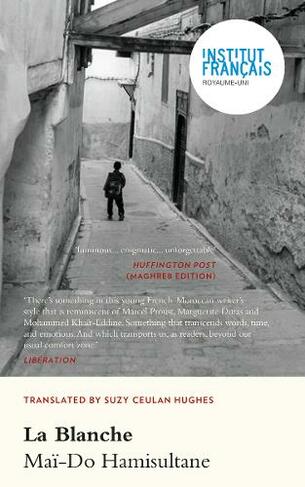
La Blanche is set largely in Casablanca, and so forms another stop on my much-neglected Around the World in 80 Books reading challenge, hosted by Hard Book Habit who sadly don’t seem to be blogging any more but it’s a great challenge so do join in if you can!
La Blanche is narrated by a young woman whose grandfather was murdered in their home in 1992. Along with her mother she flees Morocco to France, but following a painful break-up of a relationship finds herself heading back to the land of her birth.
“It rained heavily in the night. Torrential summer rain. I didn’t sleep a wink. Perhaps partly too, because I’m anxious about going back to Morocco. It’s as though I’d been bracketing off my childhood for years. Once I’d arrived in France I’d never thought about my childhood in Casablanca again. I’d left it all over there, apart from a little scrap of white paper, folded in four, that I always keep with me.”
The narrative moves back and forth across time, building a picture of her privileged childhood in Casablanca, the violence that shattered it, and the psychological fall-out from a disintegrating romantic relationship as an adult. This is handled expertly and is never confusing, blending together with ease to create a fully realised portrait of this young woman’s life.
The language is taut and every word placed carefully – hence this novella only comes in at 80 pages – but the story is in no way underwritten. Hamisultane has a startling and inventive way of writing, such as here, when the narrator awakes to realise her lover has left:
“It’s morning. The bed is empty. Light is flowing across the room. I close the shutters because I’m afraid it might flow straight though my body.”
It’s so impressive that La Blanche was a debut novel. The time shifts, language and characterisation are handled so deftly making for a satisfying and evocative read.
“My grandfather wakes me.
It is dawn.
He’s taking me out with him.
‘As quick as you can,’ he says to me. ‘While we can still see the morning dew beading the blooms on the rose bushes.’”
The Suicide Shop – Jean Teule (2007, trans. Sue Dyson 2008) 169 pages
It’s a funny one this. I only post about books I recommend and I do recommend this quirky, gothic, post-apocalyptic tale, but something stopped me loving it as much as some of Gallic Books other offerings.
The titular shop is run by the Tuvache family, who for generations have offered people ways to end their lives. They are mournful in nature and bleak in outlook, apart from Alan, the youngest Tuvache who is bad for business.
“please PLEASE stop smiling! Do you want to drive away all our customers? Why do you have this mania for rolling your eyes round and wiggling your fingers either side of your ears? Do you think customers come here to see your smile?”
Poor Alan’s schoolwork is no better, failing to capture the environmental desolation that humans live with:
“A path leading to a house with a door and open windows, under a blue sky where a big sun shines! Now come on, why aren’t there any clouds or pollution in your landscape? […] Where’s the radiation? And the terrorist explosions? It’s totally unrealistic. You should come and see what Vincent and Marilyn were drawing at your age!”
Alan and his siblings are named after famous suicides: Turing, van Gogh and Monroe. Vincent refuses to eat and is planning a grisly theme park where people can die in various inventive ways, Marilyn is depressed and feels ugly and cumbersome. They are a perfect fit for their family; only Alan resolutely forges his own path, despite living in a shop where the carrier bags state: “Has your life been a failure? Let’s make your death a success!”
There isn’t a plot so much in The Suicide Shop, rather we follow the family through the years as Alan proves an irresistible sunny force, exerting more influence over his family than they initially realise. Their bafflement with Alan reminded me of The Addams Family, (which I loved as a child), completely at a loss as to what to do with someone who doesn’t share their world view.
“We force him to watch the TV news to try and demoralise him”
As you’d expect, the humour in The Suicide Shop is very dark. It sells rusty razor blades with a sign that says “even if you don’t make a deep enough cut, you’ll get tetanus” but overall it’s a gentle humour, like the woman who grows attached to the trapdoor spider she buys to end her life, names it Denise and starts knitting it booties.
Looking on goodreads, there’s plenty of people who adored this story and I’m not entirely sure why I’m not one of them. But I still found The Suicide Shop a quick, diverting read with some entertaining touches.
“Life is the way it is. It’s worth what it’s worth! It does it’s best, within limitations. We mustn’t ask too much of life either. It’s best to look on the bright side.”
The Suicide Shop was made into an animated film in 2012, directed by Patrick Leconte. Here’s the English language trailer:
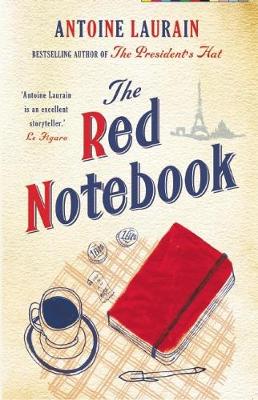
The Red Notebook – Antoine Laurain (2014, trans. Emily Boyce and Jane Aitken 2015) 159 pages
The Red Notebook walks a very thin line and I suspect for some readers it will have crossed that line, from whimsical romance at a distance, to creepy stalker tale. Looking at goodreads most seem to have gone for the former, and that’s how I read it too, but I’m not entirely unsympathetic to the latter view.
Anyway, I’ll put my psychological reservations to one side and let you know about a charming novella that conjures Paris beautifully, features a cameo from Patrick Modiano, and plays into that old romantic trope of lovers that are destined for one another.
Laure is a widow in her 40s who mugged for her mauve handbag and ends up in hospital in a coma. Bookseller Laurent – similar name, similar age to Laure – finds her bag after the mugger has dumped it having removed ID, purse and mobile phone. He tries to hand it in but police bureaucracy means he ends up holding on to it, trying to piece together the owner from its contents:
“a little fawn and violet leather bag containing make-up and accessories, including a large brush whose softness he tested against his cheek. A gold lighter, a black Montblanc ballpoint (perhaps the one used to jot down her thoughts in the notebook), a packet of licorice sweets…a small bottle of Evian, a hairclip with a blue flower on it, and a pair of red plastic dice.”
The titular notebook is part of the contents, and it is a diary which Laurent reads to try and find clues to who Laure is:
“I’m scared of red ants.
And of logging on to my bank account and clicking ‘current balance’.
I’m scared when the telephone rings first thing in the morning.
And of getting the Metro when its packed.
I’m scared of time passing.
I’m scared of electric fans, but I know why.”
Laurent has some success in piecing together Laure’s life, and in the process we learn about them both. Laurent has a teenage daughter who is brattish but loving, and a girlfriend to whom he’s not entirely committed. He likes his job and he’s interested in literature.
He’s also increasingly interested in Laure and a sequence of events lead to him collecting her dry cleaning and cat-sitting for her (!) It was at this point I thought things had gone too far, but then Laurain manages to tip the balance of power in a believable turn of events that meant the story kept me on side.
If you’re in the mood for some escapism across the channel and some gentle romance, then The Red Notebook could be just the ticket.
Monsieur Linh and His Child – Philippe Claudel (2005, trans. Euan Cameron 2011) 130 pages
I only knew Philippe Claudel as a film director until Emma’s review of Monsieur Linh and His Child put his work as a novelist on my radar. Do head over to Emma’s review as she has lots of interesting things to say about this novella. She also rightly pointed out it would be a perfect read for NADIM, so here it is!
Monsieur Linh arrives in an unspecified French port town as a refugee from an East Asian war. His son and daughter-in-law were killed, and he has fled with his baby granddaughter, Sang Diû.
“Six weeks. This is how long the voyage lasts. So that when the ship arrives at its destination, the little girl has already doubled the length of her life. As for the old man, he feels as if he has aged a hundred years.”
Monsieur Linh is a lonely and isolated figure. His fellow refugees cook for him but do so without any warmth or affection. He is deeply traumatised and lives only for his granddaughter.
One day, walking in the unfamiliar town with its cars, strange food, odd smells and a language he doesn’t understand, he meets Monsieur Bark, when they sit on the same park bench. Monsieur Bark is a widower who is grieving deeply for his wife. He smokes and talks incessantly, although Monsieur Linh cannot understand a word.
“When Monsieur Bark speaks, Monsieur Linh listens to him very attentively and looks at him, as if he understood everything and did not want to lose any of the meaning of the words. What the old man senses is that the tone of Monsieur Bark’s voice denotes sadness, a deep melancholy, a sort of wound the voice accentuates, which accompanies it beyond words and language, something that infuses it just as the sap infuses a tree without one seeing it.”
The language barrier does not mean that there is a lack of understanding between the two men. Claudel demonstrates without sentimentality how a true friendship develops between them, affectionate and accepting and full of meaning for both. These two deeply traumatised men are able to help each other heal in a way that is wholly believable and deeply moving.
Monsieur Linh and His Child is a wonderful, heartwarming story about the nature of unconditional love, friendship, and how we can help alleviate others’ pain without words. It’s about the humanity that bonds us all, and that is a timely reminder in today’s political climate. Highly recommended.
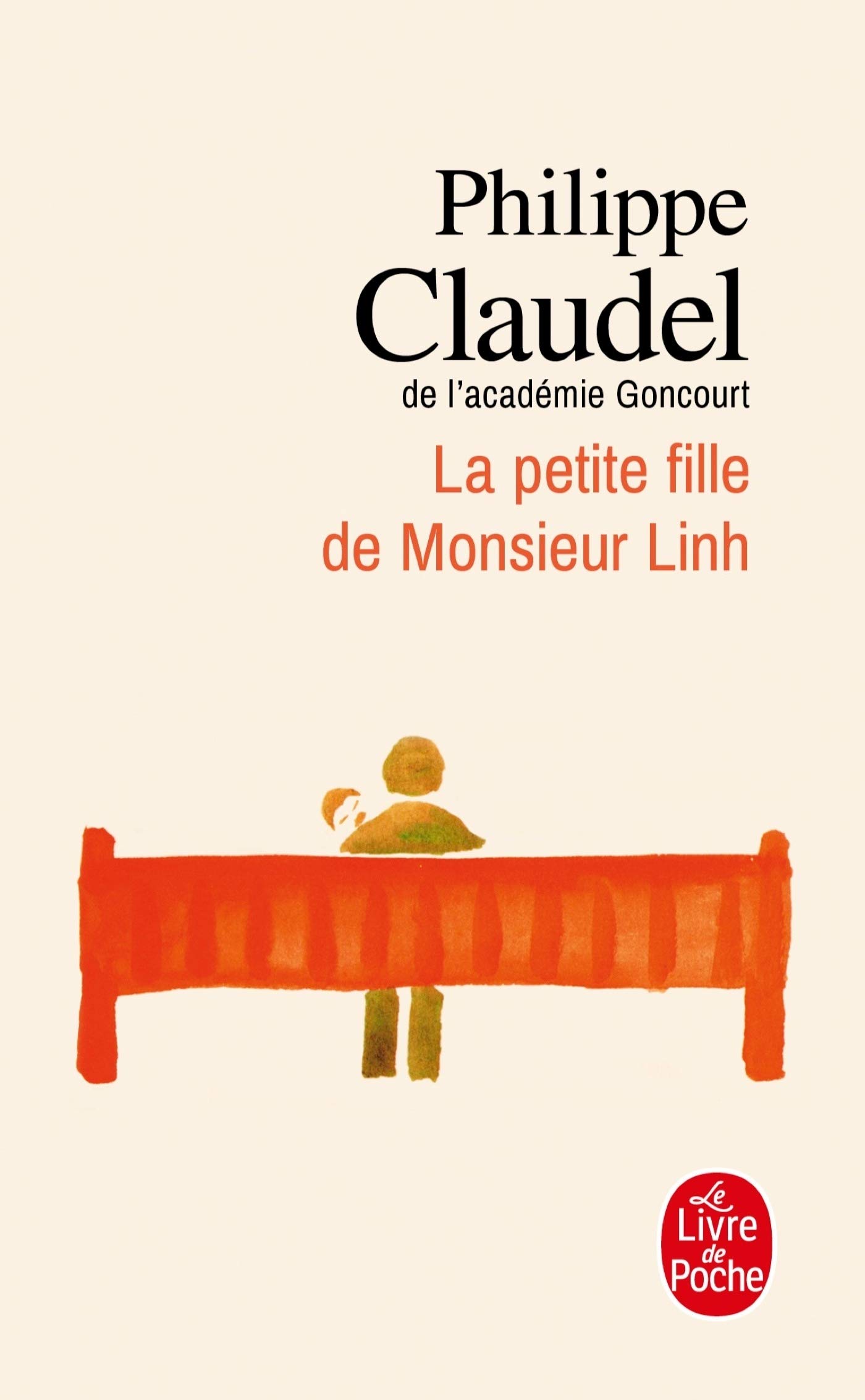
Here is the French cover, because as Emma rightly pointed out, the UK edition is ugly:
The Ten Loves of Mr Nishino – Hiromi Kawakami (1995, trans. Allison Markin Powell 2019) 195 pages
I really enjoyed the previous novels by Hiromi Kawakami that I’ve read, Strange Weather in Tokyo and The Nakano Thrift Shop, so I approached The Ten Loves of Mr Nishino with high expectations. Although this was still highly readable and full of well-realised, idiosyncratic characters, I didn’t find it quite as satisfying as the others. I think this is because I misunderstood the title. I thought Nishino was the subject and the Loves were the object. But, in having the Ten Loves tell their stories in individual chapters, it turns out they are the subject, Nishino the object – an enigmatic object who remains mysterious to the end.
This is not a novella about the romance of love, though it is about the impact of romantic encounters. Kawakami is interested in how people relate to each other and the effect that we have on people’s lives that we can’t recognise or fully comprehend. She’s not interested – at least not here – on rose-tinted explorations of romantic love. The first chapter is from the point of view of a married woman who has an affair with Nishino:
“What is love, really? People have the right to fall in love, but not the right to be loved. I fell in love with Nishino, but that’s not to say he was required to fall in love with me. I knew this, but what was so painful was that my feelings for Nishino had no effect on his feelings for me. Despite this pain, I longed for him more and more.”
We then go back in time to when Nishino was at school, and learn something of his painful past:
“A strange air drifted around Nishino. An air that none of the other kids in class had. I had the impression that, if I were to try and push that air around, there would be no end to it. The more I tried to push it, the deeper I would get caught up in it. And no matter how hard I pushed, I would never reach Nishino on the other side.”
Nishino is someone who is never without a partner, and sometimes these women overlap. The women’s perspectives on each other add to the narrative; one of his loves is stunningly beautiful, but we only learn this from his subsequent girlfriend, as the woman herself would never describe herself that way.
Despite his womanising, it is Nishino who comes across as vulnerable, much more so than the women, even when he causes them pain.
“I wanted to flee from Nishino as quickly as possible. This desire welled up from the bottom of my heart. I still couldn’t put my finger on what the sense of discomfort was – all I knew for sure was that it was present. And no matter how hard I tried, I simply couldn’t make it go away – that cold and awful uneasiness.
I wanted to flee. This simple thought flooded my mind. The same way that I had wished I could love him.”
Through ten very different women, we catch glimpses of Nishino but we never see him fully. This captures the central question of the novella: how much do we ever know another person? It’s not a bitter question though, or a desolate one. Rather it is one of compassion. I came away from Ten Loves… with a sense not of the importance of romantic love, but of kindness. Because at the point you touch another person’s life, you have no idea of what has gone before and what they carry with them.
It’s always with some trepidation that I embark on Novella a Day in May, as I’m never sure I’ll make it to the end. This year the feeling is even more marked, as with all that is happening in the world I’m finding it hard to read as well as write blog posts. But I do really enjoy NADIM, so I’m making a start and I’ll try not to berate myself if I don’t finish this year. Onwards!
I shouldn’t really worry about not feeling ready or particularly organised, as the world has a way of laughing at such endeavours. I read Convenience Store Woman a while ago and thought I’d get it written up well in advance of NADIM 2020. Then somehow the document got overwritten – and by somehow I mean I stupidly overwrote it – and I couldn’t recover it. So I’m writing this months after I initially read the novella. It speaks to its strength that even with my terrible memory I could recall how good it is and how much I enjoyed it.
Keiko is in her mid-thirties and has been working in a convenience store half her life. For all of her life, she has never fitted in:
“My parents were at a loss what to do about me, but they were affectionate to me as ever. I’d never meant to make them sad or have to keep apologizing for things I did, so I decided to keep my mouth shut as best I could outside home. I would no longer do anything of my own accord, and would either just mimic what everyone else was doing, or simply follow instructions.”
Within the highly ordered, routine environment of the Hiiromachi Station Smile Mart convenience store, Keiko finds her approach works well.
“For the first time ever, I felt I’d become a part of the machine of society. I’ve been reborn, I thought. That day, I actually became a normal cog in society.”
However, as a woman approaching middle-age, Keiko comes under pressure to become a different type of normal cog. She is always single, with no interest in sex. She will not be getting married or having children any time soon, and the job that was at first tolerated by others, is now thought odd as it is not a career. Her sister has helped by thinking up a lie she can use, that she has health issues that suit a part-time job, or elderly parents that need her support, but still Keiko finds herself coming under closer scrutiny for her life choices.
A new employee at the store, Shiraha, may offer a solution. He is a misogynist with ill-thought out social theories and is completely unlikable. However, if they live together, Shiraha gets a place to stay and Keiko can pretend to fit in. What could possibly go wrong?
Keiko is a truly unique character. She is detached to an almost disturbing extent – whacking a playmate over the head with a shovel as a child, idly wondering about knifing her nephew to keep him quiet. Ultimately though, she is a convenience store woman to her core:
“A convenience store is not merely a place where customers come to buy practical necessities, it has to be somewhere they can enjoy and take pleasure in discovering things they like. I nodded in satisfaction and walked briskly around the store checking the displays. […] I could hear the store’s voice telling me what it wanted, how it wanted to be. I understood it perfectly.”
Convenience Store Woman is funny and almost surreal in places, but it is also an incisive look at what it means to be a woman struggling to find a place of acceptance within a society that oppresses who she truly is.