Novella a Day in May #30

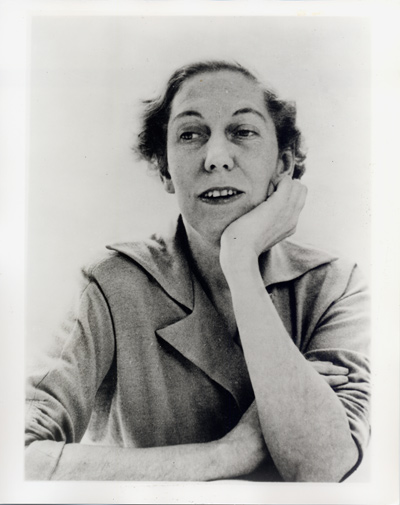
Yesterday I wrote about Eudora Welty, today I’m looking at a novella by her editor, William Maxwell. Maxwell was fiction editor at The New Yorker from 1936-1975 and a contributor until his death in 2000. He was editor to extraordinarily successful writers as well as a writer himself.

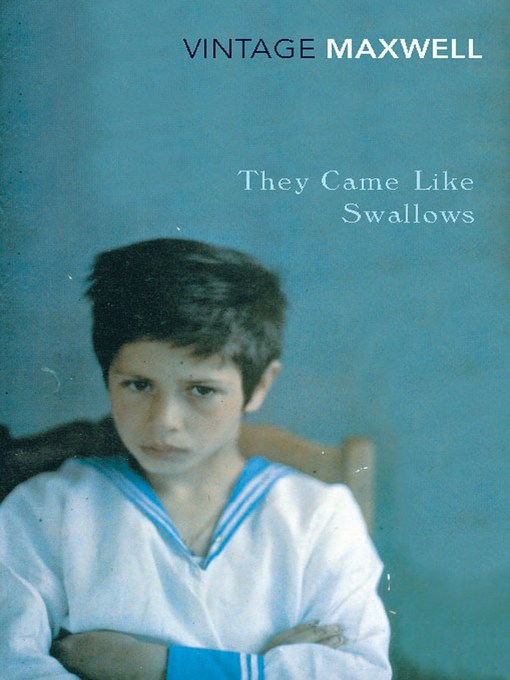
Image from here

I’ve abandoned the two novella posts I was ending this series with, because I loved this one so much I wanted it to have a post all to itself.

They Came Like Swallows (1937, 140 pages)

The title of this semi-autobiographical novella is taken from WB Yeats’ Coole Park:

They came like swallows and like swallows went,
And yet a woman’s powerful character
Could keep a Swallow to its first intent;
And half a dozen in formation there,
That seemed to whirl upon a compass-point,
Found certainty upon the dreaming air,

A woman’s powerful character is the central compass-point of this story. Elizabeth Morison is mother to Bunny and Robert, wife to James. The 3 parts of this novella are told from the point of view of each of the male members of the Morison family in turn.

It begins with Bunny, aged 8 and a sensitive child who takes things to heart, would prefer to be indoors than out, and suffers under his older, more rumbustious older brother. He is still of an age where his mother has the power to change everything and make it alright.

“Somewhere in the front part of the house a door opened so that his mother’s voice came up the stairs. A spring inside him, a coiled spring, was set free. He sat up and threw his covers to the foot of the bed. When he was washed and dressed he went downstairs. His mother was sitting at the breakfast table before the fire in the library.”

“While he stood waiting before her and while she considered him with eyes that were perplexed and brown, the weight grew. The weight grew and became like a stone. He had to lift it each time that he took a breath.

‘Whose angel child are you?’

By these words and by the wholly unexpected kiss that accompanied them he was made sound and strong. His eyes met hers safely.”

I thought Maxwell effectively captured a sense of childhood and just how hard it can be day-to-day, without ever lurching into sentimentality. He writes in a constrained way yet captures moments in their entirety; he shows the profound in the everyday.

That’s not to say he can’t be poetic, but it is a restrained poetry. When he chooses an image it is startling and evocative. Every word in this novella works hard, yet overall it flows with deceptive ease. I particularly liked this description of Robert reading:

“It began the way Robert liked books to begin, and by the second page he was submerged. The lamp cord was his only means of contact with the upper air. He clung to that, and shaped his words in silence as he read.”

Robert also adores his mother. Under Bunny’s point of view he seemed somewhat brutal, but in his section we learn how much he also relies on maternal love as he enters adolescence:

“With his mother Robert was almost never constrained or ill at ease. It seemed easy and natural for her to be talking about whatever was on her mind. She didn’t stop what she was doing. Hardly ever. And that way he felt free to tell her all sorts of things. Because he always knew she would go right on sorting the sheets and pillowcases.”

I’m about to go on to a massive SPOILER so skip the remainder if you don’t want to know, although I knew this at the start of They Came Like Swallows and it didn’t affect my enjoyment of it at all: Elizabeth Morison dies. She succumbs to the flu epidemic that swept through after the First World War, and so these 3 people are left reeling without their centre. Maxwell’s restrained style effectively captures the numbness of grief, and how the inexpressible is articulated in a society that does not encourage outbursts of emotion, particularly from men. James blames himself for taking his wife on a crowded train:

“He read the letters while he walked back and forth between the fireplace and the windows – read them over and over without retaining what he read. Then he threw envelopes and letters upon the library table and stood perfectly still, pressing his shoulder against the mantel.

For two days now (ever since they came into his room at daybreak to tell him) he had been getting on that train. And there was no way, apparently, that he could stop.”

I thought They Came Like Swallows was perfectly written. Part of what focussed me on novellas in the first place was exasperation at the baggy, overlong, overly-indulgent novels I kept coming across, that had me muttering to myself how they ‘needed a heavier edit.’ If Maxwell is an example of what happens when editors decide to write, more should do so.
Novella a Day in May #29

It’s thanks to this mini-project that I finally read Eudora Welty, as I had two of her novellas in the TBR. I’m glad I did, as the latter of these two has definitely whetted my appetite for more of her work.

Eudora-Welty-1962

The Robber Bridegroom (1942, 185 pages)

I enjoyed this reworking of The Brothers Grimm tale which Welty sets in eighteenth century Mississippi. Clement Musgrove arrives back home:

“As his foot touched the shore, the sun sank into the river the colour of blood, and at once a wind sprang up and covered the sky with black, yellow, and green clouds the size of whales, which moved across the face of the moon.”

With this foreboding change in the weather, he finds himself sharing a room with real-life keelboater Mike Fink, and Jamie Lockhart, a gentleman robber. Lockhart saves Musgrove’s life, and so is invited back to his home, which he shares with his horrible wife, who predictably is wicked stepmother to the beautiful Rosamond. Rosamond isn’t perfect though:

“As for Rosamond, she did not mean to tell anything but the truth, but when she opened her mouth in answer to a question, the lies would simply fall out like diamonds and pearls.”

The tale unfolds along familiar lines, with theft, mistaken identity, illicit love and people thought to be dead when they’re not, all in the surrounds of a forest. While I thought The Robber Bridegroom was vividly told and entertaining, I wasn’t sure what Welty was really doing with the tale. Rosamond is given sexual agency which would be a departure for many fairytales; and it’s grounded in a historical reality which adds to the mythology around the Southern states pre-Civil War. It’s an interesting tale but I felt Welty could have done more with it, pushed it a bit further into something truly original but still grounded in fable.

“The only thing that could possibly keep her from being totally happy was that she had never seen her lover’s face. But then the heart cannot live without something to sorrow and be curious over.”

The Ponder Heart (1954, 132 pages)

This, however, I adored. It featured a truly idiosyncratic, distinctive narrator and was funny, unsettling and compulsively readable.

Edna Earle Ponder lives in Clay County, Mississippi, and is proud of being a Ponder and running the town hotel. She is telling the tale of her Uncle Daniel to a silent interlocutor.

“I don’t run the Beulah Hotel for nothing: I size people up: I’m sizing you up right now. People come here, pass through this book, in and out, over the years – and in the whole shooting-match, I don’t care from where or how far they’ve come, not one can hold a candle to Uncle Daniel for looks or manners. If he ever did thing to be sorry for, it’s more than he ever intended.”

Her Uncle Daniel dresses all in white and has a tendency to give away money. His father tries to get him committed; Daniel has a lovely time in the institution and his father ends up committed instead. Then there is an ill-fated marriage to the wonderfully monikered Teacake Magee.

“As for Uncle Daniel, he went right ahead, attracting love and friendship with the best will and the lightest heart in the world. He loved being happy! He loved happiness like I love tea.”

Teacake Magee proves impervious to Uncle Daniel’s charms after 2 months and they split up (we’re never quite sure why) and then Daniel marries Bonnie Dee without his family knowing.

“I wish you could have seen Bonnie Dee! I wish you could. I guess I’d known she was living, but I’d never given her a real good look. She was just now getting her breath. Baby yellow hair, downy – like one of those dandelion puffballs you can blow and tell the time by. And not a grain beneath. Now, Uncle Daniel may not have a whole lot of brains, but what’s there is Ponder, and no mistake about it. But poor little Bonnie Dee!”

And from this marriage the trouble starts. Welty builds her story expertly: you know something bad has happened, you don’t quite know what, by whom or to whom. As it is revealed, it is totally believable and an awful comic tragedy, told in the inimitable style of Edna Earle.

“I’m the go-between, that’s what I am, between my family and the world. I hardly ever get a word in for myself.”

She’s vain and arrogant about her position as a Ponder; she looks down on people and is racist; she’s appalling in lots of ways but Edna Earle spins a good yarn.

“What Uncle Daniel did was just bestow his [love] all around quick – men, women and children. Love! There’s always somebody wants it. Uncle Daniel knew that. He’s smart in way you aren’t, child.”

I was truly sorry to leave The Ponder Heart behind.

Novella a Day in May #28

If I was being facetious (which I never am 😉 )I might compile a Jean Rhys checklist:

  • Heroine is displaced, either in France from the Caribbean or in England from Caribbean and/or France
  • She is emaciated and constantly on the brink of starvation
  • For some reason, getting a regularly-paid job never occurs to her
  • And so she has casual employment as a model/actress/any job vaguely associated with sex work in the early 20th century
  • She uses men for financial gain and is in turn used by them
  • She has a judgemental landlady
  • She owns at least one piece of really expensive clothing left over from a better time
  • She self-medicates with alcohol
  • She is highly sensitive but weirdly passive, so things don’t generally go well

Not including Wide Sargasso Sea, this seems to be the form things generally take in a book by Rhys. Yet I’m happy to keep reading her because she writes with such precision and insight, and at moments is capable of absolute brilliance. Here are two novellas by her.

Images from here and here

Quartet (1928, 144 pages, originally published as Postures) is a fictionalised account of Rhys’ affair with Ford Madox Ford.

“ ‘I bet that man is a bit of a brute sometimes,’ thought Marya. And as she thought it, she felt his hand lying heavily on her knee.”

Marya’s husband Stephan has been put in prison for fraud and she is left alone in Paris. She seems to have been both aware and unaware of the nature of his business.

“Stephan disliked being questioned and, when closely pressed, he lied. He just lied. Not plausibly or craftily, but impatiently and absent-mindedly. So Marya had long ago stopped questioning. For she was reckless, lazy, a vagabond by nature, and for the first time in her life she was very near to being happy.”

She will bring this dissonance into the affair that she has with a man named Heidler. On the one hand she seems to know that she is being manipulated not only by him but by his wife Lois. On the other hand she still seems to plunge into this situation, living with them both and sleeping with Heidler, making  herself both materially and emotionally vulnerable. A lot remains unexplained. We’re not entirely sure why Marya does what she does, although Rhys suggests, as she does in her other writing, that morals are a luxury not everyone can afford.

“Poverty is the cause of many compromises.”

Marya may also have done it just for the sheer hell of it. Heidler and Lois seem to have no redeeming qualities whatsoever, and so it could be that Marya wanted any experience rather than a mundane existence:

“Her life swayed regularly, even monotonously, between two extremes, avoiding the soul-destroying middle.”

Certainly this may explain why she falls in love with Heidler when he seems so thoroughly horrible.

Quartet is morally ambivalent; Marya seems deeply unhappy for the entire book and she is powerless, so it is hard to judge her even though I felt frustrated at her seeming lack of agency. Rhys simply presents people and situations, and asks the reader to assign their own values.

“The value of an illusion, for instance, and that the shadow can be more important than the substance.”

Quartet was adapted into a film in 1981 by Merchant Ivory. I’ve not seen it but the cast is stellar:

Secondly, Voyage in the Dark (1934, 159 pages). Anna is freezing in England, unable to acclimatise after a life spent in the Caribbean. She is orphaned and earning a living as a chorus girl in a touring theatre company. Life is a procession of dingy B&Bs and while she gets used to England, she misses home:

“the smell of streets and the smells of frangipani and lime juice and cinnamon and cloves, and sweets made of ginger and syrup, and incense after funerals or Corpus Christi processions, and the patients standing outside the surgery next door and the smell of the sea-breeze and the different smell of the land-breeze.”

She meets an older man, Walter, and they begin a relationship. Although she is not being manipulated to the extent of Marya in Quartet, Anna is also powerless in the relationship. She is young, naïve and penniless; Walter is none of these things.

“Perhaps I’m going to be one of the ones with beastly lives. They swarm like woodlice when you push a stick into a woodlice home. And their faces are the colour of woodlice.”

When the relationship breaks down, Anna spirals into despair. She drinks too much, is depressed and has to seek a backstreet abortion.

“I stopped going out; I stopped wanting to go out. That happens very easily. It’s as if you had always done that – lived in a few rooms and gone one to another. The light is a different colour every hour and the shadows fall differently and make different patterns. You feel peaceful, but when you try to think it’s as if you’re face to face with a high, dark wall.”

It’s difficult to say why I don’t find Rhys utterly bleak. Her protagonists are always despairing, but I think for most there is hope. They cling onto something, and while that may be an entirely unsuitable lover or a destructive circumstance, they have a determined streak, even if they allow themselves to be buffeted by forces they could have easily avoided. Rhys is also a writer that constantly brings me up short with startling images, like this one of trying to communicate with a lover who won’t listen:

 “It was like letting go and falling back into water and seeing yourself grinning up through the water, your face like a mask, and seeing bubbles come up as if you were trying to speak from under the water.”

Reading these two novellas means I’ve now read all of Rhys’ novels and short stories and I’m truly sorry to have reached the end. She may only have one main theme, but it is a richly explored one that rewards careful reading.

Novella a Day in May #19

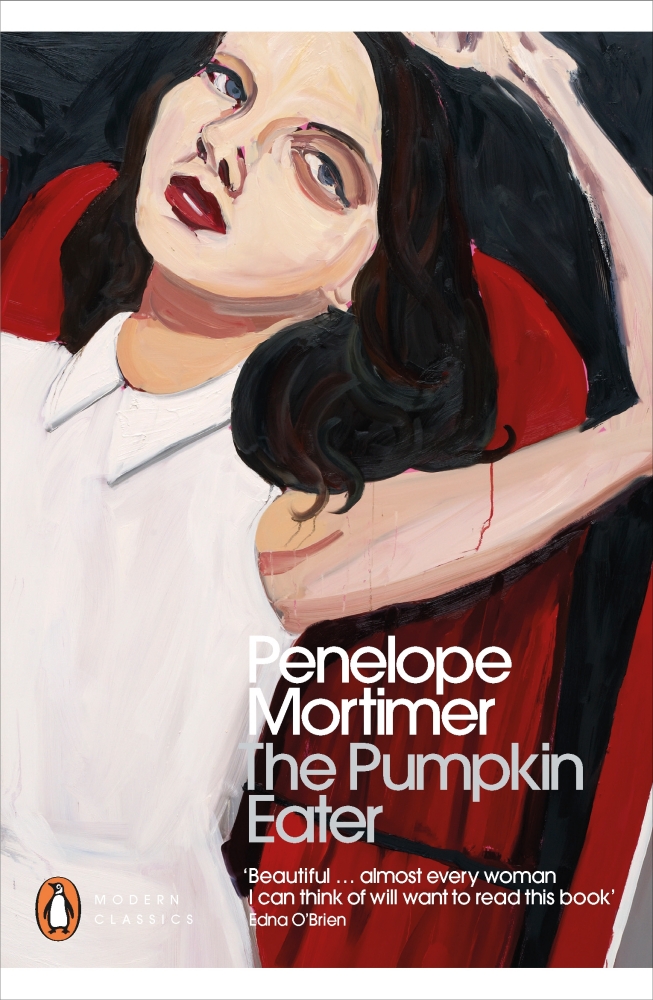
The Pumpkin Eater – Penelope Mortimer (1962) 144 pages

The Pumpkin Eater begins with a woman speaking to her psychiatrist, a silent interlocutor with whom she reflects on the pressures her unhappy marriage exerted on her mental health. We come to know her as Mrs Armitage, wife of a successful screen writer, Jake Armitage, who is selfish and unfaithful. Although Mrs Armitage has been married before, she feels as trapped in this marriage as any 1960s wife who would be reluctant to ask for a divorce.

“It must have been then, I think, that Jake and life became confused in my mind, and inseparable. The sleeping man was no longer accessible, no longer lovable. He increased monstrously, became the sky, the earth, the enemy, the unknown. It was Jake I was frightened of; Jake who terrified me; Jake who in the end would survive. He rolled over, his mouth slightly open, and began to snore.”

Mrs Armitage lives in London while they are building a big glass tower of a family home in the countryside. Jake frequently travels, leaving her with their ever-increasing number of children.  As tensions between them increase, Mortimer brilliantly portrays  “the complex, subtle and occasionally tragic conversations which are the last resort of communication between men and women.”

It is thought that this novel was semi-autobiographical, detailing the disintegration of the author’s marriage to John Mortimer, and it is absolutely scathing in its treatment of the male protagonist:

“His eyes were still quite empty, and I realised now that they never changed, even in love.”

However, Mortimer does not just tear Jake/John apart, The Pumpkin Eater is better than that. She is interested in the destructiveness of human relationships, with those we claim to love.

“We should have been locked up while it lasted, or allowed to kill each other physically. But if the choice had been given, it would not have been each other we would have killed, it would have been ourselves.”

I’ve made this sound heavier than it is; I think Mortimer writes this unflinching dissection of a marriage with a heavy dose of bone-dry humour. Ultimately, The Pumpkin Eater is, if not exactly optimistic, about how we survive such pain and how it possible to endure.

 “I began, very tentatively, to believe in myself. It was as though I were feeling my own face with my fingertips in the dark.”

Novella a Day in May #4

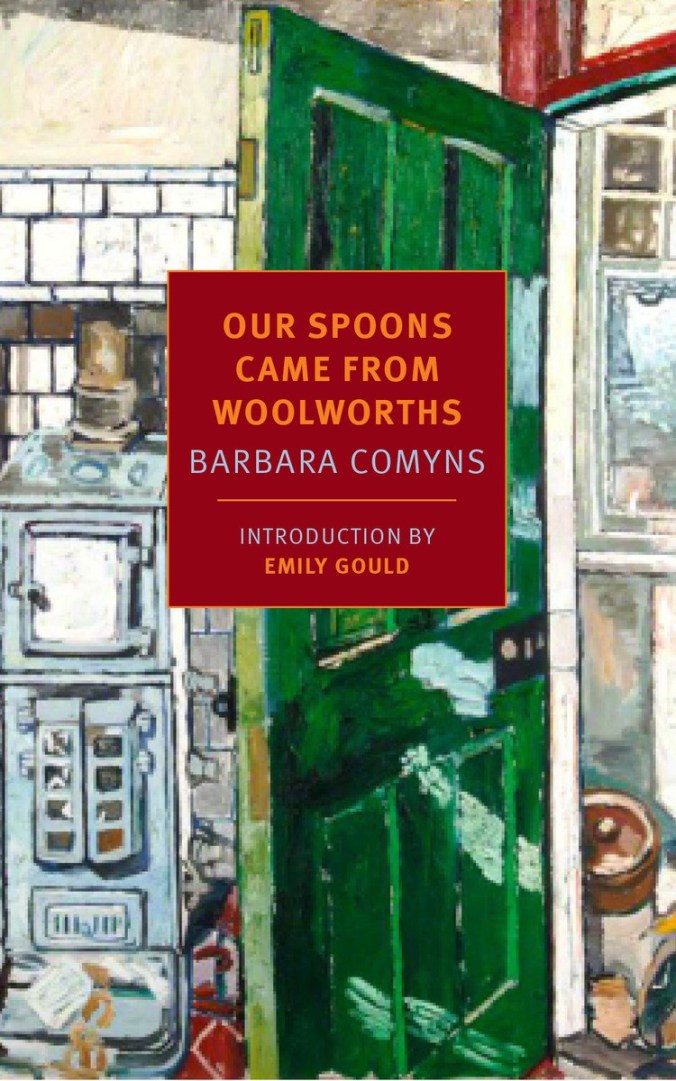
Our Spoons Came From Woolworths – Barbara Comyns (1950, 195 pages)

Our Spoons Came From Woolworths is the first Barbara Comyns I’ve read, attracted by the whimsical title and it being a Virago. I’m so glad I picked this up. Our Spoons Came From Woolworths was a compelling read, and not nearly as whimsical as I had assumed.

our_spoons_cover_image_2048x2048

The NYRB edition

It tells the story of Sophia’s marriage at a young age to Charles, an artist, in the 1930s. They are painfully naïve, and Charles especially has no idea about money:

“He said Eva had told all her relations about the coming baby, and they had asked him masses of questions about how he was going to support a wife and family. They had given him some money, though, four pounds in all. I was glad to hear this as we only had one golden guinea left in the dresser drawer, but my gladness did not last long, because it turned out he had already spent the money on some paints, brushes, books and an enormous walnut cake from Fullers.”

With the arrival of the baby, the poverty becomes even more pressing. Charles is monumentally selfish and self-absorbed, but not quite despicable. He’s just clueless and self-centred, and this means his actions are inadvertently cruel.  Although the situation is quite desperate, Comyns’ voice is matter-of-fact and never asks for sympathy.  There is a light, almost surreal humour present:

“Charles said he had borrowed some money to send telegrams to his relations saying we had a boy of six ounces. I told him it was six pounds not ounces, but he said a few pounds either way wouldn’t make any difference. But Charles’ telegrams caused a huge sensation, and his family was most disappointed when in due course they discovered we had quite a normal baby.”

But the humour always highlights the bigger picture, such as Charles’ disregard and disinterest in his children. While Comyns is unsentimental, this does not mean she is unaware of the power of her story. She has plenty to say about the role of women in interwar Britain and the hypocrisies that meant they were expected to marry and then make the best of it, with little means of support beyond their husbands. She also shows how this is bound up in sexual politics, with male infidelity so much more accepted than female, yet women deserving an equal right to happiness:

“Some time later, when I realised I had been unfaithful, I didn’t feel guilty or sad, I just felt awfully happy I had had this experience, which if I had remained ‘a good wife’ I would have missed, although, of course, I wouldn’t have known what I was missing. I felt quite bewildered. I had …been a kind of virgin all the time. I wondered if there were other women like this, but I knew so few women intimately it was difficult to tell.”

The story is also an indirect plea for a welfare state. What Sophia and her children endure would not be life-threatening after the end of the Second World War, with a social safety net established to protect them from absolute destitution and starvation.

But I worry now I’ve made Our Spoons Came From Woolworths sound very heavy, which it isn’t. Comyns knows how to say serious things with a lightness of touch that is quite remarkable.  You’re not left in any doubt as to Sophia’s desperation, but it remains a hopeful novel about human resilience. It’s generally thought to be thinly-disguised biography (Comyns was married to the painter John Pemberton between 1931-5 and had two children with him) and Comyns makes her point about these types of stories – concerning women and poverty – desperately needing to be heard at a time when no-one really wanted to listen, in deadpan comic style:

“This book does not seem to be growing very large although I have got to Chapter Nine. I think this is partly because there isn’t any conversation. I could just fill pages like this:

‘I am sure it is true,’ said Phyllida.

‘I cannot agree with you,’ answered Norman.

‘Oh, but I know I am right,’ she replied.

‘I beg to differ,’ said Norman sternly. That is the kind of stuff that appears in real people’s books. I know this will never be a real book that business men in trains will read, the kind of business men that wear stiff hats with curly brims and little breathing holes in the side. I wish I knew more about words.”

Although I understand from other bloggers that Comyns’ other novels are very different, I am now officially an ardent fan.

Image from here

Novella a Day in May #2

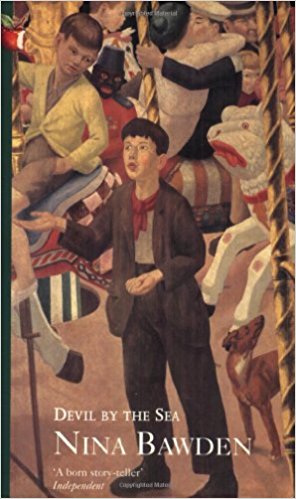
Devil by the Sea – Nina Bawden (1976, 192 pages)

When I was a child I loved Nina Bawden’s books, particularly The Peppermint Pig and Carrie’s War, which a read and re-read. For some reason though, I never picked up her novels for adults. Ali has been championing her writing over on her blog Heavenali, and this prompted me to dig Devil by the Sea out of the Virago TBR (yes, the TBR is so humungous now there are TBR sub-piles) and give it a read.

I’m happy to say that Bawden is just as wonderful writing for adults as she is for children. This creepy, tightly plotted tale is a compulsive read with plenty to say about human relationships – particularly those between adults and children – and the nature of feeling Other. It begins:

“The first time the children saw the Devil, he was sitting next to them in the second row of deckchairs in the bandstand. He was biting his nails.”

The children are Hilary and Peregrine. They are not happy, carefree children; Bawden would never be that patronising in her portrayal of young people. Instead, Hilary is jealous and angry, and can be petty. Peregrine is religious and anxious. They live in a seaside town all year round and it is holiday season. Their half-sister is having an affair with a vain married man who does not love her. Their father and step-mother are under-involved in the children’s lives. Their Auntie beachcombs and keeps the rotting fish she finds. Into all this comes a man they believe is the devil.

“The man turned and looked at them. A shadow crossed his face: like an animal, he seemed to shrink and cringe before the mockery Hilary had made of him […] He continued to watch her with a steady, careful stare. She fumbled in the pocket of her cotton dress. Her voice croaked with embarrassment.

‘Would you like a toffee?’

The man looked beyond her to Peregrine. Briefly, their eyes met. Peregrine could not look away, he was transfixed. The man’s eyes were dark and dull, dead eyes without any shine in them. They reflected nothing.”

A child with the unfortunate moniker of Poppet goes missing, and Hilary saw the man lead her away.

“Poppet’s picture was in the middle of the front page and Hilary looked at it with interest….She read the first few lines beneath the picture and a dark veil came down over her eyes. Her heart beat wildly in her throat. Something cold and evil menaced her from the shadowed corners and for a while she crouched quite still, as if afraid to wake a sleeping beast.”

The fact that this evidence is not easily voiced for the situation resolved is due to the misunderstanding and myth-making of children; the obliviousness and myopia of adults; the fear of everyone.

Despite being a gothic tale in many ways, Devil by the Sea is wholly believable. This is not least because Bawden is not interested in making her characters likable, but rather real, complex, flawed and fascinating. It is creepy and captivating and deeply unsettling. On the strength of this, I will definitely be reading more of Bawden’s adult fiction, not least because I was lucky enough to win The Birds on the Trees in Ali’s giveaway last year 🙂

“Courage calls to courage everywhere, and its voice cannot be denied.” (Millicent Fawcett)

Today is the 100th anniversary of the 1918 Representation of the People Act in Britain receiving Royal Assent, which enabled all men and some women over the age of 30 to vote for the first time (it would be another 10 years before women got equal voting rights). There are lots of events going on this year to commemorate the centenary, but it’s also worth noting that the suffragettes argued for equal pay for equal work, and yet 100 years later (last week) Carrie Gracie has been giving evidence to MPs over pay discrimination at the BBC. This is just one example. The fight for equal rights worldwide is ongoing.

Suffragettes,_England,_1908

For this post I’ve picked one novel written by a suffragette and a short story from the twentieth-first century portraying suffragettes.

Firstly, No Surrender by Constance Maud (1911), who was a member of the Women Writers Suffrage League. I read a crusty copy from the library which had that pleasing old book smell, but Persephone have published it as one of their beautiful editions too, and if you’re on a book-buying ban like me, they also offer it as a free e-book.

Maud looks at suffrage primarily through the story of young cotton mill worker Jenny Clegg. Jenny Clegg’s father has all the power in their home while her mother does all the work:

“Her voice took on its usual apologetic tone with her lord and master. For Mrs Clegg was imbued with a spirit of such humility that she apologised not only for rising early and late taking rest, while fulfilling her manifold obligations towards her mate, such as bearing and raising his ten children, cooking, washing, mending, cleaning for the family, but even for her very existence up to the age of fifty-five in this strenuous service without pay.”

Mr Clegg squanders the money earned by the women in his family such as Jenny. He is selfish but supported by law and society in his behaviour:

“Mr Clegg regarded his daughter sternly, but without wrath. He answered her in measured tones, strong in his sense of his impregnable position, backed as he felt himself to be, not only by the law of the land, the tradition of generations, his own physical force and intrinsic superiority of sex, but by the innermost conviction and consent of all right-thinking womankind.”

Jenny’s political awareness is given direction when she encounters Mary O’Neil, a moneyed society girl who rebels against her class’ expectations of her and supports the suffragettes. There is humour in her mother’s friend Lady Walker’s attitudes towards her own gender:

“ ‘Can you suppose for one moment that a man like Horace Boulder, or even Penhaven, would have been attracted, had Helen or Cicely shown a tendency to independent interests and original thought?’ “

There were plenty of women against the suffragettes, and Lady Walker’s dismissal of them as “ ‘hysterical, unsexed creatures, with a mania against men.’” was not unusual. The character provides some much needed levity, but is never presented as ridiculous, as this internalised misogyny had a major impact on the lives of women at the time, helping maintain the limitations of their rights and freedoms.

Maud covers the main events of the movement up until that time, and uses various scenarios to get across the arguments of women’s suffrage: speeches from carriages, dinner party conversations, arguments between lovers. This is both the strength and weakness of the novel. No Surrender is an issue-lead novel, despite Maud placing a romance between Jenny and Joe Hopton, Labour party candidate, as the driving plot. As such, it sometimes falters under the weight of its intentions. Much as I dislike Dickens, he is an absolute master at dramatising his social commentary. Maud is not so gifted and sometimes No Surrender is overly didactic, with poorly realised characters and a sentimental tone. But I must stress that this is not all it is. It is also able to dramatise how:

“Courage, self-abnegation, forethought, invention, and a keen sense of humour marked the tactics of the militant movement.”

bringing a unique, personal perspective to balance the reportage (and lack thereof) regarding the movement. While at times I found the characterisation of the working classes a bit ‘gor blimey guv’nor’ (or perhaps I should say ‘ee by gum’ as its northern stereotypes) it’s still commendable that Maud roots the story in the working classes, and shifts the focus from the middle class suffragettes.

 “’there’s a good many ladies who’d be doin’ far more good in the world if they thought more about their womanhood and less about their ladyhood’”

So all in all, a flawed novel but a fascinating one, written contemporaneous to the movement by someone who was directly involved.


Secondly, A Mighty Horde of Women in Very Big Hats, Advancing, the final and longest story in the short story collection The Apple by Michel Faber (2006), in which he revisits the characters and setting of his hugely successful novel The Crimson Petal and the White. I’m going to ignore the links to TCPATW to avoid spoilers for those who haven’t read it (it’s great – you should definitely read it!)

The story is narrated by an elderly man in a nursing home in the 1990s, recalling his life when he was very young, with his artist father, bohemian mother, and Aunt Primrose (who dresses in men’s clothes and shares a bed with his mother, but the menage a tois arrangement is never explicitly stated).

“You know, because I was a child in what’s now called the Edwardian era, and because I was born the day Queen Victoria died, I always think of the Edwardians as children. Children who lost their mother, but were too young to realise she was gone, and therefore played on as before, only gradually noticing, out of the corners of their eyes, the flickering shadows outside their sunny nursery. Shadows of commotion, of unrest. Sounds of argument, of protest, of Mother’s things being tossed into boxes, of fixtures being forcibly unscrewed, of the whole house being dismantled.”

Amongst this change, there is a conflict between old and new which is obvious to the small child on a daily basis:

“Bureaucrats, tradesmen, doctors, postmen, parsons, waiters, porters, the whole pack of them; they ignored my mother and Aunt Primrose, and directed their remarks to my father.”

But he is a preoccupied artist and it is the women who drive the lives of the household, with energy, fun, and strong political convictions:

“She an Aunt Primrose worked as a kind of music hall duo, Mama getting by on charm and disarming honesty, while Aunt Primrose supplied the sardonic touch. My father was – if you’ll excuse what’s definitely not meant as a pun – the straight man.”

The story culminates on Women’s Sunday, the Hyde Park rally of 21 June 1908 which was the first major meeting organised by the WSPU. A Mighty Horde of Women in Very Big Hats, Advancing covers a great many themes in its 60-plus pages: being part of stories we can’t fully comprehend, the flawed nature of memory, how history is made, the need to attach a narrative to our lives looking back. Faber is a brilliant storyteller, able to cover all this within a driving plot, authentic voice and lightness of touch. He’s said he won’t write any more since publishing Undying in 2016 following the death of his wife, and I sincerely hope he changes his mind. All the stories in The Apple were highly readable, they worked individually, as a whole, and as a sort-of sequel to TCPATW. He’s a great writer.

To end, a silly portrait of a suffragette but not one I can dismiss because it was probably the first time I learnt what a suffragette was:


“The 1920s were a great time for reading” (Bill Bryson)

A little while ago I wrote about Sarah Water’s The Paying Guests, her novel set in the 1920s, which I took refuge in as I was trying to grow my hair into a bob (well, it made sense at the time). Rest easy reader, I know you must have been worrying about it, but a friend proclaimed this weekend that my hair looks most definitely bob-like so I’m walking around like a fabulous flapper:

tumblr_nafgvzuguE1qbuqcio1_r1_500

Maybe not. But regardless, to celebrate I’m looking at two novels from the 1920s, as recommended by Sarah Waters at the end of The Paying Guests. Choosing from the list of ten was a serious business, involving shortlists, consulting with various bookish types, taking votes…. OK, I just picked the two I had on my TBR mountain 🙂

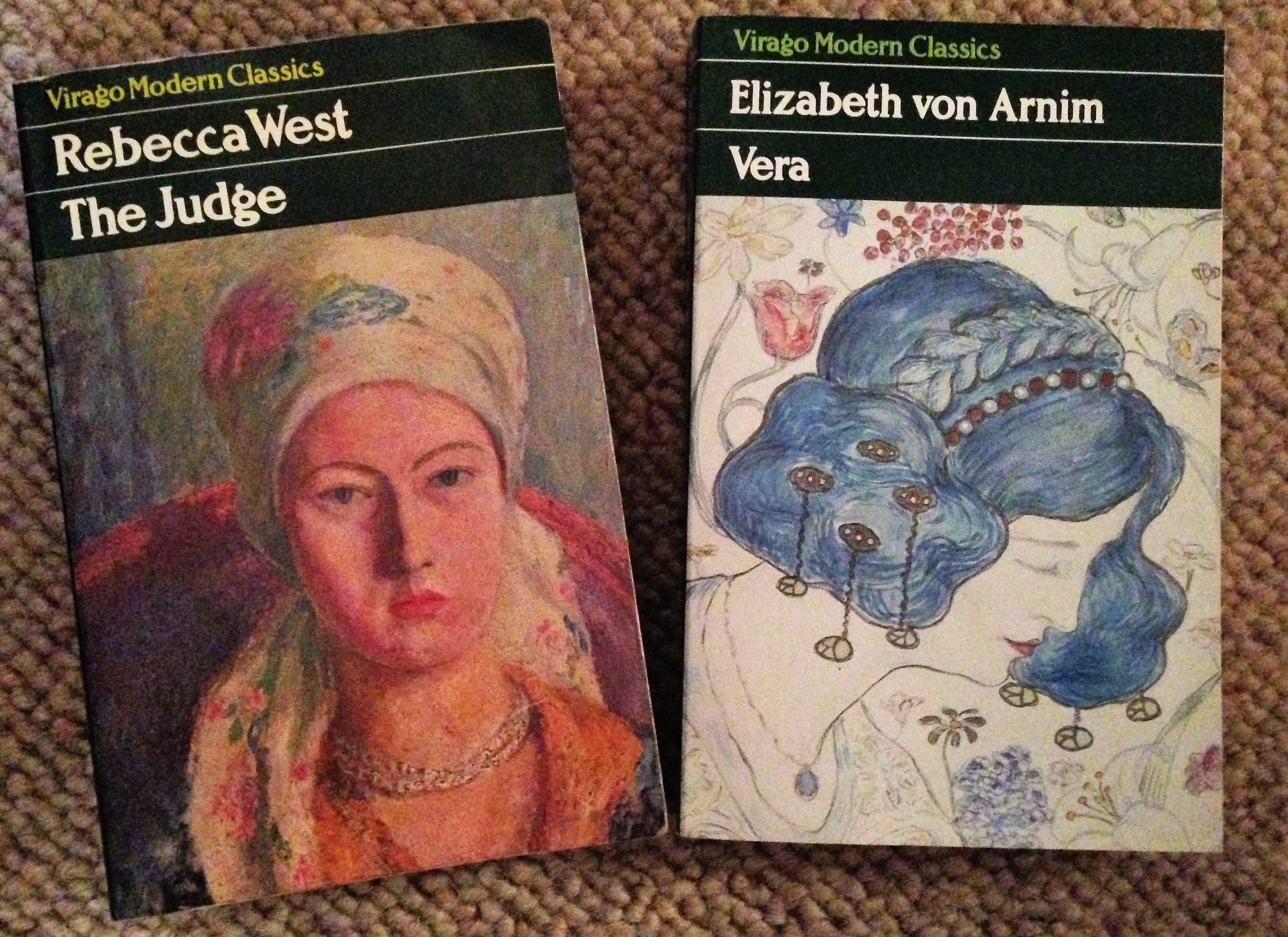
Firstly, The Judge by Rebecca West (1922) which Sarah Waters describes thusly: “Suffragism, illegitimacy, motherhood, melodrama: like lots of West’s fiction, this is sprawling, brilliant, funny – and a little bit crazy.” The story begins in Edinburgh, where Ellen, nineteen years old, beautiful and a suffragette, meets Richard Yaverland:

“For sufficient reasons he was very sensitive to the tragedies of women, and he knew it was a tragedy that such a face should surmount such a body. For her body would imprison her in soft places: she would be allowed no adventures other than love, no achievements other than births.”

Later in the story it will emerge what those sufficient reasons are, but against her better judgement Ellen falls in love with worldly, handsome Richard.

“She was not sure that she approved of love. The position of women being what it was. Men were tyrants, and they seemed to be able to make their wives ignoble. Married women were often anti-Suffragists; they were often fat; they never seemed to go out on long walks in the hills or write poetry.”

Alongside this humour and Ellen’s naivety “I will have nothing to do with any man until I am great. Then I suppose I will have to use them as pawns in my political and financial intrigues” West does have something serious to say about relationships between the sexes at that moment in time. The Judge presents detailed character studies of Ellen, Richard and his mother Marion, and how society has influenced the nature and capacity of their love. This is not a rose-tinted view of young marriage by any means.

“Perhaps something like fear would have come upon her if she had known how immense he felt with victory; how he contemplated her willingness to love him in a passion of timeless wonder, watching her journey from heaven, stepping from star to star, all the way down the dark whirling earth of his heart; and how even while he felt a solemn agony at his unworthiness he was busily contriving their immediate marriage. For there was a steely quality about his love that would have been more appropriate to some vindictive purpose.”

 The second half of the novel sees Ellen leave Edinburgh to live with Richard and his mother in the Home Counties. More emerges about the circumstances of Richard’s illegitimacy and subsequently complex family dynamics. It is at this point that the melodrama mentioned by Sarah Waters really starts to ramp up. I think it’s here that the novel may start to lose readers, but although it begins to spiral somewhat, I still thought the novel had a lot to say about women’s position and the ramifications of moral absolutes. Marion and Richard have a relationship Freud would have found great mileage in, teetering on the edge of impropriety. Ellen is understandably somewhat befuddled by this brittle woman and her weird family, but she decides they suit her:

 “The rapidity with which she had changed from the brooding thing she generally was, with her heavy eyes and her twitching hands perpetually testifying that the chords of her life had not been resolved and she was on edge to hear their final music, and the perfection with which she had assumed this bland and glossy personality at a moment’s notice, struck Ellen with wonder and admiration. She liked the way this family turned and doubled under the attack of fate. She felt glad that she was going to become one of them, just as a boy might feel proud on joining a pirate crew.”

The Judge is somewhat overblown, but I enjoyed it for that reason – sometimes it’s nice to indulge in a bit of mad melodramatics alongside the serious issues.

IMG_0702

Secondly, Vera by Elizabeth von Arnim (1921) which Sarah Waters describes as “a brilliant depiction of a sinister, suffocating marriage, this novel also features one of the most likeable spinster aunts in British fiction.” Sinister is right: this is a very different tale to the delightful The Enchanted April. Definitely not escapist, Vera is rather one of those novels where you want to reach into the book, yank out one of the characters and shake them until they listen to you, the older, wiser reader. Maybe I get over-involved in my reading…

Lucy Entwhistle, young and naïve, finds herself almost alone in the world after her beloved father dies. Blundering into her grief moments after the death is the older, good-looking Wemyss, also grieving a loss, as his wife has recently died in possibly murky circumstances:

“‘How good you are!’ she said to Wemyss, her red eyes filling. ‘What would I have done without you?’

‘But what would I have done without you?’ he answered; and they stared at each other, astonished at the nature of the bond between them, at its closeness, at the way it seemed almost miraculously to have been arranged that they should meet on the crest of despair and save each other.”

Vera is extremely clever, as at first we don’t like Wemyss, but like Lucy’s beloved spinster Aunt Dorothy, it’s not totally clear why: “whatever she felt about his legs she welcomed him with the utmost cordiality”. The more time he spends with Lucy, the more unpleasant he reveals himself to be – a wholly self-centred, arrogant, ignorant bully. Aunt Dorothy is wise enough to realise that if she registers her objections, it will only push Wemyss and Lucy closer together, and so she keeps quiet, though distressed, as she watches the tragedy unfold.

“His way of courting wouldn’t be – she searched about in her uneasy mind for a word, and found vegetarian. Yes; that word sufficiently indicated what she meant: it wouldn’t be vegetarian.”

Von Arnim’s lovely humour stops the tale being bleak, but it is a tense tale, increasingly so after Wemyss and Lucy marry less than a year from the death of the titular wife. The scales begin to fall from Lucy’s eyes:

“One learns a lot on a honeymoon, Lucy reflected, and one of the things she had learned was that Wemyss’s mind was always made up.”

But Lucy doesn’t realise the extent of what is going on in her marriage. We are living at a time of fourth-wave feminism, and in a post-Freudian world, so I would say Lucy is in a psychologically abusive marriage with a narcissistic, megalomaniac sadist who seeks to destroy her.  But she cannot see it.

“the mood of tender, half-asleep acquiescence in which, as she lay in his arms, he most loved her; then indeed she was his baby…You couldn’t passionately protect Vera. She was always in another room.”

Wise Vera.  There is a glimmer of hope, and that hope is the wonderful Aunt Dorothy. Never underestimate the clear-sighted spinster Wemyss, you have no idea who you’re dealing with.

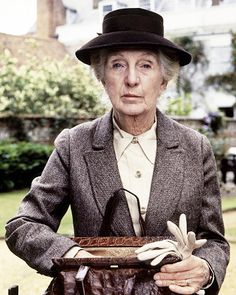
Joan Hickson, the greatest Miss Marple - 5 points if you can spot the wardrobe malfunction in this picture

Joan Hickson, the greatest Miss Marple – 5 points if you can spot the wardrobe malfunction in this picture

Image from here

Vera is a brilliantly written psychological study of the dangers for women in a society that seeks to position them as economically and socially dependent on men, particularly when this dependency is wrapped up in romantic notions. It made me furious and it made me sad. It also made me glad that although we have some way to go, I live where my rights as a woman are enshrined in law.

To end, what Lucy needs is a Lesley Gore classic cranked up to 11, sung by the perennially awesome feminist icon Joan Jett:

“Going underground, going underground” (The Jam)

There were a few blissful weeks over the summer when everyone took their kids on holiday and my commute to work was almost bearable, because it was done with approximately two-thirds less people than usual.  Now those halcyon days are well and truly behind us and everyone’s back at work, I thought I’d try reading about public transport to see if it fills me with new-found affection for my early morning travel.  Given that I’m reading during said commute, with my book touching my nose and my head wedged into someone’s armpit, there’s still some way to go, despite the efforts of some wonderful staff.

tumblr_mrdrouoRed1r09qfio5_r2_250

Firstly,  Murder Underground by Mavis Doriel Hay. This was the first of Hay’s three crime novels, and is part of the British Library Crime Classics re-issues, which I completely adore. I love these so much I even bought one full-price the other day, rather than waiting for them to turn up in charity bookshops, which is something I never do.  This could be the start of a slippery slope….

book-tunnel-11287160032j7BO

The wonderfully-monikered Miss Euphemia Pongleton is found strangled by her own dog leash on the stairs of Belsize Park station (for those of you who know the Misery Northern line – see, it can get worse – you could be dead).   Suspicion falls on her wastrel nephew Basil Pongleton, whom she was constantly inheriting and disinheriting:

“It’s awfully difficult to explain and I had a ghastly time with the police yesterday. Wonder they didn’t arrest me right away, but they’re keeping an eye on me. I noticed a fishy-looking fellow with police-feet lounging opposite my window in Tavistock Square this morning”

The dialogue is definitely part of the appeal of golden age detective fiction for me, it’s just wonderful. While Basil is dithering around making matters worse, his eminently more sensible cousin Beryl tries to unravel the mystery.  Miss Pongleton lodged at the Frampton Hotel, and each of the eccentric fellow boarders has their part to play.  My favourite was Mrs Daymer:

“a middle-aged lady who liked to accentuate the gaunt strangeness of her appearance by unfashionable clothes. She would explain proudly that they were of hand-woven material…perhaps their intimate connection with the sheep justified their particular unwieldiness”

Mrs Daymer, who gives off a smell of wet sheep in the rain, is unperturbed by the murder as she writes crime fiction and likes to “suck [people] dry” for her novels. Between her and Beryl, they manage to piece together what happened.  This being the golden age, there is a missing will, confusion over some pearls and an obese terrier (ok, so that last one isn’t really a trope but I had to give him a mention). Murder Underground is not the most taxing mystery (I’m useless at guessing who done it, and even I got this one quite early) but it’s a great example of this period in detective fiction, and very readable.

Swift2_2108266i

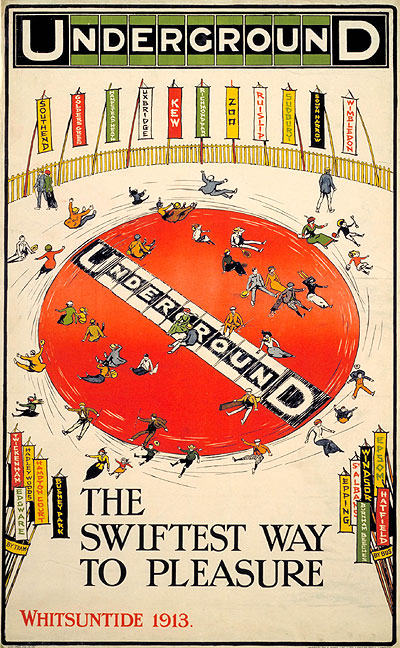
If only this poster was right… unfortunately I find it the swiftest way to passive-aggressive tutting, both given and received.

Secondly, Metroland by Julian Barnes. I don’t always get on with Julian Barnes.  I can see he’s a highly accomplished writer, but I find him coldly intellectual and distancing.  However, in Metroland I think he does capture something about a certain time in late adolescence and the wish for a brave new world. Christopher and his friend Toni live in the suburbs at the tail end of the Metropolitan line, and wish they didn’t:

“Toni and I prided ourselves on being rootless. We also aspired to future condition of rootlessness, and saw no contradiction in the two states of mind; or in the fact that we each lived with our parents, who were, for that matter, the freeholders of our respective homes.”

Yes, Christopher and Toni are hugely pretentious snobs.  They desperately wish to be French, which leads them into unintentionally hilarious scenarios like trying to be flaneurs along Oxford Street.  They also talk about art with a capital A:

“Art was the most important thing in life, the constant to which one could be unfailingly devoted and which would never cease to reward; more crucially it was the stuff whose effect on those exposed to it was ameliorative.”

Oh dear.  But in case you’re wondering why on earth you would want to spend any time in this idiot’s company,  I do think it’s worth it.  As I said, I find Barnes can be cold, but actually his portrait of Christopher is quite affectionate, and although you laugh at his pretentions, he’s not contemptible, just young and striving for something different to that with which he has grown up.  Christopher gets his wish and moves to France, but of course he doesn’t quite end up living the life he imagined. Metroland is about how its not always a disaster to not achieve your dreams, and how ordinary can also equal happy.

To end, a wonderfully British reaction to an unusual happening on the tube (for those of you not of these isles, rest assured that the response from passengers at the end is actually a huge outpouring of unconditional enthusiasm, I promise you):