“Everything alters, yet does remain the same.” (Anthony Powell)

This is the eighth instalment in my 2024 resolution to read a book per month from Anthony Powell’s A Dance to the Music of Time sequence. Published between 1951 and 1975, and set from the early 1920s to the early 1970s, the sequence is narrated by Nicholas Jenkins, a man born into privilege and based on Powell himself.

The eighth volume, The Soldier’s Art, was published in 1966 and is set in 1941.Unlike the previous few novels, this only had three chapters, the middle one depicting Nick’s leave in London, bookended by his experiences in the army while still billeted in Northern Ireland.

As I mentioned in the previous volume’s post, Nick doesn’t really fit in with army life. But he doesn’t particularly labour on this, or feel sorry for himself. I enjoyed this exchange when he runs into Bithel again:

“’Told me you were a reader – like me – didn’t you?’

‘Yes I am. I read quite  a lot.’

I no longer attempted to conceal the habit, with all its undesirable implications. At least admitting to it put one in a recognisably odd character of persons from whom less need be expected than the normal run.”

In this volume I felt I saw a much fuller picture of Nick’s touchstone Widmerpool. Is machinatious a word? If it isn’t, the character of Widmerpool suggests it should be, because his machinations inform his behaviour through and through.

Nick is acting as his secretary, desperate to get away.

“Indeed, it was often necessary to remind oneself that low spirits, disturbed moods, sense of persecution, were not necessarily the consequences of serving in the army, or being part of a nation at war, with which all inclusive framework depressive mental states now seemed automatically linked.”

Nick manages to stay out of Widmerpool’s connivances due to the latter’s egomaniacal need for control. However, he can observe his senior officer’s behaviour at much close quarters than before, including:

“An amateur soldier in relation to tactical possibilities, and … a professional trafficker in intrigue”

“[My] incredulity was due, I suppose, to an underestimation, even after the years I had known him, of Widmerpool’s inordinate, almost morbid self-esteem.”

By the end of the novel Widmerpool is moving on, and I had a horrible feeling that by the end of this novel sequence he might be Prime Minister…

Another of Nick’s schoolfriends is present in the company. Stringer, maintaining his sobriety, turns up as a mess waiter.

“Friendship, popularly represented as something simple and straightforward – in contrast with love – is perhaps no less complicated, requiring equally mysterious nourishment”

Stringer is an intriguing character, with a deep sense of sadness about him. We’ve never learnt what led him to self-medicate with alcohol, and now he is sober he seems to have an extreme resignation to life. He seems too equanimous, knowing no joy. I find him quite haunting.

In the middle chapter Nick uses his leave to visit friends in London. His wife Isobel and young child get a passing reference. If I was Isobel I’d be mightily annoyed that my husband spent his army leave in Blitz-torn London rather than in the country with his newly-expanded family, but maybe she’s more tolerant than I am.

This middle section was hugely moving. Powell conveys the tragedy of war, of lives cut short without warning. Of the senseless waste and cruel arbitrariness of it all. He does it all with understatement which perfectly drives home the horror, and how this became a regular occurrence for so many. It was an astonishing chapter.

It is in army life that Powell finds his comedy and satire. This was probably the most sad, most moving, and most silly and funny of all the volumes I’ve read so far.

I particularly enjoyed a completely daft dinner scene between two Colonels, one called Eric, one called Derrick. Powell uses the rhyming names to full effect, having both of them end their sentences with the other’s name, as they engage in a furious, but politely mannered argument.

“Both habitually showed anxiety to avoid a junior officer’s eye at meals in case speech might seem required. To make sure nothing so inadvertent should happen, each would uninterruptedly gaze into the other’s face across the table, with all the fixedness of a newly engaged couple, eternally enchanted by the charming in appearance of the other.”

There’s also Nick’s experience of inciting the wrath of a General, when he admits he doesn’t like Trollope and prefers another author:

“‘There’s always Balzac, sir.’

‘Balzac!’

General Liddament roared the name. It was impossible to know if Balzac had been a very good answer or a very bad one.”

The more I read of this sequence the more impressive I find it. Powell’s wit, humanity, clear-sightedness, and ability to balance the various aspects of life are really extraordinary. And he does it all with such a light touch.

“All the same, although the soldier might abnegate thought and action, it has never been suggested that he should abnegate grumbling.”

To end, I’m feeling quite smug for working out that I can shoehorn in an 80s pop video by choosing one by some of the Blitz Kids (and fair to say 80s pop videos did not generally follow an Anthony Powell-esque light touch 😀 ):

“Literature illuminates life only for those to whom books are a necessity.” (Anthony Powell)

This is the seventh instalment in my 2024 resolution to read a book per month from Anthony Powell’s A Dance to the Music of Time sequence. Published between 1951 and 1975, and set from the early 1920s to the early 1970s, the sequence is narrated by Nicholas Jenkins, a man born into privilege and based on Powell himself.

The seventh volume, The Valley of Bones, was published in 1964 and is set at the start of World War Two, when Nick has joined the army as an officer.

I’ve said when reading previous novels in the sequence that I’m intrigued by Nick’s outsider’s view, as it’s not clear where it comes from since he seems so much a part of the society he portrays. In the army, the distinction is clearer. Nick finds himself billeted to South Wales within a company made up mostly of bankers, very different to his bohemian artsy London life.

“I indicated that I wrote for the papers, not mentioning books because, if not specifically in your line, authorship is an embarrassing subject for all concerned.”

Nick casts his sharp eye over these new associates in the same way he has for his friends, family and acquaintances up to this point. A central character is Captain Rowland Gwatkin, a man who seems simultaneously devoted to the army and entirely bewildered by it too:

“Gwatkin lacked in his own nature that grasp of ‘system’ for which he possessed such admiration. This deficiency was perhaps connected in some way with a kind of poetry within him…Romantic ideas about the way life is lived are often to be found in persons themselves fairly coarse- grained.”

Gwatkin is really tightly wound, and there is a sense of impending doom at best, destruction at worst with him.

Nick is an indifferent soldier, neither very good nor absolutely awful. There is some consideration of philosophical theories of war, but primarily Nick is interested in those who surround him:

“It is a misapprehension to suppose, as most people do, that the army is inherently different from all other communities. The hierarchy and discipline give an outward illusion of difference, but there are personalities of every sort in the army, as much as out of it.”

Powell brilliant portrays the simmering tensions in the company, both from the mix of personalities attempting to work together within and the increasing threat from Hitler without. There are those with alcohol problems, death by suicide, and broken hearts, yet the days mostly pass in utter tedium. Nothing changes even after the company is uprooted to a posting to Northern Ireland:

“At Castlemallock I knew despair. The proliferating responsibilities of an infantry officer, simple in themselves, yet, if properly carried out, formidable in their minutiae, impose a strain in wartime even on those to whom they are a lifelong professional habit; the excruciating boredom of exclusively male society is particularly irksome in areas at once remote from war, yet oppressed by war conditions.”

As Adjutant Maelgwyn-Jones observes: “That day will pass, as other days in the army pass.”

Yet there is some light relief too, such as an inspection from a visiting General, seemingly obsessed with breakfast foodstuffs:

“The General stood in silence, as if in great distress of mind, holding his long staff at arm’s length from him, while he ground it deep into the earth the surface of the barnhouse floor. He appeared to be trying to contemplate as objectively as possible the concept of being so totally excluded from the human family as to dislike porridge.”

And Nick does get some weekend leave in order to catch up with his family. There he finds people thrown together, behaving oddly and under strain. In other words, not so very different from his army posting. As his pregnant wife Isobel observes: “the war seems to have altered some people out of recognition and made others more than ever like themselves.”

In The Valley of Bones Anthony Powell shows himself uninterested in the glorification of war or in any sort of jingoism. He also doesn’t fall into the trap of a wholly satirical, detached point of view either. He manages a delicate balance between conveying the seriousness of war alongside the human inadequacies and frailties of those expected to enact it.

He also pulls an absolute masterstroke at the finish. The boredom, the admin, the essentially unthreatening – if somewhat self-destructive – colleagues are turned upside down in an instant, and Nick finds himself carried forward, powerless in a situation about which he has a deep sense of foreboding. It’s a chilling ending and I’m anxious to see how it plays out in the next volume, The Soldier’s Art.

“In the army – as in love – anxiety is an ever present factor where change is concerned.”

To end, a song absolutely synonymous with wartime Britain for many, which seems particularly apt for Nick as he’s always running into people he met previously:

“The good ended happily, and the bad unhappily. That is what Fiction means.” (Oscar Wilde, The Importance of Being Earnest)

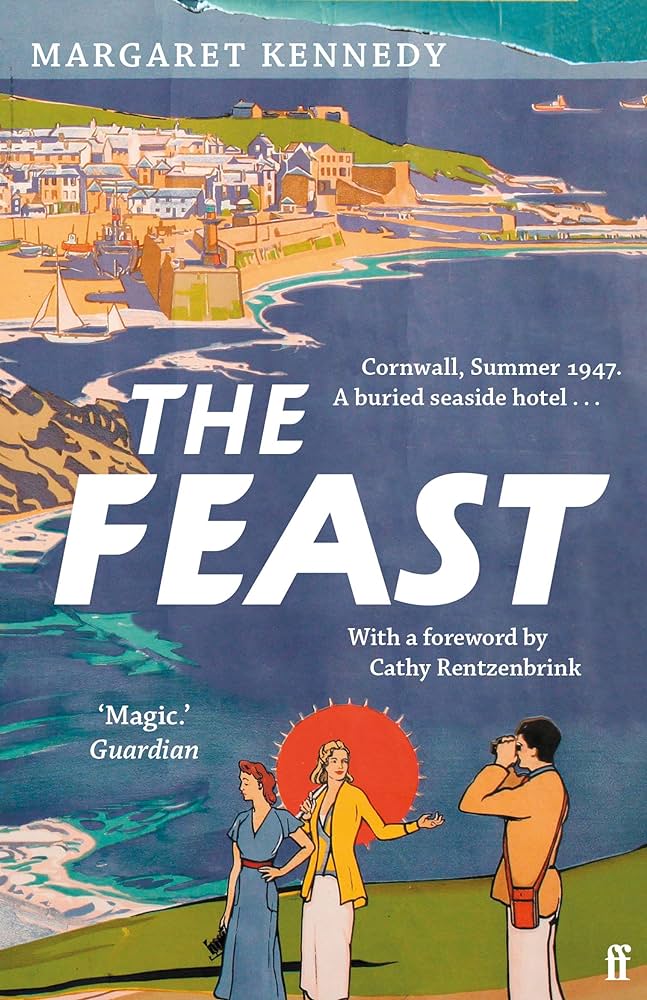
Summer seems to have finally arrived here in the UK, for a few days at least 🙂 So I thought I would post about a summer read which I really enjoyed recently. The Feast by Margaret Kennedy was published in 1950 and it’s set in 1947. Republished by Faber in 2021, they’re definitely marketing it as a summer read:

To describe the premise of The Feast is to do it a disservice in a way, because it sounds so trite and contrived. But I promise you that Kennedy is such a skilled writer that it works beautifully.

She sets it up the plot enticingly in the prologue. Two clergyman are holidaying together, but one of them has to work. Within Reverend Bott’s Cornish parish, there has been a catastrophe. A cliff has subsided into the sea, burying Pendizack Manor hotel and several of its inhabitants. Others escaped as they were at the titular picnic at the time, and they’ve told him quite a story… we then go back to seven days before the event to meet all the guests and staff who were there in run-up to the disaster.

It’s here that the overarching contrivance occurs – among the characters are representations of the seven deadly sins. We have the guests: Lady Gifford as greed; Mrs Cove as covetousness; Mrs Lechene as lechery; Canon Wraxton as wrath; and Mr Paley as pride. Amongst the staff we have owner Mr Siddal as sloth and housekeeper Miss Ellis as envy. Some of these characters are monstrous in their behaviour and yet Kennedy always keeps them recognisably human.

Lady Gifford is comparatively benign, albeit entirely self-serving, self-pitying and unconcerned with the impact she has on her family. Her husband no longer loves her, and the holiday brings their marriage to breaking point:

“For a few minutes he could not reply. At last he said, “I shall never live with you again. There’s nothing in life you value more than your saucer of cream.”

“Why shouldn’t I? I can afford cream. Why shouldn’t I go to live where the cream is?”

“I won’t live with you any more. You’re not human.”

Lady Gifford closed her eyes and lay back upon her pillows. Hard words break no bones, as both of them knew very well. He left her and went downstairs.”

While the Gifford’s children are disregarded, Mrs Cove actively wishes her children harm. She is one of the most disturbing characters in the book, neglecting her children to the point of abuse. As her daughter Blanche reflects:

“She did not love her mother. None of them did, nor had it ever occurred to them that they ought to do so. She had never asked for their affection. But neither did they criticize or rebel against her. She pervaded and ruled their lives like some unpropitious climate, and they accepted her rule as inevitable, evading its harshness by instinct rather than by reason. […] Nothing of importance had ever been said to them in their mother’s voice and many characters in their favourite books were more real to them than she was. They seldom thought about her.”

The younger members of the Gifford and Cove families join forces and provide some solace – and danger – for each other.

“The children vanished, rising up like a flock of starlings immediately after luncheon and betaking themselves to some hidden place. They retired into their own world, as children will when their elders misbehave. Bewildered, unable to judge, they turned their backs upon the ugly memory.”

Meanwhile, among the adults, alliances are forged and romances begun. The biggest change occurs in Canon Wraxton’s brow-beaten daughter Evangeline. At the start of the novel she has deeply worrying habit:

“Perhaps it was a waste of time, to grind up glass with a nail file, but surely nothing worse? Because she would never use it, she would never do anything wicked with it. And that little pill box full of powdered glass was such a relief to possess. They said it could never be detected in a person’s food…It was a very powerful little treasure, that box. She kissed it sometimes.”

But she develops a really touching friendship with Mrs Paley, whose marriage to the prideful Paul is utterly dead, and things start to change for them both:

They found a comfortable little hollow in some heather close to the shelter and lay upon their backs, side by side, watching the stars come out and discussing the best way to make the tea ration last. Neither felt the least impulse, just then, to confide in the other. But they knew what united them. They were a little astonished at themselves and inclined to giggle, as women will when they embark upon some daring adventure.”

But if I’ve made The Feast sound very dark, I’ve done it a disservice. Kennedy doesn’t shy away from the worst of human nature and her astute characterisation makes the behaviour all too real. But there are lighter moments too. Those of you who dislike historical fiction might enjoy Mr Siddal’s description of Anna Lechene’s craft:

“She writes well. Everybody does nowadays. She writes this biographical fiction, or fictional biography, whichever you like to call it. She takes some juicy scandal from the life of a famous person, and writes a novel round it. Any facts that don’t suit her go out. Any details she wants to invent come in. She’s saved the trouble of creating plot and characters and she doesn’t have to be accurate because it’s only a novel, you know.”

I also enjoyed this description of Sir Henry’s politics, breaking up a tense scene:

“Everybody seemed to be very angry. They were saying many things which Sir Henry himself had thought during the course of the day, but with which he now began to disagree. For he was a Liberal – the kind of Liberal which turns pink in blue surroundings and lilac at any murmur from Moscow.

In Pendizack Lounge he inclined to pink.”

The tension in the narrative occurs precisely because the reader knows what is going to happen and as the portraits of the various characters built over the week, I really hoped some of them ended up under the cliff while others survived!

The Feast is an enjoyable, compelling read with plenty to say and plenty to entertain.

To end, an English PEN event took place when Faber re-released The Feast. The discussion is really interesting particularly in giving some wider context around Kennedy’s writing:

“Love is at once always absurd and never absurd.” (Anthony Powell)

This is the sixth instalment in my 2024 resolution to read a book per month from Anthony Powell’s A Dance to the Music of Time sequence. Published between 1951 and 1975, and set from the early 1920s to the early 1970s, the sequence is narrated by Nicholas Jenkins, a man born into privilege and based on Powell himself.

The sixth volume, The Kindly Ones, was published in 1962 and is set around the start of World War Two. This felt a bit of a departure from previous volumes in some ways. We learn a lot more about Nick in this novel; he features much more directly in his own narrative. Powell also shockingly almost approaches a plot in The Kindly Ones, confounding my expectations 😀

The volume starts by looking back in time, with Nick remembering his childhood at Stonehurst, just before World War I broke out. My favourite character from At Lady Molly’s makes a reappearance: General Alymer Conyers, proving himself good in a crisis and kind to those who need it most.

He is visiting Nick’s parents, and I was interested to learn more about them. They are presented with the same clear-sighted economy with which Powell treats so many of his characters, which I found striking in consideration of close family. Nick doesn’t seem to like his father particularly, but there is no rancour or resentment there either:

“’I like to rest my mind after work,’ he would say. ‘I don’t like books that make me think.’

[…]

The one thing he hated, more than constituted authority itself, was to hear constituted authority questioned by anyone but himself. This is perhaps an endemic trait in all who love power, and my father had an absolute passion for power, although he was never in a position to wield it on a notable scale.”

Powell has a knack of presenting his characters with discernment, but without the heavy moral judgement which would make the volumes pretty unreadable. It’s an intelligent, sensitive approach and I think it contributes to writing that is so of its time still managing not to date badly.

It’s hard to see where Nick’s objectivity and distance from his entirely conventional upbringing has occurred, although his friend Moreland suggests maybe Nick’s life wasn’t as conservative as it seemed, in comparison to his own:

“’Ours was, after all, a very bourgeois Bohemianism,’ he used to say. ‘Attending the Chelsea Arts Ball in absolutely historically correct Renaissance costume was regarded as the height of dissipation by most of the artists we knew. Your own surroundings were far more bizarre.’”

Moreland isn’t doing so well, and in the second part of the novel Nick and Isobel have gone to stay with him and Matilda in the country.

“It became clear these fits of ennui were by no means a thing of the past. He would sit for hours without speaking, nursing a large tabby cat called Farinelli.”

They end up at a party with Sir Magnus Donners, where Nick’s old schoolfriend Templar is present with his wife Betty, who is thoroughly depressed. I was struck by the portrayals of female mental illness in this volume. Within this tale are two women who are suffering greatly and Powell treats them with understanding and compassion, never dismissing it with misogyny around ‘hysteria’ which I suspect was much more prevalent at the time.

At the start of the novel the Jenkins’ housemaid Billson has what we would probably now call a dissociative episode, which is where General Conyers intervenes in the manner I mentioned above. At Donner’s party years later, Nick’s compassion is with Betty rather than his friend:

“She had been shattered by the unequal battle. The exercise of powerful ‘charm’ is, in any case, more appreciated in public than in private life, exacting, as it does, almost as heavy demands on the receiver as the transmitter, demands often too onerous to be weighed satisfactorily against the many other, all too delicate, requirements of married life. No doubt affairs with other women played their part as well.”

The plot I was so surprised to find occurs in the next part of the story. During the childhood episode that begins the novel, we encounter mystic/charlatan Dr Trelawney. He reappears as Nick makes a visit to sort out his Uncle Giles’ effects at a seaside hotel and a somewhat dramatic scene ensues, which Nick helps to resolve by dredging up childhood memories. Dr Trelawney is a sinister character, as Nick observes in his room: “A scent vaguely disturbing, like Dr Trelawney’s own personality.” But he is not a comic creation, rather adding to the sense of foreboding around world events:

“There was something decidedly unpleasant about him, sinister, at the same time absurd, that combination of the ludicrous and alarming soon to be widely experienced by contact with those set in authority in wartime.”

If I’ve made The Kindly Ones sound very heavy though, I’ve done it an injustice. There are still plenty of comic moments to enjoy, such as the reappearance of the fortune-telling Mrs Erdleigh, who had met Nick’s late mother-in-law:

“’Lady Warminster was a woman amongst women,’ said Mrs Erdleigh.’ I shall never forget her gratitude when I revealed to her that Tuesday was the best day for the operation of revenge.’”

There is also Nick’s continued gentle ribbing of his brother-in-law: “Erridge, a rebel whose life had been exasperatingly lacking in persecution.”

And Widmerpool behaves with pomposity, even though he is always underscored by a sense of menace:

“I recognised that a world war was going to produce worse situations than Widmerpool’s getting above himself and using a coarsely military boisterousness of tone to which his civilian personality could make no claim.”

The novel ends with Nick getting his longed-for commission in the army as an officer. He could have joined as a squaddie but obviously that would never do 😀 (I can’t be too scathing about Nick’s reluctance/snobbery, given I’d be terrified to join the army and utterly useless if I did.)

I expect the next volume will cover the war years which have been building throughout the last few volumes. Given its title of The Valley of Bones, I wonder if Powell will allow Nick to sustain that ironic distance. I’ll be intrigued to find out.

“At the back of one’s mind sounded a haunting resonance, a faint disturbing buzz, that was not far from fear.”

“The cat is, above all things, a dramatist.” (Margaret Benson)

This is my contribution to Reading the Meow hosted by Mallika at Literary Potpourri, a fantastic week-long celebration of literature inspired by our feline friends!

A Cat, A Man and Two Women by Junichiro Tanizaki (1936, transl. Paul McCarthy 2015) is published by the ever-wonderful Daunt Books and I really liked the simple cover:

There seems to have been a flurry in recent years of slightly whimsical stories about cats and I thought ACAMATW would be one of these, I’m not sure why. The prospect was fine with me, I don’t mind whimsy if I’m in the right mood and I adore cats. But in fact this wasn’t whimsical at all. It was a psychological study – albeit a gentle one – of three people and the catalyst (no pun intended but I’m happy its there 😀 ) of their shared pet.

I would just like to pause (paws?) here to let you know that my typing is being severely hampered by my calico cat sitting on my lap, demanding attention – and my tuxedo cat (her brother) has just arrived and there’s a bit of a turf war ensuing…

The titular cat of this novella is Lily, adored companion of Shozo. The story opens with his ex-wife Shinako appealing to his new wife Fukuko to let her have Lily. Her letter emphasises Shozo’s adoration of Lily and Shinako deliberately sets a cat among the pigeons (ha! I’m only a little bit sorry for this 😀 ) of the new marriage,

Even Shozo, feckless in the extreme, notices the change.  

“Could Fukuko be jealous of Lily? He considered this possibility for a moment but then dismissed it as making no sense. After all, Fukuko herself was basically fond of cats. When Shozo was living with his former wife, Shinako, he had sometimes mentioned her occasional jealousy of the cat to Fukuko who had always made rather scornful fun of this silliness.”

Shozo requests his wife cook meals she doesn’t enjoy, so he can share them with Lily. I’m not surprised Fukuko is annoyed:

“Fukuko had been prepared to sacrifice her own taste for her husband’s sake, while in fact it was for the cat that she cooked; she had become a companion to the cat.”

(Update: turf war won by the tuxedo. Calico has stalked off in disgust. Tuxedo determined to rest on my dominant hand and impede my typing.)

The tensions in the marriage centre around Lily, but really have nothing to do with her. She merely highlights Shozo’s lack of drive and inability to engage fully in relationships, except with his cat.

“When he heard people with no knowledge of a cat’s character saying that cats were not as loving as dogs, that they were cold and selfish, he always thought to himself how impossible it was to understand the charm and lovableness of a cat if one had not, like him spent many years living alone with one.”

Shozo isn’t unsympathetic. His mother is manipulative and choosing Lily seems to be one of the rare independent choices Shozo has made. He has had a longer relationship with Lily than either of his wives and his bond with the cat is meaningful to him.

“It was Lily, with whom he’d lived so long, who was more intimately bound up with many memories of his; who formed, in fact, an important part of Shozo’s past.”

Tanizaki does a great job of portraying Lily as a very believable feline, without attributing human motivations or emotions to her. He leaves this to his three human protagonists, who fail to see she is not a strategist in these adult negotiations.

Shinako gets her wish, and the cat she was indifferent to arrives at her sister’s home, where Shinako now has a room. Gradually, she finds herself discovering new emotional territory, thanks to Lily:

“When she thought of the link that bound them together, her anger faded; and she felt, rather, that both of them were to be pitied.”

“Other people had told her so often that she was hard hearted, she had come to believe it herself. But when she considered how much trouble she had put herself to recently for Lily’s sake, she was surprised, wondering where these warm and gentle feelings had been hiding all this time.”

But will Shozo want his cat back? Will Shozo and Fukuko’s marriage survive without Lily to blame for the irritations and lack of understanding?

Tanizaki has a great understanding of cats and of people which makes this novella really shine. The humour is gentle and the psychological observations astute. The ending is left very open which didn’t wholly work for me but this is a minor quibble in regard to this engaging and insightful novella.

ACAMATW was adapted into the film A Cat, Shozo and Two Women in 1956. The summary on Wikipedia makes me think the filmmakers opted for a less open-ended conclusion to the story. From this clip the cat actor looks a lot more tolerant than my two would be 😀

“Apparent simplicity of outlook is always suspicious.” (Anthony Powell)

This is the fifth instalment in my 2024 resolution to read a book per month from Anthony Powell’s A Dance to the Music of Time sequence. Published between 1951 and 1975, and set from the early 1920s to the early 1970s, the sequence is narrated by Nicholas Jenkins, a man born into privilege and based on Powell himself.

The fifth volume, Casanova’s Chinese Restaurant, was published in 1960 and begins by considering a bombed-out pub from World War Two, which triggers memories of the past and events of the 1920s and 1930s. It expands on relationships from the previous novels and portrays various marriages.

This shifting back and forth through time means characters who have died are resurrected, and minor ones expanded upon. Although perhaps they would rather not be, finding themselves the subject of Powell’s razor-sharp observations:

“The sight of Mr Deacon always made me think of the Middle Ages because of his resemblance to a pilgrim, a mildly sinister pilgrim, with more than a streak of madness in him, but then in every epoch a proportion of pilgrims must have been sinister, some mad as well.”

“[St John Clarke’s] name was rarely seen except in alphabetical order among a score of nonentities signing the foot of some letter to the press.”

The gathering alongside Mr Deacon at the pub leads to two of the main characters in this volume: Moreland the composer whom Nick befriends, and his acquaintance, the really quite disturbing music critic Maclintick.

“Under his splenetic exterior Maclintick harboured all kind of violent, imperfectly integrated sentiments. Moreland, for example, impressed him, perhaps rightly, as a young man of matchless talent, ill equipped to face a materialistic world.”

Marriage is the major theme of this volume, and the scenes of Maclintick’s domestic life are truly horrible. Only marginally more disturbing are the descriptions of Nick’s schoolfriend Stringham battling with his alcoholism, and his childhood secretary Miss Weedon opportunistically using it to control him.

There are of course lighter sides to the tale too. Powell takes his satirical eye to relationships between the sexes, both in dating:

“Barnby always dismissed the idea of intelligence in a woman as no more than a characteristic to be endured.”

And later in marriage, as Moreland laments: “I shall be glad when this baby is born. Matilda has not been at all easy to deal with since it started. Of course, I know that is in the best possible tradition.”

Powell doesn’t dwell on Nick’s marriage to Isobel in great detail, but in the brief glimpses we have they seem happy together, despite sadnesses to contend with. Nick also seems to enjoy his extended, eccentric in-laws. Erridge has gone to fight in the Spanish Civil War, without success:

“His time in Spain seems to have been a total flop. He didn’t get up to the front and he never met Hemingway.”

There’s also Nick’s description of his mother-in-law Lady Warminster, more affectionate than biting: “She looked as usual like a very patrician Sibyl about to announce a calamitous disaster of which she had personally given due and disregarded warning.”

By far my favourite scene was at Lady Warminster’s party, where the reader gets to know St John Clarke further, his having made only brief appearances in previous volumes:

“He came hurriedly into the room, a hand held out in front of him as if to grasp the handle of a railway carriage door before the already moving train gathered speed and left the platform.

‘Lady Warminster, I am indeed ashamed of myself,’ he said in a high, rich, breathless, mincing voice, like that of an experienced actor trying to get the best out of a minor part in Restoration comedy. ‘I must crave the forgiveness of you and your guests.’

He gave a rapid glance round the room to discover whom he had been asked to meet, at the same time diffusing about him a considerable air of social discomfort.”

Nick’s touchstone of Widmerpool only makes brief appearances: “I should never have gone out of my way to seek him, knowing, as one does with certain people, that the rhythm of life would sooner or later be bound to bring us together again.” but he manages to seem an entirely menacing background presence regardless.

I’m enjoying A Dance to the Music of Time more and more. Powell’s satire is never bitter or leaves me feeling uncomfortable, as satire can sometimes do. He’s clear-sighted and affectionate without being sentimental. Returning to the sequence is starting to feel like catching up with your wisest, wittiest friend. An absolute delight.

“Marriage, partaking of such – and thousand more – dual antagonisms and participations, finally defies definition.”

To end, if either of The Proclaimers are married, then I hope they wore nicer suits at their actual weddings:

“I record these speculations…to emphasise the difficulty in understanding, even remotely, why people behave as they do.” (Anthony Powell)

I’ve just managed to keep up my 2024 resolution to read a book per month from Anthony Powell’s A Dance to the Music of Time sequence this April! It’s been a bit of a month and May looks equally challenging so I won’t be doing my Novella a Day in May this year, though I will focus on novellas for the month as I had some lined up that I’m really keen to read.

Back to A Dance to the Music of Time! Published between 1951 and 1975, and set from the early 1920s to the early 1970s, the sequence is narrated by Nicholas Jenkins, a man born into privilege and based on Powell himself.

The fourth volume, At Lady Molly’s, was published in 1957 and is set in the 1930s before the start of World War Two. Politics is only mentioned very occasionally though, and the focus remains on the relationships between an insular set of people.

This is the volume where I started to get a sense of the dance. With marriages a strong theme, the characters circle around, encountering one another for periods before spinning off again. Others weave in and out.

 Nick is now working as a script writer and his affair has ended. At the start of the novel he is taken by a colleague to a party at Lady Molly Jeavons. Once again he runs into acquaintance/talisman Widmerpool:

“Yet, for some reason, I was quite glad to see him again. His reappearance, especially in that place, helped to prove somehow rather consolingly, that life continued its mysterious, patterned way. Widmerpool was a recurring milestone on the road”

Widmerpool is engaged to Mildred Haycock, who is quite a few years older than him and has a colourfully described past. Later we learn that Widmerpool’s political aspirations are growing, and there is a chilling speech he gives Nick over lunch at his club, in favour of appeasement of Hitler.

Once again I was struck by Powells astute, clear-sighted assessment of people. Surrounded as it is by a satirical comedy of manners, he can really pack a punch when he chooses.

“Sentiment and power, each in their way, supply something to feed the mind, if not the heart. They are therefore elements operated often to excess by persons in temperament unable to love at all, yet at the same time unwilling to be left out of the fun, or to bear the social stigma of living emotionally uninteresting lives.”

There are lighter portraits too of course. My favourite in At Lady Molly’s was retired General Alymer Conyers. In his eighties, he spends his retirement reading Virginia Woolf, practising the cello, and learning about psychoanalysis:

“‘Been reading a lot about it lately,’ said the General. ‘Freud – Jung – haven’t much use for Adler. Something in it, you know. Tells you why you do things. All the same, I didn’t find it much help in understanding Orlando.’

Once more he fell into a state of coma.”

Quiggin and Mona Templar reappear (“She was like a strapping statue of Venus conceived at a period when more than a touch of vulgarity had found its way into classical sculpture.” Ouch.) living in a cottage owned by Erridge, who is now Lord Warminster. The lord of the manor dresses in scrappy clothes, has a big beard and gives a lot of his money away to good causes. I work near Shoreditch so none of this sounds like remotely remarkable manhood to me, but to his 1930s aristocratic family he seems mad. I’ve read somewhere he may have been based on George Orwell!

Nick meets two of Erridge’s sisters when he visits, including Isabel, “a bit of a highbrow when she isn’t going to night clubs”. He falls in love at first sight but their courtship happens entirely away from the eyes of the reader. Powell’s interest isn’t romance, but rather the dynamics of relationships and how these play out in the wider world.

“Women may show some discrimination about whom they sleep with, but they’ll marry anybody.”

There are so many ways A Dance… is of its time (which I think is exactly as intended) but it also doesn’t age, through Powell’s astute characterisation. I was very struck by this comment early on in At Lady Molly’s:

“One of those men oddly prevalent in Victorian times who sought personal power through buffoonery”

You don’t have to look very far back through our Prime Ministers to find a much more recent example…

I absolutely whizzed through At Lady Molly’s and I’m really looking forward the next volume, Casanova’s Chinese Restaurant.

To end, a beautifully simple rendition of a song about Molly:

“Life was not an art-form, or rather, it was an extremely mixed genre.” (Antal Szerb)

Back in February, I read a collection of Antal Szerb’s short stories for the #ReadIndies event: Love in a Bottle published by Pushkin Press. I really enjoyed his writing and had his novel Journey by Moonlight (transl. Len Rix 2000) in the TBR too, which I decided to save for this week’s 1937 Club hosted by Kaggsy at Kaggsy’s Bookish Ramblings and Simon at Stuck in a Book.

When I think of farce, I tend to think of very broad-strokes comedy. Yet Journey by Moonlight manages to portray farcical circumstances with light humour and characterisation of great subtlety.

It begins with Mihály and Erzsi on honeymoon, having decided to formalise their relationship after an affair behind the back of Erzsi’s husband Zoltan.

“It was not exactly new or surprising to her that Mihály could say and do things she failed to understand. For a time she had successfully concealed her lack of comprehension, wisely asking no questions and acting as if eternally familiar with everything to do with him. She knew that this wordless assumption of authority, which he thought of as her ancestral, intuitive woman’s wisdom, was her strongest means of holding on to him.

[..]

And yet they had married because he had decided they understood each other perfectly, and that, for both, the marriage rested on purely rational foundations and not fleeting passion. For just how long could that fiction be sustained?”

Well, in answer to that question, not very long at all. Mihály loses Erzsi on a train in Italy and makes very little effort to reunite with her. Hardly surprising, given that even when they were physically together she was an abstract concept to him more than an actual living, breathing woman, his wife.

“[Erzsi] had become for him a sort of beautiful memory. He drank heavily to sustain this mood, to make himself believe that he wasn’t with Erzsi but with the memory of Erzsi. With Erzsi as history.”

Mihály is a drifter. To all appearances he has lived a life of bourgeois predictability, but inwardly he has drifted into it. Now he creates an outward life which reflects his inner life.

“At home and abroad he had been schooled in mastery. Not self-mastery, but the mastery of his family, his father, the profession which did not interest him. Then he had taken his place in the firm.

[…]

He had forced himself to become something other than what he was, to live never after his own inclination but as he was expected to. The latest and not least heroic of these exertions had been his marriage.”

The difficulty for Mihály seems to be recognising what his own inclinations are. He hasn’t supressed any great yearning or talent to take the path he has.

His overwhelming preoccupation is with the past. Acknowledging “there’s no cure for nostalgia”, he finds it impossible to live in the now or to take meaningful action in the present. As Erzsi’s ex-husband observes, Mihály is a man “so utterly withdrawn and abstracted that you have no real relationship with anybody or anything”.

At the start of his honeymoon he runs into a childhood friend, conman and thief, János Szepetneki. This sends Mihály into a protracted reverie, thinking about his other friends from that time, the elusive and compelling siblings Éva and Tamás Ulpius, and the religiously-minded Ervin. They will recur throughout the narrative, both absent and present as memories, symbols and occasionally like János, actual people. 

What stops this being completely tedious and self-indulgent is the strong vein of humour running through Journey by Moonlight. It is not overtly comic but it is consistently ironic. Mihály is both serious and faintly ridiculous and his most dramatic moments are consistently undermined.

There are entertaining interludes with the various people he encounters. My favourite occurs when the one decisive act he plans for himself is halted by an almost stranger insisting he become a godfather to a child he has never met. This request for lifelong duty occurs for no apparent reason and is one which Mihály greets with extreme reluctance. And yet, he is drawn in and distracted from his course:

“How distressing that the most sublime moments and stages of our lives can be approached only with the most banal expressions; and that, probably, these are indeed our most banal moments. At such times we are no different from anyone else.”

Yet Szerb doesn’t let the humour undermine the message of Journey by Moonlight. He is exploring how, as human beings, we recognise and live a meaningful, worthwhile life for ourselves. It’s a fine balance which he achieves expertly (the only clunky part for me was a long exposition by an academic friend of Mihály’s on dying as erotic act).

“And again he had the feeling that the really important things were happening elsewhere, where he was not; that he had missed the secret signal. His road led absolutely nowhere and his nostalgia now would gnaw him eternally, remain eternally unquenched, until he too departed.”

Szerb portrays the despair of human beings alongside our ridiculousness, and he does it all with great compassion.

“And sublime and terrible things always happened to him when life was stupid and precious.”

Marina Sofia also reviewed Journey by Moonlight this week, and you can read her wonderful post here.

To end, of the many songs about the moon, I chose this one from björk, because I thought it fitted the tone of Journey by Moonlight well. She takes her art seriously but she’s not afraid to be silly too:

“Now that I’m over sixty I’m veering toward respectability.” (Shelley Winters)

The 1937 Club is running all week, hosted by Kaggsy at Kaggsy’s Bookish Ramblings and Simon at Stuck in a Book. Often these Club years are a good opportunity to indulge in some golden age crime, and today I’m looking at one from the British Library Crime Classics series, which has been doing great work bringing many of them back.

I’ve read three other from the series by John Bude, all of which I enjoyed, so I was looking forward to The Cheltenham Square Murder.

Bude takes the trope of a closed circle of suspects and places them in a respectable square of Regency houses in the titular spa town.

“A quiet, residential backwater in which old people can grow becomingly older, undisturbed by the rush and clatter of a generation which has left them nothing but the memories of a past epoch.”

I always like a map or room plan in a novel and here we have a plan of the square and inhabitants, which wasn’t really needed but pleased me nonetheless.

The square couldn’t be more genteel. There is a man of the cloth and his sister; a doctor; a formidable spinster and her pack of dogs; two elderly sweet sisters; and a couple who look down on everyone but as they are titled no-one seems bothered.

The exceptions are Mr Buller, who seems a right wrong ‘un, and Captain Cotton who is a cad and a bounder. When the latter is shot in the head with an arrow through an open window while visiting the former, it sends everyone into a spiral.

“Rumour again stepped in. The Rev. Matthews was suspected of having connived with the murderer. Sir Wilfred and Lady Eleanor had fled from justice. Fitzgerald was the murderer. Dr. Pratt was the murderer. Poor Mr West had been arrested for the murder stepping onto the boat at Dover. Miss Boone had shot all her dogs and then attempted to take her own life. Currents and crosscurrents of suggestion and counter-suggestions crept into their shrinking ears and left the Misses Watt bewildered. They felt that at any moment, due to some horrible miscarriage of justice, they themselves might be warned that anything they had to say would be taken down in writing and (possibly) used in evidence.”

Thankfully, Superintendent Meredith, who has been such an effective sleuth in Budes other novels, is visiting his friend Aldous Barnet (from The Sussex Downs Murder) on the square, one of the few residents who doesn’t practice archery.  It’s agreed Meredith can consult on the case.

Well, I can only think that taking the waters at Cheltenham has a stultifying effect on Meredith’s powers, because there is something so completely, blindingly obvious about the crime, that he somehow fails to consider until page 161. His second in command is local police Inspector Long who, despite his clumsily evoked regional accent and general attitude of misogyny, is portrayed as quite capable. He doesn’t notice this either.

This made for a slightly frustrating read, as who the murderer was became clear quite quickly too. I don’t mind it when I guess the outcomes with golden age mysteries as they are my comfort read, and I like a police procedural, but this felt a bit plodding. 

There was still a lot to enjoy though. The exposure of rivalries, betrayals and tensions behind a respectable façade is always fun. The characterisation of the various neighbours is very well realised, and I also liked the setting and the use of the square as a way of expanding the country house murder story to a wider environment.

The humour is gentle, such as the Misses Watts panicking that they will be arrested, or the interrogation of a faded Bright Young Thing given to inappropriate chumminess:

“So you flatly deny it was you?

Absolutely flatly, old boy.”

The Cheltenham Square Murder ran to 285 pages in this edition and I think had it been 200 pages it would have been absolutely cracking. But as it was, still an enjoyable and diverting escapist read.

To end, of all the 80s pop videos I’ve posted on this blog, this might be the most 80s of all 😀

“All human beings, driven as they are at different speeds by the same Furies, are at close range equally extraordinary.” (Anthony Powell)

It’s month three in my 2024 resolution to read a book per month from Anthony Powell’s A Dance to the Music of Time sequence. Published between 1951 and 1975, and set from the early 1920s to the early 1970s, the sequence is narrated by Nicholas Jenkins, a man born into privilege and based on Powell himself.

Either I’m getting used to Powell’s syntax, or as he developed as a writer he found a fondness for full stops, because I found The Acceptance World (1955) had a much more comprehensible prose style than its two predecessors.

As usual Powell doesn’t explicitly state when the story is set, but a reference early on to “the country’s abandonment of the Gold Standard at about this time” means it starts around 1931. Economics feature heavily in The Acceptance World and the privileged circles Nick moves in are not entirely immune. There are frequent references to “the slump” taking a toll. Unfortunately political satire never seems to date;

“’Intelligence isn’t everything,’ I said, trying to pass the matter off lightly. ‘Look at the people in the Cabinet.’”

Schoolfriends and university friends reappear: Templer, Widmerpool, Stringham and Manners. The title is taken from recurring talisman/character Widmerpool’s new job. Templer tells Nick “’Widmerpool is joining the Acceptance World. […] he is going to become a bill-broker.’” This work, like most City work, makes absolutely no logical sense and reaps large financial rewards. Essentially Widmerpool accepts the transitory debts of companies and takes them on based on their reputation. Later in the novel Nick sees this principal applying more widely:

“The Acceptance World was the world in which the essential element – happiness, for example – is drawn, as it were, from an engagement to meet a bill. Sometimes the goods are delivered, even a small profit made; sometimes the goods are not delivered, and disaster follows; sometimes the goods are delivered, but the value of the currency is changed. Besides in another sense, the whole world is the Acceptance World as one approaches thirty; at least some illusions are discarded. The mere fact of still existing as a human being proved that.”

The tone felt more sombre in this volume. Having spent time with Nick through his schooldays and at debutante parties in the first two volumes, he is now nearing thirty. Europe’s economic and political situation, while not given lengthy consideration, is creeping into everyday life. On a smaller scale, there are divorces, disillusionment and alcoholism amongst his peer group. If this sounds too depressing, Powell’s satire keeps a sharp, humorous eye on proceedings, such as Stringham’s divorce:

“Soon after the decree had been made absolute, Peggy married a cousin, rather older than herself, and went to live in Yorkshire, where her husband possessed a large house, noted in books of authentically recorded ghost stories for being rather badly haunted.”

He also sets a humorous tone from the beginning, detailing a meeting with his Uncle Giles in an unprepossessing Bayswater hotel:

 “He spoke slowly, as if, after much thought, he had chosen me from an immense number of other nephews to show her at least one good example of what he was forced to endure in the way of relatives.”

The ‘her’ in quote above is Mrs Erdleigh, a dreamy woman who reads cards: “She seemed hardly to take in these trivialities, though she smiled all the while, quietly, almost rapturously, rather as if she were enjoying a warm bath after a trying day shopping.”

The novel expands on Nick’s circumstances of work a bit further, although it remains all a bit vague. He has published a novel but he says very little about it:

“‘I liked your first,’ said Quiggin.

 He conveyed by these words a note of warning that, in spite of his modified approval, things must not go too far where books were concerned.”

There is also consideration of women, as Nick begins an affair with an old friend. His observations are callow generalisations, but I don’t think the reader is supposed to find Nick particularly insightful or wise in this regard. In contrast, his observations about men are astute, from the comic summation:

“Like most men of his temperament, he held, on the whole, rather strict views regarding other people’s morals. […] In any case he was not greatly interested in such things unless himself involved.”

To a thoughtful consideration of those slightly older than him affected by the previous war:

“He seemed still young, a person like oneself; and yet at the same time his appearance and manner proclaimed that he had had time to live at least a few years of his grown-up life before the outbreak of war in 1914. Once I had thought of those who had known the epoch of my own childhood as ‘older people’. Then I found there existed people like Umfraville who seemed somehow to span the gap. They partook of both eras, specially forming the tone of the post war years; much more so, indeed, than the younger people. Most of them, like Umfraville, were melancholy; perhaps from the strain of living simultaneously in two different historical periods.”

I really enjoyed The Acceptance World and there’s so much I haven’t covered here. I’m starting to find returning to the sequence like sinking into a big squashy chair. Although it’s not a comfort read, Powell’s writing, his comedy and insights, and the (now) familiar world he creates are a joy to return to.

I’m also beginning to really understand the complexity and subtlety of what Powell is doing in A Dance to the Music of Time. His style is so deceptive; he seems to be writing about nothing while in fact he’s writing about everything:

“I began to brood on the complexity of writing a novel about English life, a subject difficult enough to handle with authenticity even of a crudely naturalistic sort, even more to convey the inner truth of the things observed.”

To end, in honour of Mrs Erdleigh: