Novella a Day in May 2026 – No.4

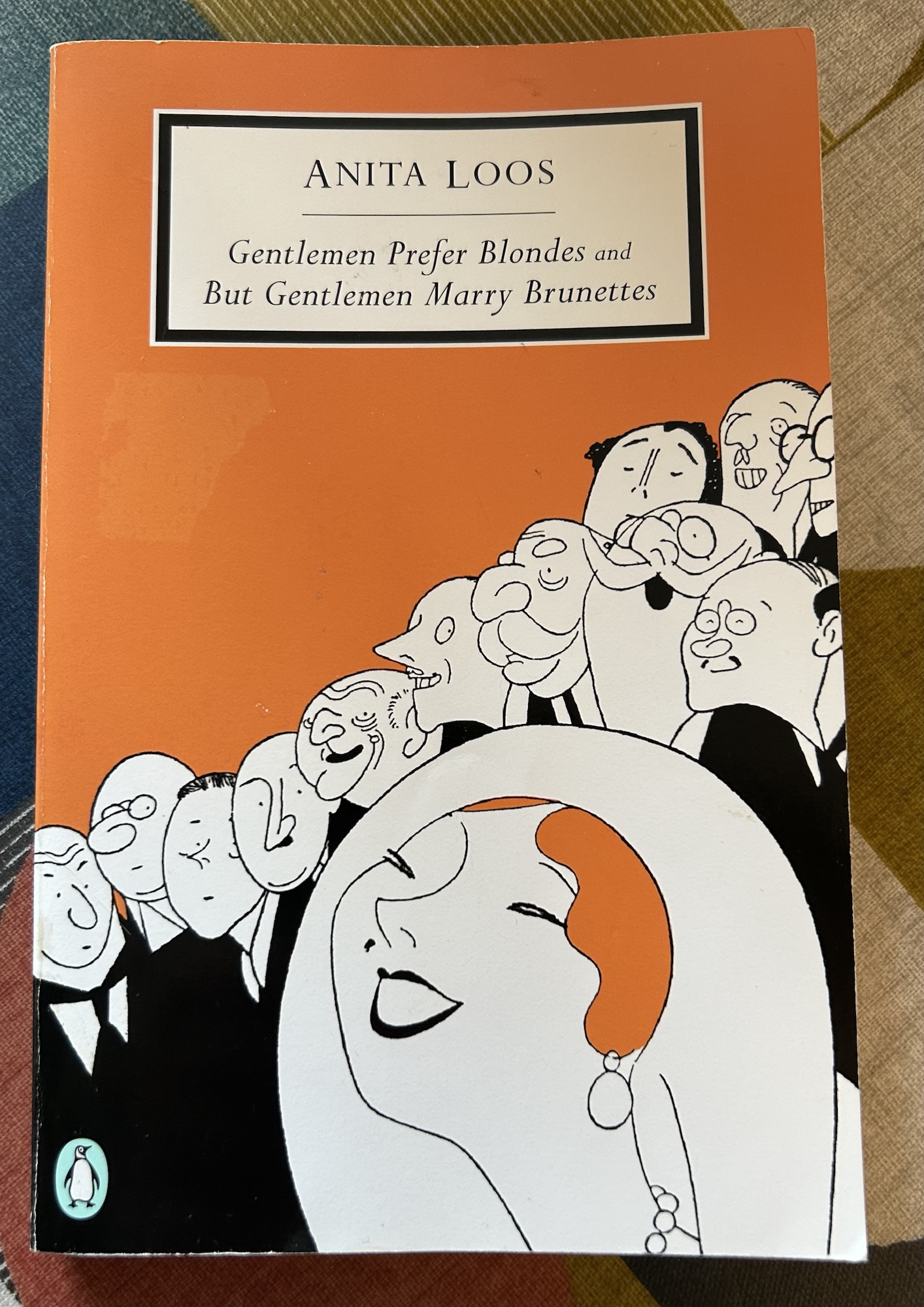
I knew of Anita Loos’ Gentlemen Prefer Blondes (1925) from the iconic 1952 filmed musical, but somehow I never got round to reading it. I found this Penguin edition of the novella plus the sequel with the original illustrations by Ralph Barton, and realised now was the time for me to spend with Lorelei Lee, gold-digging flapper.

Told in diary form, we follow Lorelei around New York and then Europe, as she dates a series of men, trying to get them to spend as much money on her as possible.

“So by the time Piggie pays for a few dozen orchids, the diamond tiara will really seem like quite a bargain. Because I always think that spending money is only just a habit and if you get a gentleman started on buying one dozen orchids at a time he really gets very good habits.”

Lorelei is also on a constant quest to improve her mind, aided by Mr Eisman who suggests she keep a diary, although it never quite works. Her attempt to host a literary salon ends thusly:

“So Sam asked if he could bring a gentleman who writes novels from England, so I said yes, so he brought him. And then we all got together and I called up Gloria and Dorothy and the gentleman brought their own liquor. So of course the place was a wreck this morning and Lulu and I worked like proverbial dogs to get it cleaned up, but Heaven knows how long it will take to get the chandelier fixed.”

She does, however, attract a novelist:

“As soon as he found out that I was literary. I mean he has called up every day and I went to tea twice with him. So he has sent me a whole complete set of books for my birthday by a gentleman called Mr. Conrad. They all seem to be about ocean travel although I have not had time to more than glance through them.”

Ultimately though, she asks her maid to read Lord Jim and then tell her what happens.

The diary forms a series of vignettes as Lorelei and her acerbic friend Dorothy ricochet from one party and one man to another, before they travel to Europe. Dorothy is quick-witted and incisive, but also much more romantic. While she falls in love on the ship to England, Lorelei bemoans the lack of spending opportunities.

“I mean I really hope I do not get any more large size imitations of a dog as I have three now and I do not see why the Captain does not ask Mr. Cartier to have a jewelry store on the ship as it is really not much fun to go shopping on a ship with gentlemen, and buy nothing but imitations of dogs.”

It is this humour and the guilessness of Lorelei’s tone that make this such an enjoyable read. She is relentlessly materialistic,  but there is nothing vicious about her.

Loos also has some serious points to make among the light comedy. Lorelei was sexually assaulted in the past, and shot her assailant. In court, she was subject to misogynistic destruction of character. As she observes:

“I mean a gentleman never pays for those things but a girl always pays.”

There is a sense that she feels that men are still getting the better deal, when all they lose is money.

“I mean I always seem to think that when a girl really enjoys being with a gentleman, it puts her to quite a disadvantage and no real good can come of it.”

The reader also questions who is using who. Lorelei wants money, but what do this succession of men really want – do any of them truly care for Lorelei and are they even taken in by her?

When she and Dorothy are in London, they are mistaken for rich and subsequently invited to a series of aristocratic homes because people want to flog them things:

“So we went to tea to a lady’s house called Lady Elmsworth and what she has to sell we Americans seems to be a picture of her father painted in oil paint who she said was a whistler. But I told her my own father was a whistler and used to whistle all of the time and I did not even have a picture of him but every time he used to go to Little Rock I asked him to go to the photographers but he did not go.”

This is a perfect example of how Loos captures Lorelei’s ignorance but she is not the butt of the joke. Not knowing who Whistler is stops her being ripped off. Similarly, I usually dislike non-standard spellings to demonstrate a character’s poor education as condescending, but with Lorelei it serves to remind the reader that she is young and naïve and not to judge her actions too harshly.

“The Eyefull Tower is devine and it is much more educational than the London Tower, because you cannot even see the London Tower if you happen to be two blocks away. But when a girl looks at the Eyefull Tower she really knows she is looking at something. And it would even be very difficult not to notice the Eyefull Tower.”

I mean, she’s not wrong…

The other way Loos achieves balance is through Dorothy’s reported comments, cutting through any suggestion of whimsy:

“Dorothy looked at me and looked at me and she really said she thought my brains were a miracle. I mean she said my brains reminded her of a radio because you listen to it for days and days and you get discouradged and just when you are getting ready to smash it, something comes out that is a masterpiece.”

Gentlemen Prefer Blondes is a clever, entertaining satire on early twentieth century materialism, relationships between the sexes, and the choices available to women. Lorelei is somehow charming, and Loos never loses sight of the comedy – a protracted farce with a diamond tiara is particularly entertaining!

I think I’ll try the sequel for tomorrow, but I understand its not quite as accomplished. Fingers crossed that it is still enjoyable…

“I mean champagne always makes me feel philosophical because it makes me realize that when a girl’s life is as full of fate as mine seems to be, there is nothing else to do about it.”

The tone of the film is frothier, but of course I’ll end with the trailer of Marilyn Monroe as Lorelei and Jane Russell as Dorothy:

Novella a Day in May 2026 – No.2

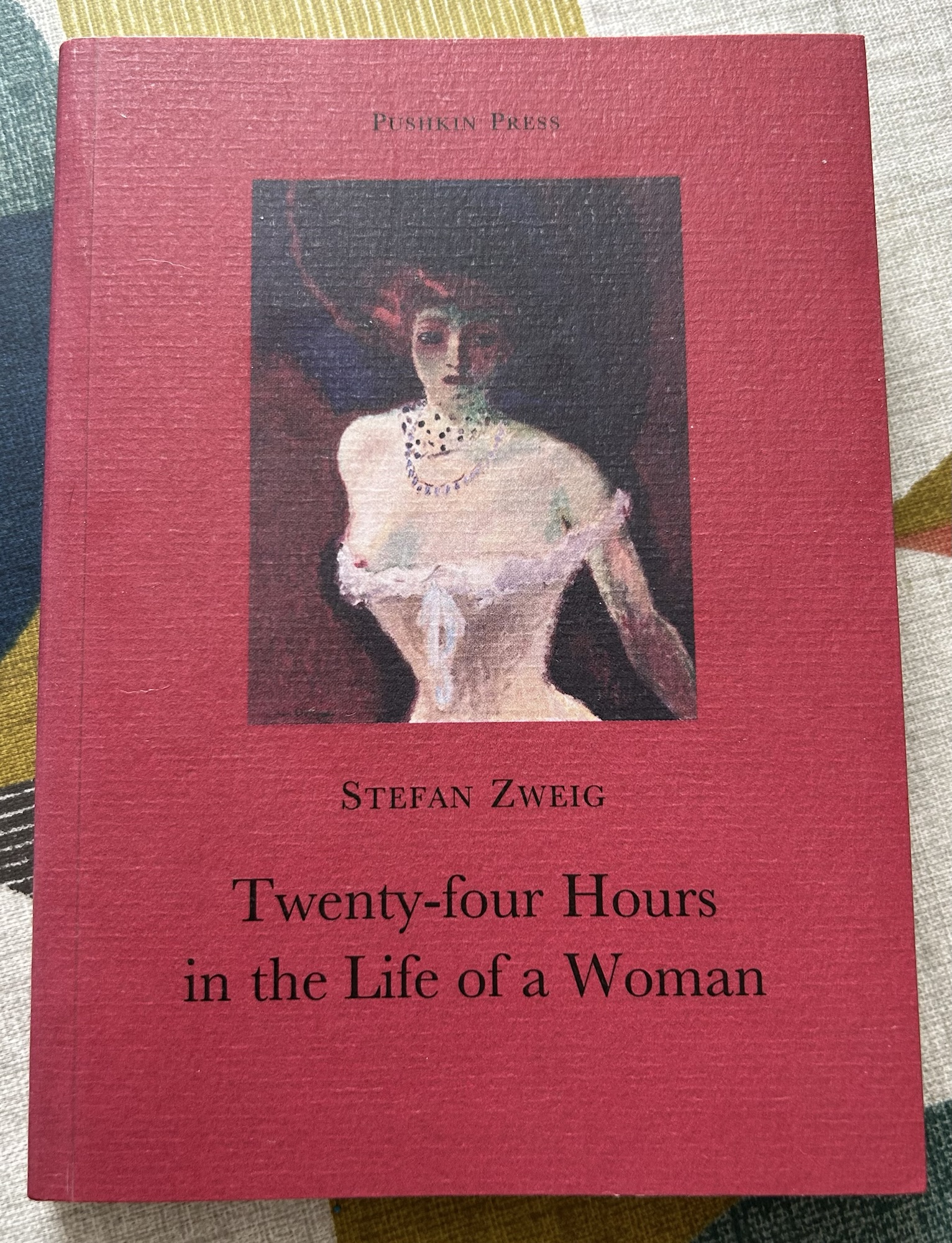
Stefan Zweig is a favourite writer of mine, I find him so insightful and compassionate. I also really like Pushkin Press Classics published in the smaller editions with the French flaps, so I was pleased to find just such a copy of his 1927 novella Twenty-four Hours in the Life of a Woman (transl. Anthea Bell 2003).

It opens at a guesthouse on the French Riviera, “ten years before the war” with the unnamed first-person narrator remembering the arrival of an attractive single man who quickly absconds with Henriette, the wife of a manufacturer. Her absence causes quite a stir:

“Silently, one by one, as if put to shame by so shattering an emotional outburst, we crept back to our rooms, while that stricken specimen of mankind shook and sobbed alone with himself in the dark as the building slowly laid itself to rest, whispering, muttering, murmuring and sighing.”

The narrator takes a more liberal view of Henriette’s conduct, which puts him at odds with the other guests. I enjoyed Zweig’s gentle humour here:

“Well, it’s of no importance here to go back in every detail over the stormy course of an argument conducted between soup and dessert: only professionals of the table d’hôte are  witty, and points made in the heat of a chance dispute at table are usually banal, since the speakers resort to them clumsily and in haste.”

The narrator’s assertion that “I’d rather understand others than condemn them.” attracts the attention of Mrs. C, who from the way she’s initially described sounded easily in her nineties, but as it turns out is sixty-seven! She deliberately builds an intimacy with the narrator in order to tell her story, and he becomes the silent interlocutor to her tale.

“It is intolerable to spend one’s whole life staring at a single point in it.”

She describes how, at the age of forty-two, grieving her husband and with her sons fully grown, she arrived at Monte Carlo.

“I came there out of tedium, out of the painful emptiness of the heart that wells up like nausea, and at least tries to nourish itself on small external stimulations.”

She is not a seasoned gambler, but her husband enjoyed the casinos so she visits, and there becomes consumed by the vision of a young man compulsively placing bets.

“His face spoke the same fantastically extravagant language of extremes as the hands”

[…]

“A fear of something dreadful, something I had felt invisibly enveloping the young man like a miasma from the first moment.”

What follows is a character study of Mrs C and a portrait of addiction which is entirely believable. With his characteristic humanity, discernment and understanding, Zweig considers the supressed tragedies of people’s lives and how we continue to live.

Twenty-four Hours in the Life of a Woman possibly felt more dramatic on initial publication – for twenty-first century readers nothing especially unpredictable takes place. But that is not to diminish it in any way. The evocation of strong feeling, and of trauma, is so sensitively realised that it remains a deeply affecting read.

This story has been filmed several times, including a made for television version with Ingrid Bergman. However, in its depiction of the glamour, seediness, seductions and betrayals of gambling, it also reminded me of a film I saw recently with lovely JacquiWIne, Bay of Angels:

“Who could be frightened in as wide and bright, as clean and quiet a house as this?” (Richard Yates, Revolutionary Road)

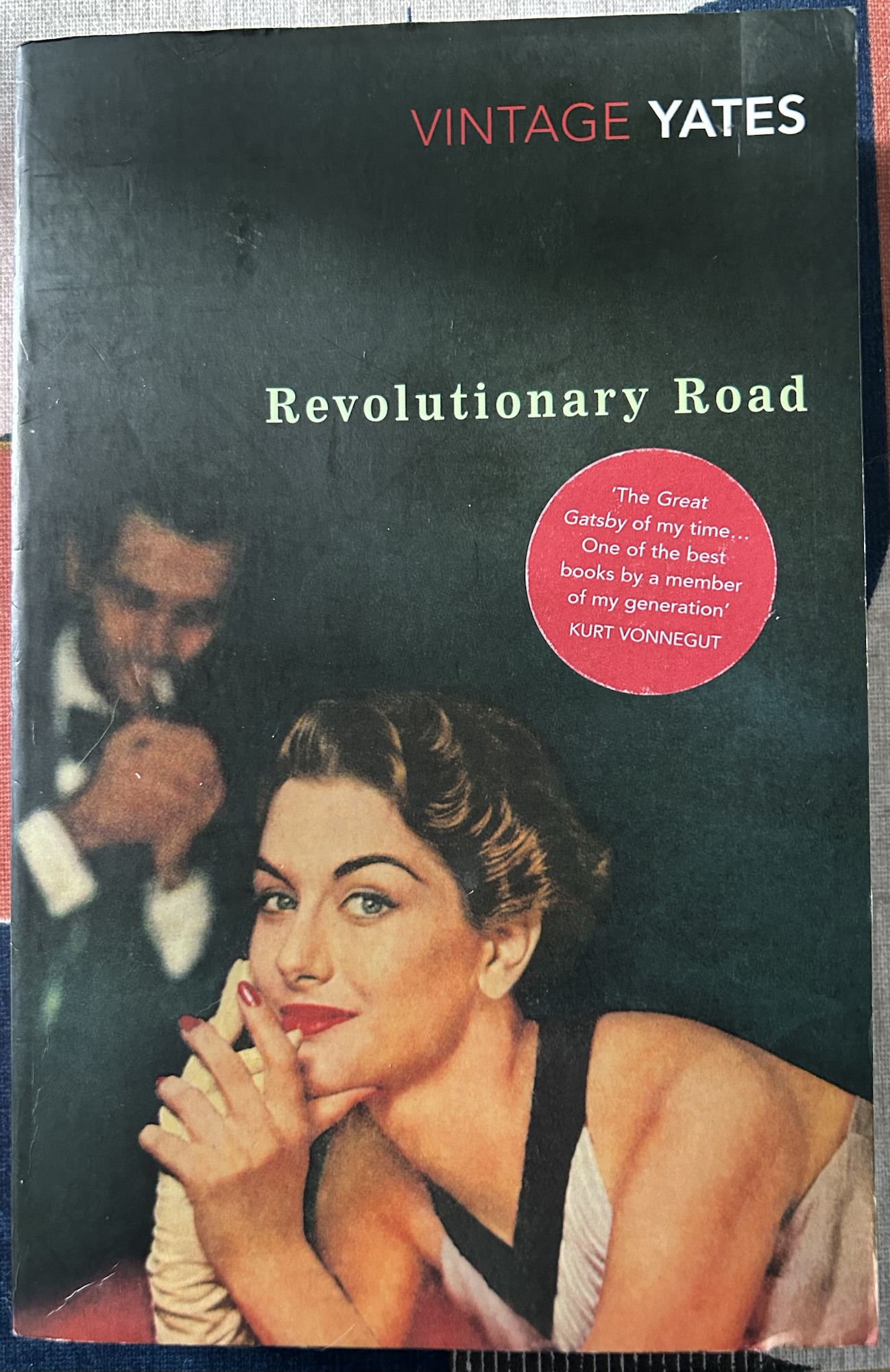
One of the benefits of taking part in events like the 1961 Club, hosted by Kaggsy and Simon this week, is that it encourages me to finally get to novels languishing in the TBR, such as Revolutionary Road by Richard Yates.

I have enjoyed Richard Yates when I’ve read him previously but I also know that I kept putting off Revolutionary Road because he can be so bleak. And it is bleak, good grief. But Yates is such a great writer that reading this was never a slog, and I whizzed through his first novel.

The two protagonists, married couple April (“A tall ash blonde with a patrician kind of beauty”) and Frank Wheeler (“the kind of unemphatic good looks that an advertising photographer might use to portray the discerning consumer of well-made but inexpensive merchandise”) are just shy of thirty and living in suburban Connecticut in 1955.

Frank would probably take issue with the authorial description above, as he sees himself as “an intense, nicotine stained, Jean-Paul Sartre sort of man,”.

Frank and April are monumentally smug and pretentious, seeing themselves as living in suburbia with two children, a job in the city for him and role as a homemaker for her, but somehow above it all and different to their neighbours, all of whom are doing exactly the same:

“Intelligent, thinking people could take things like this in their stride, just as they took the larger absurdities of deadly dull jobs in the city and deadly dull homes in the suburbs. Economic circumstance might force you to live in this environment, but the important thing was to keep from being contaminated. The important thing, always, was to remember who you were.”

A crisis early on forces April to feel that she cannot continue. She feels their life needs enormous change and that she is to blame for holding Frank and his immense mind back.

“this idea that people have to resign from real life and ‘settle down’ when they have families. It’s the great sentimental lie of the suburbs, and I’ve been making you subscribe to it all this time. I’ve been making you live by it!”

What she fails to realise is that her husband is deeply ordinary, no great thinker, and with no discernible talent at anything so far. So her plan that they move to France and she work while he simply lives off her while he decides what to do, is fundamentally flawed.

Yates expertly portrays these two young people bound up in each other’s idea of who they are; feeding one another’s vanities and delusions. They become excited at the plan and for a while it rejuvenates their relationship:

“He felt tense and keyed up; the very act of sitting on a coffee table seemed an original and wonderful thing to do.”

However, the reader is more aware than April that her husband is not entirely convinced of the plan. Deep down, he knows his inadequacy, and his play-acting.

“he found he had made all his molars ache by holding them clamped too long for an effect of  grim-jawed determination by candlelight”

When April finds herself pregnant again, Frank sees a way out. They will have to stay in suburbia to raise their third child. April disagrees, and the strain and tension in their marriage gradually tightens to breaking point…

Revolutionary Road is an absolute masterpiece and it is astonishing that it was Yates first novel. The characterisation is unblinking; the post-war American Dream with all its materialistic conformity is minutely dissected.

What I found so clever was that having found April and Frank vain, shallow, and condescending for almost all the novel, by the end I felt desperately sad and sorry for both of them. Yates has written a tragedy, and suggested it is occurring daily behind the manicured lawns and bright smiles of middle-class, mid-century America.

“It was invincibly cheerful, a toyland of white and pastel houses whose bright, uncurtained windows winked blandly through a dappling of green and yellow leaves. Proud floodlights were trained on some of the lawns, on some of the neat front doors and on the hips of some of the berthed, ice-cream colored automobiles.”

To end, a trailer for the 2008 adaptation, which I know I’ve seen but don’t really remember. Time for a rewatch:

“Every woman who writes is a survivor.” (Tillie Olsen)

Simon and Kaggsy are running one of their marvellous Club events all week, this time it is the 1961 Club. I’m hoping to do a few posts, and I’m starting with a short story.

Tell Me a Riddle by Tillie Olsen is a collection of four stories, with the titular tale published in 1961, so that is the one I will concentrate on. But all four are expertly realised with distinct narrative voices and I really recommend the whole collection.

Tell Me a Riddle looks at the last year or so together of a couple who emigrated from Russia (as the author’s parents had done). It opens:

“For forty-seven years they had been married. How deep back the stubborn, gnarled roots of the quarrel reached, no one could say – but only now, when tending to the needs of others no longer shackled them together, the roots swelled up visible, split the earth between them, and the tearing shook even to the children, long since grown.”

This antagonistic couple are not mellowing with age. He wants to move to supported accommodation, the Haven, she is determined to stay put. The fury of the sacrifices she has made throughout married life spill out, as he tries to entice her:

“A reading circle. Chekhov they read that you like, and Peretz. Cultured people at the Haven that you would enjoy.”

“Enjoy!” She tasted the word. “Now, when it pleases you, you find a reading circle for me. And forty years ago, when children were morsels and there was a Circle, did you stay home with them once so I could go? Even once? You trained me well. I do not need others to enjoy. Others!” Her voice trembled. “Because you want to be there with others. Already it makes me sick to think of you always around others. Clown, grimacer, floormat, yesman, entertainer, whatever they want of you.”

Having not spoken her resentments previously, she now digs her heels in:

“Enough. Now they had no children. Let him wrack his head for how they would live. She would not exchange her solitude for anything. Never again to be forced to move to the rhythms of others.”

The impasse escalates, with neither seeming to be anywhere close to winning, until events overtake them and her health begins to deteriorate:

“A bellyful of bitterness and every day the same quarrel in a new way and a different old grievance the old quarrel forced her to enter and relive. And the new torment: I am not really sick, the doctor said it, then why do I feel so sick?”

They move around the USA, visiting children and grandchildren, both reflecting on what they left behind and what lives they have enabled their children to create. Olsen analyses the promises and shortfalls of the American Dream through ordinary lives.

At the start of the story the husband has called his wife “Mrs Word Miser”, among other epithets. But by the end, as she lays dying in bed:

“The week Lennie and Helen came, the fever returned. With it the excited laugh, and incessant words. She, who in her life had spoken but seldom and then only when necessary (never having learned the easy, social uses of words), now in dying, spoke incessantly.”

The deathbed scenes are vivid and affecting. In a short space of around 50 pages Olsen brings her characters into noisy, awkward being and achieves what takes some writers ten times the space. She has absolute command of the short story and uses it expertly.

I realise I’ve made the story sound quite depressing, but while it is sad, I didn’t find it bleak. The characters are so strong and determined, and the voices so true and clear, that Tell Me Riddle conveys an energy which isn’t depleting.

I have Olsen’s novella Yonnonido in the TBR which I keep putting off – I’m really looking forward to picking it up now.

To end, a song from 1961 that I thought was much later in the decade, probably because it is such a timeless classic:

“Every night he tried himself and every night he acquitted himself.” (Emeric Pressburger, The Glass Pearls)

Well, it’s only February but I already think that I’ve read one of the most extraordinary books of my year: The Glass Pearls by Emeric Pressburger (1966).  Most pleasingly, it was a twofer for reading events this month, #ReadIndies hosted by Kaggsy as it is published by Faber as one of their Faber Editions series; and Hungarian Literature Month hosted by Winston’s Dad as Emeric Pressburger was born in Miskolc, Hungary.

Pressburger studied in Prague, moving to Weimar-era Berlin and then escaping the Nazis by moving first to Paris then London. It was there he met Michael Powell, and the powerhouse filmmaking duo was formed. I’m a big fan of Powell and Pressburger films, and it was this that led me to read The Glass Pearls (and a nice chat with the bookseller who is also a P&P fan.) But it absolutely stands on its own terms, not simply as curio for cinephiles.

At the start of the novel, Karl Braun is moving into a lodging house in Pimlico, unloading a few items from a piano tuner’s van. His neighbours are curious, but mild-mannered Karl soon fits in. His fellow lodgers, Strohmayer who always has a deal on the go, and Kolm, a concert-loving chemist, are also European émigrés who escaped Hitler’s regime and assume Braun is the same. But the reader soon knows something the characters don’t: Braun is a Nazi escaping justice from the trials.

“I have lived for twenty years according to self-imposed rules; it wasn’t easy and I’m not going to change my ways now. I denied myself everything I used to enjoy most.”

Pressburger’s mother died at Auschwitz, as did many members of his extended family. In this astonishing novel he writes from the point of view of a Nazi doctor who carried out atrocities at Wittau concentration camp.  It is so brilliantly done. The third-person narrative means it is presented as this is the man, this is what he did and how he now lives, which means as a reader you can stick with it where a first-person narrative would be too much to ask. But in writing from Braun’s point of view, it is also made personal, and you are asked to spend time alongside someone who has repeatedly taken unforgivable actions, for which he feels no remorse.

Braun frequently has nightmares about pursuit and capture, and justifies himself at imagined trials thusly:

“He would never do anything to serve only his own purpose unless it served the common purpose as well. He would go to any length to help others, disregarding his own interest. He loved his work; he was a good family man; adored his wife and child; he was religious, prayed to God and respected his laws. He was a romantic and romantics were the salt of this earth.”

And in this way Pressburger consistently shows us the man, his complete and utter delusion, his cruelty and vanity, and also makes him recognisable.

Braun leads an ordinary life in post-war London. He has a love interest who he takes to concerts in a sedate courtship; he has to navigate his workplace politics; he chats to his fellow lodgers. No-one knows he is Dr Otto Reitmüller.

“He made enough money for his needs, he even had a little in the bank. He enjoyed a good book, a good play, a good concert, a good talk. What else does a man want from life?”

We know one thing he wants: his wife and child back, killed in Hamburg bombings. Braun wasn’t with them, called back to camp to continue his horrors, which are portrayed clearly, sickeningly, but not sensationally.

Braun isn’t pretending to be cultured, or bereaved. He is both those things and an unrepentant torturer. It is powerful portrait that demands responsibility from those who enact war crimes, but also from those who witness, to acknowledge how it could happen again when the people who did it were ordinary – friends and neighbours.

His paranoia steadily grows as the newspapers report on the trials, the deadlines are extended, and a fellow fugitive urges him to get the money they stashed in Swiss bank account and join ‘the Brotherhood’ to live out their days in Argentina.

“He knew he could never have stuck it out in prison. His strong sense of justice would have reared up against petty persecutions by his warders.”

Braun becomes more fearful and restless. Two men seem to be watching him, the tension mounts, and while I didn’t want him to escape, The Glass Pearls absolutely worked on the level of a thriller where you are speeding through it to know the outcome.

“One had to be careful about the deductive powers of a fertile brain. Once trained for critical examination and to present the fullest picture of possible dangers to its master, the brain tended to overdo things were not watched too closely.”

It felt Hitchcockian in many ways, but a reversal of the innocent man pursued by shady forces.

“Suddenly he knew that all he was yearning for was peace.”

There’s a very interesting Afterword in this edition from filmmaker Kevin Macdonald, who is also Pressburger’s grandson. He movingly describes Pressburger’s survivors guilt and how when he developed dementia, he had delusions of being chased by Nazis. Astonishingly, he also says:

“Emeric went so far as to imbue the Braun character with certain traits of his own; such that, to some degree, Braun is a self-portrait.”

To end, a trailer for a delightful Powell and Pressburger film that is slightly less well-known than some of their big hitters. I’m not the biggest fan of romance but it would take a heart of stone to resist the charm of I Know Where I’m Going!

“I suppose we don’t know much except from the books we have read, but at least we want to live.” (Barbara Comyns, A Touch of Mistletoe)

I’d planned to read Barbara Comyns’ A Touch of Mistletoe (1967) in December for obvious reasons, but I fell behind with my plans as always. Despite the title it’s not a Christmas book at all, and instead it’s got my 2026 reading off to a great start.

A Touch of Mistletoe is thought to be semi-autobiographical, as it follows sisters Vicky and Blanche Green from teenagers in the 1920s, to extreme poverty in the 1930s, through to marriage and motherhood in wartime, ending in the 1950s. Certainly a semi-feral childhood is something Comyns has explored before:

“Our mother rather lost interest in us after the thirst got hold of her and, although our grandfather was vaguely fond of us, he certainly wasn’t interested.”

While their brother Edward seems fairly content in a disengaged way, the sisters are desperate to leave their Warwickshire home. Vicky wants to go to art school, but the solicitor who controls her inheritance from her father does not think this is an appropriate use of funds. Blanche is yet to come of age:

“Blanche could not draw, but she had the very special gift of romantic beauty. She was extremely tall and willowy, with a flowing mass of almost black hair, classical features and a pale moon face, her skin as fine as the skin inside egg shells.”

Comyns is so adept with those arresting similes. Another that struck me later was:

“He looked like an ugly bird who had been given beautiful dogs eyes by mistake”

And:

“He was a great admirer of Cézanne and I did not say that he usually left me feeling rather cold and I thought his paintings looked as if he lived on sour apples.”

Vicky escapes to Amsterdam but finds herself an unpaid housekeeper for a filthy home, looking after bull terriers. (I must admit I skim-read some of the passages to do with the dogs, it was pretty awful.) She escapes, and after briefly returning home where her mother has swopped alcohol for incessant cleaning, the sisters finally get to London.

“It took us months to get used to the insidiousness of London grime and the hard water.”

They live in poverty, sharing a bed in boarding house, along with cockroaches and rats. They very nearly starve entirely, and the descriptions of hunger, inadequate clothing and squalid rooms put me somewhat in mind of Jean Rhys. Unlike Rhys the sisters are less dependant on men for money favours, and Comyns retains a cheeriness all of her own:

“Our bed sitting room was in a large Victorian house in quite a pleasant square with a garden in the centre where lime trees grew. Our room was on the hall floor and was painted a brilliant orange and blue, even the cheap china was orange and blue. The divan cover was a large damask table cloth dyed black. We thought it a wonderful room with its gas fire and ring with a little tin kettle on it.”

A striking detail of this time was their meagre meals: “To avoid spending shillings we used candles; but it was a slow way to cook—about twenty minutes to get an egg to boil.”

The situation doesn’t last forever, as Blanche finds work as a lady’s companion and Vicky falls in love with an art student. The description of married life here is very similar to Our Spoons Came from Woolworths. While Vicky’s husband Gene initially seems just as selfish as Charles in Spoons:

“Our marriage was such a happy one, perhaps partly due to the fact that Gene always had his own way over everything”

It gradually emerges that in fact he is very unwell. I thought the portrayal of serious mental illness – along with their mother’s alcoholism previously – was dealt with without judgement. There are parts of A Touch Of Mistletoe which are of their time and while I don’t think intended to be derogatory, are not language we use now. But the descriptions of Gene are sympathetic, and the outdated treatment he has sounds horrific but is never sensationalised.

Vicky worries about providing for their son Paul:

“He needed so much—good food, fresh air, clothes, education—there was no end to it and all I had to offer was love.”

Yet somehow they muddle through, with the help of kindly friends and neighbours, as well as Marcella, the family’s housekeeper of many years. Throughout it all Comyns retains her signature tone of unnerving guilelessness.

Later, Vicky remarries but her husband Tony also struggles with alcohol. Blanche has also had marriage troubles, and both feel they are entering old age as 40 looms (!)

The experience of London during the war is brilliantly evoked, as it was in Mr Fox, with enormous terrors sitting alongside the surprising smaller details:

“One evening, I think it was our wedding anniversary, we went to a famous restaurant where they had pheasant on the menu, but, when the waiter brought it to our table, it was only Spam pressed into the shape of a bird’s wing.”

A Touch of Mistletoe is longer than other Comyns I’ve read (336 pages) as she usually tends towards novella length, and I wondered if her beguiling, eccentric tone could sustain a longer novel. I needn’t have doubted. It was an absolute joy to spend longer than usual with a captivating writer whose voice is entirely her own.

To end, I can’t think of an appropriate 80s tune, so instead here’s the trailer for a film I saw twice last year, once at my local Odeon and then again with a Q&A with the writers/lead actors and director at the wonderful Prince Charles in December. It’s a gentle, beautifully observed film about grief and regret, friendship and kindness, and it’s got some silly jokes in it too. If you’ve not caught The Ballad of Wallis Island yet I do recommend it:

“A desire to move furniture is a desire for life. “(Celia Fremlin, The Long Shadow)

I’ve been meaning to read Celia Fremlin for a while, encouraged by JacquiWine’s excellent reviews. Happily, this coincided with my plan to read some Christmas-set golden age/cosy mysteries in December, as The Long Shadow (1975) builds its tension through a haunted group of houseguests throughout the festive period.

I immediately knew I was in for a treat with Fremlin. We join Imogen at the first party she’s attended since her husband died two months ago. We quickly learn that while she is grieving, she also recognises that Ivor was not a pleasant person. There is no sentimentality in her reflections.

“How Ivor would have loved being dead! It was a shame that he was missing it all. How he would have loved to watch the letters pouring in, day after day, by every post, in their tens and in their dozens, each one a tribute to himself.”

She also casts a critical eye over the niceties of solo party attendance:

“She’s a widow, that’s what she is. With wooden detachment, Imogen watched Myrtle’s social aplomb faltering before the task of finding something intriguing to say about Imogen: something at least as amusing as Dutch Elm disease.

She gave it up.”

There’s also some astute observations about the deeply odd ways that the English approach the bereaved:

“Even Edith Hartman from next door had at last stopped popping in with cups of tepid Oxo and soothing stories about people who had died of cancer recently.”

But soon Imogen has more to worry about than navigating social mores, as someone rings in the middle of the night, telling her they know she killed her husband.

Told from Imogen’s point of view, she is clear she didn’t kill him. She has little time to reflect though, as it’s not long before her adult step-children turn up; the somewhat reprobate son Robin, and acquisitive daughter Dot, with her husband Herbert and their two young sons, Vernon and Timmie.

More bafflingly, Robin brings an almost silent girl to the house who wafts around preparing macrobiotic food, and Ivor’s scatty second wife Cynthia flies in from Bermuda to also take up residence. Then someone starts moving Ivor’s papers and updating them, the children have faces visiting them in nightmares and see a man in a Santa costume sat in Ivor’s study, and Imogen begins to wonder if a ghost isn’t part of the company too…

“It was high time Ivor got moving. It wasn’t fair to be dead and yet to stay around like this, in every room, in every corner of the house”

As a reader we are meant to be sceptical of ghosts and suspect everyone else, and they certainly act suspiciously! All of the adults seem to be Up To Something but I certainly couldn’t work out what was going on.

The Long Shadow is well-paced at only 242 pages, with a finale that is satisfying and believable. There’s even a final comic twist right at the last sentence. It’s certainly made me keen to read more Fremlin and thankfully Faber have made more reissues available.

Although not heavily Christmas-themed, it’s a great Christmas read with its house full of extended family, things unspoken, and would be easily digested after a dinner of heavier festive fare 😊

To end, two of my favourite folk singers coming together to sing insults at each other in honour of Christmas (please note, they have updated some of Kirsty MacColl and Shane MacGowan’s name-calling, but the language remains decidedly colourful):

“She had adored her husband, and was very fond of her French pepper-mill.” (Margery Sharp, The Foolish Gentlewoman)

It’s been a busy month trying to get to grips with my new job, but I’m delighted to contribute to Dean Street December, hosted by Liz at Adventures in Reading, Running and Working from Home. This reading event provides a lovely end to the reading year, and it encouraged me to get The Foolish Gentlewoman by Margery Sharp (1948) off the TBR, which Dean Street Press publish as part of their Furrowed Middlebrow imprint.

I really enjoy Margery Sharp’s comic eye, and there’s a perfect example early in this novel in a description of the family’s Sealyham:

“His shaggy eyebrows and meditative gaze gave him an old-gentleman look; he sat there like a retired Colonel, newspaper laid aside, contemplating Socialism.”

The terrier’s family are hodgepodge: widowed fifty-five year old Isabel Brocken, “sentimental, affectionate, uncritical,” and her priggish brother-in-law Simon:

“Mr Brocken was not conceited enough to perceive in himself any compensating charms. To be loved without reason did not flatter him. He put up with Isabel’s affection, as he put up with Isabel, because he had to.”

As well as two younger people staying at the house: Isabel’s nephew Humphrey and her companion Jacqueline, both recovering from the recent war.

This unlikely group live a life of very little strife, ensconced in Isabel’s old family home of Chipping Lodge, sat in a suburb of London which escaped the bombs. (Unlike Simon’s house which is why he finds himself having to tolerate other people, while it is rebuilt.)

Keeping them in domestic order are the self-contained housekeeper Mrs Poole and her teenage daughter Greta.

Their domestic peace is shattered when Isabel invites her old school friend Tilly Cuff to stay indefinitely. The motivation stems from a perceived injustice she did to Tilly years ago, and a plan to make amends. For Tilly does not seem to have thrived:

“No-one ever fell in love with Tilly, not even curates.”

Simon, Humphrey and Jacqueline are horrified. Firstly by Isabel’s plan to leave Tilly all her money, and secondly by Tilly herself:

“Is she to be allowed to beggar herself for the sake of a peculiarly offensive incubus?”

Sharp is always good at villains without caricature, and Tilly is a perfect example. She is manipulative and mendacious, particularly towards Greta Poole. It is Greta and her mother that provide the greatest emotional engagement in the novel: Tilly’s treatment of them shows her to be a real threat, and Simon’s attitude towards them shows him not to be irredeemably hard-hearted.

Yet Tilly is also shown to be vulnerable, lonely and defensive. Although she is powerful in her ability to completely destabilise the entire household, really she has less resources, personal and financial, to draw on than anyone else.

I found The Foolish Gentlewoman to be a surprising page-turner, as I wanted to see how the household would escape Tilly! And yet, things didn’t quite pan out as I expected. Sharp has fun with confounding reader’s expectations:

“To set one’s foot on a tragic stage, and find that the part thrust into one’s hand belonged to a domestic comedy: to read on, and perceive in prospect a crisis after all potentially tragic: to turn the last page upon anticlimax. How inartistic, and yet how life like!”

Yes, anti-climatic in a sense, but wholly satisfying and enjoyable. I particularly liked the happy ending arranged for Simon:

“With no less than five persons had Mr Brocken narrowly escaped, if not intimacy, a degree of acquaintance that would have allowed any one of them to become a nuisance to him.”

A gentle joy made readily available thanks to the excellent Dean Street Press and Furrowed Middlebrow.

“Happiness is a very fragile thing.” (Barbara Comyns)

It was JacquiWine’s review of The Juniper Tree by Barbara Comyns (1985) last month that encouraged me pick this from the TBR in time for Novellas in November, hosted by hosted by Cathy and Bookish Beck.

I really enjoy Comyns’ individual voice. She can give a sharp edge to stories presented seemingly without guile which works well within the premise here, taking as a starting point the Grimm Brothers fairytale of the same name:

My mother she killed me,
My father he ate me,
My sister, little Marlinchen,


Gathered together all my bones
Tied them in a silken handkerchief,


Laid them beneath the juniper-tree,
Kywitt, kywitt, what a beautiful bird I am.

Thankfully Comyns writes a less cannibalistic/abusive version but there are fairytale motifs from the story scattered throughout. This gives the novella a somewhat unreal, atemporal quality, although references are made to the 1980s.

The striking opening scene directly draws on the Grimm tale, as Bella Winter (physically similar to Snow White, although she feels highly self-conscious of a facial scar) travels to Richmond in search of a job:

“I noticed a beautiful fair woman standing in the courtyard outside her house like a statute, standing there so still. As I drew nearer I saw that her hands were moving. She was paring an apple out there in the snow and as I passed, looking at her out of the sides of my eyes, the knife slipped, and suddenly there was blood on the snow.”

The affluent woman is Gertrude, married to Bernard.  Bella ultimately gets a job over the river in Twickenham with Mary:

“Her teeth were small and pointed rather as an animal’s, indeed she resembled an animal with her delicate boned face with its merry expression, perhaps a squirrel.”

But this doesn’t prevent Bella becoming more and more entwined in Gertrude and Bernard’s life. It’s not surprising that she is in search of a family. Her mother is cold and judgemental:

“There was one shadow that I kept in the back of my mind as much as possible, and that was my mother. To me she was almost like a wicked fairy, poor woman.”

Bella also left behind a selfish lover Stephen, who was driving when the accident occurred which left her with the scar on her face, for which he blames her.

But Bella has a young daughter Marline, also known as Tommy, who she loves dearly. Tommy is biracial and both she and her mother face racism throughout. However, they build a happy life, living above Mary’s antique/junk shop and transforming a “gritty” back yard into a pretty walled garden.

They regularly cross the river to Gertrude and Bernard’s abundant, if carefully curated, home. Bella enjoys sitting with Gertrude under the titular tree, where territorial magpies build their nest and watch the comings and goings.

It’s hard to say more without venturing into spoilers, but if this is sounding a bit contrived and fey, there are enough prosaic details to ground the story, and humour too:

“I was glad to return to the freedom of the shop and to be queen of my own home—eat cornflakes or baked beans for supper, wear a dressing gown for breakfast and read books that did not improve the mind in bed.”

I also thought there was scepticism regarding relationships between the sexes here, no guarantee of happy-ever-afters. As well as positive portrayals, both Stephen and Bella’s mother are abusive to partners, and Bernard is in an ambiguous Pygmalion role. Families are shown as places of anger and destruction as well as nurturing, and Bella has to chose her people to create a happy life.

The undercurrent of death also stops the story feeling whimsical, and there is a very upsetting death which takes place, precipitating Bella needing inpatient mental health care. Although not gratuitous or gruesome, it is something some readers would want to avoid so if you want to know, DM me!

The introduction to my NYRB edition mentions the ending being abrupt, but I have to disagree. The ending ties up everything as much as it can and I can’t see anywhere further the story could go, having fulfilled its fairytale basis and continued into a pragmatic 1980s conclusion.

To end, a very young Björk making her film debut in an adaptation of the Grimm Tale:

“It was not a bad life, while things happened fast. And they usually did.” (Ursula Parrott, The Ex-Wife)

When I saw The Ex-Wife by Ursula Parrott (1929) in my local charity bookshop I snapped it up, remembering JacquiWine’s review. Faber Editions are always reliable too, and it’s great that they’ve brought this back into print (as have McNally in the US.) It evokes a young woman navigating independence during Jazz Age New York so vividly.

Pat is twenty-four when her marriage to Pete falls apart, with extra-marital dalliances on both sides, aided by alcohol and parties.

“In the three weeks we had been to six parties, three first nights, five speakeasies, four night clubs, two operas, and a concert”

These young people are so inexperienced and naïve, and the collapse of their marriage seems inevitable as neither have the first clue how to save it:

“I thought: “I will try to make it up to Pete by being good tempered always, and looking as pretty as possible, and following all his stories, and not being extravagant anymore.” I felt very grown up.”

From my twenty-first century view I wouldn’t want to save a marriage to someone who pushed me through a plate-glass door because he wasn’t happy about the pregnancy he was equally responsible for, but Pat is very attached to her husband and wants him back.

She moves in with her friend Lucia, five years older and also divorced, who tries to persuade Pat of the advantages of their situation:

“‘We are free. Applesauce! Free to pay our own rent, and buy our own clothes, and put up with the eccentricities of three to eight men who have authority over us in business, instead of having to please just one husband.’”

We follow Pat as she navigates single life as woman in the Roaring Twenties: working, socialising, happy and unhappy. She is attractive and young, and men are interested in her. Parrott has some wonderful turns of phrase and a way of crafting sentences that is so arresting.

“Hoping sometime to wake and find I had slept beside a lover and friend, I slept to wake beside a stranger exigent, triumphant, or exasperated, or perhaps as bored and polite as I.”

Pat enjoys parties and manages a successful career. She also has genuine friends both male and female, but there is an undercurrent of sadness with some of her male friends who are older than she is, and so fought in the war.

“Kenneth looked as if he would understand about Peter, and the men one kissed cure one of the memory of Peter, and the little hope one cherished about Peter, in spite of judgement and the common sense and the well-meant advice of one’s friends.”

Pat is a fashion copywriter who enjoys spending money and there are some gorgeous descriptions of clothes throughout The Ex-Wife. New York is obviously another love, and this passage made me wonder if it inspired the opening scene of Woody Allen’s Manhattan:

“Sam gave Lucia an Orthophonic Phonograph for a birthday present. Gershwin’s ‘Rhapsody in Blue’ was almost the only record we ever played on it. We turned that on, about once an hour when we were at home.

‘That tune matches New York,’ Lucia said. ‘The New York we know. It has gaiety and colour and irrelevancy and futility and glamour as beautifully blended as the ingredients in crepes suzette.’

I said, ‘It makes me think of skyscrapers and Harlem and liners sailing and newsboys calling extras.’

‘It makes me think I’m twenty years old and on the way to owning the city,’ Lucia said. ‘Start it over again, will you?’”

Apparently the novel was a scandalous sensation on first appearance and had to be published anonymously. There is much in it that feels very modern and I was surprised that a 1929 novel was so open in discussions of sex, domestic violence and abortions. The difference in grief responses from Pat and Pete regarding their young child felt very real and heartbreaking, despite Parrott not overly exploring it.

There are also some pithy observations about what increased freedom for women at this time really means:

“The principal thing that relieving women from the dullness of domesticity did, was to relieve men from any necessity of offering stability in return for love, fidelity and so on.”

Yet really what makes The Ex-Wife still so readable after nearly a century is the closely-observed characterisation of Pat. She is so endearing: young in many ways, older in others. She is frank about her loneliness and vulnerabilities; unapologetic about her enjoyment of bars, dancing and shopping. She is wise and naïve and she really grows throughout The Ex-Wife.

“Enclose with that decree a complete assortment of young illusions, a beatific confidence, an entertaining lack of common sense, and an innocent expression—and I shall be—just as if I had never married.”

To end, a scene from the film adaptation made just a year later, which won Norma Shearer an Oscar: