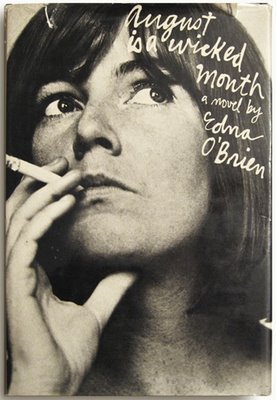
Many, many years ago, decades even, when I was a sixth-former (that’s Year 12, kids) my English teacher gave out a list of suggested reading for A levels. Somewhat surprisingly, I didn’t finish it entirely (although just in case that seems worryingly off-brand, I should say my name still went round to the teachers on a list as the pupil who borrowed most library books that year) and I can remember the few that escaped me. One was August is a Wicked Month, and having read it now I’m a bit surprised it was on a sixth-form reading list. Because it is explicit. But it’s also very realistic so maybe my teachers thought it was responsible reading 😀
Ellen is in her late twenties and her ex-husband has taken their son camping. Ellen is not good at being alone and managing feelings:
‘I’ll just be,’ she said. A rare thing for her, racked as she was with anxiety, wondering always what would happen next, if an affair would be eternal, or if she loved her son over much, or if the wheels of a car they sat in would fly off and leave them half dead on the roadside.
So she decides to go to the south of France for sun and anonymous sex:
“She had been brought up to believe in punishment; sin in a field and the long awful spell in the Magdalen laundry scrubbing it out, down on her knees getting cleansed. She longed to be free and young and naked with all the men in the world making love to her, all at once. Was that why he ran?”
Written in 1965, this is not a tale of the joys of sexual liberation and freedom. Despite the setting, the tale is not glamorous. Ellen falls in with a crowd that includes a film star, but its all lonely and sad and isolating. She may as well have stayed away,
“She wanted to go home, not to London to the pipes of light but home to the race to which she belonged: and then she shivered uncontrollably, knowing that their thoughts were no longer hers. She had vanished back into childhood and the dark springs of her terrors.”
Everything Ellen does seems a misstep but not comically so. Her confused interactions with people, failed flirtations and disappointing sex just serve to highlight the inadequacy of human communication and the tendency to look for solace in precisely the wrong places.
This was the first Edna O’Brien I’ve read and I thought her writing was wonderful. She has a way of building images in a way that is so startling and disconcerting, but recognisable:
“Yellow all around, the lemons in the trees like lobes of light, the odd lit bulb, and his face yellow like parchment, from age. His blue eyes were not dead but were something worse. They had the sick look of eyes that will wounded and for whom death would be a relief.”
She can also be incredibly spiky and unforgiving:
“Her hands were long and white and soft. Hands into which cream and money had been poured and unlike the face they were able to be beautiful without showing the umbrage of the unloved.”
The only misstep for me was an event towards the end that seemed unnecessarily dramatic and as if there wasn’t enough faith in Ellen’s story as it stood to carry the novella. But a minor quibble overall – I’ll definitely be seeking out the Country Girls trilogy after this.
The White Bird Passes – Jessie Kesson (1958) 159 pages
Last year I read a short story by Jessie Kesson and I was so impressed I really wanted to try more of her work. Luckily I saw her novella The White Bird Passes in my local charity shop and swooped in. I wasn’t disappointed.
Eight year-old Janie lives with her mother in Our Lady’s Lane, aptly named because this side street is full of matriarchs, including Poll Pyke, Battleaxe and The Duchess. They live in absolute poverty, hand to mouth, and yet the story isn’t depressing because Janie isn’t depressed. She loves living where she lives.
The novella is based on Jessie Kesson’s early life and it is beautifully balanced portrayal. It doesn’t shy away from the realities (suicide, sex work, disease and infestations) but these sit alongside love, humour, enjoyment.
“The Green was as much part of the Lane as the communal pump in the causeway. If you weren’t in the Lane you were ‘down at the Green’. There is no third alternative. Even if there had been, you would have been out of your mind to have chosen it in preference to the Green.
The summer through, the Greens chair-o-planes, whirling high, blistered with colour and blared with music. The Devil’s Own Din was how the sedate residents of Hill Terrace described it in protest to the Lord Provost and the Town Council, but to the Laners who were the true lovers of the Green it was music.”
It authentically captures characters and dialogue, without ever descending into caricature. At no point is there any authorial judgement on the way the characters are living, it is simply as it is.
“Janie never had to beg for her own needs. There were better ways of satisfying them. The surest way to get a penny was to scour the football grounds for empty beer bottles and sell them back to the beer shops at half rate. A fair bargain, since the bottles hadn’t belonged to you in the first place. More remunerating but less infallible, was to stand outside The Hole in the Wall on Saturday night, bump into the first drunk man you saw, weep loudly, pretending he had bumped into you. That was usually a sure threepence forced into your palm. Sometimes it was sixpence if the man was drunk enough. For her other needs, Janie confined herself to the dustbins in High Street.”
Janie’s mother Liza comes from a reasonably well-off family who view her as a disgrace. When Liza takes her for a visit, we get a glimpse of a life away from urban poverty.
“Janie wondered at her mother’s easy intimacy with this country; her quick recognition of the flowers in the woodworkers’ gardens, with names unheard of in the Lane; Snow in Summer, Dead Man’s Bells, Love in a Mist, Thyme, yellow St. John’s wort, pink star bramble-blossom. ‘There’s going to be a good crop of brambles the year.’ Liza cast an experienced eye over them. ‘We’ll need to come for a day in autumn for the bramble picking.’ They wouldn’t of course. But Janie had learned to enjoy the prospect more than the reality.”
Eventually the Cruelty Man catches up with Janie and enacts the local opinion that “the bairn would be better in a home.”
This part of the story is not given the same consideration by Kesson. Again, there is no judgement. You can see why Janie was taken away and how it can be both the right and wrong decision. But the state orphanage is not Kesson’s consideration in The White Bird Passes. The story belongs to the Lane and the women of the Lane, especially to Janie and Liza.
“But Liza had been beautiful, Janie remembered. Almost like Shelley said. Her beauty made the bright world dim. Not quite the same though. All the other women of the Lane had been grey. Prisoners clamped firmly into the dour pattern of its walls and cobblestones. But Liza had always leapt burnished, out of her surroundings. And in the leaping had made the dim world bright.”
The Life and Death of Harriett Frean – May Sinclair (1922) 184 pages
I am very fond of Victorian novels. Those huge, sprawling tales of domestic realism suit me very well in the right mood. However, the heroines do have a tendency towards pious self-sacrificing virgins, whose superhuman goodness is rewarded in the end by a rich husband and/or massive legacy. So even while they profess a dedication to heavenly rewards, they can do so from the comfort of being hugely loaded in the earthly realm, alongside a hottie in a big white shirt (which admittedly does sound pretty appealing).
It is this premise that May Sinclair takes issue with in The Life and Death of Harriett Frean.
Early in the novel there is an example of how the child Harriett behaves in the way expected of little Victorian girls, and as a result does not get her needs met. The only reward is a sense of self-satisfaction:
“Being naughty was just that. Doing ugly things. Being good was being beautiful like Mamma. She wanted to be like her mother. Sitting up there and being good felt delicious.”
Sinclair shows how this conditioning is reinforced through insidious guilt-trips:
“Understand, Hatty, nothing is forbidden. We don’t forbid, because we trust you to do what we wish. To behave beautifully…”
And so Harriett grows up idolising her parents and never questioning whether this mode of behaviour is more about convenience for others than actually what is right.
Harriett’s biggest sacrifice is refusing to enter a relationship with the man engaged to her friend. It is this she consistently returns to, through a life that never truly sees or allows for others. Sinclair shows the vanity and self-centredness wrapped up in supposed self-effacement:
“When she thought of Robin and how she had given him up, she felt a thrill of pleasure in her beautiful behaviour, and a thrill of pride in remembering that he had loved her more than Priscilla.”
The Life and Death of Harriet Frean explores how this type of behaviour – inauthentic, fundamentally dishonest – can lead to unhappiness in big and small ways, from never having cutlets served how you prefer to destitution for some. But Harriett never really learns, sticking stubbornly to her frame of reference even as life repeatedly demonstrates the inadequacy of doing so and the damage that can be done.
For me the novella remained just the right side of didactic, but I think had it been longer it may have drifted into preachiness. As it was, it remained an interesting counterpoint to all those fictional Victorian heroines who may not have found things quite so clear-cut in real life.
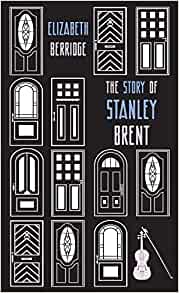
The Story of Stanley Brent – Elizabeth Berridge (1945) 75 pages
Oh dear, I am so behind on everyone’s blogs and of course my own blogging. I hope everyone is well and reading lots of lovely books, and that those in the northern hemisphere are enjoying the longer, lighter days. I’m really hoping May sees me catching up with the blogosphere, and against my better judgement I’m going to give my annual Novella a Day in May a bash too…
Elizabeth Berridge is a writer that I really wanted to get to, and thankfully she has a couple of novellas to her name, so this month seemed the perfect time. The Story of Stanley Brent was her debut and at 75 pages it just makes my criteria for a novella* rather than a short story (in modern editions, my old edition is a bit shorter so I’m starting the month by cheating 😀 )
Opening five years into the last century with a proposal of marriage hastily undertaken on an aunt’s landing, Berridge expertly sets up the themes of her novella: domesticity, social awkwardness, romantic hopes butting up against worldly realities (in this instance, not being able to embrace fully as Ada is in a dressing gown and risks her decency).
The proposal brings out the very different characters of the titular protagonist and his betrothed:
“Ada saved quietly and fiercely for a good home, Stanley lived in the moment and hoped for some stroke of luck, content with the right to kiss his fiancé and hold her hand without reproach, to sit out dances with her. She was promised to him, that was enough.”
Things being enough while Ada hopes for more, will continue through their marriage. Stanley, so determinedly placed by Berridge at the centre of the story, is rarely the leading man of his own life. He drifts into middle management but doesn’t drive the estate agency in any direction and fails to keep up with the changing world. The First World War happens away from him, unable to join up due to a back problem. The Great Strike has a limited impact on his life beyond the train disruption challenging his commuting routine.
His lack of reflection or insight has traumatic consequences for Ada on their wedding night. The impact of total sexual ignorance is dealt with frankly by Berridge, reminding me of Ian McEwan’s On Chesil Beach:
“That her body, washed meticulously and yet ignored by her, should attain such an importance, should cause a good and decent man like Stanley to be so – so bestial and undignified, was shattering. If Stanley could not be trusted, who could? And yet her friends who were married seemed happy enough, they had children… at this a fierce fearful doubt struck her. Suppose they, as Stanley had said, taut and angry, his patience gone, suppose they enjoyed this hateful and frightening thing?”
Somehow the couple recover, conceive two children, and things tick along. Ada has an extra-marital affair, Stanley drinks more heavily over the years. They are lives of quiet desperation, and I felt Stanley’s story was a sad one, all the more so because he didn’t seem to realise he had the power to make it a different one.
“He shook his head. It was all too big for him, he must keep to the small things, the concrete reasons, solid as stepping stones in turbulent waters.”
His father-in-law is another powerless, sad man in the story, one who plays an unfinished tune on the violins he makes and mends. A melancholy refrain in the book but somehow I didn’t find TSOSB depressing. It ends on a hopeful note, but one which may or may not be realised.
I was so impressed by this first encounter with Elizabeth Berridge and it definitely made me keen to read more. I have Across the Common by her and it’s fewer than 200 pages so maybe I’ll even manage it later this month 😊
Someone less impressed than me was a previous owner of my very old secondhand copy, who inscribed it with the following:
“Berthe, from Mother. Sorry, a very bad choice. No Spiritual Outlook. October 1945.”
I would love to have known how Berthe found it. I hope she enjoyed it more than her mother did.
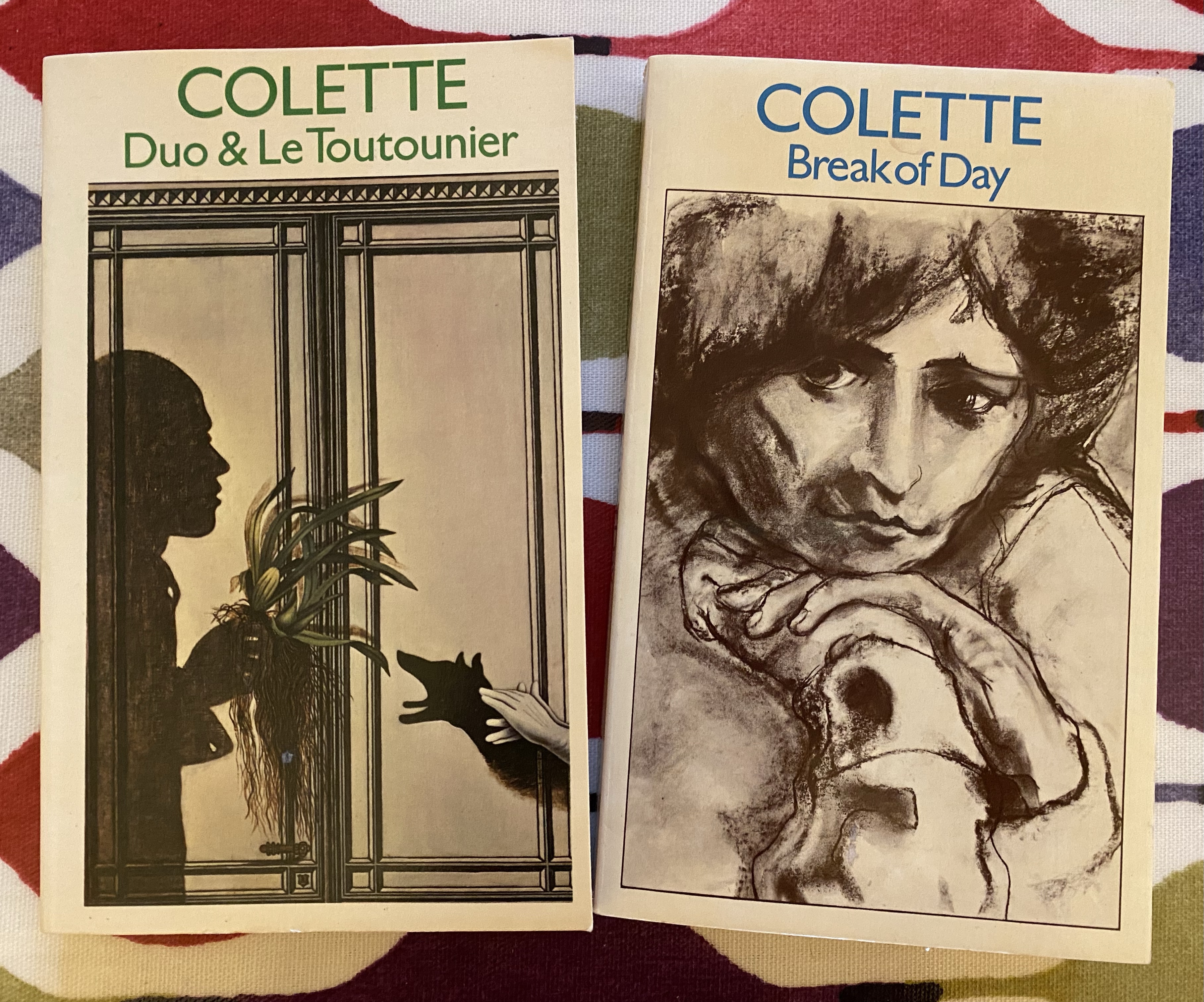
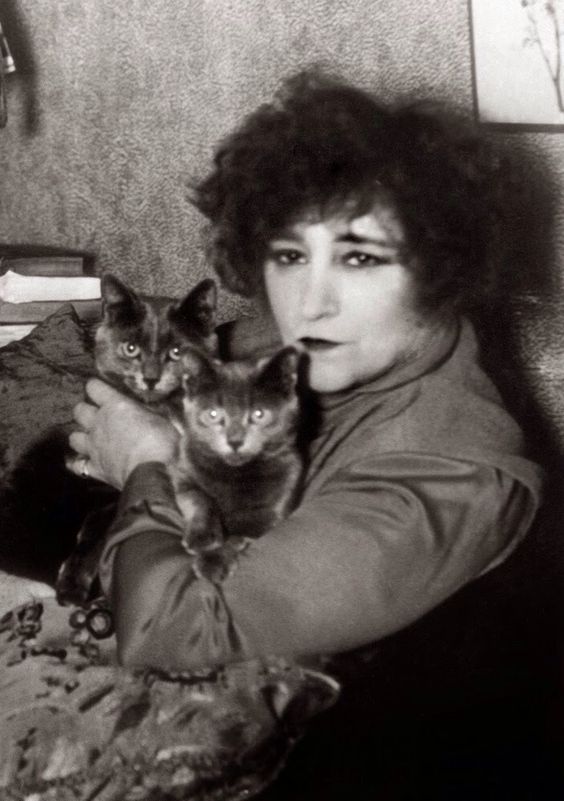
Mallika’s annual Book and Author Anniversaries post alerted me to the fact that today is the 150th anniversary of Colette’s birthday, and the perfect prompt for me to get two of her books out of the TBR (in Women’s Press editions which pleases me – how I regret clearing out loads of my The Women’s Press books when I was trying to streamline before a move one time. Never get rid of books kids – better to die under a toppling pile than live with regret 😉 )
Firstly, Duo and it’s short sequel Le Toutounier (1934 & 1939; trans. Margaret Crosland 1974). Duo follows the discovery by Michel and immediate aftermath of his wife Alice’s short-lived affair with a colleague. They are on holiday in the south of France, somewhat isolated and under the watchful eye of Michel’s family retainer Maria. The novel is primarily dialogue between the couple as they try and decide what remains for them.
Colette’s love of the natural world is very much in evidence as she captures their holiday home and Alice’s feelings of suffocation:
“On the poplars the golden bronze of the new leaves still wrongfully occupied the place of the green. A crabapple tree, its white petals lined with bright red, had defeated the somewhat sickly Judas tree and the syringas in their attempt to escape the destructive shade of the shiny aucubas, extended their slender branches and their butter white stars through the broad grasping leaves, which were mottled like snakes.”
Her precise descriptions of people and their mannerisms also suit this tale especially well, expertly capturing the tension and careful watchfulness between two people fearful of their disintegrating relationship.
“He caressed her with a few crude words, which she heard with a quiver of her eyelashes, as though he had shaken a bunch of flowers over her. They both accepted these exchanges, which were caused by chance, travel, a sudden change of season.”
Michel and Alice don’t tear each other apart, but at the same time their relationship seems doomed. However, the precision and containment of the story to a few days in a specific place, doesn’t make for a heavy or oppressive read. Colette’s humour is always present, with some surprising phrases:
“Out of modesty the servant placed a saucepan lid over the milk.”
During Duo, we learn something of Alice’s family, her sisters Colombe, Hermine and Bizoute.
“When I think about my family as much as that, it’s because I’m finding Michel terribly boring.”
In Le Toutounier she visits their stuffy, smoke-filled Paris apartment with the titular “huge, indestructible sofa of English origin, battered down like a forest road in the rainy season.”
It’s a short novel (80 pages) and I can see why it was put in the same volume as Duo as I think it is best read following on from its predecessor, forming a portrait of an interlude in Alice’s life.
Bizoute is away from home, leaving Colombe and Hermine together with their complicated love lives. Neither of them are with available men and the situation escalates. But the focus in Le Toutounier is not on relationships between the sexes but rather between the sisters, and what it means for women in a family to be close to one another. As so often, Colette focuses her sensual descriptions on women, showing appreciation but not sentimentality:
“The fine woollen dressing gown with a pattern of embossed stitching fell over her quivering shoulders, and it’s pink glow rose to her cheeks, where the makeup had lost its delicate morning colour beneath successive layers of powder.”
Secondly, Break of Day (1928, trans. Enid McLeod 1949) which nowadays would probably be called autofiction, occupying a place between biography and outright fiction. ‘Colette’ spends the summer in Provence, contemplating her past and wondering about the future. All her preoccupations are here – the natural world, animals:
“After dinner I mustn’t forget to irrigate the little runnels that surround the melons, and to water by hand the balsams, phlox and dahlias, and the young tangerine trees, which haven’t yet got roots long enough to drink unaided in the depths of the earth, or strength to break into leaf without help, under the steady scorching of the heavens. The young tangerine trees, planted … for whom? I don’t know. Perhaps for me. The cats will spring sideways at the months when by ten the air is blue as a morning glory. The pair of Japanese hens, perching drowsily on the arm of a rustic arm chair, will chirp like birds in a nest. The dogs, already far away from this world, will be thinking of the coming dawn, and I shall have the choice of a book, bed, or the coast road”
Men and women:
“My true friends have always given me that supreme proof of devotion, a spontaneous aversion for the man I loved.”
“When a man’s glance is following certain household preparations, especially those for a meal, there is apt to be a look on his face that combines religious attention, boredom and fear.”
Her mother:
“On an autumn morning she was the first and only one to see herself reflected in the first disc of ephemeral ice in the well bucket, before her nail cracked it.”
“She would, alas, have judged us plainly, with that divine cruelty of hers which was innocent of wrath.”
Break of Day is fairly plotless save for a slight drama with two young people, but not quite stream of consciousness either, written in a more structured style. If you enjoy Colette’s writing then this is a little gem, but definitely not one to read when you want to be pulled along by a cracking yarn.
Overall the sense is of Colette (author/character) coming to terms with the last part of her life, with aging and with what remains. It isn’t sad but it has a melancholy quality, although I sensed few regrets and an acceptance of how her life had been lived so far and how it would continue.
“Everything is much as it was in the first years of my life, and little by little I recognised the road back.”
I loved all of these reads. It’s been a while since I picked up Colette and I wondered why I’d left it so long. She’s funny, incisive, precise, sensual, and absolutely in command of her own voice. There’s no-one like her.
To end, a 1970s performance to match my 1970s editions, about the breaking of day:
Today is Bloomsday, and the centenary of the publication of James Joyce’s Ulysses. I decided this meant I couldn’t put it off any longer and 2022 would be the year I finally cracked the spine on this tome (metaphorically of course – I don’t crack spines, I’m not an animal.)
When I read War and Peace back in 2017, I opted out of a review-type book post, intimidated at the thought of trying to say anything remotely coherent or interesting about such a revered novel. Instead I opted for a reading diary. Now here I am with a similarly revered, equally intimidating cornerstone of literature. There’s no way I can say anything useful about Ulysses, especially in its centenary year with all the celebratory events happening.
And so I present my Ulysses reading diary, neither coherent nor interesting! In fact, to manage any expectation of intellectual engagement with the genius of Joyce in this post, I should confess that the first hurdle I had to overcome in approaching the text was to get the Ulysses 31 theme tune out of my head (it’s probably unnecessary to explain here that I am a child of the 80s…)
Day 1
“Ulysses, Ulysseeeeees, soaring through all the galaxieeeeees….” Pesky earworm.
Normally if I’m told a book is difficult, I arrogantly assume I can do it. But Ulysses is genuinely intimidating. What I need to remind myself is:
I really love James Joyce. Genuinely, Dubliners is one of my favourite-ever books. So I might even enjoy Ulysses.
Other people have done it. I’ve even met some of them. Lovely bloggers left encouraging comments on my previous post where I explained what I planned to do. It’s definitely do-able.
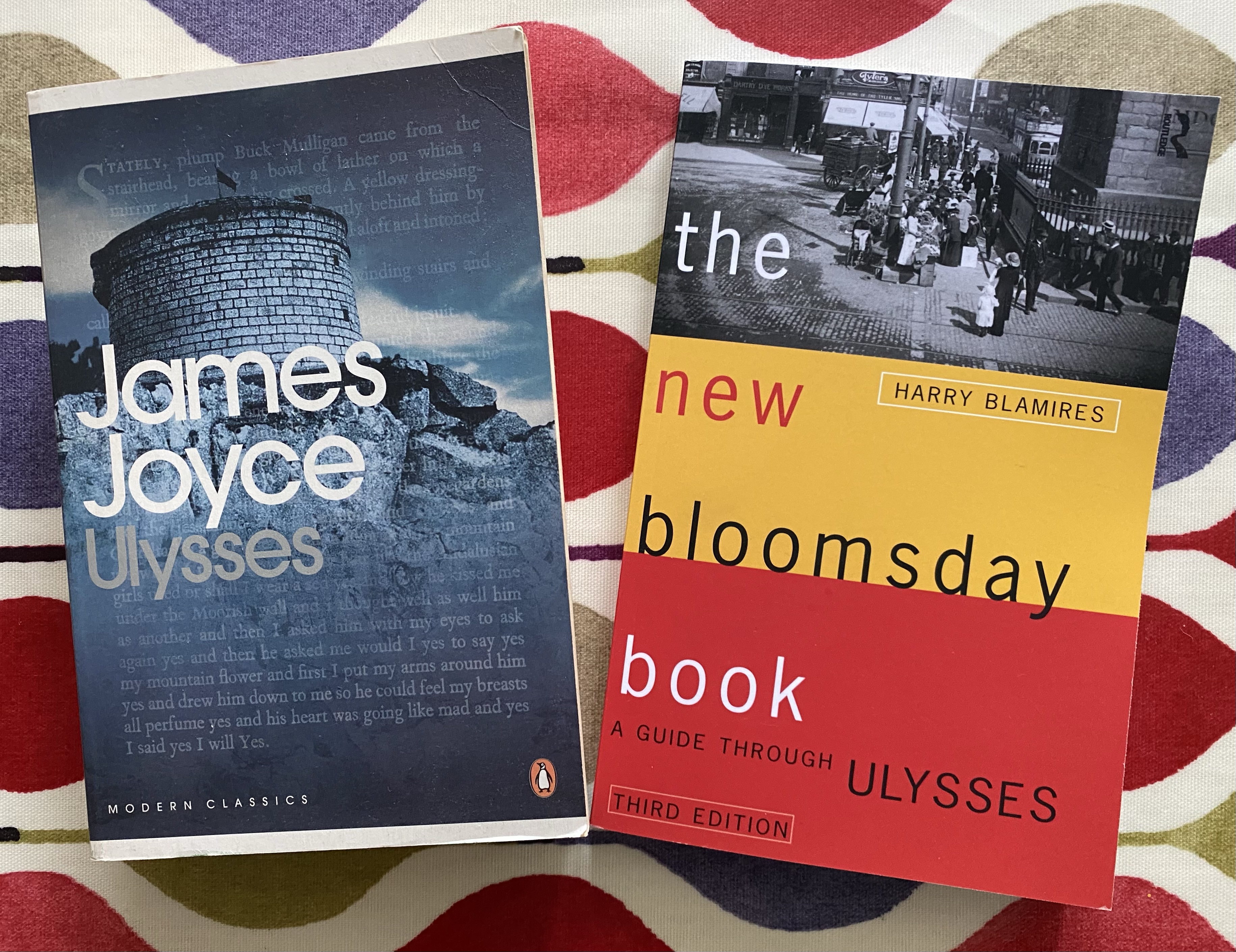
I am not going in unarmed. I have The New Bloomsday Book: A Guide Through Ulysses by Harry Blamires (3rd ed. 1996) at my side. I’m almost certain I read on twitter that this was a good thing, and surely twitter is never wrong??
I’ve read the 80+ page introduction to my edition and now wonder if I should gain degrees in Classical Civilisation/Modernism/European History/Religious Studies before even attempting this novel.
I’ll start tomorrow.
Pages read: None. Pages remaining: 933
Day 2
OK, possibly I overreacted. I think maybe I knew too much in advance. In the end, I was amazed I could make it to the end of a single sentence. But so far Ulysses is beautiful yet also sordid, and very readable. I’m glad I’ve got the reading companion though, as there was complex word play around the word ‘melon’ that I definitely wouldn’t have picked up on my own.
Pages read: 140 Pages remaining: 793
Day 3
For such a learned, intellectual novel, Ulysses also manages to be emotionally affecting. Now I’m just under a quarter of the way through I’m finding Leopold Bloom very moving. There’s something pathetic about him, and isolated and sad, even among the crowds of Dublin.
“I was happier then. Or was that I? Or am I now I? Twentyeight I was. She twentythree. When we left Lombard street west something changed. Could never like it again after Rudy. Can’t bring back time. Like holding water in your hand. Would you go back to then? Just beginning then. Would you? Are you not happy in your home you poor little naughty boy? Wants to sew on buttons for me. I must answer. Write it in the library.
Grafton street gay with housed awnings lured his senses. Muslin prints, silkdames and dowagers, jingle of harnesses, hoofthuds lowringing in the baking causeway. Thick feet that woman has in the white stockings. Hope the rain mucks them up on her.”
Pages read: 218 Pages remaining: 715
Day 4
Fair to say my pace has slackened off today. I woke up with the book on my face, which upon removal revealed two hungry cats giving me the death stare.
Pages read: 250 Pages remaining: 683
Days 5, 6, 7
I’m sure a more attentive reader would get a lot more out of Ulysses, but as an inattentive reader I’m still really enjoying it. I especially like the section which the companion tells me corresponds with The Wandering Rocks in Homer. It’s 19 sections where, by following many characters for a short time, Joyce creates the hustle and bustle of the afternoon of 16 June 1904 in Dublin. He does this as much through the inner lives of his characters and their interactions with one another, as with description. Having said that, here are some descriptions which caught me:
“Two carfuls of tourists passed slowly, their women sitting fore, gripping the handrests. Palefaces. Men’s arms frankly round their stunted forms. They looked from Trinity to the blind columned porch of the bank of Ireland where pigeons roocoocooed.”
“Stephen Dedalus watched through the webbed window the lapidary’s fingers prove a timedulled chain. Dust webbed the window and the showtrays. Dust darkened the toiling fingers with their vulture nails. Dust slept on dull coils of bronze and silver, lozenges of cinnabar, on rubies, leprous and winedark stones.
Born all in the dark wormy earth, cold specks of fire, evil, lights shining in the darkness. Where fallen archangels flung the stars of their brows. Muddy swinesnouts, hands, root and root, gripe and wrest them.”
“Moored under the trees of Charleville Mall Father Conmee saw a turfbarge, a towhorse with pendent head, a bargeman with a hat of dirty straw seated amidships, smoking and staring at a branch of poplar above him. It was idyllic: and Father Conmee reflected on the providence of the Creator who had made turf to be in bogs whence men might dig it out and bring it to town and hamlet to make fires in the houses of poor people.”
I’m very grateful for the companion guide. I’m reading part of Ulysses then the corresponding section in the guide, and this isn’t nearly as tedious as I anticipated. It reassures me that I’m picking up a lot, and it’s highlighting the things I didn’t have hope of recognising.
Among all this learning, my most significant take away is: I’m going to start using the phrase “I beg your parsnips.”
Pages read: 403 Pages remaining: 530
Day 8, 9, 10
More than 100 pages of very unpleasant scenes, filled with boorish, racist, drunk men. An effective contrast to Bloom’s sober gentleness and moderation, (although also some questionable voyeurism from him) but I was very glad to leave it behind.
I wasn’t keen on the following section set out like a play either, and Bloom and Stephen’s hallucinations weren’t the most pleasant reading.
It’s hot, my hayfever is terrible, I’m sleep deprived and grumpy so not the best reader right now. Don’t listen to me.
Pages read: 704 Pages remaining: 229
Days 11, 12
Thank goodness – back on a much more straightforward narrative (or as near to one as you get with Joyce) and I’m enjoying Ulysses again. (I don’t normally mind experimental narratives so I’m blaming my hayfever brain.) Lovely scenes between Bloom and Dedalus.
“Literally astounded at this piece of intelligence Bloom reflected. Though they didn’t see eye to eye in everything a certain analogy there somehow was as if both their minds were travelling, so to speak, in the one train of thought.”
Which is then followed by 50-odd pages of (surprisingly explicit, even by today’s standards) almost punctuation-free stream of consciousness – a brave choice to end and a masterstroke.
“…I dont like books with a Molly in them like that one he brought me about the one from Flanders a whore always shoplifting anything she could cloth and stuff and yards of it O this blanket is too heavy on me thats better I havent even one decent nightdress this thing gets all rolled under me…”
Pages read: 933 Pages remaining: zero!
So that’s me all done! And one of the Big Scary Tomes ticked off my Le Monde’s 100 Books of the Century Reading Challenge. While it doesn’t yet occupy a special place in my heart like Dubliners, I still got so much from Ulysses. It’s such an achievement to be simultaneously so epic and so determinedly everyday. I would definitely read it again, and I’d love to go to the Bloomsday events in Dublin, which I’m sure would mean I’d enjoy a re-read even more.
To end, an opportunity to indulge myself with one of the loves of my life, because here Kate Bush is singing Molly Bloom’s soliloquy:
P.S Virginia Woolf did modify her view of Ulysses at a later date: “very much more impressive than I judged. Still I think there is virtue & some lasting truth in first impressions; so I don’t cancell mine. I must read some of the chapters again. Probably the final beauty of writing is never felt by contemporaries”
Having read Barbara Comyns recently for the 1954 Club, I was delighted to pick her up again for this reading project. How I loved Mr Fox – there is no-one with a voice quite like Barbara Comyns.
The novella opens with Caroline and her small daughter living in a flat with Mr Fox. They are not romantically involved, but the pragmatic Mr Fox suggests it would work as a financial arrangement. His work is sporadic, varied, and not always entirely legal:
“It wasn’t always holidays Mr. Fox was enjoying when he went away. Sometimes he went to prison, not for crime but because he didn’t pay his rates to the borough council. He thought it a pity to waste money on rates and preferred going to prison – it was Brixton he went to. He once suggested I went to prison instead of paying my rates, but I didn’t like the thought of being shut up and when I made a few enquiries about Holloway I heard it was perfectly beastly there and not to be compared to Brixton.”
I really enjoy Comyns’ characters which she somehow manages to make guileless yet never fey. They are survivors but never in a remotely aggressive or self-pitying way.
Caroline’s husband has left and she’s not sorry. She is caring for her small daughter Jenny and worried about money. Mr Fox is a savvy and useful friend, but can also be moody and unreasonable.
“I hoped Mr. Fox didn’t think I’d runaway and left Jenny on his hands; he might even put her in an orphanage and it would take months to get her out again.”
This is the end of the 1930s, and so we know times are going to get much more difficult for these London-dwellers. Comyns captures the bombing in her own inimitable way:
“So I had to spend the day wandering about without any shoes. I passed some of the time filling sandbags in the street; heaps of people were doing it and it seemed a fashionable thing to do.”
Of course, the war brought opportunities for people like Mr Fox, and essentially he is a spiv. Caroline seems both aware and entirely unaware of what Mr Fox is up to, and helps him in the unlikely trade of second-hand pianos. After a time in the suburbs which makes them miserable, they return to the city:
“I began to enjoy an almost empty London. Shopping became almost a pleasure and sometimes we would go to the theatre and there would be hardly anyone there; and it was the same in restaurants. Often in the evening we would take the dogs for a walk in Hyde Park and it would be deserted and lovely. Once when we were walking home a flying bomb stopped right over our heads, and as we turned and ran in the opposite direction a great explosion came and then an enormous amount of dust. The dogs were more upset than we were.”
Comyns has such a unique and unlikely view on things I’ve no idea how typical the experiences in Mr Fox are, but I understand it was based on her real-life situation during that time. She doesn’t shy away from the difficulties of life but presents them in such a surprising way I’m often astonished rather than saddened. Mr Fox was still an emotionally affecting novel though, and such an entertaining one. I was sorry to reach the end.
“Perhaps it was just as well to get the sad part of my life over at one go and have all the good things to look forward to.
Don’t Look At Me Like That – Diana Athill (1967) 187 pages
I was aware of Diana Athill’s incredible career at Andre Deutsch but it wasn’t until Granta re-issued her only novel in 2019 that her fiction work was on my radar. I have a bias in favour of editors writing novels due to my love of William Maxwell, and Don’t Look at Me Like That is certainly an interesting exploration of character.
It opens with Meg Bailey, daughter of a clergyman, nearing the end of her school career in the 1950s. As she explains: “When I was at school I used to think that everyone disliked me, and it wasn’t far from true.”
Athill brilliantly captures the trials of adolescence and how the clever and pretty Meg is “aggressively self conscious”, convinced simultaneously of both her inferiority and superiority to everything around her.
It is a time on the brink of huge social change and the difference is between generations is coming into sharp relief. Meg’s parents lead an ordinary life, making the best of their privations.
“Rationing and austerity in general deprived my father of nothing he valued… And my mother who had suffered because of their poverty, hating the drab life they were compelled to lead, felt a release of tension when everyone’s life became equally drab.”
But Meg wants something more. Roxane is probably her only friend and seems to lead a much more glamorous life with her widowed mother, Mrs Weaver. At first entranced by Roxane’s mother, Meg later sees beyond the façade, when she lives with them while studying art.
“There was something feverish in the energy she devoted to her play-acting, and without understanding what longings drove her to it I could feel their uncomfortable presence.”
Mrs Weaver is a brilliant piece of characterisation, a beguiling and somewhat menacing mix of vulnerability and pretention.
Things change when Roxanne marries the man her mother wants her to, family friend Dick. Athill portrays the shifting sexual mores in this time before the 1960s sexual revolution so well. While there is sex before marriage for some, there is still a great deal of naivety, and limited awareness that women are entitled to sexual pleasure. As such, Roxane does not have the best start to married life.
“Roxane had accepted something which I had never before thought of: that life could be as it ought not to be, and that one still had to live it.”
Meg meanwhile begins carving out a successful career in London and starts seeing Dick without Roxane.
“Without knowing it, I had learned what Dick was really like, and he was like me.”
Inevitably they begin an affair. Athill’s subtle writing means that while neither Meg nor Dick are particularly likeable, they are very believable. They are both selfish and weak but also young, naive and a bit lost.
We see the rest of their affair play out within the setting of Meg’s 1950s bedsit London life, and Dick and Roxane’s suburban family life.
“There was no change in my feelings for Roxanne: she was still the girl I knew best and whom I loved for her innocence, affection, and vulnerability. And there was no doubt in my mind about me: I was betraying her. These two facts simply coexisted, without seeming to affect each other. I was appalled by myself, but of course I could meet her.”
Don’t Look at Me Like That is so evocative of a particular time and place. I thought the characterisation was complex but done with a light touch. While I didn’t particularly care for any of the characters in the love triangle, I found myself very affected by Meg’s kind and bewildered parents. The following passage broke my heart:
“When my father got a book on abstract painting out of the library so that he could talk to me about modern art I was so embarrassed that I let some milk boil over on purpose to end the conversation.”
A very readable novella that is brave enough to show its characters with all their flaws and without judging them harshly.
The Bathroom – Jean-Philippe Toussaint (1985, trans. Nancy Amphoux & Paul De Angelis 1990) 102 pages
A young man decides he’s going to stay in his bathtub. Thankfully, his long-suffering girlfriend Edmondsson is happy to fund this indolent lifestyle. He leaves on occasion to talk to his decorators (who aren’t decorating as Edmondsson is vacillating between white and beige paint) and sit in the kitchen. Otherwise, he’s back in the bath:
“A friend of my parents was passing through Paris and came to see me. From him I learned it was raining. Stretching out an arm toward the washbasin, I suggested he take a towel […] I didn’t know what he wanted from me. When the silence had begun to seem permanent, he began to tell me about his latest professional activities, explaining that the difficulties he had to contend with were insurmountable since they were linked to incompatibilities of temperament among persons at the same hierarchical level.”
The novella is in three sections, each paragraph numbered. This unusual structure isn’t as irritating as it should be. It somehow emphasises the banality of his existence without becoming banal itself.
In the middle section, the narrator heads to Venice. In this beautiful and historic city, he mainly stays in his hotel room, taking up darts:
“When I played darts I was calm and relaxed. Little by little, emptiness would creep over me and I would steep myself in it”
We’ve seen that he can be socially awkward, guiding people into the toilet when showing them round the flat, mildly insulting the previous tenants, but later in the novella it seems this behaviour could be deliberate:
“I left the hotel and, in the street, asked a running man the way to the Post Office. I’ve always enjoyed asking people in a hurry for information.”
In the third section he heads back to Paris although I lived in hope Edmondsson was finally sick of him.
Apparently Touissaint is a fan of Beckett and The Bathroom definitely has the feel of Beckett: nihilistic, unreal verging on surreal, contained environments, experimental forms. It echoes itself and takes the reader in disorienting circles.
“Immobility is not absence of movement but absence of any prospect of movement.”
Not a novel for when you want a ripping yarn, but an interesting quick read.
“I would ask her to console me. Softly, she would ask, Console you for what? Console me, I would say”
This is my second contribution to this week’s 1954 Club, hosted by Simonand Kaggsy, and a chance to revisit Barbara Comyns, having really enjoyed Our Spoons Came From Woolworths.
The opening line of Who Was Changed and Who Was Dead may have usurped The Crow Road* to become my favourite beginning to a novel ever:
“The ducks swam through the drawing-room windows.”
Thus the scene is set for an unsettling domestic tale where nothing can be taken for granted.
The Willoweed family live in an English village where the river has just flooded in June. Then follows pages of dead animals, which I was prepared for, having read Jacqui’s wonderful review but I was exceedingly relieved when it ended (unfortunately there was also a horrible cat death later). Much as I could have done without the litany of death, it sets the tone for the darkness that follows.
In 1911 Emma, Dennis and Hattie live with their father Ebin and their grandmother who rules with a rod of iron. She is permanently furious, which Ebin attributes as follows:
“It’s all this cleaning, I suppose; but she can’t expect me to help; my hands are my best feature, and they would be ruined.”
Ebin does very little apart from make vague overtures towards his children’s schooling and sleep with the baker’s wife.
“‘Father makes me hate men,’ thought Emma as she pumped water into a bucket.”
This is not an idyllic pre-war rose-tinted existence. Money is tight, relationships are tense, there is sexual deceit, violent undercurrents that threaten to overwhelm, and macabre power games. Grandmother Willoweed treats the servants horribly, but Old Ives the handyman is a match for her:
“They always exchanged birthday gifts, and each was determined to outlive the other.”
Their lives are disrupted by a mysterious illness that sweeps through the village. People kill themselves following horrific delusions. By the time the cause of the illness has been identified, tragedy has touched the family and violence has ensued. As the title tells us, lives will have changed irrevocably one way or another.
I don’t want to say much more as the joy of reading Barbara Comyns is being so unsettled as to have no idea which way she is going to take you. There’s no-one like her; her view is so singular, so disturbing and yet so compelling. I found Who Was Changed and Who Was Dead brutal and horrifying, and also funny and enchanting. I couldn’t look away.
The novel picks up precisely where The Sugar House left off, with Clara and Archie having decided to separate. Clara moves back to her parents’ house to live with them and her grandmother in West Kensington. As she packs up her old life, she feels disassociated:
“She had the odd impression that it was not she who was stripping hangers and throwing armfuls of clothes into suitcases but some callous, efficient stranger. She herself was lying on the unmade bed, staring blankly at the cracks in the sugar-pink ceiling.”
This sense of disassociation deepens and broadens throughout the novel. When Clara announces to her mother “It’s a great relief not to have any feelings. I’m certainly not going to risk getting involved with anyone again.”
The reader of course knows what will happen. She attends a party with her friend Clive Heron (an intriguing character, my personal theory is he works for MI5) and falls instantly in love with the dashing soldier Richard Crayshaw.
What follows is such a clever exploration of someone slowly – then suddenly – unravelling. Clara stops eating and sleeping, she has a “strange sense of heightened perception” ever since she danced with Richard. She believes they communicate telepathically, a belief supported by others, but then she thinks the photographs of dead soldiers in her father’s study are speaking to her. She has gone from no feeling:
“Null and void. Null and void. She sat staring at the roses on her bedroom wall-paper, saying the words over and over again until she was half hypnotised.”
To too much feeling. At first her mania is disguised by being in love – plenty of people feel heightened and have reduced appetite and problems sleeping in the excitement of new romance. Certainly that is what Clara’s mother Isabel believes.
But gradually the reader begins to realise that Clara is really quite unwell. As Beyond the Glass is told from Clara’s perspective this takes some time, but it dawns us through others’ responses to her. In this way it is reminiscent of Wish Her Safe at Home, another excellent novel about severe mental illness.
Eventually she is ‘certified’ – made an in-patient at a public mental health hospital. The descriptions of the environment and the practices make me wonder how on earth anyone would have a hope of ever becoming well again. Thankfully mental health services, though chronically underfunded, are very different now.
I was so impressed with how White conveyed Clara’s disorientation and confusion, without making the narrative confusing and disorienting at all:
“Time behaved in the most extraordinary way. Sometimes it went at tremendous pace, as when she saw the leaves of the creeper unfurl before her eyes like a slow motion film, or the nurses, instead of walking along the passage, sped by as fast as cars. Yet often, it seemed to take her several hours to lift a spoon from her plate to her mouth.”
During her deep distress there are also echoes of events that occurred earlier in the narrative, particularly in The Sugar House, showing with the lightest of touches that her severe ill health has been building for a while:
“Since her marriage she had had an increasing sense of unreality, as if her existence had been broken off like the reel of a film.”
The recurring images of mirrors and glass as barriers reminded me of Plath’s The Bell Jar. Like The Bell Jar, this novel is based on the personal experiences of the author.
“She had an instantaneous vision of herself as someone forever outside, forever looking through glass at the bright human world which had no place for her and where the mere sight of her produced terror.”
Beyond the Glass ends on a note of hope, and faith, drawing on the Catholic thread that runs through all four novels. At times Clara’s Catholicism is more strongly felt in the story than at others, reflecting the character’s experience of her faith. I’m not religious but I felt the focus on this theme ended the novel and the series perfectly.
It’s so impressive that all the novels in the quartet are distinct and stand individually, while also developing across the sequence a fully realised portrait of Clara, and her family.
I’ve really enjoyed immersing myself in Clara’s life and I’m going to miss her (and her much-maligned mother, a great piece of characterisation). I wish Antonia White had continued writing her story.
“Something told her that, when they saw her again, they would know as well as she did that she no longer belonged to the world beyond the glass.”
To end, I finished my previous 1954 Club post with a filmed musical, so here’s another. The film of The Pajama Game is from 1957 but the Broadway show first appeared in 1954: