“For me writing is an act of the will.” (Elizabeth Jolley)

I’ve been meaning to read Elizabeth Jolley for ages so I’m pleased to be finishing AusReading Month 2023 hosted by Brona at This Reading Life with one of her novellas.

Milk and Honey (1984) has quite a Gothic feel to it, so it’s worked out well with Hallowe’en too…
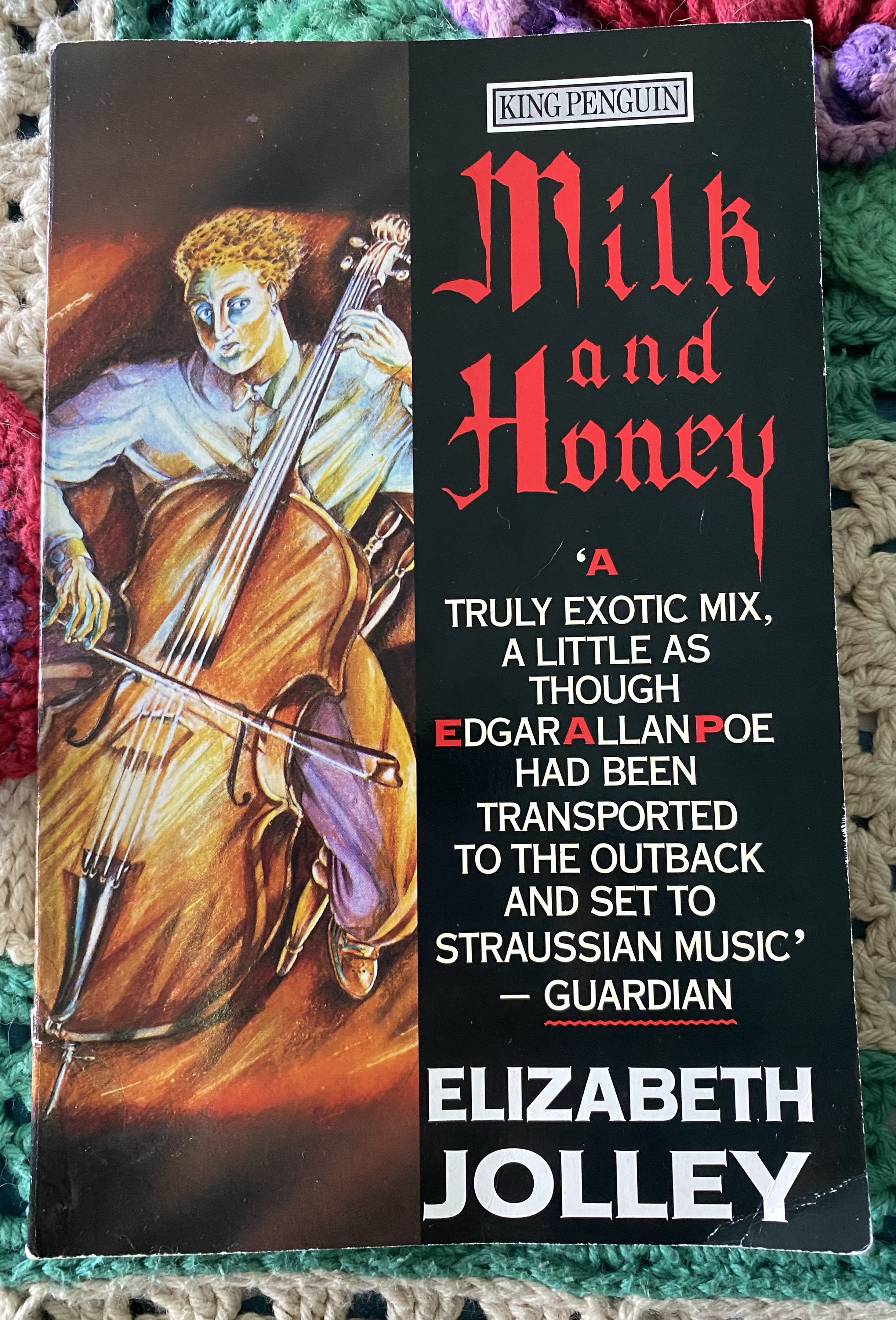
The story is narrated by Jacob, who at the beginning of the novella is an unhappy, unfulfilled door-to-door salesman with an injured hand.

“Sometimes, after my cup of real coffee in the Beach Hotel, I sat outside on the small, sandy cliffs, looking down onto the sea as it came up in long, slow waves to the rocks and sunk sighing back down the beach, and I felt the profound melancholy that all my life has come over me from time to time. It was the melancholy of dark trees standing alone and the quiet sadness of the colours of the land, dark greens and browns and the sand subdued. As I sat, the colours deepened, tawny, dun coloured blending beneath the low grey sky. And from somewhere hidden, the sun lit up the sea.”

We then go back in time to when Jacob was a teenager and sent by his father to live with the Heimbachs so he can be tutored in the cello by Leopold.  The widowed tutor adores Jacob, calling him ‘Prince’, but his sisters Tante Rosa and Aunt Heloise may be more ambivalent. Certainly Jacob’s lauded genius may not be as evident as Leopold proclaims. But Jacob does play with feeling:

“When I played the cello and the cello hesitated, poised on a single note so pure and restrained and lovely, I closed my eyes with an exquisite love of the cello. I was in love with the cello.”

Also in the house are Leopold’s children. His daughter Louise is a romantic interest for Jacob, and there is his son Waldemar who has unspecified disabilities. The household is insular and claustrophobic, but Jacob willingly relinquishes external experiences:

“I had no wish to be free. I preferred not to go to school, and, though the house and garden were open to the street, I never went out into the street. I read and studied and lived in the household which seemed to contain all in the way of books and musical instruments and teachers I could ever need.”

For the reader though, the household is deeply unsettling. We never really know what anyone’s motivations, views or plans are. Jacob is self-focussed and so as a narrator he doesn’t tell us. We piece together certain aspects of the wider life of the household – I guessed an unpleasant twist towards the end – but so much is left unspecified.

Conspiracies abound in this small household. A major decision is taken early in the novel that is traumatising for Jacob but we’re not completely sure why such action is taken. Jacob is having an affair but it seems entirely likely that everyone knows about it. A wedding ceremony is sprung on him, and yet everyone seems to think this is completely acceptable:

“But even after the surprise celebration of our engagement, on the day of my inheritance, the idea of marriage had seemed remote, something vague, talked about in laughter while eating apples and trying on rings made from human hair, something looked forward to from childhood but, like a disease experienced by adults, never reached.”

Milk and Honey is an odd novel and at times I wasn’t sure it was for me. There was so much that was unexplained that it could be entirely discombobulating, and Jacob was so oblivious and callow I wasn’t sure he could carry me through. I’m glad I persevered though, and I would definitely be interested to read more by Jolley. From this, I would say she writes about nature beautifully and is expert in creating an unsettling, memorable atmosphere.

You can read Lisa’s excellent review of Milk and Honey here.

To end, a bit of a departure from my usual 80s cheese – I always find Elgar’s cello concerto in E minor so moving (and this is with the City of Birmingham symphony orchestra, which was Elizabeth Jolley’s place of birth before she emigrated to Australia – see what I did there? 😀 ):
“Borderline, feels like I’m going to lose my mind.” (Madonna)

Somehow I’ve accumulated several Janette Turner Hospital books in the TBR, without ever managing to get round to reading any of them. So thank goodness for AusReading Month 2023 hosted by Brona at This Reading Life which finally got me to pick one up!

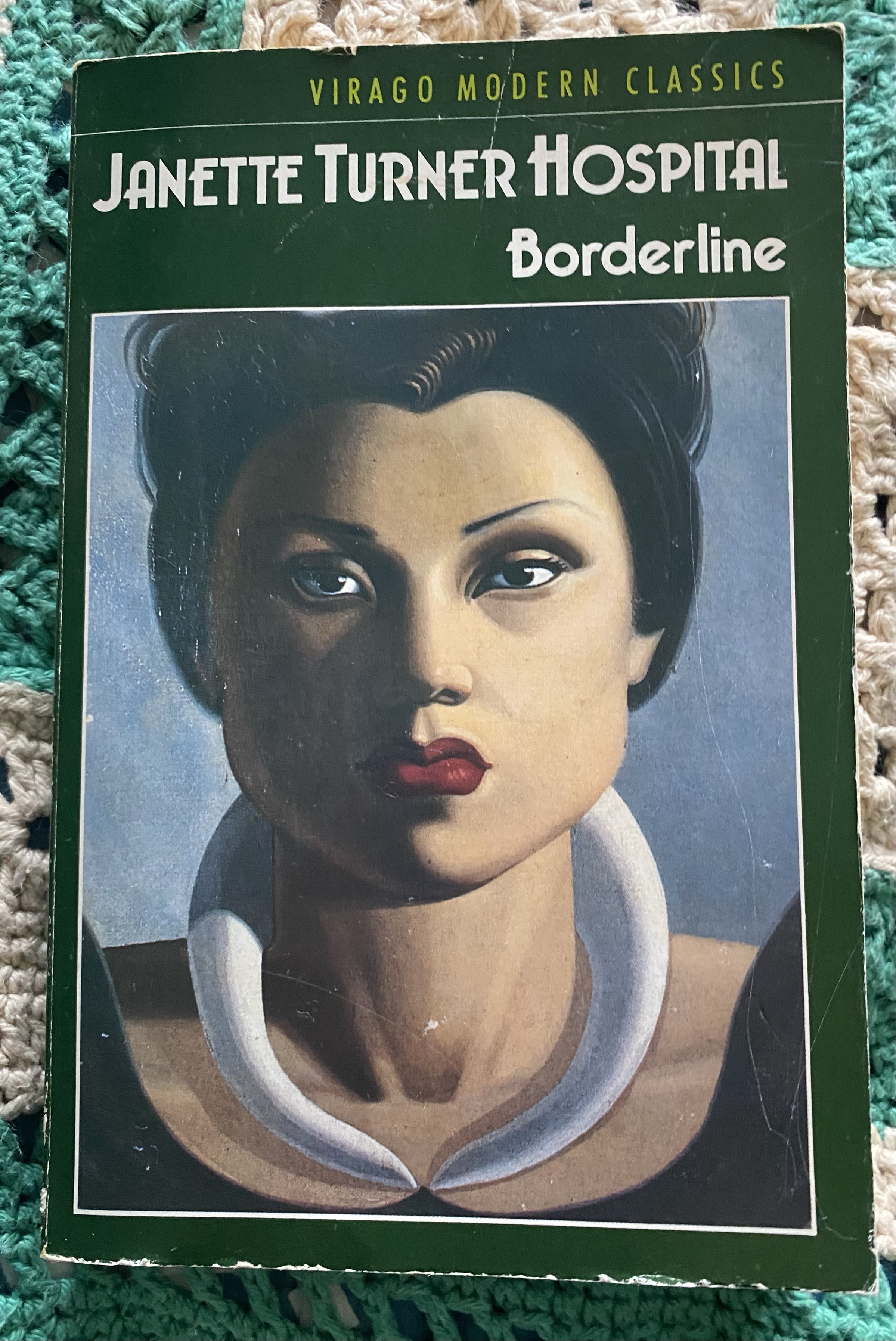
Borderline is JTH’s third novel, published in 1985. The blurb on the back describes it as a metaphysical thriller, but I don’t think that’s a helpful description. There are thriller elements but what JTH is more concerned with is the unreliable narratives we tell ourselves and others; how we can love those who remain so unknown to us; and the unpredictability of all our lives that can change in an instant. These themes don’t lend themselves to definite resolutions, so those seeking a thriller will be disappointed.

However, if you’re happy to go along with an exploration of these ideas that ends without any neat answers, there’s a lot to enjoy in Borderline.

The narrator is Jean-Marc, a man who has always had a slightly Oedipal relationship with his father’s girlfriend, Felicity. Seymour aka Old Volcano, was an artist much older than Felicity, who was nearer in age to her stepson.

“When I was five, my father was already famous and my mother was mostly distraught. Later she escaped. She made a quantum leap into banality. Which is the true secret of happiness – a second marriage, a very ordinary life, other children. Naturally she does not care to see me, a revenant from that earlier bad time, and I do not blame her at all.”

Felicity and Seymour’s relationship inevitably ends, and Felicity becomes a successful art dealer. She is returning from a trip when, at a border crossing between the United States and Canada, she makes the impulsive decision to smuggle Dolores Marquez, a refugee from El Salvador, with the help of a man called Gus.

Gus’ full name is Augustine, he’s a salesman who is routinely unfaithful to his wife. Felicity calls Dolores La Magdalena after a painting. People in this novel have different names, different roles, splintered lives. They disappear and no-one knows where to begin looking for them.

Gus’ daughter Kathleen turns up at Jean-Marc’s house, and their relationship seems to almost transgress boundaries, but not quite. As they try and locate their loved ones, Jean-Marc acknowledges that he is filling in a lot of gaps with very little to go on:

“Her stories bombard me, they seem to have become my own memories, they writhe and change and regroup in the way true memories do. They are like photographs in her grandfather’s dresser, a deluge of the ever-present past.”

The plot of Borderline is enough to pull the reader along, but this is not the novel to read if you want a plot-driven story. Jean-Marc tracks Felicity as best he can, but she remains out of reach. The stories in Borderline are unclear in origin: what Jean-Marc has experienced, what he has been told, what he is making up.

“Her days are baroque, they curl into each other like acanthus leaves, she lives somewhere between now and then. She moves in and out of her life.”

“Still, I have to admit, there has always been a quality of absence about her; which is why her disappearance itself seems insubstantial, merely a figure of speech, or a trick of the light, a momentary thing.”

I would completely understand if someone experienced this novel as a frustrating and disappointing read. However, I felt Borderline was an effective exploration of how human beings try and make sense of themselves, each other and the world when so much remains unknown and chaotic. It has some truly breathtaking passages and JTH is absolutely a writer I’d like to explore further.

To end, let it never be said that I shy away from the obvious in my 80s song choices 😀

“Compared to memory, every possession can only ever seem disappointing” (Giorgio Bassani)

This is my final post for the 1962 Club, hosted by Simon and Kaggsy, which has been running all week. It’s been a great event as always, and I’m really pleased it prompted me to pick the three I’ve read off the TBR pile at long last!

(Please note, despite the subject matter I’ve made a deliberate choice not to draw contemporary parallels. I think Lisa explained this decision really well in her blog post here.)

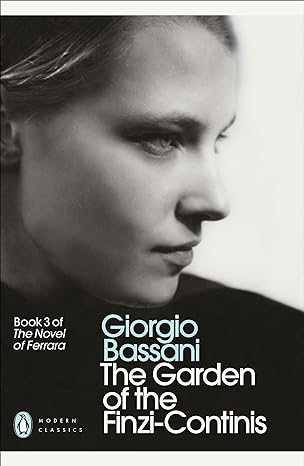
I adored Giorgio Bassani’s The Gold-Rimmed Spectacles (1958) when I read it last year, so I had high expectations when I approached The Garden of the Finzi-Continis (transl. Jamie McKendrick, 2007), the third book in his Romanzo di Ferrara cycle. It fully lived up to those expectations.

The unnamed narrator tells us in the Prologue that he is looking back from 1957 to a time before World War II. However the tone is more elegiac than nostalgic, as he also tells us that those he recalls perished in concentration camps.

Before the war the Finzi-Continis were a prosperous family, but the conflict destroyed them and all they owned. The large house is now squatted in, and the titular space:

“All the broad-canopied trees, limes, elms, beeches, poplars, plane trees, horse chestnuts, pines, firs, larches, cedars of Lebanon, cypresses, oaks, holm oaks, and even the palm trees and eucalyptuses planted in their hundreds by Josette Artom during the last two years of the first world war, were cut down for firewood, and for some time the land had returned to the state it was in when Moisè Finzi-Contini acquired it”

So it is with this knowledge that we then meet the younger, somewhat callow narrator, and follow his developing friendship with the younger Finzi-Contini’s, Alberto and Micòl, son and daughter of Professor Ermanno and Signor Olga.

Racial laws are coming into effect in Italy in the late 1930s, and this sees the narrator invited into the walled estate, as Jewish people are banned from places such as the local tennis club.

“They entirely left aside the existence of a far greater intimacy, a secret one, to be valued only by those who shared it, which derived from the fact that our two families, not by choice, but by virtue of a tradition more ancient than any possible memory, belonged to the same religious observance, or more accurately to the same ’School’”

Despite the growing pressures of the outside world, within the Finzi-Continis walls the narrator remembers a time where:

“The weather remained perfect, held in that state of magical suspension, of glassy, luminous, soft immobility which is the special gift of some of our autumns. In the garden it was hot, just slightly less than if it was summer.”

In this enchanted space the narrator falls for Micòl, but their relationship never develops, characterised by misunderstandings and ambiguity that they are too young to resolve. Being too young for what life throws at you is also shown through the political conversations with Giampi Malnate, an older Christian friend of Alberto, as well as an experience of terminal illness.

What I thought was so subtle and clever from Bassani is that nothing overly dramatic happens. Rather, things fade out. The huge events that we know are looming take place outside of the novel, and instead we are shown how we can take for granted the moments that seemingly have no wider ramifications. Except of course, they do. This is a formative time for the narrator.  

The Garden of the Finzi-Continis is not a plot-driven novel. It is a beautifully written evocation of a time before unimagined horrors. It is reflective and elegiac in tone without ever letting sentimentality lessen the portrait of a family obliterated by the Holocaust. It’s a truly devastating read.

The novel was adapted into a film in 1970, which won the Best Foreign Language Oscar that year. Has anyone seen it? It looks pretty faithful to the book so I’m interested to watch it:

“Writing’s not always a pleasure to me, but if I’m not writing every other pleasure loses its savour.” (John Braine)

This is my second contribution to the 1962 Club, hosted by Simon and Kaggsy, which is running all week. Do check out all the wonderful posts!

I picked up Life at the Top by John Braine because it is the sequel to Room at the Top (1957) which I really rated, with its depiction of the postwar north of England and Joe Lampton’s determination to leave his working -class life behind, whilst juggling complex sexual relationships. Life at the Top I didn’t find as compelling, but there was still a lot to enjoy.

Set ten years after Room at the Top, the novel follows Joe as he lives the life he thought he always wanted. Even if you’ve not read the first novel, take a guess as to how that’s working out for him 😀

“The truth was that I actually wanted a drink now, I wanted something to blur things slightly, to put a haze between me and the pink wallpaper and the pink cupboards and the white refrigerator and the electric oven and the mixing machine and the pink wall table and the pink covered stool; it was too bright and shiny and hygienic at eight o’clock on a March morning with Harling Crescent quiet under the weight of Sunday, it reminded me rather too coldly that I was thirty-five and a father of two children and at least ten pounds overweight.”

Joe adores his young daughter Barbara but feels alienated from his son Harry, who has been sent away to a school of his grandfather’s choosing. He and his wife Susan still sexually desire one another, but there seems to be little intimacy. Working at the family firm (Susan’s family), Joe is frustrated:

“I had stopped wanting things. I wanted power, power to put through my own ideas; I wanted to be taken seriously, I wanted to be something more than the boss’s son-in-law.”

He is going to become a local councillor, but that doesn’t suggest fulfilment to him (nor should it, bloomin’ Tory! 😀 )

“The prosperous middle-aged grumblers, the solid sensible citizens; I would sit here or in the committee room listening to them; taking great care not to offend them, and without my realising it, I would become exactly like them. Waiting my turn to grumble, waiting my turn for thrombosis, waiting my turn for death.”

So what does Joe do? Talk honestly with his nearest and dearest? Seek out a life of authenticity? Reflect honestly on the deep-rooted cause of his dissatisfaction and what he can do to make his life more fulfilling? No, of course not. He starts an affair with an attractive young journalist named Norah Hauxley and runs away to London.  The shadow of his former lover (from Room at the Top) still looms large, and I felt Alice was really the only woman Joe had loved:

“She was grown up. I hadn’t met a grown up woman in ten years, and for ten years I hadn’t felt the need to be with one. And Alice, even Alice, had been broken somewhere, she had lost the habit of happiness.”

Joe is not likable. He takes decisions that hurt others. He behaves selfishly. He’s a bit of a misogynist.But still I found myself staying alongside him as narrator, because he’s so honest. He doesn’t ask the reader to like him, because he doesn’t much like himself. I thought Braine did a brilliant job of presenting a man so of his time, and so completely believable.

Life at the Top doesn’t have a huge amount of plot, but I found it a compelling read in its honesty, particularly around flawed human relationships.

“I looked at her in surprise; I had not felt so close to her since we were first married. But I made no move to comfort her.”

Life at the Top is a short read, and I may not have stuck with it had it been longer. But as it was it was well-judged, and there are some developments in Joe’s familial relationships toward the end that I found truly moving. I’m glad the 1962 Club prompted me to finally pick this one up after it had been languishing in the TBR for many a year.

Life at the Top was adapted into a film in 1965, with the magnetic Laurence Harvey, who also starred in Room at the Top. Unfortunately the director changed from the first excellent film, and although I tried to watch the sequel, I found it so heavy-handed and unsubtle compared to the book that I gave up. But it did make me appreciate the book more!

So rather than a trailer for the film, here’s a 1962 song about rain, which the West Yorkshire town of Warley would be no stranger to:

“I regret profoundly that I was not an American and not born in Greenwich Village.” (John Lennon)

The 1962 Club, hosted by Simon and Kaggsy, starts today and is running all week which I am very excited about 😊 The Club weeks are always great and I’m really looking forward to seeing the posts. This is the first of  what I hope will be three contributions, but as I never blog as much as I mean to, failure is almost inevitable!

The Golden Spur was Dawn Powell’s last novel, and it’s a humorous look at the bohemian arts scene of late 1950s New York, specifically Greenwich Village. This was a world Powell was very much a part of and my edition features an effusive introduction from Gore Vidal who was one of her close friends.

We are introduced to the artists and writers – both up and coming, and those very much faded and failing – their hangers-on and their varied associates through the outsider view of Jonathan Jaimison. He is in his late twenties and recently discovered that his father isn’t the domineering tyrant he grew up with, but someone from this scene, back when his mother was hanging out with Prohibition-era flappers.

So Jonathan leaves his Ohio home and soon makes his way to the titular bar, at the start of his quest to find his biological father:

“Through a gap in the plum velvet cafe curtains he could see the bar … He breathed deep of the heady New York air, that delirious narcotic of ancient sewer dust, gasoline fumes, roasting coffee beans, and the harsh smell of the sea that intoxicates inland nostrils. Then he pushed open the door.”

He’s quickly adopted by Lize and Darcy, two frenemies who sleep with the same male artists, although it’s not entirely clear why, as they seem to have no great fondness for men or for art:

“The girls never asked questions about a man’s private interests or listened when he tried to tell them. For them it was enough that he was a man and that he was there. Who needs a talking man?”

“That his newest canvas was gone should have told her something, but she wasn’t sure which was the new one because all his pictures looked alike to Lize. Great lozenges of red and white (‘I love blood,’ he always said), black and grey squares (‘I love chess,’ he’d say), long green spikes (‘I love asparagus’). All Lize had learned about art from her life with painters was that the big pictures were for museums and the little ones for art.”

As Jonathan makes his way in New York, he moves between two generations: the young artists and the fading interwar generation. There is a nostalgia for the Prohibition period and what New York was then which is beautifully evoked, alongside a recognition that New York is a city that continually makes itself and its inhabitants anew:

“Jonathan recognised New York as home. His whole appearance changed overnight, shoulders broadened, apologetic skulk became swagger; he looked strangers in the eye and found friendship wherever he turned. With the blight of Jaimison heritage removed, his future became marvellously incalculable, the city seemed born fresh for his delight. He took for granted that his mother’s little world, into which he had dropped, was the city’s very heart.”

Although The Golden Spur is described as a comic novel, I didn’t find it laugh-out-loud funny. Rather I’d describe it as affectionately satirical. It ribs the 1950s arts scene and the vacuous people drawn to it, but it never has a bitter or nasty tone:

“Anybody with a tube of paint and a board was an artist. But writers were not writers unless decently unpublished or forever muffled by a Foundation placebo.”

“‘I just want to be overestimated,’ Earl shouted, ‘like everybody else, goddammit.’”

Despite the overarching plot being Jonathan’s search, this really isn’t a plot-driven novel. Rather, the question of his paternity is a device to introduce the various characters and their world. It’s a novel to read for the evocation of the city, of a particular society found within it, and for the characterisation and the wit. In the way that Tales of the City was serialised in the San Franciso Chronicle, I felt The Golden Spur could have worked similarly in The Village Voice. It’s almost a series of sketches, albeit well realised ones.

I can’t say I loved this quite as much as Gore Vidal clearly did, but then he probably recognised a lot of the characters and situations within the novel. I still found a great deal to enjoy, and Powell certainly has a way with words:

“She was making more and more passes at the wrong men, then trying to recoup with stately cultural pronouncements in her refined Carolina accent, which she kept polished up like her grandfather’s shotgun, ready to bring recalcitrant suitors into line.”

To end, I was going to go with the song Little Lize because that’s the only other time I’ve come across the name. I thought it would be easy to get a good quality version as the massively successful Fisherman’s Friends have recorded it. But I couldn’t find a decent one so here they are instead singing about never leaving home. New York isn’t for everyone…

“I think of a writer as a river: you reflect what passes before you.” (Natalia Ginzburg)

A desperate scrabbling attempt to get a final post written for Women in Translation Month!

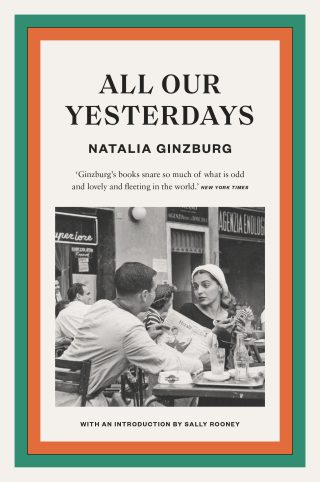
Daunt Books are such an interesting publisher and I was keen to read Natalia Ginzburg having heard wonderful things in the blogosphere, so I swooped on All Our Yesterdays (1952, transl. Angus Davidson 1956) when it turned up in my local charity bookshop. I think I’d read somewhere that this wasn’t the best place to start with this author, but I absolutely loved it.

The novel follows two families living in a northern Italian town from the 1930s, through the war years to peacetime. Although the blurb on the French flaps of my edition suggests Anna, the daughter of the poorer family, is the protagonist, really Ginzburg follows them all to a greater or lesser extent, with no overarching plot other than the sequence of years.

Although this approach sounds like a shortcoming, it works so well. It’s not a documentary novel but it gestures towards this with an omniscient neutral(ish) viewpoint and only reported speech. This felt unusual to read, but is so clever in capturing the everyday experiences of those living through extraordinary circumstances.

Anna’s siblings are Concettina, Ippolito, and Giustino. Concettina is popular with boys but struggles to find a purpose in life; Ippolito channels his energies into anti-Fascist activities with his friend from the richer family across the road:

“Emanuele and Ippolito did not even know Italy, they had never seen anything except their own little town, and they imagined the whole of Italy to be like their own little town, an Italy of teachers and accountants with a few workmen thrown in, but even the workmen and the accountants became rather like teachers in their imagination.”

Their lives are equally dictated by world events and by commonplace ones. Anna falls pregnant by her boyfriend and marries an eccentric older man, Cenzo Rena, moving with him to the southern village of Borgo San Costanzo. Her affair with her self-involved, callow boyfriend was no great passion, and while her marriage to Cenzo Rena attracts approbation, he is a warmer, more generous man than the one her own age.

“She was alone with Giuma’s face that gave her a stab of pain in her heart, and every day she would be going back with Giuma amongst the bushes on the river bank, every day she would see again that face with the rumpled forelock and the tightly closed eyelids, that face that had lost all trace both of words and of thoughts of her.”

These are people destined to be on the outskirts of war. Cenzo Rena holds a lot of sway in his local area and does help Jewish people fleeing the Nazi occupation, but on the whole the story of All Our Yesterdays is not one involving soldiers or revolutionaries. It is about ordinary people and for them the conflicts of war are reported facts not lived experience. The latter for them includes a lot of mundanity:

“And the bread in town was rationed and was a kind of soft, grey dough that you couldn’t ever digest, the bread was like the soap and the soap was like the bread, both washing and eating had become very difficult.”

Yet this doesn’t mean the story isn’t affecting, or that the characters avoid tragedy. There are some truly tragic events that are hugely affecting. Ginzburg manages to be even-handed in her treatment of her characters but not detached. Her writing is warm but unsentimental as she demonstrates that flawed people are as worthy of love and mourning as idealised ones.

In case I’ve made it sound unremittingly serious, I should mention that there humour in All Our Yesterdays too. There are romantic entanglements that are treated with a degree of levity, and eccentric housekeepers/family retainers with various foibles. All life is here.

I can’t think of another writer who approaches Ginzburg’s style, and looking back on it I can’t explain how she does what she does. This was a story that snuck up on me, the deceptively simple storytelling drawing me in more than I realised until I was totally immersed. An extraordinary novel.

“Fanfares of trumpets usually announced only small, futile things, it was away fate had of teasing people. You felt a great exultation and heard a loud fanfare of trumpets in the sky. But the serious things of life, on the contrary, took you by surprise, they spurted up all of a sudden like water.”

To end, of course there’s a very famous song I could post on the theme of Yesterday, but instead, to continue the mix of despair alongside levity: have you seen a parrot singing Creep by Radiohead?

“Life has to be endured, and lived. But how to live it is the problem.” (Daphne du Maurier)

I was disappointed to miss posting for Ali’s annual Daphne du Maurier Reading Week this year, due to the demands of blogging on novellas every day for a month, so once that madness was over I thought I would enjoy a visit to this ever-readable author.

(Also, thank you to everyone who commented on which Big Massive Tome I should pick up after so many novellas. Bleak House was far and away the winner, so I’m embarking on Dickensian legal wrangling next 😊)

Apparently DDM said that Frenchman’s Creek (1941) was the only romantic novel she wrote. This meant I went into it expecting a similar experience to when I read Jamaica Inn, that is: enjoying it but wishing I had read it as a teenager. Now I’m older I’m more inclined towards the psychological darkness of My Cousin Rachel and her frankly terrifying short stories.

However, these expectations were confounded. Frenchman’s Creek can definitely be read as a romance: a young beautiful noblewoman leaves her stifling court life and starts running around the Cornish coast with a sexy French pirate. But I thought there were some much more interesting themes being explored in this novel too.

Dona St Columb is married to the ineffectual Harry, and is part of the indulgent court of Charles II. After a particular prank that she regrets, she leaves London and makes her way to Harry’s country pile in Cornwall.

“The sense of futility had been growing upon her for many months, nagging at her now and again like dormant toothache, but it had taken Friday night to arouse in her that full sense of self-loathing an exasperation, and because of Friday night she was jolting backwards and forwards now in this damnable coach, bound on a ridiculous journey to a house she had seen once in her life and knew nothing about, carrying with her, in anger and irritation, the two surprised children and their reluctant nurse.”

Once there, her pompous neighbour lets her know that dangers lurk amongst the beautiful countryside and coast, in the form of a successful pirate from Brittany.

“‘No lives have been lost as yet, and none of our women have been taken,’ said Godolphin stiffly, ‘but as this fellow is a Frenchman we all realise that it is only a question of time before something dastardly occurs.’”

Throughout the novel anyone expressing xenophobia is shown to be monumentally stupid, which is not always what I expect in novels of this period and it was certainly refreshing.

It isn’t long before Dona crosses paths with the captain of La Mouette, Jean Benoit Aubréy. Undoubtedly his portrait is romantic: he sketches birds, reads poetry, and of course is extremely handsome. Dona finds she has much in common with Jean Benoit, namely the search for an authentic life and personal freedom. As his loyal man William explains:

 “’Approve and disapprove are two words that are not in my vocabulary, my lady. Piracy suits my master, and that is all there is to it. His ship is his Kingdom, he comes and goes as he pleases, and no man can command him. He is a law unto himself.’”

Dona longs for something similar, but it is clearly demonstrated how limited she is due to being a woman. She has to meet the expectations of domestic roles, and also of her class. It is the insistence of her male neighbours that brings Harry to Cornwall, and his mendacious friend Rockingham, who poses a real threat to Dona.

Du Maurier expertly builds the tension as a trap is laid for the pirate, and he takes phenomenal risks to outmanoeuvre his enemies. Frenchman’s Creek is real page-turner, but it is also a believable exploration of a woman’s search for meaning and personal agency in her life. Her romantic partner is fully portrayed but not overly dwelt upon – this is Dona’s story and the romantic relationship is one that brings her back to herself:

“She felt, in a sense, like someone who had fallen under a spell, under some strange enchantment, because this sensation of quietude was foreign to her, who had lived hitherto in a turmoil of sound and movement. And yet at the same time the spell awoke echoes within her that she recognised, as though she had come to a place she had known always, and deeply desired, but had lost, through her own carelessness, or through circumstances, or the blunting of her own perception.”

Du Maurier really is so good at what she does. In Frenchman’s Creek she creates a compelling adventure alongside some lovely evocations of the natural world while highlighting the enduring challenges of the expectations placed on women. Dona’s quest for a life that will enable a fulfilling expression of self remains as relevant and compelling as ever.

“Much will be forgotten then, perhaps, the sound of the tide on the mud flats, the dark sky, the dark water, the shiver of the trees behind us and the shadows they cast before them, and the smell of the young bracken and the moss. Even the things we said will be forgotten, the touch of hands, the warmth, the loveliness, but never the peace that we have given to each other, never the stillness and the silence.”

I wanted to end with a trailer for the 1944 film adaptation with Joan Fontaine, but alas I couldn’t find it anywhere. So here is a clip from the 1998 BBC adaptation, which for reasons best known to itself has moved the story to the time of the Glorious Revolution and completely invented a scene. Has anyone seen this version? It doesn’t look very enticing but I do think Tara Fitzgerald is a good actor:

Novella a Day in May 2023 – No.27

The Stepford Wives – Ira Levin (1972) 139 pages

Earlier in the month when I read The War of the Worlds, I mentioned I rarely read sci-fi. If I rarely read sci-fi, I never read horror. So this is definitely the month for going outside my comfort zone and learning to love it 😊

The Stepford Wives is such a well-known classic that I’m assuming everyone knows what the story is. I did, and didn’t diminish the horror or the tension in any way. I will keep this review very brief though, to try and avoid spoilers as far as possible…

The story is told from the point of view of Joanna, a photographer with a young family, who moves to the insular suburb:

“She wished: that they would be happy in Stepford. That Pete and Kim would do well in school, and that she and Walter would find good friends and fulfilment. That he wouldn’t mind the commuting – though the whole idea of moving had been his in the first place. That the lives of all four of them would be enriched, rather than diminished, as she had feared, by leaving the city – the filthy, crowded, crime-ridden, but so alive city.”

It takes Joanna longer than she hoped to settle in to Stepford. None of the women in the town are very sociable, spending endless hours cleaning their homes which they claim leaves them little time for anything else:

“That’s what she was, Joanna felt suddenly. That’s what they all were, all the Stepford wives: actresses in commercials, pleased with detergents and floor wax, with cleansers, shampoos, and deodorants. Pretty actresses, big in the bosom but small in the talent, playing the suburban housewives unconvincingly, too nicey-nice to be real.”

She does make one friend Bobbie, who is determined to leave the area:

“Is that your idea of the ideal community? I went into Norwood to get my hair done for your party; I saw a dozen women who were rushed and sloppy and irritated and alive; I wanted to hug every one of them!”

Meanwhile her husband Walter seems quite content, joining the local Men’s Association with the other local patriarchs who seem determined to keep clearly delineated lines between the sexes.

Slowly the realisation of what is happening in Stepford dawns on Joanna. She is resistant to the gaslighting that surrounds her – but it is already too late?

The Stepford Wives is truly horrifying. Not only because the tension is built so expertly by Ira Levin (the novella form seems particularly suited to this) and not only because of the actual events portrayed. But because – as the blistering introduction by Chuck Palahnuik in my edition makes completely clear – we may all already be living in Stepford…

Novella a Day in May 2023 – No.26

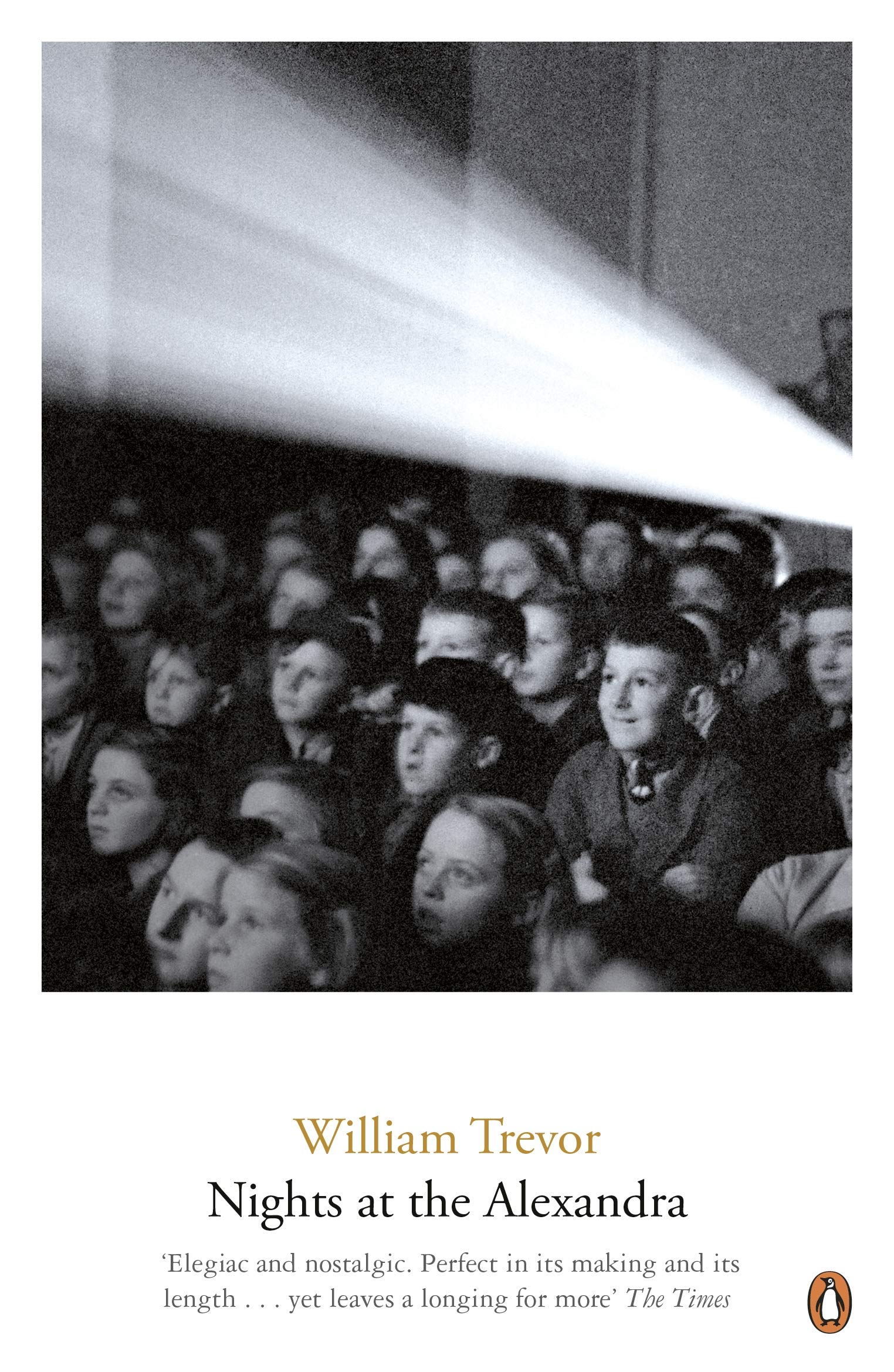
Nights at the Alexandra – William Trevor (1987) 71 pages

Many of you will be aware that Cathy at 746 Books and Kim at Reading Matters are hosting their wonderful A Year with William Trevor reading event throughout 2023.

Earlier this month, Cathy reviewed Trevor’s novella Nights at the Alexandra, and it sounded so completely wonderful I knew I’d have to get to it before the end of May. I did and it was all I anticipated.

It opens with 58 year-old Harry remembering his life as a young adult, just about to leave school, during World War II. The Messingers – she English, he German – have moved to Ireland to avoid the prejudice their relationship would encounter in their countries of birth. She is much younger than her husband, and glamourous.

“I remember that more distinctly than any other moment in my life. She was already in the car when she spoke, and her tone of voice was not one normally employed when making a request. With a gentle imperiousness, she commanded what she wished, and before she drove away she glanced at me once, a smile flickering across her thin features.”

Harry is from a Protestant family, living in a Catholic town. He is expected to follow his father into the timberyard business – something his elder sister has already done by working in the office and which she bitterly resents.

“The family atmosphere was as it always was: my grandmothers silent in their dislike of one another, my brothers sniggering, my mother tired. Annie resentful, my father ebullient after an hour or so in the back bar of Viney’s hotel.”

Harry does not want to follow his father in any way. He is desperate for something else, without knowing what it is. The Messingers – particularly Mrs Messinger – with their large house, cigarettes and tea, affection and childlessness, stories and difference, offer this to Harry.

They offer him further escape when Mr Messinger decides to build the titular cinema in the town, named after his wife. Harry is able to have a job, and refuse the timberyard once and for all.

Nights at the Alexandra has such a subtle and finely-wrought tone. The relationships between the characters are beautifully evoked and in less-skilled hands could have easily descended into cliché. Instead Trevor gives us a story of human lives with all their pain and love, longing and helplessness, that somehow grants his characters some peace too. There are also moments of deadpan humour:

“My father lent his observations weight through his slow delivery of them, his tone suggesting revelations of import yet to come. But invariably this promise remained unfulfilled.”

Now, it could be said Reader, that my tears are not worth very much. I’ve always been a crier anyway, and currently I’m bereaved and pre-menopausal, so it doesn’t take much to set me off. But I wept at the end of Nights at the Alexandra. It was so completely realised, so moving and poetic, unsentimental and sympathetic. Perfection.

Novella a Day in May 2023 – No.21

“I feel I’m only going to write short stories and novellas from now on. Chekhov said, toward the end of his life, “Everything I read strikes me as not short enough.” And I agree.” Martin Amis

A Pelican at Blandings – PG Wodehouse (1969) 192 pages

After the destabilised plots, shifting characterisation and unanswered questions of Untold Night and Day yesterday, a very silly, plot-driven novella today, where everything is tied up neatly at the end.

PG Wodehouse needs no introduction and while I would say A Pelican at Blandings is not him on top form, spending a few hours with a middling Wodehouse is still an absolute joy and time well spent.

Poor Lord Emsworth just wants to be left alone with his pig, the Empress. She has refused a potato which is causing her doting owner a great deal of distress. Unfortunately people always seem to be insisting on joining him at Blandings Castle.

“She left the room, and Lord Emsworth sank back in his chair looking like the good old man in some melodrama of Victorian days whose mortgage the villain has just foreclosed. He felt none of the gentle glow he was accustomed to feel when one of his sisters removed herself from his presence.”

Lady Constance is back at Blandings Castle with a woman named Vanessa Polk in tow. What’s more, she has invited horrible Lord Alaric and his niece Linda Gilpin to stay there too. She has plans to marry Vanessa to Alaric. Lord Emsworth decides this is a bridge too far, and this is before he knows Alaric has invited Wilbur Trout to stay. He calls on his aptly named brother Galahad, the Pelican Club member of the title, to rescue him.

Galahad wastes no time in telling Constance what he thinks of avaricious Alaric:

“’Are you telling me that that human walrus has fallen in love at first sight with Vanessa Polk?’

‘Alaric is not a human walrus.’

‘You criticise my use of the word human?’

Lady Constance swallowed twice, and was thus able to overcome a momentary urge to hit her brother over the head with the glass vase containing gladioli. It is one of the tragedies of advancing age that the simple reactions of childhood have to be curbed.”

Meanwhile one of Galahad’s numerous godsons, bestowed on him by Pelican Club members, Johnny Halliday, is in love with Linda Gilpin but they are currently estranged.

There are also some shenanigans with a plan to steal a picture:

“It’s a thing that must be done at dead of night, the deader the better. We must arrange a rendezvous. Where can we meet? Not in the ruined chapel, because there isn’t a ruined chapel.”

Lacking a Jeeves (although I’m very fond of the butler Beach), thank goodness Lord Emsworth has Galahad! Will he stop Constance’s terrible matchmaking, sort out the picture theft, reunite his godson with his betrothed, and bring some peace to his benighted brother’s life?

Of course he will.

“’Clarence has an amazing story to relate. Relate your amazing story, Clarence.’

‘Er,’ said Lord Emsworth.

‘That’s not all there is of it.’ Gally assured the Duke. ‘There’s a lot more, and the dramatic interest mounts steadily as it goes on.’