“The business of her life was to get her daughters married.” (Jane Austen)

It’s month two in my 2024 resolution to read a book per month from Anthony Powell’s A Dance to the Music of Time sequence. It was published between 1951 and 1975, and set from the early 1920s to the early 1970s. The sequence is narrated by Nicholas Jenkins, a man born into privilege and based on Powell himself.

After reading A Question of Upbringing in January, I think I’ve adapted to Powell’s unusual prose style with long, meandering sentences. I had to remind myself in A Buyer’s Market (1952) that it was likely that very little was going to happen. Once I’d readjusted to the lack of plot, the style made more sense. It has the feel of extended reminiscences, with the reader listening in.

In A Buyer’s Market, Nick has left university and is working for a publishing house focussed on art books. That is about as much as we hear of his career, as the novel is concerned with the social life of the upper classes and the parties that form part of the season for debutantes. The time isn’t specified but it seems to be around the late 1920s.

Sometimes I joke with my mother that she gave birth 77 years too late. That, had I been born in 1900, it would have worked perfectly for me in terms of an adulthood in the era of my tastes in books, films, fashion, decor and architecture. But, as I don’t fancy being poor before the invention of the NHS, I’d have to be born into much richer circumstances and become a flapper. Well, A Buyer’s Market thoroughly disabused me of that notion. Goodness me, the round of parties seemed unutterably tedious. It says something for Powell’s writing that the novel wasn’t tedious at all.

The novel begins, after a brief flashback scene, with Nick attending a dinner party at Lady Walpole-Wilson’s:

“her comparative incapacity to control her own dinner parties, at which she was almost always especially discomposed, seemed to me a kind of mute personal protest against circumstances – in the shape of her husband’s retirement – having deprived her of the splendours, such as they were, of that position in life owed to her statuesque presence; for in those days I took a highly romantic view, not only of love, but also of such things as politics and government: supposing, for example, that eccentricity and ineptitude were unknown in circles where they might, in fact, be regarded – at least insofar as the official entertaining of all countries is concerned – almost as the rule rather than the exception.”

(Please note the quote above is one sentence!)

At this point Nick believes he is in love with Barbara Goring, but it is when she plays a prank on Nick’s old Eton associate Widmerpool, that he rapidly changes his mind. This is not through sympathy for Widmerpool to whom he still has ambivalent feelings, but there remain hints at the greater role he will play in Nick’s life:

“I did not, however, as yet see him as one of those symbolic figures, of whom most people possess at least one example, if not more, round whom the past and the future have a way of assembling.”

Nick and Widmerpool are having coffee at a street stand when they bump into Mr Deacon, an old artist friend of Nick’s parents, who is touting  disarmament pamphlets with a young woman, Gypsy Jones. Nick’s old schoolfriend Stringham arrives, and this unlikely quintet go to a second party at Mrs Andriadis’ – a more bohemian affair than the dinner, but one where Nick identifies  “almost exactly the same chilly undercurrent of conflict”.

If the cynicism wasn’t apparent enough in this volume’s title, Powell makes his feelings abundantly clear. The parties of this circuit are not joyful affairs, they are occasions where everyone wants something: spouses, social advancement, career advancement, money.

“Everyone used to say that dances bored them; especially those young men – with the honourable exception of Archie Gilbert – who never failed to respond to an invitation, and stayed, night after night, to the bitter end. Such complaints were made rather in the spirit of people who grumble at the inconvenience they suffer from others falling in love with them.”

It all sounds a bit desperate and boring.

Later in the novel Nick attends a party at Sir Magnus Donner’s castle, where many of the characters from the party appear again. It is a small social set but not an intimate one. Sir Magnus seems particularly unlikable and even sinister. One of my favourite passages was Nick’s spiky assessment of his host:

“Sir Magnus himself did not talk much, save intermittently to express some general opinion. His words, wafted during a comparative silence to the father end of the table, would have suggested on the lips of a lesser man processes of thought of a banality so painful – of such profound and arid depths, in which neither humour, nor imagination, nor indeed, any form of human understanding could be thought to play the smallest part – that I almost supposed him to be speaking ironically, or teasing his guests by acting the part of a bore in a drawing room comedy. I was far from understanding that the capacity of men interested in power is not necessarily expressed in the brilliance of their conversation.”

I mentioned when reading A Question of Upbringing that it was the satire that saved the novel for me and it is the same here. I doubt Anthony Powell saw himself as a subversive but he definitely has an assessing gaze regarding the privileged upper classes. I also thought it was notable what he doesn’t comment on. The need for an abortion is detailed but not judged, gay male characters have their sexuality mentioned in passing but again not judged. Both these were still illegal in the UK when this novel was published.

Although the theme of the novel is about commodification and how “Human life is lived largely at surface level”, I did feel the reader had a growing intimacy with Nick. Barely present in his own story in the first volume, in A Buyer’s Market Nick reported more of his own speech, motivations and feelings. This strengthened the storytelling and I’m looking forward to seeing what he does next.

To end, after reading this novel, not even Liza can persuade me to come to the debutante’s ball:

“Some things I cannot see until I write about them.” (Yuko Tsushima)

I wasn’t planning on joining in Japanese Literature challenge 17 hosted by Meredith at Dolce Bellezza other than enjoying other bloggers wonderful posts. However this enthusiastic post by Marina Sofia on Tsushima Yūko’s Territory of Light meant I immediately started rooting through the TBR to find Child of Fortune (1978, transl. Geraldine Harcourt 1983), which I knew I had buried somewhere…

This is the first of her novels I’ve read and on the strength of this I definitely want to read more. Novella length, it tells the story of Kōko, a 36-year-old single mother to eleven-year-old Kayako. Told in the third person from Kōko’s perspective, it is a compelling examination of one woman’s inner world and her barely articulated resistance to the expectations placed on her.

Early in the novel, Kōko suspects she is pregnant. She is ambivalent about Osada, the father, as she is about most things. But gradually she realises that she wants to keep the child:

“Maybe she was reaching an age when it was senseless to want a fatherless child; but, precisely because of her age, she didn’t want to make a choice that she would regret till the day she died. Lately she was more convinced than ever that there was no point in worrying about what people thought. She would soon be thirty-seven. The only person watching Kōko at thirty-seven was Kōko. When this obvious fact finally came home to her it was still a surprise – what a very lonely fact it was!”

Geraldine Harcourt’s informative introduction explains that pregnancy at that age in Japan around this time could still be viewed as shameful even within marriage, so Kōko’s decision is doubly transgressive.

Kōko is an intriguing character, as she lives an unconventional life which places her in opposition to so many, by barely doing anything. Her lack of decision-making is an act of quiet but determined resistance.

Her sister Shoko is much more conventional and doesn’t approve; Kōko’s daughter Kayako much prefers to spend time with her more affluent, conformist aunt. Kōko tries to explain to Shoko:

“No, that’s not it – don’t think I’ve liked using choosing a different world from other people. I know I’ve been stubborn – but not about Kayako alone. All my life, though I often haven’t known which way to turn, I have managed to make choices of my own. I don’t know if they were right or wrong. I don’t think anyone can say that.”

But really she hasn’t made that many choices. She married because of pregnancy; husband Hatanaka organised the divorce years later, unsurprisingly as Kōko didn’t love him, still holding a candle for her lover Doi. She doesn’t enjoy her job teaching piano, but she also takes no steps to do anything else. She doesn’t take great care of herself and she doesn’t have many friends or interests.

Two driving forces in her life are her love for her brother, who died many years earlier, and sexual desire. The latter has led to her current predicament, the former suggests one reason that may be contributing to her lack of attachments.

“A little over a year ago, Kōko had understood something for the first time: the in the end she had let everything slip away from her, that in reality she hadn’t a single resource. It was an alarming discovery.”

Her lack of attachment includes reality – we are taken into Kōko’s dreams and daydreams, woven in seamlessly but disconcertingly.  As we move back and forth in time, learning about Kōko’s childhood, marriage, griefs and pains, Tsushima builds a picture of a woman who may not be completely likable but who is recognisably human and flawed, and muddling through the best way she knows how.

I was really rooting for Kōko to find a more articulate agency, and the penultimate scene was unbearably tense in this regard. Child of Fortune is never didactic yet absolutely achieves a compelling portrait of a woman fighting for her life, against immense societal pressure.   

“Kōko was shaken by the realisation that even now, more than twenty years later, she still lacked any compelling reason to go on living. And by the fact that the will to live was still there.”

To end, Kōko has fond memories of a visit to Karuizawa, which does look lovely:

PS When I was looking for a title quote for this post, I found this great conversation between Tsushima and Annie Ernaux.

“Books do furnish a room.” (Anthony Powell)

I’ve decided that 2024 will be the year of a reading project I’ve been considering for a while – a book per month throughout the year from Anthony Powell’s A Dance to the Music of Time sequence. Published between 1951 and 1975, and set from the early 1920s to the early 1970s, the sequence is narrated by Nicholas Jenkins, a man born into privilege and based on Powell himself.

What’s that you say? I have half-completed reading projects still languishing? I have a spiralling TBR that doesn’t need 12 more books added to it? Be gone! You are clearly a pragmatist and such attitudes have no place in my reading life 😀

In the first novel, A Question of Upbringing (1951), we follow Nick Jenkins from his school days at a thinly-disguised Eton to his university days at a thinly-disguised Balliol College, Oxford. Starting at School, we meet Jenkins’ friends Stringham and Templer, and hear of their frustrations with housemaster Le Bas.

“’He started life as a poet,’ Stringham said. ‘Did you know that? Years ago, after coming back from a holiday in Greece, he wrote some things he thought were frightfully good. He showed them to someone or other who pointed out that, as a matter of fact, they were frightfully bad. Le Bas never got over it.’

‘I can’t imagine anything more appalling than a poem by Le Bas,’ said Templer, ‘though I’m surprised he doesn’t make his pupils learn them.’

‘Who did he show them to?’ I asked.

‘Oh, I don’t know,’ said Stringham. ‘Henry James, or Robert Louis Stevenson, or someone like that.’”

The boys are varying degrees of privileged, from uber-wealthy to moderately wealthy, from landed gentry to new money. The societal hierarchies are complex and imperfectly understood, even by those in their midst:

“Clearly some complicated process of sorting out was in progress among those who surrounded me: though only years later did I become aware of how early such voluntary segregations begin to develop; and of how they continue throughout life.”

In theory I have limited patience for such stories, after the enormous damage Eton-educated men and their cronies have done in UK politics. Yet I found myself enjoying A Question of Upbringing. I think because Powell doesn’t suggest the superiority of anyone he’s writing about or the systems in place, casting a satirical eye over it all.

For example, when Nick begins his travels, he finds himself hopelessly ill-equipped to comprehend any culture beyond his own:

“I had seen a provincial company perform The Doll’s House not many months before, and felt, with what I now see to have been quite inadmissible complacency, that I knew all about Ibsen’s countrymen.”

It is during these travels that he meets Widmerpool again, a boy somewhat disregarded as figure of fun at school, who shows himself to be more astute than Nick and the other pupils allowed for.

“Later in life, I learned that many things one may require have to be weighed against one’s dignity, which can be an insuperable barrier against advancement in almost any direction.”

Nothing of huge significance seemingly happens in A Question of Upbringing, but it wouldn’t surprise me if events somehow cast a long shadow in later volumes. As a standalone novel, Powell keeps the narrative compelling by picking out certain moments and impressions, rather than plodding through years with equal weighting. It’s a short novel, only 223 pages in my edition and this length worked well – satisfying but also with a sense of setting the scene for later novels.

It took me a while to adjust to Powell’s dense writing style; he likes long sentences of several clauses. Once I had got used to this though, I found myself swept along.

“The evening was decidedly cool, and rain was half-heartedly falling. I knew now that this parting was one of those final things that happen, recurrently, as time passes: until at last they may be recognised fairly easily as the close of a period. This was the last I should see of Stringham for a long time. The path had suddenly forked. With regret, I accepted the inevitability of circumstance. Human relationships flourish and decay, quickly and silently, so that those concerned scarcely know how brittle, or how inflexible, the ties that bind them have become.”

Nick is an enigmatic narrator. In this first volume he describes many people and events, observes whole scenes, without appearing to have spoken or acted himself at all. We learn very little about him. I found myself wondering why Powell had opted for an omnipresent narrator over an omniscient one, when Nick barely seems present. But that’s not a criticism, just what seemed a curious choice. Maybe Nick will emerge from his own story in the subsequent volumes. I’m looking forward to finding out.

To end, a dance from the 1950s, looking back to the 1920s:

“Orange is red brought nearer to humanity by yellow.” (Wassily Kandinsky)

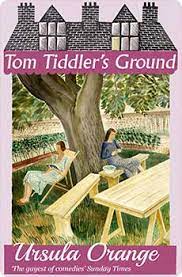
This is my contribution to Dean Street December hosted by Liz at Adventures in Reading, Running, and Working From Home. Tom Tiddler’s Ground by the delightfully named Ursula Orange (1941) is part of their Furrowed Middlebrow imprint and I thought it was an absolute joy.

It tells the story of Constance Smith and her childhood friend Caroline Cameron, who find themselves living together again in the early days of World War II. Caroline is urbane and worldly, leaving behind her life in London with her husband John. She is entirely self-focussed and amoral, but also quite caring regarding people. Despite her shortcomings, I really liked her.

Constance could not be more different. We are introduced to her early on through the thoughts of the billeting officer who is trying to persuade people in the quiet village of Chesterford to take evacuees:

“Mrs Latchford grimaced and lit a cigarette. A thoroughly unenviable job altogether, and she felt she deserved a few minutes respite with nice, schoolgirlish, foolish Constance Smith. Foolish? Well, of course, it always looked a little foolish to see a woman of over thirty behaving like an enthusiastic bride, even after two years of marriage. But apart from that and her volubility and her poppings out and her nippings in and all her silly mannerisms, was Constance at all foolish? Certainly she handled the relations-in-law-in-the-village situation well, or rather did not handle it at all, but accepted it so naturally and pleasantly that she might really be said to be on the best of terms with her sister-in-law, Mary Hodges, the local greengrocer’s wife.”

Her husband Alfred is an utterly self-centred snob, intent on social climbing and ashamed of his sister. He married well-to-do Constance for social advancement and he doesn’t love her. Caroline sees this clearly on arrival in the village with her daughter Margeurite.

The other evacuee is Mrs Gossage, who seems entirely disinterested in everyone, including her baby son Norman.  

We follow this unlikely group of housemates as they adjust to their much-changed living arrangements. The story moves between the characters but is told primarily from Caroline’s point of view, which I thought worked well. She has good insights into other people and is entirely clear-sighted about herself too:

“There was a certain note in her voice that led Caroline to suspect that Lavinia belonged to that large class of people who find children sweet, but rather prefer they should go and be sweet upstairs in the nursery. It was an attitude she entirely sympathised with and absolutely hated people for.”

Constance as narrator would be far too guileless to carry the reader along. And of course, Caroline’s arrival in the village offers an outsider’s view on the characters and various intrigues. But what is lovely too, is Caroline’s changing attitude towards the village. Initially she is greatly amused by everyone, but as time moves on she starts to see them as real people, her “strange lapses into sincerity” possibly becoming longer lasting. This isn’t a trite city-girl-learns-the-true-value-of-Things-when-forced-into-small-town-life tale however. Orange is not at all sentimental about people:

“Caroline, looking at the expression on Mary’s face, marvelled at the extraordinary cruelty of the thoroughly respectable woman.”

“There was no doubt Constance, in her misery, was very pathetic. There was no doubt she was also rather irritating.”

But there’s not a bitter tone either. I found the characters recognisable and portrayed with human understanding. Caroline would be rather a controversial figure for the time, but Orange doesn’t judge her.

“It’s my red finger-nails that put the idea of asking me into her head, I’m sure.”

I liked the fact that Caroline didn’t overly judge herself, which would seem somehow hypocritical, but she does recognise that her actions hurt people, which she regrets.

There are serious concerns in Tom Tiddler’s Ground; adultery, bigamy, child neglect and lack of choices for women. Somehow Orange balances that with a knowing humour without belittling the issues at all.

My favourite character was George, Constance’s gentle, drifting brother:

“What could you do with a man who loved women, who loved domestic life, but who (according to Constance) had never seemed to want to marry anyone in particular? A man who obviously adored other people’s children, but who had none of his own? A man who had plenty of personality and probably (under all that indolence) considerable abilities, but who had never settled any profession or career? The only answer was – nothing, you could do nothing with him. And […] that was, of course, what George preferred. Caroline liked him enormously.”

We learn more about George’s background, who to my twenty-first century eyes had PTSD from World War I. Orange builds to a satisfying denouement, tying up many characters pasts with the present in a way that promises a better future, despite the war.

I really loved Tom Tiddler’s Ground, and got very excited about the thought of exploring Ursula Orange further, thinking the humour and characterisation made her another Margery Sharp. However, Stacy Marking’s excellent introduction to this edition explains the publishers took exception to Caroline as a character, and so she adjusted her style for later books, which also contained more snobbery (somewhat in evidence here but not overly stressed – Mrs Gossage is definitely treated with condescension, but also compassion). If anyone has read any other novels by Ursula Orange I’d love to know how you found them, especially as DSP publish some other titles.

“‘I suppose we ought to be thinking about Christmas,’ said Constance, a few days later. Everybody became conscious of a very strong disinclination to think about anything of the sort.”

To end, it’s a time of year when Nat King Cole is on heavy rotation, and quite right too. Here he is singing about orange (sort of 😉 )

“Writing is not a profession but a vocation of unhappiness.” (Georges Simenon)

November is the month of many reading events, and I definitely won’t manage them all, but I’m starting with Novellas in November, hosted by Cathy at 746 Books and BookishBeck.

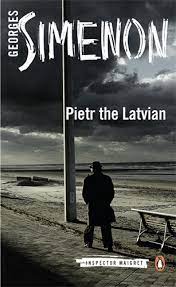
I’m taking this as a good opportunity to carry on with my much-neglected Le Monde’s 100 Books of the Century reading challenge, reading Pietr the Latvian by Georges Simenon (1930, transl. David Bellos 2013) which is No.84 in the list.

This was Maigret’s first outing and Simenon clearly had a very thorough understanding of his policeman from the start. Like many Maigret stories it is novella length, coming in at 162 pages in my English translation.

“Not that he looked like a cartoon policeman. He didn’t have a moustache and he didn’t wear heavy boots. His clothes were well cut and made of fairly light worsted. He shaved every day and looked after his hands.

But his frame was proletarian. He was a big, bony man. Iron muscle shaped his jacket sleeves and quickly wore through knew trousers. He had a way of imposing himself just by standing there. His assertive presence had often irked many of his own colleagues.”

In this first story, Maigret is in pursuit of a thief and conman, Pietr the Latvian, who may not even be from Latvia. (I was anticipating some xenophobia, which there wasn’t in the novel, but be warned there is Antisemitism at points.)

There is intelligence that Pietr has travelled to Paris from the Netherlands and Maigret is tasked with apprehending him. At the Gare du Nord he thinks he spots Pietr, but is then called to a train to identify the body of a man who also matches the description.

Following the first man takes Maigret into the world of well-heeled Parisian hotels:

“Maigret persisted in being a big black unmoving stain amidst the gilding, the chandeliers, the comings and goings of silk evening gowns, fur coats and perfumed, sparkling silhouettes.”

Things become more complex as Maigret follows various leads around the first man. His unshowy, procedural approach is evident from the start as he doggedly pursues evidence throughout Paris and to Fécamp at the coast. The conman knows Maigret is closing in and the danger grows.

I’ve not read all the Maigrets as there are at least eleventy million of them, but I would say from my limited knowledge that this isn’t the strongest. For such a short novel, it is repetitive at times and I wonder if this is because it was published firstly as a serial. In that format the repetitions would work well, but in the novel they weakened the story and it could have done with an edit with the new format in mind.

However, there is still so much to enjoy. The evocation of Paris, the character of Maigret and the novella length make this a quick, entertaining read. Simenon’s affection for his creation is evident and this makes his Detective Chief Inspector so appealing.

“The Latvian was on a tightrope and still putting on a show of balance. In response to Maigret’s pipe he lit a cigar.”

“For me writing is an act of the will.” (Elizabeth Jolley)

I’ve been meaning to read Elizabeth Jolley for ages so I’m pleased to be finishing AusReading Month 2023 hosted by Brona at This Reading Life with one of her novellas.

Milk and Honey (1984) has quite a Gothic feel to it, so it’s worked out well with Hallowe’en too…

The story is narrated by Jacob, who at the beginning of the novella is an unhappy, unfulfilled door-to-door salesman with an injured hand.

“Sometimes, after my cup of real coffee in the Beach Hotel, I sat outside on the small, sandy cliffs, looking down onto the sea as it came up in long, slow waves to the rocks and sunk sighing back down the beach, and I felt the profound melancholy that all my life has come over me from time to time. It was the melancholy of dark trees standing alone and the quiet sadness of the colours of the land, dark greens and browns and the sand subdued. As I sat, the colours deepened, tawny, dun coloured blending beneath the low grey sky. And from somewhere hidden, the sun lit up the sea.”

We then go back in time to when Jacob was a teenager and sent by his father to live with the Heimbachs so he can be tutored in the cello by Leopold.  The widowed tutor adores Jacob, calling him ‘Prince’, but his sisters Tante Rosa and Aunt Heloise may be more ambivalent. Certainly Jacob’s lauded genius may not be as evident as Leopold proclaims. But Jacob does play with feeling:

“When I played the cello and the cello hesitated, poised on a single note so pure and restrained and lovely, I closed my eyes with an exquisite love of the cello. I was in love with the cello.”

Also in the house are Leopold’s children. His daughter Louise is a romantic interest for Jacob, and there is his son Waldemar who has unspecified disabilities. The household is insular and claustrophobic, but Jacob willingly relinquishes external experiences:

“I had no wish to be free. I preferred not to go to school, and, though the house and garden were open to the street, I never went out into the street. I read and studied and lived in the household which seemed to contain all in the way of books and musical instruments and teachers I could ever need.”

For the reader though, the household is deeply unsettling. We never really know what anyone’s motivations, views or plans are. Jacob is self-focussed and so as a narrator he doesn’t tell us. We piece together certain aspects of the wider life of the household – I guessed an unpleasant twist towards the end – but so much is left unspecified.

Conspiracies abound in this small household. A major decision is taken early in the novel that is traumatising for Jacob but we’re not completely sure why such action is taken. Jacob is having an affair but it seems entirely likely that everyone knows about it. A wedding ceremony is sprung on him, and yet everyone seems to think this is completely acceptable:

“But even after the surprise celebration of our engagement, on the day of my inheritance, the idea of marriage had seemed remote, something vague, talked about in laughter while eating apples and trying on rings made from human hair, something looked forward to from childhood but, like a disease experienced by adults, never reached.”

Milk and Honey is an odd novel and at times I wasn’t sure it was for me. There was so much that was unexplained that it could be entirely discombobulating, and Jacob was so oblivious and callow I wasn’t sure he could carry me through. I’m glad I persevered though, and I would definitely be interested to read more by Jolley. From this, I would say she writes about nature beautifully and is expert in creating an unsettling, memorable atmosphere.

You can read Lisa’s excellent review of Milk and Honey here.

To end, a bit of a departure from my usual 80s cheese – I always find Elgar’s cello concerto in E minor so moving (and this is with the City of Birmingham symphony orchestra, which was Elizabeth Jolley’s place of birth before she emigrated to Australia – see what I did there? 😀 ):

“Borderline, feels like I’m going to lose my mind.” (Madonna)

Somehow I’ve accumulated several Janette Turner Hospital books in the TBR, without ever managing to get round to reading any of them. So thank goodness for AusReading Month 2023 hosted by Brona at This Reading Life which finally got me to pick one up!

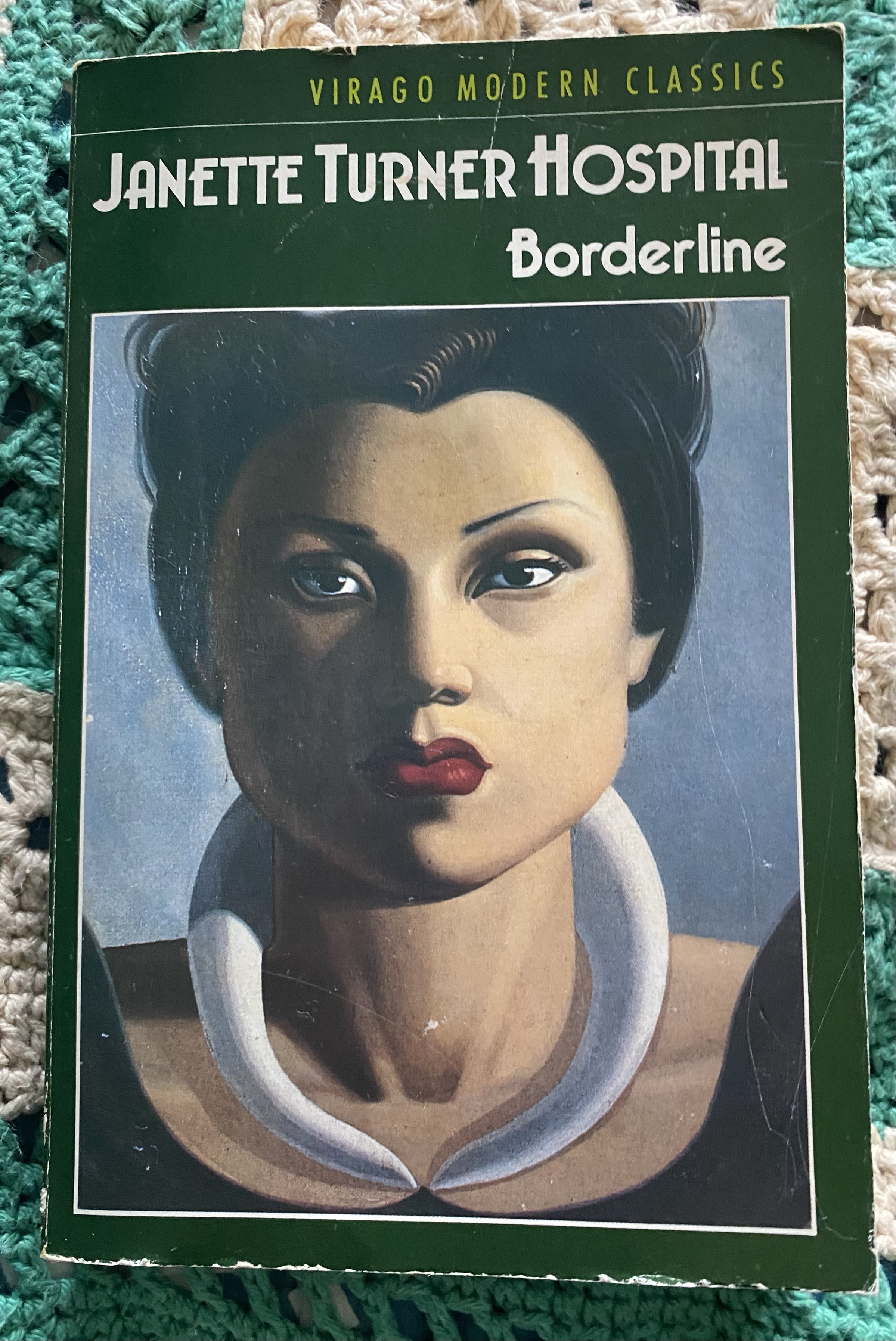
Borderline is JTH’s third novel, published in 1985. The blurb on the back describes it as a metaphysical thriller, but I don’t think that’s a helpful description. There are thriller elements but what JTH is more concerned with is the unreliable narratives we tell ourselves and others; how we can love those who remain so unknown to us; and the unpredictability of all our lives that can change in an instant. These themes don’t lend themselves to definite resolutions, so those seeking a thriller will be disappointed.

However, if you’re happy to go along with an exploration of these ideas that ends without any neat answers, there’s a lot to enjoy in Borderline.

The narrator is Jean-Marc, a man who has always had a slightly Oedipal relationship with his father’s girlfriend, Felicity. Seymour aka Old Volcano, was an artist much older than Felicity, who was nearer in age to her stepson.

“When I was five, my father was already famous and my mother was mostly distraught. Later she escaped. She made a quantum leap into banality. Which is the true secret of happiness – a second marriage, a very ordinary life, other children. Naturally she does not care to see me, a revenant from that earlier bad time, and I do not blame her at all.”

Felicity and Seymour’s relationship inevitably ends, and Felicity becomes a successful art dealer. She is returning from a trip when, at a border crossing between the United States and Canada, she makes the impulsive decision to smuggle Dolores Marquez, a refugee from El Salvador, with the help of a man called Gus.

Gus’ full name is Augustine, he’s a salesman who is routinely unfaithful to his wife. Felicity calls Dolores La Magdalena after a painting. People in this novel have different names, different roles, splintered lives. They disappear and no-one knows where to begin looking for them.

Gus’ daughter Kathleen turns up at Jean-Marc’s house, and their relationship seems to almost transgress boundaries, but not quite. As they try and locate their loved ones, Jean-Marc acknowledges that he is filling in a lot of gaps with very little to go on:

“Her stories bombard me, they seem to have become my own memories, they writhe and change and regroup in the way true memories do. They are like photographs in her grandfather’s dresser, a deluge of the ever-present past.”

The plot of Borderline is enough to pull the reader along, but this is not the novel to read if you want a plot-driven story. Jean-Marc tracks Felicity as best he can, but she remains out of reach. The stories in Borderline are unclear in origin: what Jean-Marc has experienced, what he has been told, what he is making up.

“Her days are baroque, they curl into each other like acanthus leaves, she lives somewhere between now and then. She moves in and out of her life.”

“Still, I have to admit, there has always been a quality of absence about her; which is why her disappearance itself seems insubstantial, merely a figure of speech, or a trick of the light, a momentary thing.”

I would completely understand if someone experienced this novel as a frustrating and disappointing read. However, I felt Borderline was an effective exploration of how human beings try and make sense of themselves, each other and the world when so much remains unknown and chaotic. It has some truly breathtaking passages and JTH is absolutely a writer I’d like to explore further.

To end, let it never be said that I shy away from the obvious in my 80s song choices 😀

“Compared to memory, every possession can only ever seem disappointing” (Giorgio Bassani)

This is my final post for the 1962 Club, hosted by Simon and Kaggsy, which has been running all week. It’s been a great event as always, and I’m really pleased it prompted me to pick the three I’ve read off the TBR pile at long last!

(Please note, despite the subject matter I’ve made a deliberate choice not to draw contemporary parallels. I think Lisa explained this decision really well in her blog post here.)

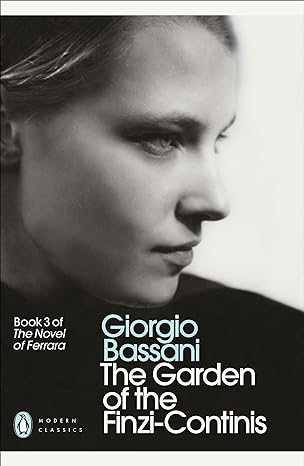
I adored Giorgio Bassani’s The Gold-Rimmed Spectacles (1958) when I read it last year, so I had high expectations when I approached The Garden of the Finzi-Continis (transl. Jamie McKendrick, 2007), the third book in his Romanzo di Ferrara cycle. It fully lived up to those expectations.

The unnamed narrator tells us in the Prologue that he is looking back from 1957 to a time before World War II. However the tone is more elegiac than nostalgic, as he also tells us that those he recalls perished in concentration camps.

Before the war the Finzi-Continis were a prosperous family, but the conflict destroyed them and all they owned. The large house is now squatted in, and the titular space:

“All the broad-canopied trees, limes, elms, beeches, poplars, plane trees, horse chestnuts, pines, firs, larches, cedars of Lebanon, cypresses, oaks, holm oaks, and even the palm trees and eucalyptuses planted in their hundreds by Josette Artom during the last two years of the first world war, were cut down for firewood, and for some time the land had returned to the state it was in when Moisè Finzi-Contini acquired it”

So it is with this knowledge that we then meet the younger, somewhat callow narrator, and follow his developing friendship with the younger Finzi-Contini’s, Alberto and Micòl, son and daughter of Professor Ermanno and Signor Olga.

Racial laws are coming into effect in Italy in the late 1930s, and this sees the narrator invited into the walled estate, as Jewish people are banned from places such as the local tennis club.

“They entirely left aside the existence of a far greater intimacy, a secret one, to be valued only by those who shared it, which derived from the fact that our two families, not by choice, but by virtue of a tradition more ancient than any possible memory, belonged to the same religious observance, or more accurately to the same ’School’”

Despite the growing pressures of the outside world, within the Finzi-Continis walls the narrator remembers a time where:

“The weather remained perfect, held in that state of magical suspension, of glassy, luminous, soft immobility which is the special gift of some of our autumns. In the garden it was hot, just slightly less than if it was summer.”

In this enchanted space the narrator falls for Micòl, but their relationship never develops, characterised by misunderstandings and ambiguity that they are too young to resolve. Being too young for what life throws at you is also shown through the political conversations with Giampi Malnate, an older Christian friend of Alberto, as well as an experience of terminal illness.

What I thought was so subtle and clever from Bassani is that nothing overly dramatic happens. Rather, things fade out. The huge events that we know are looming take place outside of the novel, and instead we are shown how we can take for granted the moments that seemingly have no wider ramifications. Except of course, they do. This is a formative time for the narrator.  

The Garden of the Finzi-Continis is not a plot-driven novel. It is a beautifully written evocation of a time before unimagined horrors. It is reflective and elegiac in tone without ever letting sentimentality lessen the portrait of a family obliterated by the Holocaust. It’s a truly devastating read.

The novel was adapted into a film in 1970, which won the Best Foreign Language Oscar that year. Has anyone seen it? It looks pretty faithful to the book so I’m interested to watch it:

“Writing’s not always a pleasure to me, but if I’m not writing every other pleasure loses its savour.” (John Braine)

This is my second contribution to the 1962 Club, hosted by Simon and Kaggsy, which is running all week. Do check out all the wonderful posts!

I picked up Life at the Top by John Braine because it is the sequel to Room at the Top (1957) which I really rated, with its depiction of the postwar north of England and Joe Lampton’s determination to leave his working -class life behind, whilst juggling complex sexual relationships. Life at the Top I didn’t find as compelling, but there was still a lot to enjoy.

Set ten years after Room at the Top, the novel follows Joe as he lives the life he thought he always wanted. Even if you’ve not read the first novel, take a guess as to how that’s working out for him 😀

“The truth was that I actually wanted a drink now, I wanted something to blur things slightly, to put a haze between me and the pink wallpaper and the pink cupboards and the white refrigerator and the electric oven and the mixing machine and the pink wall table and the pink covered stool; it was too bright and shiny and hygienic at eight o’clock on a March morning with Harling Crescent quiet under the weight of Sunday, it reminded me rather too coldly that I was thirty-five and a father of two children and at least ten pounds overweight.”

Joe adores his young daughter Barbara but feels alienated from his son Harry, who has been sent away to a school of his grandfather’s choosing. He and his wife Susan still sexually desire one another, but there seems to be little intimacy. Working at the family firm (Susan’s family), Joe is frustrated:

“I had stopped wanting things. I wanted power, power to put through my own ideas; I wanted to be taken seriously, I wanted to be something more than the boss’s son-in-law.”

He is going to become a local councillor, but that doesn’t suggest fulfilment to him (nor should it, bloomin’ Tory! 😀 )

“The prosperous middle-aged grumblers, the solid sensible citizens; I would sit here or in the committee room listening to them; taking great care not to offend them, and without my realising it, I would become exactly like them. Waiting my turn to grumble, waiting my turn for thrombosis, waiting my turn for death.”

So what does Joe do? Talk honestly with his nearest and dearest? Seek out a life of authenticity? Reflect honestly on the deep-rooted cause of his dissatisfaction and what he can do to make his life more fulfilling? No, of course not. He starts an affair with an attractive young journalist named Norah Hauxley and runs away to London.  The shadow of his former lover (from Room at the Top) still looms large, and I felt Alice was really the only woman Joe had loved:

“She was grown up. I hadn’t met a grown up woman in ten years, and for ten years I hadn’t felt the need to be with one. And Alice, even Alice, had been broken somewhere, she had lost the habit of happiness.”

Joe is not likable. He takes decisions that hurt others. He behaves selfishly. He’s a bit of a misogynist.But still I found myself staying alongside him as narrator, because he’s so honest. He doesn’t ask the reader to like him, because he doesn’t much like himself. I thought Braine did a brilliant job of presenting a man so of his time, and so completely believable.

Life at the Top doesn’t have a huge amount of plot, but I found it a compelling read in its honesty, particularly around flawed human relationships.

“I looked at her in surprise; I had not felt so close to her since we were first married. But I made no move to comfort her.”

Life at the Top is a short read, and I may not have stuck with it had it been longer. But as it was it was well-judged, and there are some developments in Joe’s familial relationships toward the end that I found truly moving. I’m glad the 1962 Club prompted me to finally pick this one up after it had been languishing in the TBR for many a year.

Life at the Top was adapted into a film in 1965, with the magnetic Laurence Harvey, who also starred in Room at the Top. Unfortunately the director changed from the first excellent film, and although I tried to watch the sequel, I found it so heavy-handed and unsubtle compared to the book that I gave up. But it did make me appreciate the book more!

So rather than a trailer for the film, here’s a 1962 song about rain, which the West Yorkshire town of Warley would be no stranger to:

“I regret profoundly that I was not an American and not born in Greenwich Village.” (John Lennon)

The 1962 Club, hosted by Simon and Kaggsy, starts today and is running all week which I am very excited about 😊 The Club weeks are always great and I’m really looking forward to seeing the posts. This is the first of  what I hope will be three contributions, but as I never blog as much as I mean to, failure is almost inevitable!

The Golden Spur was Dawn Powell’s last novel, and it’s a humorous look at the bohemian arts scene of late 1950s New York, specifically Greenwich Village. This was a world Powell was very much a part of and my edition features an effusive introduction from Gore Vidal who was one of her close friends.

We are introduced to the artists and writers – both up and coming, and those very much faded and failing – their hangers-on and their varied associates through the outsider view of Jonathan Jaimison. He is in his late twenties and recently discovered that his father isn’t the domineering tyrant he grew up with, but someone from this scene, back when his mother was hanging out with Prohibition-era flappers.

So Jonathan leaves his Ohio home and soon makes his way to the titular bar, at the start of his quest to find his biological father:

“Through a gap in the plum velvet cafe curtains he could see the bar … He breathed deep of the heady New York air, that delirious narcotic of ancient sewer dust, gasoline fumes, roasting coffee beans, and the harsh smell of the sea that intoxicates inland nostrils. Then he pushed open the door.”

He’s quickly adopted by Lize and Darcy, two frenemies who sleep with the same male artists, although it’s not entirely clear why, as they seem to have no great fondness for men or for art:

“The girls never asked questions about a man’s private interests or listened when he tried to tell them. For them it was enough that he was a man and that he was there. Who needs a talking man?”

“That his newest canvas was gone should have told her something, but she wasn’t sure which was the new one because all his pictures looked alike to Lize. Great lozenges of red and white (‘I love blood,’ he always said), black and grey squares (‘I love chess,’ he’d say), long green spikes (‘I love asparagus’). All Lize had learned about art from her life with painters was that the big pictures were for museums and the little ones for art.”

As Jonathan makes his way in New York, he moves between two generations: the young artists and the fading interwar generation. There is a nostalgia for the Prohibition period and what New York was then which is beautifully evoked, alongside a recognition that New York is a city that continually makes itself and its inhabitants anew:

“Jonathan recognised New York as home. His whole appearance changed overnight, shoulders broadened, apologetic skulk became swagger; he looked strangers in the eye and found friendship wherever he turned. With the blight of Jaimison heritage removed, his future became marvellously incalculable, the city seemed born fresh for his delight. He took for granted that his mother’s little world, into which he had dropped, was the city’s very heart.”

Although The Golden Spur is described as a comic novel, I didn’t find it laugh-out-loud funny. Rather I’d describe it as affectionately satirical. It ribs the 1950s arts scene and the vacuous people drawn to it, but it never has a bitter or nasty tone:

“Anybody with a tube of paint and a board was an artist. But writers were not writers unless decently unpublished or forever muffled by a Foundation placebo.”

“‘I just want to be overestimated,’ Earl shouted, ‘like everybody else, goddammit.’”

Despite the overarching plot being Jonathan’s search, this really isn’t a plot-driven novel. Rather, the question of his paternity is a device to introduce the various characters and their world. It’s a novel to read for the evocation of the city, of a particular society found within it, and for the characterisation and the wit. In the way that Tales of the City was serialised in the San Franciso Chronicle, I felt The Golden Spur could have worked similarly in The Village Voice. It’s almost a series of sketches, albeit well realised ones.

I can’t say I loved this quite as much as Gore Vidal clearly did, but then he probably recognised a lot of the characters and situations within the novel. I still found a great deal to enjoy, and Powell certainly has a way with words:

“She was making more and more passes at the wrong men, then trying to recoup with stately cultural pronouncements in her refined Carolina accent, which she kept polished up like her grandfather’s shotgun, ready to bring recalcitrant suitors into line.”

To end, I was going to go with the song Little Lize because that’s the only other time I’ve come across the name. I thought it would be easy to get a good quality version as the massively successful Fisherman’s Friends have recorded it. But I couldn’t find a decent one so here they are instead singing about never leaving home. New York isn’t for everyone…