The White Bird Passes – Jessie Kesson (1958) 159 pages
Last year I read a short story by Jessie Kesson and I was so impressed I really wanted to try more of her work. Luckily I saw her novella The White Bird Passes in my local charity shop and swooped in. I wasn’t disappointed.
Eight year-old Janie lives with her mother in Our Lady’s Lane, aptly named because this side street is full of matriarchs, including Poll Pyke, Battleaxe and The Duchess. They live in absolute poverty, hand to mouth, and yet the story isn’t depressing because Janie isn’t depressed. She loves living where she lives.
The novella is based on Jessie Kesson’s early life and it is beautifully balanced portrayal. It doesn’t shy away from the realities (suicide, sex work, disease and infestations) but these sit alongside love, humour, enjoyment.
“The Green was as much part of the Lane as the communal pump in the causeway. If you weren’t in the Lane you were ‘down at the Green’. There is no third alternative. Even if there had been, you would have been out of your mind to have chosen it in preference to the Green.
The summer through, the Greens chair-o-planes, whirling high, blistered with colour and blared with music. The Devil’s Own Din was how the sedate residents of Hill Terrace described it in protest to the Lord Provost and the Town Council, but to the Laners who were the true lovers of the Green it was music.”
It authentically captures characters and dialogue, without ever descending into caricature. At no point is there any authorial judgement on the way the characters are living, it is simply as it is.
“Janie never had to beg for her own needs. There were better ways of satisfying them. The surest way to get a penny was to scour the football grounds for empty beer bottles and sell them back to the beer shops at half rate. A fair bargain, since the bottles hadn’t belonged to you in the first place. More remunerating but less infallible, was to stand outside The Hole in the Wall on Saturday night, bump into the first drunk man you saw, weep loudly, pretending he had bumped into you. That was usually a sure threepence forced into your palm. Sometimes it was sixpence if the man was drunk enough. For her other needs, Janie confined herself to the dustbins in High Street.”
Janie’s mother Liza comes from a reasonably well-off family who view her as a disgrace. When Liza takes her for a visit, we get a glimpse of a life away from urban poverty.
“Janie wondered at her mother’s easy intimacy with this country; her quick recognition of the flowers in the woodworkers’ gardens, with names unheard of in the Lane; Snow in Summer, Dead Man’s Bells, Love in a Mist, Thyme, yellow St. John’s wort, pink star bramble-blossom. ‘There’s going to be a good crop of brambles the year.’ Liza cast an experienced eye over them. ‘We’ll need to come for a day in autumn for the bramble picking.’ They wouldn’t of course. But Janie had learned to enjoy the prospect more than the reality.”
Eventually the Cruelty Man catches up with Janie and enacts the local opinion that “the bairn would be better in a home.”
This part of the story is not given the same consideration by Kesson. Again, there is no judgement. You can see why Janie was taken away and how it can be both the right and wrong decision. But the state orphanage is not Kesson’s consideration in The White Bird Passes. The story belongs to the Lane and the women of the Lane, especially to Janie and Liza.
“But Liza had been beautiful, Janie remembered. Almost like Shelley said. Her beauty made the bright world dim. Not quite the same though. All the other women of the Lane had been grey. Prisoners clamped firmly into the dour pattern of its walls and cobblestones. But Liza had always leapt burnished, out of her surroundings. And in the leaping had made the dim world bright.”
The Life and Death of Harriett Frean – May Sinclair (1922) 184 pages
I am very fond of Victorian novels. Those huge, sprawling tales of domestic realism suit me very well in the right mood. However, the heroines do have a tendency towards pious self-sacrificing virgins, whose superhuman goodness is rewarded in the end by a rich husband and/or massive legacy. So even while they profess a dedication to heavenly rewards, they can do so from the comfort of being hugely loaded in the earthly realm, alongside a hottie in a big white shirt (which admittedly does sound pretty appealing).
It is this premise that May Sinclair takes issue with in The Life and Death of Harriett Frean.
Early in the novel there is an example of how the child Harriett behaves in the way expected of little Victorian girls, and as a result does not get her needs met. The only reward is a sense of self-satisfaction:
“Being naughty was just that. Doing ugly things. Being good was being beautiful like Mamma. She wanted to be like her mother. Sitting up there and being good felt delicious.”
Sinclair shows how this conditioning is reinforced through insidious guilt-trips:
“Understand, Hatty, nothing is forbidden. We don’t forbid, because we trust you to do what we wish. To behave beautifully…”
And so Harriett grows up idolising her parents and never questioning whether this mode of behaviour is more about convenience for others than actually what is right.
Harriett’s biggest sacrifice is refusing to enter a relationship with the man engaged to her friend. It is this she consistently returns to, through a life that never truly sees or allows for others. Sinclair shows the vanity and self-centredness wrapped up in supposed self-effacement:
“When she thought of Robin and how she had given him up, she felt a thrill of pleasure in her beautiful behaviour, and a thrill of pride in remembering that he had loved her more than Priscilla.”
The Life and Death of Harriet Frean explores how this type of behaviour – inauthentic, fundamentally dishonest – can lead to unhappiness in big and small ways, from never having cutlets served how you prefer to destitution for some. But Harriett never really learns, sticking stubbornly to her frame of reference even as life repeatedly demonstrates the inadequacy of doing so and the damage that can be done.
For me the novella remained just the right side of didactic, but I think had it been longer it may have drifted into preachiness. As it was, it remained an interesting counterpoint to all those fictional Victorian heroines who may not have found things quite so clear-cut in real life.
Well, we’ve reached the end of November and contrary to my plans but entirely in keeping with my expectations, I’ve barely managed to blog at all despite all the wonderful reading events that take place. Still, I’m delighted that I am at least managing to join in with AusReading Month 2022 hosted by Brona at This Reading Life. (Even if it is at the eleventh hour and I’m conveniently ignoring the fact it’s already 1 December in Australia right now – I really must do better.)
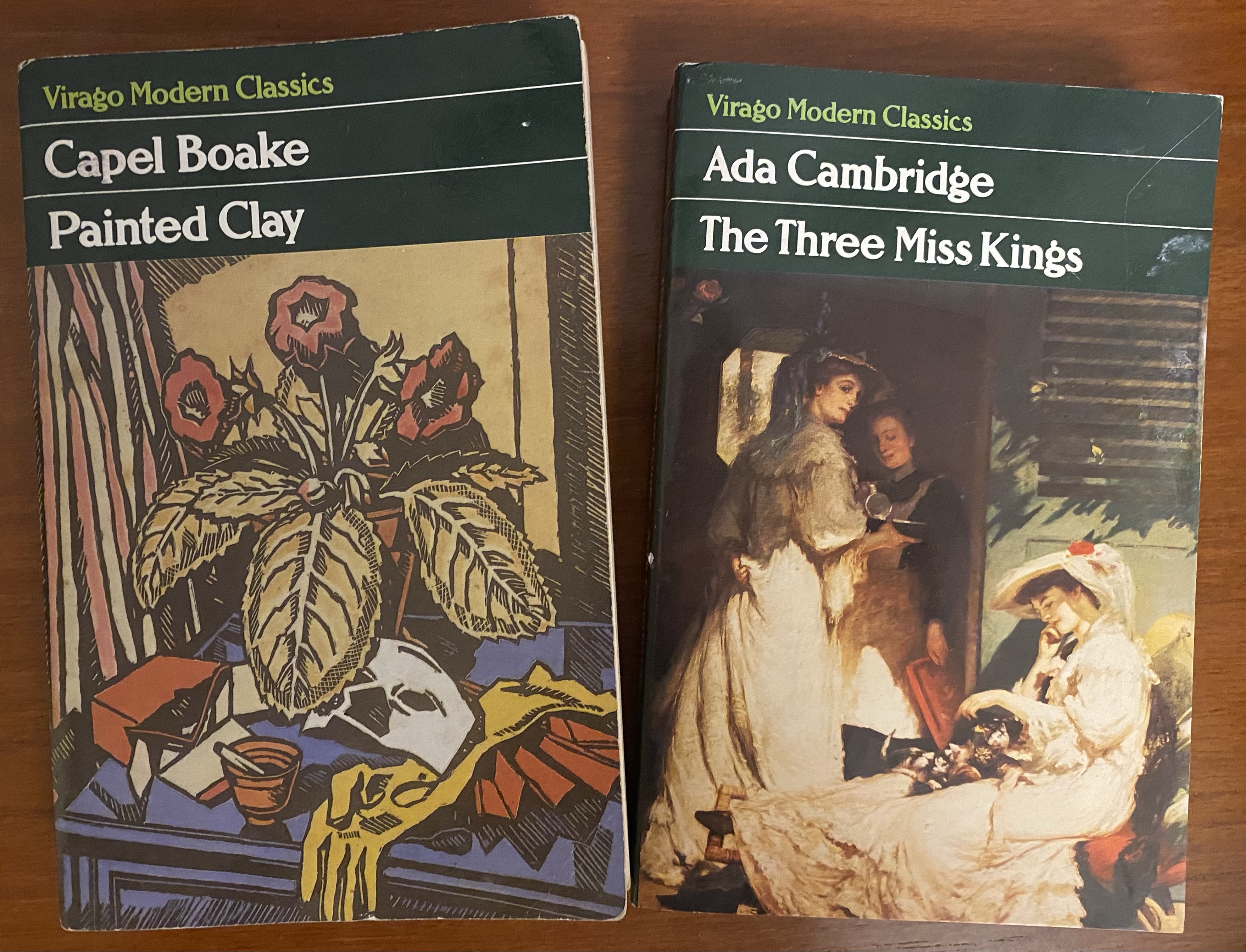
I chose two novels out of the humungous VMC pile and they both turned out to be entertaining considerations of the roles of women in late nineteenth and early twentieth century Melbourne.
In reverse chronological order, Painted Clay by Capel Boake (1917). Set in 1913-14, this coming-of-age story follows Helen Somerset as she tries to forge her own way in a society that places considerable strictures on women.
At the start of the novel, lonely and isolated Helen is only a few years older than the century, as she living in a suburb with her distant father:
“Several women had watched carefully and had made sure their curtains had not been down for months. They always took their curtains down, washed them, and put them up again, every four weeks. The end house did not do this. Therefore there must be something very wrong with the occupants of the end house.”
Determined for change, she makes overtures to the young women who live next door, and finds herself invited in. She is shy and awkward, but the family is warm and welcoming.
“She knew that if she were alone she could have carried on the most brilliant conversation with everybody, but now she seemed to have nothing to say.”
Belle is engaged to sleazy Bert, while her sister Irene moons over the picture of a matinee idol. They are full of life and show Helen another way to live. She joins Irene in working in a shop, suffering under the deliberately unpleasant work given to her by the jealous supervisor. We follow Helen from shop to office work, as she learns to wrestle with the bullying of women and the unwanted attentions of men, struggling to work out what she wants when it seems to be so different from other women her age:
“She fled from the thought of sex; it horrified her – but it came back and back. She tried to close her mind against it, but it came insistent and whispering, distorting her view of life full in despair she went to her books again.”
Helen is not a wet blanket though, or a naïve and priggish beauty which can sometimes make heroines of this era hard to warm to. She’s quite determined to live her own life, away from the life paths everyone seems to expect of her.
“Helen had a soft, but unyielding obstinacy against which all argument beat in vain.”
Things begin to change for her when she is taken into a bohemian artistic set. She falls in lust with Alick Russell, and one thing leads predictably to another … what is less predictable is Helen’s reaction to sleeping with a man outside marriage:
“She wondered why she did not grieve over it, why she was not overcome with sorrow and repentance. She puzzled over it with frowning brows, but could reach no satisfactory conclusion.”
[…]
“I can’t see the difference between being married and not. It doesn’t seem to me to matter very much, and yet it does. I wish I were either a very bad woman or a very good one. If I were a bad woman nothing would bother me, and if I were a very good woman I wouldn’t think about it. I would just be married, and that would be the end of it.”
Painted Clay is a carefully non-didactic exploration of women’s roles and choices at this moment in time. Female characters are not judged for choosing unsatisfactory marriages, when the alternative may be worse for them. Older unmarried women are not shown as leading happy lives due to how limited their choices are, yet Helen is consistent in her belief that marriage is not for her.
Although not explicit, female desire is dealt with frankly, as is the fallout from its expression – fallout which lands disproportionately on women rather than men, despite their equal involvement.
What struck me most though, was not the attitude towards female sexuality or marriage, but towards sex work. It is referred to more than once in the novel and Boake is determinedly non-judgemental of those who undertake it. There is this interview Helen undergoes with a recruiting Madam:
“Helen shook her head, ‘No’ she said. ‘I can’t.’ Her tone was final, and the woman recognised it, though she made a last effort to persuade her. ‘Why not?’ she asked.
‘I don’t know why not,’ answered Helen. ‘It’s not my way, that’s all.’”
Then later in the novel she takes a woman from the street for a hot meal:
“Helen looked round with a frown. She found that everyone in the room was staring at them. She looked at them with bitter scorn. She hated them for their smug complacency. She felt neither love, liking, or even pity for the girl she was with, but she preferred her to the smug suburban women with their intolerable air of conscious virtue.”
I expected a much more judgemental attitude for the time, and it was refreshing to have this assumption undermined. (Also on the subject of the streets – the urban setting and changing seasons are wonderfully evoked. Sadly I don’t know Melbourne but I’m sure those who do would find much to enjoy in this evocation of it in the early decades of the last century).
Painted Clay was Capel Boake’s first novel and on the strength of this I would definitely be interested in reading more. It’s not the most sophisticated novel but it’s concise, well-paced and very readable. Boake died in her 40s having published three novels (one further was published posthumously) and some poetry.
Secondly, The Three Miss Kings by Ada Cambridge (1891) which I was encouraged to take off the shelf by Emma’s escapism list. Although depicting a far more conventional life of middle-class mores and marriage than Painted Clay, The Three Miss Kings still manages to cast an askance, humorous view at late Victorian life.
At the beginning of the novel the titular heroines – Elizabeth, Patty and Eleanor – find themselves all alone in the world after their father dies.
“It was a curious position altogether. As far as they knew, they had no relations, and they had never had a friend. Not one of them had left their home for a night since Eleanor was born, and not one invited guest had slept there during the whole of that period. They had never been to school, or had any governess but their mother, or any experience of life and the ways of the world save what they gained in their association with her, and from the books that she and their father selected for them.”
Cambridge is at pains to stress the young women’s refinement and ‘breeding’ to an extremely tedious degree. However, later in the novel she stops banging on about this quite so much, which was certainly a relief, and gets on with telling an oft-told tale in a very readable way (excepting a couple of clunky passages with characters voicing long opinions on topical issues such as the role of the church).
The women travel from their rural home to Melbourne to be shocked and then embraced by city life, under the guiding light of their self-appointed guardian Mrs Duff-Scott:
“The only drawback to her enjoyment in them was the consciousness that, though they were nobody else’s, they were not altogether hers. She would have given half her fortune to be able to buy them, as she would buy three bits of precious crockery, for her absolute possession, body and soul—to dress, to manage, to marry as she liked.”
Three comely young ladies, refined of manner and naïve of just about everything – what will possibly happen? Mrs Duff-Scott has an idea, and lines up potential suitors for all of them with alarming ineptitude. I particularly enjoyed her assessment of Mr Westmoreland:
“He was the richest of them all, and the most stupid, and therefore he seemed to be cut out for Patty, who, being so intellectual and so enterprising, would not only make a good use of his money, but would make the best that was to be made of him.”
Cambridge does undermine some of the conventions she is focussing on, or at least mocks them lightly. For example, how to describe her heroines:
“like a tall lily, I feel I ought (and for a moment was tempted) to add, only that I know no girl ever did look like a lily since the world was made, nor ever will, no matter what the processes of evolution may come to.”
She’s also very pragmatic alongside the romance, such as the consideration of marrying for money:
“If these motives seem poor and inadequate, in comparison with the great motive of all (as no doubt they are), we must remember that they are at the bottom of a considerable proportion of the marriages of real life, and not perhaps the least successful ones. It goes against me to admit so much, but one must take things as one finds them.”
She even allows some feminist commentary regarding commanding male heroes:
“’Who would marry a chicken-hearted milksop if she could get a splendid tyrant like that?’ exclaimed Patty, fervently, for the moment forgetting there were such things as woman’s rights in the world.”
So although a romance in many ways, The Three Miss Kings is not unwaveringly romantic. I’ve never read Ada Cambridge before and I really enjoyed this first encounter. She brought a different voice, humour and interesting characterisation to make a familiar story include some surprises.
The story is firmly rooted in 1880 and in Melbourne, with descriptions of the International Exhibition. Melbourne Cup, public gardens, streets and crowds which were very evocative. If I’ve not said much about the plot it’s because I don’t think it’s really needed – you get the idea!
“I don’t think it is that things are going wrong, dear. It is only that we have to manage them, and to steer our way, and to take care of ourselves, and that is so trying and perplexing.”
To end, forward a century for service as usual with a 1980s pop video, from a Melbourne band:
To describe my blogging as patchy would be to suggest a productivity that currently I can only aspire to. Thankfully Simon and Kaggsy are hosting one of their wonderful club events this week, always irresistible and especially so this time, as 1929 is bang in the middle of the interwar years, my reading sweet spot.
(Great badge 🙂 )
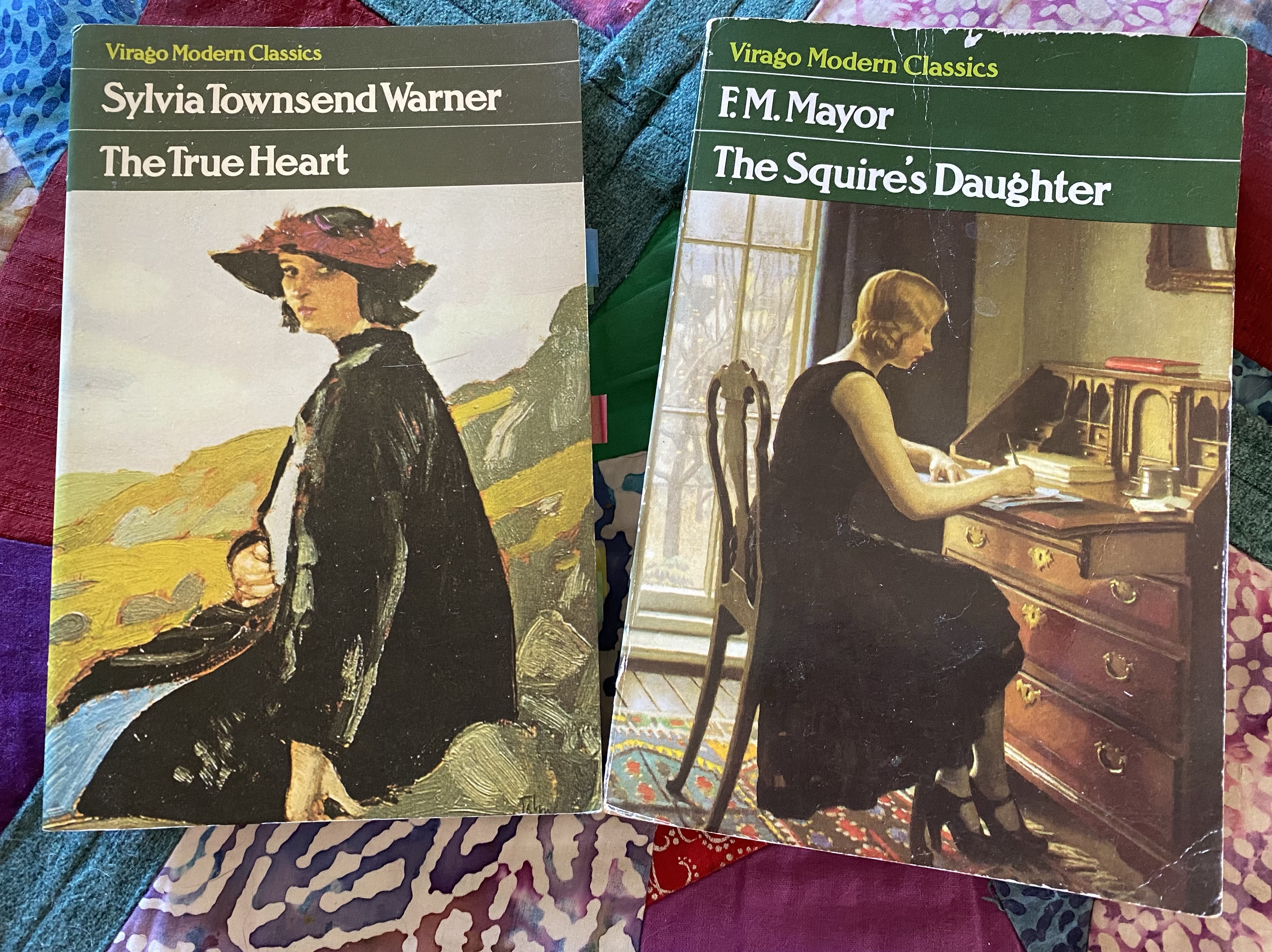
I’m hoping to post twice this week, and I thought I’d start here with two Virago Modern Classics.
I probably wouldn’t have been particularly drawn to The True Heart if it wasn’t written by Sylvia Townsend Warner, author of the wonderful Lolly Willowes. The blurb on the back says:
“This is the love story of Sukey Bond and Eric Seaborn. Sukey is an orphan, in service, the lowest of the low. It is 1873, and in her first position as a servant girl on a farm in the Essex Marshes, she meets Eric – gentle, simple […] The lovers are parted by Eric’s rich mother […] But nothing can deter Sukey. Only Queen Victoria, she feels, can help, so she sets off to see her. Extraordinary things happen on this heroic journey, but Sukey’s simple love and courage carry her to final victory- reunion with her beloved Eric and love triumphant.”
Absolutely nothing in that description appeals to me. Well, maybe the Essex Marshes. And Queen Victoria. But nothing else. However, I was quickly won over by this description on page two of Miss Pocock, the Matron of Sukey’s orphanage on prize-giving day:
“She had been up since 4 A.M. putting finishing touches to the orphans housewifery. Now she wore her new purple bodice and her face of state, where the expression never varied, as if her countenance were cased up in invisible stays.”
Having excelled on the prize day, virtuous Sukey goes to work as a maid on a farm, a position found for her by an orphanage patroness, Mrs Seaborn.
“Sukey was still persuaded that there was something very odd and exceptional about her life, though she, of course, was a very ordinary creature. In truth it was humdrum enough and the cares and pleasures that filled her days were those common to any servant-girl on a small farm. Nor were the other inmates of the farm remarkable in any way that appeared to her.”
There she meets Mrs Seaborn’s son Eric, an outsider like Sukey, living alongside the Norman family who run the farm:
“They spoke of him always as ‘Young Eric,’ and by the insistence upon his youthfulness seemed to disassociate themselves from him. He was like a pet lamb, grown too large for the house but whom the household had forgotten to put out of doors.”
Eric has been dumped at the farm by his mother who is ashamed of his ‘idiocy’ and seizures. The two fall in love, each naïve and inexperienced. Sukey soon believes she is pregnant despite knowing nothing of the facts of life and therefore not realising that there is zero chance she has conceived a child. What stops the story from being overly saccharine is STW’s humour, which is gently witty – entertaining but never slyly undermining her characters.
“A baby may grow up and make any number of people miserable. Besides justification, they also require long clothes and short clothes and little woollen socks – and how is an unmarried baby going to find these?”
As the blurb suggests, Eric’s mother separates them and Sukey begins her epic journey towards reconciliation. The story is a retelling of Cupid and Psyche, and the tale does have a mythic quality as Sukey meets various colourful characters on her journey and through some sort of miracle manages to stay safe.
The tone of The True Heart is so finely balanced. I think as a twenty-first century reader I was waiting for the knowing irony, the askance aside which never came. It made me question if this is how I’m used to seeing love presented in contemporary stories, which is a pretty bleak thought. Yet STW is not remotely sentimental either. Rather she is clear-sighted and compassionate.
“He was sorry for birds. He loved all helpless things, all wild things, all harmless and thoughtless things, for he himself was wild and harmless, thoughtless and helpless. He was sorry for the bird, he understood its distress. Her distress he could not understand. It passed by him like the wind – violent, alien, incomprehensible. Her anger was aflame that would not take upon him.”
A singular novel, thought-provoking and written with the lightest touch.
By contrast, the female protagonist in The Squire’s Daughter by FM Mayor is somewhat jaded by her worldly experiences even by the age of 21. Ron de Lacey – as the title indicates – is from a privileged background and she uses this privilege to enjoy a frivolous, vacuous London life as a flapper (aka living my dream life 😀 ).
“In Ozzy’s set they were all young; for her sex the most successful age was eighteen; the new Cabaret girl was sixteen, she and Nadine were already rather old. Aunt Laura knew spinsters by the score, they were generally political, and Ron hated politics.”
Ozzy is her brother, somewhat estranged from his family due to his refusal to fight in the War, the conflict casting a long shadow even for a generation who barely remember it.
Ron also returns to the family seat of Carne rarely, and seems indifferent to its pending sale despite the pain it causes her father. The heirs care nothing for the country seat, only the staff seem to share her father and aunt’s understanding of what it once meant:
“Carne was like a college to the old servants, and they were its Fellows.”
“The gardener combined contempt for her with a fond respect for gentry.”
However, it is not because she hugely values her London life that Ron feels alienated from Carne. There is a sense that she is entirely adrift, with no sense of purpose or of self anywhere.
“She had been an ultra-smart young woman, extracting every ounce of success from her seasons, and with Ozzy’s set she could be as vulgar and exaggerated as a chorus girl. In repose, however, her eyes were often unsatisfied, and sometimes sad.”
It is during a visit at Carne that Ron falls somewhat inexplicably in love with the most English-monikered man, Bob Manners. I really enjoyed this conversation between them over dinner, whereby Ron attempts to engage Bob in discussion about a literary great:
“‘Do you like Tchekov?’
‘I don’t know what it is? Is it a drink?’
‘No it’s a Russian, who writes plays.’
[…]
‘I think there’s nobody like Tchekov. I know just where I am with him. He’s like all of us. His people drift about, and want something terribly for five minutes, and then want something else, and all the time they don’t know what they want after all.’
‘I’ve never met any Englishmen like that.’ said he, ‘nor do I want to, nor do I believe they exist.’
‘Yes, but I expect my Englishmen aren’t your Englishmen.’”
They begin a tentative courtship, he unused to romance, she overused to its rituals:
“She was neither shy nor nervous. She could not imagine life without frequently going to tea with men who had fallen, we’re falling, or might fall in love with her.”
The novel follows their relationship and those of her family, alongside the disintegration of Carne. Although the tone is restrained, I found The Squire’s Daughter to be really a very sad novel. It was about the long-term damage of war; the pain of failed communication with those you love; the desperate search for meaning to live your life by, across the generations.
“I suppose one had a surfeit of feeling in the war and used it all up.”
To end, a clip of Greta Garbo still managing to be stunning in the world’s worst fitting dress, in 1929 film Wild Orchids (flogging scene at beginning, skip to 1:00 to avoid):
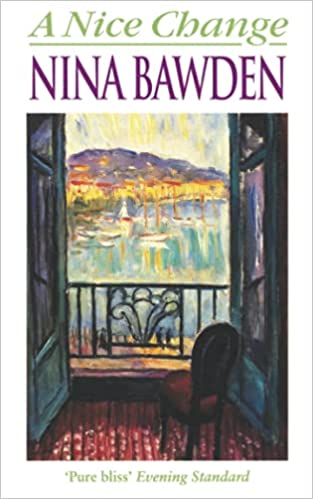
Although I wouldn’t describe Nina Bawden as a comfort read – she is far too sharply observant for that – it was with some relief that I started A Nice Change, after the traumas of The Gold-Rimmed Spectacles yesterday. A middle-class comedy of manners amongst holidaymakers in Greece sounded free of serious consequence and therefore just the ticket.
The story opens with solicitor Amy arriving in Athens airport with her husband Tom, a Labour MP, who has spotted his ex-mistress Portia heading to the same hotel as them:
“What the hell is she doing here? What the hell can he do? Amy has booked (a package deal, paid in advance) this reportedly comfortable hotel entirely for his benefit. She hates lying around pools, or on beaches, is bored by rich food as she is bored by rich people, likes to keep on the move when she travels. But he has just had a small but humiliating operation that made bicycling around Brittany, their earlier, energetic plan for this summer fortnight, out of the question.”
Despite being a philandering politician, Tom isn’t especially despicable. He’s not especially likable either. He’s just a middle-aged man worried about his waistline, dissatisfied at work but feeling too old to start anything new. He’s recognisable and ordinary, rather than a moustache-twirling villain.
“He could never again think of himself as an honest man. (There is a certain enjoyment in this self-abasement that he acknowledges occasionally, even though most of the time he prefers to see it as a decent humility.)”
Amy, on the other hand, seems quite a decent and caring person.
“Now it is only with Tom that she feels these physical characteristics to be shameful, disabling. With other people (more often with women than men) she is unselfconscious, competent, kindly, a good listener, even a good talker, on rare occasions quite witty. Well, cheery, anyway, she corrects herself.”
She is aware of Tom’s affair and knows it is over. She doesn’t want to know any details, so Tom spends the holiday worrying that Amy will discover who Portia is. Tom’s charming father arrives too, adding to his concerns.
Alongside these domestic woes are the other guests: Mr and Mrs Boot, an older couple who refer to each other as Mother and Daddy belying Mr Boot’s somewhat less-than-paternal traits; lovely young doctor Prudence Honey (ha!) awaiting the arrival of her extrovert grandmother; grieving widower Philip; and some mysterious elderly female twins, who Amy thinks look vaguely familiar…
Bawden is a great social observer, but never harshly judgemental:
“Connection thus established, they nod, and smile, and make various other small facial gestures to express friendly intentions towards each other and amused dismay at the suddenly crowded bar; every seat taken and not even much standing room since several of the newcomers have crutches or zimmer frames which they deploy cunningly to give them extra floor space.”
Although it’s a novella, Bawden handles all the characters expertly and none felt under-explored to me. There are various mysteries around the guests which gradually come to light without feeling contrived, and I thoroughly enjoyed my time at Hotel Parthenon.
This week is Daphne du Maurier Reading Week, hosted by Ali who shares a birthday with the author today. It’s always a wonderful event so do check out the posts!
I’m a bit consumed with Novella a Day in May at the moment, but Ali said you can participate in DDMReadingWeek with a short story, which was very tempting. I was so impressed when I read the NYRB Classics short story collection Don’t Look Now for DDMReadingWeek back in 2019, and I have the Virago collection The Breaking Point in my TBR (luckily they only have one story in common, The Blue Lenses). The Alibi is the first story in the Virago collection.
The story opens with James Fenton and his wife Edna taking their usual Sunday stroll along Albert Embankment. A picture of middle-class contentment, but you know that this being du Maurier, anything remotely safe and familiar is about to be undermined.
And it is. Passing a nanny “pushing a pram containing identical twins with round faces like Dutch cheeses”, his wife mentions arranging dinner with their friends, and among all this domesticity Fenton suddenly feels entirely disassociated. He could kill someone.
“‘They don’t know,’ he thought, ‘those people inside, how one gesture of mine, now, at this minute, might alter their world. A knock on the door, and someone answers – a woman yawning, an old man in carpet slippers, a child sent by its parents in irritation; and according to what I will, what I decide, their whole future will be decided. Faces smashed in. Sudden murder. Theft. Fire.’ It was as simple as that.”
He decides he will murder someone entirely at random. In order to undertake his nefarious plan, he takes a room in a seedy flat, sublet by Madame Kaufman, a woman worn down by life, living with her small son Johnnie.
To justify his taking of the room he claims to be a painter, and goes as far as buying canvases and oils. At this point, his plan starts to go awry…
Everything that I love about du Maurier was in this story. The creepily destabilising of the familiar; the resolute ordinariness of evil; the sense that anything could happen and that whatever it is would be horribly believable. There was also some humour in the portrayal of the deeply unpleasant James Fenton:
“If there was one thing he could not stand it was a woman who argued, a woman who was self-assertive, a woman who nagged, a woman who stood upon her rights. Because of course they were not made for that. They were intended by their Creator to be pliable, and accommodating, and gentle, and meek. The trouble was that they were so seldom like that in reality.”
The end of the story completely reframed all that had gone before – du Maurier is certainly a writer that keeps her readers on their toes.
I’m really looking forward to finishing the collection once I’ve stopped consuming novellas at quite such a rapid rate. Many thanks Ali, for hosting this wonderful event, and a very happy birthday to you!
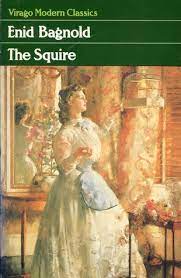
The Squire is a novella I have two copies of – one in Persephone edition and one in VMC. Sometimes I wonder if having several copies of the same books in different editions is the sign of a problem – but I suspect readers of this blog are the wrong people to ask 😀
The Persephone edition has smaller print so meets my novella criteria at coming it at under 200 pages (the VMC is 270 pages but much larger print and wide margins). Either way, it’s a quick read!
The squire of the title is the privileged middle-class lady of Manor House, wife of a “Bombay merchant” who is away in India on business (aka ripping off traders in the name of white imperialism) while she awaits the birth of her fifth child.
“Drifting towards the birth of her baby with a simple and enchanted excitement she walked in radiance like a bride.”
The novel covers the last few hours before the birth, and after. This is a life of ease, albeit with servant worries and a best friend more concerned with her latest love affair. The squire drifts through it all:
“She who had once been thirsty and gay, square-shouldered, fair and military, strutting about life for the spoil, was thickened now, vigorous, leonine, occupied with her house, her nursery, her servants, her knot of lives, antagonistic and loving.”
The setting is resolutely domestic. There are no concerns for the squire outside of this sphere. Reading it now, the order, predictability and comfort struck me as particularly poignant, as we know that in just over a year the world would change irrevocably. It’s unlikely the squire’s staff of seven for her family of six would still be in place once war was declared. But for now:
“The last curtain was drawn, the parlourmaid had gone and the hall was empty. It smelt of greenery and flowers and polish, very still, folded for its evening, waiting for its night.”
There is some lovely characterisation in The Squire. My particular favourites were her son Boniface, who determinedly stays in his own world, refusing to pander to his mother’s feelings by saying he missed her when he didn’t; and Pratt the butler, grumpy and unyielding, but also very fond of his mistress:
“Pratt bent his tall figure over the library fire, fire-tongs in hand…Only the firelight lit his trousers. The lights on the circuit had fused. The circuit involved the squire’s bedroom above, the staircase and landing outside. He heard her calling for a candle. He stood still (a dignified, black figure, holding the fire-tongs) because his smouldering nature was accustomed to save itself by inaction. Let her mend her fuse.”
Thankfully for the squire, the more accommodating live-in midwife arrives, swelling her staff to eight. The midwife and the squire have known each other for years and speak intimately and frankly, as you’d expect considering what they have been through together:
“ ‘As I grow older I come to consider men…husbands of women, husbands of mothers…as hindrances to my work.’
‘You wouldn’t get your work without them.’”
The Squire was considered very frank for the time, apparently HG Wells, despite his liberal views, was shocked at Bagnold’s use of the word nipple 😀 What surprised me as a twenty-first century reader was the squire’s alcohol consumption (port in gravy, sherries before dinner) and the readiness of the doctor to prescribe a “quarter of morphia” to a woman who has just given birth as he considers her over-excited. Later, after the squire has breastfed, she observes “the morphia still drifting about her like evaporating wool” so presumably the newborn has just had a dose of controlled drugs too – eek.
The Squire is beautifully written and very readable, capturing a particular experience of motherhood and birth at a very specific time.
This is my second contribution to this week’s 1954 Club, hosted by Simonand Kaggsy, and a chance to revisit Barbara Comyns, having really enjoyed Our Spoons Came From Woolworths.
The opening line of Who Was Changed and Who Was Dead may have usurped The Crow Road* to become my favourite beginning to a novel ever:
“The ducks swam through the drawing-room windows.”
Thus the scene is set for an unsettling domestic tale where nothing can be taken for granted.
The Willoweed family live in an English village where the river has just flooded in June. Then follows pages of dead animals, which I was prepared for, having read Jacqui’s wonderful review but I was exceedingly relieved when it ended (unfortunately there was also a horrible cat death later). Much as I could have done without the litany of death, it sets the tone for the darkness that follows.
In 1911 Emma, Dennis and Hattie live with their father Ebin and their grandmother who rules with a rod of iron. She is permanently furious, which Ebin attributes as follows:
“It’s all this cleaning, I suppose; but she can’t expect me to help; my hands are my best feature, and they would be ruined.”
Ebin does very little apart from make vague overtures towards his children’s schooling and sleep with the baker’s wife.
“‘Father makes me hate men,’ thought Emma as she pumped water into a bucket.”
This is not an idyllic pre-war rose-tinted existence. Money is tight, relationships are tense, there is sexual deceit, violent undercurrents that threaten to overwhelm, and macabre power games. Grandmother Willoweed treats the servants horribly, but Old Ives the handyman is a match for her:
“They always exchanged birthday gifts, and each was determined to outlive the other.”
Their lives are disrupted by a mysterious illness that sweeps through the village. People kill themselves following horrific delusions. By the time the cause of the illness has been identified, tragedy has touched the family and violence has ensued. As the title tells us, lives will have changed irrevocably one way or another.
I don’t want to say much more as the joy of reading Barbara Comyns is being so unsettled as to have no idea which way she is going to take you. There’s no-one like her; her view is so singular, so disturbing and yet so compelling. I found Who Was Changed and Who Was Dead brutal and horrifying, and also funny and enchanting. I couldn’t look away.
The novel picks up precisely where The Sugar House left off, with Clara and Archie having decided to separate. Clara moves back to her parents’ house to live with them and her grandmother in West Kensington. As she packs up her old life, she feels disassociated:
“She had the odd impression that it was not she who was stripping hangers and throwing armfuls of clothes into suitcases but some callous, efficient stranger. She herself was lying on the unmade bed, staring blankly at the cracks in the sugar-pink ceiling.”
This sense of disassociation deepens and broadens throughout the novel. When Clara announces to her mother “It’s a great relief not to have any feelings. I’m certainly not going to risk getting involved with anyone again.”
The reader of course knows what will happen. She attends a party with her friend Clive Heron (an intriguing character, my personal theory is he works for MI5) and falls instantly in love with the dashing soldier Richard Crayshaw.
What follows is such a clever exploration of someone slowly – then suddenly – unravelling. Clara stops eating and sleeping, she has a “strange sense of heightened perception” ever since she danced with Richard. She believes they communicate telepathically, a belief supported by others, but then she thinks the photographs of dead soldiers in her father’s study are speaking to her. She has gone from no feeling:
“Null and void. Null and void. She sat staring at the roses on her bedroom wall-paper, saying the words over and over again until she was half hypnotised.”
To too much feeling. At first her mania is disguised by being in love – plenty of people feel heightened and have reduced appetite and problems sleeping in the excitement of new romance. Certainly that is what Clara’s mother Isabel believes.
But gradually the reader begins to realise that Clara is really quite unwell. As Beyond the Glass is told from Clara’s perspective this takes some time, but it dawns us through others’ responses to her. In this way it is reminiscent of Wish Her Safe at Home, another excellent novel about severe mental illness.
Eventually she is ‘certified’ – made an in-patient at a public mental health hospital. The descriptions of the environment and the practices make me wonder how on earth anyone would have a hope of ever becoming well again. Thankfully mental health services, though chronically underfunded, are very different now.
I was so impressed with how White conveyed Clara’s disorientation and confusion, without making the narrative confusing and disorienting at all:
“Time behaved in the most extraordinary way. Sometimes it went at tremendous pace, as when she saw the leaves of the creeper unfurl before her eyes like a slow motion film, or the nurses, instead of walking along the passage, sped by as fast as cars. Yet often, it seemed to take her several hours to lift a spoon from her plate to her mouth.”
During her deep distress there are also echoes of events that occurred earlier in the narrative, particularly in The Sugar House, showing with the lightest of touches that her severe ill health has been building for a while:
“Since her marriage she had had an increasing sense of unreality, as if her existence had been broken off like the reel of a film.”
The recurring images of mirrors and glass as barriers reminded me of Plath’s The Bell Jar. Like The Bell Jar, this novel is based on the personal experiences of the author.
“She had an instantaneous vision of herself as someone forever outside, forever looking through glass at the bright human world which had no place for her and where the mere sight of her produced terror.”
Beyond the Glass ends on a note of hope, and faith, drawing on the Catholic thread that runs through all four novels. At times Clara’s Catholicism is more strongly felt in the story than at others, reflecting the character’s experience of her faith. I’m not religious but I felt the focus on this theme ended the novel and the series perfectly.
It’s so impressive that all the novels in the quartet are distinct and stand individually, while also developing across the sequence a fully realised portrait of Clara, and her family.
I’ve really enjoyed immersing myself in Clara’s life and I’m going to miss her (and her much-maligned mother, a great piece of characterisation). I wish Antonia White had continued writing her story.
“Something told her that, when they saw her again, they would know as well as she did that she no longer belonged to the world beyond the glass.”
To end, I finished my previous 1954 Club post with a filmed musical, so here’s another. The film of The Pajama Game is from 1957 but the Broadway show first appeared in 1954:
This week I’m looking at two novels by Antonia White, prompted by the pending arrival of next week’s 1954 Club, hosted by Simon and Kaggsy. When I looked at the TBR for 1954 novels, one that I had was Beyond the Glass. However, it’s the final novel in a quartet, and I hadn’t read the middle two…
It’s been six years since I read Frost in May and I’m not sure why it’s taken me so long to pick up Antonia White again, because I really enjoyed that first instalment. Frost in May was written in 1933, and White didn’t continue the story again until 1950, going on to write the last two in the quartet in 1952 and 1954.
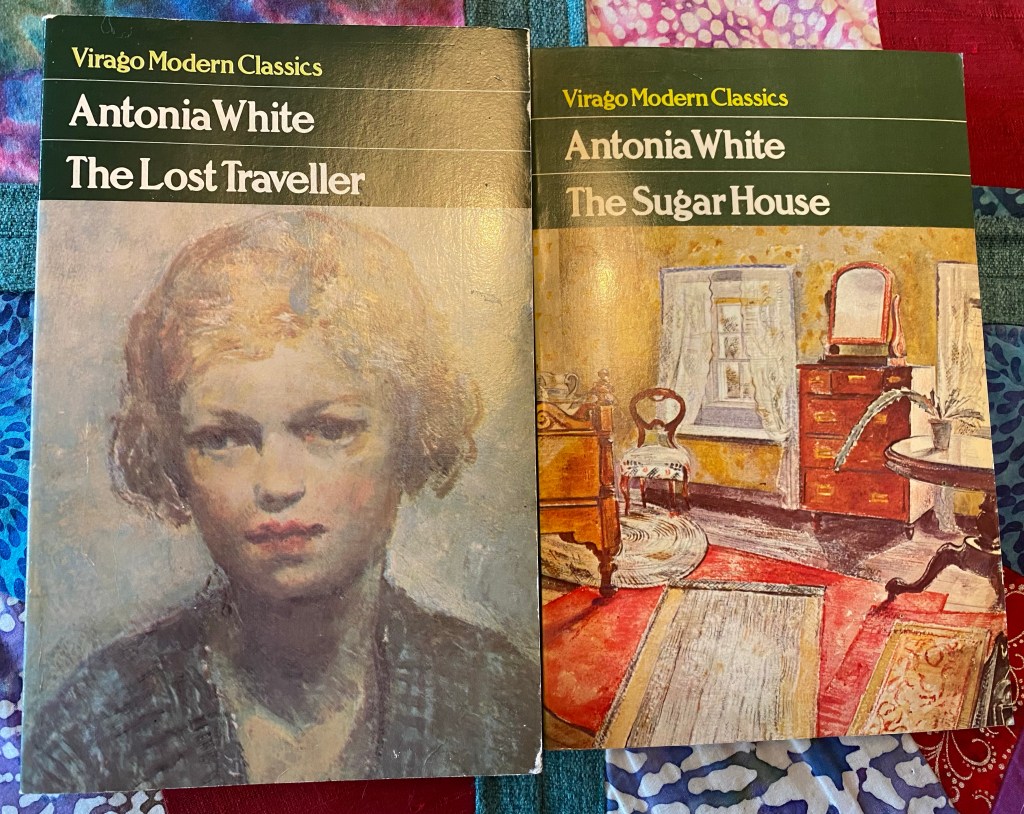
The Lost Traveller (1950) sees Nanda from Frost in May renamed Clara and returning to her childhood home in West Kensington to attend the funeral of her paternal grandfather. Her father is bereft, but in 1914 emotions were to be controlled absolutely:
“Suddenly he was touched by an old fear of which he had never spoken to anyone, the fear that one day he might lose all control of his mind. Against that there was only one weapon; his obstinate will.”
Mr Batchelor is a teacher who harbours academic ambitions for Clara. His feckless wife Isabel wants Clara to be beautiful. She is both of these things, but not to the extent that either of her parents would like. The complex family relationships are brilliantly portrayed by White: the mismatched parents, the passive aggressive power struggles between Isabel and her mother-in-law (“Mrs Batchelor’s face … assumed a look of patient malice.”) and in the middle of it all, adolescent Clara.
“At home, to be silent was taken for a sign one was sulking.”
After her mother is ill with the mysterious women’s problems that were always so common and yet so unspoken, Clara’s father can no longer pay her school fees (the NHS was over 30 years away) and so she has to leave Catholic boarding school to attend a local Protestant school. She’s actually quite happy there, and makes two friends, although neither of them are Catholic, to the concern of her convert parents.
“Isabel, who would never have come to such a decision on her own, was willing to follow him. Catholicism seemed to her a poetical and aristocratic religion.”
Clara’s religion plays a large part in The Lost Traveller, as she tries to establish what it means for her as a young adult, away from the structures of her convent school.
Of course, with the year being 1914, readers know what the family is about to live through. However, when war breaks out, the only person it really affects is Mr Batchelor, as he sees the population of his old boys steadily wiped out.
“If only he could have gone to the front with them, he would have been completely happy.”
Although Clara prides herself on not being as vacuous as her mother, in some ways she is just as self-focussed and oblivious:
“Since she had nobody at the front in love with her and was too young to be a nurse or W.A.A.C, Clara refused to take any interest in the progress of the war.”
So while the war takes place somewhere else, Clara struggles with her sense of self, trying to work out who she is and how to manage the tumultuous feelings of teenage life in a family where so much goes unspoken. Her father is devout, strict, and given to tempers. Clara adores him and yet there is distance between them:
“Why couldn’t he understand without being told that there was nothing she would not do, cut her hair off, hold her hand to the fire, if it would bring any comfort? Why couldn’t he realise that the one impossible thing was to speak?”
Meanwhile her mother is struggling with her life choices – or lack thereof – and is drawn to one of her husband’s colleagues, Reynaud Callaghan, who encourages her romantic fancies.
“‘But I love Versailles,’ she went on dreamily. ‘I had an ancestress at the court of Louis XVI. I should have adored that life. Those exquisite clothes and the balls by candlelight and the masquerades by moonlight.’”
Isabel is great creation: vain, shallow, a snob, and yet in many ways she sees more clearly than anyone else. She tries to talk to Clara about childbirth and sex, but Clara stops her. Clara’s naivete about both is astonishing yet believable.
An opportunity comes up for Clara to be a governess for six months to an aristocratic Catholic family, which her family are keen she take up. I found her charge thoroughly unpleasant – an over-privileged, spoilt, entitled little brat. The type that grows up to run the country 😉
It’s there that Clara meets Archie Hughes-Follett, injured in the line of duty. He will come to play a much larger role in her life in The Sugar House.
“When she considered her vanity and duplicity and how little her beliefs influenced her behaviour, she began to wonder whether she might not be insensibly growing into a hypocrite.”
The Sugar House (1952) picks up Clara’s story six years later in 1920. She is an actress, having paid for her drama tuition herself with money made from working in a government office. She doesn’t seem wholly committed to her profession, but she is to her older lover Stephen Tye.
Needless to say, the reader may not be quite so enamoured of a man given to pronouncements such as: “‘No female novelist is worth reading,’ said Stephen. ‘Women can’t write novels any more than they can write poems.’” He then wheels out the tired old misogynist cliché that Branwell wrote Wuthering Heights. Sigh…
Thankfully we don’t have to endure this awful man for too long, as he ends up on a different tour to Clara. I thought the touring life was wonderfully evoked by White:
“Though towns changed, landlady’s sitting-rooms remained the same. There were always round tables with red or green serge cloths, aspidistras, photographs of seaside towns in plush frames and, in lucky weeks, a tinny, yellow-keyed piano.”
Clara often finds herself sharing rooms with fellow actor Maidie, who is at once much more devout and much more worldly than Clara. Religion is not such a strong theme throughout The Sugar House as it was in The Lost Traveller, but it is there as a constant.
When things fall apart with Stephen – as the reader knows they inevitably will – Clara returns to the security of what she knows: home, and Archie. He loves her, and unlike Stephen he respects her writing:
“I didn’t think even you could write anything which got me so much.”
However, he is conflicted and confused. He has the same childlike quality he had in The Lost Traveller, but his self-medicating with alcohol has worsened:
“Often he had sulked like a schoolboy but never had she seen him in this mood of aggressive bitterness.”
Clara doesn’t love him, but she marries him. Although Maidie has helped Clara to become less naïve, she is still hopelessly ignorant and to a modern reader the whole thing is doomed to failure. Probably to 1950s readers too, as this is Clara on her wedding day:
“She wondered if he had really expected her to run away. Her will was too paralysed even to formulate the wish.”
The titular house is their first married home, as Clara is desperate to leave the stifling atmosphere of her parents’ house. She finds a place in Chelsea, the portrayal of which is amusing for twenty-first century readers. Now it is one of the most expensive parts of London, but apparently in the 1920s it was bohemian and considerably less salubrious. This does not go down well with her upright father:
“ ‘No doubt you fill the place with short-haired women and long-haired men. Archie has all my sympathy if he prefers the public house.”
The horror!
Interestingly, what draws Clara to this atmosphere is the evidence of people working. Artists wander the streets with the tools of their trade tucked under the arms, and Clara realises she is desperate to write:
“Oh, God, don’t let me be just a messy amateur.”
However, her increasingly stressful married life where Archie fritters away money and drinks heavily means that she finds it hard to focus on work. The house, with its distempered walls that look like sugar icing, cramped rooms and two untidy people living it, begins to oppress her almost as much as her parents’ house.
“Once this sense of non-existence was so acute that she ran from the basement to the sitting room full of mirrors almost expecting to find nothing reflected in them.”
Eventually things reach a breaking point, at once dramatic and understated, entirely believable and very sad. I wouldn’t normally read books by the same author so close together, but I’m glad I did here. I’ve felt very much submerged into Clara’s world and completely involved in her story.
“Yet here, as there, she found herself both accepted and a little apart. She was beginning to wonder if there were any place where she did perfectly fit in”
All being well, Beyond the Glass next week!
(I should mention there is antisemitism expressed in both novels, particularly The Lost Traveller. However, the characters stating such views are never portrayed as admirable. I think writing in the 1950s, White was reminding a contemporary readership who would have had the holocaust in recent living memory, of the pervasiveness of racism in society).
To end, a song that sums up Clara and Archie’s situation pretty well:
After bookish travels (sadly not actual travels) to Ireland and Wales in March, I thought I would start April with a visit to Scotland and a stop on my Around the World in 80 Books reading challenge. As with actual travels, things did not go entirely plan…
I have piles of Scottish authors in the TBR but my initial choices did not work out. The first novel I chose was excellent but brutal, so I just wanted to leave it behind at the end and not blog about it. My second choice I thought was safe; an established and accomplished author. Unfortunately I chose a novel she wrote at age 21, before she realised that sentences need a coherent structure. I got so sick of re-reading to try and work out which pronoun referred to which character that it was a rare DNF for me.
Given my reading pace is so slow at the moment, I then panicked and chose a novella and a short story to try and get something read. Thankfully these turned out to be enjoyable reads 😊
Firstly, Edinburgh-born Muriel Spark’s final novel, The Finishing School (2005). The titular institution is College Sunrise, on the shores of Lake Geneva, run by Rowland and Nina Mahler, although by Rowland in name only:
“To conserve his literary strength, as he put it, he left nearly all the office work to Nina who spoke good French and was dealing with the bureaucratic side of the school and with the parents, employing a kind of impressive carelessness.”
Feckless Rowland is thrown of kilter by the arrival of Chris Wiley at the school:
“His own sense of security was so strong as to be unnoticeable. He knew himself. He felt his talent. It was all a question of time and exercise. Because he was himself unusual, Chris perceived everyone else to be so.”
Chris is writing a novel about Mary Queen of Scots, unhindered by the actual facts of what happened. Although Rowland is tutor to the young artistic students, Chris keeps his writing progress secret, fully aware that this stokes Rowland’s obsession with him.
In this short novel, the other pupils and staff at the school are sketched in lightly but enjoyably, such as Mary: “her ambition was to open a village shop and sell ceramics and transparent scarves”.
Not a great deal happens, but the tension builds as Rowland becomes more fixated on Chris, and the two end up in a co-dependent relationship, as Chris observes:
“I need his jealousy. His intense jealousy. I can’t work without it.”
This being Spark, I couldn’t guess which way the novel would end as she mixes the very dark with a lightness of touch:
“ ‘Too much individualism,’ thought Rowland. ‘He is impeding me. I wish he could peacefully die in his sleep.’”
I wouldn’t say The Finishing School was Spark at the height of her powers – I found it a diverting read and an enjoyable one, but for me, Spark at her best is breath-taking, almost shocking. If you’re already a fan, there’s still much to enjoy here though. The askance view of human relationships, the morbid alongside the comic, the skewering of pretentious writers, and the arresting non-sequiturs.
Secondly, Until Such Times by Inverness-born writer Jessie Kesson (1985), which I had as part of the anthology Infinite Riches: Virago Modern Classics Short Stories (ed. Lynn Knight, 1993). It was a pretty good match for Spark although I didn’t plan it as such, with some darkly comic characterisation and a very unnerving ending.
The bairn is taken to live with her Grandmother and Aunt Edith:
“But you weren’t here to stay forever! Your Aunt Ailsa had promised you that. You was only here to stay… ‘Until Such Times’, Aunt Ailsa had said on the day she took you to Grandmother’s house…”
We join her with the house in a vague state of uproar trying to prepare for a visit from Aunt Millie and Cousin Alice. There is a suggestion that the visitors are respectable and admirable, whereas the bairn and Aunt Ailsa are somehow disreputable.
The narrative moves back and forth, showing the reader more than the bairn understands about her family situation and expertly drawing the dynamics between Grandmother, Aunt and child. The tension for a child living in a strict household and the manipulations and judgements of the Aunt (who is somehow unwell but never quite clear how; she is referred to by an old-fashioned term no longer used) was so well evoked.
At only 11 pages long, Kesson shows all that can be achieved in a short story: well-drawn characters, social commentary, narrative tension and a recognisable world. The final sentence was a perfect ending. I thought Until Such Times was really impressive and I’ll definitely look out for more of Kesson’s work.
To end, a Scottish treat for my mother, who is a big fan:









 madame bibi lophile recommends
