I really enjoyed Elisa Shua Dusapin’s debut novel Winter in Sokcho so I was looking forward to picking up Vladivostok Circus (2022, transl. Aneesa Abbas Higgins 2024) for Women in Translation Month this year. The two novels share the setting of tourist attractions out of season, and of carefully evoked relationships defined as much by distances as by intimacies.
Nathalie is twenty-two and has graduated in costume design in Belgium. She arrives in Vladisvostok – a place she knows from childhood – to spend time with an acrobat trio who are working on their Russian bar performance. They will be performing at Ulan-Ude, seeking to perform a triple jump four times in a row.
“They communicate in Russian, constantly interrupting each other. Anton gives directions, demonstrates a move to Nino, who listens, hands on hips, visibly impatient. Anna climbs back onto the bar. Their movements synchronise. Anna sets the beat, a rhythmic pulse, rising and falling, like a breath being pushed out and sucked back into the lungs, a beating heart at the centre of the ring.”
Ukrainian trampoline champion Anna is their new ‘flyer’ after the previous acrobat, Igor, was injured in an accident five years previously. Nino is from a German circus family and has worked with Anton since he was eight years old. They are both haunted by what happened with Igor.
The four of them are left in the empty winter circus with manager Leon, and Dusapin expertly portrays the barren environment absent of tourists and glitter, smelling of the departed animals.
Nathalie feels awkward from the start, when she arrives before she is expected. She is unsure of her designs and she talks too much, straining the polite interest of the men. Anna is openly hostile and there is a shaved cat called Buck wandering around, adored by Leon. The atmosphere is unsettling and uneasy.
“By the end of the evening, they all have their headphones on. They each go back to their own room listening to music. I put my headphones on too, but without any music. I sit there, focusing on the sounds inside my own head. It makes me feel closer to the others somehow.”
Gradually however, the relationships deepen. This occurs in a believable way, by increments and without sentimentality.
“‘Aren’t you ever scared?’ I ask after a while.
‘All the time,’ he says. ‘I’m terrified with every new jump. Scared of getting hurt. Scared of hurting Anna. I’m scared of the audience too; I get stage fright.’”
Physical forms are flawed in this novel: Anna worries she is too heavy, Anton is nearing retirement, both men nurse injuries and Nathalie has psoriasis. This emphasises human frailty, building tension throughout this short novel as the group strive for their bodies to achieve this dangerous spectacle.
I think Winter in Sokcho is the stronger novel and if you’ve not read this author before then I would recommend that as the place to start. But there is still plenty to enjoy in Vladivostok Circus; Dusapin is so good at creating an unnerving quality to her settings and characterisation which somehow still manages to be entirely believable and warm.
“It occurs to me that my materials can have an impact on their act too. Smoothing out the skin, tapering the body, enabling it to rise more quickly and to a greater height. And at the same time, accelerating the fall.”
I’m going through a bit of a reading slump at the moment, not a terrible one as I’m finding I can focus on my comfort reads, but I’m struggling with anything that needs more concentration. It’s very frustrating.
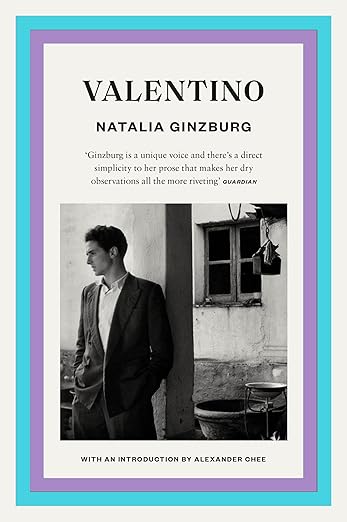
I wanted to take part in August’s Women in Translation Month, so I was hoping to recover my reading mojo in time. Having enjoyed All Our Yesterdays and The Dry Heart by Natalia Ginzburg previously, I thought her direct style would suit my addled brain well. Valentino (1957 transl. Avril Bardoni 1987)) is essentially a short story, just 62 pages in my edition (a Daunt Books reissue) and I whizzed through it on a short train journey to visit a friend in Sussex.
The story is narrated by Caterina, sister of the titular character:
“My father believed that [Valentino] was destined to become a man of consequence. There was little enough reason to believe this, but he believed it all the same and had done ever since Valentino was a small boy and perhaps found it difficult to break the habit.”
Valentino is vain and feckless, entirely undeserving of the faith his parents put in him and the sacrifices the whole family have made to finance his medical studies. He fritters away his time and routinely gets engaged to ‘teenagers wearing jaunty little berets’.
So when he announces his latest engagement, no-one takes it particularly seriously:
“It had happened so often already that when he announced he was getting married within the month nobody believed him, and my mother cleaned the dining room wearily and put on the grey silk reserved for her pupils’ examinations at the Conservatory and for meeting Valentino’s perspective brides.”
However, this engagement to Maddelena sticks. She is older, unattractive and incredibly rich. Valentino’s parents are heartbroken at his avariciousness being made so apparent. Caterina is more equanimous and she soon realises that Maddelena is caring and hard-working. Valentino is not worthy of his bride.
“It was not easy to explain to my sister Clara the turn that events had taken. That a woman had appeared with lashings of money and a moustache who was willing to pay for the privilege of marrying Valentino and that he had agreed.”
What follows is a carefully realised study of the family members and their dynamics, particularly around Valentino’s marriage. Caterina’s direct voice conveys the hurt Valentino inflicts, not through cruelty but through utter obliviousness and self-focus, without demonising him.
In such a short space, Ginzburg achieves a really moving portrait of familial relationships and how these exist under the pressures exerted by society. There is sadness in the tale but also a deadpan humour. Caterina presents the situation without judgement, enabling a real depth to the characterisation.
Ginzburg is such an intelligent, insightful writer who never seeks to alienate readers with her cleverness. She presents knotty complexity with a deceptive simplicity of style. If you’ve never read her, Valentino is a good place to start.
“My emotions at that time were neither profound nor melancholic and I was confident that sooner or later things would improve for me.”
To end, Rudolph Valentino playing ‘a youthful libertine’ and dancing a tango, over 100 years ago:
Death in the Museum of Modern Art is a collection of six stories set during the siege of Sarajevo, although Lazarevska never names the “besieged city” that features in all the tales. Lazarevska is a Bosnian writer and survivor of the siege.
I always find it really hard to write about short story collections, so I’ll just focus on the opening and closing tales. In Dafna Pehfogl Crosses the Bridge between There and Here, the titular character reflects on her long. “unlucky”, “clumsy” life, starting when the maid burned the last coffee listening to her mother’s labour screams. Dafna is something of a scapegoat for her family and remained unmarried as her suitors weren’t smart enough for her family. Now in old age she finds herself alone in the war-torn city. Her family on “the other side” have arranged her passage to safety.
“She stepped boldly and decisively. Freed from other people’s gaze and lengthy sighs. Her feet were light on the deserted bridge between there and here.”
This is the only story in the collection written in the third person, but it didn’t distance Dafna in any way. I really hoped she’d make it to safety…
The final story, Death in the Museum of Modern Art has a dry humour to it. The narrator is answering questions that will form part of an exhibition at MoMA, including “How would you like to die?”
“I would have liked to tell him about that terrible feeling I have of being late… the feeling that I have being overtaken and I’m losing my sense of being present. Neither here, nor there.”
Without heavy judgement, Lazarevska demonstrates how the lived experience of war is being simplified and packaged up for art consumers. The impossibility of the questionnaires even beginning to capture anything meaningful from such a situation.
“But for an American, one ‘easy’ is the same as another. Hence a visitor to the Museum of Modern Art may read that my friend the writer wanted to die easily. He understands that, but the writer does not. That word introduces confusion into the writer’s answer. Can wishes of this kind be expressed in a foreign language, particularly one that does not distinguish one ‘easily’ from another?”
Lazarevska writes in a constrained style, both tonally and structurally. She doesn’t waste a word and has a real command of the short story form – I thought the six stories in this collection were all equally strong.
Lazarevska writes about the siege of Sarajevo in a way that is evocative but not overly emotive, trusting that the circumstances are extraordinary and shocking enough that they don’t need embellishment. Her focus is broadly domestic, looking at how ordinary lives find ways to carry on. The result is a compelling and memorable collection that places the reader alongside the characters as they hold onto their humanity through the most brutal experience.
“The hand I write with his healed. If any new questions should ever arrive, I shall write my answers myself. I’m writing all of this with my own hand.”
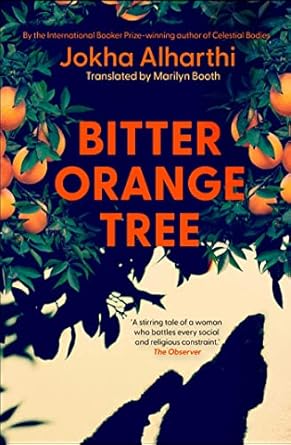
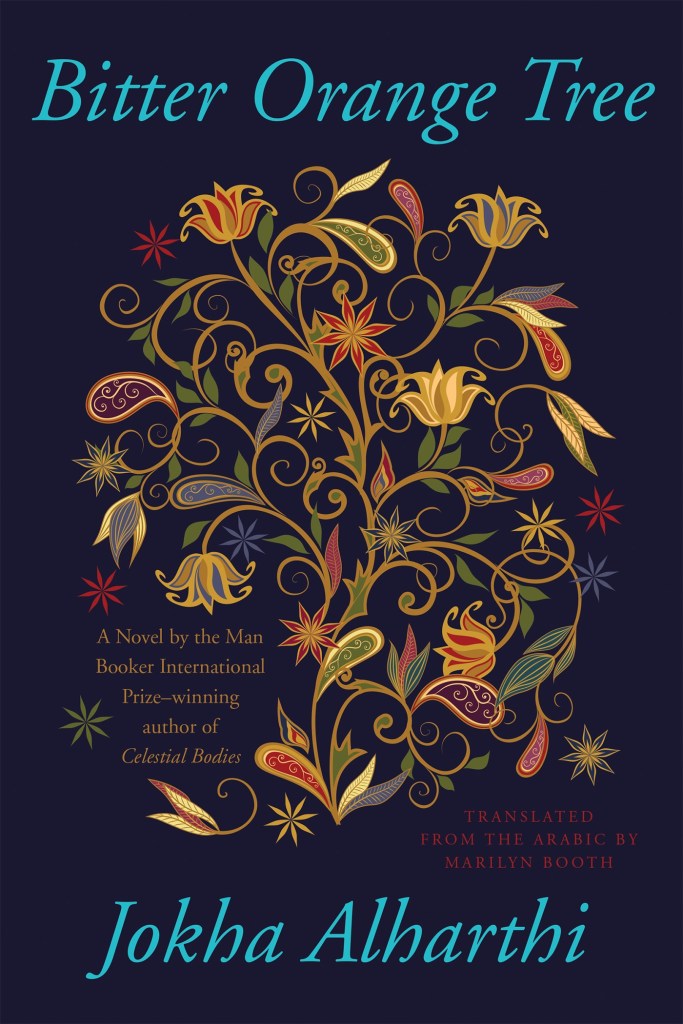
For this year’s Women in Translation Month I’m trying to focus on countries I’ve yet to visit on my Around the World in 80 Books reading challenge. This meant I was delighted to find a copy of Bitter Orange Tree by Jokha Alharthi (2016, transl. Marilyn Booth 2022) in my much-frequented local charity bookshop, as I’ve not read a book by an Omani author before.
I had completely missed Celestial Bodies for which Alharthi and Booth won the Man International Booker Prize in 2019. At that time Alharthi was the first Omani woman to be translated into English.
Bitter Orange Tree is a short novel, just 214 pages in my edition with quite large type, which I read entirely during a train journey back from Newcastle. (In fact, everyone around my table was reading a print book – it was like the olden days! For balance, I should say on the journey up I was sat next to someone who spent the whole time scrolling through TikTok and Insta, never watching any of the short content through to the end. I found it exhausting and had to mind my own business in the end 😀 )
The story is told from the point of view of Zuhour, a young woman who has left Oman to study in a nameless, cold, foreign city (most likely Edinburgh). She balances descriptions of her current life where a friend’s sister has fallen in love with a man her family wouldn’t approve of, with memories of Oman and particularly her grandmother-figure, Bint Aamir.
Zuhour harbours guilt regarding not staying with her grandmother, who has now died. A comment to a friend is the starting point for memories and reflections on Bint Aamir’s life:
“She always longed to own some land… just a tiny patch, with date palms growing on it, even if there was only space for five or so. And a few little fruit trees – lemon, papaya, banana, bitter orange. She would even plant those herself. She would water them and take care of them. And eat from them. And rest in their shade.”
Bint Aamir’s life is not easy, expelled along with her brother from her father’s house, she struggles for money. Gradually she finds a role in a relative’s home and while owning nothing, she provides almost everything.
“Bint Aamir’s feet were submerged in the soil that was the ground of our lives. She built the walls that made this household exist and thrive, mud brick by mud brick.”
Zuhour’s past and present conflate frequently, and I thought Alharthi conveyed so effectively the way memories underpin and inform the present. The conflation and the movement back and forwards between different times was seamless and never confusing.
“Tears run from my eyes, from both my eyes, from my two sound eyes. My tears spill over her one eye, which is damaged; over the herbal concoctions that were prescribed by ignorance; over the violence and harshness of childhood; over children orphaned by their mothers deaths and thrown out by their fathers, and over their brothers tragic ends; over a field she did not possess; over a companion she was never fortunate enough to have; over son who is not hers; over the grandchildren of a friend who died before she did.”
There’s also some humour, and I particularly liked this description of Zuhour’s friend Christine:
“Her cup of decaf coffee with soy milk was tall and skinny: it looked just like her. Here at this party, she was an exact scan of the figure I always saw at the university: T-shirt jeans running shoes ponytail nose ring tattoo long skinny cup.”
There were aspects of the story that were less successful for me though. Alongside the friends’ illicit relationship that Zahour has complex, unresolved feelings about, there is also a story of domestic violence involving her sister Sumayya. Both these sub-plots were too shallowly explored, before they petered-out. I felt that either Bitter Orange Tree needed to be longer, or one of these sub-plots needed to be cut and the other further developed.
While I liked the imaginative style, sometimes it became overly sentimental, particularly with regard to Bint Aamir. Although Zahour acknowledges “All her contentment was drawn from the happiness of the people for whom she cared.” she sometimes goes on flights of fancy regarding what her grandmother didn’t have in life, without knowing how her grandmother felt. These seemed clunky to me, although in fairness this may have been deliberate, to emphasise Zahour’s callow inexperience and inability to think beyond cliches at times.
But I only blog about books I like and I did like Bitter Orange Tree. The handling of past and present was so deft, and the style so readable. From looking online I think a lot of people preferred Celestial Bodies so I’d be keen to give that a try. If you’ve read Celestial Bodies I’d love to hear how you found it.
I’m always a bit trepidatious about agreeing to blog tours, which is why I don’t do many. What if I don’t enjoy the book? I only blog about books I like so what if I have to drop out? Thankfully Corylus Books have never done me wrong, consistently offering excellent crime novels in translation.
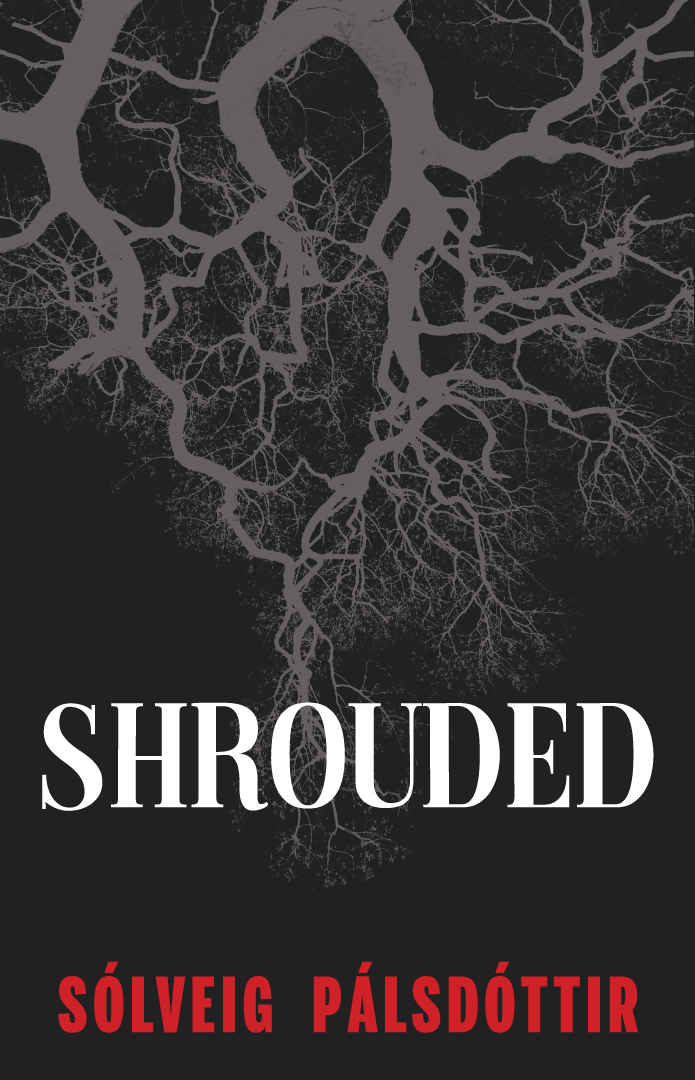
When they suggested Shrouded by Sólveig Pálsdóttir (2023, transl. Quentin Bates 2023), I had two questions: did it matter that I hadn’t read the others in the series? Was it gory (I can’t do gore)? Reassured on both counts, I’m so glad I took the opportunity to join in because I found much to enjoy in this novel.
My allotted date for the tour was 1 August so this is also my first post for Women in Translation Month (#WITMonth), a wonderful and well-established event running for the whole of August.
“A retired, reclusive woman is found on a bitter winter morning, clubbed to death in Reykjavik’s old graveyard. DetectivesGuðgeir and Elsa Guðrún face one of their toughest cases yet, as they try to piece together the details of Arnhildur’s austere life in her Red House in the oldest part of the city.
Why was this solitary, private woman attending séances, and why was she determined to keep her severe financial difficulties so secret? Could the truth be buried deep in her past and a long history of family enmity, or could there be something more? Now a stranger keeps a watchful eye on the graveyard and Arnhildur’s house.
With the detectives running out of leads, could the Medium, blessed and cursed with uncanny abilities, shed any light on Arnhildur’s lonely death?”
The story opens with Arnhildur preparing to go to a séance. We are privy to her thoughts, her frustrations and her little vanities. In a very short space, Pálsdóttir creates a sense of Arnhildur so that when she is murdered, the injustice is fully realised. Although the reader is witness to the murder, it isn’t remotely gory or gratuitous. It’s a responsible and carefully balanced portrait which insists that the murder of an older woman, someone seemingly entirely ordinary, is taken seriously.
Having not read the rest of the series, when police detectives Guðgeir and Elsa Guðrún arrive to investigate I was expecting some clunky exposition to bring readers up to speed. This never happened, and instead we are presented with an established working relationship, respectful and gently teasing, in which we are expected to draw our own conclusions regarding the personalities of the individuals and the dynamic between them.
“‘It’s never this dark in Akureyri,’ Elsa Guðrún assured him, a tie between her teeth as she pulled her brown hair back into a ponytail.
‘Really?’ Guðgeir grinned. This north country pride that some would describe as conceit had always amused him. ‘All the same, it’s a good way further north than Reykjavík.’
Elsa Guðrún wasn’t going to accept Guðgeir’s straightforward geographical point.”
The relationships with the wider team are well drawn, with a sense of professionals rubbing along together as best they can with some tensions and frustrations – in other words, most people’s working lives. There is humour too, and I particularly enjoyed tightly-wound senior officer Særós’ penchant for Insta-type inspiration:
“As always, the week’s aphorism hung on the wall behind her, a print out with black letters on white in a simple IKEA frame. This week it said, Always be the best possible version of yourself.”
Arnhildur was resistant to change and technology, which means no mobiles with sophisticated GPS, laptops or tablets of hers are available to aid the investigation. This made for a police procedural that felt pleasingly traditional while still rooted in the modern world.
One shortcut that might have been available was the presence of Valthór, a medium. I know some readers whose hearts sink at the presence of a psychic in detective stories, but Pálsdóttir never uses the character as an easy way to resolve any plot, despite one of her detectives being open to the possibility of Valthór’s skills:
“Growing up in the west of Iceland, he had been aware that most older people had some belief inan afterlife, and that there were a few people with the ability to converse with the dead. Many of them also believed in premonitions, dreams and prophecies. The people with whom Guðgeir had grown up had fought for their existence, in close touch with the brutal forces of nature that regularly demanded people’s lives. These people had been more down-to-earth than any Guðgeir knew today, and he was still convinced that there was much about the world that could be neither felt nor seen.”
Valthór is a really affecting character, truly suffering in the aftermath of Arnhildur’s death and he enables a continued emotional resonance within the story as Guðgeir and Elsa Guðrún pragmatically and doggedly work to solve the crime.
They discover aspects of Arnhildur’s past that led to her estrangement from her family, and truly disturbing events touching her life before she died. There are a couple of very sinister characters that are deeply unnerving in their believability.
Shrouded is a quick pacy read that I whizzed through on a train journey to Liverpool. Initially I was smugly congratulating myself that I’d guessed certain elements and I was somewhat surprised that a novel which seemed so accomplished had resolved things rather straightforwardly. However, I was far too quick to pat myself on the back 😀 I’d made all the assumptions and deductions Pálsdóttir had guided the reader towards, and I’d missed others entirely, which meant the very end made for a surprising and really satisfying conclusion.
Shrouded is responsible in its treatment of the victim, it’s never sensationalist. It has plenty to say about how people who don’t easily fit in are treated. It demonstrates the complexities of relationships between flawed people (ie all of us) without having characters behave in ridiculous ways.
I realise I’m making it sound dull when it really isn’t! It makes important points without losing sight of the story. I really enjoyed Shrouded and now I need to read the preceding novels in the series; my TBR is never going down, is it…?
Here are the rest of the stops on the blog tour so do check out how other readers found Shrouded:
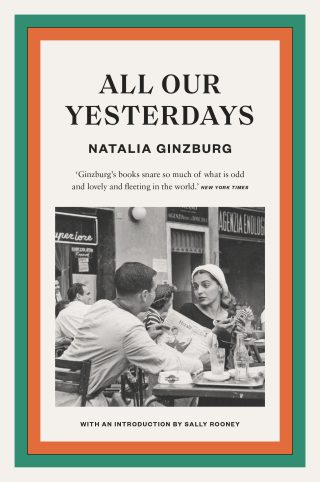
Daunt Books are such an interesting publisher and I was keen to read Natalia Ginzburg having heard wonderful things in the blogosphere, so I swooped on All Our Yesterdays (1952, transl. Angus Davidson 1956) when it turned up in my local charity bookshop. I think I’d read somewhere that this wasn’t the best place to start with this author, but I absolutely loved it.
The novel follows two families living in a northern Italian town from the 1930s, through the war years to peacetime. Although the blurb on the French flaps of my edition suggests Anna, the daughter of the poorer family, is the protagonist, really Ginzburg follows them all to a greater or lesser extent, with no overarching plot other than the sequence of years.
Although this approach sounds like a shortcoming, it works so well. It’s not a documentary novel but it gestures towards this with an omniscient neutral(ish) viewpoint and only reported speech. This felt unusual to read, but is so clever in capturing the everyday experiences of those living through extraordinary circumstances.
Anna’s siblings are Concettina, Ippolito, and Giustino. Concettina is popular with boys but struggles to find a purpose in life; Ippolito channels his energies into anti-Fascist activities with his friend from the richer family across the road:
“Emanuele and Ippolito did not even know Italy, they had never seen anything except their own little town, and they imagined the whole of Italy to be like their own little town, an Italy of teachers and accountants with a few workmen thrown in, but even the workmen and the accountants became rather like teachers in their imagination.”
Their lives are equally dictated by world events and by commonplace ones. Anna falls pregnant by her boyfriend and marries an eccentric older man, Cenzo Rena, moving with him to the southern village of Borgo San Costanzo. Her affair with her self-involved, callow boyfriend was no great passion, and while her marriage to Cenzo Rena attracts approbation, he is a warmer, more generous man than the one her own age.
“She was alone with Giuma’s face that gave her a stab of pain in her heart, and every day she would be going back with Giuma amongst the bushes on the river bank, every day she would see again that face with the rumpled forelock and the tightly closed eyelids, that face that had lost all trace both of words and of thoughts of her.”
These are people destined to be on the outskirts of war. Cenzo Rena holds a lot of sway in his local area and does help Jewish people fleeing the Nazi occupation, but on the whole the story of All Our Yesterdays is not one involving soldiers or revolutionaries. It is about ordinary people and for them the conflicts of war are reported facts not lived experience. The latter for them includes a lot of mundanity:
“And the bread in town was rationed and was a kind of soft, grey dough that you couldn’t ever digest, the bread was like the soap and the soap was like the bread, both washing and eating had become very difficult.”
Yet this doesn’t mean the story isn’t affecting, or that the characters avoid tragedy. There are some truly tragic events that are hugely affecting. Ginzburg manages to be even-handed in her treatment of her characters but not detached. Her writing is warm but unsentimental as she demonstrates that flawed people are as worthy of love and mourning as idealised ones.
In case I’ve made it sound unremittingly serious, I should mention that there humour in All Our Yesterdays too. There are romantic entanglements that are treated with a degree of levity, and eccentric housekeepers/family retainers with various foibles. All life is here.
I can’t think of another writer who approaches Ginzburg’s style, and looking back on it I can’t explain how she does what she does. This was a story that snuck up on me, the deceptively simple storytelling drawing me in more than I realised until I was totally immersed. An extraordinary novel.
“Fanfares of trumpets usually announced only small, futile things, it was away fate had of teasing people. You felt a great exultation and heard a loud fanfare of trumpets in the sky. But the serious things of life, on the contrary, took you by surprise, they spurted up all of a sudden like water.”
To end, of course there’s a very famous song I could post on the theme of Yesterday, but instead, to continue the mix of despair alongside levity: have you seen a parrot singing Creep by Radiohead?
Life has caused me to fall behind on blog writing, so unusually I’m writing this a few weeks after having read the book. Thankfully I found this one really stayed with me and I can get it in just in time for the last week of Women in Translation Month 😊
Having really enjoyed Mieko Kawakami’s Miss Ice Sandwich (2013) during my novella reading in May, I was delighted to find a copy of All the Lovers in the Night (2011, transl. Sam Bett and David Boyd 2022) in my local charity bookshop. It’s very different to my previous read of hers, and while I didn’t enjoy it as immediately as Ms Ice Sandwich, it did grow on me.
Fuyuko Irie is in her thirties and lives alone. She used to work in an office but her alienation from her colleagues means she prefers working at home. Her colleague/friend Hijiri is supportive of her talents and sends her regular work as a freelance proofreader, this work suiting her precise and solitary nature.
But this means that Fuyuko is even more isolated and achingly lonely. Kawakami is so good at capturing that modern urban alienation for people living surrounded by others but unable to connect, the feelings compounded when in the midst of a crowd.
“As I passed below the haloes of green and red traffic signals, I was taken by this strange view of the evening, the city streets full of people – people waiting, the people they were waiting for, people out to eat together, people going somewhere together, people heading home together. I allowed my thoughts to settle on the brightness filling their hearts and lungs, squinting as I walked along and counted all the players of this game that I would never play.”
It looks like things could change for Fuyuko when she meets Mitsutsuka, a physics teacher. Light is important to Fuyuko – every Christmas Eve (her birthday) she walks the streets at night looking at the illuminations. As Mitsutsuka explains the workings of light to her, they begin a tentative friendship, with brief points of connection offering glimmers of hope:
“‘Um, do you think the light you’re thinking about and the light I’m talking about are, um, the same thing?’
‘Of course they are, Mitsutsuka said with a smile. ‘We’re talking about the same light.’”
In a flashback chapter we learn more about Fuyuko’s background, and why she finds herself in the situation she does. There is an event in the past that Fuyuko describes without naming it in the way that I think most readers would, suggesting she doesn’t fully recognize her trauma or why she is making subsequent self-destructive decisions.
Kawakami subtly demonstrates how Fuyuko could change things for herself, but also how wider society makes this extremely difficult for her. She and Hijiri are women who have made very different choices and present themselves very differently to the world, but both struggle under the expectations placed on women and the fact that these are not an easy fit for either of them. A brief meeting with old school friend Noriko suggests traditional choices are not always happy ones either.
“I’d been on my own for ages, and I was convinced that there was no way I could be any more alone, but now I’d finally realised how alone I truly was. Despite the crowds of people, and all the different places, and a limitless supply of sounds and colours packed together, there was nothing here that I could reach out and touch. Nothing that would call my name. There never had been, and there never would be. And that would never change, no matter where I went in the world.”
All the Lovers in the Night is a slow burn novel, despite being only just longer than novella length. As I mentioned at the start, it was a story that grew on me and I found Fuyuko’s voice more compelling the more I read. A few weeks on and she’s really stayed with me.
Despite the sadness and alienation running through All the Lovers in the Night, I thought it ended with a suggestion of hope. That incrementally things can change, and improve. That imperfect people can make poor decisions but might still be moving towards a brighter time while doing so.
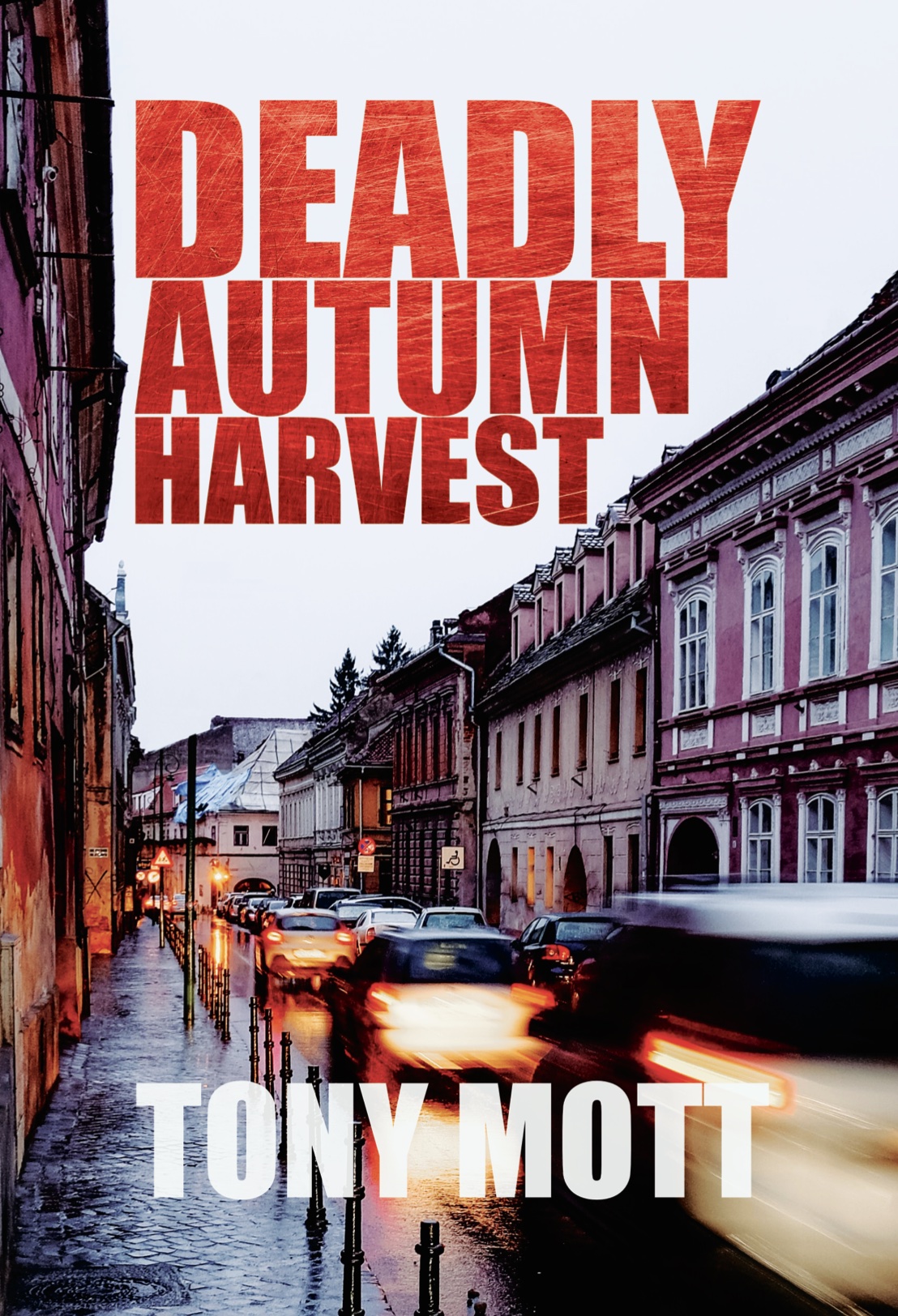
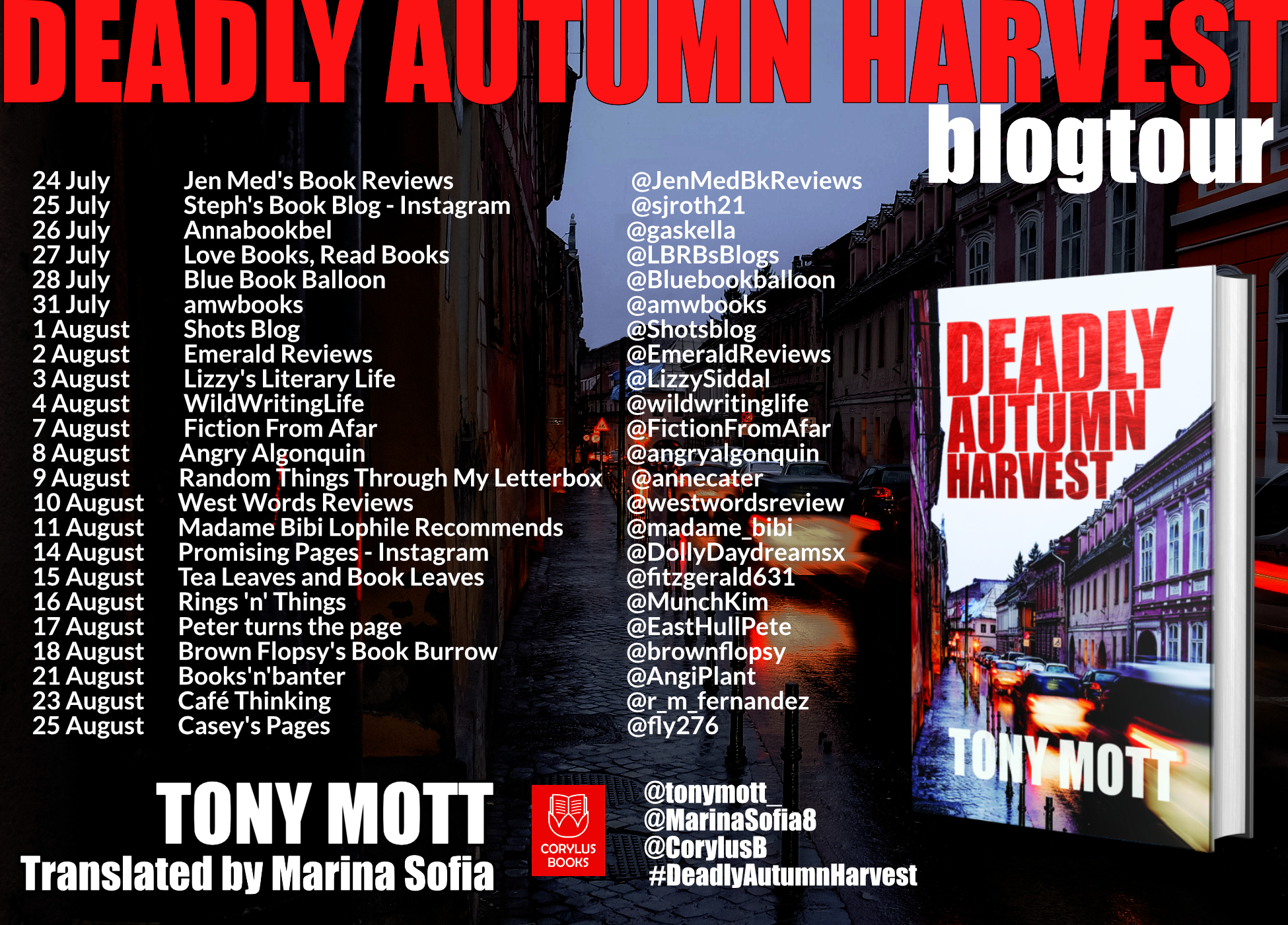
When I took part in a blog tour for Corylus Books earlier in the year, it was for a novella, which helpfully chimed with my Novella a Day in May reading. The bookish stars have aligned again for my taking part in a Corylus Books blog tour, as Deadly Autumn Harvest (2020) by Romanian author Tony Mott fits perfectly with my plans for #WITMonth reading, translated as it is by lovely blogger Marina Sofia (2023).
Here is the blurb from Corylus Books:
“A series of bizarre murders rocks the beautiful Carpathian town of Braşov. At first there’s nothing obvious that links what look like random killings. With the police still smarting from the scandal of having failed to act in a previous case of a serial kidnapper and killer, they bring in forensic pathologist Gigi Alexa to figure out if several murderers are at work – or if they have another serial killer on their hands. Ambitious, tough, and not one to suffer fools gladly, Gigi fights to be taken seriously in a society that maintains old-fashioned attitudes to the roles of women. She and the police team struggle to establish a pattern, especially when resources are diverted to investigating a possible terrorist plot. With the clock ticking, Gigi stumbles across what looks to be a far-fetched theory – just as she realises that she could be on the murderer’s to-kill list.”
I don’t read much contemporary crime because I don’t want to read about women being killed in various gruesome ways. I’m relieved to say I thought Deadly Autumn Harvest got the balance right between giving enough detail so that the horrors were realised, but with nothing being gratuitous. There was a responsibility in how the victims were portrayed, so you got a sense of them as people and the injustice in how their lives ended.
Forensic pathologist Gigi Alexa is an intriguing figure too. Cascading curly blonde hair and resolutely dressed in bright colours, I thought she was an idiosyncratic and believable investigator, good at her job and super-committed, yet not entirely detached:
“Usually, by the time she got to see the bodies, they had been drained of any semblance of life or a back story, they were mere puzzles to be solved. But today it had all been a little too close for comfort.”
She’s also a scientist who is not above a bit of superstition:
“Three bad omens. She counted them. First, she stumbled over her slippers as she got out of bed, so she went to the bathroom in her bare feet. Then she stepped into the sand that Morty had scattered from his litter tray. Thirdly, once she got into the kitchen, her coffee machine refused to get going so she would have to boil up Greek coffee instead. Three signs of bad luck on a Tuesday – no doubt more would follow.”
As Gigi and her team investigate the murders, she has to contend with various frustrations in the male-dominated environment. She’s not surrounded by idiots though. I liked her relationship with her boss CI Matei, and Emil, her colleague in pathology. There was also some humour (alongside remembrance of previous toxicity) in the reappearance of her impeccably turned-out ex, Superintendent Vlad Tomescu. (Slight spoiler, skip the next sentence and quote if you don’t want to know!) Gigi becomes single during the novel and her sardonic reflections on this state also lightened the tone:
“She didn’t miss him at all. It would be a while yet before she started missing the warmth of someone to curl up with in bed. Maybe during the winter. Except maybe by then she would have invested in an electric blanket.”
The mystery is very well-paced and the novel isn’t overlong at just 225 pages. We are there at the moment of the killings at various points, before we are returned Gigi and her team’s investigation. Although I’d be amazed if anyone guesses the connection before Gigi, we’re given a fair chance to guess the perpetrator. I’d like to proclaim I worked out who did it, but I suspected absolutely everyone at some point 😀
Deadly Autumn Harvest is a quick, compelling read with a truly chilling murderer pursued by a team of believable, well-rounded investigators.
Finally I should just say that Deadly Autumn Harvest definitely made me want to visit Braşov! I’ve never been, it sounds absolutely beautiful and with Gigi and her team on the case there won’t be any serial killers left to spoil my holiday – perfect.
Here are the stops from the rest of the tour, so do check out how other bloggers got on with Deadly Autumn Harvest:
After getting off to a pretty good start with my Women in Translation Month reading, I stalled badly with my final post. Although I read these two novels during August, writing about them in time for WIT Month 2021 (hosted by Meytal at Biblio) proved an insurmountable task. I still hope one day to get my blogging back on track but clearly August 2021 was not where this miracle was going to occur!
So here we are in September and I’m revisting two authors I’ve enjoyed in the past. When I decided to write on them initially I didn’t consider any connected themes, but there are some: ideas of home, otherness, what it means to live among a community, unlikely friendships, coming to terms with aging.
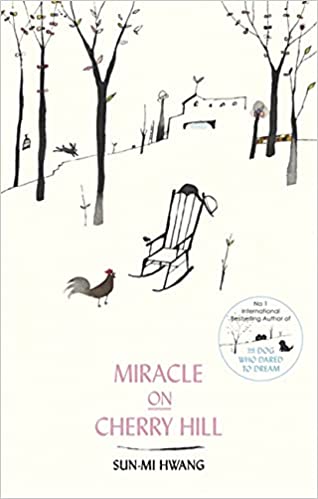
Firstly, Miracle on Cherry Hill by Sun-Mi Hwang (2019, trans. Chi-Young Kim 2019). I enjoyed the simplicity of The Hen Who Dreamed She Could Fly and found it very moving, so I was looking forward to this. I also thought – rightly – that it shouldn’t be too traumatic, given I’m a delicate flower at the moment. Like The Hen… this is a quick read with no great surprises, but that’s not a criticism, as it still offers a rich story with fully realised characters.
Miracle on Cherry Hill sees successful business leader Kang Dae-su move back to his childhood home town having been diagnosed with a brain tumour (named Sir Lump). He plans to hole up in a huge, fenced-off house, away from any company to see out his days.
“Cherry Hill was an outdated name. New apartment buildings had uprooted nearly every last cherry tree around it, like insects gnawing through greenery. Only one old original house remained in this neighbourhood, near the bus stop, because the woods surrounded it and the owner was stubborn. He also owned all the land surrounding the house, At least, that’s what they said – nobody had ever laid eyes on the owner.”
Things don’t go quite according to Kang’s plan. For a start, the townspeople have used his property while he has been absent. The children play hide-and-seek in the grounds, an elderly woman with dementia grows vegetables, her granddaughter Yuri exercises her puppy and collects hens eggs.
“How dare Sir Lump pity him? He heard something coasting along with the wind, something like humming. Kang remained on his back. If he concerned himself with every singing animal or person who was evidently trespassing on his property the tumour would swell and burst from sheer irritation.”
Despite Kang’s irritation, a series of comic events demonstrate it’s better to share his garden for continued use by the town. What’s more, he even invites people in, recognising troubled youngster Sanghun would benefit from being employed to mow his lawns.
As Kang begrudgingly becomes involved in the life of the town and the people who live there, he becomes reconciled to his past, and the pain from childhood he has been holding onto begins to heal.
“Each of these new discoveries left him with a refreshing sensation, as if a cold drop of water was falling into the depths of his heart. These feelings had to be carefully swallowed down.”
Miracle on Cherry Hill is a sweet tale, but not sentimental as it tackles some difficult issues. It’s fabulistic but also recognisably real. It’s poignant and playful, and as someone who loves a redemption story I found it charming.
Secondly, Drive Your Plow Over the Bones of the Dead by Olga Tokarczuk (2009 trans. Antonia Lloyd-Jones 2018) which was a highly anticipated read for me, having loved Flights. For some reason I didn’t count that read on my Around the World in 80 Books Reading Challenge, so Drive Your Plow… has formed my Poland visit.
This is a very different reading experience to Flights, which was fragmentary and mixed different genres. In contrast, Drive Your Plow… is more linear and plot-driven. However, it is still a complex novel that resists easy categorisation. I really loved it.
Janina Duszejko is a middle-aged woman with mysterious ailments, who hates her name and lives alone in a remote part of Poland:
“All you can see on the map is a road and a few houses. It’s always windy here, as waves of air come pouring across the mountains from west to east from the Czech Republic. In winter the wind becomes violent and shrill, howling in the chimneys. In summer it scatters amongst the leaves and rustles – it’s never quiet here.”
This harsh and isolated landscape suits Janina, as she is viewed as eccentric and regards people warily. When she engages in company, it is in her own way:
“What a lack of imagination it is to have official first names and surnames. No one ever remembers them, they’re so divorced from the Person, and so banal they don’t remind us of them at all…That’s why I try my best never to use first names or surnames, but prefer epithets that come to mind of their own accord the first time I see the Person.”
Janina is a fan of Blake and this is reflected not only in the title of he novel and the epigraphs, but also her Fondness for Capitalising for Emphasis, which I thought a nice touch and added to the sense of her unique voice.
At the start of the novel, Janina is disturbed by her neighbour Oddball, who asks her to come with him to check on another neighbour, Big Foot. He is dead, having choked on a bone. Janina doesn’t grieve for him as he was part of the local hunting club, and she much prefers animals to humans. Sadly her “Little Girls” – her two dogs – have disappeared.
As other members of the hunting club die – all local powerful men, all seemingly pretty unpleasant – Janina shares her theory with the police that animals are taking their revenge for the cruelties enacted upon them. This theory is supported by her astrological studies, and is completely ignored by the authorities:
“Once we have reached a certain age, it’s hard to be reconciled to the fact that people are always going to be impatient with us.”
The mystery of the deaths of the men isn’t the heart of the novel though. Although the blurb on mine describes it as ‘an existential thriller’ I wouldn’t even go that far. For me the driving force of the story is the character of Janina and how she exposes attitudes to women, to aging; the power of the patriarchy, of money; and the disregard of anyone who is inconvenient to conventional society. She does this simply by existing and narrating how people respond to her.
I should warn readers here that the novel does describe cruelty to animals. Because Janina is appalled by it, the scenes are never dwelt on, but they are important to the story. This can make it a tough read but that is precisely the point – to question the horrors of how animals are treated. Drive Your Plow… was adapted into a film called Spoor in 2017 and I was going to end with the trailer, but even then there are some pretty grim scenes so I opted not to.
Drive Your Plow… raises important, complex themes through the voice of a truly memorable narrator. There is a dry humour running through the novel, but it also doesn’t pull its punches. The landscape is beautifully evoked and the characterisation compassionate. It will stay with me for a long time.
“As I gazed at the black and white landscape of the Plateau, I realised that sorrow is an important word for defining the world. It lies at the foundations of everything, it is the fifth element, the quintessence.”
After a somewhat harrowing start to my WITMonth reading, this week I have two novels from Pushkin Press which I found much easier-going. That’s not to say they are the lightest of reads though, as they deal with serious themes: trying to carve a space as a female artist in a patriarchal society, and bereavement.
Firstly, Miss Iceland by Auður Ava Ólafsdóttir (2018, trans. Brian FitzGibbon 2019). Set in the 1960s, Hekla is young woman named after a volcano, who leaves her remote town to move to Reykjavík in the hope of realising her dream of becoming a writer.
The story begins with her coach journey to the city as she attempts to read Ulysses in its original language (quite an undertaking even when it’s written in your first language):
“How many pages would it take to overtake the tractor if James Joyce were a passenger on the road to Reykjavík?”
This witty and serious woman also has to fend off the attentions of an older man who says he can get a place in the Miss Iceland contest:
“We’re looking for unattached maidens, sublimely endowed with both clean-limbedness and comeliness”
Bleugh. Hekla is not remotely interested. She goes to stay with her schoolfriend Ísey who is married and has started a family, a situation about which she seems conflicted:
“I didn’t know it would be so wonderful to be a mother. Having a baby has been the best experience of my life. I’m so happy. There’s nothing missing in my life. Your letters have kept me alive. I’m so lonely. Sometimes I feel like I’m a terrible mother.”
Ísey wanted to write too and her sections have a lovely phrasing and style. There’s no doubt she has talent but her choices have been made and at this moment in time they preclude writing. Hekla is much more single-minded, but she may struggle to get her voice heard as much as Ísey, because their society does not favour independent-minded female writers.
To pay the bills Hekla takes a job as a waitress at the Hotel Borg. The more experienced staff tell her tales of female staff getting fired because of the attention of male customers, and which stores have backdoor exits she can use to escape if she is followed.
Ólafsdóttir effectively demonstrates how the patriarchy supresses men too. Hekla’s best friend is Jón John, who is gay and sees his prospects for a happy life as being fairly hopeless. He is used by men for sex before they return home to their wives, and while he wants to be a costume designer the lack of opportunity means he fishes on trawlers:
“The most handsome boy in Dalir told me he that he loved boys.
We kept each other’s secrets.
We were equals.”
Miss Iceland isn’t a bleak tale because Hekla is so resilient, and I’ve probably made it sound much sadder than it is. Jón John is a very forlorn character who really moved me, but Hekla is pragmatic to the point of detachment. She is entirely honest with her boyfriend, failed poet Starkadur (a reference to Cold Comfort Farm?) that her interest in him is purely physical. In this way she reminded me of another fictional artist, Margery Sharp’s Martha.
Despite Miss Iceland being told from Hekla’s point of view, in some ways I finished it in a similar position to Starkadur, feeling quite distant from her as a character. Ísey and Jón John are much more engaging. However, I think that is clever writing on the part of Ólafsdóttir rather than a flaw in the novel. Hekla is a writer, she has that slight detachment when she is with people of only wanting to get back to her typewriter.
“In my dream world the most important things would be: a sheet of paper, fountain pen and a male body. When we’ve finished making love, he’s welcome to ask if he can refill the fountain pen with ink for me.”
Miss Iceland ends with a two major pragmatic decisions about how to navigate a society which will not allow free expression of who you are. It’s not optimistic but nor is it defeatist. It is frustrating though, which I think was exactly the point.
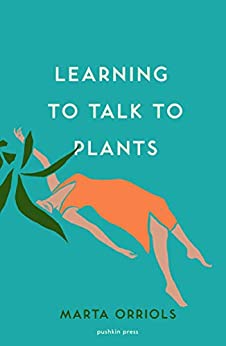
Secondly, Learning to Talk to Plants by Catalan writer Marta Orriols (2018, trans. Mara Faye Lethem 2020). I spend a lot of my working life talking about and dealing with grief, and I thought this was an excellent exploration of one woman’s first year grieving for her partner.
Paula Cid is a neonatologist who loves her job. Her partner Mauro has been killed in road traffic collision.
“I often think and speak of Mauro using the adverbs before and after, to avoid past tense.”
What no-one knows is that Paula and Mauro had been going through a tough time in their relationship, and the day he died he had told her he was leaving her for a younger woman.
“You liked to buy me shoes. I never told you but I wasn’t crazy about the ones you chose for me….They were shoes for a woman who didn’t have my feet, or my style that wasn’t really a style. They were shoes for a woman who wasn’t me.”
Paula was such a well-realised character, I really liked her and I really liked the fact that she didn’t always behave well, even though she was a fundamentally decent person. She throws herself into her work, which is not entirely commendable despite how vital her work is. She is a bit of a pain to her colleagues. She is not always easy with her father and her friends. She resents any suggestion that her grief is similar to anyone else’s:
“My pain is mine and the only possible unit for measuring or calibrating it is the intimacy of everything that compromised the how. How I loved him, how he loved me. How we were, uniquely, no longer us and, therefore, how I could uniquely grieve him.”
Reasonable, I think.
What I also liked is how Learning to Talk to Plants didn’t skirt round the issue of sex. Paula is in early middle-age, she is not ready to renounce her sex life, even though society thinks it an unseemly way for a grieving woman to behave:
“Pleasure that appears just four weeks after losing your partner forever feels too bold”
However, Learning to Talk to Plants is not about Paula’s relationship with men, or even with Mauro. It is about her relationship with herself, about taking the time to nuture herself, and rediscovering hope, however abstract:
“You said talking to plants was a private, transformative act, an act of faith for those who don’t believe in miracles. I get up, take a breath, and add to my list: Learn to talk to plants.”
Learning to Talk to Plants skilfully avoids cliché, mawkishness or sentimentality. I did feel sorry for those plants though…
To end, one of the younger members of my family has been channelling Axl Rose in her attire this week, despite having no idea who he is (probably for the best). Here is the Postmodern Jukebox version of Sweet Child O’Mine:






 madame bibi lophile recommends