Life has caused me to fall behind on blog writing, so unusually I’m writing this a few weeks after having read the book. Thankfully I found this one really stayed with me and I can get it in just in time for the last week of Women in Translation Month 😊

Having really enjoyed Mieko Kawakami’s Miss Ice Sandwich (2013) during my novella reading in May, I was delighted to find a copy of All the Lovers in the Night (2011, transl. Sam Bett and David Boyd 2022) in my local charity bookshop. It’s very different to my previous read of hers, and while I didn’t enjoy it as immediately as Ms Ice Sandwich, it did grow on me.
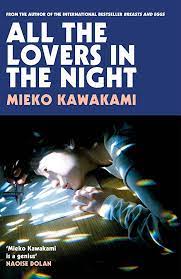
Fuyuko Irie is in her thirties and lives alone. She used to work in an office but her alienation from her colleagues means she prefers working at home. Her colleague/friend Hijiri is supportive of her talents and sends her regular work as a freelance proofreader, this work suiting her precise and solitary nature.
But this means that Fuyuko is even more isolated and achingly lonely. Kawakami is so good at capturing that modern urban alienation for people living surrounded by others but unable to connect, the feelings compounded when in the midst of a crowd.
“As I passed below the haloes of green and red traffic signals, I was taken by this strange view of the evening, the city streets full of people – people waiting, the people they were waiting for, people out to eat together, people going somewhere together, people heading home together. I allowed my thoughts to settle on the brightness filling their hearts and lungs, squinting as I walked along and counted all the players of this game that I would never play.”
It looks like things could change for Fuyuko when she meets Mitsutsuka, a physics teacher. Light is important to Fuyuko – every Christmas Eve (her birthday) she walks the streets at night looking at the illuminations. As Mitsutsuka explains the workings of light to her, they begin a tentative friendship, with brief points of connection offering glimmers of hope:
“‘Um, do you think the light you’re thinking about and the light I’m talking about are, um, the same thing?’
‘Of course they are, Mitsutsuka said with a smile. ‘We’re talking about the same light.’”
In a flashback chapter we learn more about Fuyuko’s background, and why she finds herself in the situation she does. There is an event in the past that Fuyuko describes without naming it in the way that I think most readers would, suggesting she doesn’t fully recognize her trauma or why she is making subsequent self-destructive decisions.
Kawakami subtly demonstrates how Fuyuko could change things for herself, but also how wider society makes this extremely difficult for her. She and Hijiri are women who have made very different choices and present themselves very differently to the world, but both struggle under the expectations placed on women and the fact that these are not an easy fit for either of them. A brief meeting with old school friend Noriko suggests traditional choices are not always happy ones either.
“I’d been on my own for ages, and I was convinced that there was no way I could be any more alone, but now I’d finally realised how alone I truly was. Despite the crowds of people, and all the different places, and a limitless supply of sounds and colours packed together, there was nothing here that I could reach out and touch. Nothing that would call my name. There never had been, and there never would be. And that would never change, no matter where I went in the world.”
All the Lovers in the Night is a slow burn novel, despite being only just longer than novella length. As I mentioned at the start, it was a story that grew on me and I found Fuyuko’s voice more compelling the more I read. A few weeks on and she’s really stayed with me.
Despite the sadness and alienation running through All the Lovers in the Night, I thought it ended with a suggestion of hope. That incrementally things can change, and improve. That imperfect people can make poor decisions but might still be moving towards a brighter time while doing so.
To end, any excuse for the wonderful Patti Smith:
 madame bibi lophile recommends
Life. It’s so annoying when it gets in the way!
I hope things settle down for you 🙂
LikeLiked by 1 person
Thanks Lisa! Pesky life taking away from my reading/blogging time 😁
LikeLike
I loved Ms Ice Sandwich, too, and have this one on my list. Hope life calms down for you soon.
LikeLiked by 1 person
I hope you enjoy this when you get to it Susan! I want to read Heaven and Breasts and Eggs too now.
LikeLiked by 1 person
Patti’s song absolutely made for your review (that’s how it works, right?!).
LikeLiked by 1 person
Absolutely how it works 😁
LikeLike
Excellent song choice!
LikeLiked by 1 person
Thanks Cathy!
LikeLiked by 1 person
This sounds a goody, and great to hear Patti too – thanks for making the time!
LikeLiked by 1 person
Glad you like the sound of this Jane!
LikeLiked by 1 person
Thanks for taking the time to blog; hope life is busy in a good way not in a ‘ stressful, I desperately need some reading time’ way. I like the sound of this one and I enjoyed reading the quotes and hearing the song.
LikeLiked by 1 person
Yes, not stressful thankfully, just busy! But I’m glad now to have a bit more time for reading 🙂 Glad you like the sound of this one & enjoyed Patti!
LikeLike
Sorry life is being a pig – how dare it get in the way of reading! This sounds like an interesting one, though – women are still so constrained by society’s expectations, aren’t they, particularly in some culture. And yes – any excuse for Patti is a good one!!
LikeLiked by 1 person
It is really interesting – from the two I’ve read I’d say the author is interested in women who don’t conform but she explores it in quite different ways. Hopefully life will stop interfering with my reading time soon 😀
LikeLiked by 1 person
I have a copy of this on my TBR pile and am very much looking forward to it. One of the things I find interesting about Japanese literature (especially by women) is the sense of isolation / alienation that runs through so much of it, from books written in the 20th century (e.g. Tsushima’s Territory of Light) to more contemporary ones (e.g. books by Kawakami, Yoko Ogawa and Sayaka Murata).
LikeLiked by 1 person
I think you might like this one Jacqui, it’s an interesting exploration of isolation. There isn’t a happy ending with trite answers, but there’s still a sense of hope. I thought it was a brave conclusion, and certainly a realistic one.
LikeLike
Just tell life to go away and give you peace to get on with the much more important task of reading! Not sure the book is one for me, but it’s always good to hear Patti!
LikeLiked by 1 person
Precisely FF, how dare it! Glad you enjoyed Patti 😊
LikeLiked by 1 person
I read Breasts and Eggs by Meiko Kawakami during August, and I really enjoyed it. You’re right that Kawakami is excellent at portraying urban settings and modern life. I have seen other people say Ms Ice Sandwich is a bit different to the two I have read but perhaps that might be the one I go for next, although I really like the sound of this one too.
LikeLiked by 1 person
I’m glad you like the sound of this one Ali. She’s certainly a really interesting writer. Breasts and Eggs is on my list for sure!
LikeLiked by 1 person
Life, indeed, I totally missed WIT month this year. Never mind I’m reading women in translation in October instead! Great review, an author I’ve yet to read!
LikeLiked by 1 person
Pesky life! But of course it’s great to read women in translation any time of year. So glad you like the sound of this one Claire. Jacquiwine recently posted a lovely review of it: https://jacquiwine.wordpress.com/2023/10/03/all-the-lovers-in-the-night-by-mieko-kawakami-tr-sam-bett-and-david-boyd/
LikeLiked by 1 person