Continuing my plan to focus on countries I’ve yet to visit on my Around the World in 80 Books reading challenge for this year’s Women in Translation Month, I was pleased to find an anthology of short stories from Afghanistan in my oft-visited local charity bookshop. I later found out it was the first anthology of short fiction by Afghan women translated into English.
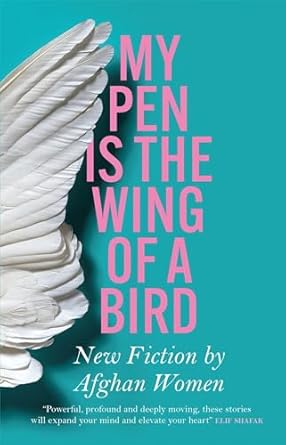
My Pen is the Wing of a Bird: New Fiction by Afghan Women (2022) brings together twenty-three stories by eighteen women (ten of whom have since left Afghanistan) as part of the UNTOLD Narratives project. The stories are translated by a variety of translators from the Pashto and Dari languages.
This will be a really short review (for me!) because if I find writing about short story collections by one author difficult, writing about an anthology by different writers is nearly impossible. So I’ll just say from the start that I found this collection powerful, evocative, moving. It was a compelling read and I’d urge anyone to get hold of a copy.
Often short story collections – even by the same author – can seem patchy but I thought this collection was remarkably consistent. The stories focus on the daily life for women and children in Afghanistan, some set in the past and evoking the country’s long history of conflict, but most with a contemporary setting. I’ll just pick out a few moments to hopefully give a sense of the collection.
There are several stories which are a tough read; domestic violence in particular features in a few. But a sense of hope and resilience pervades. In A Common Language by Fatema Haidari (transl. from Dari by Dr Zubair Popalzi), young female workers leave their hard-won jobs in support of a colleague who is sexually harassed, realistic but still hopeful about their chances of finding further employment. This is immediately followed by The Late Shift by Sharifa Pasun (transl. from Pashto by Zarghuna Kargar) where Sanga, a young working mother, continues to go to her work as a newsreader in 1985, despite the falling bombs all around her.
“Before she entered the studio, she took off her shoes and put on the special sandals that were kept in a metal cupboard. The people in charge of the studios didn’t want anyone bringing in dust that could harm the equipment […] The studios were soundproof; no sound from explosions could enter from outside.”
There are a couple of stories dedicated to those who have died. Blossom by Zainab Akhlaqi (transl. from Dari by Dr Negeen Kargar) is one, dedicated to Afghan schoolgirls and the students who died at Sayed ul-Shuhada high school on 8 May 2021. Through the story, the narrator comes to realise the importance of her friend’s question: “If a person never reads a book how can he change?” This is carefully explored and never clunky.
I don’t think it’s a spoiler as such but do skip the next bit where I talk about the ending if you wish! The final lines of the story are simple yet intensely moving:
“I put on my black school uniform and white scarf and filled my bag with notebooks. I cut a fresh branch of blossom from our garden and went to school.”
My Pillow’s Journey of Eleven Thousand, Eight Hundred and Seventy-Six kilometres by Farangis Elyassi (transl. from Dari by Dr Zubair Popalzai) is one of the few stories set somewhere other than Afghanistan and shows that leaving your home country can be an ambivalent experience. The narrator moves to a life in the United States, but struggles for the first time in her life with insomnia. She is convinced it is linked to the loss of her comfortable pillow, made for her by her mother. Slowly she realises it is more complex (again, skip the next quote to avoid spoilers):
“my sleep was bound to the warm embrace of my country, it was bound to visiting my beloved mother, it was bound to the chatter I shared with my sisters, to the friendship and silliness so I shared with my brother, to the laughter I enjoyed with my friends. My peaceful sleep was because of the small service I used to do for my country, because of my streets, because of a sense of freedom one can feel only in one’s country.”
Looking at the UNTOLD Narratives website, I can see that this month they published My Dear Kabul, a collective diary from the women who wrote My Pen is the Wing of a Bird. It sounds unmissable.


This is a very timely review given the new rules announced by the Taliban, even more draconian that existed already. Sad that so many of the writers have left their country but what else can they do. A desperate situation.
LikeLiked by 2 people
It must be so desperate to feel you have no choice but to leave your home. The story with the pillow really brought that to me – such a simple device but so effective.
LikeLiked by 2 people
Congratulations on finding such a diverse range of works for WIT Madame Bibi! This sounds as if it is a very powerful and important publication; thank you for bringing it to my attention with your excellent review. I have already reserved a copy so hope to read it for myself relatively ( I have a wobbling tbr pile!) soon.
LikeLiked by 2 people
I’m so glad you like the sound of this one! The stories detail such tough things but there’s so much hope and resilience. I really hope you like it.
LikeLiked by 1 person
I absolutely LOVED this collection and am so excited to hear about “My Dear Kabul”!! Thank you for this review.
LikeLiked by 1 person
Great to hear you loved this! My Dear Kabul sounds brilliant doesn’t it? I’m excited to read it.
LikeLiked by 1 person
These sound emotionally wrenching too. The only book I’ve read set in Afghanistan is the second of Khaled Hosseni’s books which was a heavy one too. Must look up a copy of these as the women’s voces first hand aren’t so easy to come by.
LikeLiked by 2 people
Yes absolutely, I was really surprised this was first anthology to be translated into English. Untold Narratives seems to be a great project. I hope you can find a copy.
LikeLike
I remember seeing some reviews of this when it came out and thinking it sounded profoundly affecting – a view only confirmed by your thoughtful review. I’d have to be in the right frame of mood for something like this, but it does seem to be an excellent collection. A great way of sampling lots of different authors, too!
LikeLiked by 1 person
Yes, definitely one for a robust mood, although there’s so much hope and resilience in the pages too. It really is an excellent collection.
LikeLike
This sounds like a remarkable collection. A particularly good choice for #witmonth as it brings together more than one language in translation. These stories are so relevant to our times and it’s good to see them being published.
LikeLiked by 1 person
It is so good to see them being published, absolutely. The Untold Narratives seems a great project.
LikeLike
I was hoping you would write about the collection of Afghan writing you’d mentioned in a comment on BIP and here it is. I’m off to check the library!
LikeLiked by 1 person
Hooray! Hope you find a copy.
LikeLike