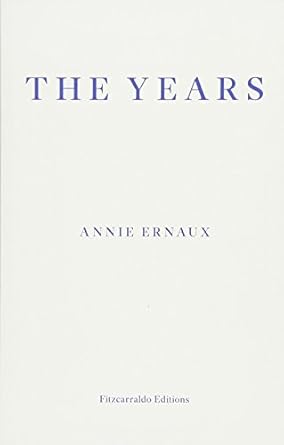
#ReadIndies is running all month hosted by Kaggsy and Lizzy and it has meant I’ve finally got to a book that I’ve been meaning to read for ages: The Years by Annie Ernaux (2008, transl. Alison L. Strayer 2018) published by Fitzcarraldo Editions.
A further incentive was that I really want to see the theatre adaptation which is currently running, and now I’ve read the book I have bought my ticket 😊
The Years is a book which deliberately avoids categorisation. Told in chronological order from 1941 to 2006 but in a fragmentary style, it is a memoir/autobiography/autofiction where Ernaux never uses the first person. She refers to ‘she’ for the more personal memories triggered by photographic images, and ‘we’ for considerations of the society and cultural influences experienced by ‘she’ at the time.
Growing up, she is aware of the poverty of her family, and dreams of escape. Ernaux captures so well the confusion of trying to find an authentic escape, trying to determine what she truly wants, alongside what advertising tells her she wants:
“Meanwhile, as we waited to be old enough to wear Rouge Baiser lipstick and perfume by Bourjois with a j as in joy, we collected plastic animals hidden in bags of coffee, and from Menier chocolate wrappers, Fables of La Fontaine stamps that we swapped with friends at break time.”
“It seems to her that education is more than just a way to escape poverty. It is a weapon of choice against stagnation in a kind of feminine condition that arouses her pity, the tendency to lose oneself in a man.”
There are strong feminist themes running throughout The Years, as she grows up on the brink of societal change. At the start:
“Nothing, not intelligence, education, or beauty mattered as much as a girl’s sexual reputation, that is, her value on the marriage market, which mothers scrupulously monitored as their mothers had done before them.”
Yet the 1960s are on their way… Ernaux pulls no punches in detailing the tyranny of menstrual cycles, and of “kitchen table abortions” before the contraceptive pill arrives and pregnancy terminations are legalised.
“Between the freedom of Bardot, the taunting of boys who claimed that virginity was bad for the health, and the dictates of Church and parents, we were left with no choices at all.”
The Years is lightened by humour too, such as this wry observation regarding her young feminist:
“Two future goals coexist inside her: (1) to be thin and blonde, (2) to be free, autonomous, and useful to the world. She dreams of herself as Mylène Demongeot and Simone de Beauvoir.”
The Years is a powerful evocation of a woman’s life at a specific time. Ernaux demonstrates so clearly how lives are bound up with the culture and the wider political forces in which they take place. It is impossible to consider the life in The Years without considering France in the same period. Yet this is an observation which occurs as she looks back, not at the time:
“Between what happens in the world and what happens to her, there is no point of convergence. They are two parallel series: one abstract, all information no sooner received them forgotten, the other all static shots.”
But as she grows older:
“What is most changed in her is the perception of time and her own location within it.”
And yet,plus ca change plus c’est la même chose, as Ernaux notes consumerism and its false promises endure:
“More than a sense of possession it was this feeling people sought on the shelves of Zara and H&M, instantly granted upon acquiring things, a supplement of being.”
The fragmentary style in The Years is perfect example of an experimental style being grounded by the story it wishes to tell, rather than being employed just for the sake of being different or to demonstrate the author’s cleverness. It conveys the experience of memory as well as the memories themselves. As a reader you are drawn into the layering of images, feelings and experiences in such a direct and immersive way, with all the intimacy of a first-person narrative despite the fact that Ernaux never articulates ‘I’.
“Everything will be erased in a second. The dictionary of words amassed between cradle and death bed, eliminated. All there will be is silence and no words to say it. Nothing will come out of the open mouth, neither I nor me. Language will continue to put the world into words. In conversation around a holiday table, we will be nothing but a first name, increasingly faceless, until we vanish into the vast anonymity of a distant generation.”

 madame bibi lophile recommends
Fascinating to see how the dramatisation compares withe the book. It sounds quite a challenge to adapt. Do you think you might review it?
LikeLiked by 1 person
I hadn’t thought to but I guess I could try! I think it is a real challenge to adapt, I’m interested to see what they do, the cast looks great.
A few years back I went to an adaptation of Drive Your Plow Over the Bones of the Dead which was really inventive, so I’m hoping this is as well done!
LikeLiked by 1 person
I’ve yet to read Annie Ernaux but your persuasive review and intriguing quotes have made me think the time might now be right; I’ve reserved a copy of this at the library. The reflections on memory, perception of time and our psychological location being inextricably bound up with our physical and temporal location are very appealing and thought provoking.
I hope you enjoy the production! 😊
LikeLiked by 1 person
I hope you enjoy this when you get to it! I’ve been meaning to try her for ages, and found her reputation quite intimidating, but this was really readable in the end.
LikeLike
Sounds a powerful read and I’m intrigued by the structure too, but I didn’t get on too well with the one Ernaux I’ve read so far–I appreciated her honesty and how well and authentically she’d captured her feelings and struggles in her teenage years but her as a character was not very likeable.
LikeLiked by 1 person
That’s interesting to hear Mallika as I’d like to read more by her now. I found this very intimate but I guess at the same time the use of ‘she’ is a bit abstracted so her individual character is not completely to the fore.
LikeLike
This just leaps off the page (so to speak) thank you so much, from the quotes you’ve chosen I identify with her utterly and will get myself a copy of this as soon as poss. Enjoy the production and yes, if you get the time I would love to hear how it compares!
LikeLiked by 1 person
I’m so glad this appeals Jane! I really hope you enjoy it.
LikeLiked by 1 person
Interestingly, Madame B, I don’t think this is one of hers I’ve read, yet in subject matter it does sound very similar to some I have. While I admire her honesty and her way of dealing with her subject, I’ve drawn away a little really. I have to admit that I found myself not actually liking her very much from the most recent book, and so I’m not sure if I’ll go back to her. But will be very interested to hear how you find the play!
LikeLiked by 2 people
That’s interesting Kaggsy as Mallika mentioned not liking her much either! I’m intrigued to see how I find her other books where maybe her personality is a bit more apparent. I’m really pleased to have finally got to this one though!
LikeLiked by 1 person
I’m glad you found this an immersive read! There’s so much in it, isn’t there. and I loved the way it encapsulates the collective experiences of Ernaux’s generation.
I’ll be very interested to hear what you think of the paly. A friend and I saw the it at the Almeida last year, and we were out on a limb in not particularly enjoying it. Gina McKee is especially good, but I didn’t like the way the production dealt with some of Ernaux’s early sexual experiences, which came across as somewhat puerile. We were definitely in the minority, though,so I’ll be interested to hear your thoughts!
LikeLiked by 1 person
Ah, that’s interesting Jacqui. I was annoyed to miss it at the Almeida last year and pleased to see the West End transfer. I’ll bear in mind what you say!
LikeLike
Having now seen the production, I’m out on a limb with you Jacqui! It was brilliantly acted and the staging of the final seen with the images on the sheets was really wonderful. But overall I found it tonally odd, having read the book. It was like they were backing off from the content with too much silly humour. But I guess my reading of the book was different to the production’s reading of it.
LikeLike
Doesn’t immediately seem like one that would be easily adapted for the stage – it’ll be interesting to see how it works. Hope you enjoy it!
LikeLiked by 1 person
Thank you FF, I hope so too!
LikeLiked by 1 person
Back when she was first in print (before these lovely indie rediscoveries) I found her on a library browse. I had been in a slump because the weather had been so horribly humid, and it felt like I had forgotten how to focus on a book…so I decided to look for very slim volumes in the stacks, just to see if I could recover some sense of momentum. I don’t think my log even goes back that far; all I remember is that I loved the first one enough to return and borrow whatever else they had (of course they had very ordinary covers, not these striking blue-and-white lovelies). I love the bits you’ve quoted here and I hope you enjoy the show.
LikeLiked by 1 person
That’s great to hear Marcie! Although she has quite an intimidating reputation, I found her very readable and I can imagine her style would suit a slump recovery. I want to read more of her so I will bear this in mind next time I’m struggling too 🙂
LikeLike