I feel like it wasn’t so long ago I read and enjoyed Old Baggage by Lissa Evans (2018), but as I blogged about it I can see it was six years ago! Where does the time go…? Anyway, it was Susan’s enticing review of Small Bomb at Dimperley (2024) which reminded me that I really should pick up Evans again, and as it turned out, now was exactly the right time.
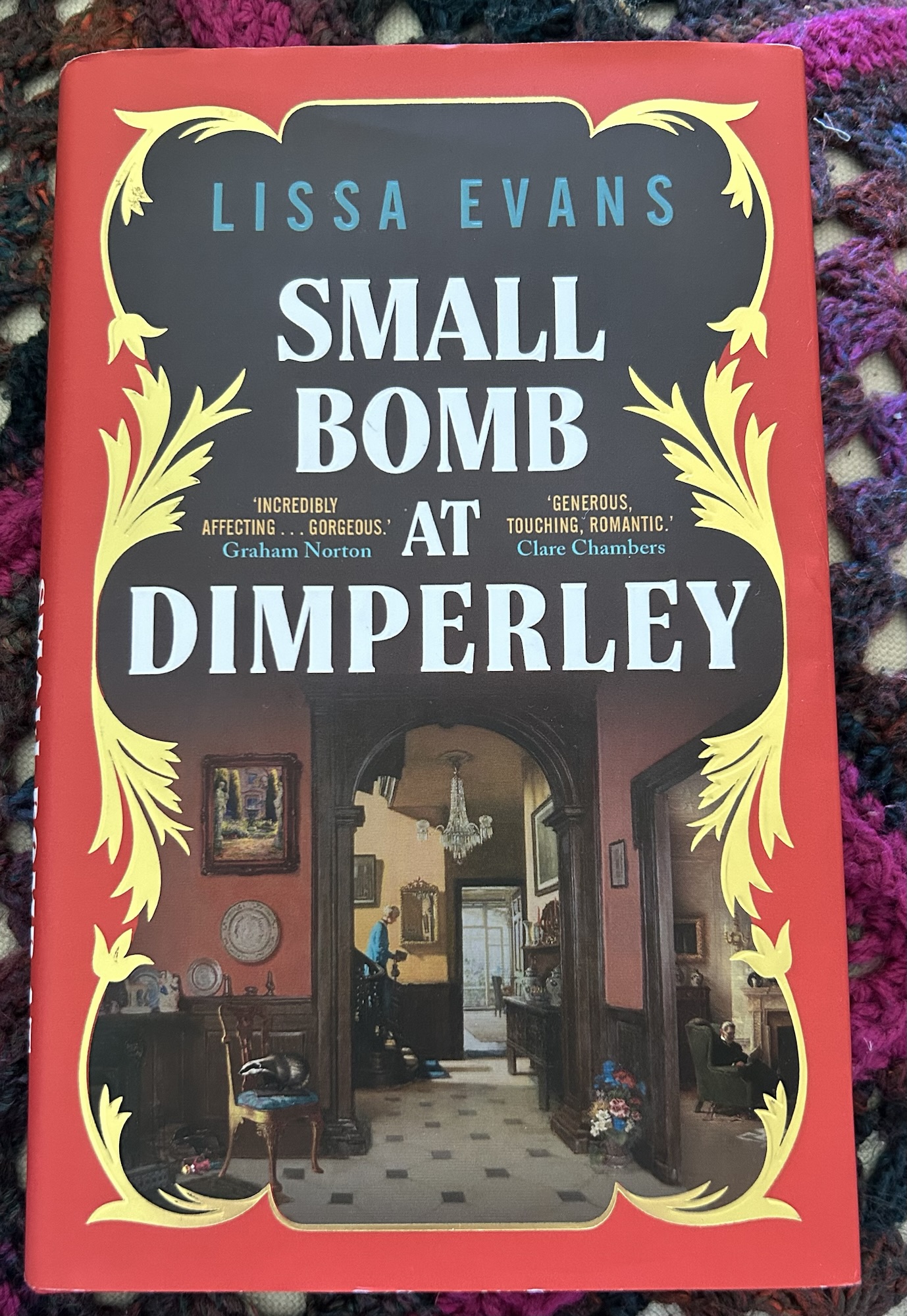
Set immediately after World War II, the titular country pile is falling down around its much-reduced inhabitants’ ears. Home of the “lesser nobility” Vere-Thissets, their wastrel heir Felix has died in the war and they are awaiting the return of his diffident brother Valentine to take up the reins.
Dowager Lady Irene Vere-Thisset is struggling with post-war societal changes, including:
“A farmer named Jeffries who habitually spoke to Irene with familiarity which suggested they’d first met when queuing at a whelk stall and who had actually clapped her on the back last year when she had been presenting the trophy for best heifer at the county fair.”
During the war the house had been a maternity hospital, and Mrs Zena Baxter has stayed on, with her now two-year-old daughter Allison:
“It was quite galling to be forced to admire a piece of shrapnel that had somehow landed in Addenham churchyard and which was kept in a velvet-lined box as if it were a saint’s jawbone, when she herself had been dug out of the basement shelter of Hackney Young Women’s Hostel five hours after the building had suffered a direct hit.”
Zena is organised and capable, which is just what Dimperley needs, the only other remaining staff being Hersey who arrived at age fifteen and is now fighting off retirement. Zena has ended up as secretary to Alaric Vere-Thisset, as he writes an interminable history of the family despite the fact that:
“no Vere-Thisset had ever raised an army, or invented anything, or written a proper book, or endowed an institution, or even become a Member of Parliament.”
Meanwhile, Felix’s widow Barbara is struggling to get to know her daughters after they have been in the US for several years, escaping the conflict. Poor Barbara is physically defeated by much of everyday life, and has been left to undertake many of the noblesse oblige responsibilities without acknowledgement or thanks.
No-one thinks Valentine can make a go of running this money-pit, including Valentine:
“Lacking in either personal magnetism or the sort of skills that were needed for the forging and maintenance of useful connections. He was, as his father had noted, a poor rider, a below-average shot, an indifferent golfer and rather unfortunately ‘the image of my Uncle Fenwick’, though Irene had been unable to confirm the latter since every picture of Uncle Fenwick had been removed from the family album after the incident”
But what has been overlooked is that none of these attributes actually matter. Personal magnetism and charm are vastly overrated qualities, and what Valentine lacks in these he makes up for in decency, hard work and humility. He’s also likely dyslexic, and this alongside being forced to write with his non-dominant right hand at school means he is consistently underestimated.
We follow the family as Valentine and Zena try to take Dimperley by the scruff of the neck, and all of them attempt to work out a place for themselves in the ever-shifting new world of Labour governments, working women and – horror of horrors – an expanding National Trust (!)
Small Bomb at Dimperley wears its research lightly, so you never get an info-dump but rather a believably evoked sense of the immediate postwar period. What is foregrounded is the characters, and they are all wonderful. The more eccentrically comic Alaric and Barbara are never condescended to – their behaviour is laughed at but never they themselves. They are treated with insight and compassion, as is Lady Irene despite her clinging to archaic attitudes. The depth of characterisation creates flawed, believable people who I really invested in.
Small Bomb at Dimperley demonstrates how everyone deserves to find their place of repose – somewhere to be cared for, to love and to be loved. It shows how this occurs in a variety of ways and is not the preserve of the glamorous or the charismatic. Evans is so good at creating engaging circumstances and people who she treats with such humanity, humour and warmth.
“You couldn’t give half the population a gun and send them away for five years and then expect their slippers still to fit when they came home.”
It’s been a while since I ended with an 80s tune, so here’s a song about a more modest abode than Dimperley:
 madame bibi lophile recommends
I usually prefer books written at the time to historical fiction but I’ve liked Lissa Evans’ other novels and really enjoyed this one, I thought it was very well done. https://librofulltime.wordpress.com/2024/09/20/book-review-lissa-evans-small-bomb-at-dimperley/
LikeLiked by 1 person
I completely agree Liz, I don’t read much historical fiction at all. I do think she’s very good at the details though, from the two I’ve read.
LikeLiked by 1 person
Oh, the cup of tea on arrival, what a wonderful ritual.
LikeLiked by 1 person
Absolutely!
LikeLiked by 1 person
I liked the sound of Old Baggage, even though I don’t read much historical fiction
LikeLiked by 1 person
I really enjoyed Old Baggage, and I’m not really a historical fiction reader at all. I hope you enjoy it if you give it a try!
LikeLiked by 1 person
This sounds excellent. I hadn’t heard of this author, I hope her books are in my local library!
LikeLiked by 1 person
I hope so too Lisa!
LikeLiked by 1 person
Thanks so much for link, Madame Bibi. I’m so glad you enjoyed this one. Those National Trust bolshevik references were priceless!
LikeLiked by 1 person
They were so much fun! Thanks so much for the steer towards this one Susan 🙂
LikeLiked by 1 person
Like you, I’ve read and enjoyed other books by Lissa Evans, and it sounds as if she’s delivered another winner with this one! I’m glad to hear the period research doesn’t feel too heavy-handed on the page, often a pitfall with this type of fiction…
LikeLiked by 1 person
If you’ve enjoyed her before I think you’d like this one Jacqui! She is very clever at weaving in historical detail without it feeling clunky.
LikeLike
Now why did I think this was a mystery novel? It sounds very well done, and I do have some sympathy for the downfall of the rich after the wars, even if they deserved it… 😉
LikeLiked by 1 person
It does look like it could be a mystery novel!
Haha! They are sympathetic despite enormous inherited privilege.
LikeLiked by 1 person
Sounds marvellous Madame B! I’ve heard of Evans’ books but never read them thought it seems from what you say they may be worth checking out…
LikeLiked by 1 person
She’s very readable Kaggsy, and her characterisation is excellent. I hope you enjoy her if you give her a try!
LikeLiked by 1 person
I haven’t heard of Evans but this sounds good and without that info dump (!) that can be so annoying. Wodehouse is absolutely right, in any house!
LikeLiked by 1 person
You’re so right – you don’t need a country house to be offering visitors a cup of tea on arrival!
LikeLiked by 1 person
I just recently checked into which of hers I could get on ILL and am looking forward to reading one of them before long. And what is WITH that wallpaper in their house? lol
LikeLiked by 1 person
Lovely review. And you’re so right about the compassion with which she treats even the most irritating or minor characters.
LikeLiked by 1 person
Thank you! I really like her humane approach.
LikeLike