Simon and Kaggsy are running one of their marvellous Club events all week, this time it is the 1961 Club. I’m hoping to do a few posts, and I’m starting with a short story.
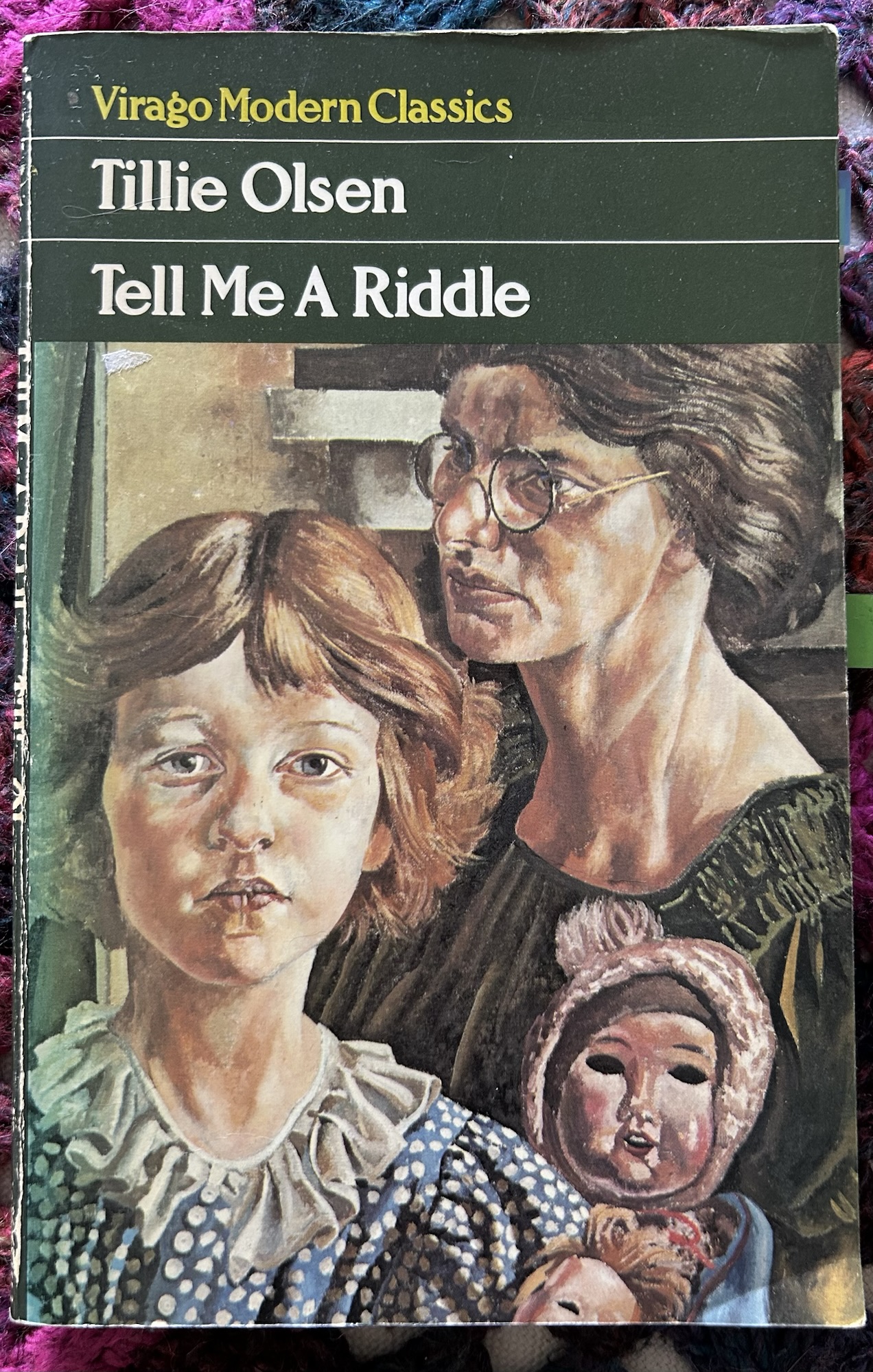
Tell Me a Riddle by Tillie Olsen is a collection of four stories, with the titular tale published in 1961, so that is the one I will concentrate on. But all four are expertly realised with distinct narrative voices and I really recommend the whole collection.
Tell Me a Riddle looks at the last year or so together of a couple who emigrated from Russia (as the author’s parents had done). It opens:
“For forty-seven years they had been married. How deep back the stubborn, gnarled roots of the quarrel reached, no one could say – but only now, when tending to the needs of others no longer shackled them together, the roots swelled up visible, split the earth between them, and the tearing shook even to the children, long since grown.”
This antagonistic couple are not mellowing with age. He wants to move to supported accommodation, the Haven, she is determined to stay put. The fury of the sacrifices she has made throughout married life spill out, as he tries to entice her:
“A reading circle. Chekhov they read that you like, and Peretz. Cultured people at the Haven that you would enjoy.”
“Enjoy!” She tasted the word. “Now, when it pleases you, you find a reading circle for me. And forty years ago, when children were morsels and there was a Circle, did you stay home with them once so I could go? Even once? You trained me well. I do not need others to enjoy. Others!” Her voice trembled. “Because you want to be there with others. Already it makes me sick to think of you always around others. Clown, grimacer, floormat, yesman, entertainer, whatever they want of you.”
Having not spoken her resentments previously, she now digs her heels in:
“Enough. Now they had no children. Let him wrack his head for how they would live. She would not exchange her solitude for anything. Never again to be forced to move to the rhythms of others.”
The impasse escalates, with neither seeming to be anywhere close to winning, until events overtake them and her health begins to deteriorate:
“A bellyful of bitterness and every day the same quarrel in a new way and a different old grievance the old quarrel forced her to enter and relive. And the new torment: I am not really sick, the doctor said it, then why do I feel so sick?”
They move around the USA, visiting children and grandchildren, both reflecting on what they left behind and what lives they have enabled their children to create. Olsen analyses the promises and shortfalls of the American Dream through ordinary lives.
At the start of the story the husband has called his wife “Mrs Word Miser”, among other epithets. But by the end, as she lays dying in bed:
“The week Lennie and Helen came, the fever returned. With it the excited laugh, and incessant words. She, who in her life had spoken but seldom and then only when necessary (never having learned the easy, social uses of words), now in dying, spoke incessantly.”
The deathbed scenes are vivid and affecting. In a short space of around 50 pages Olsen brings her characters into noisy, awkward being and achieves what takes some writers ten times the space. She has absolute command of the short story and uses it expertly.
I realise I’ve made the story sound quite depressing, but while it is sad, I didn’t find it bleak. The characters are so strong and determined, and the voices so true and clear, that Tell Me Riddle conveys an energy which isn’t depleting.
I have Olsen’s novella Yonnonido in the TBR which I keep putting off – I’m really looking forward to picking it up now.
To end, a song from 1961 that I thought was much later in the decade, probably because it is such a timeless classic:


This is the third review I’ve read for 1961 club and it has gone straight onto my list (the other two reviews were of books I read for the club too!). In fact, I see there is a copy waiting to be dusted off from my library stacks so I may sneak in there later! Tillie Olsen is a new author to me so thank you for the introduction.
As I read your summary, I did wonder whether I would find this story too bleak and depressing so thank you for disabusing me. From the excerpts cited, the characterisation seems masterful; I already feel this couple are very real and present.
LikeLiked by 1 person
Oh great! I’m so glad I’ve persuaded you. I really like the other stories in the volume too, I hope you enjoy them. She seems especially gifted at creating distinct, authentic voices.
I hope you don’t find it too bleak – undoubtedly there is sadness and bitterness, but there’s so much energy too.
LikeLike
I’ve just finished this (and the other three stories too) so am popping back just to let you know I am glad I read this (thanks to you). I thought all of the stories were very strong but Tell Me A Riddle was particularly powerful and compelling. I agree with you about the energy – it is palpable, both the negative and the positive.
LikeLiked by 1 person
Thanks so much for letting me know, very kind of you! Glad you found it as powerful as I did.
LikeLike
Such venom! This does sound very striking.
LikeLiked by 1 person
The voices are so distinct!
LikeLiked by 1 person
Gosh, this sounds incredibly powerful, Madame B, and I so understand the woman’s wish for solitude!! Glad it was a good start to 1961 for you.
LikeLiked by 1 person
It really is Kaggsy, the voice is so distinct and furious. I’m glad to have finally plucked it from the TBR!
LikeLiked by 1 person
Wow. Sounds like my mom! Lots of resentment for alawys having to have it HIS way, HIS interests. No wonder she doesn’t morn.
LikeLiked by 1 person
A lot of resentment – a whole lifetime together!
LikeLike
And this is why they invented divorce! Goodness, imagine living with someone you hate and despise for 47 years – torture!
LikeLiked by 1 person
Absolutely! I guess in 1961 divorce wasn’t used to the same extent, especially for the older generation.
LikeLiked by 1 person
Great choice!
LikeLiked by 1 person
Thanks Cathy!
LikeLiked by 1 person
Crikey, this sounds brilliant, that venom building up over the years and a brilliant example to use something as homey as a book group; I’m with her, where was he to look after the children . . .
LikeLiked by 1 person
It’s so well done Jane, the voices leap off the page.
Absolutely – he couldn’t spare one night to sit with his own children?!
LikeLiked by 1 person
I’ve only read one story by Tillie Olsen (included in a British Library Women Writers anthology), but it was so good that I’ve been looking out for her books ever since. Her work seems very affecting from an emotional perspective, and I get the sense that motherhood might well be a recurring theme….
LikeLiked by 1 person
Great to hear you rate her too Jacqui! My other favourite from this volume is I Stand Here Ironing, which is also about motherhood.
LikeLike
Oh, I meant to reread this for the club and it went entirely out of my head: maybe I can still manage to do so, even yet! It’s great you’ve enticed so many commenters here to go looking for her now.
LikeLiked by 1 person
I think you can squeeze it in Marcie!
I hope everyone enjoys her – I was so truck by her skill.
LikeLike
Pingback: Novella a Day in May 2026 – No.17 | madame bibi lophile recommends