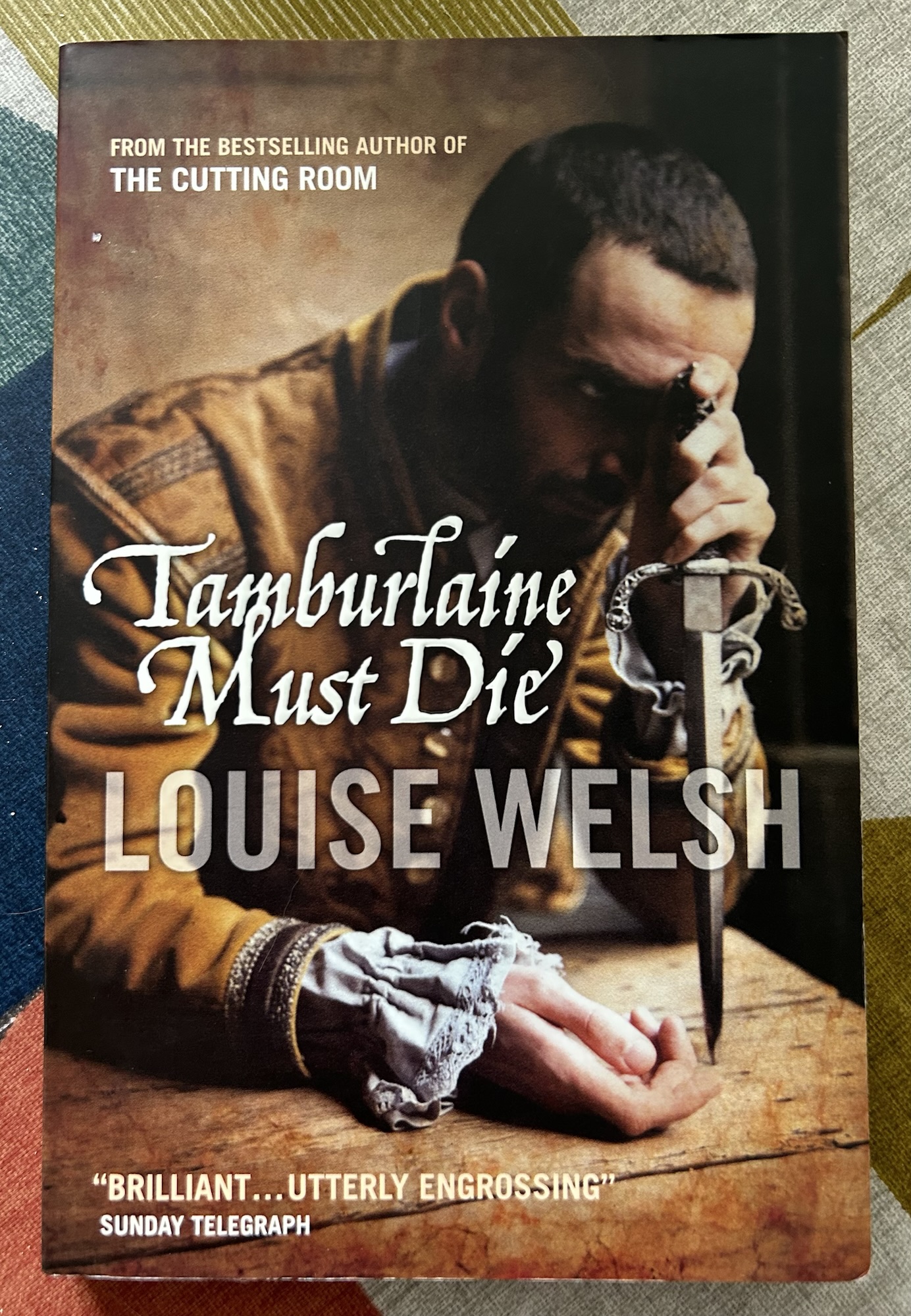
I rarely read historical fiction, or modern crime, but having enjoyed Louise Welsh’s first two Rilke thrillers (I haven’t read the third published this year) I decided to give her 2005 historical novella Tamburlaine Must Die a try. I also have a fondness for Early Modern theatre and so a story about Christopher ‘Kit’ Marlowe’s last days was tempting.
Kit Marlowe was stabbed in a pub in Deptford in 1593, after an argument over the bill. He was 29 years old, already a successful playwright, probably a genius, more than likely a spy for Elizabeth I’s government, outspoken atheist (whether he believed it or not), and unapologetic about his sexual encounters with men and women. The last three in that list all put him at considerable risk in the society of the time, meaning that from the start questions have been raised as to the motivations behind his murder.
Tamburlaine Must Die takes the form of a letter written by Marlowe the day before his death, neatly side-stepping attempts to answer who was truly behind his murder and why. Instead we follow Marlowe as he knows his days are likely numbered.
“I like best what lies beyond my reach, and admit to using friendship, State and Church to my own ends. I acknowledge breaking God’s laws and man’s with few regrets.”
Someone using the name of Marlowe’s famous anti-hero Tamburlaine is distributing heretical tracts around London. Marlowe is summoned before the Privy Council, and resolutely denies it is him. Unfortunately, his friend and former roommate, playwright Thomas Kyd, has confessed under torture that Marlowe made him copy such texts:
“They made him sing until he hit the high notes, then they chorused your name and he picked up the refrain.”
Generally I would have liked more characterisation of Marlowe throughout the novella, but his deep sense of betrayal by Kyd was truly affecting.
Marlowe travels around London trying to find out who Tamburlaine is, feeling this is his main chance of survival. Welsh evokes Elizabethan London viscerally and naturally, never weighed down by her research. She also avoids too much foresight which is usually tedious, although I did like this observation by Marlowe:
“Suddenly I felt sure this place could not survive. There was so much energy, so little space. One day the City must surely combust.”
Marlowe encounters the great and not-so-good of society in his quest:
“The room swam and I was at one with the tavern dwellers, the prostitutes and sinners. I was with my own kind and this low place suited me better than all of Walsingham’s luxury and Ralegh’s philosophising.”
This includes a memorable encounter with necromancer Dr Dee and a consideration of a deal with Sir Walter Raleigh:
“Raleigh is the most calculating of men, and reckless with it. Raleigh is a fine pirate and a bad spy. He’s adept at fiction and poor at deceit. He can weigh smoke.”
Ultimately though, a sense of defeat hangs over everything and even without knowing the history, the reader realises young Marlowe is up against far greater forces than he can combat or outrun.
“‘Are you Tamburlaine?’ I asked, half dazed.
And he laughed. ‘Put that impostor from your mind. Whoever he might be, his threats are nothing compared to ours.’
‘Death is the same whoever brings it.’
He gave me a last look and asked ‘Do you really think so?’”
Looking at the Wiki page for this book, apparently it had mixed reviews, some really positive but one that described it as ‘buccaneering tosh’. As someone who loved Errol Flynn films as a child, such an assessment would raise my expectations rather than lower them, but regretfully I have to disagree with the reviewer. Tamburlaine Must Die thankfully takes a low-key approach to what is a potentially highly dramatic story. Swords are drawn but Marlowe doesn’t crash wildly through his final days, unlike many of his preceding ones.
Tamburlaine Must Die is evocatively written, descriptive without losing sight of the story. I personally would have liked more of a sense of desperation and the sadness at such a young life cut short, but it is still an immersive read.
To end, an entertaining turn by Rupert Everett as Marlowe in Shakespeare in Love:
 madame bibi lophile recommends
Oh, this does sound interesting, Madame B. I don’t always go for historical fiction either, but the Marlowe story is irresistible!
LikeLiked by 2 people
It really is, isn’t it? This version is very evocative for sure!
LikeLike