As I mentioned in my last post, I’m disappointed not to be doing my novella a day in May project this year, but for my sanity something had to give! Simon is undertaking a book a day for the month which I’m sure will give me many ideas for next year 😊
I still plan to focus on novellas this month though, and last year when I read Small Things Like These by Claire Keegan, a few people mentioned that I read needed to read Foster. How right they were, it’s an extraordinary novella.
Apparently it started life as a New Yorker short story (it has two copyright dates) and although I haven’t read that version, as a novella I would say it is completely realised in just 88 pages.
A young girl is taken to the west of Ireland to live with the Kinsellas, her aunt and uncle, as her mother is heavily pregnant and struggling with the number of children she has to care for. Her father gambles away the family heifer and there isn’t enough food to go round, or time for adequate physical or emotional care.
At the place where she is to spend the summer, chores are achieved daily on the farm and within the home. There is enough food and enough care.
“Her hands are like my mother’s hands but there is something else in them too, something I had never felt before and have no name for. I feel at such a loss for words but this is a new place, and new words are needed.”
Although the time is never specified, it seems to be around the 1970s/early 1980s as there is a discussion of hunger strikers. The narrator is nameless and we’re not sure of her age, but I would say somewhere around nine to eleven years old.
“I am in a spot where I can neither be what I always am nor turn into what I could be.”
Keegan trusts the reader not to need everything spelled out. We get a sense of the wider family dynamics and the feelings of various family members without them being explicitly stated. The slowly building bonds of trust and affection between the young narrator and the Kinsellas are so delicately evoked and tenderly realised.
A stunning scene sees the narrator and Mr Kinsella walking along the beach. When they turn around to walk back, he can only see her footprints
“’You must have carried me there.’
[..]
We stand then, to pause and look back out at the water.
‘See, there’s three lights now where there was only two before.’
I look out across the sea. There, the two lights are blinking as before, but with another, steady light, shining in between.
‘Can you see it?’ he says.
‘I can,’ I say. ‘It’s there.’
And that is when he puts his arms around me and gathers me into them as though I were his own.”
There is also the gradual understanding by the narrator that a life is possible, and exists, beyond that which she has always known.
“But this is a different type of house. Here there is room, and time to think. There may even be money to spare.”
Throughout, there is an awareness that this is a temporary time, with a defined end date. The situation cannot endure and the narrator and the Kinsellas will have to part.
Foster is a stunning novella. A deeply moving and perfectly crafted gem, complete in itself, down to the final devastating line.
I’ve not seen the film adaptation of Foster, but it looks faithful, and beautifully shot:
I’ve just managed to keep up my 2024 resolution to read a book per month from Anthony Powell’s A Dance to the Music of Time sequence this April! It’s been a bit of a month and May looks equally challenging so I won’t be doing my Novella a Day in May this year, though I will focus on novellas for the month as I had some lined up that I’m really keen to read.
Back to A Dance to the Music of Time! Published between 1951 and 1975, and set from the early 1920s to the early 1970s, the sequence is narrated by Nicholas Jenkins, a man born into privilege and based on Powell himself.
The fourth volume, At Lady Molly’s, was published in 1957 and is set in the 1930s before the start of World War Two. Politics is only mentioned very occasionally though, and the focus remains on the relationships between an insular set of people.
This is the volume where I started to get a sense of the dance. With marriages a strong theme, the characters circle around, encountering one another for periods before spinning off again. Others weave in and out.
Nick is now working as a script writer and his affair has ended. At the start of the novel he is taken by a colleague to a party at Lady Molly Jeavons. Once again he runs into acquaintance/talisman Widmerpool:
“Yet, for some reason, I was quite glad to see him again. His reappearance, especially in that place, helped to prove somehow rather consolingly, that life continued its mysterious, patterned way. Widmerpool was a recurring milestone on the road”
Widmerpool is engaged to Mildred Haycock, who is quite a few years older than him and has a colourfully described past. Later we learn that Widmerpool’s political aspirations are growing, and there is a chilling speech he gives Nick over lunch at his club, in favour of appeasement of Hitler.
Once again I was struck by Powells astute, clear-sighted assessment of people. Surrounded as it is by a satirical comedy of manners, he can really pack a punch when he chooses.
“Sentiment and power, each in their way, supply something to feed the mind, if not the heart. They are therefore elements operated often to excess by persons in temperament unable to love at all, yet at the same time unwilling to be left out of the fun, or to bear the social stigma of living emotionally uninteresting lives.”
There are lighter portraits too of course. My favourite in At Lady Molly’s was retired General Alymer Conyers. In his eighties, he spends his retirement reading Virginia Woolf, practising the cello, and learning about psychoanalysis:
“‘Been reading a lot about it lately,’ said the General. ‘Freud – Jung – haven’t much use for Adler. Something in it, you know. Tells you why you do things. All the same, I didn’t find it much help in understanding Orlando.’
Once more he fell into a state of coma.”
Quiggin and Mona Templar reappear (“She was like a strapping statue of Venus conceived at a period when more than a touch of vulgarity had found its way into classical sculpture.” Ouch.) living in a cottage owned by Erridge, who is now Lord Warminster. The lord of the manor dresses in scrappy clothes, has a big beard and gives a lot of his money away to good causes. I work near Shoreditch so none of this sounds like remotely remarkable manhood to me, but to his 1930s aristocratic family he seems mad. I’ve read somewhere he may have been based on George Orwell!
Nick meets two of Erridge’s sisters when he visits, including Isabel, “a bit of a highbrow when she isn’t going to night clubs”. He falls in love at first sight but their courtship happens entirely away from the eyes of the reader. Powell’s interest isn’t romance, but rather the dynamics of relationships and how these play out in the wider world.
“Women may show some discrimination about whom they sleep with, but they’ll marry anybody.”
There are so many ways A Dance… is of its time (which I think is exactly as intended) but it also doesn’t age, through Powell’s astute characterisation. I was very struck by this comment early on in At Lady Molly’s:
“One of those men oddly prevalent in Victorian times who sought personal power through buffoonery”
You don’t have to look very far back through our Prime Ministers to find a much more recent example…
I absolutely whizzed through At Lady Molly’s and I’m really looking forward the next volume, Casanova’s Chinese Restaurant.
To end, a beautifully simple rendition of a song about Molly:
Apparently Leonard Woolf thought The Years the poorest of Virginia’s novels, but it was also far and away her best-selling work. So I was intrigued to know how I’d find it…
The titular years of this novel are 1880;1891;1907;1908;1910; 1911;1913;1914;1917;1918; and the Present Day. And so Woolf covers the end of the Victorian era to World War I and beyond, through the lens of the middle-class Pargiter family. Except for 1880, she portrays one day in their lives, some with significant events, others very ordinary.
In 1880, Rose Pargiter, mother to young adults Eleanor, Morris and Edward, teenagers Milly and Delia, and pre-teens Martin and Rose, is in bed in their London townhouse, dying from a long illness. Woolf captures the conflicted feelings and strain for the family around this time, particularly for Delia:
“She longed for her to die. There she was – soft, decayed but everlasting, lying in the cleft of the pillows, an obstacle, a prevention, an impediment to all life. She tried to whip up some feeling of affection, of pity. For instance, that summer, she told herself, at Sidmouth, when she called me up the garden steps…But the scene melted as she tried to look at it.”
Over in Oxford where Edward is studying, their cousin Kitty is trying to find a role for herself and struggling against the constraints of late Victorian womanhood:
“”When I was your age,” Miss Craddock continued, remembering her rôle as teacher, “I would have given my eyes to have the opportunities you have, to meet the people you meet; to know the people you know.”
“Old Chuffy?” said Kitty, remembering Miss Craddock’s profound admiration for that light of learning.
“You irreverent girl!” Miss Craddock expostulated. “The greatest historian of his age!”
“Well, he doesn’t talk history to me,” said Kitty, remembering the damp feel of a heavy hand on her knee.”
Each time Woolf jumps forward, she trusts the reader to keep up and doesn’t get bogged down by lots of explanation or exposition. We are given a snapshot the characters, whoever she is focussed on, and we fill in the gaps to a greater or lesser extent.
There are phrases and echoes across the different sections, tying them all together and giving a coherence to what could have been a more fragmentary, less satisfying novel. I also liked the repeated motif of starting each section with a birds-eye view of the time of year. I was particularly fond of this opening to 1908:
“It was March and the wind was blowing. But it was not “blowing.” It was scraping, scourging. It was so cruel. So unbecoming. Not merely did it bleach faces and raise red spots on noses; it tweaked up skirts; showed stout legs; made trousers reveal skeleton shins. There was no roundness, no fruit in it. Rather it was like the curve of a scythe which cuts, not corn, usefully; but destroys, revelling in sheer sterility. With one blast it blew out colour – even a Rembrandt in the National Gallery, even a solid ruby in a Bond Street window: one blast and they were gone. Had it any breeding place it was in the Isle of Dogs among tin cans lying beside a workhouse drab on the banks of a polluted city.”
As the above shows, Woolf grounds her tale in a recognisable topography and as always I found her descriptions of London detailed and realistic, and of Oxford too, even all these years later.
Alongside these recognisable realities, there was also plenty to enjoy regarding Woolf’s unique and arresting descriptive powers. I’m a big fan of Woolf and I just love her way of capturing inner moments, especially unreal, discombobulating moments, such as Eleanor at a dinner party during an air raid:
“A little blur had come round the edges of things. It was the wine; it was the war. Things seemed to have lost their skins; to be freed from some surface hardness; even the chair with gilt claws, at which she was looking, seemed porous; it seemed to radiate out some warmth, some glamour, as she looked at it.”
Woolf brings all the characters together in the final section for a party given by Delia. She emphasises the fallacy of a reunion by highlighting the aloneness felt by many of the family. North, son of Morris, is back after many years abroad and feels detached from everything. His sister Peggy is somewhat bitter and frustrated. She tries to get Eleanor to talk about the Pargiters childhood, but Eleanor is much more interested in life now.
“That was odd, it was the second time that evening that somebody had talked about her life. And I haven’t got one, she thought. Oughtn’t a life to be something you could handle and produce? – a life of seventy odd years. But I’ve only the present moment, she thought. Here she was alive, now, listening to the fox-trot. […] Yes, things came back to her. A long strip of life lay behind her. Edward crying, Mrs. Levy talking; snow falling; a sunflower with a crack in it; the yellow omnibus trotting along the Bayswater Road. And I thought to myself, I’m the youngest person in this omnibus; now I’m the oldest…Millions of things came back to her. Atoms danced apart and massed themselves. But how did they compose what people called a life?”
There isn’t a plot so much in The Years, only as much as there are plots to any life. Woolf captures times and places for a particular family without trying to drive the novel unrealistically. Yet The Years is still a pacy read, the driving forces being the times that are lived through and the human will to carry on.
To end, some footage of 1930s London, although I doubt Virginia ever got herself caught up with rush hour workers:
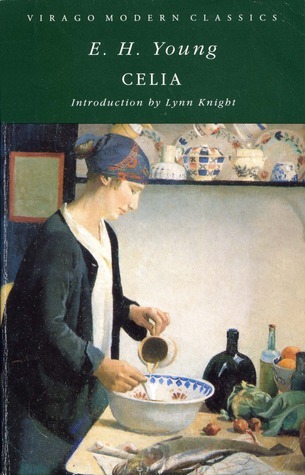
I’ve really enjoyed the three EH Young novels I’ve read but it’s been ages since I picked her up. I’m thankful to the 1937 Club, running all week and hosted by Kaggsy at Kaggsy’s Bookish Ramblings and Simon at Stuck in a Book for prompting me to get back to her!
Like the other novels by Young that I’ve read, Celia is set in the fictional Upper Radstowe (based on lovely Clifton in Bristol) amongst middle-class domestic life. Celia is forty-five, living in genteel shabbiness with her husband Gerald and their son Jimmy and daughter Catherine. She is quietly despairing.
Gerald is an architect who designs unimaginative houses that Celia despises: “here was the same puzzle of gain and loss, more money for the family and a little less beauty in the world.”
Young portrays with frankness that Celia and Gerald have a sexless marriage, because Celia cannot bear the thought of physical intimacy with her husband:
“by neglecting some of the duties of a good housewife, she stored the energy necessary for avoiding friction; by avoiding as much as possible, Gerald’s demonstrations of affection, and she had almost perfected her technique, she could give him the friendship and the kindness which vanished when more was asked of her.”
But in all honesty, she also neglects those other housewife duties too because they hold no real interest for her. She is an indifferent housekeeper (I can definitely relate) and cook, and spends a lot of her time at step removed from her surroundings. She dreams of a lost love – Richard, the brother of schoolfriend Pauline – and talks to herself.
“She had always a secret pride in its intangible persistence, its difference from a love nourished by the senses, and a more secret fear that what gave it life was its dreamlike quality.”
Those around her are used to vagueness and detachment. Living nearby is her “very stupid” sister May, her solicitor husband Stephen and their daughters including Susan. Celia’s brother John inherited the family drapery business and also lives close by, with his wife Julia and their various offspring. Another sister Hester is living a scandalously single life in London.
May and Julia form a pair, keeping each other company with their distracting daily small rivalries.
“She was congratulating herself on a superior wit because these two had supplied her with so much unintentional amusement, but she knew she had supplied them with something they valued more than laughter, an opportunity for criticism and disapproval.”
As the above quote shows, Celia can be judgemental of others. There are times when she is really quite cruel to her relatives, telling them what to do and not being entirely kind about it. But she is also fond, loving, intelligent, silly and funny. She’s a wonderful, fully-rounded, very believable creation.
The least likable character is her brother John: “John’s sense of duty towards his family was chiefly confined to criticism.” Even loving wife Julia loses patience with him at one point:
“She was enraged by John’s masculine belief in the sufficiency of his lasting passion for her, his primitive conviction that she was honoured by it and for its sake must gladly endure his faults of character and his intolerance of her own. In this rarely candid moment, she searched her mind for any other reason why she should like him and could not find one, but he was a habit and she would have been lost without him.”
We follow the extended family through various dramas, some larger than others. Stephen takes himself off for a few days, leaving May wondering if she’s been abandoned. John has to face his eldest son not wanting to follow him into the business. Celia’s son Jimmy has a crush on May’s daughter Susan (first cousins – eek). Celia has to wrestle with her mother-in-law, and there various intrigues which amount to very little. As Celia observes:
“I live in a teacup and forget it isn’t the whole world.”
However, Celia isn’t a comfort read. It is concerned with the realities of married life at a time when divorce was very rare and opportunities for women generally were very limited. Young portrays the frustrations, sadnesses, tedium, and even fear her characters experience alongside the small joys, affection and love in their lives. It feels very real, and while it is not depressing it also doesn’t offer any false hope or sentiment either.
“The art of living, the only one Celia tried to practise, was as exacting as any other.”
By end of the novel the characters know themselves and each other slightly better, and have gained some wisdom and insight through small incremental steps. There are no major epiphanies and no huge outward changes. It is a finely written and closely observed tale of interwar middle-class lives that above everything else, carry on.
While it was an involving and affecting novel, I didn’t feel Celia was the strongest of Young’s work that I’ve read – there were too many superfluous characters and the light plotting couldn’t quite sustain the length. For me, it would have benefitted from cutting one branch of the family and around 100 pages. But EH Young not at her tip-top best is still so very good and there is a great deal to enjoy in Celia.
“She had a calm indifference to what anyone might think of her, not because she herself was indifferent people, but because while she was interested in herself, as any intelligent person must be, she did not expect or wish to arouse interest in others, she had no apologies to make for what she was not, or explanations of what she was.”
When I think of farce, I tend to think of very broad-strokes comedy. Yet Journey by Moonlight manages to portray farcical circumstances with light humour and characterisation of great subtlety.
It begins with Mihály and Erzsi on honeymoon, having decided to formalise their relationship after an affair behind the back of Erzsi’s husband Zoltan.
“It was not exactly new or surprising to her that Mihály could say and do things she failed to understand. For a time she had successfully concealed her lack of comprehension, wisely asking no questions and acting as if eternally familiar with everything to do with him. She knew that this wordless assumption of authority, which he thought of as her ancestral, intuitive woman’s wisdom, was her strongest means of holding on to him.
[..]
And yet they had married because he had decided they understood each other perfectly, and that, for both, the marriage rested on purely rational foundations and not fleeting passion. For just how long could that fiction be sustained?”
Well, in answer to that question, not very long at all. Mihály loses Erzsi on a train in Italy and makes very little effort to reunite with her. Hardly surprising, given that even when they were physically together she was an abstract concept to him more than an actual living, breathing woman, his wife.
“[Erzsi] had become for him a sort of beautiful memory. He drank heavily to sustain this mood, to make himself believe that he wasn’t with Erzsi but with the memory of Erzsi. With Erzsi as history.”
Mihály is a drifter. To all appearances he has lived a life of bourgeois predictability, but inwardly he has drifted into it. Now he creates an outward life which reflects his inner life.
“At home and abroad he had been schooled in mastery. Not self-mastery, but the mastery of his family, his father, the profession which did not interest him. Then he had taken his place in the firm.
[…]
He had forced himself to become something other than what he was, to live never after his own inclination but as he was expected to. The latest and not least heroic of these exertions had been his marriage.”
The difficulty for Mihály seems to be recognising what his own inclinations are. He hasn’t supressed any great yearning or talent to take the path he has.
His overwhelming preoccupation is with the past. Acknowledging “there’s no cure for nostalgia”, he finds it impossible to live in the now or to take meaningful action in the present. As Erzsi’s ex-husband observes, Mihály is a man “so utterly withdrawn and abstracted that you have no real relationship with anybody or anything”.
At the start of his honeymoon he runs into a childhood friend, conman and thief, János Szepetneki. This sends Mihály into a protracted reverie, thinking about his other friends from that time, the elusive and compelling siblings Éva and Tamás Ulpius, and the religiously-minded Ervin. They will recur throughout the narrative, both absent and present as memories, symbols and occasionally like János, actual people.
What stops this being completely tedious and self-indulgent is the strong vein of humour running through Journey by Moonlight. It is not overtly comic but it is consistently ironic. Mihály is both serious and faintly ridiculous and his most dramatic moments are consistently undermined.
There are entertaining interludes with the various people he encounters. My favourite occurs when the one decisive act he plans for himself is halted by an almost stranger insisting he become a godfather to a child he has never met. This request for lifelong duty occurs for no apparent reason and is one which Mihály greets with extreme reluctance. And yet, he is drawn in and distracted from his course:
“How distressing that the most sublime moments and stages of our lives can be approached only with the most banal expressions; and that, probably, these are indeed our most banal moments. At such times we are no different from anyone else.”
Yet Szerb doesn’t let the humour undermine the message of Journey by Moonlight. He is exploring how, as human beings, we recognise and live a meaningful, worthwhile life for ourselves. It’s a fine balance which he achieves expertly (the only clunky part for me was a long exposition by an academic friend of Mihály’s on dying as erotic act).
“And again he had the feeling that the really important things were happening elsewhere, where he was not; that he had missed the secret signal. His road led absolutely nowhere and his nostalgia now would gnaw him eternally, remain eternally unquenched, until he too departed.”
Szerb portrays the despair of human beings alongside our ridiculousness, and he does it all with great compassion.
“And sublime and terrible things always happened to him when life was stupid and precious.”
Marina Sofia also reviewed Journey by Moonlight this week, and you can read her wonderful post here.
To end, of the many songs about the moon, I chose this one from björk, because I thought it fitted the tone of Journey by Moonlight well. She takes her art seriously but she’s not afraid to be silly too:
Today I’m looking at the fifth of Angela Thirkell’s Barchester novels, Summer Half. Although strictly speaking, Barchester only features now and again, most of the novel being set in Southbridge School and the master’s homes.
Reading Angela Thirkell can be a trepidatious experience. I really enjoy her comedy, but she can also be an unmitigated snob and racism can filter in too. Thankfully, although there were brief elements of both in this novel, they were always short-lived. There are also repeated references to hitting women thrown casually into conversation, although no suggestion it would actually occur.
Those elements aside, I was in the mood for a comic novel featuring events of no consequence, and that was exactly what I got. I really enjoyed it!
Summer Half begins with Colin Keith, the least interesting of the characters, deciding to take a job teaching the Mixed Fifth at the local public school, Southbridge. His father is keen for him to become a barrister, but Colin decides for wholly flimsy reasons to educate the young. He has no vocation for it and finds the prospect terrifying.
“He saw himself falling in love with the headmaster’s wife, nourishing unwholesome passions for fair-haired youths, carrying on feuds, intrigues, vendettas with other masters, being despised because he hated cricket, being equally despised because he didn’t know the names of birds, possibly being involved in a murder which he could never prove he hadn’t committed, certainly marrying the matron.”
None of the above happens and thankfully the Mixed Fifth decide they like him and don’t give him a hard time. The irrepressible Tony Morland from earlier Barchester novels features – now an adolescent – along with his friends Eric Swan and chameleon-loving Hacker.
“Hiding their eagerness under an air of ancient wisdom, critically kind, agreeably aloof, living private lives in the public eye, exploring every wilderness of the mind, yet concerned with a tie or scarf.”
The Masters live in school during term time, and so Colin befriends Everard Carter, a teacher of ability and dedication, who isn’t remotely sentimental about his charges but admits: “I’m wretched without them.” There is also grumpy, socially inept Philip Winter, (a communist!) engaged to Rose Birkett, the beautiful “sparrow-wit” daughter of the headmaster.
Rose is the nearest the novel has to a villain, and she isn’t really villainous. She’s just monumentally self-focussed and devoid of any capacity to comprehend anyone’s needs beyond her own. She enjoys male attention (presumably because admirers will want to please her) and continuously gets engaged:
“What significance, if any, she attached to the word engaged, no one had yet discovered, unless it meant being taken out in the cars of the successive young men to whom she became attached. Her parents very much hoped she would grow out of the habit in time, but for the present all they could do was tolerate young Mr Winter and hope for the best.”
Colin takes Everard Carter to his home over the holidays, where he promptly falls in loves with Kate Keith, Colin’s sister. Her frankly pathological obsession with darning everyone’s clothes and sewing on buttons doesn’t stop Carter from falling in love at first sight: “he saw his journey’s end”.
Lydia, Colin’s youngest sister, is quite the contrast to Kate. She is boisterous and given to fits of passion over Horace and Shakespeare, while proclaiming a future for herself of staying unmarried and breeding golden cocker spaniels. She also has no qualms about ripping her clothes, stuffing her food, and starting arguments with people she has perceived as doing wrong by those she cares about.
Needless to say, Lydia and Tony become good friends. I thought they were perfectly suited, both being characters I like and enjoy immensely in books, yet would find irritating beyond belief in real life.
We follow this privileged set through a summer of school, picnics, punting on rivers, tennis, croquet, unfounded jealousies and rivalries which are resolved amicably, and the most English of love affairs:
“If he did touch her he thought he might go mad, and as he was right at the end of the pew farthest from the door, that would have been uncomfortable for everyone.”
Summer Half is an ensemble piece where everyone bumbles along together more or less agreeably. Spiky, rude Philip is quite the reformed character by the end, and Rose remains entirely unreformed but nor is she punished.
There are some great comic set pieces, including such dramas as an overflowing bath, and the cleaning of a pond to avoid church attendance. That’s about as high as the stakes get, which was entirely what I wanted.
Summer Half is an enjoyable, escapist read with no aspirations towards being anything other than it is, as Thirkell’s disclaimer at the start would indicate: “It seems to me extremely improbable that any such school, masters, or boys could ever have existed.” Sometimes we need a break, and for me this was exactly the right novel at the right time.
To end, there are many songs about summer which I could choose, but I’ve opted for this completely bonkers video, set for reasons that are entirely unfathomable, in a boys boarding school. It’s no wonder our country’s in the state it is if this is what goes on at Eton:
The 1937 Club is running all week, hosted by Kaggsy at Kaggsy’s Bookish Ramblings and Simon at Stuck in a Book. Often these Club years are a good opportunity to indulge in some golden age crime, and today I’m looking at one from the British Library Crime Classics series, which has been doing great work bringing many of them back.
I’ve read three other from the series by John Bude, all of which I enjoyed, so I was looking forward to The Cheltenham Square Murder.
Bude takes the trope of a closed circle of suspects and places them in a respectable square of Regency houses in the titular spa town.
“A quiet, residential backwater in which old people can grow becomingly older, undisturbed by the rush and clatter of a generation which has left them nothing but the memories of a past epoch.”
I always like a map or room plan in a novel and here we have a plan of the square and inhabitants, which wasn’t really needed but pleased me nonetheless.
The square couldn’t be more genteel. There is a man of the cloth and his sister; a doctor; a formidable spinster and her pack of dogs; two elderly sweet sisters; and a couple who look down on everyone but as they are titled no-one seems bothered.
The exceptions are Mr Buller, who seems a right wrong ‘un, and Captain Cotton who is a cad and a bounder. When the latter is shot in the head with an arrow through an open window while visiting the former, it sends everyone into a spiral.
“Rumour again stepped in. The Rev. Matthews was suspected of having connived with the murderer. Sir Wilfred and Lady Eleanor had fled from justice. Fitzgerald was the murderer. Dr. Pratt was the murderer. Poor Mr West had been arrested for the murder stepping onto the boat at Dover. Miss Boone had shot all her dogs and then attempted to take her own life. Currents and crosscurrents of suggestion and counter-suggestions crept into their shrinking ears and left the Misses Watt bewildered. They felt that at any moment, due to some horrible miscarriage of justice, they themselves might be warned that anything they had to say would be taken down in writing and (possibly) used in evidence.”
Thankfully, Superintendent Meredith, who has been such an effective sleuth in Budes other novels, is visiting his friend Aldous Barnet (from The Sussex Downs Murder) on the square, one of the few residents who doesn’t practice archery. It’s agreed Meredith can consult on the case.
Well, I can only think that taking the waters at Cheltenham has a stultifying effect on Meredith’s powers, because there is something so completely, blindingly obvious about the crime, that he somehow fails to consider until page 161. His second in command is local police Inspector Long who, despite his clumsily evoked regional accent and general attitude of misogyny, is portrayed as quite capable. He doesn’t notice this either.
This made for a slightly frustrating read, as who the murderer was became clear quite quickly too. I don’t mind it when I guess the outcomes with golden age mysteries as they are my comfort read, and I like a police procedural, but this felt a bit plodding.
There was still a lot to enjoy though. The exposure of rivalries, betrayals and tensions behind a respectable façade is always fun. The characterisation of the various neighbours is very well realised, and I also liked the setting and the use of the square as a way of expanding the country house murder story to a wider environment.
The humour is gentle, such as the Misses Watts panicking that they will be arrested, or the interrogation of a faded Bright Young Thing given to inappropriate chumminess:
“So you flatly deny it was you?
Absolutely flatly, old boy.”
The Cheltenham Square Murder ran to 285 pages in this edition and I think had it been 200 pages it would have been absolutely cracking. But as it was, still an enjoyable and diverting escapist read.
To end, of all the 80s pop videos I’ve posted on this blog, this might be the most 80s of all 😀
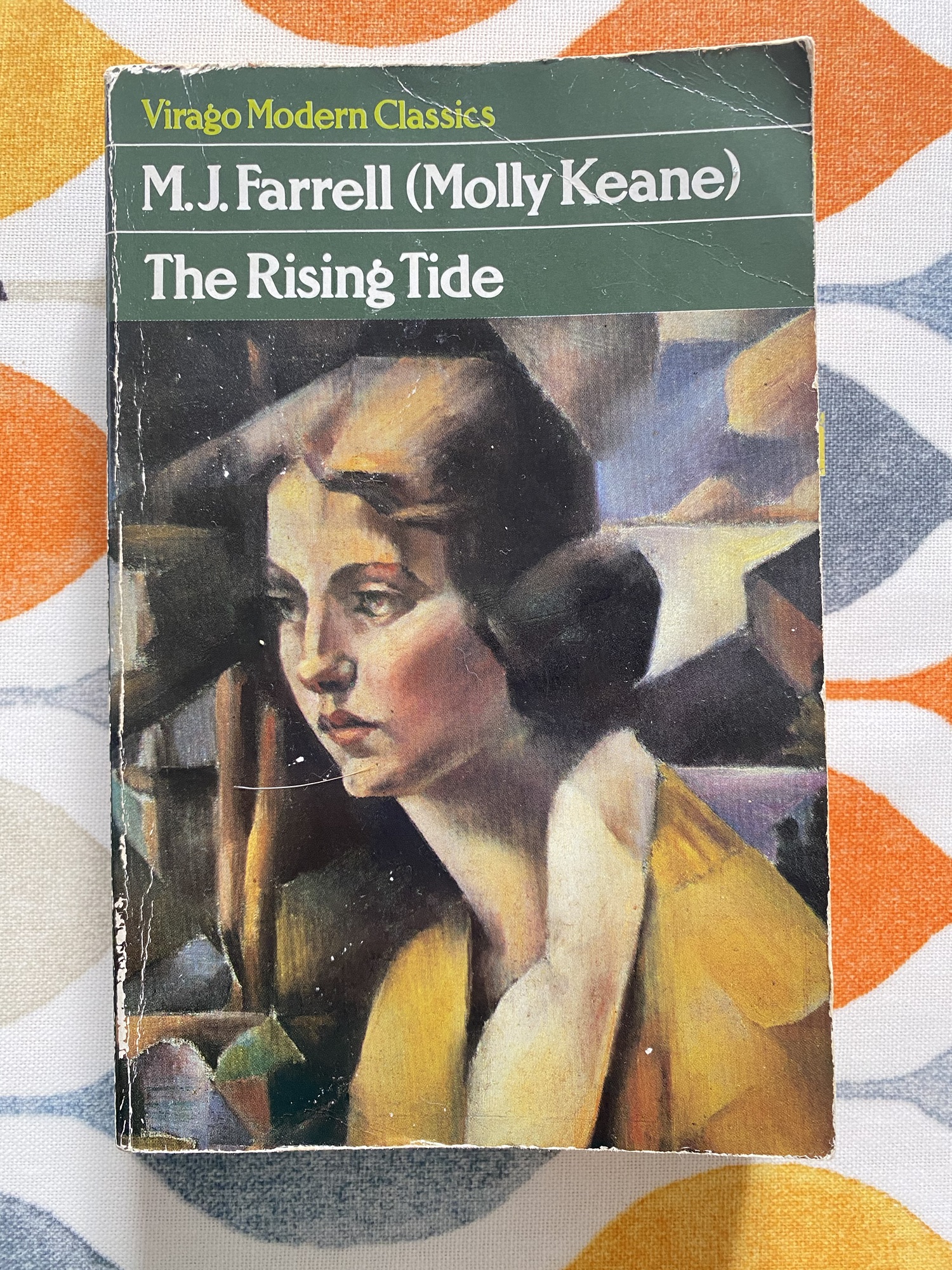
I’ve really enjoyed the Molly Keane novels I’ve read, but I think The Rising Tide might be my favourite of them all. There’s lots here that is familiar to readers of Keane’s work: Irish upper classes, Gothic Big Houses, controlling matriarchs, a stomach-churning obsession with bloodsports… but the edges were softened a bit here. The matriarchs were horribly believable yet not skirting quite as close to Gothic caricature as some of her creations; the bloodsports were referenced frequently but from the point of view of two people who hated them; snobbery was less to the fore. Keane’s astute characterisation and observational skills were as sharp as ever and the descriptive writing – especially regarding clothes and gardens – absolutely sumptuous.
The Rising Tide opens at the start of the last century. The big house is Garonlea, and Lady Charlotte French-McGrath rules over it in a constant display of her mean spirit. Her style has all the fuss and overdecoration of the Victorian period, but without any generosity:
“No lighting or heating. Tepid bathwater at best. All the wallpaper dark green or dark red. Festoons of red velvet curtains, tassels, fringes. In this room seventeen ‘occasional’ tables beside big ones and a vase of flowers on each one.”
Charlotte’s devoted husband Ambrose really just wants to be left to walk in his woods. They have four young daughters out in society: Muriel, Enid, Violet and Diana, as well as an heir in their son Desmond.
“Really, there was nothing else to be done except the things that Lady Charlotte did and she did them with wrath and speed and efficiency and throughout showed an unflinching social front.”
Things change when Desmond brings his glittering, selfish fiancée Cynthia to Garonlea:
“‘Muriel, my dear, you may take Cynthia up to her room.’
‘Yes, I’m rather a dirty girl, I think,’ said Cynthia, blinking like a cat, gold cat in the warm light room where white chrysanthemums smelt antiseptically and a majestic silver tea service glittered on an elaborately clothed table.”
Cynthia charms everyone, especially youngest daughter Diana. Cynthia likes to be charming and she likes to be adored by all. Hence, her and Lady Charlotte’s relationship is doomed from the start, and as awful as Lady Charlotte is, Cynthia is no better. She is only concerned with making people worship her and has no interest in them beyond that:
“She was always thrilled by it [the worship] and it called out at moments a dramatic feeling of goodness and humanity in her, rather an imitation sensation perhaps and one that never lasted long enough to cause her any serious personal inconvenience.”
Diana, the youngest and most rebellious of the sisters, dislikes men, enjoys it when the fashion changes so she can cut her hair, wears trousers and she adores Cynthia. But Keane is never condescending or stereotyping towards Diana and the portrait is subtle. I read Diana’s attachment as romantic, but it isn’t possessive and in fact this could easily be my twenty-first century reading of an intense chaste attachment. (There’s another character who is definitely gay, and again he is not judged for this.) Later, Keane points out that Diana, in being left to tend her gardens and live a useful life, becomes the happiest of all the sisters, rather than pitiable or bitter for remaining unmarried.
One reservation Diana has regarding her beloved Cynthia is the treatment of her children. Simon and Susan are very different to their mother and she is cruel to them, forcing them into pursuits they find terrifying and otherwise utterly unconcerned with their lives:
“Cynthia was rather impersonal about the children. If they had not had decorative value and if they had not excited Desmond so much, she would have had very little to do with them. Perhaps when they were older and started riding they would be more interesting.”
“Why could they not love hunting and dogs and ratting and badger digging and their ponies, as all right-minded children should, instead of having to be compelled and encouraged to take their parts in these sports and pleasures?”
Yet Keane demonstrates sympathy for Cynthia too. It’s a small SPOILER to say that Desmond dies in World War I, and Cynthia did truly love him. This isn’t apparent to the rest of her family in her behaviour, as she manages her grief by throwing herself into the role of society hostess. She is made for this, as are the 1920s. As she parties, drinks to excess and has affairs, very few recognise the deep pain she is running from:
“If she could fill the present moment so that she need not look before or behind it, she found that she had some ease and quietness of mind. Hunting she thought was best, but what really made her nearest to forgetting was her perpetual and indefeatable success with the men.”
“All the rest of her life was a dangerous shell of pretence, a thin shell against her ear full of screaming whispers.”
This makes Cynthia understandable, but not any more likable. She is entirely selfish and there is no kindness in her. After the death of Lady Charlotte, she is mistress of Garonlea and Diana lives with her. Cynthia knows the trauma experienced by Diana within the walls of the house but does not make any allowances for her, as this would not be convenient.
“It was a pity that all these changes at Garonlea altered it so little for Diana. To her Garonlea was more itself than it had been before Cynthia had tore down its red wallpapers and hurled the unwanted ancestors into attics with their faces to the wall […] The spirit and power of Garonlea still lived with a tenfold strength. It was as if it stored and reserved its power for a future day. Quite literally the breath of such places, the strong camphor-filled breath, on the still laden air of an outdoor place thick with old childish memories filled Diana with hatred and a tremendous consciousness of things as they had been at Garonlea all her life till now.”
As the above paragraph shows, Keane makes Garonlea its own character too. It is a looming, energy-sapping, Gothic presence: “The ruthless benignancy of Garonlea and all that Garonlea stood for. It would always be the same, it always had been.”
This is such a long post and there’s loads I haven’t mentioned! Not least the descriptive writing. Details of clothes are used to emphasise the differences between the generations: the multi-layered, highly scaffolded dresses of the sisters, in contrast to the looser styles of the Bright Young Things who follow them. Keane’s love of gardening is apparent too, in detailed descriptions of the grounds:
“Near the house sunlight poured on flat grass and on groups of blue hydrangeas and thickets of red-hot pokers. It lay the length of the opened bank of the valley as hotly as in July. Black cattle standing close together in a ring of chestnut trees looked as if they were all carved from the same block and not yet unjoined from it. There was a shaken air of blue where the half turned bracken and the woods sloped down and up.”
The Rising Tide is such a rich novel and there’s so much to enjoy. Keane’s characterisation is sharp but never cruel, and her understanding of the societal changes that occurred in the first third of the twentieth century is acute. To those of you who have made it this far, thank you for sticking with me 😀
To end, a 1930s-style party tune on a Gothic theme, hopefully Cynthia would approve:
So my plan is to post on one book a day as this wonderful event is running all week. However, various bloggers suggestions of what to read in the meantime made me realise I’d missed some, so my best laid plans may well change! The start of the week is sorted, but the end of week could well be subject to alteration 😀
Today I’m starting with Margery Sharp, whom I adore, so I’m delighted that the 1937 Club has prompted me to pick up The Nutmeg Tree.
Sharp’s insightful but gentle, humane comedic tone is perfectly realised in Julia, a woman we meet taking a bath for as long as it takes the bailiffs to leave. Once they do, she hurriedly heads off to France at the behest of her daughter Susan, whom she hasn’t seen since she was a toddler.
“Those nineteen months of being young Mrs Packett had exhausted her supply of maternal affection; and she was also aware that for a young child the life at Barton was far more suitable than the life she herself looked forward to, in Town. She hadn’t yet any definite plans about it, but she hoped and trusted that it would be very unsuitable indeed.”
Susan has been raised by her paternal grandparents after her father died in World War I. She is a Proper Young Lady, while Julia has led a ramshackle life, entirely of her choosing. Now Susan wants to get married, her grandmother doesn’t approve, and Susan has called in Julia for reinforcements.
She arrives in France having become semi-engaged to an attractive trapeze artist on the way there. Julia is completely delightful and while she doesn’t always behave honourably, she does behave warmly. She understands and enjoys people. Her daughter is almost the polar opposite:
“Julia, who could get intimate with a trapeze artist after five minutes conversation – who was intimate with the salesman after buying a pair of shoes – had talked for an hour to her own daughter, about the girl’s own father and lover, without the least intimacy at all.”
As with The Stone of Chastity, I was struck by Sharp’s liberal attitude towards sex. As far as I know she wasn’t a controversial author, so maybe attitudes like this were more prevalent in the 1930s than I’ve allowed for:
“If she took lovers more freely than most women it was largely because she could not bear to see men sad when it was so easy to make them happy. Her sensuousness was half compassion”
However, safe to say Susan would not share that view. She is, her mother realises, “a prig”. “Strong on logic, weak on human nature.” Susan is entirely inflexible. It becomes apparent that no-one particularly likes her, though she is loved and admired. Sharp is too subtle to demonise Susan though, or make her a villain. She is a not an unpleasant person, but just someone who is better suited to ideas and projects than to the realities of human society and all its complexities.
“‘It takes all sorts to make a world,’ thought Julia. But it was no use saying that to Susan.”
Meanwhile, Susan’s lover Bryan is, Julia realises, more like Julia herself. Convinced he will make Susan very unhappy, she wonders how on earth to maintain her fragile reconciliation with her daughter while not encouraging the match. As if this weren’t enough to contend with, another love interest arrives for Julia…
Sharp has all this play out with great comic pacing. I enjoyed the broader running jokes, whereby her mother-in-law Mrs Packett is convinced Julia owns a cake-shop despite absolutely no evidence of this, and proceeds with organising an entire business plan; and Julia’s continued attempts to impress people and pretend she is other than she is, by reading The Forsythe Saga – no-one is fooled and no-one cares.
The older Mrs Packett is only a secondary character, but I thought she was wonderful and wished Sharp had given her a novel to herself:
“It seemed to her more likely that her mother-in-law was of the type, not rare among Englishwomen, in whom full individuality blossoms only with age: one of those who, at sixty-one, suddenly startle their relatives by going up in aeroplanes or by marrying their chauffeurs.”
The Nutmeg Tree is not a fluffy read though. There’s a strong theme around choices – or lack thereof – for single women without money. Julia has moments of real despair, Bryan reveals a really quite vicious side to himself, and I was very struck by this paragraph about dating soldiers home on leave from the war:
“You could be dining out with a man, having a perfectly lovely time, and suddenly across the room he would catch another man’s eye, or a man would pause by your table, and all at once they were somewhere else and you were left behind. It had seemed as if war were a sort of fourth dimension, into which they slipped back without even noticing, even out of your arms… so you never really knew them”
The Nutmeg Tree is a wonderful character study set within a well-paced comedy. In Julia, Sharp has created a well-rounded, wholly believable chancer, who the reader roots for because she is entirely without malice. Margery Sharp really is a joy.
To end, The Nutmeg Tree was adapted as Julia Misbehaves in 1948. Has anyone seen it? From the trailer it looks like it could be fun:
It’s month three in my 2024 resolution to read a book per month from Anthony Powell’s A Dance to the Music of Time sequence. Published between 1951 and 1975, and set from the early 1920s to the early 1970s, the sequence is narrated by Nicholas Jenkins, a man born into privilege and based on Powell himself.
Either I’m getting used to Powell’s syntax, or as he developed as a writer he found a fondness for full stops, because I found The Acceptance World (1955) had a much more comprehensible prose style than its two predecessors.
As usual Powell doesn’t explicitly state when the story is set, but a reference early on to “the country’s abandonment of the Gold Standard at about this time” means it starts around 1931. Economics feature heavily in The Acceptance World and the privileged circles Nick moves in are not entirely immune. There are frequent references to “the slump” taking a toll. Unfortunately political satire never seems to date;
“’Intelligence isn’t everything,’ I said, trying to pass the matter off lightly. ‘Look at the people in the Cabinet.’”
Schoolfriends and university friends reappear: Templer, Widmerpool, Stringham and Manners. The title is taken from recurring talisman/character Widmerpool’s new job. Templer tells Nick “’Widmerpool is joining the Acceptance World. […] he is going to become a bill-broker.’” This work, like most City work, makes absolutely no logical sense and reaps large financial rewards. Essentially Widmerpool accepts the transitory debts of companies and takes them on based on their reputation. Later in the novel Nick sees this principal applying more widely:
“The Acceptance World was the world in which the essential element – happiness, for example – is drawn, as it were, from an engagement to meet a bill. Sometimes the goods are delivered, even a small profit made; sometimes the goods are not delivered, and disaster follows; sometimes the goods are delivered, but the value of the currency is changed. Besides in another sense, the whole world is the Acceptance World as one approaches thirty; at least some illusions are discarded. The mere fact of still existing as a human being proved that.”
The tone felt more sombre in this volume. Having spent time with Nick through his schooldays and at debutante parties in the first two volumes, he is now nearing thirty. Europe’s economic and political situation, while not given lengthy consideration, is creeping into everyday life. On a smaller scale, there are divorces, disillusionment and alcoholism amongst his peer group. If this sounds too depressing, Powell’s satire keeps a sharp, humorous eye on proceedings, such as Stringham’s divorce:
“Soon after the decree had been made absolute, Peggy married a cousin, rather older than herself, and went to live in Yorkshire, where her husband possessed a large house, noted in books of authentically recorded ghost stories for being rather badly haunted.”
He also sets a humorous tone from the beginning, detailing a meeting with his Uncle Giles in an unprepossessing Bayswater hotel:
“He spoke slowly, as if, after much thought, he had chosen me from an immense number of other nephews to show her at least one good example of what he was forced to endure in the way of relatives.”
The ‘her’ in quote above is Mrs Erdleigh, a dreamy woman who reads cards: “She seemed hardly to take in these trivialities, though she smiled all the while, quietly, almost rapturously, rather as if she were enjoying a warm bath after a trying day shopping.”
The novel expands on Nick’s circumstances of work a bit further, although it remains all a bit vague. He has published a novel but he says very little about it:
“‘I liked your first,’ said Quiggin.
He conveyed by these words a note of warning that, in spite of his modified approval, things must not go too far where books were concerned.”
There is also consideration of women, as Nick begins an affair with an old friend. His observations are callow generalisations, but I don’t think the reader is supposed to find Nick particularly insightful or wise in this regard. In contrast, his observations about men are astute, from the comic summation:
“Like most men of his temperament, he held, on the whole, rather strict views regarding other people’s morals. […] In any case he was not greatly interested in such things unless himself involved.”
To a thoughtful consideration of those slightly older than him affected by the previous war:
“He seemed still young, a person like oneself; and yet at the same time his appearance and manner proclaimed that he had had time to live at least a few years of his grown-up life before the outbreak of war in 1914. Once I had thought of those who had known the epoch of my own childhood as ‘older people’. Then I found there existed people like Umfraville who seemed somehow to span the gap. They partook of both eras, specially forming the tone of the post war years; much more so, indeed, than the younger people. Most of them, like Umfraville, were melancholy; perhaps from the strain of living simultaneously in two different historical periods.”
I really enjoyed The Acceptance World and there’s so much I haven’t covered here. I’m starting to find returning to the sequence like sinking into a big squashy chair. Although it’s not a comfort read, Powell’s writing, his comedy and insights, and the (now) familiar world he creates are a joy to return to.
I’m also beginning to really understand the complexity and subtlety of what Powell is doing in A Dance to the Music of Time. His style is so deceptive; he seems to be writing about nothing while in fact he’s writing about everything:
“I began to brood on the complexity of writing a novel about English life, a subject difficult enough to handle with authenticity even of a crudely naturalistic sort, even more to convey the inner truth of the things observed.”





 madame bibi lophile recommends