“The power of books, this marvellous invention of astute human intelligence.” (Mariama Bâ)

My Around the World in 80 Books reading challenge is much neglected, so I was pleased to find a novella from a Sengalese writer in my local charity bookshop/goldmine, in time for Novellas in November hosted by Cathy and Bookish Beck.

So Long a Letter by Mariama Bâ (1980, transl. Modupé Bodé-Thomas, 1981) is only 89 pages long but covers major themes, around choices available to women in 1970s Senegal; polygamous marriage; Sengalese society emerging from colonialism; and generational difference. It is framed as a letter from Ramatoulaye to her long-term friend Aissatou, but as one long letter with no reply, it doesn’t really feel like an epistolary novel.

At the start of the novel, Ramatoulaye’s husband Modou has just died. As she undertakes four months and ten days of mourning as part of her Islamic faith, she reflects on the pain caused when Modou took his second wife, Binetou, a friend of their eldest daughter.

“I have enough memories in me to ruminate upon. And these are what I am afraid of, for they smack of bitterness. May their evocation not soil the state of purity in which I must live.”

Ramatoulaye trained as a teacher and works at the university, but finds herself considering what she gave up for married life:

“How many dreams did we nourish hopelessly that could have been fulfilled as lasting happiness and that we abandoned to embrace others, those that have burst miserably like soap bubbles, leaving us empty handed?”

Having met her husband during training, she has been married for thirty years and raised twelve children. Now the children are older and with her husband gone, she finds herself caught between generations:

“It was the privilege of our generation to be the link between two periods in our history, one of domination, the other of independence. We remained young and efficient, for we were the messengers of a new design.”

Yet her daughters are the ones achieving a marriage of equal partners, and while Ramatoulaye welcomes this, she struggles with other behaviours such as wearing trousers and smoking:

“The unexpectedness of it gave me a shock. A woman’s mouth exhaling the acrid smell of tobacco instead of being fragrant.”

The full extent of Modou’s disregard of Ramatoulaye emerges later in the novel: he didn’t tell Ramatoulaye he was courting Binetou or considering marriage, but leaves one day not to return. His friends arrive at the house to explain he has married again and left the family.

A strength of the story is Ramatoulaye’s refusal to outright condemn the young second bride. She recognises that Binetou has been pushed by her mother to marry for financial gain.

“Binetou, like many others, was a lamb slaughtered on the altar of affluence.”

And when Binetou doesn’t behave kindly, Ramatoulaye frames it thus:

“A victim, she wanted to be the oppressor. Exiled in the world of adults, which was not her own, she wanted her prison gilded. Demanding, she tormented. Sold, she raised her price daily. What she renounced, those things which before used to be the sap of her life which she would bitterly enumerate, called for exorbitant compensations, which Modou exhausted himself trying to provide.”

There is a strong sense of sisterhood running through So Long a Letter. In writing to her recently divorced friend, the narrative remains between two women, creating an intimacy and a focus on unmediated female experience.

“I am not indifferent to the irreversible currents of women’s liberation that are lashing the world. This commotion that is shaking up every aspect of our lives reveals and illustrates our abilities.

My heart rejoices each time a woman emerges from the shadows.”

To end, a film adaptation was released this year. From the trailer, it looks faithful to the book:

Novella a Day in May 2025: No.8

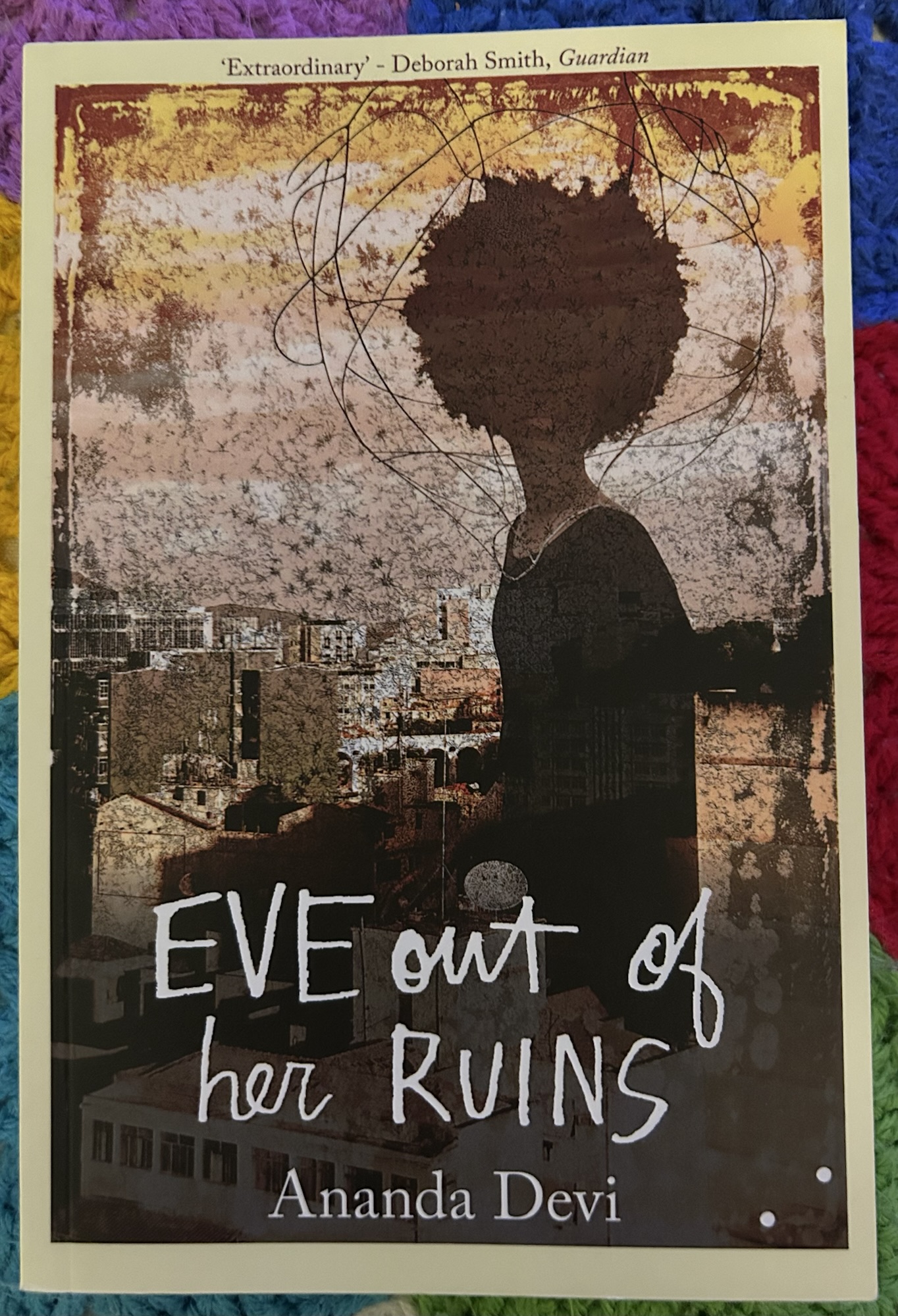
Eve Out of Her Ruins – Ananda Devi (2006, transl. Jeffrey Zuckerman, 2016) 164 pages

I picked up Eve Out of Her Ruins as I hadn’t read any Mauritian literature before and I’m enjoying seeking out new-to-me authors as part of my Around the World in 80 Books reading challenge.

The story is told from the point of view of four young people: Eve, Saad, Savita and Clélio who live in Troumaron, a cité geographically close to and societally far away from the capital Port-Louis. As Saad observes:

“Our cité is our kingdom. Our city in the city, our town in the town. Port Louis has changed shape; it has grown long teeth and buildings taller than its mountains. But our neighbourhood hasn’t changed. It’s the last bastion.”

Saad runs with the gangs to not draw attention to himself, but he loves poetry ever since he discovered Rimbaud, and he dreams of being a writer and escaping the ghetto.

“Just as the island unfurled it’s blues and oranges, so the words unfurled still more vividly purple rages in my head.”

He is in love with Eve, who learnt early on that although she had nothing, she still had something to sell. She has been trading her body to boys and then men, for school supplies and other things she needs, since she was a child. At 17, she is still a child, but a worn-out one.

“Saying no is an insult, because you would be taking away what they’ve already laid claim to.”

“I think I look like lots of things — organic, or mineral, or strange and sloughed off, but I don’t look like a woman. Only a reflection of a woman. Only an echo of a woman. Only the deformed idea of a woman.”

Eve’s sex work is portrayed carefully. It’s not explicit but nor is it obfuscated. I thought this was responsible without being overly harrowing or voyeuristic.

Clélio likes to sing from the rooftops, but is bewildered at how to escape the cité when he is already known to the police. He pins his hopes on his elder brother who has escaped to France, while simultaneously recognising that his brother’s life may not be going well, and he is unlikely to return to collect Clélio as he promised.

“I am Clélio. Dirt poor bastard, swallower of everyone else is rusty nails. What can you do? Nobody changes just like that.”

Eve and her friend Savita are in love, and it is Savita who recognises that Eve is getting more and more closed off as she tries to protect herself from the impact of her sex work and the domestic violence her father metes out at home. It is also Savita who recognises that as they get older, the boys’ anger is growing and the girls are increasingly vulnerable.

Saad sees this too, but knows Eve won’t listen to him however desperately he tries to reach her. There is real tension in the narrative as the sense of imminent violent explosion grows.

Eve Out of Her Ruins is a tough read and a million miles away from the paradisical tourist resorts of Mauritius. It is not poverty porn though, or voyeuristic. The voices of the young people ring true and lack any self-pity. The reader is not asked to pity them, but recognise their resilience and feel the desperation of seeking a way out when the odds are against you.

“They tell me I’ll succeed. But success does not mean the same thing for everyone. It’s a slippery word. In my case, it simply means that locked doors could open just a bit and I could, if I sucked in my stomach, slip through and escape Troumaron.”

In the Author’s Preface, Devi explains “I loved them and wanted to find a way out for them. I couldn’t, not for everyone. So I have left a trail of crumbs for some of them to follow.” Hence, there is hope in Eve Out of Her Ruins, it is not relentlessly bleak. But neither is it unrealistic or sentimental. It definitely doesn’t promise a happy-ever-after for the youngsters of Troumaron.

“I read in secret, all the time. I read in the toilets, I read in the middle of the night, I read as if books could loosen the noose tightening around my throat. I read to understand that there is somewhere else. A dimension where possibilities shimmer.”

“The life of every man is a diary in which he means to write one story, and writes another.” (JM Barrie)

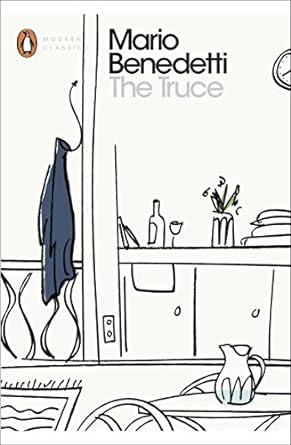
Continuing my endeavour to try and get some momentum back in my Around the World in 80 Books reading challenge, today I’m off to Uruguay, with Mario Benedetti’s The Truce: The Diary of Martín Santomé (1960, transl. Harry Morales 2015) which I was alerted to by Fiction Fan’s glowing review at the start of the year.

As the title suggests, the novella is in diary form, as Martín records his days in the run-up to his retirement, reflecting on how to live out his days. He is a quiet man in an administrative job; things are predictable.

“Today was a happy day; just routine.”

He is a widow of twenty years, and although he still has an eye for women (particularly their legs) he hasn’t had another relationship:

“The entire machinery of my emotions came to a halt twenty years ago when Isabel died. First there was pain, then indifference, then, much later, freedom, and then, finally, tedium. Long, lonely, constant tedium.”

His children Esteban, Jaime and Blanca are essentially unknown to him:

“At least Blanca and I have something in common: she, too, is a sad person with a calling for happiness.”

But although Martín is recording a lot of sadness, it’s not overly depressing. He has an acceptance of his life, and he makes quietly humorous observations, such as an old acquaintance learning of Isabel’s death:

“There is a sort of automatic reflex which makes one talk about death and then immediately look at one’s watch.”

Or his grief when his mother died:

“Only a fervent hatred of God, relatives and fellow man sustained me during that period.”

But things are about to change for Martín in ways he didn’t expect, when he falls in love with Laura Avellaneda, a work colleague half his age. While this would naturally raise questions about power dynamics and appropriateness, I felt it worked in The Truce, as Martín has been established as a gentle man, uninterested in wielding any sort of power or manipulation, and he is very respectful of Laura:

“I’m not going to demand anything. If you, now or tomorrow or whenever, tell me to stop, we won’t discuss the matter anymore and we’ll remain friends.”

In this short novel Benedetti perfectly evokes the gentle, slowly evolving love of Martín and Laura, and of Martín’s grief and acceptance of all he has lost in life alongside all that he still has. It suggests hope is still a realistic thing to hold onto, at any time.

The Truce isn’t sentimental, and although it depicts a romance it’s not rose-tinted. There is one point in particular where Martín behaves badly. He is not a perfect human-being and he causes hurt as well as joy to people.

But it is an empathetic tale, warmly clear-sighted towards ordinary people and all the foibles, weaknesses and strengths that we all carry.

The Truce is realistic, in a way that suggests even the most painful experiences can still be worthwhile. It explores how to not let pain overwhelm, and the importance of compassion for others and for the self:

They suffer from the most horrible variant of solitude: the solitude of someone who doesn’t even have himself.

This was my first experience of Benedetti and I’d be interested to read more by him. Apparently he wrote over ninety books so there’s plenty for me to choose from!

“It takes a village to raise a child.” (Proverb)

Well, as I predicted a significant part of my May was grim, but at least it was short-lived. So while I couldn’t commit to my novella a day in May project this year, I have managed to read a few novellas which I’m hoping to blog on before the end of the month. Here’s hoping June is a massive improvement!

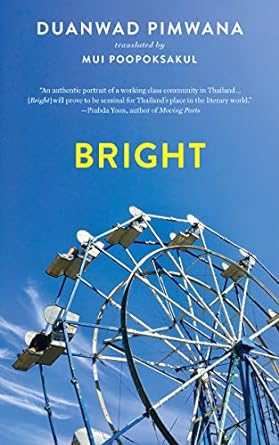
When I undertook the Around the World in 80 Books reading challenge, I wanted each book to be by an author from that country, not only set there. So the challenge has slowed as I try and locate appropriate translated fiction. Bright by Duanwad Pimwana (2002 transl. Mui Poopoksakul 2019) was apparently the first novel by a Thai woman to be translated into English. A volume of her short stories has also been translated, under the title Arid Dreams.

Bright almost reads like a series of short stories, except that the characters and setting are carried across the vignettes. It begins with a five-year-old boy, Kampol, being abandoned by his father who is taking his little brother Jon to live with his grandmother after their mother has left. But Bright isn’t unremittingly grim or a trip into poverty porn. The community of Mrs Tongan’s tenements rally round Kampol with varying degrees of willingness to ensure the boy is cared for.

“Kampol watched his father walk off until he disappeared. The flavour of the palo stew had grown distant, and the scent of detergent faint. He opened his hand: the blue action figure glinted in the dim light.”

We meet the various residents through Kampol’s eyes and we follow the events of the community alongside him. He plays with his best friend Oan, and is often cared for often by Oan’s hardworking mother Mon. But Pimwana never lets us forget that Kampol is carrying a lot of pain, just below the surface.

“He had found the best hiding place: you’d have to travel back in time to discover it. He skipped away joyfully. But then his melancholy caught up to him and his steps grew slow and measured – he didn’t know where to go.”

My heart sank when mobile caterer Dang offers Kampol a way to earn money if he keeps it quiet – but Dang only wants Kampol to walk on his back to relieve his aching muscles. Kampol also earns money running errands for soft-hearted Chong, the shopkeeper who finds it hard to refuse people credit. Bookish Chong was my favourite character, a man trying to convince the local kids of the joy of the printed word, without much success apart from Kampol.

“Chong was mournful as he watched the tree-cutting operation. The workers sawed off one section at a time, starting from the crown and working their way down. The pines disappeared, one top at a time, one tree at a time. Kampol stood next to Chong staring upward until the sky was empty. The notion of his mother, too, grew empty in his mind.”

The simple writing style worked really well in keeping the reader alongside Kampol while not claiming to be completely a child’s point of view. I found it direct and compelling in portraying a life with both hardships and joys in it.

Pimwana portrays a Thailand away from the tourist hotspots or glamourous settings. In doing so, she never patronises her characters or preaches of a life of either degrading poverty or sentimental saintly striving. The personalities in her pages are entirely believable, human and humane. It’s a fine balance that she achieves with the lightest touch. A hugely impressive and highly readable novella.

“He had felt lonesome before, many times in fact. But in those moments, even if he didn’t have anyone in the world, he had his familiar neighbourhood, with its familiar crevices and corners that he knew so well, which provided comfort. There was the wall outside Chong’s shop, where the jasmine bush stood, marked with dirt from where he leaned against it when he visited. Or there was the wedged fork of the poinciana. Or behind Mrs Tongjan’s house, his hideout beneath the shrub whose leafy branches bowed down and kissed the ground. When desolation struck, Kampol had these familiar nooks to embrace him.”

“I must love a loathed enemy.” (Romeo and Juliet, Act 1 Scene V)

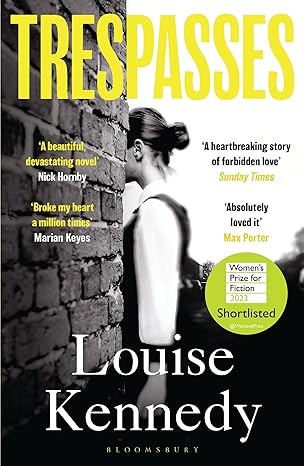
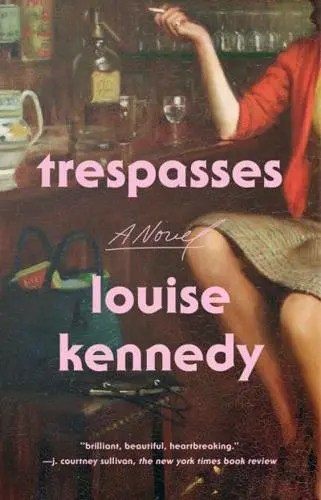
I’m not sure there’s much I can add to the cacophony of praise that Trespasses by Louise Kennedy (2022) has garnered. In fact I did consider not writing a post at all. But in the end because it moved me so much I thought I’d jot a few thoughts down as part of Reading Ireland 2024 aka the Begorrathon, hosted by Cathy at 746 Books. It’s also a stop on my Around the World in 80 Books reading challenge.

A summary of the plot doesn’t do this finely-crafted tale justice.

Cushla Lavery is a Catholic teacher, twenty-four years old and working at a school in a garrison town in 1970s Northern Ireland. She also helps out at her family’s pub, which is where she meets Michael Agnew – around twice her age, Protestant, and married. The attraction is instant and mutual.

“Countless times she had replayed the evening in her head, searching for the word or gesture or pronunciation that had repelled him, that had shown she was too young, too unsophisticated, too Catholic. It seemed piteous now that she had opened her college Irish books at Penny’s messy, elegant table, desperate to impress him. Perhaps she had been too obviously besotted with him.”

They know they have to keep their relationship secret. At the height of the Troubles, they are different religions and Michael already attracts attention through his work as a barrister defending those accused of killing members of the Royal Ulster Constabulary (RUC).

This is a time when politics and violence are woven through the daily lives of people in an immediate way. Cushla has to tread carefully around British soldiers in the pub, the threat of their brutality insidious and palpable. On the way to a party with her colleague and friend Gerry, they are stopped at an army checkpoint. At the flat where Cushla and Michael meet, she tells him not to sit with the lights on and curtains open, and her trepidation is not only due to their forbidden relationship…

Meanwhile, other aspects of life don’t stop. Her grieving mother Gina is self-medicating with gin. A boy in Cushla’s class, Davy McGeown, is bullied because he is from a mixed-marriage family and he ‘smells’ – his mother can’t hang the washing out because the neighbours throw dog dirt at it. His vulnerability is noticed by the priest Father Slattery, who everyone knows shouldn’t be left alone with children.

“Michael said there were all kinds of families. Cushla’s was an unhappy one. What was his like?”

The strain of daily life, living under the misuse of power both political and religious, is brilliantly realised. The narrative is incredibly tense, and the 1970s details are vivid.

The contrast of these tensions with the tender love between Cushla and Michael is subtly portrayed and never jars. Their relationship is believable, and while Michael is known to be “Fond of the women, by all accounts. Sure he’d charm the knickers off you.” he never seems creepy. Cushla is young but not naïve. They know what they have is unlikely to end well and yet they cling to it, the human need for love asserting itself over all that would seek to subdue it.

“She was overcome with a feeling of utter defeat. She wanted to lie on her bed and sleep, but had been unable to say no to him. It wasn’t because he had been kind to her. It was because each time she saw him she was afraid it would be the last time.”

It was the resilience Kennedy portrays which ultimately I found so moving. Not only with Cushla and Michael but in those that surround them, and particularly with Davy McGeown, a bright child caught up in a situation he barely comprehends.

“Booby trap. Incendiary device. Gelignite. Nitroglycerine. Petrol bomb. Rubber bullets. Saracen. Internment. The Special Powers Act. Vanguard. The vocabulary of a seven-year-old child now.”

Kennedy is not remotely sentimental but she is compassionate. She doesn’t judge people or the situation. Through creating recognisable, fully realised characters struggling to live the best way they can, Trespasses is a stunning exploration of the endurance of human spirit.

“For the umpteenth time Cushla wished her parents had called her Anne or Margaret or Rose – not Mary, with its connotations of Marian shrines and rosaries – any name that didn’t mark her out as so obviously a Catholic. She felt guilty for the thought which, she realised, also marked her as a Catholic.”

‘We look to Scotland for all of our ideas of civilization.’ (Voltaire)

After bookish travels (sadly not actual travels) to Ireland and Wales in March, I thought I would start April with a visit to Scotland and a stop on my Around the World in 80 Books reading challenge. As with actual travels, things did not go entirely plan…

Image from Wikimedia Commons

I have piles of Scottish authors in the TBR but my initial choices did not work out. The first novel I chose was excellent but brutal, so I just wanted to leave it behind at the end and not blog about it. My second choice I thought was safe; an established and accomplished author. Unfortunately I chose a novel she wrote at age 21, before she realised that sentences need a coherent structure. I got so sick of re-reading to try and work out which pronoun referred to which character that it was a rare DNF for me.

Given my reading pace is so slow at the moment, I then panicked and chose a novella and a short story to try and get something read. Thankfully these turned out to be enjoyable reads 😊

Firstly, Edinburgh-born Muriel Spark’s final novel, The Finishing School (2005). The titular institution is College Sunrise, on the shores of Lake Geneva, run by Rowland and Nina Mahler, although by Rowland in name only:

“To conserve his literary strength, as he put it, he left nearly all the office work to Nina who spoke good French and was dealing with the bureaucratic side of the school and with the parents, employing a kind of impressive carelessness.”

Feckless Rowland is thrown of kilter by the arrival of Chris Wiley at the school:

“His own sense of security was so strong as to be unnoticeable. He knew himself. He felt his talent. It was all a question of time and exercise. Because he was himself unusual, Chris perceived everyone else to be so.”

Chris is writing a novel about Mary Queen of Scots, unhindered by the actual facts of what happened. Although Rowland is tutor to the young artistic students, Chris keeps his writing progress secret, fully aware that this stokes Rowland’s obsession with him.

In this short novel, the other pupils and staff at the school are sketched in lightly but enjoyably, such as Mary: “her ambition was to open a village shop and sell ceramics and transparent scarves”.

Not a great deal happens, but the tension builds as Rowland becomes more fixated on Chris, and the two end up in a co-dependent relationship, as Chris observes:

“I need his jealousy. His intense jealousy. I can’t work without it.”

This being Spark, I couldn’t guess which way the novel would end as she mixes the very dark with a lightness of touch:

“ ‘Too much individualism,’ thought Rowland. ‘He is impeding me. I wish he could peacefully die in his sleep.’”

I wouldn’t say The Finishing School was Spark at the height of her powers – I found it a diverting read and an enjoyable one, but for me, Spark at her best is breath-taking, almost shocking. If you’re already a fan, there’s still much to enjoy here though. The askance view of human relationships, the morbid alongside the comic, the skewering of pretentious writers, and the arresting non-sequiturs.

Secondly, Until Such Times by Inverness-born writer Jessie Kesson (1985), which I had as part of the anthology Infinite Riches: Virago Modern Classics Short Stories (ed. Lynn Knight, 1993). It was a pretty good match for Spark although I didn’t plan it as such, with some darkly comic characterisation and a very unnerving ending.

The bairn is taken to live with her Grandmother and Aunt Edith:

“But you weren’t here to stay forever! Your Aunt Ailsa had promised you that. You was only here to stay… ‘Until Such Times’, Aunt Ailsa had said on the day she took you to Grandmother’s house…”

We join her with the house in a vague state of uproar trying to prepare for a visit from Aunt Millie and Cousin Alice. There is a suggestion that the visitors are respectable and admirable, whereas the bairn and Aunt Ailsa are somehow disreputable.

The narrative moves back and forth, showing the reader more than the bairn understands about her family situation and expertly drawing the dynamics between Grandmother, Aunt and child. The tension for a child living in a strict household and the manipulations and judgements of the Aunt (who is somehow unwell but never quite clear how; she is referred to by an old-fashioned term no longer used) was so well evoked.

At only 11 pages long, Kesson shows all that can be achieved in a short story: well-drawn characters, social commentary, narrative tension and a recognisable world. The final sentence was a perfect ending. I thought Until Such Times was really impressive and I’ll definitely look out for more of Kesson’s work.

To end, a Scottish treat for my mother, who is a big fan:

“I am always late on principle.” (Oscar Wilde)

After getting off to a pretty good start with my Women in Translation Month reading, I stalled badly with my final post. Although I read these two novels during August, writing about them in time for WIT Month 2021 (hosted by Meytal at Biblio) proved an insurmountable task. I still hope one day to get my blogging back on track but clearly August 2021 was not where this miracle was going to occur!

So here we are in September and I’m revisting two authors I’ve enjoyed in the past. When I decided to write on them initially I didn’t consider any connected themes, but there are some: ideas of home, otherness, what it means to live among a community, unlikely friendships, coming to terms with aging.

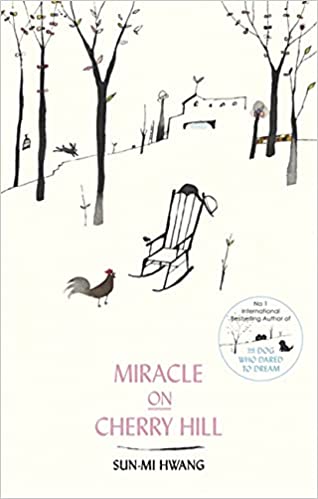
Firstly, Miracle on Cherry Hill by Sun-Mi Hwang (2019, trans. Chi-Young Kim 2019).  I enjoyed the simplicity of The Hen Who Dreamed She Could Fly and found it very moving, so I was looking forward to this. I also thought – rightly – that it shouldn’t be too traumatic, given I’m a delicate flower at the moment.  Like The Hen… this is a quick read with no great surprises, but that’s not a criticism, as it still offers a rich story with fully realised characters.

Miracle on Cherry Hill sees successful business leader Kang Dae-su move back to his childhood home town having been diagnosed with a brain tumour (named Sir Lump). He plans to hole up in a huge, fenced-off house, away from any company to see out his days.

“Cherry Hill was an outdated name. New apartment buildings had uprooted nearly every last cherry tree around it, like insects gnawing through greenery. Only one old original house remained in this neighbourhood, near the bus stop, because the woods surrounded it and the owner was stubborn. He also owned all the land surrounding the house, At least, that’s what they said – nobody had ever laid eyes on the owner.”

Things don’t go quite according to Kang’s plan. For a start, the townspeople have used his property while he has been absent. The children play hide-and-seek in the grounds, an elderly woman with dementia grows vegetables, her granddaughter Yuri exercises her puppy and collects hens eggs.

“How dare Sir Lump pity him? He heard something coasting along with the wind, something like humming. Kang remained on his back. If he concerned himself with every singing animal or person who was evidently trespassing on his property the tumour would swell and burst from sheer irritation.”

Despite Kang’s irritation, a series of comic events demonstrate it’s better to share his garden for continued use by the town. What’s more, he even invites people in, recognising troubled youngster Sanghun would benefit from being employed to mow his lawns.

As Kang begrudgingly becomes involved in the life of the town and the people who live there, he becomes reconciled to his past, and the pain from childhood he has been holding onto begins to heal.

“Each of these new discoveries left him with a refreshing sensation, as if a cold drop of water was falling into the depths of his heart. These feelings had to be carefully swallowed down.”

Miracle on Cherry Hill is a sweet tale, but not sentimental as it tackles some difficult issues. It’s fabulistic but also recognisably real. It’s poignant and playful, and as someone who loves a redemption story I found it charming.

Secondly, Drive Your Plow Over the Bones of the Dead by Olga Tokarczuk (2009 trans. Antonia Lloyd-Jones 2018) which was a highly anticipated read for me, having loved Flights. For some reason I didn’t count that read on my Around the World in 80 Books Reading Challenge, so Drive Your Plow… has formed my Poland visit.

This is a very different reading experience to Flights, which was fragmentary and mixed different genres. In contrast, Drive Your Plow… is more linear and plot-driven. However, it is still a complex novel that resists easy categorisation. I really loved it.

Janina Duszejko is a middle-aged woman with mysterious ailments, who hates her name and lives alone in a remote part of Poland:

“All you can see on the map is a road and a few houses. It’s always windy here, as waves of air come pouring across the mountains from west to east from the Czech Republic. In winter the wind becomes violent and shrill, howling in the chimneys. In summer it scatters amongst the leaves and rustles – it’s never quiet here.”

This harsh and isolated landscape suits Janina, as she is viewed as eccentric and regards people warily. When she engages in company, it is in her own way:

“What a lack of imagination it is to have official first names and surnames. No one ever remembers them, they’re so divorced from the Person, and so banal they don’t remind us of them at all…That’s why I try my best never to use first names or surnames, but prefer epithets that come to mind of their own accord the first time I see the Person.”

Janina is a fan of Blake and this is reflected not only in the title of he novel and the epigraphs, but also her Fondness for Capitalising for Emphasis, which I thought a nice touch and added to the sense of her unique voice.

At the start of the novel, Janina is disturbed by her neighbour Oddball, who asks her to come with him to check on another neighbour, Big Foot. He is dead, having choked on a bone. Janina doesn’t grieve for him as he was part of the local hunting club, and she much prefers animals to humans. Sadly her “Little Girls” – her two dogs – have disappeared.

As other members of the hunting club die – all local powerful men, all seemingly pretty unpleasant – Janina shares her theory with the police that animals are taking their revenge for the cruelties enacted upon them. This theory is supported by her astrological studies, and is completely ignored by the authorities:

“Once we have reached a certain age, it’s hard to be reconciled to the fact that people are always going to be impatient with us.”

The mystery of the deaths of the men isn’t the heart of the novel though. Although the blurb on mine describes it as ‘an existential thriller’ I wouldn’t even go that far.  For me the driving force of the story is the character of Janina and how she exposes attitudes to women, to aging; the power of the patriarchy, of money; and the disregard of anyone who is inconvenient to conventional society. She does this simply by existing and narrating how people respond to her.

I should warn readers here that the novel does describe cruelty to animals. Because Janina is appalled by it, the scenes are never dwelt on, but they are important to the story. This can make it a tough read but that is precisely the point – to question the horrors of how animals are treated. Drive Your Plow… was adapted into a film called Spoor in 2017 and I was going to end with the trailer, but even then there are some pretty grim scenes so I opted not to.

Drive Your Plow… raises important, complex themes through the voice of a truly memorable narrator. There is a dry humour running through the novel, but it also doesn’t pull its punches. The landscape is beautifully evoked and the characterisation compassionate. It will stay with me for a long time.

“As I gazed at the black and white landscape of the Plateau, I realised that sorrow is an important word for defining the world. It lies at the foundations of everything, it is the fifth element, the quintessence.”

To end, a song about a town community:

Novella a Day in May 2020 #13

The Aloe – Katherine Mansfield (1916, this edition 1983) 79 pages

The Aloe was Katharine Mansfield’s first punt at writing her short story Prelude, and so while it’s not entirely satisfactory as a fully realised story in its own right, there’s still a lot to enjoy here. It also forms another stop on my Around the World in 80 Days Reading Challenge

It begins with the Burnell family moving to a new home further out in the New Zealand countryside. The opening is told from the children’s point of view as the three of them are old enough to realise what is happening but too young to take an active part. I thought Mansfield captured the detailed minutiae of children’s lives so well:

“Kezia liked to stand so before the window. She liked the feeling of the cold shining glass against her hot little palms and she liked to watch the funny white tops that came on her fingers when she pressed them hard against the pane”

Once they arrive at the larger, more remote house, the attention shifts to the adults. Mansfield is incredibly subtle in her characterisation, drawing psychologically astute portraits but leaving the reader to work out what it means for this group of people to be living together.

Stanley Burnell is optimistic and eager about the move, little realising the various pressures it places on the women of the household, mainly because he is out in town all day:

“He was enormously pleased – weather like this set a final seal upon his bargain – he felt somehow – that he had bought the sun too and got it chucked in dirt cheap.”

His wife Linda is neither entirely happy nor completely unhappy, but certainly she is part of a generation of women given to mysterious ailments like headaches which enable her to spend a day in a room closed off from the rest of the household. She able to do so because her mother Mrs Fairchild is so capable and domesticated:

“There was a charm and grace in all her movements. It was not that she merely ‘set in order’; there seemed to be an almost positive quality in the obedience of things in her fine old hands.”

One piece of characterisation I really liked was Beryl, Linda’s sister. There is a hint that she may be trying to seduce her brother-in-law, mainly through boredom and a need to feel loved. As she writes a letter to her friend full of news that she knows is insincere, superficial prattle, she has this insight:

“Perhaps it was because she was not leading the life that she wanted to – she had not a chance to really express herself – she was always living below her power – and therefore she had no need of her real self – her real self only made her wretched.”

In lesser hands Beryl would just be a flighty, flirty, dreamer with the potential for real destruction, but Mansfield shows how all the women are forced into certain roles because society doesn’t give them the choices it affords to men. This is never didactic though; the reader is left to draw their own conclusions.

The Aloe only covers two days in this family’s life (though Mansfield ultimately wrote three short stories about the Burnells) but so much is explored, reading it is still a rich experience. My only reservation is that my delicate sensibilities could have done without the duck-killing scene (which I skimmed.) The novella does end rather abruptly but then it was never quite intended to be read as it is now.