After getting off to a pretty good start with my Women in Translation Month reading, I stalled badly with my final post. Although I read these two novels during August, writing about them in time for WIT Month 2021 (hosted by Meytal at Biblio) proved an insurmountable task. I still hope one day to get my blogging back on track but clearly August 2021 was not where this miracle was going to occur!
So here we are in September and I’m revisting two authors I’ve enjoyed in the past. When I decided to write on them initially I didn’t consider any connected themes, but there are some: ideas of home, otherness, what it means to live among a community, unlikely friendships, coming to terms with aging.
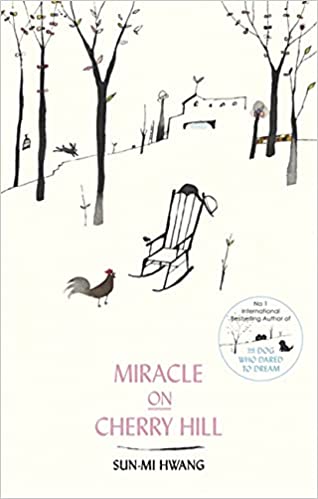
Firstly, Miracle on Cherry Hill by Sun-Mi Hwang (2019, trans. Chi-Young Kim 2019). I enjoyed the simplicity of The Hen Who Dreamed She Could Fly and found it very moving, so I was looking forward to this. I also thought – rightly – that it shouldn’t be too traumatic, given I’m a delicate flower at the moment. Like The Hen… this is a quick read with no great surprises, but that’s not a criticism, as it still offers a rich story with fully realised characters.
Miracle on Cherry Hill sees successful business leader Kang Dae-su move back to his childhood home town having been diagnosed with a brain tumour (named Sir Lump). He plans to hole up in a huge, fenced-off house, away from any company to see out his days.
“Cherry Hill was an outdated name. New apartment buildings had uprooted nearly every last cherry tree around it, like insects gnawing through greenery. Only one old original house remained in this neighbourhood, near the bus stop, because the woods surrounded it and the owner was stubborn. He also owned all the land surrounding the house, At least, that’s what they said – nobody had ever laid eyes on the owner.”
Things don’t go quite according to Kang’s plan. For a start, the townspeople have used his property while he has been absent. The children play hide-and-seek in the grounds, an elderly woman with dementia grows vegetables, her granddaughter Yuri exercises her puppy and collects hens eggs.
“How dare Sir Lump pity him? He heard something coasting along with the wind, something like humming. Kang remained on his back. If he concerned himself with every singing animal or person who was evidently trespassing on his property the tumour would swell and burst from sheer irritation.”
Despite Kang’s irritation, a series of comic events demonstrate it’s better to share his garden for continued use by the town. What’s more, he even invites people in, recognising troubled youngster Sanghun would benefit from being employed to mow his lawns.
As Kang begrudgingly becomes involved in the life of the town and the people who live there, he becomes reconciled to his past, and the pain from childhood he has been holding onto begins to heal.
“Each of these new discoveries left him with a refreshing sensation, as if a cold drop of water was falling into the depths of his heart. These feelings had to be carefully swallowed down.”
Miracle on Cherry Hill is a sweet tale, but not sentimental as it tackles some difficult issues. It’s fabulistic but also recognisably real. It’s poignant and playful, and as someone who loves a redemption story I found it charming.

Secondly, Drive Your Plow Over the Bones of the Dead by Olga Tokarczuk (2009 trans. Antonia Lloyd-Jones 2018) which was a highly anticipated read for me, having loved Flights. For some reason I didn’t count that read on my Around the World in 80 Books Reading Challenge, so Drive Your Plow… has formed my Poland visit.
This is a very different reading experience to Flights, which was fragmentary and mixed different genres. In contrast, Drive Your Plow… is more linear and plot-driven. However, it is still a complex novel that resists easy categorisation. I really loved it.
Janina Duszejko is a middle-aged woman with mysterious ailments, who hates her name and lives alone in a remote part of Poland:
“All you can see on the map is a road and a few houses. It’s always windy here, as waves of air come pouring across the mountains from west to east from the Czech Republic. In winter the wind becomes violent and shrill, howling in the chimneys. In summer it scatters amongst the leaves and rustles – it’s never quiet here.”
This harsh and isolated landscape suits Janina, as she is viewed as eccentric and regards people warily. When she engages in company, it is in her own way:
“What a lack of imagination it is to have official first names and surnames. No one ever remembers them, they’re so divorced from the Person, and so banal they don’t remind us of them at all…That’s why I try my best never to use first names or surnames, but prefer epithets that come to mind of their own accord the first time I see the Person.”
Janina is a fan of Blake and this is reflected not only in the title of he novel and the epigraphs, but also her Fondness for Capitalising for Emphasis, which I thought a nice touch and added to the sense of her unique voice.
At the start of the novel, Janina is disturbed by her neighbour Oddball, who asks her to come with him to check on another neighbour, Big Foot. He is dead, having choked on a bone. Janina doesn’t grieve for him as he was part of the local hunting club, and she much prefers animals to humans. Sadly her “Little Girls” – her two dogs – have disappeared.
As other members of the hunting club die – all local powerful men, all seemingly pretty unpleasant – Janina shares her theory with the police that animals are taking their revenge for the cruelties enacted upon them. This theory is supported by her astrological studies, and is completely ignored by the authorities:
“Once we have reached a certain age, it’s hard to be reconciled to the fact that people are always going to be impatient with us.”
The mystery of the deaths of the men isn’t the heart of the novel though. Although the blurb on mine describes it as ‘an existential thriller’ I wouldn’t even go that far. For me the driving force of the story is the character of Janina and how she exposes attitudes to women, to aging; the power of the patriarchy, of money; and the disregard of anyone who is inconvenient to conventional society. She does this simply by existing and narrating how people respond to her.
I should warn readers here that the novel does describe cruelty to animals. Because Janina is appalled by it, the scenes are never dwelt on, but they are important to the story. This can make it a tough read but that is precisely the point – to question the horrors of how animals are treated. Drive Your Plow… was adapted into a film called Spoor in 2017 and I was going to end with the trailer, but even then there are some pretty grim scenes so I opted not to.
Drive Your Plow… raises important, complex themes through the voice of a truly memorable narrator. There is a dry humour running through the novel, but it also doesn’t pull its punches. The landscape is beautifully evoked and the characterisation compassionate. It will stay with me for a long time.
“As I gazed at the black and white landscape of the Plateau, I realised that sorrow is an important word for defining the world. It lies at the foundations of everything, it is the fifth element, the quintessence.”
To end, a song about a town community:


