Novella a Day in May 2026 – No.7

Last year for this project I read Brigid Brophy’s The Snow Ball, which made me keen to read more. Hackenfeller’s Ape (1953) was her debut novel and already demonstrates what an accomplished stylist and storyteller she was.
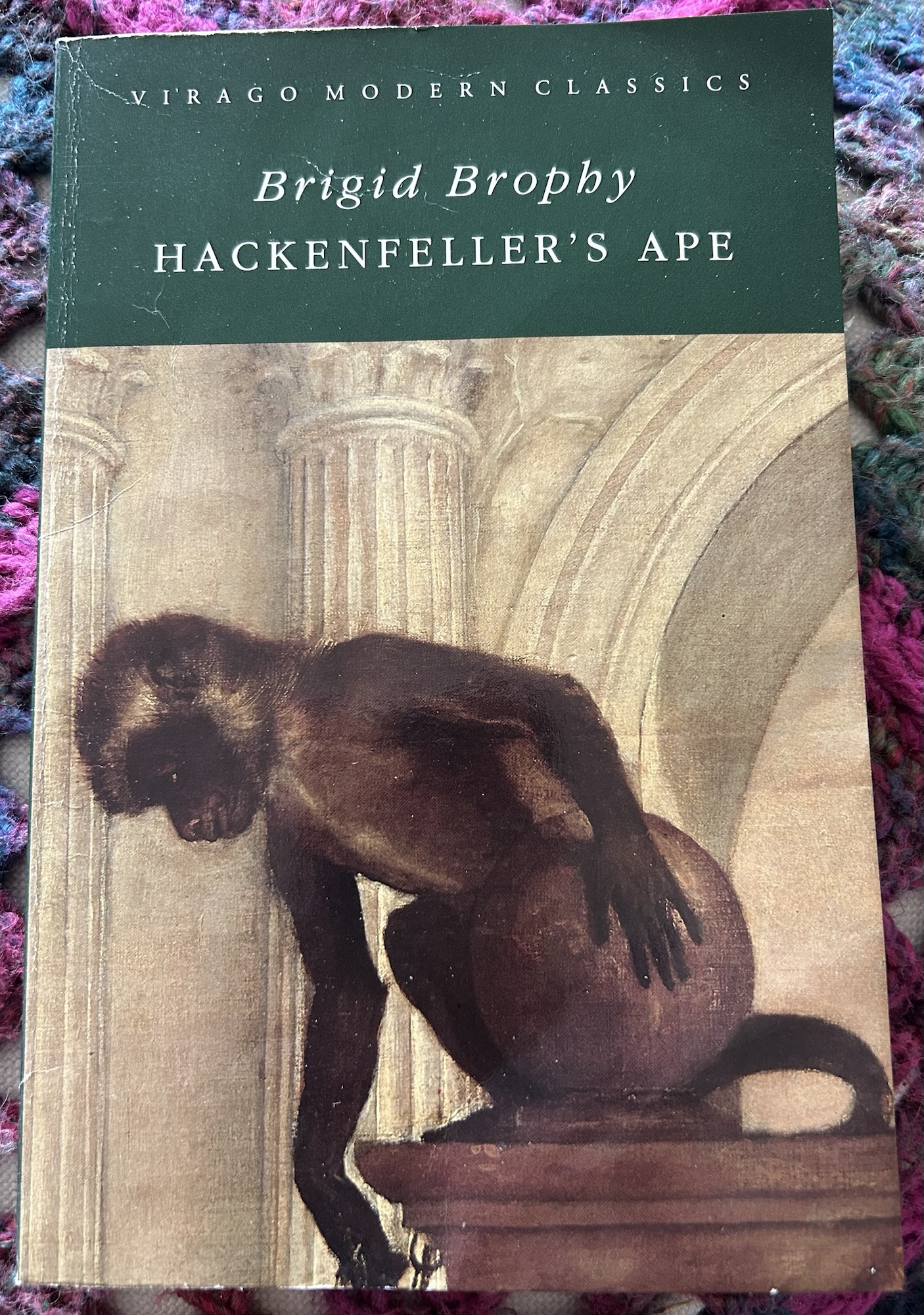
Professor Clement Darrelhyde is at London Zoo watching two Hackenfeller’s apes, Percy and Edwina. The apes are thought to be the closest to humans, and Brophy draws her parallels with a light comic touch.

“In captivity it moved on all fours; but in the jungle, as Hackenfeller had noted, it ran erect with its hands holding onto branches overhead. Children sometimes used a similar method when they learn to walk, but in the adult man it was forgotten until he had to relearn it in crowded buses and trains.”

Both the Professor and Edwina hope for a mating to occur, but Percy is not obliging, despite the Professor’s ritual of singing Mozart to them.

“Here was an animal discontent with his monkeydom, already exercising the first characteristic of Man, which Man had never satisfactorily explained, self-restraint.”

Very quickly we learn that the Professor is under time pressure. An arrogant young researcher named Kendrick wants to send Percy to space in a rocket. The Professor is outraged, disparagingly drawing parallels in his mind between Kendrick and Rossini! He has only a few days to try and rescue Percy (although, keeping him in a cage is an odd kind of rescue).

“He looked like a scholastic grasshopper, crossing Regent’s Park and shattering its pastoral calm.”

The Professor undertakes interviews of comic misunderstanding with a journalist, and the inappropriately named Colonel Hunter at the League for the Prevention of Unkind Practises to Animals. Brophy has great fun satirising the press bias and well-meaning inactivity of organisations.

Eventually the Professor is aided by Gloria, a young pickpocket and burglar who, having been in prison, is up for setting Percy free.

But what does Percy want? Brophy takes us inside his mind in a way that works perfectly. It never seems clunky or whimsical, and she never sentimentalises Percy. I particularly enjoyed this reflection of his:

“Physically, he was exhausted. The Professor had not let him have his sleep out; and that at first seemed typical of the Professor’s nattering officiousness.”

The Professor and Gloria seemed doomed to failure and I couldn’t work out how Brophy would end this tale, but it is surprising and sensational, and she carries it off with aplomb.

I should warn readers there are some upsetting moments with the animals, but these are sentences not scenes. Brophy was a leading campaigner for animal rights and she knows how to make her points without didacticism or horror.

This really is an astonishing novel, finely balancing serious issues with comedy, philosophy with outright silliness.

Hackenfeller’s Ape has been reissued by Faber as one of their wonderful Editions series. More than 70 years after it was written, I’m sure it will resonate with a new generation of readers.

Novella a Day in May 2025: No.17

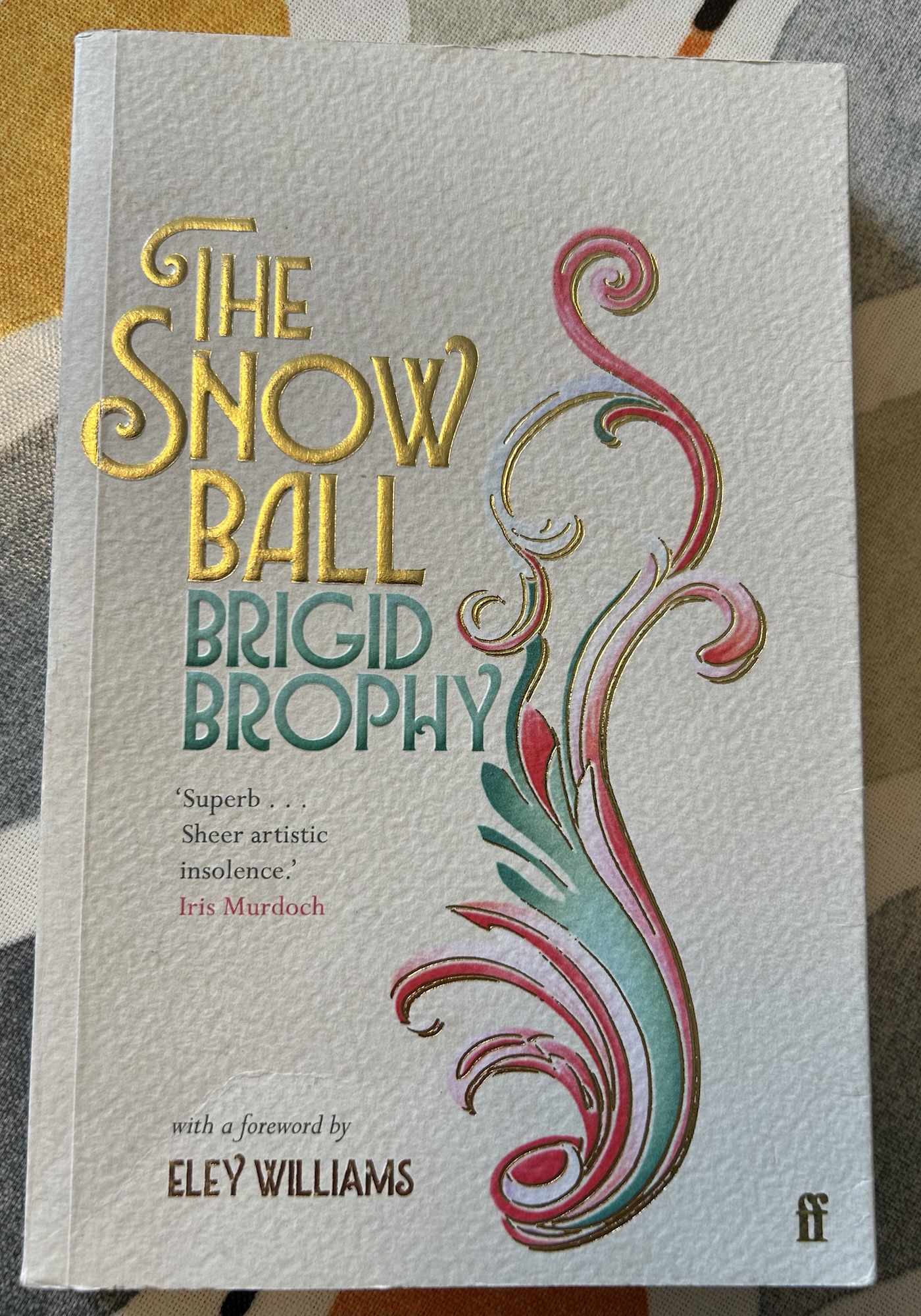
The Snow Ball – Brigid Brophy (1964) 196 pages

Brigid Brophy is an author who I’ve been meaning to try for a while, and The Snow Ball was a compelling introduction. It has an otherworldly quality, set over the course of one evening at the titular event and based on Mozart’s Don Giovanni.

An eighteenth-century fancy dress ball is being thrown by Anne and her fourth husband Tom-Tom at their Georgian London residence.  We follow Anna, Anne’s friend and confidant, throughout the evening. She is dressed as Donna Anna.

“Everyone grew a year older at once on New Year’s Eve, even those whose birthdays had been the day before. They gathered, Anna decided, for consolation: wearing historical costume to offset the advance of history.”

The incongruity and inaccuracy of the visual experience is used by Brophy to great effect, emphasising the unreality of the evening and showing how easily appearances can crack.

“Anna descended the grand staircase, knowing that Voltaire and Lady Hamilton were waiting for her in the crowd at the bottom. The noise, the scents, the very warmth of the people’s skins came to her as unmistakably twentieth century.”

Brophy has some startling images too, truly original turns of phrase. The décor is somewhat Rococo, with crumbling gold cherubs adorning the walls:

“It was as though between this room and Anna there was a genetic resemblance, a line of descent: as though it were a womb: into which, a newly born cherub in her early forties, she was always welcome to creep back.”

As this middle-aged cherub moves around the party she draws the attention of a man dressed in a black mask as Don Giovanni. She is also watched by Ruth, young and inexperienced, attending her first ball dressed as Cherubino and writing in her diary throughout the night:

“Feel there is something awful about all the people in the world, can’t think what they are here for—they don’t seem to matter—they are like atoms—they just move around without aim attracted or repelled by each other; hardly matters which. Anna K. is the most attractive woman I have ever seen. I detest her.”

We follow the seductions of the night, the dances people engage in both literally and metaphorically. Anna is a slightly subdued character next to the driven sexuality of Don Giovanni or the gregarious sociability of her friend Anne. Yet she is compelling as she tries to work out what happiness looks like for her as a recently divorced woman, against a background of revelry.

(Unlike its source inspiration, the seduction in The Snow Ball is explicitly successful and mutually consensual.)

The Snow Ball is eerie and unnerving while being recognisable. Its characters take pragmatic decisions surrounded by elevated theatricality – at one point peppermint creams rain down. It felt like a masque, but grounded in believable people rather than stock caricatures. It was hugely clever but not alienating and it’s definitely made me keen to pull Brophy’s The King of a Rainy Country out of the TBR.

“‘Have you noticed what a metaphysical ball this is?’ he said. ‘All these people bumping into one another and asking “Who are you?” even when they’ve known each other for years.’”