I enjoy satire but I think it can be hard to sustain, becoming bitter and distancing. Perfection by Vincenzo Latronico (2022, transl. Sophie Hughes 2025) judged this just right – at only 115 pages it is quick and incisive.
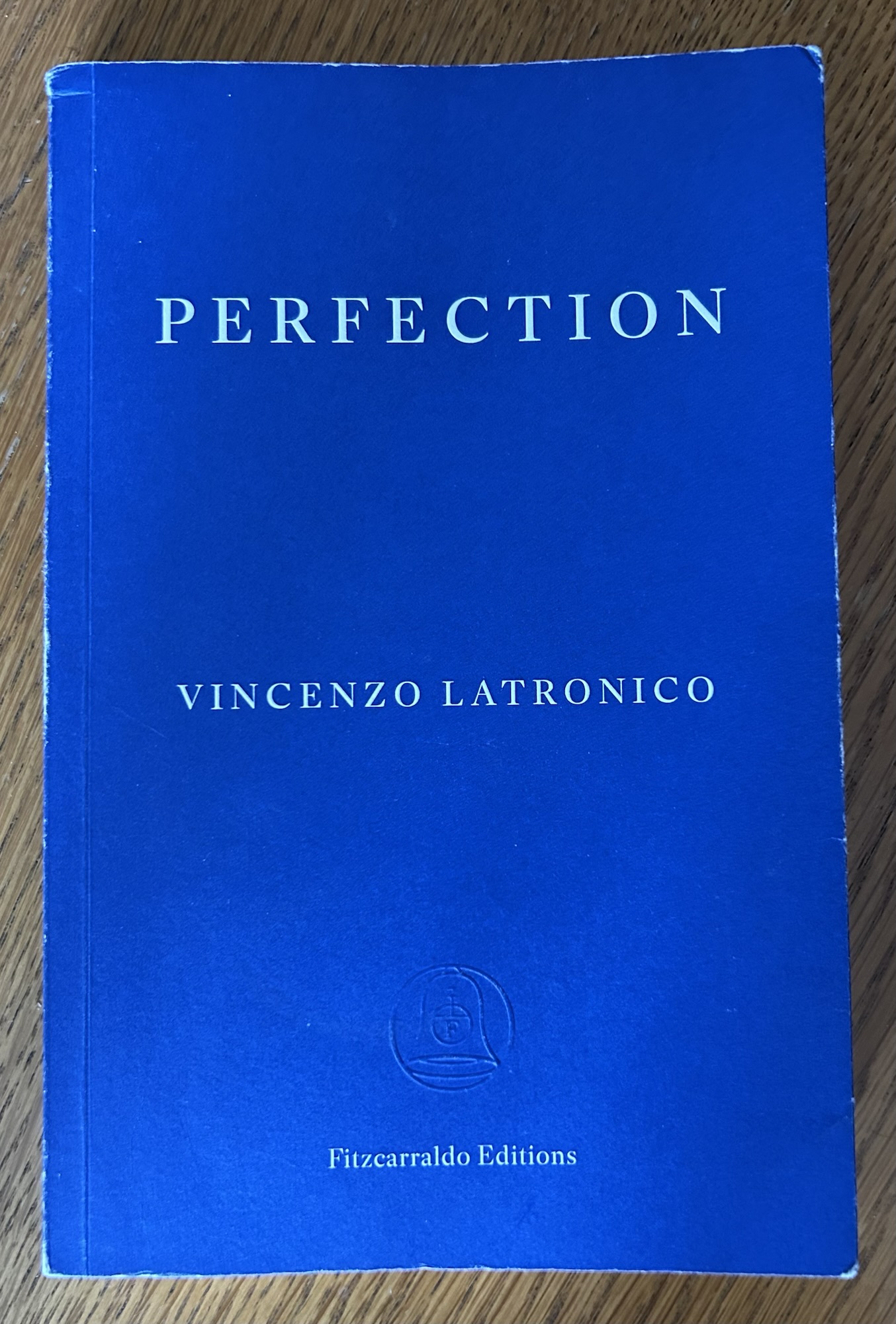
Anna and Tom have emigrated from an unnamed southern European country to Berlin, drawn by its cool reputation and cheap housing (at that time). The novella opens with an interiors magazine style description of their home, all verdant plants, string lights, mason jars, marble pastry table, and on and on and on… an overwhelming piling up of what they own and how they’ve styled it.
The next chapter gives the reality of living in that space: the clutter, the cleaning, the dust, the constantly accumulating mugs and tissues:
“It wasn’t order they so desperately craved, but something deeper and more essential. […]
In itself, chaos could be joyful, creative; But in that context, it only seemed to signal impermanence.”
Therein lies the problem. Anna and Tom are millennials who have grown up with the internet from its early iterations, they are constantly online looking at images, and feel very insecure when they can’t curate their reality like an Instagram post.
“Anna and Tom spent much of their first year in Berlin carefully constructing this mythology. And it wasn’t personal to them; its value lay precisely in its universality…. it was the topic of countless lifestyle articles and documentaries, and circulated on the Facebook timelines and Instagram feeds of an entire generation.”
They remain entirely ignorant of Berlin beyond cool places to socialise, and Germany itself. Their work is carried out online, their friends are just like them. They don’t learn German, they use Google translate.
“It never occurred to them, for example, that the distinction between Alt- and Neu- buildings in property listings had been drawn by the Allied bombings.”
Telling the story in the third person is entirely right: Anna and Tom have no innate sense of self, no inner life. They don’t know who they are if they are not viewed externally. While Latronico relates this very much to a specific online generation:
“They lived a double life. There was the tangible reality around them, and there were the images, also all around them.”
I also felt it was long-established folly to believe that what you own is who you are. Apparently Perfection was inspired by Things: A Story of the Sixties by Georges Perec, which shows how this conflict between image and reality, consumerism in a search for meaning did not arrive with the internet!
Advertising, which is both implicit and explicit in Anna and Tom’s world, is constantly promoting the idea that worth as a human is determined by money spent. You are your sofa/kitchen/car… But then, advertising also encourages consumers to constantly find themselves wanting, because there is always more money to be made by selling more stuff:
“The collective upheaval of the 20th century was over and the vestiges had been translated into the language of individualism—that is, of consumerism. Freedom had turned into abundance.”
Of course Tom and Anna aren’t happy. Their reality will always be messy at the edges, unlike a cropped image. They are also entirely incapable of working out why they aren’t happy. Content, well-adjusted people won’t spend as much money chasing illusion, so these answers won’t be sold online.
In an attempt to find meaning, they are clicktivists. I felt this was where Latronico was most scathing, whereby they and everyone in their bubble tells themselves they are socially engaged and responsible, just so long as it doesn’t mean any real action needs to be taken in their own lives, which could inconvenience them in any way:
“They identified as feminists and spoke out against social injustices, which in practise meant they were willing to express outrage at instances of racism or sexism that took place in New York. […] in practise, their social commitment amounted to using Uber only if it was snowing and always leaving tips in cash. They didn’t eat tuna.”
But for the most part I didn’t think Latronico despised Anna and Tom, I thought he felt for them as they struggled against what is essentially existential despair, without any tools to manage this. They were baffled that where they lived, what they owned, where they ate, and the holidays they took weren’t working. How could this be, when all those things looked great in online posts?
Perfection is short and snappy. It manages to be pinpoint specific and universal. Another fascinating read from Fitzcarraldo Editions!


I haven’t commented much on #NovellaADay but I have read everything via my inbox, and here we are the end with a novella I’ve read. I thought this was one of the best books nominated for — which prize was it? there are so many, I can’t remember!
Funny but incisive and with a message for us all about filling our lives with what’s real.
LikeLiked by 1 person
Thanks so much for reading all the posts Lisa, much appreciated!
I didn’t know this had been nominated for a prize, that’s good to hear. Great to hear you liked this too, as you say, a message for us all.
LikeLiked by 1 person
I looked it up: it was longlisted for the 2025 International Booker Prize, which is how I came to read it.
LikeLiked by 1 person
Ah, thank you!
LikeLiked by 1 person
Excellent review! I thought this was extraordinarily incisive without being judgemental. I didn’t know about the Perec inspiration. I felt it could easily be about an updated version of the ’80s as I read it.
LikeLiked by 1 person
Thanks Susan! Absolutely, the issues are enduring ones aren’t they? Even though he grounds it in a very specific generation, the technology is new but the issues are old…
LikeLiked by 1 person
I saw the title of this review and thought, ‘at least that’s one I won’t be adding to the list’; I tried this when it was first published but, despite all the hype, I didn’t like it. I was kind of hoping you would feel the same but after reading your masterful summary, now I think it is me and I need to work harder to get past my initial problem with the cool, detached style. I do see that is the whole point and I think you have persuaded me I should try again!
LikeLiked by 1 person
I somehow missed all the hype for this one! I just picked it up because I’ll always give Fitzcarraldo a try. I’m so often disappointed by hype so I can completely see how it could be a let down!
I think the detachment is deliberate, and the lack of characterisation. We don’t know anything about Anna and Tom as individuals but I think that’s the point – they don’t know who they are themselves beyond image and things.
I hope you enjoy it if you decide on a re-read, but at the same time, so many books, so little time… 😁
LikeLike
I’ve been circling this one, Madame B, as I love the Perec and so suspect I would like this too. Certainly consumerism was massively on the rise in the 1960s when Perec published his book, and the pressures are even more nowadays as the images come at us thick and fast from so many directions. Sounds like the author catches the hollowness of the characters’ lives brilliantly!
LikeLiked by 1 person
I’d be really interested to hear how you find this one Kaggsy, as you love the Perec. I’ll be looking to read that now.
He really does capture it brilliantly, and it’s astonishing that they have no idea as to why they might feel so unfulfilled.
LikeLiked by 1 person
It’s the online-ness that makes it all seem so hollow. At least if you were keeping up with the Joneses back in ye olden times, you really had to invite the Joneses round in order to make them jealous. Now you can simply tag them on your Instagram post…
LikeLiked by 1 person
Absolutely – the instincts are the same but the technology creates extra spaces that are so remote from actual people.
LikeLiked by 1 person
I enjoyed this a lot, but as you say, had it been any longer it would have started to strain.
LikeLiked by 1 person
Definitely – I thought he judged it well.
LikeLiked by 1 person
I have this waiting at the end of the bed so that’s good!
LikeLiked by 1 person
Great! I hope you enjoy it Jane.
LikeLiked by 1 person
I was so surprised by how much I loved this book!
LikeLiked by 1 person
It surprised me too! I thought I’d find it alienating but it was so well done.
LikeLike
I already wanted to read this one; the local library hasn’t purchased it, so I might have to make an excuse to have it… arrive.
LikeLiked by 1 person
Haha! Well, the library has forced your hand… 😀
LikeLike