I hadn’t heard of Rock Crystal by Adalbert Stifter (1945, transl. Elizabeth Mayer, Marianne Moore 1945) before, despite the fact that according to the back cover, Thomas Mann called Stifter “one of the most extraordinary, the most enigmatic, the most secretly daring and the most strangely gripping narrators in world literature”. I picked it up because NYRB Classics always prove interesting, and this was no exception.
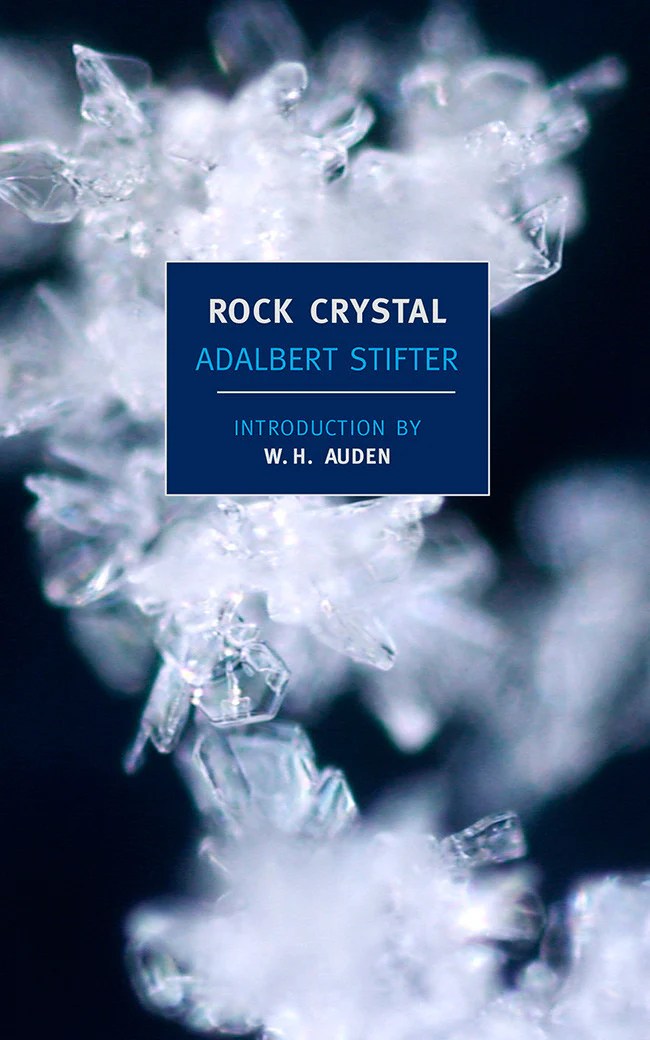
It opens with beautiful descriptions of its alpine setting:
“Among the high mountains of our country there is a little village with a small but needle-fine church-spire. Conspicuous above the green of abundant fruit trees, this spire—because the slates are painted vermilion—can be seen far and wide against the faint blue of the mountains.”
Rock Crystal is a Christmas story, and so the weather is very different:
“On the mountain, in winter, the two pinnacles called ‘horns’ are snow white and on clear days stand out in the dusky atmosphere with blinding brilliance; all the alpine meadows at the base of the summits are white then, as well as their sloping shoulders; even the precipitous rock faces or walls as the people call them, are coated with a white velvet nap of hoar-frost and glazed with ice tissue.”
And so the scene is exquisitely set for a fable, almost a fairytale. Certainly Rock Crystal’s central premise is a fairytale trope: two young children Conrad and Sanna, live in a village high in the Alps and walk through the forest to visit their grandparents in the valley.
They visit, collect their presents, and their grandmother warns them not to dawdle as they head back home. On the way home, the clear bright day changes rapidly with snow fall.
“There had descended upon everything a pervading sense of peace. Not the sound of a bird, although a few birds usually flit about in the woods even in winter, and the children on their way to Millsdorf that morning had heard them twitter.”
I thought the detail of the birds was so clever, horribly foreboding even as the children enjoy the snow.
Gradually the snow obliterates everything, so they lose their markers and without realising it walk onto a glacier.
“It was entirely dry, and they had smooth ice to walk on. But the whole cavern was blue, bluer than anything on earth, a blue deeper and finer than the vault of heaven itself, blue as azure glass with a faint light inside. There were massive ribs overhead, and more delicate ones, with pendant icicles, point lace, and tassels, the way leading further still—they knew not how far but they did not go on.”
Stifter places the reader alongside the children as they find some shelter as night falls and struggle not to fall asleep, knowing the dangers of doing so. I really couldn’t determine how this would work out.
And so the story, beautifully told, becomes unbearably tense. The complete disorientation is vividly conveyed, and these two small children against the immensity of the environment seem utterly lost.
In the introduction, WH Auden amusingly observes that Stifter takes “breathtaking risks of appalling banalities” yet somehow avoids them all. Who am I to disagree?
Rock Crystal quietly evokes the power of love of family, of community, and of place. A truly memorable read.


Gosh, this sounds marvellous Madame B. I’ve never read Stifter, though I do have his “Motley Stones” in the stacks which dear Lizzy passed on to me a few years back. I’ll try to bump it up the pile!
LikeLiked by 1 person
I hope you enjoy him Kaggsy! I’d definitely like to read more by him now, this was so beautifully written.
LikeLiked by 1 person
I’ve not read anything by Stifter, although I’ve had a copy of The Bachelors sitting around for ages, gathering dust. Rock Crystal sounds really good — the passages you quote are beautifully written — and the intro by Auden is certainly a plus!
LikeLiked by 1 person
I hope you enjoy him if you get to him! I’d like to read more now.
The Auden intro was great, short but entertaining!
LikeLike
Not an author I know at all. The description of the glacier is both beguilingly beautiful and quietly menacing.
LikeLiked by 1 person
That’s exactly it Susan! I found it ultimately very tense. I didn’t know the author either but I’m keen to try more of his work now.
LikeLiked by 1 person
I’d never heard of Stifter but I would be drawn to that cover in itself, quite apart from it being published by NYRB with a review by Auden! The writing is beautiful, haunting and atmospheric and, although sometimes I am too woosy to cop with too much menace, I get the sense that it was ultimately OK here so this is another one for my (long) list.
LikeLiked by 1 person
It is a striking cover image isn’t it? NYRB make such interesting choices. Glad I’ve tempted you, the writing is so evocative.
LikeLike
A new author to me. It does sound like a fairytale setting, and I can well imagine how the situation would make it a tense read.
LikeLiked by 1 person
He was completely new to me too, and he was so skilled at ramping up the tension!
LikeLiked by 1 person
A beautiful review of a book that I’ve been meaning to pick up for a while. It does sounds very haunting, like a fairy tale with the winter setting,..
I’ve read some of Stifter’s short stories (in a Vienna Tales anthology, I think, and possibly another collection at some point), and I remember them being evocative and well observed, As you say NYRB is always a good indicator of quality, so it’s hard to go wrong with their books!
LikeLiked by 1 person
Thanks Jacqui. It is very haunting, a lot of striking imagery.
Good to hear you’ve liked some of his short stories – I’ll have to seek out more of his work now.
I do find NYRB reassuringly reliable!
LikeLike
This sounds so good. Another on the list!
LikeLiked by 1 person
Great!
LikeLiked by 1 person
Crikey, this sounds great and I’ve never heard of him; another one for my list maybe for NovNov?
LikeLiked by 1 person
Perfect for NovNov as the nights draw in and it starts feeling chillier!
LikeLiked by 1 person
Not heard of this one, but it sounds special!
LikeLiked by 1 person
It’s very striking!
LikeLike
I’m right with you on the NYRB editions; I don’t care if I’ve never care of the author, they’ve got me!
LikeLiked by 1 person
They’re very reliable!
LikeLike