Review-along: Lady Audley’s Secret

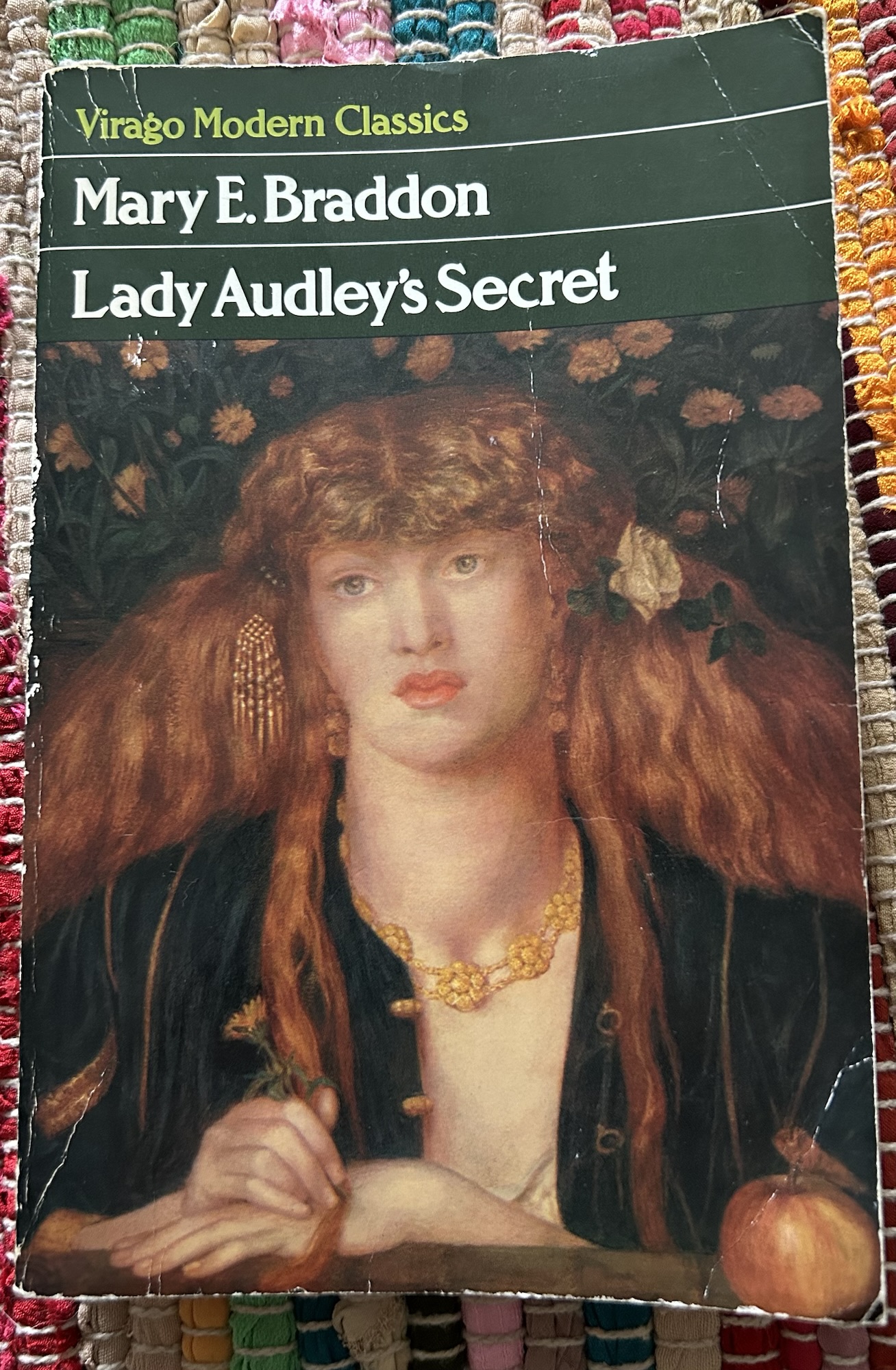
I really wanted to join in with the review-along for Lady Audley’s Secret by Mary Elizabeth Braddon (1862), as it’s a long-standing part of Mount TBR. Novellas a Day in May meant it was beyond me to post on 1 June, but here is my late entry!
The titular woman is introduced to the reader as a penniless but beautiful governess, Lucy Graham:

“Wherever she went she seemed to take joy and brightness with her. In the cottages of the poor her fair face shone like a sunbeam […] and when she tripped away, leaving nothing behind her (for her poor salary gave no scope to her benevolence), the old woman would burst out into senile raptures with her grace, beauty, and her kindliness, such as she never bestowed upon the vicar’s wife, who half fed and clothed her. For you see, Miss Lucy Graham was blessed with that magic power of fascination, by which a woman can charm with a word or intoxicate with a smile. Every one loved, admired, and praised her.”

Is it me or is there some sly humour there? This woman elbowing her way into the cottages of the poor, assuming that to bask in her presence is payment enough? I don’t think Braddon takes a humorous approach generally to this sensation story, but maybe there’s a bit happening…

Lucy catches the eye of Sir Michael Audley, windowed and stinking rich, so of course they are married. But here Lucy’s charms find their limit, with spiky step-daughter Alicia who is only a few years younger:

“She is a vain, frivolous, heartless little coquette,” said Alicia, addressing herself to her Newfoundland dog Caesar, who was the sole recipient of the young lady’s confidences; “she is a practiced and consummate flirt, Caesar; and not contented with setting her yellow ringlets and her silly giggle at half the men in Essex, she must needs make that stupid cousin of mine dance attendance upon her. I haven’t common patience with her.”

The stupid cousin is feckless Robert Audley:

“Sometimes, when the weather was very hot, and he had exhausted himself with the exertion of smoking his German pipe, and reading French novels, he would stroll into the Temple Gardens, and lying in some shady spot, pale and cool, with his shirt collar turned down and a blue silk handkerchief tied loosely about his neck, would tell grave benchers that he had knocked himself up with over work.”

However, when Robert’s friend George Talboys disappears on a visit to Audley Court, Robert can’t shake off his feeling that something is deeply amiss, and begins to investigate.

“The lazy bent of his mind, which prevented him from thinking of half a dozen things at a time, and not thinking thoroughly of any one of them, as is the manner of your more energetic people, made him remarkably clear-sighted upon any point to which he ever gave his serious attention.”

This pulls him into a convoluted tale, whereby George had abandoned his wife and baby to seek his fortune in Australia, fully expecting her to be patiently waiting after three and a half years in which he didn’t contact her once. On his return, George found his wife had died and his son was being raised by his father-in-law, a man who spends all his money on alcohol.

Robert soon realises that the new Lady Audley may be involved with George Talboys’ disappearance…shocker! The secret is quickly worked out by the reader and we watch as Robert tries to unravel her history and prove what has happened to his friend.

His investigation will see him uncover murder, arson, thefts, lies, manipulations, impersonations, conspiracies… well, it is a sensation novel after all!

The exploration of women’s roles in Lady Audley’s Secret is interesting. Lucy is constantly referred to as beautiful, doll-like, with a halo of golden curls. She revels in material wealth, but like a child.

“Her fragile figure, which she loved to dress in heavy velvets, and stiff, rustling silks, till she looked like a child tricked out for a masquerade, was as girlish as if she had just left the nursery. All her amusements were childish. She hated reading, or study of any kind, and loved society. Rather than be alone, she would admit Phoebe Marks into her confidence, and loll on one of the sofas in her luxurious dressing-room, discussing a new costume for some coming dinner-party; or sit chattering to the girl with her jewel-box beside her, upon the satin cushions, and Sir Michael’s presents spread out in her lap, while she counted and admired her treasures.”

But what is also made clear is that this love of money has grown from a background of poverty. Lucy knows what it is to be poor, and she never wants to be that way again. The way to ensure this, is to use her looks and marry for money. In Victorian society that is the best use of her resources.

Meanwhile Alicia enjoys being sporty and active, and is rubbish at running a household. She seems to spend a lot of time being furious, which seems borne of frustration that she doesn’t have a lot of options as to what to do with her sharp mind and talents, as well as Robert’s failure to realise she is in love with him.

There’s some anti-women rhetoric in the novel too, mainly from Robert, but this seemed a source of humour and I felt Braddon was more on the side of questioning the limited choices for women at the time. I also found among the sensation, a nudge towards compassion and moderation, particularly in the character of George’s father, the wonderfully named Harcourt Talboys:

“There were no shady nooks in his character into which one could creep for shelter from his hard daylight. He was all daylight. He looked at everything in the same broad glare of intellectual sunlight, and would see no softening shadows that might alter the sharp outlines of cruel facts, subduing them to beauty. I do not know if I express what I mean, when I say that there were no curves in his character—that his mind ran in straight lines, never diverging to the right or the left to round off their pitiless angles. With him right was right, and wrong was wrong. He had never in his merciless, conscientious life admitted the idea that circumstances might mitigate the blackness of wrong or weaken the force of right. He had cast off his only son because his only son had disobeyed him, and he was ready to cast off his only daughter at five minutes’ notice for the same reason.”

All in all I enjoyed Lady Audley’s Secret, but it was repetitive and overlong. This is a bit of an unfair criticism; like many Victorian ‘baggy monsters’ it was serialised and the repetition was to get readers up to speed/remind them of what had gone before. But reading it as a 376 page novel with teeny-tiny type meant I felt it could have easily stood to lose 100 pages.

However, it was also a ripping yarn, an interesting portrait of various aspects of Victorian society written in a readable style, had some lovely descriptions (if repeated too often) and some complex characterisation in Lady Audley. I’m so pleased the read-along meant I finally got to this one.

Here is Fiction Fan’s Review which also has the links to other bloggers who were much more organised than I am and posted on time!
“I’ve always been in love with Melbourne.” (Kerry Greenwood)

Well, we’ve reached the end of November and contrary to my plans but entirely in keeping with my expectations, I’ve barely managed to blog at all despite all the wonderful reading events that take place. Still, I’m delighted that I am at least managing to join in with AusReading Month 2022 hosted by Brona at This Reading Life. (Even if it is at the eleventh hour and I’m conveniently ignoring the fact it’s already 1 December in Australia right now – I really must do better.)

I chose two novels out of the humungous VMC pile and they both turned out to be entertaining considerations of the roles of women in late nineteenth and early twentieth century Melbourne.

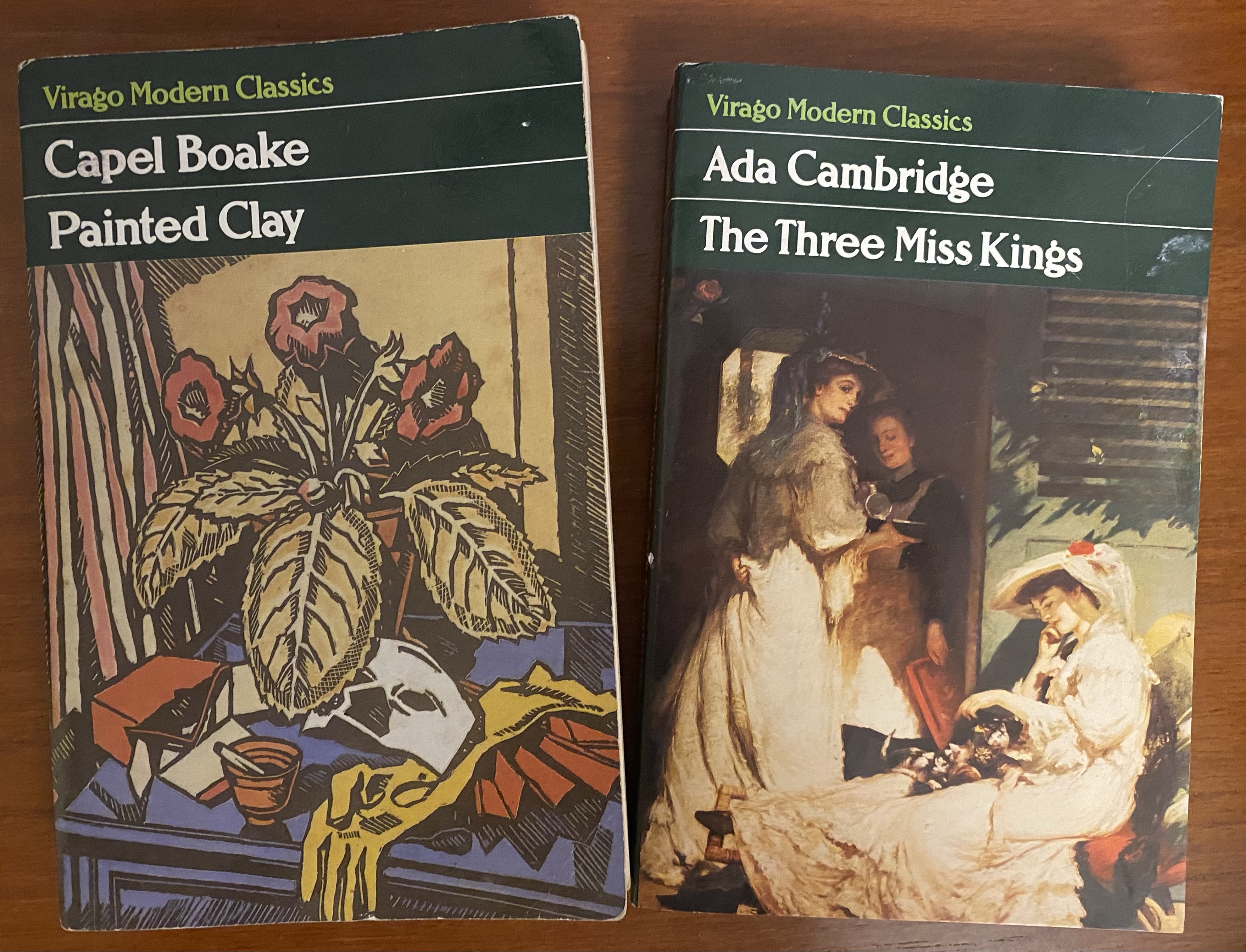
In reverse chronological order, Painted Clay by Capel Boake (1917). Set in 1913-14, this coming-of-age story follows Helen Somerset as she tries to forge her own way in a society that places considerable strictures on women.

At the start of the novel, lonely and isolated Helen is only a few years older than the century, as she living in a suburb with her distant father:

“Several women had watched carefully and had made sure their curtains had not been down for months. They always took their curtains down, washed them, and put them up again, every four weeks. The end house did not do this. Therefore there must be something very wrong with the occupants of the end house.”

Determined for change, she makes overtures to the young women who live next door, and finds herself invited in. She is shy and awkward, but the family is warm and welcoming.

“She knew that if she were alone she could have carried on the most brilliant conversation with everybody, but now she seemed to have nothing to say.”

Belle is engaged to sleazy Bert, while her sister Irene moons over the picture of a matinee idol. They are full of life and show Helen another way to live. She joins Irene in working in a shop, suffering under the deliberately unpleasant work given to her by the jealous supervisor. We follow Helen from shop to office work, as she learns to wrestle with the bullying of women and the unwanted attentions of men, struggling to work out what she wants when it seems to be so different from other women her age:

“She fled from the thought of sex; it horrified her – but it came back and back. She tried to close her mind against it, but it came insistent and whispering, distorting her view of life full in despair she went to her books again.”

Helen is not a wet blanket though, or a naïve and priggish beauty which can sometimes make heroines of this era hard to warm to. She’s quite determined to live her own life, away from the life paths everyone seems to expect of her.

“Helen had a soft, but unyielding obstinacy against which all argument beat in vain.”

Things begin to change for her when she is taken into a bohemian artistic set. She falls in lust with Alick Russell, and one thing leads predictably to another … what is less predictable is Helen’s reaction to sleeping with a man outside marriage:

“She wondered why she did not grieve over it, why she was not overcome with sorrow and repentance. She puzzled over it with frowning brows, but could reach no satisfactory conclusion.”

[…]

“I can’t see the difference between being married and not. It doesn’t seem to me to matter very much, and yet it does. I wish I were either a very bad woman or a very good one. If I were a bad woman nothing would bother me, and if I were a very good woman I wouldn’t think about it. I would just be married, and that would be the end of it.”

Painted Clay is a carefully non-didactic exploration of women’s roles and choices at this moment in time. Female characters are not judged for choosing unsatisfactory marriages, when the alternative may be worse for them. Older unmarried women are not shown as leading happy lives due to how limited their choices are, yet Helen is consistent in her belief that marriage is not for her.

Although not explicit, female desire is dealt with frankly, as is the fallout from its expression – fallout which lands disproportionately on women rather than men, despite their equal involvement.

What struck me most though, was not the attitude towards female sexuality or marriage, but towards sex work. It is referred to more than once in the novel and Boake is determinedly non-judgemental of those who undertake it. There is this interview Helen undergoes with a recruiting Madam:

“Helen shook her head, ‘No’ she said. ‘I can’t.’ Her tone was final, and the woman recognised it, though she made a last effort to persuade her. ‘Why not?’ she asked.

‘I don’t know why not,’ answered Helen. ‘It’s not my way, that’s all.’”

Then later in the novel she takes a woman from the street for a hot meal:

“Helen looked round with a frown. She found that everyone in the room was staring at them. She looked at them with bitter scorn. She hated them for their smug complacency. She felt neither love, liking, or even pity for the girl she was with, but she preferred her to the smug suburban women with their intolerable air of conscious virtue.”

I expected a much more judgemental attitude for the time, and it was refreshing to have this assumption undermined. (Also on the subject of the streets – the urban setting and changing seasons are wonderfully evoked. Sadly I don’t know Melbourne but I’m sure those who do would find much to enjoy in this evocation of it in the early decades of the last century).

Painted Clay was Capel Boake’s first novel and on the strength of this I would definitely be interested in reading more. It’s not the most sophisticated novel but it’s concise, well-paced and very readable.  Boake died in her 40s having published three novels (one further was published posthumously) and some poetry.

Secondly, The Three Miss Kings by Ada Cambridge (1891) which I was encouraged to take off the shelf by Emma’s escapism list. Although depicting a far more conventional life of middle-class mores and marriage than Painted Clay, The Three Miss Kings still manages to cast an askance, humorous view at late Victorian life.

At the beginning of the novel the titular heroines Elizabeth, Patty and Eleanor – find themselves all alone in the world after their father dies.

“It was a curious position altogether. As far as they knew, they had no relations, and they had never had a friend. Not one of them had left their home for a night since Eleanor was born, and not one invited guest had slept there during the whole of that period. They had never been to school, or had any governess but their mother, or any experience of life and the ways of the world save what they gained in their association with her, and from the books that she and their father selected for them.”

Cambridge is at pains to stress the young women’s refinement and ‘breeding’ to an extremely tedious degree. However, later in the novel she stops banging on about this quite so much, which was certainly a relief, and gets on with telling an oft-told tale in a very readable way (excepting a couple of clunky passages with characters voicing long opinions on topical issues such as the role of the church).

The women travel from their rural home to Melbourne to be shocked and then embraced by city life, under the guiding light of their self-appointed guardian Mrs Duff-Scott:

“The only drawback to her enjoyment in them was the consciousness that, though they were nobody else’s, they were not altogether hers. She would have given half her fortune to be able to buy them, as she would buy three bits of precious crockery, for her absolute possession, body and soul—to dress, to manage, to marry as she liked.”

Three comely young ladies, refined of manner and naïve of just about everything – what will possibly happen? Mrs Duff-Scott has an idea, and lines up potential suitors for all of them with alarming ineptitude. I particularly enjoyed her assessment of Mr Westmoreland:

“He was the richest of them all, and the most stupid, and therefore he seemed to be cut out for Patty, who, being so intellectual and so enterprising, would not only make a good use of his money, but would make the best that was to be made of him.”

Cambridge does undermine some of the conventions she is focussing on, or at least mocks them lightly. For example, how to describe her heroines:

“like a tall lily, I feel I ought (and for a moment was tempted) to add, only that I know no girl ever did look like a lily since the world was made, nor ever will, no matter what the processes of evolution may come to.”

She’s also very pragmatic alongside the romance, such as the consideration of marrying for money:

“If these motives seem poor and inadequate, in comparison with the great motive of all (as no doubt they are), we must remember that they are at the bottom of a considerable proportion of the marriages of real life, and not perhaps the least successful ones. It goes against me to admit so much, but one must take things as one finds them.”

She even allows some feminist commentary regarding commanding male heroes:

“’Who would marry a chicken-hearted milksop if she could get a splendid tyrant like that?’ exclaimed Patty, fervently, for the moment forgetting there were such things as woman’s rights in the world.”

So although a romance in many ways, The Three Miss Kings is not unwaveringly romantic. I’ve never read Ada Cambridge before and I really enjoyed this first encounter. She brought a different voice, humour and interesting characterisation to make a familiar story include some surprises.

The story is firmly rooted in 1880 and in Melbourne, with descriptions of the International Exhibition. Melbourne Cup, public gardens, streets and crowds which were very evocative. If I’ve not said much about the plot it’s because I don’t think it’s really needed – you get the idea!

“I don’t think it is that things are going wrong, dear. It is only that we have to manage them, and to steer our way, and to take care of ourselves, and that is so trying and perplexing.”

To end, forward a century for service as usual with a 1980s pop video, from a Melbourne band: