“My roommate got a pet elephant. Then it got lost. It’s in the apartment somewhere.” (Steven Wright)

This week’s theme stems from a very boring reason. But I try to pick themes that relate to my life or what’s happening in the world in some way, and my life is very boring. In fact, the most remarkable thing about it is just how dull it is. So brace yourself reader, and try & stay awake while I tell you that I am a leasehold flat owner.

I’ve always hated this because my managing agents are inept slimebags truly reprehensible human beings, but I spent an evening last week consoling a friend who is a share-of-freeholder and is engaged in a long dispute with her one of her neighbours/fellow freehold sharers, which has now turned vaguely medieval and who she refers to by a most unsavoury nickname.

If you’re still with me, you deserve a little treat. Here’s a trailer for one of my favourite ever films which is rather apt:

So as I spent a long time thinking about flats recently, the theme is novels set in apartment blocks. Firstly, Paradises by Iosi Havilio (2012, trans. Beth Fowler 2013). Apparently this is a sequel to the author’s previous novel Open Door, which I haven’t read, but it didn’t seem to restrict my understanding of Paradises, which I found compelling. Following the death of her partner, an unnamed woman leaves her country home with her small child, Simon, and moves to Buenos Aires. She gets a job at the local zoo:

“Something about the gloomy light, the small of the enclosure, the watchfulness of the snakes in captivity produces a hole in my stomach, an anguish that forces me to increase my pace. I skirt the large tank of water turtles, ignore the lizards walk past the door saying nursery and go outside.”

The janitor, Canetti, takes a shine to her. He used to be a bank treasurer before losing his job through fraud and is filled with bitterness. He shows the woman the el Buti squat, presided over by the obese, immobile, morphine-addicted Tosca.  She moves in:

“And yet despite the filth, the heat, those intestinal noises, and the smell of shit that rises in waves, at some point in the early hours Canetti’s words from the first time he brought me here come to mind: We’re safe here. I even babble them to myself to confirm it. And so I relax and rest a bit, although still without sleeping. On the third day I cover the windows with black bin bags to prolong the night.”

The voice of the young woman is matter-of-fact and she presents her extreme circumstances almost indifferently (Paradises has been compared to L’Etranger). This, combined with the present-tense, captured the numbness of grief and the sense of just getting through each moment. Yet according to the introduction by Alex Clark, the narrator’s passivity and weird equanimity was present in Open Door too, so maybe it’s just her character. Either way, I found her voice distinct and engaging. We follow her through her life as she juggles motherhood, work, relationships with idiodyncratic but wholly believable characters: seemingly spiky Iris who cares for Simon; the unpredictable Eloisa who seems to have no boundaries at all and drags the narrator along with her; the various residents of el Buti.

“each of us has to devise our truth in relation to the other”

The squat is surrounded by paradise trees, whose berries are poisonous and whose bark holds the cure. This duality is repeated throughout the novel: alienation sits alongside connection, love and grief are side by side. Paradises is an unsettling novel but at no point did I feel alienated from the unusual, detached woman telling the story. A remarkable achievement.

Let’s take a Vincent Cassel break (that’s definitely a thing, isn’t it?)

Secondly, A Far Cry from Kensington by Muriel Spark (1988) is set at “14 Church End Villas, South Kensington, that rooming house, shabby but clean, that today is a smart and expensive set of flats, gutted and restructured, far beyond the means of medical students, nurses, and the likes of us as we were.”

Narrated by the young widow Mrs Hawkins, she describes her time at the rooming house in the 1950s.  She moves between jobs in publishing with little respect for her employers:

“Sir Alec was thin and grey and his voice matched his looks. It sounded like a wisp of smoke wafting from some burning leaves hidden by a clump of lavender.”

“I had a sense he was offering things abominable to me, like decaffeinated coffee or coitus interruptus

Spark’s satire of publishing and writers is a joy, but A Far Cry From Kensington is also about capturing a moment in time when society is on the cusp of change. Relationships between the sexes are changing, and Mrs Hawkins pushes against societal expectations of women in the mid-20th century. She is resentful of being characterised as a capable widow (she feels this is partly due to her size and begins determinedly losing weight).

Meanwhile, there is tension in the house as someone is sending threatening anonymous letters to Wanda, a European seamstress who rooms there. The different residents begin to suspect each other while landlady Milly is certain it’s an outsider:

“Milly was upset at the suggestion that it was someone in the house, to the point of being almost mesmerized by the idea. She also feared further letters. ‘These things happen in threes’ said Milly in her way of uttering bits of folk-wisdom; she was spooning tea into the heated teapot. She always mixed tea with maxims.”

Mrs Hawkins is a great narrator: matter-of-fact, funny, uncompromising.

“I enjoy a puritanical and moralistic nature; it is my happy element to judge between right and wrong, regardless of what I might actually do.”

The plot around the victimisation of Wanda is frankly a bit bonkers and easily the weakest point in the novel, but despite a weak plot A Far Cry From Kensington is full of Spark’s wit and razor-sharp observation. Not a word in this short novel is wasted.

To end, a video putting the brutalist architecture of the Thamesmead flats to good use:
“The light of the day is followed by night, as a shadow follows a body.” (Aristotle)

We’ve arrived at the equinox where day and night are of equal length. In the northern hemisphere it’s the Spring Equinox and I’d love to say that winter finally seems far behind us but it’s still bloomin’ freezing.

Still, I’m hopeful that the weather will soon rectify my plummeting levels of vitamin D, and to celebrate I’ve chosen one novel set over a single day, and one set over a single night.

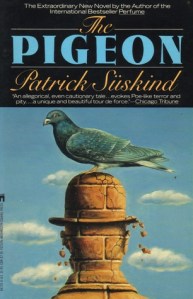
Firstly, daytime with The Pigeon by Patrick Suskind (1987, trans. John E Woods), which is a novella of just 77 pages in my edition, and yet feels entirely complete. It tells of a day in the life of Jonathan Noel, a bank security guard whose ordered, circumscribed life suits him perfectly. He lives in one room, goes to work, comes home and follows a routine whereby he tries to draw as little attention to himself as possible. Then one morning he opens his front door to find a pigeon sat there. The pigeon has also fouled the communal hallway.

“no human being can go on living in the same house with a pigeon, a pigeon is the epitome of chaos and anarchy, a pigeon that whizzes around unpredictably, that sets its claws in you, picks at your eyes, a pigeon that never stops soiling and spreading the filth and havoc of bacteria and meningitis virus, that doesn’t just stay alone, one pigeon lures other pigeons…”

As a Londoner that passage definitely spoke to me.

Jonathan manages to leave his room and get himself to work, but the presence of the pigeon has entirely destabilised him.

“But today everything was different. Today Jonathan was having no success whatever at achieving his sphinx-like calm. After only a few minutes he could feel the burden of his body as a painful pressure”

As we follow Jonathan through his day, a day beset by small catastrophes, Suskind shows “how quickly the solidly laid foundation of one’s existence could crumble.” Why Jonathan is so utterly discombobulated by the pigeon is never fully explained, but the tale is entirely believable. Jonathan is lonely and frustrated and the pigeon exposes the fissures in his careful façade.

“He had a mighty urge to pull out his pistol and let loose in every direction […] into the hot sky, into the horrible, oppressive, vaporous, pigeon blue-grey sky, bursting it, sending the leaden lid crashing with one shot, smashing down and pulverising everything and burying it all”

The Pigeon was Suskind’s follow-up to the massively successful Perfume. This is a very different tale  but an equally memorable piece of writing. Determinedly grounded in banal everyday detail, The Pigeon highlights the extraordinary inner lives that could be taking place beneath the most ordinary of outer lives.


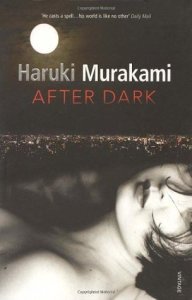
Secondly, into night with After Dark by Haruki Murakami (2004, trans. Jay Rubin) which follows a group of characters from just before midnight to just before dawn in Tokyo. A young girl, Mari, is reading in a nearly empty diner, when she encounters Takahasi, a musician who knows her and her beautiful model sister Eri. He’s chatty and seemingly unperturbed by Eri’s self-contained reticence. The difficulty of communication between people is a recurring theme:

“ ‘Finally, no matter what I say, it doesn’t reach her. This layer, like some kind of transparent sponge kind of thing, stands there between Eri Asai and me, and the words that come out of my mouth have to pass through it, and when that happens, The sponge sucks almost all the nutrients right out of them.’ ”

This idea of permeable surfaces also recurs, bring a surreal element to the story. Eri is asleep, watched by a masked man through an unplugged television set. At one point, Eri is dragged into the scene within the television. Meanwhile, Mari walks away from a mirror she has been gazing into:

“A closer look reveals that Mari’s image is still reflected in the mirror over the sink. The Mari in the mirror is looking from her side into this side. Her sombre gaze seems to be expecting some kind of occurrence. But there is no one on this side. Only her image is left in the Skylark’s restroom mirror.”

This surreal quality mixes with the viscerally real – a Chinese prostitute is beaten up and Mari is asked by the ex-wrestler manager of a love hotel to come and translate for her; characters search for and consume food; Shirakawa, the attacker, works late in his office and does sit-ups. The matter-of-fact narration is highly effective in grounding the story in a recognisable reality but also emphasising the unsettling, eerie quality of the tale. It is precisely because Tokyo and its inhabitants are so recognisable that the unpredictable, nocturnal elements are so unnerving. From this background, there is the possibility that Mari and Takahasi may begin a tentative romance:

“ ‘Wanna walk a little?’ Mari says.

‘Sure, let’s walk. Walking is good for you. Walk slowly, drink lots of water.’

‘What’s that supposed to mean?’

‘It’s my motto for life. ‘Walk slowly; drink lots of water.’

Mari looks at him. Weird motto. She does not comment on it however, or ask him about it. She gets out of the swing and starts walking. He follows her.”

I read After Dark in a wonderfully apt setting: a weirdly empty night bus (at only 201 pages I was able to finish it on the journey). I felt Murakami perfectly captured a sense of night, of the unknown, and of possibility.  He uses the night to heighten his portrayal of transgressed boundaries and of what is hidden, both knowingly and unknowingly, from others and from ourselves.

 “ ‘It’s not as if our lives are divided simply into light and dark. There’s a shadowy middle ground. Recognising and understanding the shadows is what a healthy intelligence does.’”

To end, a classy song choice for once 😉

“Our mothers always remain the strangest, craziest people we’ve ever met.” (Marguerite Duras)

It’s Mother’s Day today here in the UK and in Ireland, Nigeria, Jersey, Guernsey & the Isle of Man. The shops have never been so awash with pastel bouquets; trying to find a non-twee arrangement for a woman who would think I had lost my mind if I presented her with such has proved an epic quest.

Sometimes I worry my mother and I have a weird relationship (we definitely do). The run up to today has also been a cause of tension, as its my birthday, and we both think the other person should be the focus of the celebration* (I mean, 41 years old, who cares?) There’s nothing like reading about dysfunctional relationships to make you feel comparatively better about your own, so here are 2 short novels that expertly portray difficult, strange but loving mother/daughter relationships.

Firstly, Hot Milk by Deborah Levy (2016). Sofia and her mother Rose are in the south of Spain, desperately hoping (at least, Sofia is) that the unconventional approach of Dr Gomez will cure Rose of her various and variable health problems. The two of them have a claustrophobically co-dependent relationship, and while Sofia admits “I want a bigger life.” she is unable to tear herself away from her mother, physically and emotionally:

“I dared not move to a less painful position because I knew that she was scared and that I had to pretend not to be. She had no God to plead to for mercy or luck. It would be true to say she depended instead on human kindness and painkillers.”

Dr Gomez’s approach is psychological as well as physical, and he orders Sofia to spend time away from her mother. As the sun beats down, Sofia has time to think. Back in London, she works in a coffee shop and sleeps in what basically amounts to a cupboard on the premises. She has given up her PhD in social anthropology, but still thinks like a social anthropologist, such as when considering a woman she is interested in:

“Who is Ingrid Bauer? What are her beliefs and sacred ceremonies? Does she have economic autonomy? What are her rituals with menstrual blood? How does she react to the winter season? What is her attitude to beggars? Does she believe she has a soul? If she does, is it embodied by anything else? A bird or a tiger? Does she have an app for Uber on her smartphone? Her lips are so soft.”

We are entirely inside Sofia’s head and it is a suffocating, fascinating place to be. She is a mixture of insight and naivety, self-knowledge and self-delusion, but she starts to peel back a few layers of her life.

 “Anything covered is always interesting. There is never nothing beneath something that is covered.”

The relationship between Sofia and Rose is as suffocating as the heat that surrounds them, but Levy builds this up in small, telling details.

 “Sometimes, I find myself limping. It’s as if my body remembers the way I walk with my mother. Memory is not always reliable. It is not the whole truth. Even I know that.”

This idea of subjective truth permeates the novel. If Rose is a hypochondriac, or if she is deliberately manipulating or daughter, or if she is truly unwell, the result is the same. The truth of Rose, of Sofia, of their individual identities and relationship together will shift and change constantly. There is understanding but they don’t necessarily know one another, or themselves.

 “I have more of an ear for the language of symptoms and side effects, because that is my mother’s language. Perhaps it is my mother tongue.”

Levy is not interested in making Sofia or Rose likeable, yet both are sympathetic. They are both floundering, and this is described in beautiful precise prose.

“She had catalogued over a billion words but she could not find words for how her own wishes for herself had been dispersed in the winds and storms of a world not arranged to her advantage.”

Hot Milk has stayed with me long after I finished it. It is not a novel that ties things up neatly, because Levy would never be so trite, but that does not mean it is not satisfying. It’s a brilliant, disturbing story that creates an oppressive atmosphere and believable characters. A fully realised story in a small space: my favourite kind of writing.

Secondly, My Name is Lucy Barton by Elizabeth Strout (2016). I haven’t read Olive Kitteridge, which won Strout the Pulitzer Prize, but I definitely will now because the writing in Lucy Barton was perfection. Like Hot Milk, it’s a short tale (thanks to terrible London traffic I read the whole thing on an arduous journey to work one morning) but fully realised.

Lucy is looking back on when she was hospitalised with appendicitis. In a time before mobile phones and other digital communication (sometime in the 1980s) she feels isolated and so her husband asks her mother to visit her. Her mother has never been on a plane but she is a determined character and gets herself from the fields of Illinois to the concrete jungle of New York, to ask her daughter questions like:

“‘Wizzle, how can you live with no sky?’”

They haven’t seen each other in many years yet Lucy is happy to see her. The estrangement has emerged rather than been absolutely decided upon, but estrangement it most certainly is. Lucy’s childhood was not a happy one  and we gradually learn this through her recollections – most certainly not through any open discussion with her mother.

“There are times now, and my life has changed so completely, that I think back on the early years and I find myself thinking: It was not that bad. Perhaps it was not. But there are times too – unexpected – when walking down a sunny sidewalk, or watching the top of a tree bend in the wind, or seeing a November sky close down over the East River, I am suddenly filled with the knowledge of darkness so deep that a sound might escape my mouth, and I will step into the nearest clothing store to talk with a stranger about the shape of sweaters newly arrived.”

Lucy’s family was also incredibly poor, and yet it is this that has made her a college graduate and a writer, escaping her home town, something her brother and sister have not managed.

“There are elements that determine paths taken, and we can seldom find them or point to them accurately, but I have sometimes thought how I would stay late at school, where it was warm, just to be warm.”

Her mother regales her with anecdotes about families in their home town, but they never address the issues in their own family. It is never fully articulated exactly what went on, but it seems Lucy’s father had PTSD following the war, and was given to violent fits of temper.

“I took Vicky away in the fields until it was dark and we became more afraid of the dark than our own home, I still am not sure it’s a true memory, except I do know it, I think. I mean: It is true. Ask anyone who knew us.”

Not explicitly explaining what happened is a master stroke by Strout. The idea of unreliable memory is a recurring one and she effectively captures how family history is a mix of shared differing memories, understanding, bafflement, conflict and love. We rarely sit down and objectively explain our families and who we are to ourselves at length; it’s too close to see and insights come in flashes rather than long interior monologues. Lucy understands as best she can, and she accepts what she can.

“ ‘Lucy comes from nothing.’ I took no offense, and really, I take none now. But I think: No one in this world comes from nothing.”

Strout is a wonderful writer. She is interested in people and in presenting them in their unfinished state – there is a feeling her characters can surprise you, as we surprise each other and ourselves, because no-one is wholly consistent or coherent all of the time. She writes simply but beautifully.

“Lonely was the first flavour I had tasted in my life, and it was always there, hidden in the crevices of my mouth, reminding me.”

To end, my mother combines her mothering of me with that of my brother, who was a big Mr T fan when we were wee. But that’s really no justification for what follows:

*pub lunch

“The true novelist is one who understands the work as a continuous poem, is a myth-maker, and the wonder of the art resides in the endless different ways of telling a story.” (Muriel Spark)

Today would have been Muriel Spark’s 100th birthday, and there are celebrations and events taking place throughout the year, which you can read about here. Ali over at Heavenali is also doing a year long reading event #ReadingMuriel2018 so do join in exploring this wonderful novelist.

Image from here

2017 was the year of the novella for me. I don’t know why, but I repeatedly found myself drawn to short, tightly written, impactful stories. So it was inevitable that 2017 also became a year when I read Muriel Spark. She is absolutely masterful at the short novel. Her writing is sharp and concise, which suits her wit, but you never come away feeling short-changed; they are absolutely complete in themselves.  Here are 3 quick(ish) reviews of some Spark novellas that I read last year.

The Driver’s Seat (1970) 103 pages

This is a deeply unsettling tale, which leaves the reader with as many questions as answers by the end of it. It tells the story of the last few days of Lise’s life; this isn’t a spoiler as we know early on she will be found tied up and stabbed. Foreshadowing occurs throughout:

“She is neither good-looking nor bad-looking. Her nose is short and wider than it will look in the likeness constructed partly by the method of identikit, partly by actual photography, soon to be published in the newspapers of four languages.”

Spark does not ask that we feel sorry for Lise. The present tense and the characterisation are deliberately distancing. Lise is unlikeable – spiky and rude. She is also behaving somewhat eccentrically, dressing in vivid clashing colours  (“a lemon-yellow top with a skirt patterned in bright V’s of orange, mauve and blue… a summer coat with narrow stripes, red and white, with a white collar”) which she then screams justification for at a shop assistant:

“ ‘These colours go together perfectly. People here in the North are ignorant of colours. Conservative; old-fashioned. If only you knew! These colours are a natural blend for me. Absolutely natural.’ She does not wait for a reply”

We follow Lise as she catches a flight to an unnamed holiday destination, and goes in search of a man who represents “my type” although she does not specify exactly what this is, and we know it is not sexual. It gradually emerges that Lise has motivations that are not articulated, and yet they drive her on relentlessly:

 “ ‘It’s getting late,’ says Lise. Her lips are slightly parted and her nostrils and eyes, too, are a fragment more open than usual; she is a stag scenting the breeze, moving step by step…she seems at the same time to search for a certain air-current, a glimpse and an intimation.”

It’s almost impossible to say anymore without spoilers. There are some funny moments in this dark tale, a particular conversation filled with non-sequiturs made me laugh. But overall the feeling created is one of deep unease. It has been described as a ‘metaphysical shocker’, and is definitely not one for readers who like clear answers and loose ends all neatly tied up.

Image from here

The Ballad of Peckham Rye (1960) 143 pages

When I was reading this, one of my colleagues, who is a big Muriel Spark fan, described her as ‘a scamp’. This is a perfect description of the authorial tone in this funny, odd novella.

It opens with Humphrey Place declining to marry Dixie at the altar, and the blame for such behaviour being laid by onlookers at the door of Dougal Douglas, who is no longer around. We then head back in time to see Dougal’s arrival in Peckham and the havoc he wreaks before his departure.

Dougal acquires a position at the firm of Meadows, Meade and Grindley:

“Dougal turned sideways in his chair and gazed out of the window at the bridge; he was now a man of vision with a deformed shoulder. ‘The world of industry,’ said Dougal, ‘throbs with human life. It will be my job to take the pulse of the people and plumb the Industrial depths of Peckham.’”

Instead of doing anything near what he has been employed to do, he skives off work, gets another job at a rival firm under the name Douglas Dougal, for which he also does no work, and sets about unsettling the lives of everyone with whom he comes into contact. There is a weird, almost surreal tone to events and we are never told why Dougal is there or what his motivations are for anything.

“Mr Weedin laid his head in his hands and burst into tears.

Dougal said, ‘You’re a sick man, Mr Weedin. I can’t abide sickness. It’s my fatal flaw. But I’ve brought a comb with me. Would you like me to comb your hair?’

‘You’re unnatural,’ said Mr Weedin.

‘All human beings who breathe are a bit unnatural,’ Dougal said. ‘If you try to be too natural, see where it gets you.’”

Sharp was Catholic, and so it’s tempting to read this as an allegory. Dougal does have lumps on his head which he claims are where the horns were removed. I’m not sure we’re meant to read him as a devil, though he is devilishly beguiling. The Ballad of Peckham Rye is a quick, wonderful read, showing how easily the most ordinary of lives and events therein can tip into the extraordinary, and how little we know anyone, least of all ourselves.

Image from here

The Public Image (1968) 125 pages

The Public Image is a wonderfully pithy satire on fame, celebrity and how women are forced into certain roles. Annabel Christopher is an English actress living in Rome with her husband Frederick and baby Carl. Frederick despises his wife, she is partly aware and partly indifferent to this.

“Her husband, when she was in his company with his men friends…tolerantly and quite affectionately insinuated the fact of her stupidity, and she accepted this without resentment for as long as did not convey to her any sense of contempt. The fact that she was earning more and more money than her husband seemed to her at that time a simple proof that he did not want to work.”

While Frederick is weak and thwarted by his wife’s success, Annabel is superficial and self-obsessed, intent on cultivating her images as the “English Lady-Tiger” with her adoring Italian public. Frederick takes a drastic revenge on Annabel to try and destroy her public image, and thereby destroy her.

“She was as unaware of his secret life as she was of her own, for hers was not articulate. She probably never formed a sentence in her mind that she would hesitate to reveal to open air.”

However, while Annabel is vacuous, she is also sharp as a pin, with an astute understanding of how to cultivate and maintain her public relations. Everyone has underestimated her, and her campaign to maintain her public power will reveal a side to her previously unimagined.

It’s astonishing how little this novel has aged. In this era of dead-eyed celebrities maintaining an iron-grip on their image through incessant selfies on their Instagram accounts, Annabel looks positively self-effacing. Spark’s satire sparkles and illuminates the ugly side of glamour with incisive wit.

I’m yet to read any Spark where she seems off her tremendous game. Thankfully in this year of not buying books I still have The Mandelbaum Gate in the TBR, so I’ll definitely be reading that before her centenary is out.

Retro pop video to end as usual, but I do apologise, I couldn’t resist….


“To appreciate the beauty of a snowflake it is necessary to stand in the cold.” (Aristotle)

Temperatures have dropped in the UK and I’m writing this after coming in from a surprise snow flurry, while Scotland’s had proper snow, so I think now it’s December & officially winter. My choices this week are suitably wintry in theme, but they’re not a big tome to curl up with on a winter’s day. I’m going through a prolonged novella phase at the moment and these are excellent examples of how much can be achieved in a short space.  They’re small, but powerful.

Firstly, A Life’s Music by Andre Makine (2001, trans. Geoffrey Strachan) which comes in at 106 pages. The narrator is stuck in a snowbound railway station awaiting the Moscow train:

“Suddenly everything is illuminated by a truth that has no need of words: this night lost in a void of snow; a good hundred travellers huddled here; each seems as if he were breathing gently upon the fragile spark of his own life; this station with its vanished platforms; and these notes stealing in like moments from an utterly different life.”

The notes come from a piano being played by an elderly gentleman, tears streaming down his face. When they finally board the train, he tells the narrator his story, and why the music makes him cry. It is a tale of war and persecution, and of shifting identities in order to survive:

“As a result of this fear, and the assiduity with which he copied the actions of others during those first few weeks, he did not feel as if he were engaged in combat. And when he was finally able to relax the constantly taut string within him, he found himself in the sin of a veteran soldier”

Makine is interested in human endurance, in cruelty, in love and in moments of transcendence. He is brilliant at using small moments to illuminate big themes.

“To his surprise he felt himself growing increasingly separate from the wind, the earth, the cold, into which he had almost merged. But more surprising still was this simple bliss: the warm line where the woman’s body touched his own at night. Just this line, a gentle, living frontier, more substantial than any other truth in the world.”

A Life’s Music is a haunting tale written by a master. Makine proves that you don’t need to write at length to create something substantial. Stunning.

Secondly, A Meal in Winter by Hubert Mingarelli (2012 trans. Sam Taylor 2013) which is only 138 pages long. The premise of A Meal in Winter is incredibly simple, and the themes it explores incredibly complex. Three German soldiers find a Jewish man when they are on patrol in Poland. They do not share a common language with the young man and they take him prisoner with ease . They then retreat to an abandoned cottage to cook their meagre rations on a freezing winter’s day before taking him back to their barracks to be shot.

“everything would be better once it was warmer. Smoking and eating in front of the stove! What could be better? We would smoke while we waited for the bread to thaw and for the cornmeal to cook.”

The focus on essential human need for food, warmth and shelter is a master stroke by Mingarelli. The men are human first, soldiers second. Will they recognise their common humanity with their terrified prisoner and what will it mean if they do?

Mingarelli is excellent at building characters, scenes and atmosphere in a few words, and the desperate situation for all concerned is brilliantly evoked, within a harsh, freezing landscape:

“Sky and earth had blurred into one, and there was no comfort to be found in either. While I packed the snow into our mugs, I wondered again how it was possible that we had once seen so many sunflowers here, and not so long ago either. The landscape had been so full of them, so completely covered, that it seemed their oil must have been flowing like a river somewhere.”

A Meal in Winter is a powerful and moving novella that does not offer simple answers; it has really stayed with me.

To end, I know it’s a  wee bit early for Christmas tunes, but I’ve chosen it because of the excellent snowy outfits. Remember kids: real fur is cruel, and spandex leggings are not suitable winter attire.

“It’s the end of the world as we know it” (REM)

Kate from booksaremyfavouriteandbest suggested this week’s title & theme  – I think we all know why.

http-%2f%2fmashable-com%2fwp-content%2fuploads%2f2013%2f06%2fjohnny-depp-panics

Starting with an obvious choice, Signs Preceding the End of the World by Yuri Herrera (2009, tr. Lisa Dillon 2015), published by the wonderful &Other Stories Press – I wrote about another of their Mexican novels here. Herrera looks at the illegal immigrant experience through Makina, seeking out her brother at the behest of her mother, and desperate to return home.

“You’re going to cross and you’re going to get your feet wet and you’re going to be up against real roughnecks; you’ll get desperate of course, but you’ll see wonders and in the end you’ll find your brother, and even if you’re sad, you’ll wind up where you need to be.”

Makina’s journey is both physical and mythical.  As she travels through her homeland she has to ask men with pseudonyms for different types of help to get her across the border. The places she visits have similarly folkloric names: ‘The Place Where The Hills Meet’, ‘The Big Chilango’, ‘The Place Where People’s Hearts Are Eaten’ and across the border ‘The Place Where The Wind Cuts Like A Knife’. By not grounding Signs Preceding the End of the World in recognisable names and places, Herrera expands the simple journey to something much larger. Any tale of illegal immigration is going to have particular political resonances, but Herrera makes his heroine an Odysseus character and her trials a quest. While the tale is not surreal, there is a sense, as in myths and fables, that anything could happen:

“She looked into the mirrors: in front of her was her back: she looked behind but found only never-ending front, curving forward, as if inviting her to step through its thresholds. If she crossed them all, eventually, after many bends, she’d reach the right place; but it was a place she didn’t trust.”

Herrera is a writer who invents neologisms (definitely worth reading the interesting Translator’s Note for this novel) and so is fascinated by language. Through Makina’s journey he tracks the way that boundaries of countries, self and language are all permeable, and how this creates a modern, constantly shifting society:

“Makina senses in their tongue not a sudden absence but a shrewd metamorphosis, a self-defensive shift. They might be talking in perfect latin tongue and without warning begin to talk in perfect anglo tongue and keep it up like that, alternating between a thing that believes itself to be perfect  and a thing that believes itself to be perfect, morphing back and forth between two beasts until out of carelessness or clear intent  they suddenly stop switching tongues and start speaking that other one.”

Signs Preceding the End of the World is a fascinating, multi-layered novel, at once a story for our times but also engages with enduring, expansive themes. Hugely impressive.

And now I pause for thought to wonder if there are enough pictures of kittens in barrels to get me through a single news bulletin right now:

Secondly, Our Endless Numbered Days by Claire Fuller (2015) which I was alerted to last year by the many bloggers who loved this debut novel (written when the author was in her 40s – I must remember to tell my friend C who is coming to terms with the fact that she’s missed her window for those ‘30 Under 30’ type lists). I’m not going to buck the trend on this – I found it a compulsive read which I whizzed through to its gut-wrenching conclusion.

Peggy lives with her parents in the kind of north London middle-class bohemia that keeps Mini Boden in business.  Peggy doesn’t wear Mini Boden though, as it’s 1976 and her mother is busy being a concert pianist while her father gets into arguments with his friends in the North London Retreaters group. This collection of (male) survivalists are convinced nuclear war is imminent. A personal crisis forces Peggy’s father to act on his rhetoric, and he takes her to Germany, to live entirely isolated in “Die Hutte”, in the middle of a forest.  We know this fairytale has unravelled horribly from the opening line, told 9 years later by Peggy who is back in Highgate after a long absence:

“This morning, I found a black and white photograph of my father at the back of the bureau drawer. He didn’t look like a liar.”

The lie Peggy’s father told is astronomical: that the rest of the world has disappeared and they are the only two left living.

“ ‘We’re not going to live by somebody else’s rules of hours and minutes anymore,’ he said. ‘When to get up, when to go to church, when to go to work.’

I couldn’t remember my father ever going to church, or even to work.”

What follows is a narrative that moves back and forth between Peggy’s life in Die Hutte and that in 1985 Highgate with her mother and brother she never knew, Oskar. Fuller handles this extremely well, and I didn’t find the chopping back and forth disruptive or gimmicky. While not a thriller, Our Endless Numbered Days is definitely a page-turner, as Peggy’s comments drip-feed us information about what has gone on: there has been a fire, she has no hair, part of her ear is missing, her teeth are rotten, there is a man called Reuben involved in some way… and her father is no longer around.

The writing style is simple, and I found this a quick read, but the ideas are complex. Fuller is interested in the fantasies we tell ourselves and others in order to survive and the dangers inherent in not questioning these (insert heavy-handed political parallel here). She is interested in the price paid by powerless members of society when the powerful seek fulfilment by disregarding the needs of others (insert… well, you get the idea) and she is interested in the psychological fallout from childhood and our parents.  I saw the twists a mile off, and sometimes Peggy’s voice wavered, but this may have been intentional and it really didn’t matter. Peggy’s complex fairytale was both extreme and subtle, quite a feat.

“Oskar rapped his knuckles on the thick white ice which had risen like a soufflé out of a bucket hanging on a nail beside the back door. I recognised it, it was the bucket my father and I had used…Oskar laughed and turned the handle twisting it hard; his mouth twisting too with the effort. The tap snapped off. And for the first time since I had come home I cried – for the music, for Reuben, but most of all for the waste of a bucket.”

To end, goodbye to a poet and musician whose work is bringing me some comfort – as always – in these troubled times:

“Great things are done by a series of small things brought together.” (Vincent van Gogh)

This is my contribution to Small Press September, hosted by Bibliosa. Do head over to her blog to read all about it and join in! The novels are also two more stops on my Around the World in 80 Books Reading Challenge, hosted by Hard Book Habit.

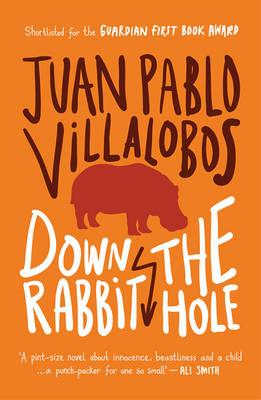
Firstly, Down the Rabbit Hole by Juan Pablo Villalobos (tr.Rosalind Harvey, 2011), which I picked up after reading Shoshi’s excellent review.  It is published by And Other Stories, a not-for-private-profit company which concentrates mainly on translated fiction. That sentence makes me feel better about the world 🙂

9781908276285

Back to the novel: Tochtli (rabbit in Nahuatl, an indigenous language of Mexico), tells us about his love of samurai films, hats, learning new words, and his life as the young son of a drug baron, Yolcaut (rattlesnake).

“I think we have a very good gang. I have proof. Gangs are all about solidarity. So solidarity means that because I like hats, Yolcaut buys me hats, lots of hats, so many that I have a collection from all over the world and all periods of the world. Although now more than new hats what I want is Liberian pygmy hippopotamus. I’ve already written it down on the list of things I want and given it to Miztli. That’s how we always do it, because I don’t go out much, so Miztli buys me all the things I want on orders from Yolcaut.”

The isolation is a necessary part of his father’s business, whose paranoia is an occupational hazard that is no doubt keeping them all alive. The tragic effect that this is having on young Tochtli becomes increasingly apparent as the story progresses. Tochtli accepts his life, knowing no different, but to the adult reader he displays worrying signs of severe anxiety: wanting his head shaved because he doesn’t want ‘dead’ hair on him, compulsively wearing hats, constant severe stomach pains, and later, after he sees something his father tried to keep hidden, selective mutism. He also takes violence pretty much in his stride:

“One of the things I’ve learnt from Yolcaut is that sometimes people don’t turn into corpses with just one bullet. Sometimes they need three or even fourteen bullets. It all depends where you aim them. If you put two bullets in their brains they’ll die for sure. But you can put up to 1,000 bullets in their hair and nothing will happen, though it might be fun to watch.”

Although dealing with extremely serious subject matter, there is humour is the novel, such as Tochtli’s description of the preparation for a drug run to Liberia which he also goes on in order to get one of his beloved pygmy hippos:

“By the way, Franklin Gomez started being Franklin Gomez yesterday in the airport. That’s what his passport from the country of Honduras says: Franklin Gomez. There were problems because Franklin Gomez didn’t want to be Franklin Gomez. Until Winston Lopez convinced him.”

In such a short tale (70 pages in my edition)Villalobos effectively widens the narrative of drug trade away from the usual barons/dealers/ users paradigm to show how the fallout from the industry can reach far and wide, including devastating those too young to have a choice about their own involvement. It is a truly moving story, not about drugs (you can read an article by the author where he refutes the term narcoliteratura here), but about children trying to cope with the messy, corrupt world adults create around them: sadly, pretty much a universal theme.

Fellow hat enthusiast, the late Isabella Blow, wearing Philip Treacy's Castle hat

Fellow hat enthusiast, the late Isabella Blow, wearing Philip Treacy’s Castle hat

Image from here

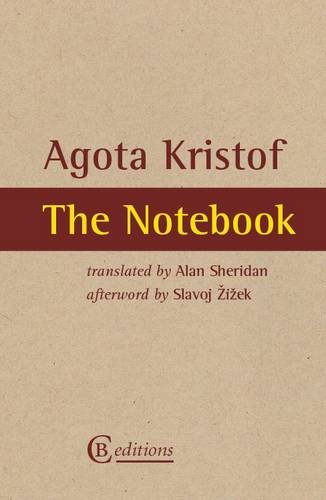
Secondly, The Notebook by Agota Kristof (1986, tr. Alan Sheridan, 1989) published by CB editions,  a publishing house which focuses on short fiction, poetry and translations. Kristof was Hungarian but was exiled to French-speaking Switzerland in 1956, and wrote this, her first novel, in French.

notebook

Like Down the Rabbit Hole, The Notebook is told from a child’s point of view, in this instance twin boys – we never know their individual names and they always use the first-person plural – who are evacuated to live with their maternal grandmother in the countryside of an unnamed nation, but which is generally thought to be Hungary.

“We call her Grandmother. People call her the Witch. She calls us ‘sons of a bitch’…Grandmother never washes. She wipes her mouth with the corner of her shawl when she has finished eating and drinking. She doesn’t wear knickers. When she wants to urinate, she just stops wherever she happens to be, spreads her legs and pisses on the ground under her skirt.”

This woman shows them no love or affection (although as the novel progresses we learn to recognise the small signs that she does care for them) and life is tough. They work on her smallholding and undertake various psychological ‘exercises’ to try and adjust to their straightened circumstances.

“ ‘My darlings! My loves! My joy! My adorable little babies!’ When we remember these words, our eyes fill with tears. We must forget these words because, now, nobody says such words to us and because our memory of them is too heavy a burden to bear. So we begin our exercise again in a different way…By repeating them we make these words gradually lose their meaning and the pain that they carry in them is reduced.”

The tone of the narration is astonishing. As the boys become more and more detached in an effort to preserve themselves from the horrors they witness, the reader is faced with filling in the gaps regarding what is happening. The delivery is so matter-of-fact that more the once I found myself stopping, thinking ‘Wait a minute, what the…’, going back and finding that something devastating had been described and I’d nearly missed it.

“Words that define feelings are very vague; it is better to avoid using them and to stick to description of objects, human beings and oneself; that is to say, to the faithful description of facts.”

The Notebook is a shattering work, and a challenging read. Human relationships are warped under the pressures of war. More than once, these pretty, golden twins get drawn into adult sex games. A young girl who is named after her birth anomaly – Harelip is apparently her given name – engages in some truly upsetting sexual acts. A neighbour behaves with horrific cruelty toward a group of starving people (presumably Jewish prisoners) and the boys wreak a terrible revenge (which they never admit in the text but you know what has happened and why). It is a difficult read but a powerful one, which does not shy away from the damage done when the acts of nations cause individuals to lose sight of their humanity. It is a political book, but not a polemical one: the twins’ equanimity leaves the reader to draw their own conclusions.

“Later, we have our own army and government again, but our army and government are controlled by our Liberators. Their flag flies over all the public buildings. The photograph of their leader is displayed everywhere. They teach us their songs and their dances; they show us their films in our cinemas. In the schools, the language of our liberators is compulsory; other foreign languages are forbidden.”

Highly recommended, but go in prepared – brilliantly written and completely brutal.

The Notebook was adapted into a film in 2013, which completely passed me by. From this trailer it looks excellent, and thankfully laws protecting children and animals means certain scenes are guaranteed to have not been filmed, surely?

“One fine day.” (Carole King)

Last week I mentioned that 2016 has been a terrible year so far. I don’t follow sport in any shape or form, but even I know Andy Murray has done his best to cheer up a post-Brexit UK by winning the men’s singles final at Wimbledon. Congratulations to all the winners!

andy-murray-wimbledon-tennis_3741489

Image from here

Obviously these wins are the result of years of dedicated training, but we all experience things that culminate in one day now and again. So to celebrate I’ve picked two novels that deal with the events of one day.

Firstly, Cheerful Weather for the Wedding by Julia Strachey (1932), who was one of the Bloomsbury group; this novel was originally published by Leonard and Virginia Woolf’s Hogarth Press, she was a niece of Lytton Strachey and was painted by Dora Carrington:

ARTstracheyJ2

This novella details the morning of a wedding: the preparations, the arrival of guests, the bustling of servants. The bride doesn’t make an entrance for a while, instead we are treated to her mother, Mrs Thatcham, giving contradictory instructions to all and not seeing that this why things are not organised as she expects:

“with a look of sharp anxiety on her face as usual – as though she had inadvertently swallowed a packet of live bumble-bees and was now beginning to feel them stirring about inside her. She stopped and looked at the clock.

‘I simply fail to understand it!’ burst from her lips.

She trotted briskly out of the drawing-room in the direction of the kitchen.”

Apparently this woman, who veers between being frustratingly tedious and a downright bully, was based on Strachey’s mother-in-law…

Meanwhile, the guests start to arrive. There are some lovely character sketches of family members and assorted hangers-on, told with gentle – in the main – humour.

“a tall, grey-haired man, in black clerical clothes, with a gaunt white face reminiscent of a Pre-Raphaelite painting of Dante. It was Canon Dakin, or Cousin Bob of Hadley Hill as the family called him.”

There is a hilarious description of a lampshade wedding gift and Aunt Katie’s verdurous wedding hat. My favourite little scene was between deluded Aunt Bella, who is busy boring her nephew Lob with tales of how her servants “simply cherish me”, and is met with the following non-sequitur:

“‘My dear lady,’ replied the cheerful Lob, speaking unexpectedly loudly, and holding his glass of wine up to the light for a moment, “I don’t care two pins about all that! No! The question, as I see it, is quite a different one. The whole thing is simply this: Is it possible to be a Reckless Libertine without spending a great deal of money?’”

When we finally meet the bride, Dolly, it is clear all is not well. For starters, she has put away most of a bottle of rum to enable her to stagger down the aisle:

“At this moment Dolly was trailing slowly down the back staircase (which was nearer to her part of the house than the main one), her lace train wound round and round her arm. From out of the voluminous folds of this there peeped a cork and the top of the neck of the bottle. In her other hand was her large bunch of carnations and lillies.” 

As Dolly is unsure of what she is doing and why, simultaneously there is an admirer of hers, Joseph, who may at any minute stop the wedding, though he is not sure of his motivations for doing so. Apparently Strachey was a fan of Chekov, and Cheerful Weather for the Wedding shows this influence in domestic subject matter and conflicted characters unable to take action. The humour is bittersweet: while the preparations and family members are portrayed with a light irreverence, the drunk bride and her inert friend? lover? – we are never told – bring a genuine sadness to proceedings. I couldn’t help feeling they were both on the brink of disaster.

“Dolly knew, as she looked around at the long wedding-veil stretching away forever, and at the women too, so busy all around her, that something remarkable and upsetting in her life was going steadily forward.”

Virginia Woolf’s opinion of Cheerful Weather for the Wedding was high: ‘I think it astonishingly good – complete and sharp and individual.’ Strachey doesn’t explain everything and leaves many questions in the reader’s mind as to what is going unsaid and undone on this nuptial morning (looking at the trailer for the 2012 film it looks as if everything is spelled out, so I will not be watching the film version – why? WHY??)  While it is short, Cheerful Weather for the Wedding is not slight – witty, sardonic, sad and wise – it is a fully realised portrait of everyday tragedy.

400x400_1335564193597-drunkbride

Image from here

Secondly, A Single Man by Christopher Isherwood (1964) tells a day in the life of George Falconer, an ex-pat English professor living alone in California just after the Cuban missile crisis, and grieving the loss of his partner Jim, killed suddenly in road traffic collision.

“And it is here, nearly every morning, that George, having reached the bottom of the stairs, has this sensation of suddenly finding himself on an abrupt, brutally broken off, jagged edge – as though the track had disappeared down a landslide. It is here that he stops short and knows, with a sick newness, almost as though it were for the first time: Jim is dead. Is dead.”

In the midst of this enormous pain, George carries on with his life: teaching a class, shopping, going to the gym, getting drunk with a friend.

“In ten minutes, George will have to be George; the George they have named and will recognise. So now he consciously applies himself to thinking their thoughts, getting into their mood. With the skill of a veteran, he rapidly puts on the psychological makeup for this role he must play.”

A Single Man is perfectly paced, capturing George’s numb putting-on-foot-in-front-of-the-other coping without losing narrative drive. The tone is gentle, treating George kindly, but without sentimentality – he is not always kind himself, and his views on those he encounters are unblinking. However, as we spend the day with George, we start to get glimmers of his desire to keep living, a sense that he will find meaning in carrying on. But then his grief completely side-swipes him:

“He pictures the evening he might have spent, snugly at home…only after a few instants does George notice the omission which makes it meaningless. What is left out of the picture is Jim, lying opposite him at the other end of the couch, also reading; the two of them absorbed in their books yet so completely aware of the other’s presence.”

There is sadness in A Single Man but it is not depressing. Rather it shows how life goes on in all its messy imperfection, and that can be OK, even when you are feeling far from fine.

 A Single Man was made into a film in 2009, the directorial debut of fashion designer Tom Ford. It certainly looked amazing and had some wonderful performances by Colin Firth and Julianne Moore, but the screenplay made some significant changes and unsurprisingly, I prefer the book for its subtlety and nuance. Kudos to Ford though, for filming a book that takes place almost entirely within one man’s head.

I hope you all have a great day ahead 🙂

“But what first, Debbie, attracted you to the millionaire Paul Daniels?” (Mrs Merton/Caroline Aherne)

Caroline Aherne, actor and writer, creator of the comedic brilliance that was The Royle Family, died on Saturday.  And so 2016 continues as forerunner for the most rubbish year in recent memory. If the political situation and the death of a yet another great person this year is getting you down, I would prescribe YouTubing  Caroline’s career for some solace.

If you enjoy someone’s work, there is a consolation that they leave this behind when they are no longer around, so I thought I would look at two novelists last works which were published in their lifetimes.

Firstly, The Old Man and the Sea by Ernest Hemingway (1952), fulfilling the sea-based tale requirement of the Around the World in 80 Books reading challenge hosted by Hard Book Habit. And so my inexplicable love affair with Hemingway continues. I’ve written before about how much I want to dislike Hemingway, but I just adore his writing. Like all great love affairs, we are wholly incompatible, and yet I find myself drawn back time and time again, whilst knowing I cannot change him. The Old Man and the Sea did not succeed in breaking the spell.

Hemingway, rocking a chunky knit to give his best salty old sea dog impression

Hemingway, rocking a chunky knit to give his best salty old sea dog impression

The titular old man is Santiago, a Cuban fisherman who sails in the Gulf Stream and has gone 84 days without catching a fish.

“Everything about him was old except his eyes and they were the same colour as the sea and were cheerful and undefeated.”

Manolin, a young boy, has known the fisherman his whole life and loves him, and it is through his eyes that we first see Santiago:

“His shirt had been patched so many times that it was like the sail and the patches were faded to many different shades by the sun. The old man’s head was very old though and with his eyes closed there was no life in his face. The newspaper lay across his knees and the weight of his arm held it there in the evening breeze. He was barefooted.

The boy left him there and when he came back the old man was still asleep.

“Wake up old man,” the boy said and put his hand on one of the old man’s knees.

The old man opened his eyes and for a moment he was coming back from a long way away. Then he smiled.”

They head out to fish separately – Manolin is banned from accompanying Santiago due to his salao bad luck – and what follows is the story of Santiago’s lone sea journey. The descriptions have Hemingway’s trademark pinpoint accuracy but this exists alongside metaphorical beauty, which absolutely captures the water and the isolation of the sailor.

“The old man knew he was going far out and he left the smell of the land behind and rowed out into the clean early morning smell of the ocean. He saw the phosphorescence of the Gulf weed in the water as he rowed over the part of the ocean that the fishermen called the great well because there was a sudden deep of seven hundred fathoms where all sorts of fish congregated because of the swirl the current made against the steep walls of the floor of the ocean.”

“The sea was very dark and the light made prisms in the water. The myriad flecks of the plankton were annulled now by the high sun and it was only the great deep prisms in the blue water that the old man saw now with his lines going straight down into the water that was a mile deep.”

The fisherman succeeds in hooking a “great fish” but is unable to bring it aboard, and so is towed by the marlin farther and farther out to sea, as he waits for the fish to die. I can’t say much more as it is only novella length (you can read the full text here) so I’ll just say that The Old Man and the Sea is extraordinary: fable, allegory, elegy, a meditative page-turner which I found truly moving.

“He looked across the sea and knew how alone he was now. But he could see the prisms in the deep dark water and the line stretching ahead and the strange undulation of the calm. The clouds were building up now for the trade wind and he looked ahead and saw a flight of wild ducks etching themselves against the sky over the water, then blurring, then etching again and he knew no man was ever alone on the sea.”

Secondly, Mrs Palfrey at the Claremont by Elizabeth Taylor.

Image from here

Following the death of her beloved husband, Mrs Palfrey moves to the Claremont Hotel on the Cromwell Road “The porch pillars had been recently painted; there were spotted laurels in the window boxes; clean curtains – a front of emphatic respectability.” to see out her days.

“She was a tall woman with big bones and a noble face, dark eyebrows and a neatly folded jowl. She would have made a distinguished-looking man and, sometimes, wearing evening dress, looked like some famous general in drag.”

Mrs Palfrey and her fellow permanent residents at the hotel are desperately trying to avoid a nursing home and rub along together in a mix of boredom, gossip and barely suppressed disdain. Although Taylor is interested in aging and how to find meaning in a world that considers you finished, this isn’t a depressing novel , but rather a gentle comedy with a melancholic tinge.

“Soon, there was a soft, slapping sound as Mr Osmond shuffled a pack of cards for a game of patience: against this, the knitting sounds, and sighs, and stomach gurglings (quickly coughed over).

‘Well, another Sunday nearly gone,’ Mrs Post said quickly, to cover a little fart. She had presence of mind.”

Mrs Palfrey is a resolute soul, who refuses to feel sorry for herself. Part of the generation who lived through both World Wars, she gets on with things.

 “She felt a determination about the lilac trees. They were to be a part of her rules, her code of behaviour. Be independent; never give way to melancholy; never touch capital. And she had abided by the rules.”

On a walk around London, she has a fall and is rescued by a young man, Ludo. He is shaggy-haired, scruffily dressed, good-looking and a wannabe writer. They end up forming an unlikely friendship and the nuances, contradictions, tensions and tenderness between the two are beautifully observed. Taylor is a wonderful writer: sharp, observant, funny and real. She put me in mind of Barbara Pym, and the blurb on the back of my copy of this novel compares her to Jane Austen.  Certainly if you like those, you’ll find a lot to love here.

 “She could glimpse bed-sitting rooms – like Ludo’s some of them – where once cooks had attended ranges, rattling dampers, hooking off hot-plates, skimming stock pots, while listening to housemaids’ gossip bought from above stairs. Mrs Palfrey went slowly by, imagining those days, which were almost clearer to her than this present structure of honeycomb housing and the isolation of each cell, because they were the days that belonged to her being young, and so were the clearest of all to her.”

To end, if you think Ernest Hemingway and Elizabeth Taylor are an unlikely pairing, here’s a heavy metal band and an orchestra performing a song named after a Hemingway novel:

“It’s the final countdown.” (Europe (the band))

This isn’t a political blog, but it is one where I try and relate books to what’s going on in my life/the wider world, and this is the week when Britain votes on whether to stay in or leave the EU. So in this post I’m looking at two books by European writers, and in order to maintain the blog’s thin veneer of impartiality, I’ve picked one by a writer from a country inside the EU, and one from outside.  Between them they are two more stops on my Around the World in 80 Books reading challenge hosted by Hard Book Habit– with none of the attendant worries of which passport queue to join, should major changes ensue…

Firstly, The Blue Fox by Icelandic by poet/novelist/songwriter for Bjork/all round Renaissance man Sjon (trans.Victoria Cribb).  This short novel (112 pages in my edition) is stunning: lyrical, sparse and truly magical. I can’t remember whose blog first introduced me to this, so if it was you please leave a comment 🙂

The story begins in 1883, with the priest Baldur Skuggason hunting a rare blue vixen:

“Snow covered the land up to the roots of the glacier, not a bare patch of earth to be seen; the vixen would write the tale of her travels on the blank sheet as soon as she embarked on them.

Grasping the weapon in both hands, he set off.”

Not a word is wasted, as Sjon creates characters and atmosphere with the minimum needed. This style is highly effective as it evokes the quiet focus of the hunt and the frozen expanse of the winter landscape.

“The sun warms the man’s white body, and the snow, melting with a diffident creaking, passes for birdsong.”

The second part of the novel goes back 16 years to explore the relationship between naturalist Fridrik B Fridriksson and his ward Abba, who has Down’s Syndrome. This section is more densely written but still beautifully constrained.

“Ghost-sun is a name given by poets to their friend the moon, and it is fitting tonight when its ashen light bathes the grove of trees that stand in the dip above the farmhouse at Brekka. This little copse was the loving creation of Abba and Fridrik, and few things made them more of a laughing stock in the Dale than its cultivation, though most of their endevours met with ridicule.”

Back in 1883, the stories intertwine and move towards an eerie, unsettling conclusion. The Blue Fox occupies a space between poetry, prose, myth, mystery and fable. Highly recommended.

Secondly, Berlin Stories by Robert Walser (tr. Susan Bernofsky), which also occupies a space between genres, this time autobiography and fiction. Walser moved to Berlin in 1905 as a young man, and Berlin Stories collects together his impressions of the city, the people he meets, the experiences he has.

I had no idea what to expect, not having read any Walser before. Picture the scene, reader: It is early morning. You hate your job. You are on a crowded platform waiting for a delayed train. You are surrounded by other commuters, who by their disregard for even the most basic social niceties are telling you that they too hate their job, and they hate you only marginally less.  Then you read this:

“Onward, onward.  That blue-eyed marvel, the early morning, has no time to waste on drunkards. It has a thousand shimmering threads with which it draws you on; it pushes you from behind and smiles coaxingly from the front. You glance up to where a whitish, veiled sky is letting a few scraps of blue peek out; behind you, to gaze after a person who interests you; beside you, at an opulent portal behind which a regal palace morosely, elegantly towers up. Statues beckon you from gardens and parks; still you keep on walking, giving everything a passing glance: things in motion and things fixed in place”

Needless to say, by page 4 of Berlin Stories, where that passage appears, I knew I was in for a beautiful journey around Berlin in Walser’s company. His style is brilliantly evocative of a city: short sketches of whatever interests him creates a series of impressions of Berlin, rather than a fixed, focused depiction. He is funny and sad, he has an eye for the minutiae and the broader picture. It is a love letter to the city, and you are left in no doubt as to why Berlin has such a culturally rich history.

“Berlin by comparison – how splendid! A city like Berlin is an ill-mannered, impertinent, intelligent scoundrel, constantly affirming the things that suit him and tossing aside everything he tires of. Here in the big city you can definitely feel the waves of intellect washing over the life of Berlin society like a sort of bath. An artist here has no choice but to pay attention.”

Like The Blue Fox, this is a short volume (139 pages) and therein lies its power. Walser creates concise, delicate yet richly vivid portraits of Berlin. Just gorgeous.

To end, I want a badge. A badge to commend my enormous self-restraint in not going on a 1980s cheese-fest (which is something I rarely restrain from) by capturing either the titular song or the band Berlin in embedded video form. Instead I’m going for a guaranteed earworm clip from a musical inspired by the Berlin stories of another writer, Christopher Isherwood.  Take it away, Liza: