“Who could be frightened in as wide and bright, as clean and quiet a house as this?” (Richard Yates, Revolutionary Road)

One of the benefits of taking part in events like the 1961 Club, hosted by Kaggsy and Simon this week, is that it encourages me to finally get to novels languishing in the TBR, such as Revolutionary Road by Richard Yates.
I have enjoyed Richard Yates when I’ve read him previously but I also know that I kept putting off Revolutionary Road because he can be so bleak. And it is bleak, good grief. But Yates is such a great writer that reading this was never a slog, and I whizzed through his first novel.

The two protagonists, married couple April (“A tall ash blonde with a patrician kind of beauty”) and Frank Wheeler (“the kind of unemphatic good looks that an advertising photographer might use to portray the discerning consumer of well-made but inexpensive merchandise”) are just shy of thirty and living in suburban Connecticut in 1955.

Frank would probably take issue with the authorial description above, as he sees himself as “an intense, nicotine stained, Jean-Paul Sartre sort of man,”.

Frank and April are monumentally smug and pretentious, seeing themselves as living in suburbia with two children, a job in the city for him and role as a homemaker for her, but somehow above it all and different to their neighbours, all of whom are doing exactly the same:

“Intelligent, thinking people could take things like this in their stride, just as they took the larger absurdities of deadly dull jobs in the city and deadly dull homes in the suburbs. Economic circumstance might force you to live in this environment, but the important thing was to keep from being contaminated. The important thing, always, was to remember who you were.”

A crisis early on forces April to feel that she cannot continue. She feels their life needs enormous change and that she is to blame for holding Frank and his immense mind back.

“this idea that people have to resign from real life and ‘settle down’ when they have families. It’s the great sentimental lie of the suburbs, and I’ve been making you subscribe to it all this time. I’ve been making you live by it!”

What she fails to realise is that her husband is deeply ordinary, no great thinker, and with no discernible talent at anything so far. So her plan that they move to France and she work while he simply lives off her while he decides what to do, is fundamentally flawed.

Yates expertly portrays these two young people bound up in each other’s idea of who they are; feeding one another’s vanities and delusions. They become excited at the plan and for a while it rejuvenates their relationship:

“He felt tense and keyed up; the very act of sitting on a coffee table seemed an original and wonderful thing to do.”

However, the reader is more aware than April that her husband is not entirely convinced of the plan. Deep down, he knows his inadequacy, and his play-acting.

“he found he had made all his molars ache by holding them clamped too long for an effect of  grim-jawed determination by candlelight”

When April finds herself pregnant again, Frank sees a way out. They will have to stay in suburbia to raise their third child. April disagrees, and the strain and tension in their marriage gradually tightens to breaking point…
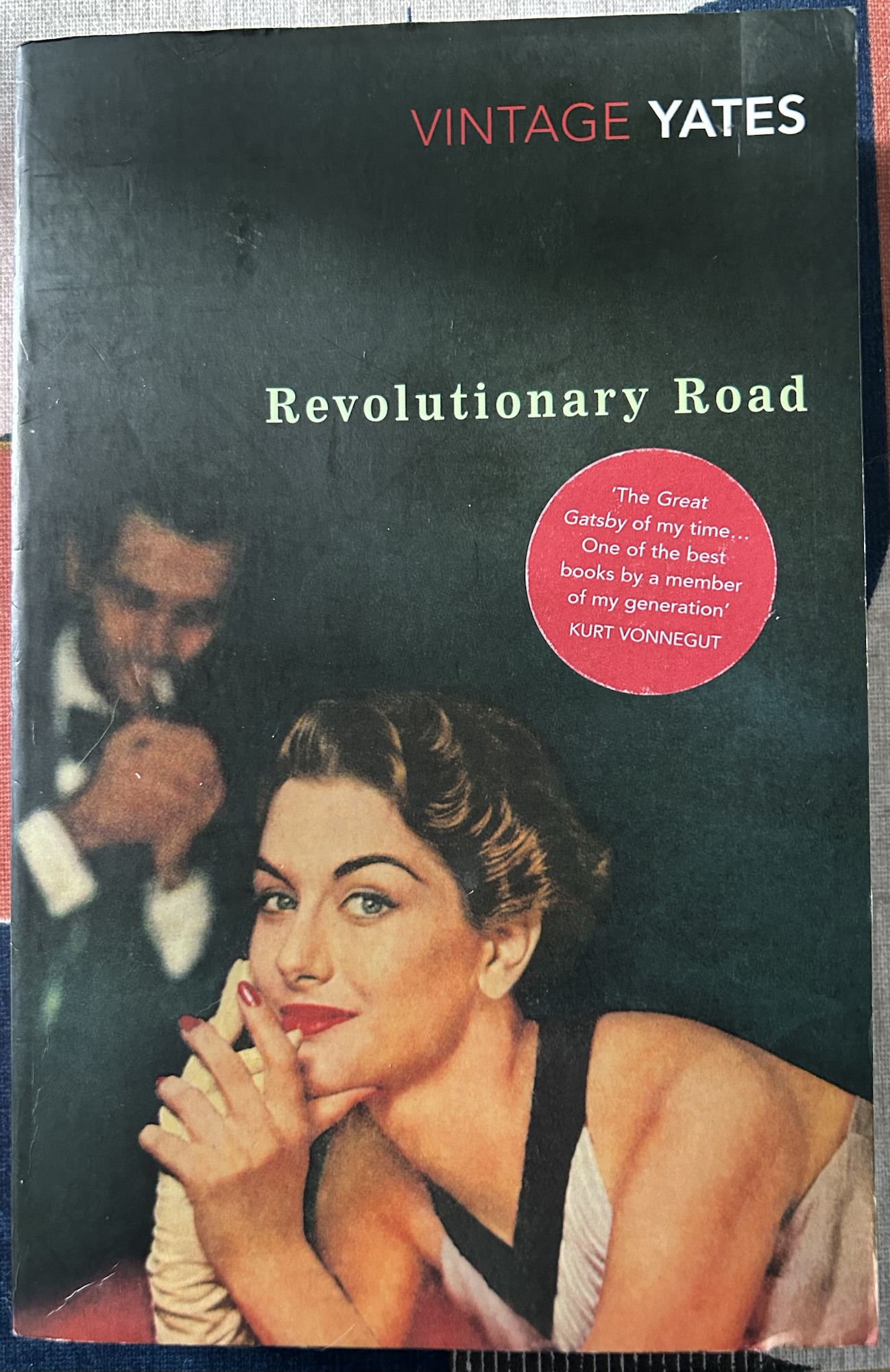
Revolutionary Road is an absolute masterpiece and it is astonishing that it was Yates first novel. The characterisation is unblinking; the post-war American Dream with all its materialistic conformity is minutely dissected.

What I found so clever was that having found April and Frank vain, shallow, and condescending for almost all the novel, by the end I felt desperately sad and sorry for both of them. Yates has written a tragedy, and suggested it is occurring daily behind the manicured lawns and bright smiles of middle-class, mid-century America.

“It was invincibly cheerful, a toyland of white and pastel houses whose bright, uncurtained windows winked blandly through a dappling of green and yellow leaves. Proud floodlights were trained on some of the lawns, on some of the neat front doors and on the hips of some of the berthed, ice-cream colored automobiles.”

To end, a trailer for the 2008 adaptation, which I know I’ve seen but don’t really remember. Time for a rewatch:

“Autumn, the year’s last, loveliest smile.” (William Cullen Bryant)

I’m clearly not alone in a love of autumn: the interwebs are awash with the beauty of it all, stunning scenes of colour change and mists of mellow fruitfulness (or something).  I was overwhelmed with images and so of course I abandoned pictures and opted for this montage of autumn scenes (because a family of beavers having a bath is quite the most brilliant thing to ever grace my viewing):

Back to books.  Firstly, the obvious choice of Quartet in Autumn by Barbara Pym.  Nominated by Philip Larkin in 1977 as the most underrated novelist of the twentieth century, it turned out to be a good year for Pym as this novel was also nominated for the Booker. Her popularity has grown steadily since this time, eradicating the problem faced by Letty, one of the titular quartet:

“She had always been an unashamed reader of novels, but if she hoped to find one which reflected her own sort of life she had come to realise that the position of an unmarried, unattached, ageing woman is of no interest whatever to the writer of modern fiction.”

Despite the title, this novel isn’t about a seasonal change but about a time in life. The quartet of Letty, Marcia, Norman and Edwin work together in an office and are heading towards retirement, all of them facing the prospect of an abundance of spare time spent alone. They are all single and slightly baffled by the world around them.

“How had it come about that she, an English woman born in Malvern in 1914  of middle-class English parents, should find herself in this room in London surrounded by enthusiastic shouting, hymn-singing Nigerians? It must surely be because she had not married. No man had taken her away and immured her in some comfortable suburb where hymn-singing was confined to Sundays and nobody was fired with enthusiasm.”

The world has changed a lot since 1914, and in the late seventies these four are looking for meaning at a time when the world is ready to place them in a home and suggest they while away their days stultifying inactivity.  Pym is interested in those thought to be terminally uninteresting; she observes lives lived on a small scale and pinpoints the quirks, the pain, the tragedy and the humour.  Quartet in Autumn could be a bleak read, and it does deal with a great deal of sadness.  The four are lonely and misunderstood and not sure what to do about any of it.

“Norman went back to work. He had a few days leave still in hand. ‘You never know when they might come in useful,’ he said, but he felt that those extra days would never be needed, but would accumulate like a pile of dead leaves drifting on to the pavement in autumn.”

But Pym is one of the best writers at evoking a gentle but incisive humour into things, and she holds her story right on the precipice between tragedy and comedy. She encourages us to laugh at life, but with kindness.  This is perfectly realised through the character of Marcia:

“Ageing, slightly mad and on the threshold of retirement, it was an uneasy combination and it was no wonder that people shied away from her or made only the most perfunctory remarks”

Yet Marcia is not a victim.  She is not well, but she is determined and she goes her own away, like her unique use of libraries:

 “The library was also a good place to dispose of unwanted objects which could not in her opinion be classified as rubbish suitable for the dustbin…one of the library assistants (a woman) had her eye on Marcia, but she was unconscious of this as she deposited a small, battered tartan-patterned cardboard box, which contained ‘Killikrankie oatcakes’ at the back of a convenient space on one of the fiction shelves.”

Quartet in Autumn is a little gem, beautifully observed and in its own quiet way, utterly scathing of the disregard shown to members of society who are inconvenient to the majority.

When she wasn’t writing novels, Pym enjoyed strangling cats (Image: Mayotte Magnus © The Barbara Pym Society)

When she wasn’t writing novels, Pym enjoyed strangling cats (Image: Mayotte Magnus © The Barbara Pym Society)

Secondly, autumn often evokes the return to school after the summer holidays, so I thought I’d look at A Good School by Richard Yates, which was published the year after Quartet in Autumn. I braced myself for this one, as Yates can be soooo depressing, but this wasn’t too bad… despite being brutal in places. Dorset Academy is a prep school funded by the eccentric, elderly and rich Abigail Church Hooper; a small, isolated “funny school” where the sons of well-meaning parents who can’t afford somewhere more prestigious are bullied/ignored educated.

“And I can see my father starting to turn away then, concluding the pleasantries, looking tired. He wasn’t old that summer – he was fifty-five – but within eighteen months he would be dead. ‘Well,’ he would say, ‘as a matter of fact I’d never heard of it either but it’s – you know – it’s supposed to be a good school.’”

We follow William Grove, a shy nervous boy desperately trying to fit in and survive at Dorset.

“He still hadn’t cried, except in the privacy of his room late at night (and even there you couldn’t be sure of remaining alone; the doors were locked only by sliding wooden bolts, easily picked open with a knife or a screwdriver; nobody was safe)but he’d come to adopt a chronic posture of humiliation. If a wretch was what they wanted, he would be a wretch.”

But rather than a relentless tale of bullying, what emerges is a claustrophobic atmosphere where everyone is damaged to a greater or lesser extent.  Grove does survive, and even finds some pleasure editing the school paper. The bullies are insecure victims themselves.  The teachers are lonely and without vocation:

“Mr Gold despised all Dorset boys on principal – rich, spoiled little snot-noses – but he had to admit this Haskell, was kind of an interesting kid…But when Mr Gold tried to tell his wife about it that night, in the kitchen of their home in Unionville, she didn’t want to listen. “’Interesting’?” she repeated. “You’re telling me ‘interesting’ and ‘sophisticated’ about some fifteen-year-old prep school kid? Come on. I think you’re going soft in the head Sidney.” And he guessed she was right”

What Yates shows is that sometimes there are circumstances that just have to be borne, survived and then left as soon as possible. It’s not always a great tragedy, just something you made it through. The novel is set around the time of Pearl Harbour, a bleak reminder that there can be many worse things to try and survive beyond your school days.

To end, something more cheerful: a clip from a documentary filmed at my school.  This is how we began every school year: