Today a novella that I picked up when Simon and I went book shopping last month. The Play Room by Olivia Manning (1969) is an unnerving evocation of young womanhood with inherent hurt and dangers, in a brilliantly evoked 1960s small town setting.
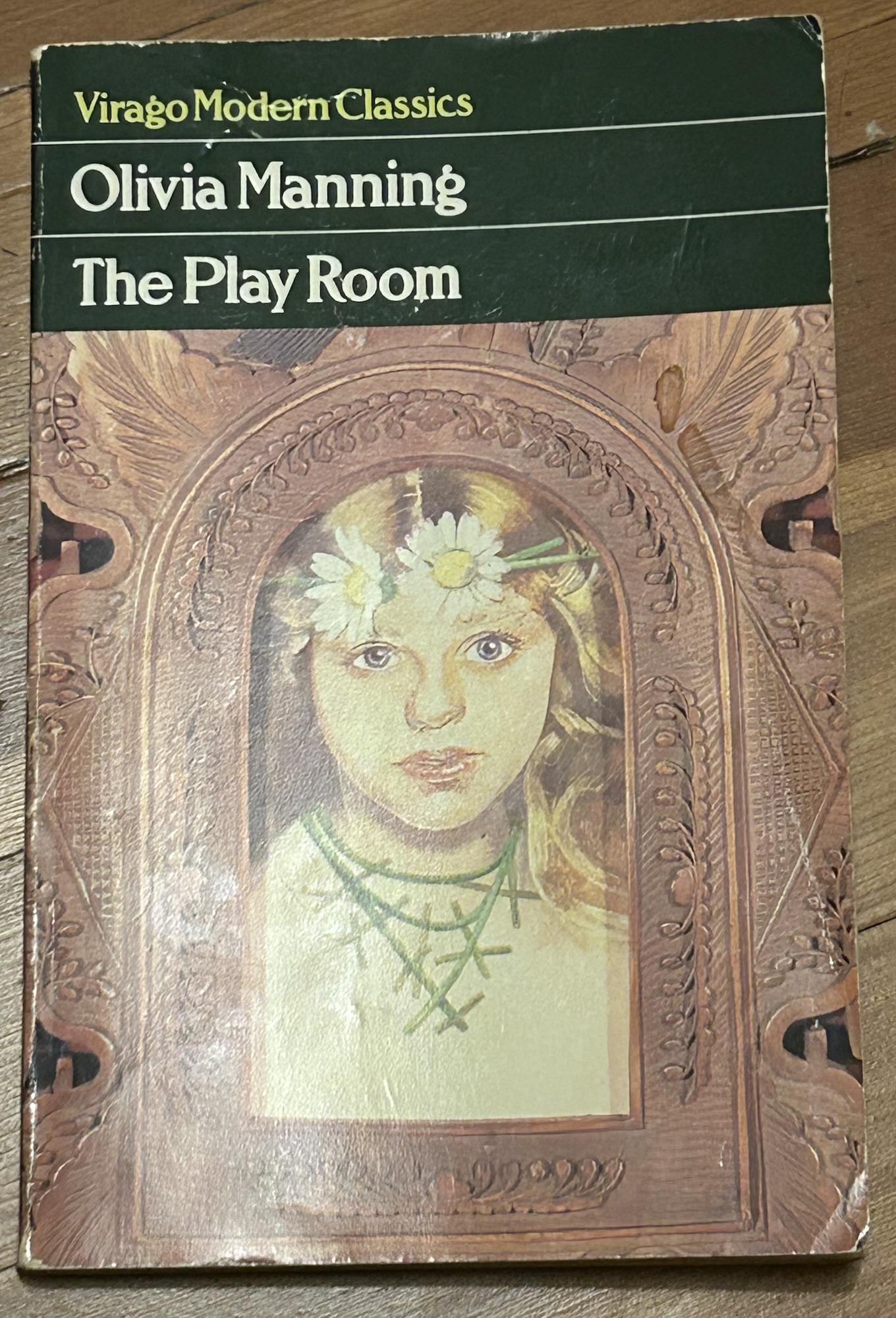
Laura Fletcher is about to sit her O’Levels (Year 11) and is deeply unhappy at her girls school in the small town of Camperlea near Portsmouth. The other girls don’t like her, which is partly understandable given Laura’s tendency towards boastful lying to cover up how inadequate she feels. The teachers are not sympathetic. When Vicky Logan, an older, beautiful girl lends her a handkerchief, she earns Laura’s utter devotion.
“Over the years, observant and admiring, Laura had noted her Vicky remained aloof from schoolroom pettiness so she seemed to Laura above human weakness.”
Vicky seems pretty aloof from everything, including her own life, happy to drift along:
“Everyone knew that should she choose to earn her living, she could at once become a film star or a model or something like that.”
I love that “something like that” – so wistful and naïve, so teenage.
Laura is desperate to be friends with Vicky but she is wrapped up in being Best Friends with a girl called Gilda. The reader realises that their friendship may be something more, but Laura remains oblivious.
“She imagined she knew everything but had to admit there was more to life than knowledge. Experience was what she needed.”
Laura’s leverage arrives through an experience she has while on holiday on the Isle of Wight with her brother. This event has dated badly and would not be written now. If you get past it, it serves as a plot point by giving Laura a true story for once and a way into Vicky and Gilda’s world.
Their world is one of motorbikes, dances and men, and Laura is out of her depth and simultaneously desperate to be part of it all. She hates where she lives and can’t wait to leave:
“She blamed her mother for it. She would, she felt, have been a totally different person had she not been born in this dreary town, in this dreary avenue and in a house perpetually fretted by the winds of anxiety.”
Her mother Mrs Fletcher is an intriguing character. She is highly anxious, controlling, self-pitying. She is dismissive to everyone. Yet although unlikable, I wondered about her – one of that generation of women who married immediately post-war, and then saw the world change beyond all recognition with women having choices barely thought of previously.
“Although she controlled everything, although she said ‘I have to take every responsibility,’ it was true that someone had to look after her. She felt too much; lived with too much difficulty; met every situation with nervous dread. Someone had to help her bear her ineptitude for life.”
To me, both she and Laura were united by their anger at their world and its limitations, although neither could see it. One of the rare scenes not from Laura’s point of view is when they shop together for a dress. Mrs Fletcher can see it is ugly, doesn’t suit her daughter, and how young and vulnerable she looks in trying to be older. Yet she knows that because of her way of behaving, nothing she can say will be given any weight by determined Laura. It is one of the most moving scenes in the book.
When Gilda goes to Malta for the summer, Laura sees her chance with Vicky. They start going to dances no longer chaperoned by the local vicar, and events soon spiral out of control. Vicky is drawn to a violent man and Laura is too young to know what to do, or even realise that anything needs to be done.
The Play Room shows how vulnerable young people are when they think they have all the answers but with no idea of what the world could ask of them. A darkness runs through the story; there is no nostalgia for school or young adulthood here. It captures the intensity of feeling in adolescence, but is not entirely without humour:
“Were she asked to die for Vicky she would, she decided, die. At least, she would give the proposition serious thought.”
I found The Play Room highly readable and evocative. I felt the holiday on the Isle of Wight is given too much space within such a short novel, but the bullying, isolated school days and Laura’s worship of an older girl she really doesn’t know at all was well realised. I hoped she would make it to London one day and not be too disappointed…
“Laura, discouraged, dropped down on the rug and shutting her eyes, saw herself walking in night-time Soho through a street a-dazzle with light, where nobody slept. There were discotheques and dance clubs and cafes and coffee bars and young men by the dozen: young men beyond dreams, with lean pliable bodies and hair curling on their shoulders, as beautiful as archangels, in clothes or colours. And she could imagine Vicky walking beside her! Everyone would look at them. Everyone.”


I skip read this, because I’m going to see if I can’t read this one, too!
LikeLiked by 1 person
Hooray!
LikeLike
This sounds like a sensitive depiction of what can be a very painful period when everything is so intense. The cover’s so familiar to me. My local art gallery bought it as Peter Blake, whose portrait of his daughter it is, lived in Bath for a while.
LikeLiked by 1 person
It certainly felt very real, and quite sad for the girls.
That picture is so striking! I’d be interested to see it in the gallery.
LikeLiked by 1 person
You must come and visit!
LikeLiked by 1 person
Absolutely – it would be a real treat!
LikeLiked by 1 person
This sounds very good, Madame B, and definitely a book which captures those teenage years. I wonder if it’s like that for young people nowadays, as they have so much more knowledge that we did and I guess grow up more quickly. I can recall the uncertainty of that age and Manning obviously captures the girls’ voices brilliantly. I’m sure I owned this once – I wonder if I still do…. 🤔
LikeLiked by 1 person
It did feel very 1960s to me, so well done in evoking that period. I think you’re right about the differences today, although I guess insecurity and frustration endure…
If you find it in the shelves I hope you enjoy it!
LikeLiked by 1 person
Mm, I had to satisfy my curiosity and looked at goodreads reviews with spoiler alerts to see what happened on the island! I am not completely sure if I discovered what it was but I have more of an idea and I’m not sure if I would get past it. However, I can never resist a green liveried Virago in the wild and my second hand copy of a green Virago ‘Doves of Venus’ by Manning arrived today in what feels like a bookish serendipity moment!
LikeLiked by 1 person
Oh that is serendipitous! I have Doves of Venus buried in the TBR somewhere, you’ve reminded me I really should dig it out…
LikeLike
I’ve never understood why people get nostalgic for adolescence – such a difficult period! Sounds as if the author does an excellent job of catching it.
LikeLiked by 1 person
Absolutely! I’m not nostalgic for that period at all!
LikeLiked by 1 person
This sounds like she has perfectly captured a very particular time in life. Sounds wonderful!
LikeLiked by 1 person
She really has – it’s very well done!
LikeLiked by 1 person
This was on my pile of 70 books to consider, but I didn’t get to it – now I regret a bit, as it sounds absolutely up my street. I liked the drama and the humour of the quotes.
LikeLiked by 1 person
I hope you enjoy it when you do get to it Simon!
LikeLike
I’m thinking about the politics of you and Simon shopping together and one of you finding a great novella! I love books about adolescence so this is right up my street!
LikeLiked by 1 person
Haha! Thankfully it didn’t come to blows 🤣 I hope you enjoy this one if you try it Jane, it portrays the pains of adolescence very well.
LikeLiked by 1 person
This sounds excellent and very much up my street. In fact, I think I have a VMC copy just like yours, I’ll have to double check.
Love what you say here, partly because it seems very relatable!
“The Play Room shows how vulnerable young people are when they think they have all the answers but with no idea of what the world could ask of them.”
LikeLiked by 1 person
Glad it appeals Jacqui – I hope you can find your copy!
The older I get, the less I feel I know 🤣
LikeLike