“Everything being a constant carnival, there is no carnival left.” (Victor Hugo)

Today is May Day, and I was thinking about the traditions of this time: celebration, revelry, pastoral fertility.  Please note I said thinking about, not participating in.  Confession time, reader: even though I’m in Oxford I didn’t want to do an all-night pub crawl/ball or get up at ridiculous o’clock to go to Magdalen Bridge for May Morning.  I lay in bed, and because Oxford is so quiet I could hear the choir and bells anyway, and it was beautiful.  Better warm in bed than in an inebriated crowd, I told myself.  Before I seem too virtuous, I should tell you that I’m really just lazy, because an hour or so later I got up for a champagne breakfast.  If this post seems even more waffly and incoherent than usual, you know why.

So, the traditions of May Day, and choosing books for this post made me think about the carnivalesque in novels.  Mikhail Bakhtin said that the carnivalesque (this is a shockingly rough paraphrase) is a time when social hierarchies are overthrown in energetic riot: as norms are disregarded, reversed and subverted, anything can happen.  Sounds like the spirit of May Day to me. Hence, for this post I’ve picked two novels that are carnivalesque/subversive in some way.

Image

The Battle Between Carnival and Lent – Pieter Bruegel the Elder 1599 (Image from http://en.wikipedia.org/wiki/File:Pieter_Bruegel_d._%C3%84._066.jpg )

My first choice is Nights at the Circus by Angela Carter (1984, Chatto & Windus).  The minute I started to think about carnivalesque, this is what sprang to mind. I thought the summary on the dust jacket was spot-on, so here it is:

Fevvers: the toast of Europe’s capitals, courted by princes, painted by Toulouse Lautrec, the greatest aerialiste of her time. Fevvers: somersaulting lazily through the air, hovering in the moment between the nineteenth century and the twentieth, between old dreams and new beginnings, born up by the spread of wings that can’t be real! Or- can they? Fevvers: the Cockney Venus, six foot two in her stockings, the coarsely lively and lovely heroine…Obsessed with Fevvers, constantly bamboozled by the anarchist sorcery of her dresser and confidante, Lizzie, the dashing young journalist Jack Walser stumbles into a journey which takes him from London to Siberia via legendary St Petersburg and out of his male certainties, into a transforming world of danger and joy, the world of Colonel Kearney’s circus…Featuring a cast of thousands, including : the clown’s requiem, the tigers’ waltz, the educated apes, the bashful brigands, the structuralist wizard. Not forgetting Sybil, the Mystic Pig.”

Just brilliant. I’ve said before that there’s no-one like Angela Carter, and Nights at the Circus is her writing at her very best.  Fevvers voice leaps of the page at you in the first paragraph:

“Lor’ love you sir!” Fevvers sang out in a voice that clanged like dustbin lids. “As to my place of birth, why, I first saw the light of day right here in smoky old London, didn’t I! Not billed the ‘Cockney Venus’ for nothing…Hatched out of a bloody great egg while Bow Bells rang, as ever is!”

If that all sounds a bit “cor-blimey-luvvaduck-rent-a-cockney”, don’t worry.  With Angela Carter you are never in the land of the stereotype, but in an exuberant world of characters the like of which you will never have met before, or since.  She is master of the original and evocative image (“like dustbin lids”) and while her work is carnivalesque and destabilising, it’s also great fun.  The circus is Carter’s world, which means anything can happen.  But beneath all the sparkle and pizzazz, she creates a world of substance.  Buffo the clown reflects:

“We are the whores of mirth, for, like a whore, we know what we are; we know we are mere hirelings hard at work yet those who hire us see us as beings perpetually at play. Our work is their pleasure and so they think our work must be our pleasure, too, so there is always and abyss between their notion of our work as play, and ours, of their leisure as our labour.”

Carter uses magic realism to explore how we construct reality, and how easily it can be deconstructed.  Where better to do that than the circus? She plays with notions of gender and sexuality, challenging the idea that they are fixed entities, and explores how identity can be constantly created and recreated.  Jack falls in love with Fevvers, unsure of who, or what, it is he loves: if he gets behind the image of the Cockney Venus, who will be there?  Is she part bird?  And who will he be in response?:

“When Walser first put on his make-up, he looked in the mirror and did not recognise himself. As he contemplated the stranger peering interrogatively back at him out of the glass, he felt the beginnings of a vertiginous sense of freedom , that, during all the time he spent with the Colonel, never quite evaporated; until that last moment where they parted company and Walser’s very self, as he had known it, departed from him, he experienced the freedom that lies behind the mask, with dissimulation, the freedom to juggle with being, and, indeed, with the language which is vital to our being, that lies at the heart of burlesque.”

Angela Carter clearly had a fierce intellect and something interesting to say about how we make our worlds.  But she also didn’t let that get in the way of a good story.  Nights at the Circus is a fantastic read, in all the senses of the word.

Secondly, Gulliver’s Travels by Jonathan Swift (1726, full text available online).  Obviously, this novel is hugely famous (even if you haven’t read it I bet you know what physical feature distinguishes a Lilliputian).  Lemuel Gulliver relates fantastical tales of his travels, and in the process Swift offers a satire on travel narratives (which were hugely popular in the eighteenth century as people travelled further and wider) and on the human condition.  I chose it for this theme as it is full of inversions and reversals; Gulliver travels to Lilliput, where he is a giant, then to Brobdingnag where he is minute; to Laputa which he considers crude and unenlightened, then to the Houyhnhnms who consider him a “yahoo”.  Gulliver’s Travels is episodic, so I’m just going to pick out a couple of events.  Firstly, one of the most famous ones: many writers at the time were obsessed by bodily functions, and Swift is no different, though thankfully not nearly as scatological as some of his contemporaries.  Here is Gulliver putting his urine to good use in Lilliput:

I was alarmed at midnight with the cries of many hundred people at my door; by which, being suddenly awaked, I was in some kind of terror….her imperial majesty’s apartment was on fire, by the carelessness of a maid of honour, who fell asleep while she was reading a romance.  I got up in an instant; and orders being given to clear the way before me, and it being likewise a moonshine night, I made a shift to get to the palace without trampling on any of the people.  I found they had already applied ladders to the walls of the apartment, and were well provided with buckets, but the water was at some distance.  These buckets were about the size of large thimbles, and the poor people supplied me with them as fast as they could: but the flame was so violent that they did little good… this magnificent palace would have infallibly been burnt down to the ground, if, by a presence of mind unusual to me, I had not suddenly thought of an expedient.  I had, the evening before, drunk plentifully of a most delicious wine called glimigrim, (the Blefuscudians call it flunec, but ours is esteemed the better sort,) which is very diuretic.  By the luckiest chance in the world, I had not discharged myself of any part of it.  The heat I had contracted by coming very near the flames, and by labouring to quench them, made the wine begin to operate by urine; which I voided in such a quantity, and applied so well to the proper places, that in three minutes the fire was wholly extinguished, and the rest of that noble pile, which had cost so many ages in erecting, preserved from destruction.

And just to finish, here is a bit of the more heavy-handed satire for you, when the king of Brobdingnag responds to a summary of British politics:

“He was perfectly astonished with the historical account gave him of our affairs during the last century; protesting “it was only a heap of conspiracies, rebellions, murders, massacres, revolutions, banishments, the very worst effects that avarice, faction, hypocrisy, perfidiousness, cruelty, rage, madness, hatred, envy, lust, malice, and ambition, could produce.”

I’ll leave it to you to decide if such motivations have left politics these days…

Gulliver’s Travels is a complex book, and one that is very hard to pin down: it is funny, it is sad, it can be read to children, it is baffling to adults.  It shifts meaning and genre according to who is reading it: truly carnivalesque.

I was hoping to end with a clip of Bellowhead performing One May Morning Early: apt, no?  But YouTube failed me.  So here they are singing about a carnival romance instead:

“The book is a film that takes place in the mind of the reader.” (Paulo Coelho)

It is a truth universally acknowledged, that the film version of a book is never as good as the original text.  Except I don’t think that’s true.  This week I’m going to look at two books where I think the film was better, but the novels are still worth reading.  Slightly odd tack for a book blog to take, and I may end up regretting this, but let’s crash ever onwards!

Firstly, The Commitments by Roddy Doyle (1987).  Here’s the trailer for the 1991 film, with a brilliant script by the author, in collaboration with the long-term writing partnership of Dick Clement and Ian La Frenais.

The Commitments is Roddy Doyle’s first novel, detailing how a group of white, working class Dubliners set up a soul band together.  I think in this novel Doyle is really learning his craft, and his writing gets progressively stronger as he goes along.  The Commitments is a far from terrible book, but it’s a bit slight, and filled with so much dialogue it reads more like a script than a novel for much of it.  Still, if you’re going to have a novel filled with dialogue it may as well be written by Roddy Doyle, who has a great ear for how people speak and seems to take real joy in capturing it on the page:

“-Grow a pair o’ tits, pal, an’ then yeh can sing with them, said Billy.

– Are you startin’ somethin’?

-Don’t annoy me.

– Here! Said Jimmy. –None o’ tha’.

The time was right for a bit of laying down the law.

-No rows or scraps, righ’.

-Well said, Jim.

– An’ annyway, said Jimmy. –The girls are the best lookin’ part o’ the group.

– Dirty bastard, said Natalie.

-Thanks very much, Jimmy, said Imelda.

-No sweat ‘melda, said Jimmy.

-What’ll we sing? Bernie asked Joey The Lips.

-You know Walking in the Rain?

-Lovely.

– I WANT HIM, Imelda sang.

– It doesn’t exactly have a strong feminist lyric, does it? said James.

– Soul isn’t words, Brother, said Joey The Lips. – Soul is feeling. Soul is getting out of yourself.”

You can see that this is writing really stripped back: minimal punctuation, not always clear who is speaking.  The style suits the tale of a bunch of people with very little creating music with only their voices and few instruments.  It makes The Commitments a quick read, and the characters are evoked with warmth through minimal authorial intervention. By writing in such a sparse way, Doyle allows the characters to speak for themselves. At other times he uses scant detail, rarely embellished with imagery, to portray the lives of the band:

“’Joey The Lips got one of his dress suits dry-cleaned. Dean crawled in under his bed and found the one he’d flung under there. He soaked the jacket till the muck was nearly all gone. Then he brought it down to the cleaners.

Black shoes were polished or bought or borrowed.”

The Commitments is a well-observed story, evocative and humorous. However, a novel about music will always have much to gain from being filmed; hearing the talented cast of the film give their voice to soul classics brings the characters into being in a way that is nearly impossible in print.

Secondly, The Princess Bride by William Goldman (1973).  Here’s the trailer for the 1987 film adaptation, screenplay by the author:

One of my favourite films from childhood that I still love to watch today – a definite winner on a rainy Sunday afternoon.  Again, it’s not that the book is bad (the film is scripted by Goldman after all so you wouldn’t expect a great deal of difference) but the film is better.  It takes all the best bits of the book and distils them into a fast-paced, funny narrative; the book can be a bit flabby at times by comparison.  The film also offers some of the best cameos ever: Billy Crystal as Miracle Max, Mel Smith as the torturer, comic genius Peter Cook as the Impressive Clergyman, as well as a perfectly cast set of main characters.  But if you like the film, you’ll like the book.  The same dry, silly humour runs through it, and who wouldn’t love a tale of: “Fencing. Fighting. Torture. Poison. True love. Hate. Revenge. Giants. Hunters. Bad men. Good men. Beautifulest ladies. Snakes. Spiders. Beasts of all natures and descriptions. Pain. Death. Brave men. Coward men. Strongest men. Chases. Escapes. Lies. Truths. Passion. Miracles.”

The tale is one of Princess Buttercup, who falls in love with the stable boy Westley.  He goes off to seek his fortune, and is captured by the Dread Pirate Roberts, who famously leaves no survivors.  Believing her One True Love to be dead, Buttercup agrees to marry the hunting-obsessed Prince Humperdink.  Before they can marry she is kidnapped by a gang comprising the cunning Vizzini (“never start a land war in Asia, [… and] never go against a Sicilian when death is on the line”), the giant Fezzik , and genius-swordsman-with-a-vendetta Montoya (“my name is Inigo Montoya, you killed my father, prepare to die!”) They are followed by the mysterious Man in Black, who seeks to foil their plans… Will goodness triumph? Will true love conquer all? Yes, of course, to both.  This is a lovely escapist fantasy, but at the same time it is a  satire on established rule and its abuses, which gives the story a more serious dimension. Prince Humperdink has arranged the kidnap of Buttercup in order to blame a neighbouring country and start a war.  (Fill in your own contemporary analogy here.)  He tells his henchmen to seek the “villains” in the thieves quarter:

““My men are not always too happy at the thought of entering the Thieves Quarter.  Many of the thieves resist change.”

“Root them out. Form a brute squad.  But get it done.”

“It takes at least a week to get a decent brute squad going,” Yellin said. “But that is time enough.

[…]

The conquest of the Thieves Quarter began immediately.  Yellin worked long and hard each day […] Most of the criminals had been through illegal roundups before, so they offered little resistance.””

Goldman is also able to extend his humour in the novel towards the processes around writing, which he couldn’t do in the film; for example his editor querying his translation of the “original” story by S. Morgenstern:

“this chapter is totally intact. My intrusion here is because of the way Morgenstern uses parentheses.  The copy editor at Harcourt kept filling the margins of the galley proofs with questions: […] “I am going crazy. What am I to make of these parentheses? When does this book take place? I don’t understand anything. Hellllppppp!!!” Denise, the copy editor, has done all my books since Boys and Girls and she had never been as emotional in the margins with me before.”

So there we go: two film recommendations as well as two book recommendations in the same post – call it a late Hogmany present from me to you, dear reader. Enjoy!

Image

“It’s always funny until someone gets hurt. Then it’s just hilarious.” (Bill Hicks)

I try to post once a week, and failed totally to do so last week.  This means the post I planned on funny books, to coincide with Comic Relief , was oh-so-topical last week but now is about as current as Christmas.  What the hell, I won’t let my ineptitude deter me from my course.  I’ve written in a previous post about my friend H insisting on lending me light reads, this week I’m going to look at two more books H hopes will encourage me to relinquish my default solemnity and embrace the sunny side of life (particularly difficult here in the UK at the moment as Spring refuses to be sprung and it’s snowing. There’s even talk of a white Easter, which is so unnecessary). I’m concerned this post is self-defeating, because humour is so personal that whether or not I found something funny is really irrelevant as to whether anyone else finds it funny, but let’s crash onwards, and hopefully I’ll be able to give you an idea of whether you want to read the novels or not.  Probably I should stop thinking about it all so seriously!

Firstly Small World by David Lodge (1984, Penguin).  H lent this to me because I am one of those nerds unable to function in the real world so I keep holing up in universities, refusing to leave until I develop book-fanciers lung (which is a disease I think I’ve just invented) from hanging out in libraries the entire time. Well, everyone needs a life plan….  So, Small World is set amongst academia, and mainly derives its humour from its portrayal of vain, self-serving academics competing with each other for a Chair of literary criticism post that only exists virtually – they don’t have to do any work for it, deliver lectures, or even use an office.  This forms the background to series of conferences where the cast of characters intermingle, bitch, gossip and have sex with one another. The nearest character to a hero is Persse McGarrigle, a ridiculously idealistic post-graduate who has spent too much time in books and too little in the real world (I obviously have no idea what that’s like). His thesis is on Shakespeare’s influence on Eliot, then on a whim he tells his fellow academics that its actually about Eliot’s influence on Shakespeare, a preposterous notion which rather than ridiculing, they all get terribly excited about. And so the foibles of contemporary academia are astutely satirised.  I say contemporary because although it was written in 1984, the following sentence convinced me of its relevance:

“How gratifying to encounter, in the dreary desert of contemporary criticism, an exponent of that noble tradition of humane learning, of robust common sense and simple enjoyment of great books.”

Unlike references to long-deceased shop chains like Rumbelows and Sketchleys, and Persse being completely confused as to what a karaoke bar is, this part of the book doesn’t seem to have dated at all.  Much as I enjoy my study (and therefore keep returning to it), many is the time I’ve sat in tutorials wishing I could just state that I liked something, without placing it in its post-modern, post-feminist, post-post-post framework to deconstruct its meaning to the point where you start to doubt your own sanity and whether you even know what a book is.

I have to admit I didn’t love Small World, I thought it was clever rather than funny, and it didn’t really engage me, but if you are involved in any sort of academia I’m sure you will recognise the characters and university politics and derive a few wry smiles of recognition at the very least.

But as I planned for the blog to be celebratory rather critical (and keep getting knocked off this course by the books H lends me, I may have to stop reading them, or at least stop blogging about them) I would like to balance this out by flagging up that David Lodge is an insightful critic as well as a novelist, and I highly recommend his The Art of Fiction. Each chapter takes a topic around creating fiction and uses an example as a discussion point, for example Defamiliarisation in Charlotte Bronte, Intertextuality in Conrad, and so on.  It’s really accessible, readable way of beginning to explore ideas, written in a non-pretentious way that his characters in Small World would be incapable of.

But The Art of Fiction is not fiction itself, and so I return to my second choice of novel, The Eyre Affair by Jasper Fforde (Hodder & Stoughton 2001). This was Fforde’s first novel featuring his heroine detective, Thursday Next.  If you think that’s a bad name pun, here are a few more: Millon De Floss; Jack Schitt; Landen Parke-Laine (a British monopoly pun “land on Park Lane” which perhaps doesn’t translate as well as the others) and many more.  As the pun Millon De Floss shows, this is a silly, fun book for literature lovers.  The Eyre of the title is Jane, and in an alternative 1985, Thursday has to defeat the evil Acheron Hades (great name) who is taking first editions of books and removing characters from them, causing all subsequent copies of the story to change.  Thursday pursues him into Jane Eyre (literally, she enters the story), where she has to stop him wiping out the heroine of one of her favourite novels without changing the story herself.  Things don’t go exactly to plan, but then Jane Eyre in Thursday’s world doesn’t have the ending we know and love….

The story is great fun, and if you love literature there are plenty of jokes to enjoy.  Thursday works as a literary detective, and this is a world where literature is taken very seriously. Teenagers swop Fielding cards:

““I’ll swop you one Sophia for an Amelia.”

“Piss off!” replied his friend indignantly.  “If you want Sophia you’re going to have to give me an Allworthy plus a Tom Jones, as well as the Amelia!”

His friend, realising the rarity of a Sophia, reluctantly agreed.”

The literary dedication of the populace continues into adulthood, such as when the Baconians, a group concerned with proving Shakespeare didn’t write Shakespeare, have their meeting fire-bombed by the radical splinter group, the New Marlovians.

The idea of characters being kidnapped from fiction works really well, as Fforde is able to use examples of characters that are abandoned by their authors to support the premise.  For example, Christopher Sly, the drunkard from the start of The Taming of the Shrew, has been found “wandering in a confused state just outside Warwick”.  He did disappear from the play, so maybe he was kidnapped in this world also?!

There is a feel of The Hitchhikers Guide to the Galaxy about The Eyre Affair and if you enjoy Douglas Adams I think you’ll enjoy this. It’s very clever but it’s not out to prove its own cleverness, and while it could have done with a slightly more heavy-handed editor in places, The Eyre Affair is a pacey, joyous tale about what happens when characters really come alive. And if H is reading this: success!  It made me laugh, my friend.

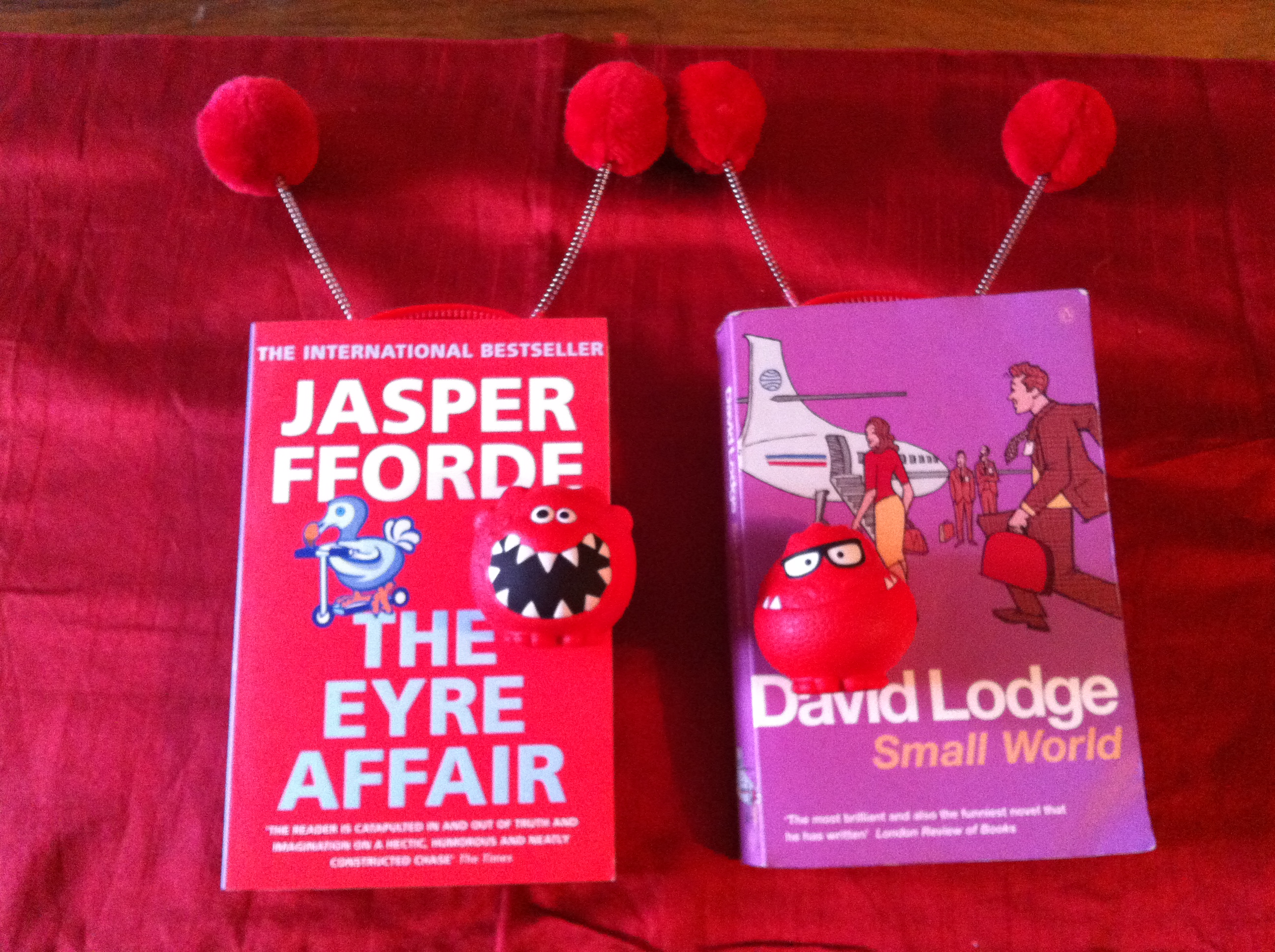
Here are the books doing their bit for Comic Relief by donning this year’s deelyboppers and red noses:

Image