Halfway through NADIM 2026! I’m frankly amazed, having only really decided to go ahead on 30 April. I’m still not sure I’ll finish as I’ve home renovations this week and two very busy work weeks coming up, but honestly I’m taking the halfway point as a win in itself!
The Faber Editions series seem to choose their titles impeccably, and Emily Holmes Coleman’s only novel, A Shutter of Snow (1930) is another powerful, haunting choice. (Or good book to take a snooze next to, according to my cat.)
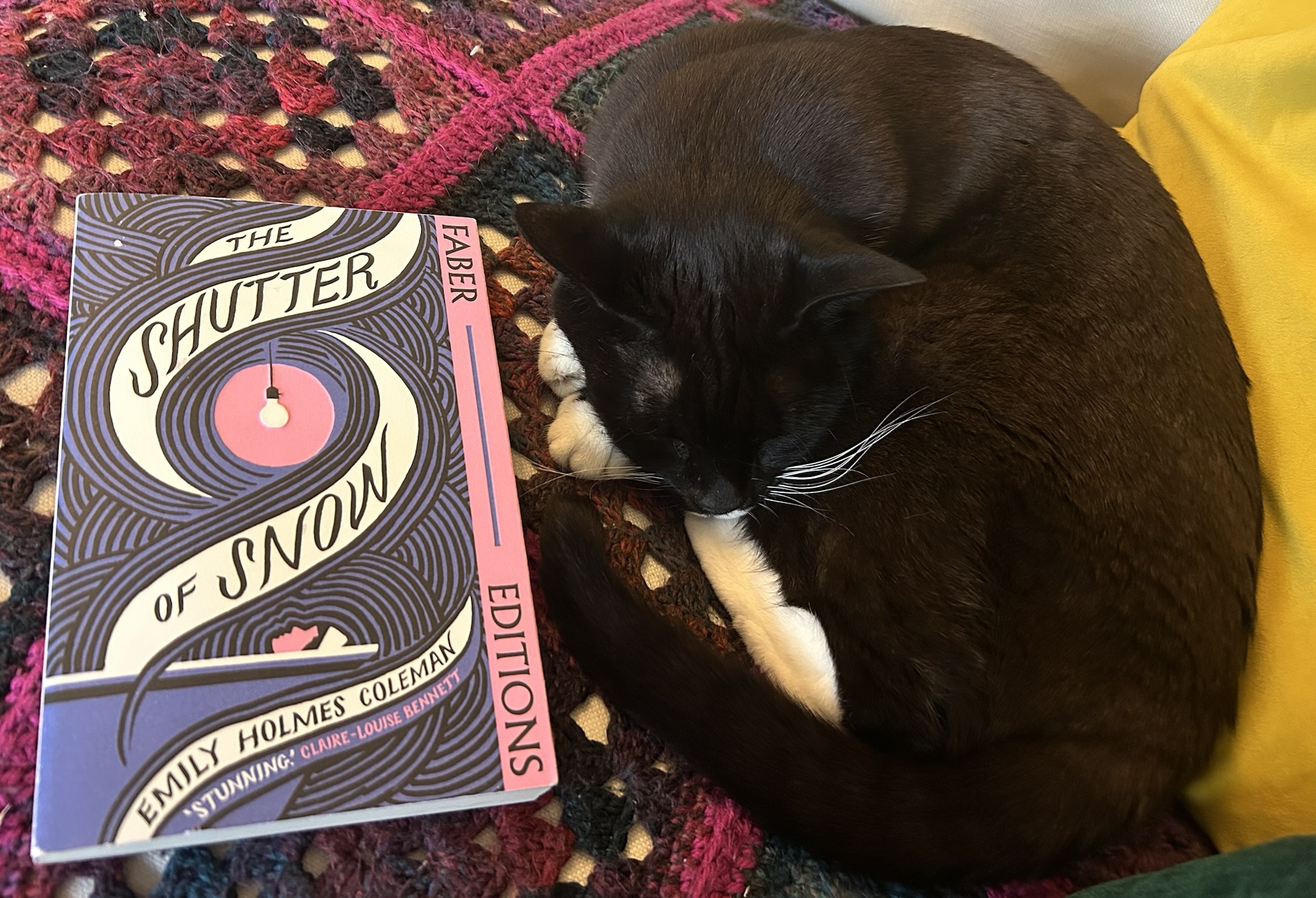
Emily Holmes Coleman drew on her own experience to detail Marthe Gail’s post-partum psychosis, from when she is admitted to a residential mental health unit up until she feels well enough to return home again. It is a disorienting, visceral narrative that places the reader alongside Marthe as she struggles with reality in a setting where avoiding it seems an entirely reasonable thing to do.
Marthe’s admission to the ward is told in a confusion of images, jumbled sentences which jump rapidly between subject and object, baffling yet also evoking perfectly the despair and violence of her arrival.
“The keys jangled from the waists of the nurses. They rattled like silver dish pans and swung chanting high like death songs. They were brittle and ice cold and had faces of stagnant riders from the snow. They were proud, and deliciously ate their indifference.”
At some point in that passage I think the ‘they’ subject changes from the keys to the nurses, but Marthe is so completely displaced it is by no means certain.
Telling the story from Marthe’s point of view but in the third person – occasionally first person – brilliantly conveys her rapidly shifting perspectives and slight detachment from what is happening. Trying to keep up with her means the reader struggles to keep track and maintain a viewpoint, just as Marthe does.
Here she is anticipating a visit from her seemingly supportive husband, but he does insist on her being silent/passive, which perhaps explains Marthe’s seeming ambivalence here:
“He was coming today. It would be some time before the red lights. He would come stalking in the door with his gentle hands and would smile at everything she said. He would look up from under his eyebrows and demand to know what she meant. He would have purple sandals and a crown of laurel. He would bring her a casket of roses and she would crush them on the floor. And there would be under his coat to the little snow-haired baby with clenched hands.”
That quick shift to violence consistently – yet unpredictably – occurs with Marthe. She will be calm and seemingly content, before suddenly spiralling and lashing out.
But she is subject to violence too, including state endorsed violence. There are numerous episodes of her being restrained, bound repeatedly in strips of cloth and blankets, attacked by other patients, and also forcibly medicated. The Shutter of Snow is a very difficult read, both structurally and in terms of subject matter.
But there is humour in the novel too, particularly in interactions with the medical professionals:
“Dr Brainerd said Marthe earnestly, just because I’ve got a toxic exhaustive psychosis is that any reason why I have to be treated like a dog?
Who told you you had a toxic exhaustive psychosis? said Dr Brainerd. You think I have anyway said Marthe, and someday you’ll be rather astonished when you find out what it’s all about. I don’t think I’ll lend your husband anymore books said Dr Brainerd.”
The lack of punctuation and speech marks there is indicative of the whole book, contributing to sense of an askew narrative without becoming entirely incomprehensible. The novel steadily becomes more coherent, reflecting Marthe’s gradual recovery.
The Shutter of Snow is a fully immersive read, where you sink into Marthe’s world of institutionalised reality, delusion, dream, fantasy. It is extraordinary in how it brings Marthe’s experience to the reader. Emily Holmes Coleman is a stunning writer and on the strength of this I wish she’d written more.
“The only thing to do is to put hammers in the porridge and when there are enough hammers we shall break down the windows and all of us shall dance in the snow.”

