This week I thought I’d use Kaggsy and Lizzy’s #ReadIndies event to focus on one indie publisher, and finally get to four books that have long been languishing in the TBR. Pushkin Press“publish some of the twentieth century’s most widely acclaimed and brilliant authors” and they are one of my favourite indies, ever-reliable. Which hasn’t stopped four from their Collection series remaining unread by me for far too long!
Today I’m starting with The Buddha’s Return by Gaito Gazdanov (1949-50, transl. Bryan Karetnyk 2014). Gazdanov was a Russian writer exiled in France and this short novel, described by the publishers as “part detective novel, part philosophical thriller, and part love story” is set in Paris, as much as it is set anywhere – reality is not a consistent concept in this story at all.
The narrator is a student who is experiencing prolonged periods of hallucinations. He tells us from the start that he is an unreliable storyteller:
“Nowhere was there any logical pattern in this, and the shifting chaos clearly failed to present even a remote semblance of any harmonious order. And so, accordingly, at that point in my life, which was marked by the constant attendance of chaos, my inner existence acquired an equally false unwavering character.”
We slide back and forth between a recognisable reality of his poverty-stricken life in Paris and his disturbing, disorienting visions, without always knowing which is which. Early on in the novel he falls to his death from a sheer mountainside, later he is arrested and interrogated by the Central State. The government’s accusations of treason are entirely surreal and illogical, yet this is also what makes them horribly believable.
There is political commentary running through the novel, but the kaleidoscopic nature of the narrative means it is not a sustained satire on any particular country, ruler or party, but rather a wider condemnation:
“The ignorant, villainous tyrants who so often ruled the world, and the inevitable and loathsome apocalyptic devastation apparently inherent in every era of human history.”
Around halfway through, more of a plot emerges as Pavel Alexandrovich, an older man whom the student befriended, is murdered and his golden statuette of Buddha stolen. As the last person to see Alexandrovich alive, the student falls under suspicion. The real-life interrogation by the investigators has shades of the surreal fantasy interrogation by the Central State:
“If we can find the statuette, you’ll be free to return home and continue your research on the Thirty Years War, the notes on which we found in your room. I must say, however, that I completely disagree with your conclusions, and in particular your appraisal of Richelieu.”
As that quote shows, there is humour in The Buddha’s Return and this lightens a tale which has a lot of dark elements: visceral war scenes, squalor, and of course murder.
Apparently, The Buddha’s Return was originally published in instalments and I can see it would work well in this format. I enjoyed it but for me the more plot-driven second half arrived at just the right time, when I’d started to feel it was losing momentum. As it was I enjoyed this consistently surprising tale which still had enough recognisable humanity in it to be involving, and I’d be keen to read more by Gazdanov.
“I have a suspicion that you just dreamt the whole thing up. It’s because you read too much, eat too little and spare hardly any thought for the most important thing at your age: love.”
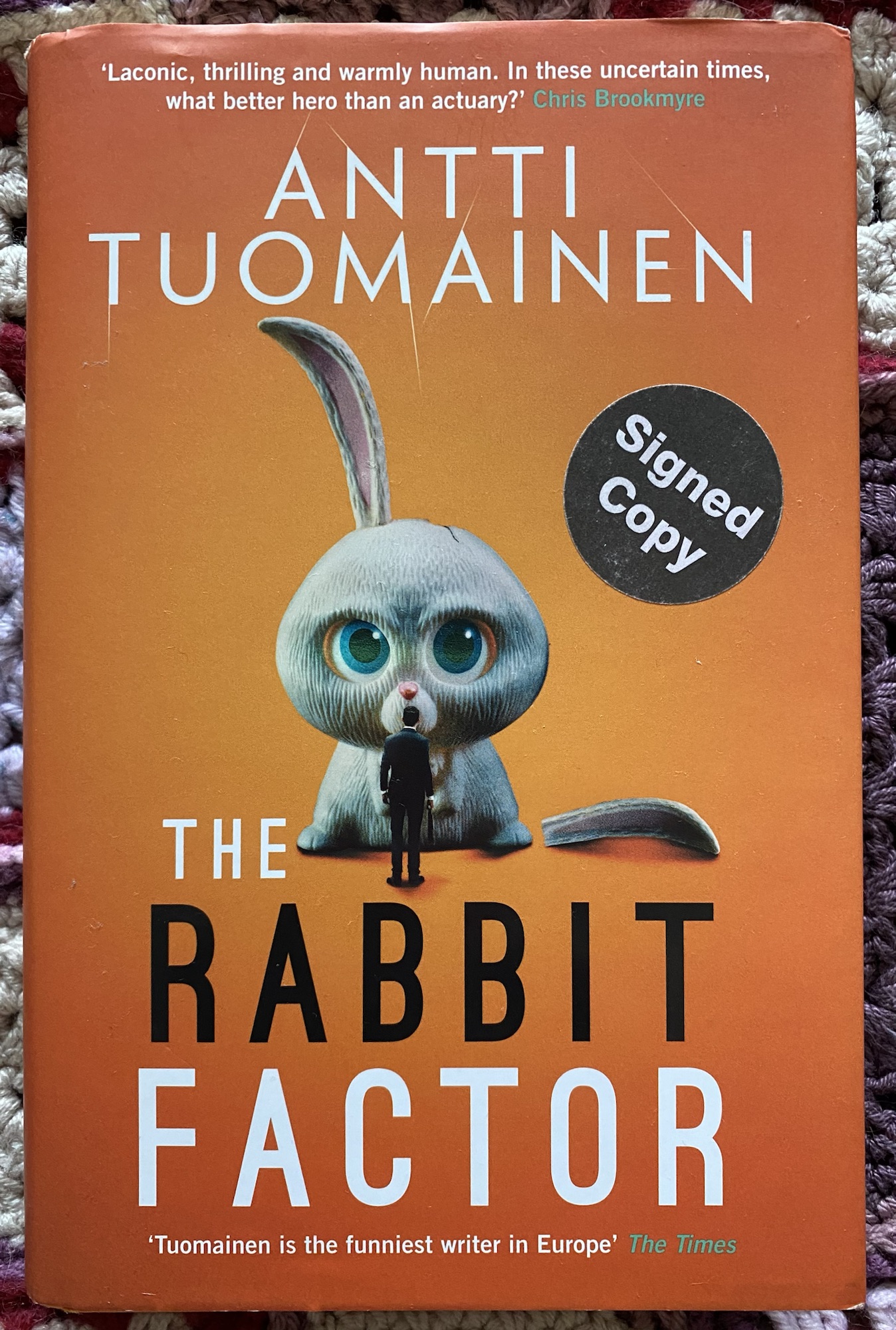
This is my first contribution to Kaggsy and Lizzy’s wonderful #ReadIndies event, running all month. The Rabbit Factor by Antti Tuomainen (2021, transl. David Hackston 2021) is published in the UK by Orenda Books, who describe themselves on their website as: “a small independent publisher based in South London. We publish literary fiction, with a heavy emphasis on crime/thrillers, and roughly half the list is in translation.”
The Rabbit Factor is the first in a trilogy about actuary Henri Koskinen, which had somehow completely passed me by until I read Annabel’s review of the final part, The Beaver Theory. A little while later I saw The Rabbit Theory in my local charity bookshop and took it as A Sign. (As I have mentioned before, I’ll take pretty much anything as A Sign in that shop, and it always results in me buying more books 😀 )
Henri is a man who likes a well ordered, predictable life: “At the age of forty-two I had only one deep-held wish. I wanted everything to be sensible.”
His job as an actuary suits him, using mathematics to predict risk. Unfortunately, what doesn’t suit him is the modern workplace – open plan, noisy and full of corporate-speak about self-actualisation. He is forced into resigning by his boss who hides his bullying behind pseudo-beneficent jargon.
Not long after, Henri is told his brother Juhani has died and he has inherited YouMeFun, an adventure park (not an amusement park) in Vantaa. Unfortunately, before he died his brother inherited their parents’ chaotic approach to life and so Henri finds himself faced with:
“An unbearable lack of organisation, staggering maintenance bills, unproductive use of man hours, economical recklessness, promises nobody could keep, carts that quite literally moved at tortoise speed? I raised my fingers to my throat and checked the position of my tie. It was impeccable.”
Juhani was also in hock to gangsters, two of which – Lizard Man and henchman AK – keep turning up to menace Henri with horrible regularity and conviction. No less threatening, but considerably less violent, is police officer Osmala who similarly seems very interested in YouMeFun and Henri. And so Henri finds himself under enormous pressure and with only his maths skills to fall back on.
“I resigned because I couldn’t stand watching my workplace turn into a playground. Then I inherited one.”
I think maybe this novel passed me by because it can be classified under Nordic-noir, and I don’t read a great deal of that. What I read I enjoy, but I choose carefully because I am a delicate flower and not really in the market for gruesome crimes. Now, there are gruesome deaths in The Rabbit Factor, but I managed these fine. The details aren’t dwelt upon and they are surrounded by such surreal silliness that the focus is more on the ridiculousness of Henri’s situation than violence.
The tone is also not noirish. One of the blurbs in my edition mentions the Coen brothers, and this is a good parallel: while there is darkness to the tale, there is also humour and humanity. Henri’s unlikely colleagues include Esa, the US-marine obsessed security officer; sweet Kristian who is unable to see that his total ineptitude is what prevents him from becoming general manger; Minttu K who seems to know about marketing if she could only stop self-medicating with alcohol; Venla who never arrives for a shift; and quietly efficient Johanna who runs the kitchen and actually seems able to do her job.
There is also Laura Helanto, manager and frustrated artist, who causes feelings to arise in Henri that he doesn’t fully understand. It’s a confusing time for him all round…
“But recent events have taught me that what once seemed likely, as per the laws of probability, is more often than not in the realm of the impossible. And vice versa: what once I would have been able to discount through a simple calculation of probability ratios and risk analysis is now in fact the entirety of my life.”
I really enjoyed The Rabbit Factor. The deadpan narration of Henri is so well-paced that it manages to also be completely engaging. His focus on detail grounds the ridiculousness of his situation so it remains believable, carrying the reader along on Henri’s absurd journey.
“Even as a child I saw mathematics as the key. People betrayed us, numbers did not. I was surrounded by chaos, but numbers represented order.”
The characterisation is equally finely balanced. Henri and his colleagues could so easily be caricatures but instead you end up rooting for these disparate individuals. Tuomainen isn’t remotely sentimental but he is kind to the people he creates. The humour is derived from the situation, never laughing at the people themselves. They change under Henri’s stewardship, and he in return finds himself behaving in ways that surprise him more than anyone:
“I say something I could never have imagined hearing myself say. ‘This doesn’t make any sense. But it has to be done.’”
Last year I decided I would buy one book a month from an independent publisher or bookshop. I think Henri would agree that the probability of my next two purchases in this regard being his adventures in The Moose Paradox and The Beaver Theory are pretty high…
To end, I was so tempted to choose Chas & Dave’s Rabbit, as I absolutely loved that song when I was little (it was released when I was four years old, and I thought they were singing about actual rabbits). But alas, my adult sensibilities prevent me from adding a song about silencing women to the blog 😀 So instead here is a literature-inspired song about drugs rabbits:
Happy Colette’s birthday! Regular readers will know how much I love Colette, and today I thought I’d look at two of her novellas which I had languishing in the TBR, La Vagabonde (The Vagabond) and L’Entrave (The Captive). Both follow periods in the life of Renée Néré, based on Colette’s experiences after her marriage to Willy ended.
Renée has left her philandering husband Adolphe Taillandy and has no regrets about doing so. However, this has left her with no money, and so she has turned from her beloved writing to earn money on the stage.
“I had savoured the voluptuous pleasure of writing, the patient struggling with the phrase until it becomes supple and finally settles down, curled up like a tamed animal, the motionless lying in wait for a word by which in the end one ensnares it.”
She is in her early thirties, and painfully aware of aging in an industry that depends on appearance and artifice. Renée has a “face which is losing the habit of being looked at in daylight” and which poverty will not help. She enjoys the stage though, and the people in it.
“They swagger, tightly buttoned in a full-skirted overcoat of the fashion of two seasons ago; for the essential, the indispensable thing, is the possession not of a clean suit but of a ‘really classy’ overcoat which covers everything: threadbare waistcoat, shapeless jacket, trousers yellowed at the knees; a dashing, flashy overcoat, which makes an impression on the director or the agent, and which in the last resort enables one to throw off that ‘things aren’t shaping well’ in the jaunty tone of a man of means.”
Colette is not sentimental about the poverty or hardships of such a life. Early on she writes of the gradual but inevitable degradation of young chanteuse Jadin, in a way that is clear-sighted but heartbreaking.
Into Renée’s world comes Maxime Dufferein-Chautel, a rich feckless admirer. What follows is a love affair of sorts, one in which Renée never quite resolves her ambivalence.
“He does not want my well-being, this man, he merely wants me.”
“There are days when solitude, for someone of my age, is a heady wine which intoxicates you with freedom, others when it is a bitter tonic, and still others when it is a poison which makes you beat your head against the wall.”
Maxime is not unpleasant or abusive, but he is pretty dull:
“I forgive him all this ordinariness for the sake of a simplicity which has nothing humble about it, and because he finds nothing to say about himself.”
And Renée is painfully aware that getting into a relationship with him may require more than she is willing to give. As her friend Hamond points out:
“Be frank, Renée, be clear sighted, and tell me whether all your sacrifices [within marriage] haven’t only lost their value in your eyes since you recovered your free will? You assess them at their true worth now that you no longer love.”
Renée is offered a tour and vacillates about whether to go. Ultimately she does and her letters to Maxime form the latter part of the novella, although we never see Maxime’s replies. The Vagabond is determinedly Renée’s story and her voice.
“This evening I should not feel sleepy, and the spell of a book – even a brand new book with that smell of printers ink and paper fresh from the press that makes you think of coal and trains and departures! – even that spell will not be able to distract me from myself.”
Despite The Vagabond’s various urban settings, there is still plenty for fans of Colette’s depictions of the natural world to enjoy, such as this description of early Spring in Paris:
“Towards the end of the afternoon, a mauve mist veils the avenues so that you do not know where they end, and the unexpected discovery of a wild hyacinth, with its three slender bells of artless blue swaying in the wind, has all the charm of a stolen joy.”
The Vagabond is slightly plotted with very little happening. It is not a slight tale though, but rather a distinctive plea for female independence alongside a consideration of how to reconcile this with romantic love and material necessity.
“Are you not he who, thinking he is giving, takes for himself? You came to share my life. To share, yes: to take your share!”
The Captive (1913, transl. Antonia White 1964) is set three years later. Renée is now financially solvent due to a legacy and whiling away her time in the south of France. She is still living the itinerant hotel-based life, unable to fully adjust to her new circumstances: “when a dog has been kept a long time on a lead, it does not go prancing off the moment you undo the catch of its chain”.
She finds herself with an unlikely trio of friends. There is young May, self-mythologising and fragile:
“Nature has drawn all the features of laughter itself in her round childish face; a Cupid’s bow mouth that tilts up at the corners like her mischievous eyes, a short little nose with quivering nostrils. But gaiety is not a perpetual fidgeting that betrays a lack of security, it is not chatter full of recriminations, nor is it a craving for everything that intoxicates. Gaiety, it seems to me, is something calmer, something healthier, something more serious.”
There is also May’s brutish lover Jean, and their friend, the opium-addicted Masseau.
“Yes, I’ve had enough of those people, it’s true. But, besides beginning to know myself, I’m also beginning to know the advantages and disadvantages of this extraordinary part of the world where mornings are enchanting and the nights, however starry, make one shiver in the discomfort of a double climate. Here cold nights are not invigorating and warm nights throb with fever rather than with passion.”
At the beginning of the novel Renée is determined to remain celibate. However, for reasons that entirely escaped this reader, she is attracted to Jean.
“A kiss, and everything becomes simple and enjoyable and superficial – and also a trifle coarse.”
She leaves Nice for Geneva to try and resist him, but they are eventually reunited. Their affair is wholly unsatisfactory for both of them. Colette explores the experience of a relationship based on sexual attraction without emotional intimacy, when the latter is also desired by both but remains elusive.
“I have insulted this lover, out there alone in the soft spring night, restoring his own identity; I have insulted him by giving him my body and supposing that this was enough. He has returned the insult.”
Like The Vagabond, it is Renée’s thoughts and experiences that the reader is privy to. We know very little about Jean and even less about what he thinks and feels. While he is not likeable, the portrayal of the affair is quite even-handed, as Renée acknowledges how little she is able to give of herself. What she does give may be as much a performance as any she made on the stage:
“You pretend to love me, you do love me. Every minute your love creates a woman better and more beautiful than myself whom you forced me to resemble.”
Somehow I didn’t find The Captive too depressing, although I’m not entirely sure why. There is something resilient about Renée even when she seems to be taking such sad decisions. Although she is adrift at this point in her life, I felt there was some hope she’d start to feel more anchored within herself soon.
“The darkness is ebbing. A faint wind stirs the trees, bringing a green smell of trampled grass. Behind the plane trees, the mound of the fortifications is emerging from the dusk and the sky is taking on the colour of a field of blue flax the subdued, slightly grey, slightly melancholy tint over summer dawn over Paris.”
To end, I was looking for archive footage from Folies Bergère to reflect Renée’s career, which led me to loads of cabaret footage, which led me to loads of Cabaret footage, which led me to this performance by Liza Minelli. Basically all roads lead to Liza 😀 I’ll never not be astonished by how the chair doesn’t move until she wants it to – the woman must have abs of steel:
This is the first of her novels I’ve read and on the strength of this I definitely want to read more. Novella length, it tells the story of Kōko, a 36-year-old single mother to eleven-year-old Kayako. Told in the third person from Kōko’s perspective, it is a compelling examination of one woman’s inner world and her barely articulated resistance to the expectations placed on her.
Early in the novel, Kōko suspects she is pregnant. She is ambivalent about Osada, the father, as she is about most things. But gradually she realises that she wants to keep the child:
“Maybe she was reaching an age when it was senseless to want a fatherless child; but, precisely because of her age, she didn’t want to make a choice that she would regret till the day she died. Lately she was more convinced than ever that there was no point in worrying about what people thought. She would soon be thirty-seven. The only person watching Kōko at thirty-seven was Kōko. When this obvious fact finally came home to her it was still a surprise – what a very lonely fact it was!”
Geraldine Harcourt’s informative introduction explains that pregnancy at that age in Japan around this time could still be viewed as shameful even within marriage, so Kōko’s decision is doubly transgressive.
Kōko is an intriguing character, as she lives an unconventional life which places her in opposition to so many, by barely doing anything. Her lack of decision-making is an act of quiet but determined resistance.
Her sister Shoko is much more conventional and doesn’t approve; Kōko’s daughter Kayako much prefers to spend time with her more affluent, conformist aunt. Kōko tries to explain to Shoko:
“No, that’s not it – don’t think I’ve liked using choosing a different world from other people. I know I’ve been stubborn – but not about Kayako alone. All my life, though I often haven’t known which way to turn, I have managed to make choices of my own. I don’t know if they were right or wrong. I don’t think anyone can say that.”
But really she hasn’t made that many choices. She married because of pregnancy; husband Hatanaka organised the divorce years later, unsurprisingly as Kōko didn’t love him, still holding a candle for her lover Doi. She doesn’t enjoy her job teaching piano, but she also takes no steps to do anything else. She doesn’t take great care of herself and she doesn’t have many friends or interests.
Two driving forces in her life are her love for her brother, who died many years earlier, and sexual desire. The latter has led to her current predicament, the former suggests one reason that may be contributing to her lack of attachments.
“A little over a year ago, Kōko had understood something for the first time: the in the end she had let everything slip away from her, that in reality she hadn’t a single resource. It was an alarming discovery.”
Her lack of attachment includes reality – we are taken into Kōko’s dreams and daydreams, woven in seamlessly but disconcertingly. As we move back and forth in time, learning about Kōko’s childhood, marriage, griefs and pains, Tsushima builds a picture of a woman who may not be completely likable but who is recognisably human and flawed, and muddling through the best way she knows how.
I was really rooting for Kōko to find a more articulate agency, and the penultimate scene was unbearably tense in this regard. Child of Fortune is never didactic yet absolutely achieves a compelling portrait of a woman fighting for her life, against immense societal pressure.
“Kōko was shaken by the realisation that even now, more than twenty years later, she still lacked any compelling reason to go on living. And by the fact that the will to live was still there.”
To end, Kōko has fond memories of a visit to Karuizawa, which does look lovely:
PS When I was looking for a title quote for this post, I found this great conversation between Tsushima and Annie Ernaux.
This is my final post for the 1962 Club, hosted by Simon and Kaggsy, which has been running all week. It’s been a great event as always, and I’m really pleased it prompted me to pick the three I’ve read off the TBR pile at long last!
(Please note, despite the subject matter I’ve made a deliberate choice not to draw contemporary parallels. I think Lisa explained this decision really well in her blog post here.)
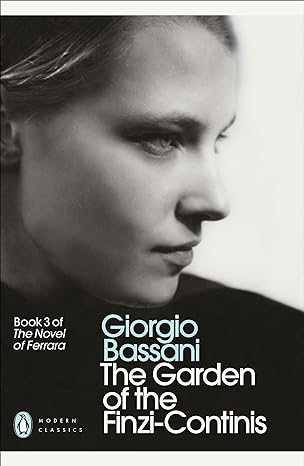
I adored Giorgio Bassani’s The Gold-Rimmed Spectacles (1958) when I read it last year, so I had high expectations when I approached The Garden of the Finzi-Continis (transl. Jamie McKendrick, 2007), the third book in his Romanzo di Ferrara cycle. It fully lived up to those expectations.
The unnamed narrator tells us in the Prologue that he is looking back from 1957 to a time before World War II. However the tone is more elegiac than nostalgic, as he also tells us that those he recalls perished in concentration camps.
Before the war the Finzi-Continis were a prosperous family, but the conflict destroyed them and all they owned. The large house is now squatted in, and the titular space:
“All the broad-canopied trees, limes, elms, beeches, poplars, plane trees, horse chestnuts, pines, firs, larches, cedars of Lebanon, cypresses, oaks, holm oaks, and even the palm trees and eucalyptuses planted in their hundreds by Josette Artom during the last two years of the first world war, were cut down for firewood, and for some time the land had returned to the state it was in when Moisè Finzi-Contini acquired it”
So it is with this knowledge that we then meet the younger, somewhat callow narrator, and follow his developing friendship with the younger Finzi-Contini’s, Alberto and Micòl, son and daughter of Professor Ermanno and Signor Olga.
Racial laws are coming into effect in Italy in the late 1930s, and this sees the narrator invited into the walled estate, as Jewish people are banned from places such as the local tennis club.
“They entirely left aside the existence of a far greater intimacy, a secret one, to be valued only by those who shared it, which derived from the fact that our two families, not by choice, but by virtue of a tradition more ancient than any possible memory, belonged to the same religious observance, or more accurately to the same ’School’”
Despite the growing pressures of the outside world, within the Finzi-Continis walls the narrator remembers a time where:
“The weather remained perfect, held in that state of magical suspension, of glassy, luminous, soft immobility which is the special gift of some of our autumns. In the garden it was hot, just slightly less than if it was summer.”
In this enchanted space the narrator falls for Micòl, but their relationship never develops, characterised by misunderstandings and ambiguity that they are too young to resolve. Being too young for what life throws at you is also shown through the political conversations with Giampi Malnate, an older Christian friend of Alberto, as well as an experience of terminal illness.
What I thought was so subtle and clever from Bassani is that nothing overly dramatic happens. Rather, things fade out. The huge events that we know are looming take place outside of the novel, and instead we are shown how we can take for granted the moments that seemingly have no wider ramifications. Except of course, they do. This is a formative time for the narrator.
The Garden of the Finzi-Continis is not a plot-driven novel. It is a beautifully written evocation of a time before unimagined horrors. It is reflective and elegiac in tone without ever letting sentimentality lessen the portrait of a family obliterated by the Holocaust. It’s a truly devastating read.
The novel was adapted into a film in 1970, which won the Best Foreign Language Oscar that year. Has anyone seen it? It looks pretty faithful to the book so I’m interested to watch it:
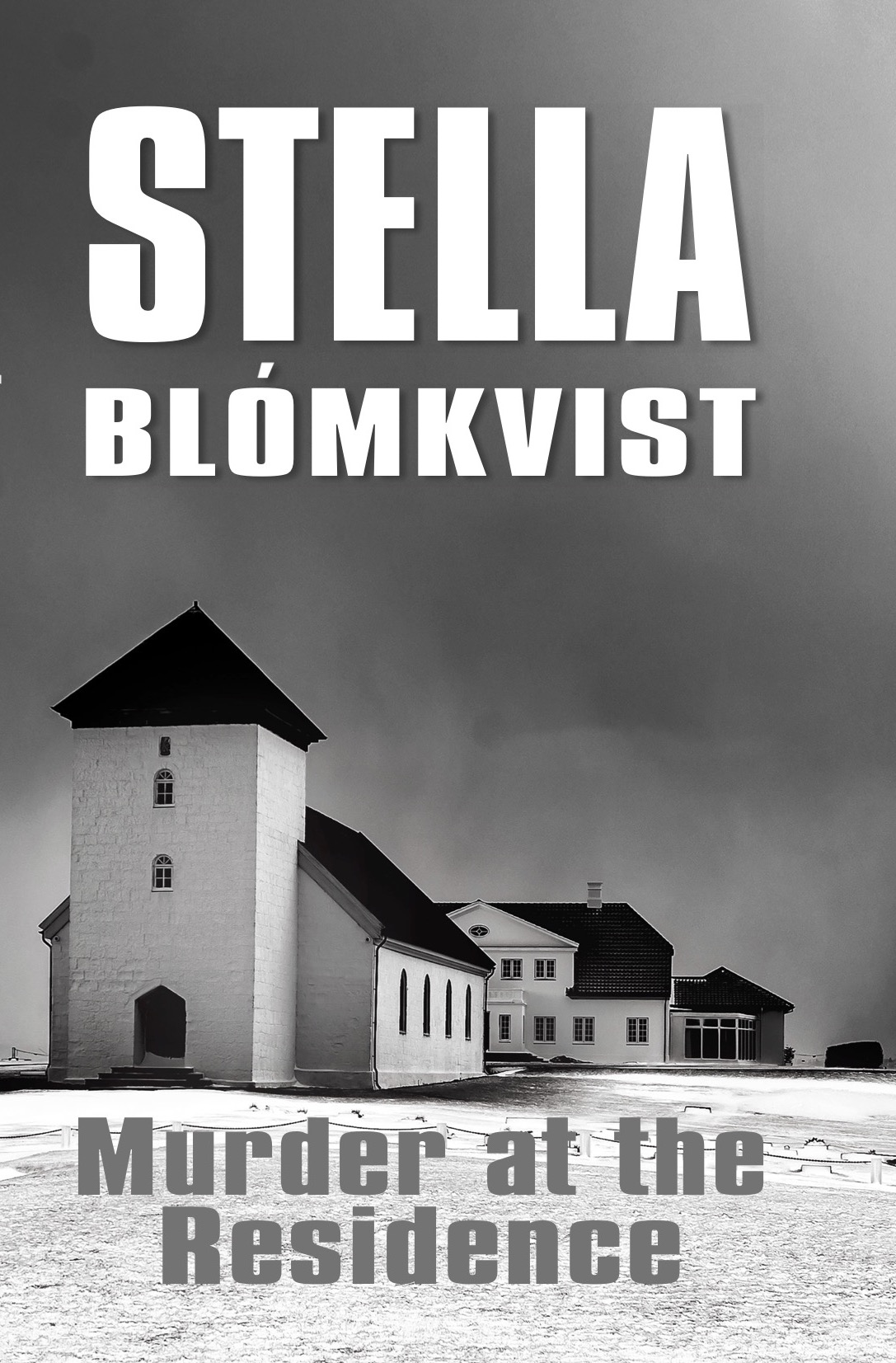
Today I’m taking part in a blog tour for Corylus Books, a lovely indie publisher with a focus on translated crime fiction. The novel Murder at the Residence offers an enduring mystery aside from the story: Stella Blómkvist is the name of the protagonist, not the author. Apparently there’s lots of speculation but it’s never been confirmed who writes this popular series. Murder at the Residence was published in 2012, the first of a second wave of Stella books, after a break since 2006.
Here is the blurb from Corylus Books:
“It’s New Year and Iceland is still reeling from the effects of the financial crash when a notorious financier is found beaten to death after a high-profile reception at the President’s residence. The police are certain they have the killer – or do they? Determined to get to the truth, maverick lawyer Stella Blómkvist isn’t so sure.
A stripper disappears from one of the city’s seediest nightspots, and nobody but Stella seems interested in finding her. A drug mule cooling his heels in a prison cell refuses to speak to anyone but Stella – although she has never heard of him. An old man makes a deathbed confession and request for Stella to find the family he lost long ago.
With a sharp tongue and a moral compass all of her own, Stella Blómkvist has a talent for attracting trouble and she’s as at home in the corridors of power as in the dark corners of Reykjavík’s underworld.
Stella Blómkvist delivers an explosive mix of murder, intrigue and surprise, and is one of Iceland’s best-loved crime series.”
The start of the novel sees Stella cruising for a New Year hook up. Her voice throughout is direct and no nonsense, and this includes articulating her sexual needs clearly. Sadly for Stella she doesn’t find a hottie to see the year in with, but she does meet Dagnija and Ilona, two Latvian women brought to Iceland on empty promises and finding themselves dragged into sex work. When Ilona disappears, Dagnija asks for Stella’s help.
Stella’s pretty busy, what with a dying man asking her to find his adopted daughter, a drug courier to defend, a young injured activist to support, and a family christening ending with the discovery of a dead body:
“The murder in the church at Bessastaðir was naturally the lead news item on both TV channels. Understandable, as it’s been a few centuries since there was last a murder at Bessastaðir. That’s as far as we know. And the President was in residence that weekend.
The body is that of a well-known financier.”
The financier Benedikt Björgúlfsson seems no great loss, but the story is bound up in the political situation in Iceland at the time:
“There were anonymous claims online that Benedikt must have been murdered by someone who had been with him at the President’s reception on Friday. The conclusion is that the guilty party has to be among society’s most powerful individuals. Others argue that this murder is the man on the street fighting back, that this is a foretaste of what other wealthy banksters can expect if the courts don’t get round to locking them up.”
As the various strands of Stella’s work start to come together, Murder at the Residence brilliantly portrays how political machinations and police corruption should concern everybody, because they affect everything. And while the story evokes its Iceland setting beautifully, it is sadly universal.
“Presumably you know the Icelandic politicians never, ever, resign due to poor judgement in their work. Taking responsibility for their own mistakes is something that simply missing from their genetic makeup.”
“Are wealthy playboys with reputations in ruins still Iceland’s heroes?”
Living in the UK means I’m not sure there was really a need to specify Iceland(ic) in those sentences….
Anyway, while Stella is (rightly) cynical regarding those in power, she’s not embittered like me 😀 So her voice remains clear-sighted and resolute but never alienating.
“It’s the familiar old song about bad foreigners making every effort to destroy Iceland’s innocence. But it’s on the overblown side this time. Our own homegrown criminals have long been perfectly capable of shovelling illegal drugs into the country. Not that they haven’t formed a few alliances along the way with European mafiosi.”
She has a softer side too – there is a budding romance, and also her young daughter Sóley Árdís to provide some work/life balance.
Murder at the Residence is expertly plotted and I just about kept up! If you’re the sort of reader who keeps notes and makes character lists when they read, those habits would serve you very well here.
The personal and political, plot and characterisation were all finely balanced. The story was also clear about the violence and corruption in the world Stella was investigating, but never gratuitous. I really enjoyed Stella’s distinctive voice and I’d love to spend more time with her. Fingers crossed more translations will follow.
Here are the stops from the rest of the tour, so do check out how other bloggers got on with Murder at the Residence:
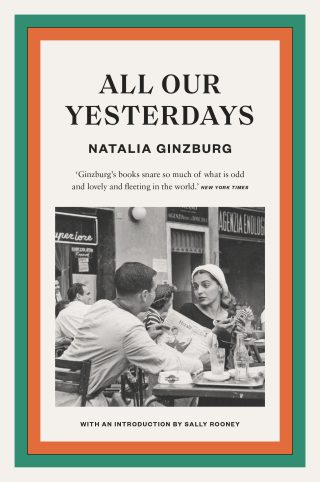
Daunt Books are such an interesting publisher and I was keen to read Natalia Ginzburg having heard wonderful things in the blogosphere, so I swooped on All Our Yesterdays (1952, transl. Angus Davidson 1956) when it turned up in my local charity bookshop. I think I’d read somewhere that this wasn’t the best place to start with this author, but I absolutely loved it.
The novel follows two families living in a northern Italian town from the 1930s, through the war years to peacetime. Although the blurb on the French flaps of my edition suggests Anna, the daughter of the poorer family, is the protagonist, really Ginzburg follows them all to a greater or lesser extent, with no overarching plot other than the sequence of years.
Although this approach sounds like a shortcoming, it works so well. It’s not a documentary novel but it gestures towards this with an omniscient neutral(ish) viewpoint and only reported speech. This felt unusual to read, but is so clever in capturing the everyday experiences of those living through extraordinary circumstances.
Anna’s siblings are Concettina, Ippolito, and Giustino. Concettina is popular with boys but struggles to find a purpose in life; Ippolito channels his energies into anti-Fascist activities with his friend from the richer family across the road:
“Emanuele and Ippolito did not even know Italy, they had never seen anything except their own little town, and they imagined the whole of Italy to be like their own little town, an Italy of teachers and accountants with a few workmen thrown in, but even the workmen and the accountants became rather like teachers in their imagination.”
Their lives are equally dictated by world events and by commonplace ones. Anna falls pregnant by her boyfriend and marries an eccentric older man, Cenzo Rena, moving with him to the southern village of Borgo San Costanzo. Her affair with her self-involved, callow boyfriend was no great passion, and while her marriage to Cenzo Rena attracts approbation, he is a warmer, more generous man than the one her own age.
“She was alone with Giuma’s face that gave her a stab of pain in her heart, and every day she would be going back with Giuma amongst the bushes on the river bank, every day she would see again that face with the rumpled forelock and the tightly closed eyelids, that face that had lost all trace both of words and of thoughts of her.”
These are people destined to be on the outskirts of war. Cenzo Rena holds a lot of sway in his local area and does help Jewish people fleeing the Nazi occupation, but on the whole the story of All Our Yesterdays is not one involving soldiers or revolutionaries. It is about ordinary people and for them the conflicts of war are reported facts not lived experience. The latter for them includes a lot of mundanity:
“And the bread in town was rationed and was a kind of soft, grey dough that you couldn’t ever digest, the bread was like the soap and the soap was like the bread, both washing and eating had become very difficult.”
Yet this doesn’t mean the story isn’t affecting, or that the characters avoid tragedy. There are some truly tragic events that are hugely affecting. Ginzburg manages to be even-handed in her treatment of her characters but not detached. Her writing is warm but unsentimental as she demonstrates that flawed people are as worthy of love and mourning as idealised ones.
In case I’ve made it sound unremittingly serious, I should mention that there humour in All Our Yesterdays too. There are romantic entanglements that are treated with a degree of levity, and eccentric housekeepers/family retainers with various foibles. All life is here.
I can’t think of another writer who approaches Ginzburg’s style, and looking back on it I can’t explain how she does what she does. This was a story that snuck up on me, the deceptively simple storytelling drawing me in more than I realised until I was totally immersed. An extraordinary novel.
“Fanfares of trumpets usually announced only small, futile things, it was away fate had of teasing people. You felt a great exultation and heard a loud fanfare of trumpets in the sky. But the serious things of life, on the contrary, took you by surprise, they spurted up all of a sudden like water.”
To end, of course there’s a very famous song I could post on the theme of Yesterday, but instead, to continue the mix of despair alongside levity: have you seen a parrot singing Creep by Radiohead?
Life has caused me to fall behind on blog writing, so unusually I’m writing this a few weeks after having read the book. Thankfully I found this one really stayed with me and I can get it in just in time for the last week of Women in Translation Month 😊
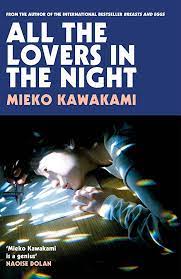
Having really enjoyed Mieko Kawakami’s Miss Ice Sandwich (2013) during my novella reading in May, I was delighted to find a copy of All the Lovers in the Night (2011, transl. Sam Bett and David Boyd 2022) in my local charity bookshop. It’s very different to my previous read of hers, and while I didn’t enjoy it as immediately as Ms Ice Sandwich, it did grow on me.
Fuyuko Irie is in her thirties and lives alone. She used to work in an office but her alienation from her colleagues means she prefers working at home. Her colleague/friend Hijiri is supportive of her talents and sends her regular work as a freelance proofreader, this work suiting her precise and solitary nature.
But this means that Fuyuko is even more isolated and achingly lonely. Kawakami is so good at capturing that modern urban alienation for people living surrounded by others but unable to connect, the feelings compounded when in the midst of a crowd.
“As I passed below the haloes of green and red traffic signals, I was taken by this strange view of the evening, the city streets full of people – people waiting, the people they were waiting for, people out to eat together, people going somewhere together, people heading home together. I allowed my thoughts to settle on the brightness filling their hearts and lungs, squinting as I walked along and counted all the players of this game that I would never play.”
It looks like things could change for Fuyuko when she meets Mitsutsuka, a physics teacher. Light is important to Fuyuko – every Christmas Eve (her birthday) she walks the streets at night looking at the illuminations. As Mitsutsuka explains the workings of light to her, they begin a tentative friendship, with brief points of connection offering glimmers of hope:
“‘Um, do you think the light you’re thinking about and the light I’m talking about are, um, the same thing?’
‘Of course they are, Mitsutsuka said with a smile. ‘We’re talking about the same light.’”
In a flashback chapter we learn more about Fuyuko’s background, and why she finds herself in the situation she does. There is an event in the past that Fuyuko describes without naming it in the way that I think most readers would, suggesting she doesn’t fully recognize her trauma or why she is making subsequent self-destructive decisions.
Kawakami subtly demonstrates how Fuyuko could change things for herself, but also how wider society makes this extremely difficult for her. She and Hijiri are women who have made very different choices and present themselves very differently to the world, but both struggle under the expectations placed on women and the fact that these are not an easy fit for either of them. A brief meeting with old school friend Noriko suggests traditional choices are not always happy ones either.
“I’d been on my own for ages, and I was convinced that there was no way I could be any more alone, but now I’d finally realised how alone I truly was. Despite the crowds of people, and all the different places, and a limitless supply of sounds and colours packed together, there was nothing here that I could reach out and touch. Nothing that would call my name. There never had been, and there never would be. And that would never change, no matter where I went in the world.”
All the Lovers in the Night is a slow burn novel, despite being only just longer than novella length. As I mentioned at the start, it was a story that grew on me and I found Fuyuko’s voice more compelling the more I read. A few weeks on and she’s really stayed with me.
Despite the sadness and alienation running through All the Lovers in the Night, I thought it ended with a suggestion of hope. That incrementally things can change, and improve. That imperfect people can make poor decisions but might still be moving towards a brighter time while doing so.
When I took part in a blog tour for Corylus Books earlier in the year, it was for a novella, which helpfully chimed with my Novella a Day in May reading. The bookish stars have aligned again for my taking part in a Corylus Books blog tour, as Deadly Autumn Harvest (2020) by Romanian author Tony Mott fits perfectly with my plans for #WITMonth reading, translated as it is by lovely blogger Marina Sofia (2023).
Here is the blurb from Corylus Books:
“A series of bizarre murders rocks the beautiful Carpathian town of Braşov. At first there’s nothing obvious that links what look like random killings. With the police still smarting from the scandal of having failed to act in a previous case of a serial kidnapper and killer, they bring in forensic pathologist Gigi Alexa to figure out if several murderers are at work – or if they have another serial killer on their hands. Ambitious, tough, and not one to suffer fools gladly, Gigi fights to be taken seriously in a society that maintains old-fashioned attitudes to the roles of women. She and the police team struggle to establish a pattern, especially when resources are diverted to investigating a possible terrorist plot. With the clock ticking, Gigi stumbles across what looks to be a far-fetched theory – just as she realises that she could be on the murderer’s to-kill list.”
I don’t read much contemporary crime because I don’t want to read about women being killed in various gruesome ways. I’m relieved to say I thought Deadly Autumn Harvest got the balance right between giving enough detail so that the horrors were realised, but with nothing being gratuitous. There was a responsibility in how the victims were portrayed, so you got a sense of them as people and the injustice in how their lives ended.
Forensic pathologist Gigi Alexa is an intriguing figure too. Cascading curly blonde hair and resolutely dressed in bright colours, I thought she was an idiosyncratic and believable investigator, good at her job and super-committed, yet not entirely detached:
“Usually, by the time she got to see the bodies, they had been drained of any semblance of life or a back story, they were mere puzzles to be solved. But today it had all been a little too close for comfort.”
She’s also a scientist who is not above a bit of superstition:
“Three bad omens. She counted them. First, she stumbled over her slippers as she got out of bed, so she went to the bathroom in her bare feet. Then she stepped into the sand that Morty had scattered from his litter tray. Thirdly, once she got into the kitchen, her coffee machine refused to get going so she would have to boil up Greek coffee instead. Three signs of bad luck on a Tuesday – no doubt more would follow.”
As Gigi and her team investigate the murders, she has to contend with various frustrations in the male-dominated environment. She’s not surrounded by idiots though. I liked her relationship with her boss CI Matei, and Emil, her colleague in pathology. There was also some humour (alongside remembrance of previous toxicity) in the reappearance of her impeccably turned-out ex, Superintendent Vlad Tomescu. (Slight spoiler, skip the next sentence and quote if you don’t want to know!) Gigi becomes single during the novel and her sardonic reflections on this state also lightened the tone:
“She didn’t miss him at all. It would be a while yet before she started missing the warmth of someone to curl up with in bed. Maybe during the winter. Except maybe by then she would have invested in an electric blanket.”
The mystery is very well-paced and the novel isn’t overlong at just 225 pages. We are there at the moment of the killings at various points, before we are returned Gigi and her team’s investigation. Although I’d be amazed if anyone guesses the connection before Gigi, we’re given a fair chance to guess the perpetrator. I’d like to proclaim I worked out who did it, but I suspected absolutely everyone at some point 😀
Deadly Autumn Harvest is a quick, compelling read with a truly chilling murderer pursued by a team of believable, well-rounded investigators.
Finally I should just say that Deadly Autumn Harvest definitely made me want to visit Braşov! I’ve never been, it sounds absolutely beautiful and with Gigi and her team on the case there won’t be any serial killers left to spoil my holiday – perfect.
Here are the stops from the rest of the tour, so do check out how other bloggers got on with Deadly Autumn Harvest:
Mallika at Literary Potpourri’s wonderful event Reading the Meow has been running all week, do check out all the great posts prompted by our feline friends! Here is my post just in time…
I’m grateful to Reading the Meow for finally getting me to pick up The Master and Margarita by Mikhail Bulgakov (finished in 1940, published in 1966) which is part of my Le Monde’s 100 Books of the Century Reading Challenge and has been languishing in my TBR for years. Although not ostensibly a book about cats, one does feature prominently as these various edition covers will attest:
The reason it had lain unread for so long was because I’m (aptly) a big scaredy-cat. I was really intimidated by this classic of twentieth-century fiction and I thought it would be far too complex and clever for me to understand. Which as it turned out, was broadly correct. I’m sure I didn’t pick up all the allusions and references, even with the notes in the back of my edition to help me (Alma Classics, trans. Hugh Aplin 2020 – I definitely recommend this edition and translation). However, I still found it very readable and a lot to enjoy, especially regarding Behemoth, the character that meant I was reading it this week particularly.
The Devil arrives in 1930s Moscow as a Professor Woland, along with his entourage: red headed, bizarrely dressed Korovyev; sinister vampiric Azazello; beautiful Hella; and Behemoth, an enormous cat that walks on his hindlegs, talks, drinks vodka and plays chess.
The proceed to wreak havoc for three days in a series of carnivalesque scenes, using the greed and corruption of people against them. It’s absolute chaos and carnage, but brilliantly Bulgakov shows that the devil doesn’t have to push very hard for all this to occur.
At the start of the novel, Woland predicts the shocking and absurd death of Berlioz, head of Massolit, a literary organisation. Once people hear of his death, this description of a barrage of statements in order to get Berlioz’s apartment is a good example of how Bulgakov balances social realism, satire, the comic and the desperate throughout:
“In them were included entreaties, threats, slanders, denunciations, promises to carry out refurbishment at people’s own expense, references to unbearably crowded conditions and the impossibility of living in the same apartment as villains. Among other things, there was a description, stunning in its artistic power, of the theft of some ravioli, which had been stuffed directly into a jacket pocket, in apartment No.31, two vows to commit suicide and one confession to a secret pregnancy.”
Meanwhile, Margarita, beautiful and unhappily married, is distressed because her lover, The Master, has committed himself to an institution and renounced his writing.
This is interspersed with the story of Pontius Pilate and Yeshua (Jesus), with the two stories echoing one another, and it emerges that this was the novel The Master was writing.
It is through the titular characters that Bulgakov prevents his satire becoming too bitter and alienating. Their devotion to each other and Margarita’s belief in The Master’s work is truly touching.
I don’t really want to say too much more as The Master and Margarita is such a complex, riotous piece of work that I think the more I try and pin it down the more I’ll tie myself in knots! It tackles the biggest of big themes; religion, state oppression, the role of art, love, faith, good and evil, how to live… It is a deeply serious work that isn’t afraid to be comical too.
But as this post is prompted by Behemoth, here is my favourite scene with him, getting ready for Satan’s Grand Ball on Good Friday and trying to distract from the fact that he is losing at chess:
“Standing on his hind legs and covered in dust, the cat was meanwhile bowing in greeting before Margarita. Around the cat’s neck there was now a white dress tie, done up in a bow, and on his chest a ladies mother-of-pearl opera glass on a strap. In addition, the cat’s whiskers were gilt.
‘Now what’s all this?’ exclaimed Woland. ‘Why have you gilded your whiskers? And why the devil do you need a tie if you’ve got no trousers on?’
‘A cat isn’t meant to wear trousers, Messire,’ replied the cat with great dignity. ‘Perhaps you’ll require me to don boots as well? Only in fairy tales is there a puss in boots, Messire. But have you ever seen anyone at a ball without a tie? I don’t intend to find myself in a comical situation and risk being thrown out on my ear! Everyone adorns himself in whatever way he can. Consider what has been said to apply to the opera glasses too, Messire!’
‘But the whiskers?’
‘I don’t understand why,’ retorted the cat drily, ‘When shaving today Azazello and Korovyev could sprinkle themselves with white powder – and in what way it’s better than the gold? I’ve powdered my whiskers, that’s all!’
[…]
‘Oh, the rogue, the rogue,’ said Woland shaking his head, ‘every time he’s in a hopeless position in the game he starts talking to distract you, like the very worst charlatan on the bridge. Sit down immediately and stop this verbal diarrhoea.’
‘I will sit down,’ replied the cat sitting down, ‘but I must object with regards your final point. My speeches are by no means diarrhoea, and you’re so good as to express yourself in the presence of a lady, but a series of soundly packaged syllogisms which would be appreciated on their merits by such connoisseurs as Sextus Empiricus, Martianus Capella even, who knows, Aristotle himself.’
‘The kings in check,’ said Woland.
‘As you will, as you will,’ responded the cat, and began looking at the board through the opera glass.”
I think overall I probably admire The Master and Margarita more than love it, and I enjoyed Bulgakov’s A Country Doctor’s Notebook more. But there is so much in this extraordinary, unique novel that will stay with me, and I’m sure it will reward repeat readings too.
To end, I tried to get my two moggies to pose with the book. With typical cattitude, they flatly refused 😀 So it’s back to 80s pop videos: