Novella a Day in May 2020 #4

Not to Disturb – Muriel Spark (1971) 96 pages


I really enjoy Muriel Spark. I like her creepy, unsettling tales, her dark humour, the ways things are not fully explained… Not to Disturb has all of this in bucketloads, but it means it’s a very hard book to review! At times I wasn’t sure what story I was reading, and now I’ve finished it I’m still not sure. I enjoyed it immensely, but in the wrong mood this could be a very frustrating read.


It’s set in a Genevan villa on a stormy night. The villa is home to the Baron and Baroness Klopstock who are locked in a room with their secretary, Vincent. The Baron’s brother is nursed in the attic and punctuates the night with howling.


Meanwhile, the servants are in their quarters discussing the evening ahead and already referring to the Klopstocks in the past tense. Heloise, the heavily pregnant maid, is reflecting on who of many possibilities could be the father of her unborn child which may be Pablo the handyman’s, but is cut short by Monsieur Clovis:


“ ‘We have serious business on hand tonight, my girl, so shut up,’ says the chef. ‘We have business to discuss and plenty to do. Quite a vigil. Has anybody arrived yet?’ “


Quite what the business is and why the servants know about it advance is never fully specified. We know there will be a death though, because the butler tells us:


“ ‘There was sure to be something unexpected,’ says Lister. ‘But what’s done is about to be done and the future has come to pass. My memoirs up to the funeral are as a matter of fact more or less complete. At all events, its out of our hands. I place the event at about 3am so prepare to stay awake.’


‘I would say 6 ‘o’clock tomorrow morning. Right on the squeak of dawn,’ says Heloise.


‘You may well be right,’ says Lister. ‘Women in your condition are unusually intuitive.’”


There’s also the couple at the gatehouse who are completely oblivious to the machinations, three people in a car lurking around the grounds waiting for Vincent, and everyone is staying up all night so they look bedraggled and upset when the press arrive as planned in the morning.


Not to Disturb is farcical, sinister and satirical. There’s a fairly horrible almost-rape scene but generally  things verge on the metaphysical rather than the visceral. It’s baffling and unsettling and I whizzed through it with great enjoyment. If ever a novelist was ill-suited to write a novel called Not to Disturb, it’s Muriel Spark 😀


If you’ve come to the end of this post and feel I’ve not told you anything useful about the novella, I’m really sorry! But in that way I may have conveyed some of the experience of reading Not To Disturb


“You are a lost generation.” (Gertrude Stein to Ernest Hemingway, 1920)

Miracle of miracles, I have managed to join in with the 1920 Club, hosted by Karen at Kaggsy’s Bookish Ramblings and Simon at Stuck in a Book. My reading capacity is still not great due to all that’s happening in the world and my work remains manic, so I thought I might not make it, but here we go on it’s final day: a hastily written and fairly incoherent contribution from me 😊

Firstly, Queen Lucia by EF Benson, the first in his hugely popular Mapp and Lucia series. Back when we were allowed in bookshops, I’d picked up a lovely box set of the first three novels from my favourite charity bookshop so I’m glad the 1920 Club gave me an incentive to get started.

We meet Emmeline Lucas arriving back in her home of Riseholme from London, and deciding to send her fly on ahead with her luggage, in order to cause a stir amongst her neighbours:

“dramatic instincts that formed so large a part of her mentality, and made her always take by right divine, the leading part in the histrionic entertainments with which the cultured of Riseholme beguiled, or rather strenuously occupied, such moments that could be spared from their studies of art and literature, and their social engagements.”

Immediately we know all we need to know: nothing happens in Riseholme, and Lucia is the centre of nothing happening.

“Mrs Lucas amused herself, in the intervals of her pursuit of Art for Art’s sake, with being not only an ambassador but a monarch…Mrs Lucas, busy and serene, worked harder than any of subjects, and exercised control that was both popular and autocratic.”

Lucia is an unmitigated snob with pretensions of cultured appreciation: she is called Lucia in deference to her constantly peppering her talk with Italian phrases, a language she doesn’t speak; she names the rooms in her house after Shakespeare plays; she visibly winces at what she perceives to be poorly played music, in order to demonstrate her delicate sensibilities to her audience.

Lucia is of course, completely clueless. She is bourgeois and has no appreciation of art except in using it to structure her own artifice for the other equally clueless inhabitants of Riseholme. Her neighbours are both in thrall to her and object to her unchallenged reign. Georgie is her BFF  who resents and adores Lucia (Benson can’t say he’s gay but devotes a good paragraph to explaining why there is no romantic interest between them); Mrs Daisy Quantock her frenemy and rival for being the epicentre of whatever the next Big Thing in Riseholme will be.

“the hours of the morning between breakfast and lunch were the times which the inhabitants of Riseholme chiefly devoted to spying on each other. They went about from shop to shop on household business, occasionally making purchases which they carried away with them in little paper parcels with convenient loops of string, but the real object of those excursions was to see what everybody else was doing, and learn what fresh interests had sprung up like mushrooms during the night.”

The plot is slight, as it’s meant to be, I think; Benson is showing the intrigues of an entirely ordinary, respectable English village. Daisy and Lucia jostle for the favour of a Guru, later Lucia is nearly dethroned when a genuine prima donna buys a holiday home in the village.

When the guru first made an appearance, my heart sank, expecting casual racism in spades. While there is undoubtedly some of that present, my sense on reading the novel was the portrayal was supposed to play to stereotypes. Without giving away spoilers, I think I was right, and what is being satirised is the ignorance of Riseholme residents.

Although the portrayal of Lucia and her acolytes is clear-sighted and relentless, it’s not cruel. Benson exposes their pretentions but he never leaves his characters devastated, only slightly chastened and all to quick to bounce back into their risible ways. This is gentle, genteel comedy and it’s never unkind.

I can’t say I found Queen Lucia laugh-out-loud funny, but I know fans of the series think the later books are better. It certainly raised a smile, had wonderful characterisation and provided some much-needed escapism during these troubled times.

The BBC adapted Mapp and Lucia in 2014. I’m not entirely convinced from this trailer, although Steve Pemberton looks perfectly cast as Georgie:


Secondly, as a big fan of Golden Age detective fiction, I have to include some as 1920 was a significant year in the genre, when Agatha Christie published Poirot’s first outing The Mysterious Affair at Styles. From the reviews I’ve read from other bloggers joining in with the 1920 Club it sounds a great read which I’ll definitely be catching up on. Another GA title from this year which I’ve chosen for this post is Freeman Wills Croft’s first novel, The Cask. You can read it in full here.

It begins with the titular cask arriving in London on a steamer. As a Londoner I enjoyed the description of the working docks, a time long gone:

“His goal was St. Katherine’s Docks, where the Bullfinch was berthed, and, passing across Tower Hill and round two sides of the grim old fortress, he pushed on till he reached the basin in which the steamer was lying. She was a long and rather low vessel of some 800 tons burden, with engines amidships, and a single black funnel ornamented with the two green bands that marked the Company’s boats. Recently out from her annual overhaul, she looked trim and clean in her new coat of black paint.”

Very different now, when it’s all massively overpriced flats and restaurants:

Image from Wikimedia Commons

The cask is discovered to hold gold sovereigns and a human hand. Broughton, the clerk from the shipping company sent to check some cargo for a fussy client, seemed to me to have rather a cavalier attitude towards the grisly contents:

“That a serious crime had been committed he felt sure, and that it was his duty to report his discovery immediately he was no less certain. But there was the question of the consignment of wines.”

All the same, it’s not long before Inspector Burnley of Scotland Yard is on the trail. The first seven chapters depict a farcical chase around London after the extraordinarily well-travelled cask, before it is finally found and the murder victim therein exposed.

Burnley has to travel to France to investigate further, which I found rather glamorous considering it took a whole day, two trains and a ferry to get to Paris. There are also trips to Belgium and to Glasgow as Burnley and his French counterpart Inspector Lefarge piece together the activities of the titular container.

Despite it being an early title in the genre, there’s still some GA tropes to enjoy in this novel, including a diagram in Chapter VI of something I’m not sure really needed elucidating, but I’m very fond of maps and room plans in GA crime so I welcomed it nonetheless:

Blessedly, there aren’t too may of the prejudices often found in GA crime, despite my fears when the French setting became apparent. But Burnley likes France and is friends with Lafarge, which was a pleasant surprise. The working classes however, are somewhat colourfully portrayed:

“‘See ’ere, boss,’ the words now poured out of his mouth in a rapid stream, ‘I’ll tell you the truth, I will, swelp me Gawd. Listen to me.’”

As a lifelong Londoner I can assure you this is *exactly* how we sound, swelp me Gawd.  Thankfully Croft soon abandons attempts at depicting the lower orders loquaciousness:

“Palmer’s statement, divested of its cockney slang and picturesque embellishments was as follows:—”

The Cask is a good, solid mystery. The puzzle is set up and we follow the police as they piece together what happened, step by step. If that makes it sound boring, it really isn’t. All the clues seem to point to one suspect but like the police, we’re really not sure he did it. I enjoyed this as an undemanding read but one that sustained my interest and attention, which is praise indeed at the moment, as I have the attention span of a particularly distractible goldfish.

To end, if there’s one thing associated with the 1920s, it’s the flapper. Here’s a clip from the 1920 silent film of that name, the whole of which is available to view on YouTube, and from this trailer looks quite fun:


“Pardon me while I have a strange interlude.” (Capt. Spaulding, Animal Crackers (1930))

This is my (incredibly long – apologies!) contribution to the 1930 Club, hosted by Karen at Kaggsy’s Bookish Ramblings and Simon at Stuck in a Book. It’s running all week so do join in if you have a chance!

The two novels I’ve chosen are lovely Virago Modern Classics both concerned with the role of women in society, specifically the work that they do, but beyond that they could not be more different. I’ll begin with a scathing indictment of war, before moving on to some light relief via a comic presentation of upper middle-class privilege…

Helen Zenna Smith’s Not So Quiet was written as a response to Remarque’s All Quiet on the Western Front, from a female perspective. It is a work of fiction but Smith aims to narrow the gap between fiction and reality by calling the narrator Helen Smith and writing from a first person perspective.

Helen has gone to France to volunteer as an ambulance driver, leaving behind her comfortable middle-class existence, much to the delight of her jingoistic mother. Helen and the other young women she works with share no such illusions, as her friend Tosh points out:

“No Smithy, you’re one of England’s Splendid Daughters, proud to do their bit for the dear old flag, and one of England’s Splendid Daughters you’ll stay, until you crock up or find some other decent excuse to go home covered in glory. It takes nerve to carry on here, but it takes twice as much to go home to flag-crazy mothers and fathers…”

In this short novel Smith documents the experience of war for those not engaged in trench warfare but shockingly, dangerously close to it. Her gaze is unflinching:

“We hate and dread the days following on the guns when they boom without interval. Trainloads of broken human beings: half-mad men pleading to be put out of their misery; torn and bleeding and crazed men pitifully obeying orders like a herd of senseless cattle, dumbly, pitifully straggling in the wrong direction, as senseless as a flock of senseless sheep obeying a senseless leader, herded back into line by the orderly, the kind sheep-dog with a ‘Now then, boys, this way. That’s the ticket, boys’,  instead of a bark; men with faces bleeding through their hasty bandages; men with vacant eyes and mouths hanging foolishly apart dropping saliva and slime; men with minds mercifully gone; men only too sane, eyes horror-filled with blood and pain…”

Not So Quiet is not a plot driven novel as such.  Instead it documents one woman’s experience, and how she is utterly destroyed by it. In addition to the horror of the men used as machine gun fodder, she sees England’s Splendid Daughters live infested with fleas, eating slop, needing illegal abortions and desperately trying to find some reprieve. For a whole generation the war wreaked absolute devastation of land, industry, mind, body and soul.

“We young ones doomed to live on without belief in anything human or divine again are the ones to be pitied.”

Not So Quiet is not a subtle novel. By that, I don’t mean it is badly written, its extremely well written. Smith is furious, and not interested in presenting a considered, moderate view. Some things do not warrant a moderate response, and the horrors of war are one of those. The world she depicts is unrelenting and nightmarish.

“I become savage at the futility.  A war to end war, my mother writes.  Never.  In twenty years it will repeat itself.  And twenty years after that.  Again and again, as long as we breed women like my mother and Mrs. Evans-Mawnington.  […]

Oh, come with me, Mother and Mrs. Evans-Mawnington.  Let me show you the exhibits straight from the battlefield.  This will be something original to tell in your committees, while they knit their endless miles of khaki scarves,…. something to spout from the platform at your recruiting meetings.  Come with me.  Stand just there.”

Reading Not So Quiet recently meant I was reading within a context of our Prime Minister pandering to the fascist fringe using inflammatory language around Brexit. This offensive rhetoric encourages people to forget that the EU was set up to promote peace and co-operation in Europe, after two twentieth century wars tore it apart. I wish more people would read things like Not So Quiet to remind themselves of experiences they’ve been lucky enough not to have to live through.

”What is to happen to women like me when this war ends … if it ever ends. I am twenty-one years of age and I know nothing of life but death, fear, blood, and the sentimentality that glorifies these things in the name of patriotism”

Deep breath… enough politics from me. But I hope I’ve shown how No So Quiet is still a relevant novel and an urgent one.

Secondly, a chance to recover with a light, fun novel about no greater tribulation than how to plant indoor bulbs. The Diary of a Provincial Lady by EM Delafield is not fluffy though – it is witty and incisive about social mores and the knots people, especially genteel British people, tie themselves in to avoid appearing rude. Again, it’s not a hugely plot driven novel, having been written as a weekly serial for Time and Tide magazine. It documents the titular lady’s experience of genteel middle-class life, with her disinterested husband Robert falling asleep behind The Times, son Robin away at boarding school, and daughter Vicky in the charge of Mademoiselle, the French governess.

“Robert takes the boys back after dinner, and I sit in hotel lounge with several other mothers and we all talk about our boys in tones of disparagement, and about one another’s boys with great enthusiasm.

Am asked what I think of Harriet Hume but am unable to say, as I have not read it. Have a depressed feeling that this is going to be another case of Orlando about which was perfectly able to talk most intelligently until I read it, and found myself unfortunately unable to understand any of it.”

One ongoing source of tension in the Provincial Lady’s life is her aristocratic neighbour, Lady Boxe, who is self-dramatizing and unable to conceive of any situation other than her own:

“Why not just pop into the train, enquires Lady B., pop across France, and pop out into Blue Sky, Blue Sea, and Summer Sun? Could make perfectly comprehensive reply to this, but do not do so, question of expense having evidently not crossed Lady B.’s horizon. (Mem.: Interesting subject for debate at Women’s Institute, perhaps: That Imagination is incompatible with Inherited Wealth. On second thoughts, though, fear this has a socialistic trend.)

The Lady’s days seemed to be filled with social events she finds tedious, writing innumerable letters, negotiating with servants and managing debt in a most peculiar way:

“Robert startles me at breakfast by asking if my cold—which he has hitherto ignored—is better. I reply that it has gone. Then why, he asks, do I look like that? Refrain from asking like what, as I know only too well. Feel that life is wholly unendurable, and decide madly to get a new hat.

Customary painful situation between Bank and myself necessitates expedient, also customary, of pawning great-aunt’s diamond ring, which I do, under usual conditions, and am greeted as old friend by Plymouth pawnbroker, who says facetiously, And what name will it be this time?

Visit four linen-drapers and try on several dozen hats. Look worse and worse in each one, as hair gets wilder and wilder, and expression paler and more harassed. Decide to get myself shampooed and waved before doing any more, in hopes of improving the position.”

The Diary of a Provincial Lady could so easily be tedious but its so well written that instead it is an utter delight. I would generally have very short patience with well-to-do ladies with very little to fill their days, but the Provincial Lady knows that a lot of what she expected to concern herself with is completely frivolous, and she’s taking an askance view of it all, while not really putting anyone down (not even Lady B).

“Lady B. amiably observes that I, at least, have nothing to complain of, as she always thinks Robert such a safe, respectable husband for any woman. Give her briefly to understand that Robert is in reality a compound of Don Juan, the Marquis de Sade, and Dr. Crippen, but that we do not care to let it be known locally.”

The Diary of a Provincial Lady is a quick read, and one that can be dipped into, given its episodic, diary structure. It’s a welcome bit of escapism in these troubled times!

“Lady Frobisher, who would be so delighted if Robert and I would come over for tea whilst there is still something to be seen in the garden. (Do not like to write back and say that I would far rather come when there is nothing to be seen in the garden, and we might enjoy excellent tea in peace—so, as usual, sacrifice truth to demands of civilisation.)”

Jacqui has also reviewed The Diary of a Provincial Lady for the 1930 Club and you can read her excellent post here.

To end, I was tempted to choose a clip from Anna Christie as it was released in 1930 and I love Greta Garbo. But instead I’ve gone for this anthem about female working life from the only person who can convincingly rhyme ‘kitchen’ with ‘ambition’:

“Genius and virtue are to be more often found clothed in gray than in peacock bright.” (Van Wyck Brooks)

This is my contribution to the third Persephone Readathon, hosted by Jessie at Dwell in Possibility.

It became apparent very quickly this year that my 2018 book buying ban would have no discernible impact at all if I didn’t rein it in again. So although not officially on a ban, I hadn’t bought any books since March and I’m trying to get that TBR stack down a bit further. This post covers the last two Persephones I had left in the pile… please note the use of past tense there. Those of you who follow me on twitter will know this happened a few hours ago:

I live opposite the greatest charity bookshop ever – what am I supposed to do? Two still had the bookmarks! I left 3 more Persephones behind in there (OK, so I already had those, but still…  😉 )

Firstly, Miss Buncle’s Book by DE Stevenson (1934), which is Persephone No.81. This simple story was an absolute joy. Unassuming spinster Barbara Buncle is desperate for money after her dividends stop paying out due to the financial crash. She decides to write a novel, and as she frequently asserts she has no imagination, she bases it on her village and the people she knows.

The novel is a smash hit, and the villagers are furious, apart from the doctor and his wife:

“I confess it amused me, Ellen – I know this is heresy in Silverstream, but it amused me immensely. It didn’t strike me as satire, nor could I find anything nasty in it. You can read it both ways… I’m pretty certain that its just a simple story, written by a very innocent person – a person totally ignorant of the world and worldly matters – perhaps even rather a stupid person.”

He’s only part right. Barbara Buncle has no side to her, so those who read the novel, Disturber of the Peace, as a satire are wrong. But she is not stupid. She is clear-sighted and that is what has enabled her to make such piercing portraits of her neighbours. The socially pretentious local bully Mrs Featherstone Hogg is determined to root out whoever has written about her in such unflattering (honest) terms:

“Once they knew who it was they could decide what was to be done, everything depended on who the man was. Whether it was the sort of man who could be terrorised, ostracised, or horse-whipped. At the very least he could be made to apologise and hounded out of Silverstream.”

Yet for all their objections, the villagers start to blur the lines between fact and fiction even further. A romance invented by Barbara develops in real life, and a deception she thought she invented turns out to be right on the money.

Barbara remains humble and somewhat bemused by it all. She is a sweet, endearing heroine but not overly saccharine. She has a strong practical streak and this is what led her to write in the first place and write so honestly.

 “It represented food and drink to Barbara Buncle, and, perhaps, a new winter coat and hat; but above all, freedom from that awful nightmare of worry, and sleep, and a quiet mind.”

Miss Buncle’s Book is charming. The portraits of the villagers are colourful but not silly, the plot is escapist but not ridiculous. A perfect antidote to our troubled times.

Secondly, Saplings by Noel Streatfeild (1945), which is Persephone No.16 and wasn’t remotely escapist. It charts the disintegration of a family during the Second World War. A clever stroke by Streatfeild is that the Wiltshire family has every privilege: they are well off, able to send their children to family members rather than generally evacuate, they can buy houses away from the city and the father isn’t called up to military service. Yet still the conflict wreaks havoc on both the adults and their four children.

I don’t know if it was because I read all of Streatfeild’s children’s books when I was young and her voice somehow set off a distant echo with me, but I loved this from the start. The opening scene sees parents Alex and Lena with their four young children, Tony, Laurel, Kim and Tuesday, at the beach. This being an interwar middle-class family, they also have a nanny and governess with them. Just as well, because Lena is not remotely maternal. She believes a mother’s role is to look lovely and be charming, and her children will never be her priority.

“He wanted to be a family man, bless him. The children were darlings, but she was not a family woman, she was utterly wife, and if it came to that, mistress too, and she meant to go on being just those things. It didn’t matter giving into him occasionally, letting him be all father. When they were alone she would brush all that away and have him where she wanted him.”

I found the frank discussion of Lena’s sexuality surprising for a novel of the period, and Streatfeild doesn’t judge her harshly because of it, but shows rather how this private need of Lena’s unfortunately has far-reaching consequences. The pressures of war will drive everyone close to breaking, and Lena’s focus on her own needs is disastrous for her children. However, I don’t want to say too much about plot because it’s very easy to give spoilers, and the joy of Saplings is seeing the subtle portraits of the four children emerge.

 “Laurel had been crying. Her cheeks had a stiff shiny look. Alex’s heart was wrung. He wanted to sit down by her and tell her how gloomy the house would be without her. That of all his children she had more tentacles round his heart. That he detested packing her off to a boarding school. That every night he would look for her funny plain little face and brisk plaits and would mind afresh because they were not there. But he had never spoken to her like that and tonight, poor scrap, was not the night to start. One word might start her crying again.”

Laurel and Tony probably suffer most. They are the eldest two and in very different ways the things left unsaid by adults effects them both profoundly. Streatfeild is expert in portraying children’s points of view without ever being patronising or sentimental and we see how the unthinking actions of adults are taken as grave injustices by the children. This could have so easily gone wrong: Saplings portrayal of the impact of war on children could have been mawkish and sickly-sweet. But actually it is even funny at times: Kim is a self-dramatising and demanding presence, and Streatfeild shows how he is charming but also, like his mother, entirely self-focussed and constantly playing to audiences.

 “Kim thought of chalk blue butterflies. He raised his eyes to the ceiling. He looked like a Hollywood choirboy rounding off a film in which the her or heroine’s soul in the in the last reel flies heavenwards.”

Saplings is expertly written and I really felt I was alongside the four children, immersed in their world. It shows the waste of war for everyone, adults and children alike. What is particularly devastating though, is the suggestion that the adults are in a better position to recover than the children. The war will end, but you only have one childhood, and for Tony, Laurel, Kim and Tuesday theirs has been torn to shreds by warfare, and by adults who systematically fail to recognise what the children need and offer them sanctuary.

“To keep homes safe was basically what most men were fighting for. Lena and Alex’s home was just the sort of set-up he himself was fighting to keep. Beautiful, orderly, full of children.”

Last year when I took part in the Persephone readathon I ended on Visage’s Fade to Grey in honour of those covers. Frankly, I think I outdid myself. This time, try as I might. I couldn’t think of an 80s classic to shoehorn in, so instead here’s a mention of Noel Streatfeild in a Hollywood blockbuster. You’ve Got Mail has always baffled me: why would you get together with the corporate capitalist pig who destroyed your family business and has lied to you almost constantly? Anyway, this is a nice mention of Streatfeild’s children’s books (2.18-3.10) and then I recommend watching The Shop Around the Corner which You’ve Got Mail is based on, but unlike the remake, is utterly charming.

Novella a Day in May 2019 #31

The Bluest Eye – Toni Morrison (1970) 164 pages

Trigger warning: this post mentions rape and child abuse

The final post of NADIM 2019! It been a close call at times as to whether I’d manage it but here’s the last novella I’m looking at: The Bluest Eye, Toni Morrison’s first novel.

This incredibly powerful novella has been banned in several states schools and the opening sentence tells you why:

“Quiet as it’s kept, there were no marigolds in the fall of 1941. We thought, at the time, that it was because Percola was having her father’s baby that the marigolds did not grow.”

Through the character of the abused child Percola Breedlove, Morrison interrogates the pervasive, destructive force of racism; what it does to individuals and what it does to communities. It is insidious, yet also visible and commonplace.

“Adults, older girls, shops, magazines, newspapers, window signs – all the world had agreed that a blue-eyed, yellow-haired, pink skinned doll was what every girl child treasured. ‘Here,’ they said, ‘this is beautiful, and if you are on this day ‘worthy’ you may have it.’”

Percola’s parents abuse one another physically, her mother is distant and her father an alcoholic. Yet Morrison at no point demonises them, even when Cholly Breedlove rapes his daughter. There are flashbacks to show how the adults arrived at the terrible place they are now in. Morrison demonstrates how, if a society tells you that you are worthless, a lesser human and without any value, it is extremely difficult not to internalise that judgement on yourself.

“The Breedloves did not live in a storefront because they were having temporary difficulty adjusting to cutbacks at the plant. They lived there because they were poor and black, and they stayed there because they believed they were ugly.”

Told mainly from the point of view of Claudia, a friend of Percola’s, the child’s view stops the violence and degradation being too relentless, but also shows how the youngest and most vulnerable members of society take in what they witness with devastating effect.

Even when not being directly abused, Percola experiences the daily wounds of racism, chipping away at her self-worth, such as the reaction from the shop owner when she goes to buy sweets:

“She looks up at him and sees the vacuum where curiosity ought to lodge. And something more. A total absence of human recognition – the glazed separateness.”

This means Percola passionately believes that if she could possess an outward marker of white ‘beauty’, things would improve for her.

“Each night, without fail, she prayed for blue eyes. Fervently, for a year she prayed. Although somewhat discouraged, she was not without hope. To have something as wonderful as that happen would take a long, long time.”

The Bluest Eye is brilliantly written and highly readable; Morrison never loses sight of the story or the characters under the weight of the immense, important themes she is exploring. It is an incredibly tough read that does not pull its punches, but neither is it voyeuristic or melodramatic. It shows how racism degrades us all and the vital need to strive for something better.

 “Along with the idea of romantic love, she was introduced to another – physical beauty. Probably the most destructive ideas in the history of human thought. Both originated in envy, thrived in insecurity, and ended in disillusion.”

Here’s Toni Morrison talking about The Bluest Eye and what led her to write it:

Novella a Day in May 2019 #30

Sleepless Nights – Elizabeth Hardwick (1979) 151 pages

Sleepless Nights is a fictional autobiography, told by a woman with the same name as the author. It begins:

“It is June. This is what I have decided to do with my life just now. I will do this work of transformed and even distorted memory and lead this life, the one I am leading today. Every morning the blue clock and the crocheted bedspread with its pink and blue and grey squares and diamonds. How nice it is – this production of a broken old woman in a squalid nursing home.”

The distorted memory means the reminiscences, memories and life story are like the crochet blanket: a series of separate pieces that come together to form a whole. So what we have are memories that dart back and forth across the woman’s life, a memory from marriage prompting a memory from childhood, prompting a memory of a neighbour, interspersed with a letter to a friend, prompting a memory of a bohemian young lifestyle in New York…

It is very cleverly written. It feels more coherent than I expected when I began the novella, and it effectively conveys the way memory works: we don’t sit and remember the beginning of our lives, working through sequentially to the current day.

“I like to remember the patience of old spinsters, some that looked like sea captains with their clear blue eyes, hair of soft, snowy whiteness, dazzling cheerfulness. Solitary music teachers, themselves bred on toil, leading the young by way of pain and discipline to their own honourable impasse, teaching in that way the scales of disappointment.”

I sat and read this straight through, but you could also just dip in for a paragraph and out again. Hardwick is master of the astonishing image:

“It has happened that someone I do not know is staying in the apartment with me. One of those charitable actions insisted upon by a friend. The stranger, thin as the elegant crane outside the window, casts a shadow because she has arrived when I was thinking about the transformations of memory. She fills the space with both the old and the new twilight, the space reserved for thoughts of my mother.”

Sleepless Nights has been published by NYRB Classics, always a reliable choice. I read it in an old VMC edition, which told me it was hailed as a literary masterpiece. I think if I was being super-picky, this might be my slight reservation. Its hugely impressive as a piece of writing but it didn’t fully move me. This is obviously a very personal thing, but for me to love a book I need strong characterisation. The narrator remained slightly enigmatic: she emerged to a degree from her memories but often she was in the shadows of them, the light cast on other people.

While enjoying a somewhat grim, dingy time as a young woman in New York, there are memories of seeing Billie Holliday live. Hardwick captures her talent, the tragedy, glamour and grit of her life very effectively. While she doesn’t shy away from what addiction did to the singer, she allows her some beautiful images too.

“Her whole life had taken place in the dark. The spotlight shone down on the black, hushed circle in a café, the moon slowly slid through the clouds. Night – working, smiling, in make up, in long silky dresses, singing over and over, again and again. The aim of it all is just to be drifting off to sleep when the first rays of the sun’s brightness begin to threaten the theatrical eyelids.”

And so to end, here is Lady Day herself:

Novella a Day in May 2019 #28

Familiar Passions – Nina Bawden (1979) 160 pages

Trigger warning: this post mentions rape and sexual assault

Like Eudora Welty who I wrote about yesterday, it was last year’s NADIM that saw me finally pick up one of Nina Bawden’s novels (for adults, despite the fact I’d loved her as a child). Devil by the Sea was truly unsettling and I was keen to read more. The lovely Ali over at heavenali had sent me this novella with another which I won in her giveaway, and its confirmed my childhood view that Bawden is a brilliant writer 😊

Familiar Passions begins with James telling Bridie, his much younger wife of 13 years, that he wants to leave her.

“After a brief interval he went on speaking flatly, in a measured voice, like a chairman reading a company report. ‘There are a couple of things I feel I ought to say. To sum things up. One is, that considered as a parental team, we haven’t done too badly. Adrian’s defection from the middle class norm, though disappointing, is not unusual for the times we live in.”

James is repugnant. At first he seems cold and self-serving, but its worse than that. The night they split up, Bridie wakes to find James raping her.

“She did not know she was afraid of James. If she had been told she would have laughed.”

Although James has suggested she stay on as a housekeeper so he has a nice home to return to in the UK while he works abroad (!) Bridie decides she is getting out.

“ ‘You don’t have to stay, you know,’ as if consoling a scared child.

The words came unbidden, without conscious thought, but as soon as she had spoken them she understood why she had addressed herself like this, as if she were someone younger and weaker than she was. It was the only way she could force herself to act.”

Bridie never seems a victim in this. She is still young – only 32 – having married James at 19, when he was a widower and raised his two children, as well as having a daughter together. She has no work experience and worries how she will get on in the world, but she is a good mother and her step-children both like her, probably more than they like their horrible father.

“The children’s faces sustained and calmed her. It came to her with the force of something she had always known but only now acknowledged, that they were the only reason she had stayed so long; their pictures, the only thing she would take with her.”

Bridie goes home to her parents. They adopted her as a baby and she has no idea about her biological parents. Her father Martin is a psychologist, her mother Muff was a nurse.

“She had always orchestrated her emotions in this way to get and keep her mother’s sympathy; softening down the discord of her coarser feelings and playing up the tender sounds that pleased her mother’s ear. Perhaps Muff’s liking for a sweet, clear tune was what was called bringing out the best in people. But it wasn’t bringing out the best in her, Bridie began to feel. Only something that, although not altogether false, was never quite the truth.”

Bridie housesits for a patient of her father’s, in Islington which is portrayed as rather rough and down at heel – how times have changed! She gradually adapts to and starts to enjoy her new life, but the ending of her marriage prompts her to find out about her birth and origins. In doing so, she uncovers way more than she ever bargained for…

Familiar Passions is a pacey novella but it never feels overplotted. The betrayals and revelations that emerge are the type that can exist in any family. It’s very much of its time – particularly regarding Bridie’s rape (and her later sexual assault) with her awareness of how few options she has. There is anger here for sure, about the limited roles and choices for women, but it never overwhelms the narrative or characterisation.

Familiar Passions is resolutely unsentimental about families but also shows how valuable they can be: how destructive but also how nurturing, in their own unique and deeply flawed ways. Ultimately it’s a hopeful novel, about realising who you are and finding your own way; bound up as both those things will be in who you have been in the past and where you have come from.

Novella a Day in May 2019 #15

The Blind Owl – Sadeq Hedayat (1937, trans. DP Costello 1957) 106 pages

This was a really challenging read, and though an astounding work, I was grateful for the novella length as it was tough to take.

Sadeq Hedayat was an Iranian writer and is considered an innovative titan of Persian literature; he’s a best-selling author in his home country. This novel was initially banned on publication, and according to Wiki there is still censorship of his work (I’ve not linked to the Wiki page because much to my horror there’s a picture of his dead body on it). Sadly, he died by suicide, and The Blind Owl certainly feels authentic in its portrayal of someone losing all sense of reality and suffering mental ill health. I’m giving this post a trigger warning for some pretty disturbing imagery in the third quote, although I’ve not picked the worst in the novella, I wanted to give a true sense of it.

“Will anyone ever penetrate the secret of this disease which transcends ordinary experience, this reverberation of the shadow of the mind, which manifests itself in a state of coma like that between death and resurrection, when one is neither asleep nor awake?”

The unnamed narrator earns his living by painting pen cases. He may or may not have killed someone:

“How could I have resisted it, I, an artist, shut up in a room with a dead body? The thought aroused in me a particular sensation of delight.”

It’s a disorienting narrative. It’s not clear what is true or false: the events described could be entirely in the man’s head and what The Blind Owl describes is him lying on his bed, thinking/hallucinating. It’s a stream of extremely disturbed consciousness. Images and events recur and shift slightly, adding to a sense of disorientation and being witness to someone’s spiralling thoughts.

“A sensation which had long been familiar to me was this: that I was slowly decomposing while I yet lived. My heart had always been at odds not only with my body but with my mind, and there was absolutely no compatibility between them. I had always been in a state of decomposition and gradual disintegration. At time I conceived thought which I myself felt to be inconceivable.”

The narrator has no compassion for humanity and this is what adds to making The Blind Owl such a tough read. He is misanthropic, and so the coldly related details of violence, dead bodies and decomposition are truly horrifying.

I don’t want to put people off reading The Blind Owl because it is truly a brilliant piece of writing, but definitely one for when you’re strong enough to take it, with a comforting escapist read lined up for afterwards.

“Am I a being separate and apart from the rest of creation? I do not know. But when I looked in the mirror a moment ago I did not recognise myself.”

“Women want love to be a novel. Men, a short story.” (Daphne du Maurier)

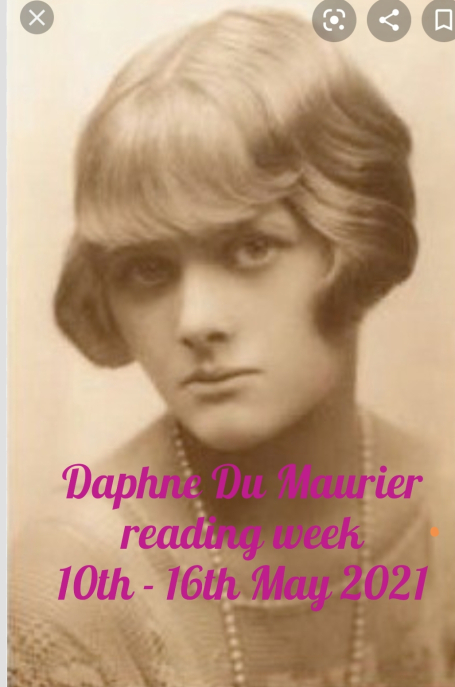
This week is Daphne du Maurier reading week, hosted by Ali over at heavenali. It’s also Ali’s birthday today, so Happy Birthday Ali!

I read Rebecca as a teenager and thought it was great, but somehow never read anything else by du Maurier. I had the NYRB collection of her short stories in the TBR, and yet I always gravitate towards the novels I have, so I’m glad #DDMreadingweek gave me the kick I needed, as it’s a great read.

I’m rubbish at reviewing short story collections so please bear with me. This is an excellent selection of nine stories, five of which are 40+ pages, the shorter ones coming in between 10-20ish pages. For me the longer stories were the stronger in the collection – although all are compelling reads – so I’ll concentrate on a couple of those.

The first two were made into incredibly famous films, so I won’t dwell on those as many of you will know the stories. What I will say is Don’t Look Now is just as creepy as the film but with a really dark humour to it, and The Birds is miles better than the film (I’m not really a Hitchcock fan) and totally freaked me out to the extent that I’ve been looking askance at every pigeon which has crossed my path since.

In Blue Lenses,  Marda West has an operation to restore her sight. She is in hospital, intensely vulnerable, dependent on the nursing staff, her doctors and her husband. She has only what they say and the sound of their voices to go on. Already she feels unnerved, even around her husband:

“Now, for no known reason except that darkness, perhaps, had made her more sensitive, she was shy to discuss her eyes with him. The touch of his hand was the same as it had ever been, and his kiss, and the warmth of his voice; but always, during these days of waiting, she had the seed of fear that he, like the staff at the hospital, was being too kind. The kindness of those who knew towards the one who must not be told.”

She has the operation to fit the titular lenses as a temporary measure and is warned they will make everything monochrome. On using her eyes for the first time with the lenses, Marda is shocked to discover is that she now sees everyone with the head of an animal.

This could be funny, or ridiculous, but in du Maurier’s hands it is deeply upsetting. There is the suggestion that the animal Marda sees tells her something about the person. One nurse is a benign cow, the other a kitten. Her doctors are both terrier dogs, one a tenacious Jack Russell, the other a sweet natured Highland. Someone she trusted is a snake, possibly in cahoots with a vulture…

At first Marda believes it is an elaborate joke being played on her, but then she goes to the window:

 “An elderly cod, leaning on two sticks, was being helped into a waiting car by the boar headed porter. It could not be plot. They could not know she was watching them.”

She is completely isolated. No-one will believe her and they will think she is mad. Who can she trust? The cow? The Highland terrier? What will Marda do with this newfound insight into people and their motivations? What will happen when the permanent lenses are fitted?

“The utter hopelessness of her position was like damnation itself. This was her hell. She was quite alone, coldly conscious of the hatred and cruelty about her.”

Blue Lenses takes a bizarre premise to question what we choose to see, how much we really know people, and to dramatise how vulnerable we are when we trust. The denouement is devastating.

Split Second begins like many a domestic fiction, and uses this familiarity to lull us into a false sense of security:

“Mrs Ellis was methodical and tidy. Unanswered letters, unpaid bills, the litter and rummage of a slovenly writing-desk were things she abhorred. Today, more than usual, she was in what her late husband used to call her ‘clearing’ mood […] First, she checked the linen. The smooth white sheets lying in rows upon their shelves, pillow slips beside, and one set still in its pristine newness from the shop, tied with blue ribbon, waiting for a guest who never came.”

So far, so deeply ordinary. Then Mrs Ellis goes for a walk, a walk she has done many times before, and when she returns it is to find strangers living in her house and no-one with any idea who she is. The police are called, but to Mrs Ellis’ horror it is she who is taken to the station:

“Could this officer and his subordinate be genuine members of the police force? Or were they, after all, members of the gang? This would explain their strange faces, their obvious mishandling of the situation. In which case they were now going to take her away to some lair, drug her, kill her possibly.

‘I’m not going with you,’ she said swiftly.

‘Now Mrs Ellis,’ said the constable, ‘don’t give any trouble. You shall have a cup of tea down at the station, and no-one is going to hurt you.’

He seized her arm. She tried to shake it off. The young policeman moved closer.”

Split Second is incredibly clever in how it positions the reader. It shows us the epitome of middle-class calm, we think we know the story we are getting, then like the experience of Mrs Ellis, everything is thrown in complete disarray. Twice I thought I had the answer to what was happening, and twice I was wrong, having followed the false trails du Maurier had set up.

Split Second is a sad story, and one that suggests we can attempt to create all the calm and order we like in our own small setting, it will be no match for the chaos and disarray of other people in the wider world.

The common theme across many of the stories is people doubting their view of reality: feeling isolated and threatened with nowhere to turn. It is this that makes du Maurier’s stories so unsettling and upsetting. The horror comes not from the more outlandish situations but from the feeling of dread, of creeping insanity with no sanctuary in sight.

I’m sure someone told me once that there’s a lot of snobbery around Daphne du Maurier, that she was seen as a popular writer and therefore not a very good one. It really is ridiculous; du Maurier is such a good storyteller, she draws you in from the start, holds you there until she’s ready to let you go, and makes it look easy.

To end, there are many cinematic adaptations of du Maurier to choose from, but I’ve picked the title story of this collection, as it was an adaptation she approved of (unlike The Birds):

Novella a Day in May 2019 #10

The Hunting Gun – Yasushi Inoue (1949, trans. Michael Emmerich 2013) Pushkin Press 106 pages

Published by the wonderful Pushkin Press, The Hunting Gun tells of the fallout from an extramarital affair via three letters, from the daughter of the woman involved, the betrayed wife, and finally the woman herself when she knows she is going to soon die.

The letters are sent to a poet who has published the titular poem about a man he once saw.

“He had simply struck me, as he came along the path with his shotgun over his shoulder and a pipe in his mouth, as having a sort of pensiveness about him that one did not ordinarily see in hunters- an atmosphere that seemed, in the crisp early-winter morning air, so extraordinarily clean that after we had passed each other I couldn’t help turning back.”

The man, Misugi Josuke, recognised himself in poem and has sent three letters he received to the poet, in order to explain why he had that atmosphere about him.

The first letter is from Shoko, the daughter of Saiko, with whom Misugi had an affair. Shoko only learns about the affair from reading her mother’s diary.

“And then I heard, very distinctly, the sound of that stack of words I had seen in her diary the night before SIN SIN SIN, piled as high as the Eiffel Tower – crashing down on top of her. The whole weight of the building she had erected from her sins in the course of the past thirteen years, all those floors, was crushing her exhausted body, carrying it off.”

Shoko’s letter is full of anger and betrayal, at both her mother and Misugi, the family friend. In contrast, Misugi’s wife, Midori, is surprisingly measured and even funny. But she acknowledges she has known for many years, and the hurt is not as fresh as that first day.

“I am sure you have had the experience of going for a swim in the ocean in early autumn and discovering that each little movement you make causes you to feel the water’s chillness more intensely, and so you stand there without moving. That was precisely how I felt then: too frightened to move. Only later did I arrive at the happy conclusion that it was only right to deceive you the way you had deceived me.”

Finally we hear from Shaiko, mother to Shoko, best friend to Midori and lover of Misugi, writing a letter to be opened after her death.

“Even after I die, my life will still be waiting here hidden in this letter until it is time for you to read it, and the second you cut the seal and lower your eyes to read its first words, my life will flare up again and burn with all its former vigour, and then for fifteen or twenty minutes, until you read the very last word, my life will flow as it did when I was alive into every limb, every little corner of your body, and fill your heart with various emotions. A posthumous letter is an astonishing thing, don’t you think?”

The Hunting Gun is a short, simply constructed novel that manages to convey emotions and characterisation of real complexity. The affair is shown to involve so many more people than just the immediate couple, and how the fallout and hurt from such a betrayal cannot be anticipated. Inoue shows the capacity human beings have for causing deep, irreparable sadness in one another, but the tone is never judgemental. A beautifully observed novella.

“Why, when we had just formed a united front, so to speak, to battle for our love, why, at a moment that should have been the most fulfilling, did I tumble into that helpless solitude?”