This week I’m focussing on Pushkin Press as part of Kaggsy and Lizzy’s #ReadIndies event to finally read four books that have long been in the TBR. For this third post today my read is Odessa Stories by Isaac Babel (1916-1937 transl. Boris Dralyuk 2016).
The Introduction to this volume by translator Boris Dralyuk is really informative and provides some fascinating context to Babel’s writing. Odessa was a booming port when Babel was born in 1894; in 1900 around 140,000 of its 400,000 population was Jewish. Babel was part of a well-to-do family but was drawn to Odessa’s underbelly, writing stories about the legendary gangsters of the city.
Dralyuk also explains about translating the melting-pot language of Odessa, so I highly recommend reading the Introduction before you start on the stories (I often read Introductions at the end). Babel was only 45 when he was killed in Stalin’s purges.
The volume is divided into three parts: Gangsters and Other Old Odessans; Childhood and Youth; and Love Letters and Apocrypha. I always struggle to write about short story collections and generally Babel’s stories are so short that I don’t want to give spoilers. Here I just want to give a flavour and you can see if you might want to seek out these stunning stories for yourself.
The first part is mainly told in the third person and weaves together tales of violence and corruption, with recurring characters including “Benya Krik, gangster and King of the gangsters”. The tales are colourful and carnivalesque, but Babel never allows the broader strokes to obscure the unlawful methods that so many live by:
“At this wedding they served turkey, roast chicken, goose, gefilte fish and fish soup in which lakes of lemon glimmered like mother-of-pearl. Flowers swayed above the dead goose heads like lush plumage. Does the foamy surf of Odessa’s sea wash roast chickens ashore?”
At the same time, he doesn’t position the reader above the gangsters or way of life. Babel suggests that this side of Odessa is as it is because this the logical way to be, and it has emerged as part of the society, laws and political structures that surround it:
“Let’s not throw dust in each other’s eyes. There’s no one else in the world like Benya the King. He cuts through lies and looks for justice, be it justice in quotes or without them. While everyone else, they’re as calm as clams. They can’t be bothered with justice, won’t go looking for it – and that’s worse.”
The second part of the stories in Childhood and Youth becomes more personal, with first-person tales that follow on from one another in some instances. I understand The Story of My Dovecote is the most famous, and rightly so. Within this brilliant collection, it still stands out. (Skip the next two paragraphs if you don’t want to know any details in advance.)
A young boy has spent five of his ten years coveting a dovecote. He manages to find ways around the anti-Semitism at his school to do well academically and get the reward of finally being able to buy his doves. He sets out to the market with his money and gets his beloved birds, tucking them into his jacket. If your heart is sinking at this description, you are absolutely right…
The story is fifteen pages in this edition and completely devastating. I would urge anyone to read it, but it will absolutely stay with you. It will rip your heart out and stamp all over it. The final word of this story is “pogrom”.
There are lighter stories in this section too, such as The Awakening, about a precocious young man:
“Writing was a hereditary occupation in our family. Levi Yitzchak, who went mad in his old age, had spent his whole life composing a tale titled A Man With No Head. I took after him.”
Odessa Stories was my first experience of reading Babel and I was blown away. Babel clearly enjoyed the almost fabulist tales of Benya the King, but somehow never glamorised him. His writing is hugely entertaining but also truthful – the violence towards people and animals suddenly appears in the midst of the stories and jolts the reader to remember the visceral realities of what is being described.
In evoking the worst of human behaviour in Dovecote, Babel is restrained and absolutely drives home the tragedy.
Babel’s writing is intensely human, marrying together humour, violence, pathos and beauty seamlessly. I will definitely seek out more by him on the strength of Odessa Stories. Sadly, there isn’t much as his life was cut short. However, Pushkin Press publish Red Cavalry, another short story collection.
“For the first time I saw my surroundings as they actually were – hushed and unspeakably beautiful.”
Happy Colette’s birthday! Regular readers will know how much I love Colette, and today I thought I’d look at two of her novellas which I had languishing in the TBR, La Vagabonde (The Vagabond) and L’Entrave (The Captive). Both follow periods in the life of Renée Néré, based on Colette’s experiences after her marriage to Willy ended.
Renée has left her philandering husband Adolphe Taillandy and has no regrets about doing so. However, this has left her with no money, and so she has turned from her beloved writing to earn money on the stage.
“I had savoured the voluptuous pleasure of writing, the patient struggling with the phrase until it becomes supple and finally settles down, curled up like a tamed animal, the motionless lying in wait for a word by which in the end one ensnares it.”
She is in her early thirties, and painfully aware of aging in an industry that depends on appearance and artifice. Renée has a “face which is losing the habit of being looked at in daylight” and which poverty will not help. She enjoys the stage though, and the people in it.
“They swagger, tightly buttoned in a full-skirted overcoat of the fashion of two seasons ago; for the essential, the indispensable thing, is the possession not of a clean suit but of a ‘really classy’ overcoat which covers everything: threadbare waistcoat, shapeless jacket, trousers yellowed at the knees; a dashing, flashy overcoat, which makes an impression on the director or the agent, and which in the last resort enables one to throw off that ‘things aren’t shaping well’ in the jaunty tone of a man of means.”
Colette is not sentimental about the poverty or hardships of such a life. Early on she writes of the gradual but inevitable degradation of young chanteuse Jadin, in a way that is clear-sighted but heartbreaking.
Into Renée’s world comes Maxime Dufferein-Chautel, a rich feckless admirer. What follows is a love affair of sorts, one in which Renée never quite resolves her ambivalence.
“He does not want my well-being, this man, he merely wants me.”
“There are days when solitude, for someone of my age, is a heady wine which intoxicates you with freedom, others when it is a bitter tonic, and still others when it is a poison which makes you beat your head against the wall.”
Maxime is not unpleasant or abusive, but he is pretty dull:
“I forgive him all this ordinariness for the sake of a simplicity which has nothing humble about it, and because he finds nothing to say about himself.”
And Renée is painfully aware that getting into a relationship with him may require more than she is willing to give. As her friend Hamond points out:
“Be frank, Renée, be clear sighted, and tell me whether all your sacrifices [within marriage] haven’t only lost their value in your eyes since you recovered your free will? You assess them at their true worth now that you no longer love.”
Renée is offered a tour and vacillates about whether to go. Ultimately she does and her letters to Maxime form the latter part of the novella, although we never see Maxime’s replies. The Vagabond is determinedly Renée’s story and her voice.
“This evening I should not feel sleepy, and the spell of a book – even a brand new book with that smell of printers ink and paper fresh from the press that makes you think of coal and trains and departures! – even that spell will not be able to distract me from myself.”
Despite The Vagabond’s various urban settings, there is still plenty for fans of Colette’s depictions of the natural world to enjoy, such as this description of early Spring in Paris:
“Towards the end of the afternoon, a mauve mist veils the avenues so that you do not know where they end, and the unexpected discovery of a wild hyacinth, with its three slender bells of artless blue swaying in the wind, has all the charm of a stolen joy.”
The Vagabond is slightly plotted with very little happening. It is not a slight tale though, but rather a distinctive plea for female independence alongside a consideration of how to reconcile this with romantic love and material necessity.
“Are you not he who, thinking he is giving, takes for himself? You came to share my life. To share, yes: to take your share!”
The Captive (1913, transl. Antonia White 1964) is set three years later. Renée is now financially solvent due to a legacy and whiling away her time in the south of France. She is still living the itinerant hotel-based life, unable to fully adjust to her new circumstances: “when a dog has been kept a long time on a lead, it does not go prancing off the moment you undo the catch of its chain”.
She finds herself with an unlikely trio of friends. There is young May, self-mythologising and fragile:
“Nature has drawn all the features of laughter itself in her round childish face; a Cupid’s bow mouth that tilts up at the corners like her mischievous eyes, a short little nose with quivering nostrils. But gaiety is not a perpetual fidgeting that betrays a lack of security, it is not chatter full of recriminations, nor is it a craving for everything that intoxicates. Gaiety, it seems to me, is something calmer, something healthier, something more serious.”
There is also May’s brutish lover Jean, and their friend, the opium-addicted Masseau.
“Yes, I’ve had enough of those people, it’s true. But, besides beginning to know myself, I’m also beginning to know the advantages and disadvantages of this extraordinary part of the world where mornings are enchanting and the nights, however starry, make one shiver in the discomfort of a double climate. Here cold nights are not invigorating and warm nights throb with fever rather than with passion.”
At the beginning of the novel Renée is determined to remain celibate. However, for reasons that entirely escaped this reader, she is attracted to Jean.
“A kiss, and everything becomes simple and enjoyable and superficial – and also a trifle coarse.”
She leaves Nice for Geneva to try and resist him, but they are eventually reunited. Their affair is wholly unsatisfactory for both of them. Colette explores the experience of a relationship based on sexual attraction without emotional intimacy, when the latter is also desired by both but remains elusive.
“I have insulted this lover, out there alone in the soft spring night, restoring his own identity; I have insulted him by giving him my body and supposing that this was enough. He has returned the insult.”
Like The Vagabond, it is Renée’s thoughts and experiences that the reader is privy to. We know very little about Jean and even less about what he thinks and feels. While he is not likeable, the portrayal of the affair is quite even-handed, as Renée acknowledges how little she is able to give of herself. What she does give may be as much a performance as any she made on the stage:
“You pretend to love me, you do love me. Every minute your love creates a woman better and more beautiful than myself whom you forced me to resemble.”
Somehow I didn’t find The Captive too depressing, although I’m not entirely sure why. There is something resilient about Renée even when she seems to be taking such sad decisions. Although she is adrift at this point in her life, I felt there was some hope she’d start to feel more anchored within herself soon.
“The darkness is ebbing. A faint wind stirs the trees, bringing a green smell of trampled grass. Behind the plane trees, the mound of the fortifications is emerging from the dusk and the sky is taking on the colour of a field of blue flax the subdued, slightly grey, slightly melancholy tint over summer dawn over Paris.”
To end, I was looking for archive footage from Folies Bergère to reflect Renée’s career, which led me to loads of cabaret footage, which led me to loads of Cabaret footage, which led me to this performance by Liza Minelli. Basically all roads lead to Liza 😀 I’ll never not be astonished by how the chair doesn’t move until she wants it to – the woman must have abs of steel:
This is the first of her novels I’ve read and on the strength of this I definitely want to read more. Novella length, it tells the story of Kōko, a 36-year-old single mother to eleven-year-old Kayako. Told in the third person from Kōko’s perspective, it is a compelling examination of one woman’s inner world and her barely articulated resistance to the expectations placed on her.
Early in the novel, Kōko suspects she is pregnant. She is ambivalent about Osada, the father, as she is about most things. But gradually she realises that she wants to keep the child:
“Maybe she was reaching an age when it was senseless to want a fatherless child; but, precisely because of her age, she didn’t want to make a choice that she would regret till the day she died. Lately she was more convinced than ever that there was no point in worrying about what people thought. She would soon be thirty-seven. The only person watching Kōko at thirty-seven was Kōko. When this obvious fact finally came home to her it was still a surprise – what a very lonely fact it was!”
Geraldine Harcourt’s informative introduction explains that pregnancy at that age in Japan around this time could still be viewed as shameful even within marriage, so Kōko’s decision is doubly transgressive.
Kōko is an intriguing character, as she lives an unconventional life which places her in opposition to so many, by barely doing anything. Her lack of decision-making is an act of quiet but determined resistance.
Her sister Shoko is much more conventional and doesn’t approve; Kōko’s daughter Kayako much prefers to spend time with her more affluent, conformist aunt. Kōko tries to explain to Shoko:
“No, that’s not it – don’t think I’ve liked using choosing a different world from other people. I know I’ve been stubborn – but not about Kayako alone. All my life, though I often haven’t known which way to turn, I have managed to make choices of my own. I don’t know if they were right or wrong. I don’t think anyone can say that.”
But really she hasn’t made that many choices. She married because of pregnancy; husband Hatanaka organised the divorce years later, unsurprisingly as Kōko didn’t love him, still holding a candle for her lover Doi. She doesn’t enjoy her job teaching piano, but she also takes no steps to do anything else. She doesn’t take great care of herself and she doesn’t have many friends or interests.
Two driving forces in her life are her love for her brother, who died many years earlier, and sexual desire. The latter has led to her current predicament, the former suggests one reason that may be contributing to her lack of attachments.
“A little over a year ago, Kōko had understood something for the first time: the in the end she had let everything slip away from her, that in reality she hadn’t a single resource. It was an alarming discovery.”
Her lack of attachment includes reality – we are taken into Kōko’s dreams and daydreams, woven in seamlessly but disconcertingly. As we move back and forth in time, learning about Kōko’s childhood, marriage, griefs and pains, Tsushima builds a picture of a woman who may not be completely likable but who is recognisably human and flawed, and muddling through the best way she knows how.
I was really rooting for Kōko to find a more articulate agency, and the penultimate scene was unbearably tense in this regard. Child of Fortune is never didactic yet absolutely achieves a compelling portrait of a woman fighting for her life, against immense societal pressure.
“Kōko was shaken by the realisation that even now, more than twenty years later, she still lacked any compelling reason to go on living. And by the fact that the will to live was still there.”
To end, Kōko has fond memories of a visit to Karuizawa, which does look lovely:
PS When I was looking for a title quote for this post, I found this great conversation between Tsushima and Annie Ernaux.
Happy Birthday Beryl Bainbridge, who would have been 91 today! I thought I wouldn’t manage a post for Reading Beryl Week hosted by Annabookbel as I had a couple of false starts. I love Beryl but the two I had in the TBR didn’t work for me – probably the wrong time (I seem to be catching #AllTheWinterViruses).
Then I thought I’d let fate decide (admittedly I knew the odds were stacked in my favour, but I just like to pretend to myself that I’m not always going to buy a book 😀 ) and I went to the consistently wonderful charity bookshop across the road from me… of course they had plenty on their shelves, including one I keep meaning to read, An Awfully Big Adventure (1989).
I could just squeeze it in because Beryl generally wrote very short novels; this one comes in at 197 pages. So I’m counting it towards Novellas in November too, hosted by Cathy at 746 Books and BookishBeck.
Set just after the war, young Stella is encouraged to pursue dramatic interests by her Uncle Vernon, who feels she needs an outlet for all her feelings:
“Emotions weren’t like washing. There was no call to peg them out for all the world to see.”
But despite Stella’s emotional reactivity, she is also strangely detached. Uncle Vernon and Aunt Lily raised her, but she is not intimate with them. She never talks to them about what is happening for her or how she feels.
This theme of the distances between people continues when Stella joins an acting troupe at the local theatre, helping backstage and playing small parts. There are complex histories, resentments and intrigues between the players, which Stella only partly grasps.
“Bunny agreed with Meredith that there was nothing wrong with Dawn Allenby apart from her love of beauty, an affliction she was ill-equipped to fight. He put it in a nutshell when he said she was the sort of girl who, if there had been a meadow handy, would have been out there in a flash picking cowslips.”
Stella is naïve and self-focussed, which means the reader sees much more than she does. She can make sharp observations but lacks the sophistication to fully comprehend their meaning. She falls for Meredith, the nicotine-stained, spiky director:
“She suspected it was education and breeding that enabled him to keep his face and his feelings separate.”
But she is so wrapped up in her own feelings she barely registers how little she knows of him, or his lack of any interest in her:
“Endeavouring to be what she imagined was his ideal, she altered her demeanour several times a day.”
The reader knows Stella will never, ever be Meredith’s ideal. But Stella remains wilfully ignorant and intent on very shaky self-reinvention. I would say this seems to be a recurrent theme in Bainbridge – the psychological warfare people can wage on one another, though self-involved disregard of others, rather than outright mendacity.
Also typical of Bainbridge is the witty, pithy turn of phrase and humour threaded throughout the darkness.
“She plumped out my vowels. I tend to have flat ones. It’s to do with catarrh as much as region.”
Apparently An Awfully Big Adventure was partly biographical with Bainbridge drawing on her time working at the Liverpool Playhouse. It certainly felt very authentic, with lots of detail about the daily drudge of postwar life, such as when Stella wants a bath:
“It meant paraffin had to be fetched from Cairo Joe’s chandlers shop next door to the Greek Orthodox Church, and then the stove lugged two flights of up the stairs and the blanket nailed to the window with tacks. In the alleyway beyond the back wall stood a row of disused stables and a bombed house with the wallpaper hanging in shreds from the chimney breast, and sometimes women, no better than they ought to be, lured men into the ruined shadows.”
An Awfully Big Adventure is ultimately very dark. Stella’s seduction by seasoned actor PL O’Hara is treated by Stella with the same detachment with which she views nearly all her relationships. But the consequences will be tragic, and again, the reader is left to realise far more than Stella.
For newcomers to Bainbridge, this would be a good place to start. It covers many of the themes she returns to and is so tonally distinctive, in the way her novels are. For those who are already fans, she is at the height of her powers here. An Awfully Big Adventure was one of the five books that gained her a Booker nomination, which she never won.
“In the end everyone expected a return on love, demanded a rebate of gratitude or respect. It was no different from collecting the deposit on lemonade bottles.”
To end, An Awfully Big Adventure was adapted to film in 1995. I have a vague memory of seeing it in the cinema at the time. This trailer has reminded me how perfectly cast it was, and how much I miss Alan Rickman’s performances:
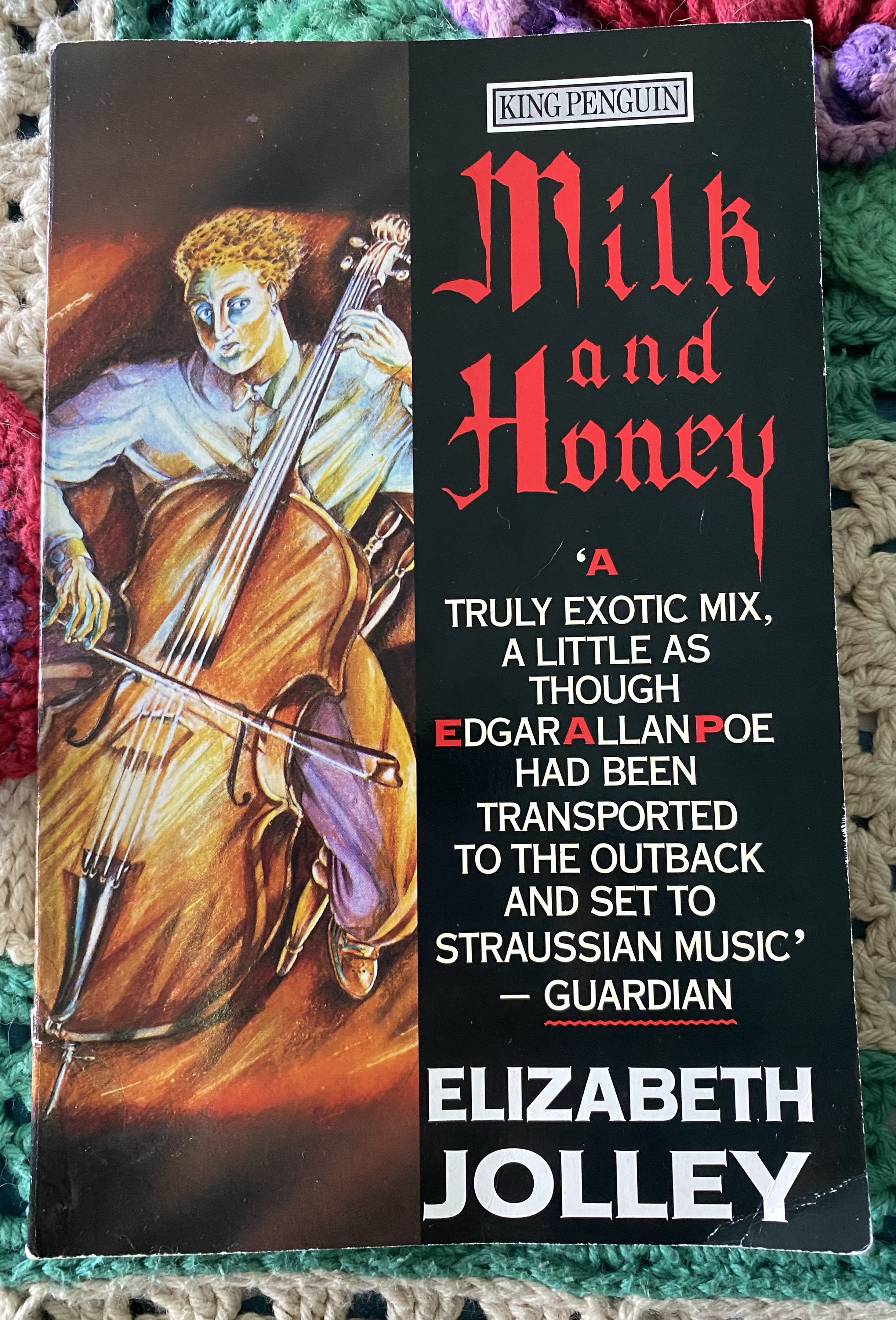
Milk and Honey (1984) has quite a Gothic feel to it, so it’s worked out well with Hallowe’en too…
The story is narrated by Jacob, who at the beginning of the novella is an unhappy, unfulfilled door-to-door salesman with an injured hand.
“Sometimes, after my cup of real coffee in the Beach Hotel, I sat outside on the small, sandy cliffs, looking down onto the sea as it came up in long, slow waves to the rocks and sunk sighing back down the beach, and I felt the profound melancholy that all my life has come over me from time to time. It was the melancholy of dark trees standing alone and the quiet sadness of the colours of the land, dark greens and browns and the sand subdued. As I sat, the colours deepened, tawny, dun coloured blending beneath the low grey sky. And from somewhere hidden, the sun lit up the sea.”
We then go back in time to when Jacob was a teenager and sent by his father to live with the Heimbachs so he can be tutored in the cello by Leopold. The widowed tutor adores Jacob, calling him ‘Prince’, but his sisters Tante Rosa and Aunt Heloise may be more ambivalent. Certainly Jacob’s lauded genius may not be as evident as Leopold proclaims. But Jacob does play with feeling:
“When I played the cello and the cello hesitated, poised on a single note so pure and restrained and lovely, I closed my eyes with an exquisite love of the cello. I was in love with the cello.”
Also in the house are Leopold’s children. His daughter Louise is a romantic interest for Jacob, and there is his son Waldemar who has unspecified disabilities. The household is insular and claustrophobic, but Jacob willingly relinquishes external experiences:
“I had no wish to be free. I preferred not to go to school, and, though the house and garden were open to the street, I never went out into the street. I read and studied and lived in the household which seemed to contain all in the way of books and musical instruments and teachers I could ever need.”
For the reader though, the household is deeply unsettling. We never really know what anyone’s motivations, views or plans are. Jacob is self-focussed and so as a narrator he doesn’t tell us. We piece together certain aspects of the wider life of the household – I guessed an unpleasant twist towards the end – but so much is left unspecified.
Conspiracies abound in this small household. A major decision is taken early in the novel that is traumatising for Jacob but we’re not completely sure why such action is taken. Jacob is having an affair but it seems entirely likely that everyone knows about it. A wedding ceremony is sprung on him, and yet everyone seems to think this is completely acceptable:
“But even after the surprise celebration of our engagement, on the day of my inheritance, the idea of marriage had seemed remote, something vague, talked about in laughter while eating apples and trying on rings made from human hair, something looked forward to from childhood but, like a disease experienced by adults, never reached.”
Milk and Honey is an odd novel and at times I wasn’t sure it was for me. There was so much that was unexplained that it could be entirely discombobulating, and Jacob was so oblivious and callow I wasn’t sure he could carry me through. I’m glad I persevered though, and I would definitely be interested to read more by Jolley. From this, I would say she writes about nature beautifully and is expert in creating an unsettling, memorable atmosphere.
You can read Lisa’s excellent review of Milk and Honeyhere.
To end, a bit of a departure from my usual 80s cheese – I always find Elgar’s cello concerto in E minor so moving (and this is with the City of Birmingham symphony orchestra, which was Elizabeth Jolley’s place of birth before she emigrated to Australia – see what I did there? 😀 ):
This is my final post for the 1962 Club, hosted by Simon and Kaggsy, which has been running all week. It’s been a great event as always, and I’m really pleased it prompted me to pick the three I’ve read off the TBR pile at long last!
(Please note, despite the subject matter I’ve made a deliberate choice not to draw contemporary parallels. I think Lisa explained this decision really well in her blog post here.)
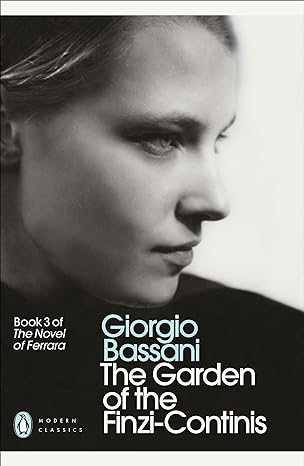
I adored Giorgio Bassani’s The Gold-Rimmed Spectacles (1958) when I read it last year, so I had high expectations when I approached The Garden of the Finzi-Continis (transl. Jamie McKendrick, 2007), the third book in his Romanzo di Ferrara cycle. It fully lived up to those expectations.
The unnamed narrator tells us in the Prologue that he is looking back from 1957 to a time before World War II. However the tone is more elegiac than nostalgic, as he also tells us that those he recalls perished in concentration camps.
Before the war the Finzi-Continis were a prosperous family, but the conflict destroyed them and all they owned. The large house is now squatted in, and the titular space:
“All the broad-canopied trees, limes, elms, beeches, poplars, plane trees, horse chestnuts, pines, firs, larches, cedars of Lebanon, cypresses, oaks, holm oaks, and even the palm trees and eucalyptuses planted in their hundreds by Josette Artom during the last two years of the first world war, were cut down for firewood, and for some time the land had returned to the state it was in when Moisè Finzi-Contini acquired it”
So it is with this knowledge that we then meet the younger, somewhat callow narrator, and follow his developing friendship with the younger Finzi-Contini’s, Alberto and Micòl, son and daughter of Professor Ermanno and Signor Olga.
Racial laws are coming into effect in Italy in the late 1930s, and this sees the narrator invited into the walled estate, as Jewish people are banned from places such as the local tennis club.
“They entirely left aside the existence of a far greater intimacy, a secret one, to be valued only by those who shared it, which derived from the fact that our two families, not by choice, but by virtue of a tradition more ancient than any possible memory, belonged to the same religious observance, or more accurately to the same ’School’”
Despite the growing pressures of the outside world, within the Finzi-Continis walls the narrator remembers a time where:
“The weather remained perfect, held in that state of magical suspension, of glassy, luminous, soft immobility which is the special gift of some of our autumns. In the garden it was hot, just slightly less than if it was summer.”
In this enchanted space the narrator falls for Micòl, but their relationship never develops, characterised by misunderstandings and ambiguity that they are too young to resolve. Being too young for what life throws at you is also shown through the political conversations with Giampi Malnate, an older Christian friend of Alberto, as well as an experience of terminal illness.
What I thought was so subtle and clever from Bassani is that nothing overly dramatic happens. Rather, things fade out. The huge events that we know are looming take place outside of the novel, and instead we are shown how we can take for granted the moments that seemingly have no wider ramifications. Except of course, they do. This is a formative time for the narrator.
The Garden of the Finzi-Continis is not a plot-driven novel. It is a beautifully written evocation of a time before unimagined horrors. It is reflective and elegiac in tone without ever letting sentimentality lessen the portrait of a family obliterated by the Holocaust. It’s a truly devastating read.
The novel was adapted into a film in 1970, which won the Best Foreign Language Oscar that year. Has anyone seen it? It looks pretty faithful to the book so I’m interested to watch it:
This is my second contribution to the 1962 Club, hosted by Simon and Kaggsy, which is running all week. Do check out all the wonderful posts!
I picked up Life at the Top by John Braine because it is the sequel to Room at the Top (1957) which I really rated, with its depiction of the postwar north of England and Joe Lampton’s determination to leave his working -class life behind, whilst juggling complex sexual relationships. Life at the Top I didn’t find as compelling, but there was still a lot to enjoy.
Set ten years after Room at the Top, the novel follows Joe as he lives the life he thought he always wanted. Even if you’ve not read the first novel, take a guess as to how that’s working out for him 😀
“The truth was that I actually wanted a drink now, I wanted something to blur things slightly, to put a haze between me and the pink wallpaper and the pink cupboards and the white refrigerator and the electric oven and the mixing machine and the pink wall table and the pink covered stool; it was too bright and shiny and hygienic at eight o’clock on a March morning with Harling Crescent quiet under the weight of Sunday, it reminded me rather too coldly that I was thirty-five and a father of two children and at least ten pounds overweight.”
Joe adores his young daughter Barbara but feels alienated from his son Harry, who has been sent away to a school of his grandfather’s choosing. He and his wife Susan still sexually desire one another, but there seems to be little intimacy. Working at the family firm (Susan’s family), Joe is frustrated:
“I had stopped wanting things. I wanted power, power to put through my own ideas; I wanted to be taken seriously, I wanted to be something more than the boss’s son-in-law.”
He is going to become a local councillor, but that doesn’t suggest fulfilment to him (nor should it, bloomin’ Tory! 😀 )
“The prosperous middle-aged grumblers, the solid sensible citizens; I would sit here or in the committee room listening to them; taking great care not to offend them, and without my realising it, I would become exactly like them. Waiting my turn to grumble, waiting my turn for thrombosis, waiting my turn for death.”
So what does Joe do? Talk honestly with his nearest and dearest? Seek out a life of authenticity? Reflect honestly on the deep-rooted cause of his dissatisfaction and what he can do to make his life more fulfilling? No, of course not. He starts an affair with an attractive young journalist named Norah Hauxley and runs away to London. The shadow of his former lover (from Room at the Top) still looms large, and I felt Alice was really the only woman Joe had loved:
“She was grown up. I hadn’t met a grown up woman in ten years, and for ten years I hadn’t felt the need to be with one. And Alice, even Alice, had been broken somewhere, she had lost the habit of happiness.”
Joe is not likable. He takes decisions that hurt others. He behaves selfishly. He’s a bit of a misogynist.But still I found myself staying alongside him as narrator, because he’s so honest. He doesn’t ask the reader to like him, because he doesn’t much like himself. I thought Braine did a brilliant job of presenting a man so of his time, and so completely believable.
Life at the Top doesn’t have a huge amount of plot, but I found it a compelling read in its honesty, particularly around flawed human relationships.
“I looked at her in surprise; I had not felt so close to her since we were first married. But I made no move to comfort her.”
Life at the Top is a short read, and I may not have stuck with it had it been longer. But as it was it was well-judged, and there are some developments in Joe’s familial relationships toward the end that I found truly moving. I’m glad the 1962 Club prompted me to finally pick this one up after it had been languishing in the TBR for many a year.
Life at the Top was adapted into a film in 1965, with the magnetic Laurence Harvey, who also starred in Room at the Top. Unfortunately the director changed from the first excellent film, and although I tried to watch the sequel, I found it so heavy-handed and unsubtle compared to the book that I gave up. But it did make me appreciate the book more!
So rather than a trailer for the film, here’s a 1962 song about rain, which the West Yorkshire town of Warley would be no stranger to:
The 1962 Club, hosted by Simon and Kaggsy, starts today and is running all week which I am very excited about 😊 The Club weeks are always great and I’m really looking forward to seeing the posts. This is the first of what I hope will be three contributions, but as I never blog as much as I mean to, failure is almost inevitable!
The Golden Spur was Dawn Powell’s last novel, and it’s a humorous look at the bohemian arts scene of late 1950s New York, specifically Greenwich Village. This was a world Powell was very much a part of and my edition features an effusive introduction from Gore Vidal who was one of her close friends.
We are introduced to the artists and writers – both up and coming, and those very much faded and failing – their hangers-on and their varied associates through the outsider view of Jonathan Jaimison. He is in his late twenties and recently discovered that his father isn’t the domineering tyrant he grew up with, but someone from this scene, back when his mother was hanging out with Prohibition-era flappers.
So Jonathan leaves his Ohio home and soon makes his way to the titular bar, at the start of his quest to find his biological father:
“Through a gap in the plum velvet cafe curtains he could see the bar … He breathed deep of the heady New York air, that delirious narcotic of ancient sewer dust, gasoline fumes, roasting coffee beans, and the harsh smell of the sea that intoxicates inland nostrils. Then he pushed open the door.”
He’s quickly adopted by Lize and Darcy, two frenemies who sleep with the same male artists, although it’s not entirely clear why, as they seem to have no great fondness for men or for art:
“The girls never asked questions about a man’s private interests or listened when he tried to tell them. For them it was enough that he was a man and that he was there. Who needs a talking man?”
“That his newest canvas was gone should have told her something, but she wasn’t sure which was the new one because all his pictures looked alike to Lize. Great lozenges of red and white (‘I love blood,’ he always said), black and grey squares (‘I love chess,’ he’d say), long green spikes (‘I love asparagus’). All Lize had learned about art from her life with painters was that the big pictures were for museums and the little ones for art.”
As Jonathan makes his way in New York, he moves between two generations: the young artists and the fading interwar generation. There is a nostalgia for the Prohibition period and what New York was then which is beautifully evoked, alongside a recognition that New York is a city that continually makes itself and its inhabitants anew:
“Jonathan recognised New York as home. His whole appearance changed overnight, shoulders broadened, apologetic skulk became swagger; he looked strangers in the eye and found friendship wherever he turned. With the blight of Jaimison heritage removed, his future became marvellously incalculable, the city seemed born fresh for his delight. He took for granted that his mother’s little world, into which he had dropped, was the city’s very heart.”
Although The Golden Spur is described as a comic novel, I didn’t find it laugh-out-loud funny. Rather I’d describe it as affectionately satirical. It ribs the 1950s arts scene and the vacuous people drawn to it, but it never has a bitter or nasty tone:
“Anybody with a tube of paint and a board was an artist. But writers were not writers unless decently unpublished or forever muffled by a Foundation placebo.”
“‘I just want to be overestimated,’ Earl shouted, ‘like everybody else, goddammit.’”
Despite the overarching plot being Jonathan’s search, this really isn’t a plot-driven novel. Rather, the question of his paternity is a device to introduce the various characters and their world. It’s a novel to read for the evocation of the city, of a particular society found within it, and for the characterisation and the wit. In the way that Tales of the City was serialised in the San Franciso Chronicle, I felt The Golden Spur could have worked similarly in The Village Voice. It’s almost a series of sketches, albeit well realised ones.
I can’t say I loved this quite as much as Gore Vidal clearly did, but then he probably recognised a lot of the characters and situations within the novel. I still found a great deal to enjoy, and Powell certainly has a way with words:
“She was making more and more passes at the wrong men, then trying to recoup with stately cultural pronouncements in her refined Carolina accent, which she kept polished up like her grandfather’s shotgun, ready to bring recalcitrant suitors into line.”
To end, I was going to go with the song Little Lize because that’s the only other time I’ve come across the name. I thought it would be easy to get a good quality version as the massively successful Fisherman’s Friends have recorded it. But I couldn’t find a decent one so here they are instead singing about never leaving home. New York isn’t for everyone…
Daunt Books are such an interesting publisher and I was keen to read Natalia Ginzburg having heard wonderful things in the blogosphere, so I swooped on All Our Yesterdays (1952, transl. Angus Davidson 1956) when it turned up in my local charity bookshop. I think I’d read somewhere that this wasn’t the best place to start with this author, but I absolutely loved it.
The novel follows two families living in a northern Italian town from the 1930s, through the war years to peacetime. Although the blurb on the French flaps of my edition suggests Anna, the daughter of the poorer family, is the protagonist, really Ginzburg follows them all to a greater or lesser extent, with no overarching plot other than the sequence of years.
Although this approach sounds like a shortcoming, it works so well. It’s not a documentary novel but it gestures towards this with an omniscient neutral(ish) viewpoint and only reported speech. This felt unusual to read, but is so clever in capturing the everyday experiences of those living through extraordinary circumstances.
Anna’s siblings are Concettina, Ippolito, and Giustino. Concettina is popular with boys but struggles to find a purpose in life; Ippolito channels his energies into anti-Fascist activities with his friend from the richer family across the road:
“Emanuele and Ippolito did not even know Italy, they had never seen anything except their own little town, and they imagined the whole of Italy to be like their own little town, an Italy of teachers and accountants with a few workmen thrown in, but even the workmen and the accountants became rather like teachers in their imagination.”
Their lives are equally dictated by world events and by commonplace ones. Anna falls pregnant by her boyfriend and marries an eccentric older man, Cenzo Rena, moving with him to the southern village of Borgo San Costanzo. Her affair with her self-involved, callow boyfriend was no great passion, and while her marriage to Cenzo Rena attracts approbation, he is a warmer, more generous man than the one her own age.
“She was alone with Giuma’s face that gave her a stab of pain in her heart, and every day she would be going back with Giuma amongst the bushes on the river bank, every day she would see again that face with the rumpled forelock and the tightly closed eyelids, that face that had lost all trace both of words and of thoughts of her.”
These are people destined to be on the outskirts of war. Cenzo Rena holds a lot of sway in his local area and does help Jewish people fleeing the Nazi occupation, but on the whole the story of All Our Yesterdays is not one involving soldiers or revolutionaries. It is about ordinary people and for them the conflicts of war are reported facts not lived experience. The latter for them includes a lot of mundanity:
“And the bread in town was rationed and was a kind of soft, grey dough that you couldn’t ever digest, the bread was like the soap and the soap was like the bread, both washing and eating had become very difficult.”
Yet this doesn’t mean the story isn’t affecting, or that the characters avoid tragedy. There are some truly tragic events that are hugely affecting. Ginzburg manages to be even-handed in her treatment of her characters but not detached. Her writing is warm but unsentimental as she demonstrates that flawed people are as worthy of love and mourning as idealised ones.
In case I’ve made it sound unremittingly serious, I should mention that there humour in All Our Yesterdays too. There are romantic entanglements that are treated with a degree of levity, and eccentric housekeepers/family retainers with various foibles. All life is here.
I can’t think of another writer who approaches Ginzburg’s style, and looking back on it I can’t explain how she does what she does. This was a story that snuck up on me, the deceptively simple storytelling drawing me in more than I realised until I was totally immersed. An extraordinary novel.
“Fanfares of trumpets usually announced only small, futile things, it was away fate had of teasing people. You felt a great exultation and heard a loud fanfare of trumpets in the sky. But the serious things of life, on the contrary, took you by surprise, they spurted up all of a sudden like water.”
To end, of course there’s a very famous song I could post on the theme of Yesterday, but instead, to continue the mix of despair alongside levity: have you seen a parrot singing Creep by Radiohead?
I had such a book hangover after Bleak House. I couldn’t settle to anything. A friend of mine who loves a certain 80s singer has a phrase when she hears other warblers: “He’s alright, but he’s not George Michael.” Well, I kept picking up books that were alright, but they weren’t Bleak House. So few books are, I find…
Then I remembered that when Simon did his books of the year round up last year, I’d recognised two were on my TBR pile. Surely books good enough to make the final cut would see me right? Of course they did 😊 Hooray for bloggers and their brilliant recommendations!
Firstly, the novella which made the top of Simon’s list, A Jest of God by Margaret Laurence (1966). This was the second in Laurence’s Manawaka sequence, but thankfully they can all be read as standalones as I’d not read anything by her before. On the strength of this, I’ll definitely be seeking out her writing again.
A Jest of God is an intimate character study of Rachel Cameron, a thirty-four-year-old teacher who lives with her emotionally manipulative mother above the Manitoba funeral business her father ran until he died.
The novel is narrated in the first-person, and Rachel’s mind is an oppressive and tense place to be. She is highly anxious and self-censoring:
“There. I’m doing it again. This must stop. It isn’t good for me. Whenever I find myself thinking in a brooding way, I must simply turn it off and think of something else. God forbid that I should turn into an eccentric. This isn’t just imagination. I’ve seen it happen. Not only teachers, of course, and not only women who haven’t married. Widows can become extremely odd as well, but at least they have the excuse of grief.”
This anxiety and second-guessing is not helped by her mother’s behaviour, which is self-pitying, judgemental and highly manipulative. Rachel recognises this, but is at a loss as to how to extricate herself:
“Her weapons are invisible, and she would never admit even to carrying them, much less putting them to use.”
“All such words cling to the mind like burrs to hair, and I can never seem to brush them away, as I know I should do.”
Rachel’s mother is not an out-and-out baddie though, and Laurence expertly demonstrates the vulnerability and fear that underlies her machinations. Similarly, Rachel does not always behave well. In one particular scene early in the book, she actually behaves despicably and doesn’t make amends despite her instant remorse. She is a complex, contradictory character, wholly believable. Laurence treats her tenderly but unflinchingly; without judgement but also without sentiment.
Rachel could so easily be a stereotype: a lonely single woman, living with her mother. But Laurence side-steps clumsy characterisation, or easy dismissal of Rachel, by delicately exploring the true meaning of the adjective so often attached to unmarried women approaching middle-age: she is desperate. She is absolutely desperate and despairing. She is lonely, and feels trapped in the life she has always known, with no way out. She wants things to be different, but she doesn’t know how. She is deeply, existentially sad.
1966 is a time of societal change, when women like Rachel could feel stifled by convention and also have some sexual freedom. So when Nick, and old schoolfriend appears, there are brief moments of physical connection. But in only seeing things from Rachel’s point view, the reader is able to realise how little intimacy there is. And that is what Rachel needs, more than the sex which Nick offers. Yet she doesn’t know how to achieve this:
“I talk to him, when he is not here, and tell him everything I can think of, everything that has ever happened, and how I feel and for a while it seems to me that I am completely known to him, and then I remember I’ve only talked to him like that when I’m alone. He hasn’t heard and doesn’t know.”
In some of Nick’s reported speech, the reader picks up on things Rachel ignores. She is so bound in her own intense feelings, she can’t really hear the cues Nick gives, over her relentless inner voice.
“He’s thirty-five, not fifteen. His past such gauche public performances. What he worried about Rachel? I’m not worried. I’m perfectly alright. Well, relax, then. I am relaxed. Oh? Shut up. Just shut up.”
A Jest of God is such an accomplished novel that is also so approachable. I found Rachel’s voice got under my skin very quickly and distinctly, and I had to read on. I think it works very well as short novel, longer would have been too oppressive and difficult to sustain I suspect. But at the length it is it remains powerful and impactful, and not as depressing as I’ve made it sound!
Ultimately there is resilience and change for Rachel, even some defiance. And there are brief moments of humour, such as Rachel trying to duck her colleague Calla’s constant invitation to attend Tabernacle with her:
“At least I have postponed it, and perhaps by that time some reasonable excuse will come along, or I’ll be dead.”
A stunning novel: a precise and compassionate character study, clever and humane. I’m so glad to have discovered Margaret Laurence at long last.
“Something must be the matter with my way of viewing things. I have no middle view. Either I fixed on a detail and see it as though it were magnified – a leaf with all its veins perceived, the fine hairs on the back of a man’s hands – or else the world recedes and becomes blurred, artificial, indefinite, an abstract painting of a world.”
Secondly, after being in Rachel’s head, I looked forward to some comic relief from an author I always enjoy: Margery Sharp. Four Gardens (1935) was number ten in Simon’s list. But this wasn’t as comic as some of her other novels; it had a slightly elegiac tone and the relationships included a certain sadness. But it wasn’t a sad novel overall, and I sunk into Four Gardens with pleasure.
Four Gardens follows the life of Caroline Chase from late teens to middle-age and the titular spaces she finds herself in. The device with gardens isn’t remotely heavy-handed and for a significant section of the novel they barely feature. But Caroline is a gardener, given half a chance, and it is instinctive and natural to her:
“Her step, as she now redescended to the rose garden, was therefore a proper gardeners tread – slow, considerate, with long abstracted pauses for survey and meditation. She also, without thinking, removed her hat and gloves.”
This is her first garden, one she trespasses into, and as she meets her first love there, it has a dreamlike quality. Perhaps this is why her love of gardening is so easily disregarded when she leaves behind youthful folly to marry the determinedly sensible Henry:
“For all these things in themselves – love at first sight, undying devotion, and general aloofness – were very exciting indeed; it was only in connection with Henry that they became so curiously prosaic.”
And so for many years Caroline doesn’t garden at all. She runs a house and she raises her son and daughter in the town where she has always lived. She is the creator of a safe space for her children and an unwavering routine for her staid but affectionate husband.
Despite the love she feels for her family and the tranquillity of her home life, I did find an element of melancholy to Caroline’s domestic arrangements. Her family are near and dear, but there seemed to be very little intimacy: she and Henry rarely communicate about anything beyond practical considerations, and she doesn’t really understand her children at all. She also despises her closest friend in the village, Ellen Watts – a monstrous and wholly believable creation. Caroline reflects very little though, and so any concerns are quickly subsumed in the relentless demands of domesticity:
“Thinking – the deliberate exercise of the brain – did not come naturally to her.”
But I wouldn’t want to give the impression that Four Gardens is ponderous or heavy-going in any way. It felt quite a realistic presentation of Edwardian contentment, though not without Sharp’s gentle jibes, such as this discussion of wallpaper where Caroline evokes her husband’s approval to counteract her mother’s reservations:
“Mrs Chase was at once silenced. […] It would have seemed perfectly reasonable to her that Caroline, who was in the house all day, should have suited her surroundings to the taste of a man who was out of it.”
I did want Caroline to exert herself in some way, to stake a claim beyond her roles meeting everyone else’s needs. Finally she does it, when she starts growing runner beans during World War I, and realises how much she is nurtured by time with her plants:
“there was usually a quiet space, between twelve and half-past, when the first work of the house was finished and before the children’s dinner became a pressing consideration; and these thirty minutes Caroline began to guard and cherish as a precious treasure.”
The war years are beautifully evoked by Sharp, with all their worry alongside self-serving censorious behaviour of some in the village. After the war, everything changes. Caroline finds herself mistress of a large house, with a garden she can’t touch unless she wants to incur the wrath of a succession of gardeners:
“The garden was looking well. But it always did look well, and gave her no special pleasure […] It was perfectly designed and perfectly kept, and to Caroline completely uninteresting.”
Meanwhile, her children are vaguely affectionate, patronising strangers. They change the names she loves, Lily becoming Lall and Leonard, Leon. They are academically accomplished and having had money their whole lives, utterly contemptuous of it. These Bright Young Things live by a morality that is absolutely baffling to Caroline, and there is a lovely echo of an earlier scene between Caroline and her mother in a later conversation between Caroline and Lall. The reader can see they are so much more alike than either realises, dramatic irony at its lightest.
I’m not one for biographical readings of novels but something of the tone of Four Gardens – affectionate, gentle, slightly sad – did make me consider the dates. In Caroline, Sharp is writing about her parents’ generation, so maybe that explains it… or maybe it has nothing to do with it at all, who knows?
Caroline’s fourth garden finally sees her able to do as she pleases. I couldn’t help feeling she might really surprise her children, and herself 😊 A warm, engaging story of a woman’s outwardly ordinary adult life during great societal change.
To end, Paul Newman adapted A Jest of God as Rachel, Rachel for his directorial debut. This very odd trailer doesn’t make it seem overly appealing: