Novella a Day in May 2019 #24

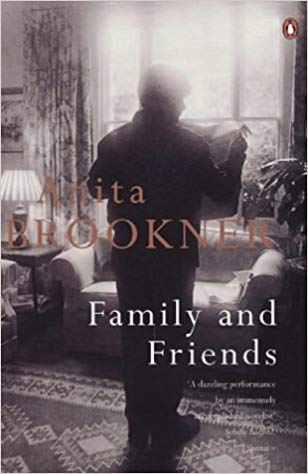
Family and Friends – Anita Brookner (1985) 187 pages

Many years ago I read Anita Brookner’s Booker-winning Hotel du Lac and although I remember very little about it I remember that I didn’t like it much. Recently I’d begun to think I should give her another try; I suspect my early 20s was a bit too young for Brookner and her incisive consideration of loneliness and disappointment. I was discussing this with a colleague, and so she lent me Family and Friends, Brookner’s follow-up to Hotel du Lac. A novella seemed a perfect way to dip my toe in again, and I’m so glad I did. I loved it.

It is the study of the Dorn family: matriarch Sofka and her children Frederick, Alfred, Betty and Mimi, beginning in the 1920s. The unnamed narrator is gazing at a wedding photograph of them all:

“I find it entirely appropriate that Sofka should have named her sons after kings and emperors and her daughters as if they were characters in a musical comedy. Thus were their roles designated for them. The boys were to conquer, and the girls to flirt. If this implies something unfinished, as if the process were omnivorous but static, that too would be characteristic. Sofka sees her children’s futures as being implicit in their names, and she has given much thought to the matter; indeed, one wonders whether she thinks about anything else.”

Throughout the novel this device is repeated: the photograph with the aging subjects and their relationships unwittingly captured over the years. Brookner’s portraits of her characters are unflinching:

“Betty is one of those women who believe in acting out a passion before they really feel it […] Mimi is not the type of girl who will, or indeed, can, do anything independently. But Betty knows that her mission in life is to be a woman who prevents men from staying with their virgin loves, and she is eager to embark on this career.”

Betty is keen to escape and uses one man to get to Paris – thwarting Mimi’s delicately-held fantasies in the meantime, and being quite aware of doing so – and then another man to get to the States, from where she never returns.

Likewise, Frederick, who is supposed to be running the family empire, flees to the French Riviera with a woman deemed wholly unsuitable by Sofka, but who makes feckless Frederick quite happy and contented. The responsibility of the business therefore falls to Alfred before he is out of his teens:

“He has, above all, obeyed his mother in everything. He does not yet know that men who obey their mothers in everything rarely win the admiration of other women.”

Over the years, perhaps only Frederick is happy. Betty is selfish and untalented, with zero insight and so unable to work out why her life is not evolving as she hoped. Alfred is disappointed in life generally, and delicate, beautiful Mimi is prone to depression.

“She has been questing unconsciously for that man, that alien, that stranger, that appointed one, who will deliver her, the sleepwalker, from her sleep. Thus, in the bosom of her family, Mimi, the good daughter, has been one of the most ready, the most willing, to defect.”

Family and Friends is about precisely what the title says. It is a study of these people over several years, with very little plot other than the typical events of people’s lives, and sparse dialogue. Although Brookner is unflinching, she is not without compassion. She sees plainly, but doesn’t sit in judgement on her characters, despite her clear-sighted discernment of all their weaknesses and the hurt they cause one another and themselves.

Anita Brookner is the ideal writer of novellas. She is so concise, not a word is wasted and every word carries its full weight. Her skill is astounding.

Despite only starting to write novels at the age of 53, Brookner was prolific and produced around a book a year for the rest of her writing life. I’m looking forward to exploring more of these now I know what I’m missing. And first on the list is a re-read of Hotel du Lac 😊

Novella a Day in May 2019 #23

The Year of the Hare – Arto Paasilinna (1975, trans. Herbert Lomas 1995) 135 pages

Following on from The Cat yesterday, I thought I’d look at another novella about a relationship with an animal today; the international bestseller about a man who leaves his life behind after injuring a wild hare.

Vatanen is a journalist deeply unhappy with his career, metropolitan life, and his marriage.

“Their flat had become an extravagant farrago of shallow and meretricious interior-decoration tips from women’s magazines. A pseudo-radicalism governed the design, with huge posters and clumsy modularised furniture. It was difficult to inhabit the rooms without injury; all items were at odds. The home was distinctly reminiscent of Vatanen’s marriage.”

The novel opens with him in a car with his photographer, hitting a hare with their car. The hare limps off and Vatanen follows it. He splints its leg and takes care of it, deciding never to return to his life.

What follows is a series of episodes in which Vanaten meets various eccentric characters as he travels further north in Finland, having adventures and finding the presence of the hare promotes honest and open conversations with people.

“If it’s difficult to teach an old dog to sit, as they say, then it’s even more difficult to teach an old Lapland roue to swim.”

The Year of the Hare is picaresque, and the emphasis is on the escapades rather than the characters. I didn’t feel I really knew Vananten any better by the end of the novella, but it had been mostly fun spending time with him and the hare.

I say mostly, because there were a couple of episodes I had to skip. These involved cruelty to animals. There was one particularly horrible incident where Vatanen tortures a raven, and there’s an extended bear hunt towards the end. But skipping over these parts still left a lot to enjoy, and the sense of Finland and its landscape is beautifully evoked.

“When, that evening, Vatanen slowly ski’d back from Vittumainen Ghyll to Laahkima Gorge, accompanied by his hare, he no longer thought about Kaartinen’s strange world. There was a half-moon, and the stars were glimmering faintly in the frozen evening. He had his own world, this one, and it was fine to be here, living alone in one’s own way. The hare ambled silently along the trail ahead of the skier, like a pathfinder. Vatanen sang to it.”

A slightly bonkers, occasionally surreal tale about following your own path and keeping an open mind as to who might accompany you part of the way.

The Year of the Hare was made into a film two years after publication, but I can’t find a trailer for that Finnish version. Its been a bestseller in France, so here is a trailer for the French film adaptation from 2006. Christophe Lambert is immediately too likeable as Vatanen but the atmosphere and scenery look spot-on:

Novella a Day in May 2019 #22

The Cat – Colette (1933, trans. Antonia White, 1953) 96 pages

Back in January when I wasn’t sure I’d manage NADIM this year (I’m still not sure – 9 posts to go!) I did a week of novellas by Colette. I loved immersing myself in her writing that week so I couldn’t resist including another of her novellas this month.

The Cat is familiar Colette territory: a young, slightly feckless couple failing to communicate. The difference is that there are three beings in this marriage: Alain, Camille, and Alain’s Russian Blue cat Saha.

Alain is from old money that is rapidly dwindling; Camille is new money that is much more abundant.

“Alain listened to her, not bored, but not indulgent either. He had known her for several years and classified her as a typical modern girl. He knew the way she drove a car, a little to fast and a little too well; her eye alert and her scarlet mouth always ready to swear violently at a taxi driver. He knew that she lied unblushingly”

They desire one another but they don’t communicate in any meaningful way. Alain almost seems to despise Camille at times – finding her tacky and invasive – unlike his pedigree cat, whom he adores. The three of them move temporarily to a friend’s flat while their home is being refurbished:

“He was incessantly and increasingly aware of his repugnance at the idea of making a place for this young woman, this outsider, in his own home. He nursed this resentment and fed it with secret soliloquies and the sullen contemplation of their new dwelling.”

For Camille, the resentments and disappointments which begin to build in their marriage become focussed towards Saha. As she points out, it is worse than another woman. Saha isn’t a competitor, but Alain loves her unconditionally and has an easy sensual relationship with his cat, whereas his sexual relationship with Camille is complicated by his feelings of contempt.

“As soon as he turned out the light, the cat began to trample delicately on her friend’s chest. Each time she pressed down her feet, one single claw pierced the silk of the pyjamas, catching the skin just enough for Alain to feel an uneasy pleasure.”

Spoiler alert: I must admit I did what I never do and skipped to the end of this story before reading very far, to check the cat wasn’t killed. I couldn’t face a story where that happened. But thankfully Colette is more subtle than that. Saha doesn’t die, which means the failures in the human relationship occur not in the rage of grief, but in something more subdued and sadder. Saha is a focus for the confused, antagonistic feelings the young couple have for one another. The cat brings these feelings to the surface more quickly than perhaps they would have done without her, but there is no doubt they would have occurred at some point.

You don’t need to be a cat lover to enjoy this story. It is a study of a young, naïve, selfish couple and the unthinking damage they do to one another, while professing their love. This being Colette, alongside the psychological insights, there are beautiful descriptions of the natural world:

“High in the sky a hazy moon held court, looking larger than usual through the mist of the first warm days. A single tree – a poplar with newly opened glossy leaves – caught the moonlight and trickled with as many sparkles as a waterfall. A silver shadow leapt out of a clump of bushes and glided like a fish against Alain’s ankles.

‘Ah! There you are Saha! I was looking for you. Why didn’t you appear at table tonight?’”

To end, here’s the lady herself with a couple of her beloved pets:

Novella a Day in May 2019 #20

Highland Fling – Nancy Mitford (1931) 199 pages

Highland Fling was Nancy Mitford’s first novel and while not as sparkling as her later works there’s still much to enjoy here. It’s familiar Mitford territory: insane upper classes, Bright Young Things, serious issues treated lightly, light issues treated seriously, and it all works out in the end.

Walter is married to Sally and is entirely useless with money, powering through both their allowances so that he has to ponder “why shouldn’t I do some work? If you come to think of it, lots of people do. I might bring out a book of poems in handwriting with corrections.”

Thankfully for the reading public, they are asked instead to look after Sally’s relative’s enormous country pile in Scotland. They take their friend Albert, who has no idea what to do with himself after Eton and Oxford until “It had come to him during the night that he wished to be a great abstract painter”; and Jane, who “had taste without much intellect, her brain was like a mirror, reflecting the thoughts and ideas of her more intelligent friends and the books she read.”

Keeping company with these Bright Young Things are all the ancient types who descend on Dulloch Castle every year for the shooting season.

“Lord Prague, it may be noted, was to all intents and purposes dead, except on shooting days when he would come to life in the most astonishing manner”

There’s also the massively racist General Murgatroyd who is violent to his dog and didn’t get the come-uppance I’d hoped for (his racism is never condoned, although some portraits of Scottish locals leave a lot to be desired), Lady Prague who is astonishingly rude to all, and Lady Brenda who has the appearance of “an overbred horse”, not helped by her habit of blowing smoke through her nostrils.

What follows is this unlikely crowd getting on each other’s nerves, lying about a missing picnic, getting pregnant, getting engaged…

Thankfully the blood sports are not described in great detail, it’s more about the ridiculous antics of people on the shoot. I do wish someone had rescued Murgatroyd’s poor dog though.

Obviously you need a high tolerance for silly toffs to read Mitford. I enjoy her writing and I did think this was fun, but as I said at the start, not quite as incisive or as funny as she would later achieve.

“Nobody dies in childbirth now, my dear. It’s considered quite vieux jeu.”

To end, something that was absolutely nothing to do with the plot, but did make me smile. For those of us irritated by schoolkids playing music out loud on their mobile phones on public transport, Albert has this experience on the train:

“They then began to play vulgar jazz tunes on a portable gramophone, a noise which Albert found more supportable than their chatter.”

Plus ça change, plus c’est la même chose 😀

Novella a Day in May 2019 #15

The Blind Owl – Sadeq Hedayat (1937, trans. DP Costello 1957) 106 pages

This was a really challenging read, and though an astounding work, I was grateful for the novella length as it was tough to take.

Sadeq Hedayat was an Iranian writer and is considered an innovative titan of Persian literature; he’s a best-selling author in his home country. This novel was initially banned on publication, and according to Wiki there is still censorship of his work (I’ve not linked to the Wiki page because much to my horror there’s a picture of his dead body on it). Sadly, he died by suicide, and The Blind Owl certainly feels authentic in its portrayal of someone losing all sense of reality and suffering mental ill health. I’m giving this post a trigger warning for some pretty disturbing imagery in the third quote, although I’ve not picked the worst in the novella, I wanted to give a true sense of it.

“Will anyone ever penetrate the secret of this disease which transcends ordinary experience, this reverberation of the shadow of the mind, which manifests itself in a state of coma like that between death and resurrection, when one is neither asleep nor awake?”

The unnamed narrator earns his living by painting pen cases. He may or may not have killed someone:

“How could I have resisted it, I, an artist, shut up in a room with a dead body? The thought aroused in me a particular sensation of delight.”

It’s a disorienting narrative. It’s not clear what is true or false: the events described could be entirely in the man’s head and what The Blind Owl describes is him lying on his bed, thinking/hallucinating. It’s a stream of extremely disturbed consciousness. Images and events recur and shift slightly, adding to a sense of disorientation and being witness to someone’s spiralling thoughts.

“A sensation which had long been familiar to me was this: that I was slowly decomposing while I yet lived. My heart had always been at odds not only with my body but with my mind, and there was absolutely no compatibility between them. I had always been in a state of decomposition and gradual disintegration. At time I conceived thought which I myself felt to be inconceivable.”

The narrator has no compassion for humanity and this is what adds to making The Blind Owl such a tough read. He is misanthropic, and so the coldly related details of violence, dead bodies and decomposition are truly horrifying.

I don’t want to put people off reading The Blind Owl because it is truly a brilliant piece of writing, but definitely one for when you’re strong enough to take it, with a comforting escapist read lined up for afterwards.

“Am I a being separate and apart from the rest of creation? I do not know. But when I looked in the mirror a moment ago I did not recognise myself.”

Novella a Day in May 2019 #13

Scars on the Soul – Francoise Sagan (1972 trans. Joanna Kilmartin 1974) 124 pages

This is a strange novella. It’s a story of a Swedish brother and sister living in France, and an extended reflection on Sagan’s writing life: a direct address to the reader.

“It isn’t literature, it isn’t a true confession, it’s someone tapping away at her typewriter because she’s afraid of herself and the typewriter and the mornings and the evenings and everything else.”

Sagan tells the story of Sebastian and Eleanor van Milhelm who are entirely feckless and devoted to one another.

“Life without her, drink without her, were like lukewarm water, Not a bad thing, all said and done, to have one’s life circumscribed to that extent by someone who – whatever she might say – was as much his slave as he was hers.”

While they are not quite incestuous, they certainly have an unhealthy attachment to one another. They move around living off their looks, finding benefactors who will pay for their lifestyle so that neither have to get jobs.

“ ‘Someone’ being that providential person who, because of their charm, their wit, their luck, would act as temporary provider for brother and sister. This person so far had never failed to materialise and was usually discovered by Sebastian, Eleanor, as in this case, being too lazy to go out.”

Yet the van Milhelms are not despicable. They are not malicious or even particularly manipulative; there is the sense that those they live off share an understanding whereby everyone knows what the deal is. There is a sense of ennui as their lives are essentially empty, yet it’s a sad story rather than a depressing one.

Scars on the Soul is certainly a post-modern novella, drawing attention to the art of Sagan as a writer and the artifice of the novel.

“There are moments when I’m on the point of writing ‘But I digress,’ an old-fashioned courtesy to the reader, but pointless in this case, since my purpose is to digress. Nevertheless, this blow-by-blow account of eroticism has irritated me. I’m returning to my van Milhelms ‘who frequently indulge in that sort of thing but never talk about it.’”

I think this novella wouldn’t be for everyone, as it is neither one thing nor the other – not fiction or non-fiction, not short story or essay. Yet I found it satisfying. I was invested in the van Milhelms story and I enjoyed Sagan’s witty reflections on writing and her fame after many years (this was written in her late 30s after the success of Bonjour Tristesse at the prodigiously young age of 18). It’s not something to read when you want a meaty, plot-driven story but Sagan is a hugely talented, skilled writer and there is much of interest here both in the fiction and in the portrait of one writer’s life.

Novella a Day in May 2019 #6

The Greengage Summer – Rumer Godden (1958, 187 pages)

I really enjoyed my first experience of Rumer Godden last year, and so it was that I picked up The Greengage Summer with high expectations, which were fully met 😊

The story is narrated by thirteen-year-old Cecil describing how she, her older sister Joss and younger sister Hester, plus ‘The Littles’ brother Willmouse and sister Vicky, are left to essentially fend for themselves at the Les Oeillets hotel in champagne country, after their mother develops septicaemia from a horsefly bite and is hospitalised.

“Perhaps it was this first sight that made me always think of the garden at Les Oeillets as green, green and gold as was the whole countryside of the Marne where, beyond the town, the champagne vineyards stretched for miles along the river, vineyards and cherry orchards, for this was cherry country too, famous for cherries in liqueur. Mother had been thinking of battlefields; she had not thought to enquire about the country itself; I am sure she had not meant to bring us to a luxury corner of France where the trees and the vines changed almost symbolically in the autumn to gold.”

It is reminiscent of Kingfishers Catch Fire, in that it is told from the perspective of someone looking back, who has been rescued from a foreign country by a man – Uncle William in this instance – with interjections from the present.

“ ‘You are the one who should write this,’ I told Joss, ‘it happened chiefly to you’; but Joss shut that out, as she always shuts things out, or shuts them in, so that no-one can guess.

‘You are the one who likes words,’ said Joss. ‘Besides…’ and she paused. ‘It happened as much to you.’

[…]

‘But you were glad enough to come back,’ said Uncle William,

We never came back,’ said Joss.

So what happened to cause them to leave themselves behind in Les Oeillets? I don’t want to give too much of the plot away…

The children are captivated by Eliot, a charming debonair English man who is having an affair with Mademoiselle Zizi, the hotel owner. Madame Corbert, the manager, is jealous, desiring Zizi herself. This is explained to them by Paul, the not much older but very much wiser hotel boy. These intrigues would be difficult enough, but Joss suddenly blooms, her beauty throwing things even further into disarray.

“I know now it is children who accept life; grown people cover it up and pretend it is different with drinks”

Some things around the hotel, or rather, around one of the guests, don’t add up, and it will be a rude awakening to the cruelties of the adult world for the children when they find out the truth. And it is the truth to a great extent – the author’s introduction to my edition explains the experience her family had, on which she based the story.

“For us champagne will always have a ghost; it can never be a wine for feasts but one for mourning.”

The Greengage Summer is a well-paced, atmospheric read with excellent characterisation. It’s no wonder it was quickly adapted into a film in 1961, starring Susannah York as Joss and Kenneth More as Eliot:

Novella a Day in May 2019 #4

A Month in the Country – JL Carr (1980) 85 pages

A Month in the Country is why I read novellas: beautifully written, acutely observed, exploring huge themes in a tightly constructed story that is an absolute gem.

Set just after World War I, shell-shocked soldier Tom Birkin arrives in the Yorkshire town of Oxgodby to uncover a medieval mural in the local church, much to the consternation of Reverend Keach:

“ ‘It wasn’t in the contract,’ he hedged, somehow managing to imply that neither were my stammer and face-twitch.”

[…]

“I looked like an Unsuitable Person likely to indulge in Unnatural Activities who, against his advice, had been unnecessarily hired to uncover a wall-painting he didn’t want to see, and the sooner I got it done and buzzed off to sin-stricken London the better.”

Tom hopes that a quiet summer of regular work, quiet and solitude will help him heal:

“The marvellous thing was coming into this haven of calm water and, for a season, not having to worry my head with anything but uncovering their wall-painting for them. And, afterwards, perhaps I could make a new start, forget what the War and the rows with Vinny had done to me and begin where I’d left off. This is what I need, I thought – a new start and, afterwards, maybe I won’t be a casualty anymore.

Well, we live by hope.”

He is employed due to a legacy, which has also employed another soldier, Moon, to find a grave just outside the church walls. Moon works out pretty quickly where the grave is so spins out his task to enable him to excavate remains he has identified at the site. The two recognise one another as kin due to their war experiences, without discussing what happened to either of them.

“This was a fairly typical beginning to most days – a mug of tea in Moon’s dug-out, usually not saying much, while he had a pipe… he would look speculatively at me. Now who are you? Who have you left behind in the kitchen? What befell you Over There to give you that God-awful twitch? Are you here to try to crawl back into the skin you had before they pushed you through the mincer?”

Carr writes about the technicalities of restoration so cleverly. Details are included to make Birkin’s voice authentic, but without it being overwhelming or seeming clunky. What he also captures is Birkin’s love of his work:

“But for me, the exciting thing was more than this. Here I was, face to face with a nameless painter reaching from the dark to show me what he could do, saying to me as clear as any words ‘If any part of me survives from time’s corruption, let it be this. For this is the sort of man I was.’”

Birkin makes friends with residents in Oxgodby: Mr Ellerbeck the station master, his young daughter Kathy, and Anne Keach, the reverend’s wife, who seems as lost as Tom. Written from the point of view of Birkin looking back, there is an elegiac quality to the story, particularly evoked through the descriptions of nature:

“For me that will always be the summer day of summers days – a cloudless sky, ditches and roadside deep in grass, poppies, cuckoo spit, trees heavy with leaf, orchards bulging over hedge briars. And we nimbled along through it”

Restoration, healing, judgement, the transitory nature of experience, time, life’s fragility… all these themes are explored in just 85 pages. And yet A Month in Country never seems limited or superficial. Absolutely deserving of its classic status.

A Month in the Country was adapted into a film in 1987. I watched it after reading this and it is a broadly faithful adaptation but not entirely successful in capturing the sense of the summer, or the relationships between the characters. Definitely worth a watch though, with an excellent cast (especially Patrick Malahide as Reverend Keach):

Novella a Day in May 2019 #1

Portrait of the Mother as a Young Woman – Friedrich Christian Delius (2006, trans. Jamie Bulloch 2010) 125 pages

Dear Reader, I’ve been somewhat absent from the blogosphere recently and I’ve really missed it. This was because at the end of March I decided on the spur of the moment to apply for a PhD which caught my eye. I had no plans for further study and so this meant April was spent in whirlwind of desperately trying to get my reading up to date, meeting with old tutors to remind them who on earth I am and begging for a reference, and then writing my application. The deadline is this Friday but I’ve now submitted my application and I’m hoping I might regain my sanity in the meantime. I don’t think I’ll get it, but my tutors have been really supportive and its good to shake things up now and again.

Aaaaaaannnnyway, I really enjoyed blogging on a novella a day in May last year, so I’m throwing myself back into it this year. I had such plans…. NADIM this year was going to be carefully thought through, with a good spread of countries (last year I ignored the southern hemisphere completely and lovely Naomi pointed out I’d also skipped Canada) and a wonderful balance of styles and subjects… yeah, that’s not happening. Instead this month (and I really hope to make it to the end) will be hastily cobbled together posts which completely fail to do the wonderful form of the novella any justice at all. But I still hope I manage to spread some novella love along the way 😊

I thought it apt to start with one from a publishing house that has done so much to champion the form: Peirene Press, who specialise in publishing contemporary European novellas, aimed to be read in one sitting. I’m a big fan of theirs and so I swooped down on Portrait of the Mother as a Young Woman when I saw it in my favourite charity bookshop.

Portrait of the Mother as a Young Woman is set over the course of one afternoon in Rome in 1943. Margherita is 19 years old, pregnant and alone as her husband is serving in the German army in Tunisia. She feels alien in a city where she doesn’t speak the language, and she is walking to a Bach concert at the Lutheran church.

“the immense city of Rome, still seemed to her like

a sea which she had to cross, checked by the fear of all things unknown, of the yawning depths of this city, its double and triple floors and layers, of the many thousand similar columns, towers, domes, facades, ruins and street corners, of endless number of pilgrimage sites for cultured visitors, which she walked past in ignorance, and of the faces of people in the streets, which were difficult to make out, in these stormy times of a far-off war which was drawing nearer every day”

And now, bear with me as I break something to you which you may have gathered from the quote above, which sounds awful but I promise it isn’t: the entire novella is one sentence. Wait, come back! It’s ok, really. Trust me 😉

There are paragraphs which make the whole thing easier, and Delius, possibly because he is a poet, has a great ear for rhythm. This means the sentence, broken by commas, works well in capturing the sense of someone walking, their thoughts falling into the pattern of their steps. I thought it was really effective and such an impressive feat of translation by Jamie Bulloch too.

“for two months she had crossed the Tiber almost every day via the Ponte Margherita, as if that were totally normal, but nothing was totally normal, especially not in these times, each day was a gift, each of the child’s movements in her belly a gift, each verse from the Bible and each glance across the Tiber”

Throughout her journey across the city, we learn about Margherita’s life in Germany and her new marriage. She is religious – daughter of and wife to clergymen – but not given to much reflection, preferring to stay silent in political discussions. Her husband and father are somewhat sceptical of the Reich, but Hitler has been in power throughout Margherita’s childhood and adolescence, she was part of the League of German Girls and it is only now, away from home, that she finds herself beginning to feel confused.

“On her own she could not work out what you were allowed and not allowed to say, what you should think and what you ought not to think, and how to cope with her ambivalent feelings”

Even though nothing of great note happens in the course of the novel, there is still an effective and believable character arc. Cut adrift, Margherita is beginning to learn who she is. There is a sense that this naïve, unquestioning woman is potentially quite steely, and as readers we know she will need that in the months and years to come.

 “She sensed something within her rebelling against the constant obligation to stifle the feeling of longing with her reason and her faith, because feelings were forbidden in wartime, you were not allowed to rejoice with happiness, you had to swallow your sadness, and like a soldier you were forced to conceal the language of the heart”

“Men are my hobby—if I ever got married, I’d have to give it up.” (Mae West)

My last post was about a romantically-involved couple for Valentine’s Day; this week I thought I’d look at a single person status much distrusted throughout literature: that of the spinster. Both my spinsters are inhabitants of beautiful Bristol, which I’d like to claim was down to well thought-through post-planning on my part, but was actually a total coincidence.

My first choice is the wonderful Miss Mole, titular heroine of the 1930 novel by EH Young. Hannah is in her late thirties, alone and shabby and the envy of no-one, yet she is a robust character who finds ways to survive and even enjoy life.

“She judged herself by the shadow she chose to project for her own pleasure and it was her business in life – and one in which she usually failed – to make other people accept her creation. Yes, she failed, she failed! They would not look at the beautiful, the valuable Hannah Mole: they saw the substance and disapproved of it and she did not blame them: it was what she would have done herself and in the one case where she had concentrated on the fine shadow presented to her, she had been mistaken.”

She is not delusional, rather she refuses to see herself as others see her -and why should she?

“This capacity for waiting and believing that the good things were surely approaching had served Hannah very well through a life which most people would have found dull and disappointing. She refused to see it so: it would have been treachery to herself. Her life was almost her only possession and she was as tender with it as a mother”

There is a strong streak of mischief in Hannah Mole too, and she enjoys teasing her well-to-do cousin Lilla, who finds her a job as a housekeeper to the reverend Robert Corder and his daughters Ethel and Ruth. This is not a remotely romantic set-up though. Corder is good at his job but he is also vain and self-centred, and enjoys his position in society because it means few people challenge him. Hannah sees him unblinkingly, and he does not like her.

“it would have horrified him to learn that he could not judge a clever or plain woman fairly. A clever one challenged him to combat in which he might not be the victor and a plain one roused in him a primitive antagonism. In failing to please him, a woman virtually denied her sex and became offensive to those instincts which he did his best to ignore.”

Hannah decides to improve things for his unhappy daughters, and feels a bond with his dead wife as she sets out to do so. She will manage things successfully, but in her own inimitable way:

“Hannah was not scrupulous about truth. She was not convinced of its positive value as human beings knew it, she considered it a limiting and an embarrassing convention.”

Hannah is realistic, but also hopeful and not remotely self-pitying. We also learn early on that she is brave, rescuing a suicidal man by smashing a window. She and a fellow tenant in her boarding house, Mr Blenkinsop, conspire to improve things for the man’s family, despite appearing to communicate at cross-purposes a great deal of the time. As she makes things work out for those around her, I really wanted things to work out for Hannah too, despite a shadow from her past looming – I think I viewed her with more compassion than she allowed herself:

“The desires, the energy, the gaiety were there, but they were ruled by an ironic conception of herself”

I really enjoyed spending time with Miss Mole. It’s a gentle novel, but it also doesn’t hide away from the realities of life for single women who are no longer young and without much money in the first half of the twentieth century, and how a judgemental society limits their choices.

Secondly, a spinster who would probably have done better without much money, Rachel Waring in Wish Her Safe at Home by Stephen Benatar (1982).  Rachel is in her late 40s with a boring job and a flatshare in London. Then her Great Aunt Alicia dies and leaves her a house in Bristol, and everything changes.

“And the hitherto dull, diffident, middle-aged woman who said to the taxi driver ‘Paddington please,’ felt in some respects more like a girl of seventeen setting out for exotic climes”

Rachel moves into the house and is determined to make the best of this fresh start:

“I had often discovered the secret of happiness: courage on one occasion, acceptance on another, gratitude on a third. But this time there was rightness to it – certainty, simplicity – which in the past mightn’t have seemed quite so all-embracing. Gaiety, I told myself. Vivacity. Positive thinking. I could have cheered.”

Gradually however, this vivacity spills over into something more. She becomes obsessed with the slave trade reformer Horatio Gavin who lived in her house centuries ago. She sees a portrait in a shop she believes to be him:

“I saw the portrait in the window.

I laughed out loud. I laughed right there, standing on the pavement, a spontaneous burst of laughter that was partly the effect of my ecstatic recognition of him and partly an aid to his more sober recognition of me

Wish Her Safe At Home details Rachel’s descent into serious mental illness. It is brilliantly done. Rachel begins as eccentric and gradually becomes truly unwell. The description of seeing the portrait is a perfect example. Most of us at some point have lost our filter in public: suddenly laughing at something remembered, or saying something out loud which we didn’t mean to. There are often experiences that we believe to be serendipitous for one reason or another. But Rachel suddenly takes this experience a step further in believing the portrait recognises her.

A novel from the first-person perspective of someone who is losing their mind is a tough read. I found it really got under my skin, more than any novel I’ve read in a long time. The first-person perspective also works brilliantly in positioning the reader in a place not exactly like Rachel’s, but certainly confused and paranoid on her behalf. There is a young couple, Roger and Celia who seem to like Rachel – why? Are they after her house? Do they feel sorry for her? Are they playing her from the start? Are they completely oblivious? Rachel’s unreliable narration means we cannot be sure.

“I don’t know when the following dialogue took place. Somehow it seems cut adrift from time, like a rowboat quietly loosened from its moorings, while its occupant, entranced, oblivious to each hill or field or willow tree upon her way lies whitely gleaming in her rose embroidered silk, trailing a graceful hand and sweetly carolling beneath a canopy of green”

That passage is meant to be overblown: Rachel is such a desperate character. Her delusions are romantic and an attempt to grasp a life so far half-lived, before it is too late. There’s nothing vindictive or cruel in her, and she is so incredibly vulnerable.

“Sometimes I felt utterly convinced I had been singled out for glory.

But not always. Far more often I felt I simply didn’t stand a chance”

I’ve not remotely done justice to the power, skill and subtlety of Wish Her Safe At Home. All I can say is: read it.

To end, the trailer for the film that apparently inspired Wish Her Safe at Home. The Ghost and Mrs Muir has had a special place in my heart since childhood. In all the times I’ve seen it, it’s never occurred to me that Mrs Muir is mentally ill. Wish Her Safe at Home has made me question everything…