Novella a Day in May 2025: No.30

Mrs Caliban – Rachel Ingalls (1982) 117 pages

Earlier in the month when I reviewed Bear, Cathy mentioned Mrs Caliban. Well, it was just sat there as part of the same Waterstone’s display where I picked up Another Marvellous Thing, and it would take a stronger reader than me to walk away… 😀 It is also part of the lovely Faber Editions series and so a very pleasing thing in itself. By coincidence, Jacqui reviewed her favourite Faber Editions yesterday, including Mrs Caliban, so do check out her post.

In the opening passage of the novella Dorothy’s husband Fred is leaving for work:

 “He remembered that he had wanted to take the paper with him. Dorothy didn’t bother to say that she hadn’t finished with it yet herself. She just went back and brought it to him.”

I thought that was such an immensely clever detail. In so few words Ingalls has conveyed the distance between the couple, Dorothy’s domestic role, her apathy, and her lack of met needs.

Dorothy is a homemaker, but that home is hanging on in appearance only. She has experienced two immense bereavements – her young son Scotty during surgery, and a subsequent miscarriage. It is this grief which has largely contributed to forcing her and Fred apart.

And so it went on: silences, separateness, the despair thinking out conversations that they knew would be hopeless.”

We quickly learn that unsurprisingly, Dorothy’s mental health may be suffering. She is hearing messages directly addressed to her from the radio:

“She hadn’t thought she was going crazy, not straight away. She believed it was just her own thoughts forcing themselves into the low pitched sounds and their insistent rhythm.”

This affects the reading of the rest of the novella: it is Dorothy’s perception of events, but did it actually happen? This is left ambiguous and works well, because in a sense it doesn’t matter. What does matter is Dorothy’s experience.

When Dorothy hears that “Aquarius the monster man” has escaped from a nearby facility, she isn’t sure if it is a general news alert or one of her personal messages.

“She came back into the kitchen fast, to make sure that she caught the toasting cheese in time. And she was halfway across the checked linoleum floor of her nice safe kitchen when the screen door opened and a gigantic six foot seven inch frog like creature shouldered its way into the house”

Again, I thought that was so clever, moving immediately from the small domestic concern to something so fantastical, linking the two together in that immediate moment with the ‘And’.

Dorothy and the creature become friends and almost immediately lovers, with her nicknaming him Larry. He lives in the house and is easy to hide because Dorothy and Fred essentially have separate spheres.

(Incidentally, I’ve seen Dorothy referred to as Dorothy Caliban, including in the Foreword to this edition, but I don’t remember Dorothy and Fred’s surname being mentioned in the story. More than likely I missed it, but I thought the title was a reference to her bond with Larry, a Caliban-type creature, with him ambiguous in the way that Shakespeare’s creation could be too.)

What is interesting is that if Larry is Dorothy’s fantasy, what that fantasy says. He is physically strong and they have a sexual bond, but he is also unfailing polite and respectful, is interested in her, and enjoys helping with domestic tasks. The feminism running through Mrs Caliban is evoked skilfully and is undeniable.

Additionally, if he is Dorothy’s fantasy, Larry is violent towards those who seek to harm him. Although we never see Dorothy especially angry, why wouldn’t she be? Both her children died, her husband runs off having affairs, and she’s left with a house to manage – for whom?

“She had no interests, no marriage to speak of, no children. Now, at last, she had something.”

In case I’ve made this sound very heavy, there is plenty of humour in Mrs Caliban too:

“Most of the time, if she couldn’t explain something to him straight away, he didn’t push it. The last time she’d been stuck was when he said he didn’t understand ‘radical chic’.”

Although ultimately I found it a sad novella. In the same way that The Tempest doesn’t fit easily into particular genres, neither does Mrs Caliban. Like the play with the ‘monstrous’ Caliban, this story can be comedic, tragic, dramatic, and fantastical. Like The Tempest, it features a lot of grief and loss.

Prospero, main protagonist of The Tempest, is a man and a sorcerer, who is able to own his anger and command his environment. Dorothy commands her environment – it is domestic and it is what she is expected to do. But she is denied so much agency, and her relationship with Larry is the start of her claiming some back.

Ingalls is such a skilled writer and Mrs Caliban has enough ambiguity that it can be read a number of ways. Ultimately I read Mrs Caliban as a grief narrative,  where the grieving person starts to find their way in the world again after it has irrevocably changed, but the sadness remains.

Novella a Day in May 2025: No.29

Another Marvellous Thing – Laurie Colwin (1986) 130 pages

Last year a Waterstones opened up a few minutes walk from where I live. I try and ration my visits but you can probably guess how that’s working out 😀 Browsing there was how I found out about Laurie Colwin, who until now had somehow passed me by. I tend to treat jacket blurbs with a mountain of salt, but anyone described as “The Barbara Pym of 1970s New York” (Jonathan Lethem) was going to have me snatching their work from the shelf.

In Another Marvellous Thing Billy and Francis have an affair, despite both being married to other people. Francis is quite a bit older than Billy, though we’re never really told their ages. Both are involved in the field of economics but have wildly different views. They are wildly different in just about every way.

“It would never work. We both know it. She is to relentlessly dour, and too fond of silence. I prefer false cheer to no cheer and I like conversation over dinner no matter what.”

The first chapter is narrated in the first person by Francis, before shifting to a third person narrator for the remainder:

“In movies men have mistresses who soothe and pet them, who are consoling, passionate, and ornamental. But I have a mistress who is mostly grumpy. Traditional things mean nothing to her. She does not flirt, cajole, or wear fancy underwear.”

Despite the bafflement they both have for why they are involved with one another, their affair is rooted in love.

“We are as faithful as the Canada goose, more or less. She is an absolute fact of my life.”

“She did not want to have these feelings: she had been so much happier when she had been unaware she had them.”

Billy and Francis are also markedly different to each other’s spouses:

“Billy, unlike my gregarious party-giving wife, thinks that there is no hell more hellish than the hell of social life.”

“He has the body of a young boy in the air of a genius or someone constantly preoccupied by the intense pressure of a rarified mental life. Together he and Billy look not so much like husband and wife as co-conspirators.”

In other words, they are both much better suited to those they are married to. This means that Another Marvellous Thing avoids the pitfalls of a will-they-won’t-they get together plotline, and instead is more interested in these two disparate characters, and a year or so of their lives together.

“The topic of her dissertation turned Francis glassy-eyed: his passion for Billy did not mitigate his indifference to the medieval wool trade.”

Despite Billy’s interiority keeping her somewhat unknown to Francis, as a reader I loved her character. She was so idiosyncratic and believable, with her refusal to conform to societal expectations:

“‘A vision of radiant loveliness,’ Francis said.

‘I’m so sorry,’ Billy said. ‘The laundry ruined my filmy peignoir.’”

Unlike Francis who is quite equanimous about being unfaithful, Billy feels horribly guilty. Later in the book the affair has finished and the chapters focus on her life afterwards, where we see much more vulnerability than she allowed Francis to witness.

“In one of her snootier moments, my mistress said to me: ‘My furnishings are interior. I care about what I think about.’”

All in all I enjoyed my first experience of Colwin’s writing. There were so many great one-liners and it did feel very New York. But the wit didn’t stop emotional truth being fully realised, particularly with Billy and her husband Grey in the later chapters. I’ll look forward to exploring her further.

Being in love, he often felt, was like having a bird caught in his hair.”

Novella a Day in May 2025: No.28

The Lady and the Little Fox Fur – Violette Leduc (1965, transl. Derek Coltman 1967) 80 pages

I found this novella, only slightly longer than a short story, incredibly moving. It follows the daily life of a frail, impoverished woman, living in a dilapidated attic room in Paris which shakes every few minutes when the Métro passes overhead.

Violette Leduc is not an author I know, but in the Introduction to my edition Deborah Levy describes her novels as “works of genius and also a bit peculiar.” Certainly Leduc has a way of skipping between images and realities that continually pulled me up short. Despite its brevity The Lady and the Little Fox Fur can’t be read quickly; the sentences have to be considered.

“Her coat was turning green with age. So much the better: it was a proof that her verdigris candlesticks in the pawn shop had not abandoned her. When the sun came out, there were two torches to light her way, the sun itself and its reflection in the window of Joris’, the shop that accepted la Semeuse coupons.”

That strange logic about the candlesticks demonstrates the frayed reasoning of The Lady, but also Leduc’s skill in layering images to evoke scenes and draw elements of her story together so clearly.

Her stylistic skill never distances the characters. A long time is spent on the hunger of The Lady, both physical and psychological. She is desperate for food, and she is desperately lonely. Every day she roams around her home city, unseen and disregarded.

“Wheat pancakes, fifty francs. The batter was spreading across the hotplate, the woman was scraping away the drips and making the edges neater with the point of her knife. But she would draw her nourishment later on from the crowd in the Métro: one cannot have everything.”

“They were workmen whose job it was to keep the flagstones level, and they put up with her there because they didn’t know she was there. The bollard she was sitting on had such stability, the place itself was so historic that she became a peasant woman who had ridden in from the Perche country to sell a farmhorse many centuries ago.”

The second part of the novella sees her take out a raggedy fox fur, which she found in rubbish when hunting for an orange to eat, to sell for food.

“There were moments when she had no saliva left to remember with, not even the pale pink water ices that her parents used to eat.”

It is desperation which drives her, as the fox fur provides warmth and companionship. Like a child, she anthropomorphises the inanimate object (as she does bugs in the floorboards and some of her furniture), showering him with kisses and affection.

The Lady and the Little Fox Fur could have been unbearably sentimental, but Leduc’s way of writing meant it wasn’t so. The Lady doesn’t pity herself and the portrayal evokes compassion and empathy rather than sympathy. She endures, repeatedly, throughout the challenges of her daily life.

“Happily, she noted, it was still not six o’clock: she was the ribbon in a little girl’s hair, fluttering in the breeze. After six, the wind in Paris grows stronger and disarranges all our principles.”

Novella a Day in May 2025: No.25

Krane’s Café – Cora Sandel (1946, transl. Elizabeth Rokkan 1968) 173 pages

Back in November Kaggsy reviewed some of Cora Sandel’s shorter writings and reminded me that I had Krane’s Café languishing in the TBR. I’m really pleased to have finally got to it, with its sly humour and incisive characterisation.

“There’s a lot to be heard before your ears drop off.”

Set just after the First World War, it opens with Katinka Stordal sitting in the titular café. She is the dressmaker in a small coastal town in northern Norway, and there is a big event coming up. Her orders are piling up, and Mrs Krane, the owner of the café with her husband, is trying to move Katinka on.

“’I’m going, I’m going,’ said Mrs Stordal. She looked up listlessly for a moment, and stayed where she was. It was one of those days when she looks much older than she really is.”

The narrative voice has this slightly bitchy, judgemental tone, which works so well. In implicitly proclaiming an alliance with the attitudes of the townsfolk, she draws attention to their pettiness and their lack of humane understanding.

People come in to try and chivvy Katinka along, with absolutely no interest as to why she is unable to move from the café or has her head in her hands. Their only concern is getting her back to work.

“As usual Mrs Brien was magnificently equal to the situation. ‘Now then, we mustn’t get hysterical, you know. We mustn’t give up. Everyone has worries. I don’t know anyone without worries. This really is naughty of you, Katinka.”

Then a man called Bowler Hat arrives…

“And he went over to Mrs Stordal and said in that low, one might almost be tempted to say melodious voice, if it were not so ridiculous, and offensive and bold into the bargain, ‘May I offer you something? Something you’d fancy? What about a little wine? The wine you’ve just been drinking? And then you can go on listening to me for a while? You mustn’t stop listening yet, you understand so well. I expect you know too how it feels to be lonely?’”

So the situation becomes scandalous. Katinka is in the back room of the café, drinking with a male stranger. She is complaining about her selfish family, her enduring fatigue with life, her lack of choices. Bowler Hat is an unnerving figure and I did wonder at times if he was a representation of the devil.

Mrs Krane feels overwhelmed without her husband to help her manage the situation, and her staff, Larsen and Sønstegård, are thoroughly enjoying the drama while pretending not to.

“Children and drunkards will tell you the truth. Both Larsen and Sønstegård admitted later that at that point they were almost afraid of more customers coming. For it was exciting to listen to Mrs Katinka, who scarcely ever gave you an answer in the normal run of affairs, sitting there giving rein to her tongue. Even though it was so dreadful to hear her gossiping like that about her own children. Throwing them to the wolves, you might almost call it.

And even though it was all a lot of nonsense.

What else could you call it?”

What emerges is a picture of real sadness. Katinka is lonely and disregarded by her family and by the town, while expected to fulfil their expectations of her. She is teased by the town’s children for her drinking, and in this small community no-one really truly acknowledges anyone else’s pain, despite how closely they all live together.

“And surely she couldn’t have thought of going and drowning herself, with all those orders, she the mother of two children besides? Nobody did that sort of thing in this town.

Suddenly it struck Mrs Krane that that sort of thing was just not written up in the paper about people in other places. Grieve the chemist had taken prussic acid in the cellar of his shop, though that had happened a long time ago and he was even scolded at his graveside by Mr Pio the curate […. ] and Iverson the tailor, who had such a spiteful wife, had walked out into the sea until it went over his head, and he never came up again, even though it was ebb tide and the sea was far out.”

In this way Sandel satirises society and its unthinking complacency towards others; the hypocrisy; and the self-interest. Yet unlike some satire, it doesn’t have a bitter edge. The characterisation is compassionate towards Katinka and Mrs Krane; and even Katinka’s daughter. The narrative voice is humorous and by aligning itself with the attitudes of the town, it avoids the superior tone of some satire.

I felt the ending was compassionate, though the town and its inhabitants remain largely unchanged…

“And all of a sudden Katinka shouted at the top of her voice, ‘Here comes the madness, the great, wonderful madness. The liberator from everything, who opens the gates and makes all spacious about you.’”

Novella a Day in May 2025: No.24

Between the Acts – Virginia Woolf (1941) 159 pages

Between the Acts is Virgina Woolf’s last novel and was published after her death. I’m a bit wary of posthumous novels; a note at the beginning from Leonard Woolf suggests it was pretty much as Virginia intended and only small corrections would have been made had she lived. This is somewhat contradicted by a letter she wrote to her publisher, so it’s impossible to know.

It is set over one day in 1939, before the war starts. It’s summertime, and at Pointz House somewhere in the middle of England, a pageant is taking place as it does every year.

The manor house belongs to the Oliver family: retired Bartholomew Oliver; his endearing, somewhat flaky widowed sister Lucy Swithin, his son Giles and Giles’ wife Isa.

A thread that pulls through the story is Isa’s attraction to gentleman farmer Rupert Haines. Woolf introduces this with startling synaesthetic imagery:

“Isa raised her head. The words made two rings, perfect rings, that floated them, herself and Haines, like two swans downstream. But his snow-white breast was circled with a tangle of dirty duckweed; and she too, in her webbed feet was entangled, by her husband, the stockbroker. Sitting on her three-cornered chair she swayed, with her dark pigtails hanging, and her body like a bolster in its faded dressing-gown.”

I so enjoy Woolf’s inventiveness, and this early passage also stood out, as she sets this tranquil, middle-class, midsummer scene:

“The nurses after breakfast were trundling the perambulator up and down the terrace; and as they trundled they were talking—not shaping pellets of information or handing ideas from one to another, but rolling words, like sweets on their tongues; which, as they thinned to transparency, gave off pink, green, and sweetness.”

But beneath the tranquillity, big emotions are brewing:

“”He is my husband,” Isabella thought, as they nodded across the bunch of many-coloured flowers. “The father of my children.” It worked, that old cliché; she felt pride; and affection; then pride again in herself, whom he had chosen. It was a shock to find, after the morning’s look in the glass, and the arrow of desire shot through her last night by the gentleman farmer, how much she felt when he came in, not a dapper city gent, but a cricketer, of love; and of hate.”

In true British stiff-upper-lipped style, love and hatred are subsumed by social convention and the need to host the pageant. The director Miss La Trobe arrives. My edition has a quote on the back suggesting this is self-portrait by Woolf, which if true is pretty startling:

“Rumour said that she had kept a tea shop at Winchester; that had failed. She had been an actress. That had failed. She had bought a four-roomed cottage and shared it with an actress. They had quarrelled. Very little was actually known about her. Outwardly she was swarthy, sturdy and thick set; strode about the fields in a smock frock; sometimes with a cigarette in her mouth; often with a whip in her hand; and used rather strong language—perhaps, then, she wasn’t altogether a lady? At any rate, she had a passion for getting things up.”

The pageant dramatises scenes from English history, and Elizabeth I is a sight to behold:

“Everyone was clapping and laughing. From behind the bushes issued Queen Elizabeth—Eliza Clark, licensed to sell tobacco. Could she be Mrs. Clark of the village shop? She was splendidly made up. Her head, pearl-hung, rose from a vast ruff. Shiny satins draped her. Sixpenny brooches glared like cats’ eyes and tigers’ eyes; pearls looked down; her cape was made of cloth of silver—in fact swabs used to scour saucepans. She looked the age in person. And when she mounted the soap box in the centre, representing perhaps a rock in the ocean, her size made her appear gigantic. She could reach a flitch of bacon or haul a tub of oil with one sweep of her arm in the shop. For a moment she stood there, eminent, dominant, on the soap box with the blue and sailing clouds behind her. The breeze had risen.”

Large portions of the novel are given over to the script of the pageant, written in verse. Yet astonishingly, Woolf still manages complex characterisation between the acts. There’s a small scene between two characters dismissed by those around them which I found so touching. Lucy Swithin is seen as something of an elderly fusspot; William Doge is a visitor subject to homophobia from Giles, in thought if not in deed but still recognised. At one point Lucy notices William is struggling with the company and takes him off for a tour of the house:

“Mrs. Swithin put her hands to her hair, for the breeze had ruffled it.

“Mr…” she began.

“I’m William,” he interrupted.

At that she smiled a ravishing girl’s smile, as if the wind had warmed the wintry blue in her eyes to amber.”

As always with Woolf, the text is so rich and multilayered and these are really just initial impressions. I’m sure I’d pick up so many other elements on a re-read, or even writing this post again. I just hope that however Woolf felt about Between the Acts, she judged her work more kindly than Miss La Trobe’s view of her pageant:

“She hadn’t made them see. It was a failure, another damned failure! As usual. Her vision escaped her.”

Novella a Day in May 2025: No.20

The Shooting Party – Isabel Colegate (1980) 191 pages

I’ll get my complaint about The Shooting Party out of the way first: there were about eleventy-million characters, far too many for a novella, and trying to keep them straight made my brain hurt. If ever a book needed a family tree/character list at the beginning it was this one. But other than that I really enjoyed it, so on with the post!

The Shooting Party was written in the latter part of the twentieth century but captures a bygone age just before the outbreak of World War I.  Colegate relies on our knowledge as readers that the lives she presents are on the brink of being changed irrevocably.

“I can’t say I positively want a war; and yet one gets the feeling sometimes – life is so extraordinarily pleasant for those of us who are fortunate enough to have been born in the right place – ought it to be so extraordinarily pleasant? – and for so few of us? And isn’t there sometimes a kind of satiety about it all – and at the same time greed?”

The titular event is taking place at Sir Randolph Nettleby’s Oxfordshire estate. Over the course of three days a group of privileged people will convene in the slaughter of hundreds of birds. It is absolutely grotesque, but thankfully Colegate spends very little time on the details of bloodsports, being more interested in the relationships between the characters. There were a few passages I skipped but it remained very readable.

Sir Randolph is aware that the world is changing. He despairs at the falling away of the old order as the world becomes increasingly mechanised and industrialised. The country estates are losing workers and he worries at the decline of the countryside.

He is quite a gentle patriarch in many ways, despite being so much a man of his time. Colegate doesn’t laugh at her characters, but there is humour throughout and I don’t think we’re supposed to take them entirely seriously all the time:

“Sir Randolph, unlike Minnie who aspired to it, considered cosmopolitanism a vice. It was alright to know your way around Paris, Sir Randolph thought, and to visit Italian picture galleries or the relics of the classical world, but generally speaking a man should stick to one country and be proud of it. If one wanted to travel there was always the Empire.”

His grandson Osbert doesn’t do well at school and the family are despairing at getting him ready for Eton, yet it is Sir Randolph who sticks up for him:

“Sir Randolph said, ‘Leave him alone. There’s no malice in him. Give him time and he’ll come along all right.’ He spoke as he might have spoken of one of his black, curly-coated retrievers, and like the retrievers Osbert in due course came along.”

Osbert has a pet duck named Elfrida Beetle and a source of tension throughout the novel is whether she will survive or get caught up with the wild ducks that the party are determined to shoot to pieces. There is also an impending sense of doom, beyond the war, as we know from the start of the novel that there is “an error of judgement, which resulted in a death”. Yet the final day of the shoot starts peaceably enough, as Sir Randolph reflects in his study:

“Freed from time, he felt influenced towards the familiar state of watchful calm, from which he was aroused by the slow crescendo and then rapid diminuendo of the breakfast gone being sounded by Rogers, an acknowledged master on the instrument.”

His wife Minnie was a favourite of the now-dead King, (another character reflects: “A pity English royalty was always so philistine.”) and like her husband she has a strong sense of duty and decorum. Unlike her husband she’s also quite a frivolous character, but this suits her role as hostess and she sees more than she says. She gets on well with her granddaughter Cicely, who shares her silliness, if not her circumspection.

“Olivia did not find Cecily boring. She liked her liveliness and suspected her of having more courage than she herself had ever had. Cecily might well choose to be unconventional; something to which Olivia had never aspired, in her actions at least. Her thoughts, generally speaking, she kept to herself.”

Olivia is Lady Lilburn married to Bob, a man so dull that even as I’ve just finished the reading the novella I can’t remember anything about him except a funny scene with him fussing over cufflinks. Another couple are Lord and Lady Hartlip, long married and quite prepared to indulge each other’s extra-marital dalliances. Where Lord Hartlip draws the line is Lady Hartlip’s compulsive gambling, which she has learnt to hide from him. Thus Colegate shows that privilege and comfort don’t equal happiness for all. In fact, happiness seems elusive to so many of these characters.

Apparently one of criticisms of The Shooting Party on publication was that it tried to shoehorn in all the Edwardian political issues and the characters were ciphers in service of these. I think this is a little unfair. As I mentioned at the start, there are soooo many characters that I can see where this criticism came from: a rich Jewish businessman subject to Anti-Semitism; a member of European aristocracy; bored wives; flighty debs; gamekeepers entrenched in the social order; a new generation coming up of self-made men… but I found them all believable and Colegate is interested in the person behind the type.

Colegate evokes the daily routines of life in a large country estate so well, and balances the inevitable elegiac quality with the practicalities of living; the sad desperation of some of the characters with humour. As the day moves on personalities are exposed and relationships change forever.

Novella a Day in May 2025: No.18

Across the Common – Elizabeth Berridge (1964) 186 pages

Back in 2023, I started off Novella a Day in May with Elizabeth Berridge’s The Story of Stanley Brent. I ended the post by saying I had Across the Common in the TBR and maybe I’d get to it later in the month 😀 Just two short years later…

Across the Common is told from the point of view of Louisa as she returns to her suburban childhood home, after leaving her artist husband Max.

“My grandfather had built the house in the eighties. It was tall and big and excelled in useless crenellations; in the front an immense stretch of holly hedge gave the house its name.”

Her two aunts, Seraphina and Rosa, still live in this Gothic pile and they are soon to be joined by Aunt Cissie:

“Since the war, which had robbed her of her second husband and her only son, something had shifted in her. A new, unbalanced cynicism revealed itself by a sarcastic twist of the mouth, a semiquaver of a shrug.”

Quite a contrast to Aunt Seraphina:

“it was all in her sigh: her lost opportunities for adventure, for love, for self-expression. She was more of a child than I had ever been, and I loved her again for her wild and illogical longings, her aching desire for drama.”

They live in an insular world. Cissie had left, so her worldliness means she wants a television on her return, but otherwise the aunts are preserved in a world long gone. The Hollies has always existed as a refuge for the women in the family, such as Louisa’s grandmother:

“She had merely withdrawn into the world of The Hollies, where unpleasant things like passion and unworthy emotions and reality were kept out by the high walls, lapped by the half tamed acres of the common.”

Louisa initially returned to her aunts for their familiarity and the need she feels to unravel who she is, based on experiences in her past which led to her leaving:

“I only wanted to remember it in order to remember something else, like turning the cut-glass top of a decanter bottle in the sun, to catch the sudden prismatic dazzle. This something lay with the aunts; it was an unease that spoiled relationships, a strange Braithwaite ambiance that lay like fallout over the family.”

However, she begins to realise that her past may be more complex than she realised, and there are secrets within the family to understand. The Gothic atmosphere is heightened when a solicitor passes on a sinister warning in a letter from her long-deceased father:

“Don’t, for your own sake, be misled by the cultivated exteriors of your aunts. They can smother, they can crush, they can exterminate.”

There’s also the fact that Louisa’s aunts are among the few people her husband struggles to tolerate:

“It was the Braithwaites, my mother’s family, who came outside Max’s indulgence. They filled him with a kind of detached horror. He was ruthless about them. Is ruthless. For he blames them for everything awry in me.”

Yet they are never caricatures of eccentric older women, but carefully drawn and fully realised. All three aunts were fabulous creations.

Berridge builds an atmosphere that feels both stifling and menacing, without being overtly threatening or devoid of love. There is humour here too, and I particularly enjoyed Aunt Seraphina’s habit of pilfering plant cuttings from Regent’s Park.

The Big Family Mystery is believable, providing enough plot to draw the story along, with Louisa’s growing understanding of her family history and herself being well-paced.

I have another Berridge in the TBR so hopefully it won’t take me two more years to get to it! She is so accomplished and her idiosyncratic characterisation is a joy.

“The Braithwaite way of life was a kind of anarchy that could scarcely be contained within one house.”

Novella a Day in May 2025: No.17

The Snow Ball – Brigid Brophy (1964) 196 pages

Brigid Brophy is an author who I’ve been meaning to try for a while, and The Snow Ball was a compelling introduction. It has an otherworldly quality, set over the course of one evening at the titular event and based on Mozart’s Don Giovanni.

An eighteenth-century fancy dress ball is being thrown by Anne and her fourth husband Tom-Tom at their Georgian London residence.  We follow Anna, Anne’s friend and confidant, throughout the evening. She is dressed as Donna Anna.

“Everyone grew a year older at once on New Year’s Eve, even those whose birthdays had been the day before. They gathered, Anna decided, for consolation: wearing historical costume to offset the advance of history.”

The incongruity and inaccuracy of the visual experience is used by Brophy to great effect, emphasising the unreality of the evening and showing how easily appearances can crack.

“Anna descended the grand staircase, knowing that Voltaire and Lady Hamilton were waiting for her in the crowd at the bottom. The noise, the scents, the very warmth of the people’s skins came to her as unmistakably twentieth century.”

Brophy has some startling images too, truly original turns of phrase. The décor is somewhat Rococo, with crumbling gold cherubs adorning the walls:

“It was as though between this room and Anna there was a genetic resemblance, a line of descent: as though it were a womb: into which, a newly born cherub in her early forties, she was always welcome to creep back.”

As this middle-aged cherub moves around the party she draws the attention of a man dressed in a black mask as Don Giovanni. She is also watched by Ruth, young and inexperienced, attending her first ball dressed as Cherubino and writing in her diary throughout the night:

“Feel there is something awful about all the people in the world, can’t think what they are here for—they don’t seem to matter—they are like atoms—they just move around without aim attracted or repelled by each other; hardly matters which. Anna K. is the most attractive woman I have ever seen. I detest her.”

We follow the seductions of the night, the dances people engage in both literally and metaphorically. Anna is a slightly subdued character next to the driven sexuality of Don Giovanni or the gregarious sociability of her friend Anne. Yet she is compelling as she tries to work out what happiness looks like for her as a recently divorced woman, against a background of revelry.

(Unlike its source inspiration, the seduction in The Snow Ball is explicitly successful and mutually consensual.)

The Snow Ball is eerie and unnerving while being recognisable. Its characters take pragmatic decisions surrounded by elevated theatricality – at one point peppermint creams rain down. It felt like a masque, but grounded in believable people rather than stock caricatures. It was hugely clever but not alienating and it’s definitely made me keen to pull Brophy’s The King of a Rainy Country out of the TBR.

“‘Have you noticed what a metaphysical ball this is?’ he said. ‘All these people bumping into one another and asking “Who are you?” even when they’ve known each other for years.’”

Novella a Day in May 2025: No.15

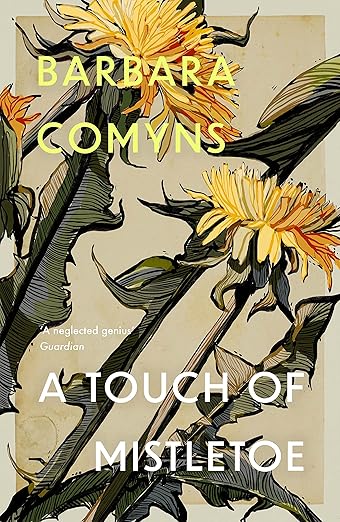
The Skin Chairs – Barbara Comyns (1962) 200 pages

I really enjoy Barbara Comyns. Her voice is so distinct, uniquely hers. She can present traumatic events – in The Skin Chairs, parental death, bullying and poverty – with an equanimity of tone which offers an idiosyncratic resilience.

The Skin Chairs is narrated by ten-year-old Frances. It opens with her going to stay with horrible relatives to give her mother a break from her six children; four girls and two boys. Frances’ Aunt Lawrence is a bully and her daughter Ruby is completely cowed by her, while her daughter Grace is her favourite and as such, completely unbearable.

“It was no wonder that the Lawrence family were so spiteful; it was dreadfully catching and gave one such a feeling of power.”

Frances’ stay with her relatives is extended as while she is away, her father dies. Ultimately her mother and her siblings move into a new house nearby called The Hollies. This gives the Lawrences a distressing amount of power over Frances’ mother, who struggles to adapt to her straitened circumstances.

“She never went shopping, although she ordered meat when the butcher called at the house (the fishmonger soon stopped calling because he said it wasn’t worth it when we always ordered herrings), and I think she would have considered it the final degradation to have been seen carrying a shopping basket.”

Her mother does learn to cook, but even that isn’t quite right:

“Mrs Hand prepared vegetables and we washed up, so she had none of the drudgery. Delicious iced cakes appeared on the table at teatime, vol-au-vent, lobster croquettes and chicken soufflés at midday and savoury supper in the evening. The little ones became bilious and, when Polly discovered that we had spent nearly a month’s supply of money in a week, we went back to stews and rice puddings, fish pie and baked apples.”

There isn’t much plot, except as Frances takes us through her days. Dramas are generally short-lived. The family struggle for money, and Frances struggles with her schoolwork.

We get to know others on the village. There is an appalling ongoing thread with a mother neglecting her child so she can have an affair with a Major. There is also the utterly eccentric Mrs Alexander who bombs around in a bright yellow car, wears gold shoes polished daily by her chauffeur, and keeps a menagerie of animals in cages:

“She had once kept a bear, but people had complained because it used to break into church during the services, and it had to be given to a zoo. ‘I sometimes wonder why I ever returned to England, so many unpleasant things happen here’.”

As with all the Comyns I’ve read there is cruelty present. Not least with the chairs, belonging to a General and said to be made from human skin. The cruelty is never dismissed although no-one is demonised, and Frances’ child’s view doesn’t obfuscate. It is presented without sensation.

Thankfully there is kindness too. Mr Blackwell arrives in the village, incredibly rich and kind to Frances during a time of acute distress. He doesn’t meet the Lawrences’ standards however:

“Then Aunt Lawrence told us the man was not a ‘gent’ at all, but a retired brass-founder. He was rolling in money, he owned an appalling Birmingham accent and would be quite impossible to know. I imagined him rolling in brassy coins all alone and felt sorry for him planning to live in a village where no one would know him.”

The horrible central image of The Skin Chairs suits Comyns well. She is so clever at presenting the domestic, but making it unnerving and almost Gothic. Yet The Skin Chairs is also gentle, and the characters – even the dreadful ones – treated with compassion. I’ve a few other Comyns’ languishing in the TBR and this made me keen to get them!

Novella a Day in May 2025 No.14

La Femme de Gilles – Madeleine Bourdouxhe (1937, transl. Faith Evans 1992) 122 pages

La Femme de Gilles is a curious read from a twenty-first century perspective. The protagonist Elisa is entirely bound up in her husband Gilles. Her existence is wholly for him: cooking for him, keeping his house, bearing his children that she loves only as an extension of him, sexual pleasure derived solely from pleasing him. It’s the extremity of these feelings at the obliteration of any personal motivation for her actions outside of Gilles that make her so extraordinary to my eyes.

So when Gilles starts an affair with Elisa’s sister Victorine, outwardly Elisa does very little:

“Whatever happened, whatever had already happened, the main thing was not to make a fuss, simply to watch, and act in subtle little ways to keep intact the love with which she’d surrounded him, and to which he would return one day. There was no escape from a love as strong as hers.”

Elisa’s initial realisation is heartbreaking, as she turns her back on Gilles and Victorine to get ready and accompany them to the cinema:

“One by one she fixed her gaze on some of the objects around her, things that made up her familiar world, then her eyes lit on her own hands as they closed the bag, and she saw they were trembling. Precisely at that moment Elisa knew that behind her back there was another world, a world that was complicated, threatening, unknown.”

In a such a short space, Bourdouxhe creates an acute psychological portrait, primarily of Elisa, but also of her unintentionally cruel husband and her vacuous sister:

“Afterwards it’s a question of trying to make sense of things, sense of life, and life doesn’t touch Victorine, it will never mark her smile or her eyes, which will stay young, clear, innocent for a long time. Unconscious offenders are the most dangerous of criminals.”

Yet she also sustains a real momentum to a story which primarily takes place in Elisa’s tortured head, and follows her inaction. It feels pacy and tense, even as Bourdouxhe steps outside of the narrative to directly address her characters:

“You are alone with the greatest pain you have ever known.”

Poor Elisa really is isolated. She can’t speak with her husband, her sister or her mother. The villagers in the remote area where she lives become aware and gossip about her. But Elisa doesn’t really want to leave, she just wants things to be as they once were:

Going from one place to another – is that really the world, or is it rather something very small, invisible, confused, something buried inside of us, something that we always take with us wherever we are, whether we’re here, or whether we are there? Whether we are far away or at home?”

La Femme de Gilles is an immersive read with incisive characterisation. Apparently Simone de Beauvoir was a fan (I tried to find what she said about it in the The Second Sex but my edition has a rubbish index). In her first novel, Bourdouxhe created a haunting narrative which I’m sure will stay with me.