Review-along: Lady Audley’s Secret

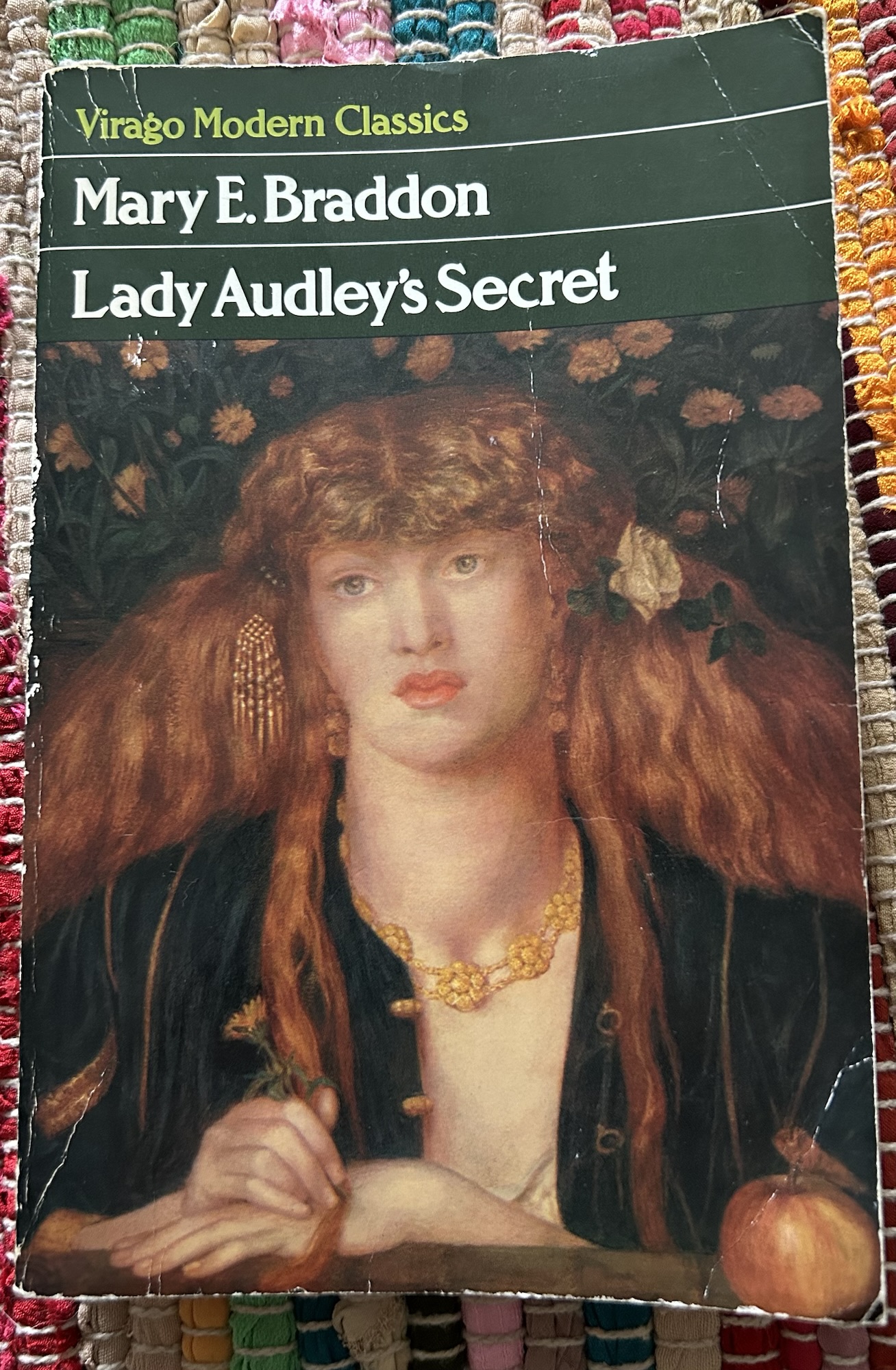
I really wanted to join in with the review-along for Lady Audley’s Secret by Mary Elizabeth Braddon (1862), as it’s a long-standing part of Mount TBR. Novellas a Day in May meant it was beyond me to post on 1 June, but here is my late entry!
The titular woman is introduced to the reader as a penniless but beautiful governess, Lucy Graham:

“Wherever she went she seemed to take joy and brightness with her. In the cottages of the poor her fair face shone like a sunbeam […] and when she tripped away, leaving nothing behind her (for her poor salary gave no scope to her benevolence), the old woman would burst out into senile raptures with her grace, beauty, and her kindliness, such as she never bestowed upon the vicar’s wife, who half fed and clothed her. For you see, Miss Lucy Graham was blessed with that magic power of fascination, by which a woman can charm with a word or intoxicate with a smile. Every one loved, admired, and praised her.”

Is it me or is there some sly humour there? This woman elbowing her way into the cottages of the poor, assuming that to bask in her presence is payment enough? I don’t think Braddon takes a humorous approach generally to this sensation story, but maybe there’s a bit happening…

Lucy catches the eye of Sir Michael Audley, windowed and stinking rich, so of course they are married. But here Lucy’s charms find their limit, with spiky step-daughter Alicia who is only a few years younger:

“She is a vain, frivolous, heartless little coquette,” said Alicia, addressing herself to her Newfoundland dog Caesar, who was the sole recipient of the young lady’s confidences; “she is a practiced and consummate flirt, Caesar; and not contented with setting her yellow ringlets and her silly giggle at half the men in Essex, she must needs make that stupid cousin of mine dance attendance upon her. I haven’t common patience with her.”

The stupid cousin is feckless Robert Audley:

“Sometimes, when the weather was very hot, and he had exhausted himself with the exertion of smoking his German pipe, and reading French novels, he would stroll into the Temple Gardens, and lying in some shady spot, pale and cool, with his shirt collar turned down and a blue silk handkerchief tied loosely about his neck, would tell grave benchers that he had knocked himself up with over work.”

However, when Robert’s friend George Talboys disappears on a visit to Audley Court, Robert can’t shake off his feeling that something is deeply amiss, and begins to investigate.

“The lazy bent of his mind, which prevented him from thinking of half a dozen things at a time, and not thinking thoroughly of any one of them, as is the manner of your more energetic people, made him remarkably clear-sighted upon any point to which he ever gave his serious attention.”

This pulls him into a convoluted tale, whereby George had abandoned his wife and baby to seek his fortune in Australia, fully expecting her to be patiently waiting after three and a half years in which he didn’t contact her once. On his return, George found his wife had died and his son was being raised by his father-in-law, a man who spends all his money on alcohol.

Robert soon realises that the new Lady Audley may be involved with George Talboys’ disappearance…shocker! The secret is quickly worked out by the reader and we watch as Robert tries to unravel her history and prove what has happened to his friend.

His investigation will see him uncover murder, arson, thefts, lies, manipulations, impersonations, conspiracies… well, it is a sensation novel after all!

The exploration of women’s roles in Lady Audley’s Secret is interesting. Lucy is constantly referred to as beautiful, doll-like, with a halo of golden curls. She revels in material wealth, but like a child.

“Her fragile figure, which she loved to dress in heavy velvets, and stiff, rustling silks, till she looked like a child tricked out for a masquerade, was as girlish as if she had just left the nursery. All her amusements were childish. She hated reading, or study of any kind, and loved society. Rather than be alone, she would admit Phoebe Marks into her confidence, and loll on one of the sofas in her luxurious dressing-room, discussing a new costume for some coming dinner-party; or sit chattering to the girl with her jewel-box beside her, upon the satin cushions, and Sir Michael’s presents spread out in her lap, while she counted and admired her treasures.”

But what is also made clear is that this love of money has grown from a background of poverty. Lucy knows what it is to be poor, and she never wants to be that way again. The way to ensure this, is to use her looks and marry for money. In Victorian society that is the best use of her resources.

Meanwhile Alicia enjoys being sporty and active, and is rubbish at running a household. She seems to spend a lot of time being furious, which seems borne of frustration that she doesn’t have a lot of options as to what to do with her sharp mind and talents, as well as Robert’s failure to realise she is in love with him.

There’s some anti-women rhetoric in the novel too, mainly from Robert, but this seemed a source of humour and I felt Braddon was more on the side of questioning the limited choices for women at the time. I also found among the sensation, a nudge towards compassion and moderation, particularly in the character of George’s father, the wonderfully named Harcourt Talboys:

“There were no shady nooks in his character into which one could creep for shelter from his hard daylight. He was all daylight. He looked at everything in the same broad glare of intellectual sunlight, and would see no softening shadows that might alter the sharp outlines of cruel facts, subduing them to beauty. I do not know if I express what I mean, when I say that there were no curves in his character—that his mind ran in straight lines, never diverging to the right or the left to round off their pitiless angles. With him right was right, and wrong was wrong. He had never in his merciless, conscientious life admitted the idea that circumstances might mitigate the blackness of wrong or weaken the force of right. He had cast off his only son because his only son had disobeyed him, and he was ready to cast off his only daughter at five minutes’ notice for the same reason.”

All in all I enjoyed Lady Audley’s Secret, but it was repetitive and overlong. This is a bit of an unfair criticism; like many Victorian ‘baggy monsters’ it was serialised and the repetition was to get readers up to speed/remind them of what had gone before. But reading it as a 376 page novel with teeny-tiny type meant I felt it could have easily stood to lose 100 pages.

However, it was also a ripping yarn, an interesting portrait of various aspects of Victorian society written in a readable style, had some lovely descriptions (if repeated too often) and some complex characterisation in Lady Audley. I’m so pleased the read-along meant I finally got to this one.

Here is Fiction Fan’s Review which also has the links to other bloggers who were much more organised than I am and posted on time!
Novella a Day in May 2023 – No.16

The War of the Worlds – HG Wells (1898) 180 pages

I hardly ever read sci-fi and if we discount dystopian fiction then I basically never read it at all. However, I enjoyed HG Wells’ Ann Veronica when I read it back in 2019, and said it had encouraged me to try his science fiction.  I then promptly ignored this impetus for four years 😀

One of the benefits of novellas is that you can dip your reading toe into stories you might not otherwise try, and probably if The War of the Worlds was 500 pages I would never have come to it, despite it being part of my Le Monde’s 100 Books of the Century Reading Challenge. At 180 pages it was much less intimidating, and I really enjoyed it.

It opens:

“No one would have believed in the last years of the nineteenth century that this world was being watched keenly and closely by intelligences greater than man’s and yet as mortal as his own; that as men busied themselves about their various concerns they were scrutinised and studied, perhaps almost as narrowly as a man with a microscope might scrutinise the transient creatures that swarm and multiply in a drop of water. With infinite complacency men went to and fro over this globe about their little affairs, serene in their assurance of their empire over matter.”

I thought that was a brilliant piece of scene-setting, balancing a huge unknown menace alongside the determinedly everyday. This is something Wells does throughout, firstly in the initial reactions to the invasion:

“I saw my neighbour gardening, chatted with him for a time, and then strolled in to breakfast. It was a most unexceptional morning. My neighbour was of opinion that the troops would be able to capture or to destroy the Martians during the day.”

And secondly in the geography of the novel. It particularly resonated with me as it was places I knew well, having been part of where I grew up. He chooses central and south London, but also a big focus on suburbs like Leatherhead, Chobham, Walton-on-Thames (which aren’t where I grew up but I know them well, being nearby). It seems they haven’t changed massively in 125 years and were still recognisable, the main difference seeming to be cars rather than horse and carts. He couldn’t have picked places any more settled, to throw the extraordinary Martian invasion into the sharpest relief. I thought it was a masterstroke.

He also manages to make the Martians truly terrifying without demonising them, which I wasn’t expecting at all. Despite knowing Wells’ progressive views, as a Victorian novel I expected some sense of moral superiority to be asserted, rather than a challenge to imperialism:

“And before we judge of them too harshly we must remember what ruthless and utter destruction our own species has wrought […] Are we such apostles of mercy as to complain if the Martians warred in the same spirit?”

If I’ve made this sound a very heavy read, it really isn’t. Wells manages to create a tense narrative while driving his political points home, but at the same time he has a fairly light touch and even some moments of levity:

“At the sight of the sea, Mrs. Elphinstone, in spite of the assurances of her sister-in-law, gave way to panic. She had never been out of England before, she would rather die than trust herself friendless in a foreign country, and so forth. She seemed, poor woman, to imagine that the French and the Martians might prove very similar.”

The War of the Worlds was a ripping yarn, succinctly told, with a social conscience. A great read.

Novella a Day in May 2020 #27

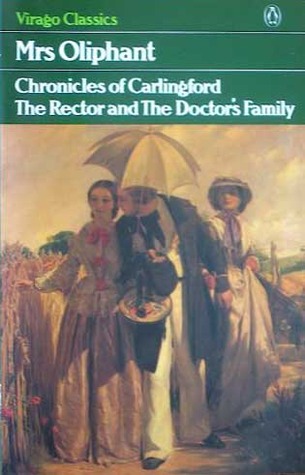
The Doctor’s Family – Margaret Oliphant (1863) 153 pages

Halfway through the final week of NADIM 2020 and for the first time this month it’s feeling do-able! I don’t want to tempt fate (especially as I’m changing broadband providers this week) but I’m hopeful I might actually complete a novella for every day…

After the brutality of First Love yesterday, I thought I’d take refuge in Victorian gentility. Also, I thought it would make a change from my resolutely twentieth and twenty-first century choices this month. The Doctor’s Family takes place in the fictional town of Carlingford, a setting Margaret Oliphant revisited in four subsequent novels as well as the short story The Rector, which was included in my Virago edition.

Dr Edward Rider has come to Carlingford after his wastrel brother Fred caused him to lose his practice elsewhere. He lives:

“in the new quarter of Carlingford; had he aimed at a reputation in society he could not have done a more foolish thing; but such was not his leading motive. The young man, being but young, aimed at practice.”

Unfortunately Fred has followed him to Carlingford where he does very little except smoke pungent pipes and go out to waste money. However, Oliphant doesn’t paint Fred as evil (to my twenty-first century eyes he sounded depressed) and she doesn’t paint Dr Rider as wholly virtuous. He can be short-tempered and dismissive to his patients, more than once he takes out his anger on his horse (thankfully not dwelt on in detail but still repulsive), and he doesn’t have high ideals about his vocation, though he is a reasonable doctor. In other words, the brothers are flawed human beings each muddling through, and bound by a “strange interlacement of loathing and affection”.

His family suddenly enlarges in a way Dr Rider did not expect, when Fred’s wife, children and sister-in-law all – never alluded to by Fred – arrive from Australia. They rent a house on the outskirts of town and Dr Rider visits initially out of a sense of duty more than any affection, as Susan, Fred’s wife is petty and spiteful, and his children are feral. His sister-in-law Nettie, on the other hand, is capable and practical, and essentially runs their entire lives for them.

Again, the characterisation here is subtle. Nettie isn’t one of Dickens’ holier-than-thou self-sacrificing virgins. Rather she is a determined, independent young woman who sees what needs to be done and does it. Oliphant makes it clear that Nettie gains from the situation, that it suits her.

“Those brilliant, resolute, obstinate eyes, always with the smile of youth, incredulous of evil, lurking in them, upon her bewildered advisor. ‘I am living as I like to live.’”

Short-tempered Dr Rider develops feelings for Nettie and can’t understand how she puts up with her selfish, demanding, draining family. She is less judgemental than he is:

“She knew their faults without loving them less, or feeling it possible that faults could make any difference to those bonds of nature.”

But while the family seem settled in their slightly unconventional ways, events will conspire to change things irrevocably.

This is the first time I’ve read Margaret Oliphant and I enjoyed her immensely. I liked her flawed characters and her resistance to showing situations as morally black-and-white, which can sometimes be the case in Victorian fiction (and I’m a big fan of the period and the women writers). I read The Rector as well (but I’ve not discussed it here as it’s not a novella) and found that story lighter and wittier than The Doctor’s Family. Both together mean I’d be interested to see how Oliphant developed the inhabitants of Carlingford in later novels.

If you like Victorian social realism but can’t face the hefty tomes that genre often involves, if you like Elizabeth Gaskell’s Cranford, or if you sometimes wish George Eliot wasn’t so heavily intellectual, then a trip to Carlingford will be just perfect for you.

There are no great surprises for the reader in The Doctor’s Family; things work out exactly as you’d expect. But that is no criticism and especially in these uncertain times, it’s a perfect example of the solace to be found in reading.

“I’ve got my country’s 500th anniversary to plan, my wedding to arrange, my wife to murder and Guilder to frame for it; I’m swamped.” (Prince Humperdinck, The Princess Bride)

I have an enduring weakness for swashbucklers, which I think is due to watching Errol Flynn at an impressionable age.

1545181599_c4320d5653_z

So of course I have been watching the BBC series The Musketeers, which ended a few weeks ago.  I was very put-out that [SPOILER ALERT] Marc Warren’s dastardly Comte de Rochefort died in the final episode. There wasn’t really any other option for his character, but Marc Warren always creates great baddies and I was sad to see him go (also he looked awesome– I think eyepatches should come back as a thing):

MW001 (13)

Image from here

I thought I’d console myself by looking this week at literary villains.  There are so many great ones to choose from, and villains are often so much more compelling than the heroes.  Of course some of them are just downright despicable:

joffrey

Image from here

But generally the story is a sorrier place when they’re not in it (and therefore usually ends at that point).

Firstly, for obsessive, depraved stab-happy villains, you need never look further than Jacobean tragedy.  I’ve chosen Ferdinand from The Duchess of Malfi by John Webster (1612). Ferdinand is the twin brother of the titular character and he is barking mad (quite literally, as he thinks he is a werewolf and goes round digging up graves after dark).  He doesn’t want the sister he characterises as a ‘lusty widow’ remarrying.  To this end he employs melancholic henchman Bosola:

‘Your inclination to shed blood rides post

 Before my occasion to use you.  I give you that

 To live i’ the court here, and observe the duchess;

 To note all the particulars of her haviour,

 What suitors do solicit her for marriage,

 And whom she best affects.  She’s a young widow:

 I would not have her marry again.’

The poor Duchess, being female, is entirely disempowered against Ferdinand and her other brother, a corrupt Cardinal.  She only wants love:

“Why should only I,

Of all the other princes of the world,

Be cas’d up, like a holy relic?  I have youth

 And a little beauty.”

She finds affection with the pretty steward Antonio, but normal family life never stands a chance in the depraved court where your own brother is sexually obsessed with you “my imagination will carry me/ To see her in the shameful act of sin”  and spends his time, when he’s not pretending to be a wolf, imagining you in flagrante:

Happily with some strong-thighed bargeman;
Or one o’th’woodyard that can quoit the sledge
Or toss the bar; or else some lovely squire
That carries coals up to her privy lodgings.

Yep, Ferdinand is insane.  Yet he’s part and parcel of a society that is utterly degraded and false.  In the hands of a good actor, he isn’t cartoony evil, twirling his moustache, but almost as much as a victim as the Duchess.  There have been two productions in London in recent years which have seen excellent performances by Harry Lloyd (Old Vic, 2012) and David Dawson (Globe, 2014) as Ferdinand, both of which captured his cruel depravity, and his tragedy.

duchess of malfi old vic  normal

Images from here and here

This being a Jacobean tragedy, I don’t think it’s a SPOILER to say that everyone dies, yet Webster gives Ferdinand a moment of clarity, and some of the most beautiful lines in drama, as his dying words:

Whether we fall by ambition, blood or lust,
Like diamonds we are cut with our own dust.

Amazing. Those final lines make Ferdinand complex and insightful, and a truly great villain.

Secondly, another sure-fire source of colourful villains: Charles Dickens.  I’m not the biggest Dickens fan, but actually the things I don’t like about him (clearly delineated binaries like good/bad and one-dimensional stereotypes instead of fully realised characters) do make for opportunities to enjoy all-out villainy.  You can usually tell the villains in Dickens because he helpfully signposts them through names like Ezekiel Slime or similar.  In this instance, I’m going to look at David Copperfield’s (1849) Uriah Heep (see what I mean?) the obsequious clerk to David’s landlord Mr Wickfield. I chose him over a more obvious villain like Bill Sykes from Oliver Twist, because he’s more insidious (although Bill Sykes outdoes every villain in the millinery stakes):


tom-hardy--2-1485603292

Image from here

Bill Sykes never tries to present himself as anything other than downright terrifying, whereas Uriah Heep is always trying to convince everyone of his humility:

“”I got to know what umbleness did, and I took to it. I ate umble pie with an appetite. I stopped at the umble point of my learning […] I am very umble to the present moment, Master Copperfield, but I’ve got a little power!'”

Of course, he is far from humble.  Instead his fawning manner disguises a vicious class jealousy and powerful ambition to take over the Wickfield business through blackmail, before marrying the virtuous Agnes (as someone who can’t stand Dickens’ pious virgins I think it’s not a bad match, but I realise I may be alone in this). With Victorian beliefs that appearance demonstrated character, it seems improbable that anyone would ever trust the unattractive Heep:

“a youth of fifteen …whose hair was cropped as close as the closest stubble; who had hardly any eyebrows, and no eyelashes, and eyes of a red-brown, so unsheltered and unshaded, that I remember wondering how he went to sleep. He was high-shouldered and bony; dressed in decent black, with a white wisp of a neckcloth buttoned up to the throat; and had a long, lank, skeleton hand…”

Yet he still manages to ingratiate himself quite successfully and defraud the Wickfields amongst others.  Of course, this being Dickens, the good end happily and the bad unhappily, so his comeuppance is inevitable.  Heep is a highly effective villain, wholly unlikeable and so oily he just seeps across the page. Uriah Heep : a villain so villainous they named a rock band after him (really).

To end, probably the most single-minded, seductive villain of all time (George Sanders’ voice is a joy):