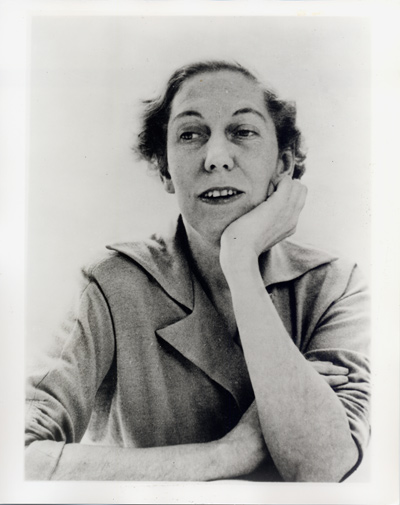
“People call me a feminist whenever I express sentiments that differentiate me from a doormat.” (Rebecca West)

A definite theme of the blog this year has been me being late for reading events. This will probably be my final post of 2018 so it’s apt to end on yet another belated entry, this time for Rebecca West Day in Jane at Beyond Eden Rock’s Birthday Book of Underappreciated Lady Authors, which was 21 December.
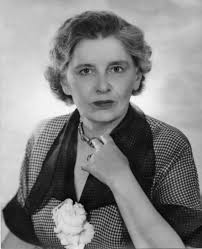
I’d hoped to do a post on two books, but the second half of this year has also seen me sluggish in both reading and blogging, so it’s just the one novel, The Fountain Overflows (1956), the first in the trilogy about the Aubrey family.

The story starts in 1900 and is narrated by Rose, one of four children of Piers and Clare. Piers is a gambling addict, and so although he and his wife are from genteel backgrounds, they survive on the brink of absolute destitution. The children grow up moving from place to place.

“We were experts in disillusion, we had learned to be cynical about fresh starts even before we ourselves made our first start”

Despite this, the children are not timid or anxious, but rather self-reliant and independent. Their mother is devoted to their father, as they all are, and the children clear-sightedly see their struggles.

“But I did not trust her. I loved her. Still I could see that she had been tripped by the snare of being grown up, she lay bound and struggling and helpless […] we children could always deceive her. Had it not been so we could not have provided for her happiness half as well as we did.”

West achieves a delicate balance in the portrayal of the Aubrey adults. It would be very easy to create to caricatures of a selfish, wastrel father and downtrodden female victim:

“ ‘Oh I am getting old and ugly, but it is not that. I cannot compete with debt and disgrace, which is what he really loves.’ “

Yet Clare never seemed especially weak to me. Her focus is music, and this takes priority over everything else. Rose and her sister Mary are gifted and practice incessantly, their brother Richard Quin is also talented but more interested in juggling and sports; their poor sister Cordelia has no talent and refuses to acknowledge it, egged on by a music teacher who is in love with her and so blind to her faults.

The Aubrey household is an intellectual one, with priorities very different to those around them in the south London suburb where they live.

“’You are allowed to read the newspapers now. I hope you will not attach too much importance to them. They give you a picture of a common-place world that does not exist. You must always believe that life is as extraordinary as music says it is.’”

West can be a colourful writer and there are elements of that here, with supernatural events and poltergeists related as matter-of-factly as trips to the House of Commons and music concerts. There isn’t a strong over-arching plot but enough to pull the reader along. The story has sadness in it, as any family with an addict in it will know, but it is not depressing because Rose’s voice is strong, unapologetic and funny in it’s unblinking assessment of those who surround her:

 “Her colouring recalled a doll left out in the rain, she had the dislocated profile of a camel”

However, as a reader I found it very hard to indulge Piers as much as his wife and children did. To me he was utterly selfish and self-focussed even without his gambling, without the slightest scruple as to the risk he placed his family in.

“I had a glorious father, I had no father at all.”

The Aubrey’s practical cousin Rosamund and Aunt Constance frequently live them as they are also subject to a husband who refuses to provide, although in a very different way to Piers. There is plenty here about what led to first-wave feminism in the UK without being didactic. The men are fairly appalling but not judged harshly (except by me). Rather, West’s focus is the constraints which prevent women being able to sort things for themselves. There’s also a recurring focus on women’s clothes and how the start of the twentieth century saw female oppression made explicit through the fashions:

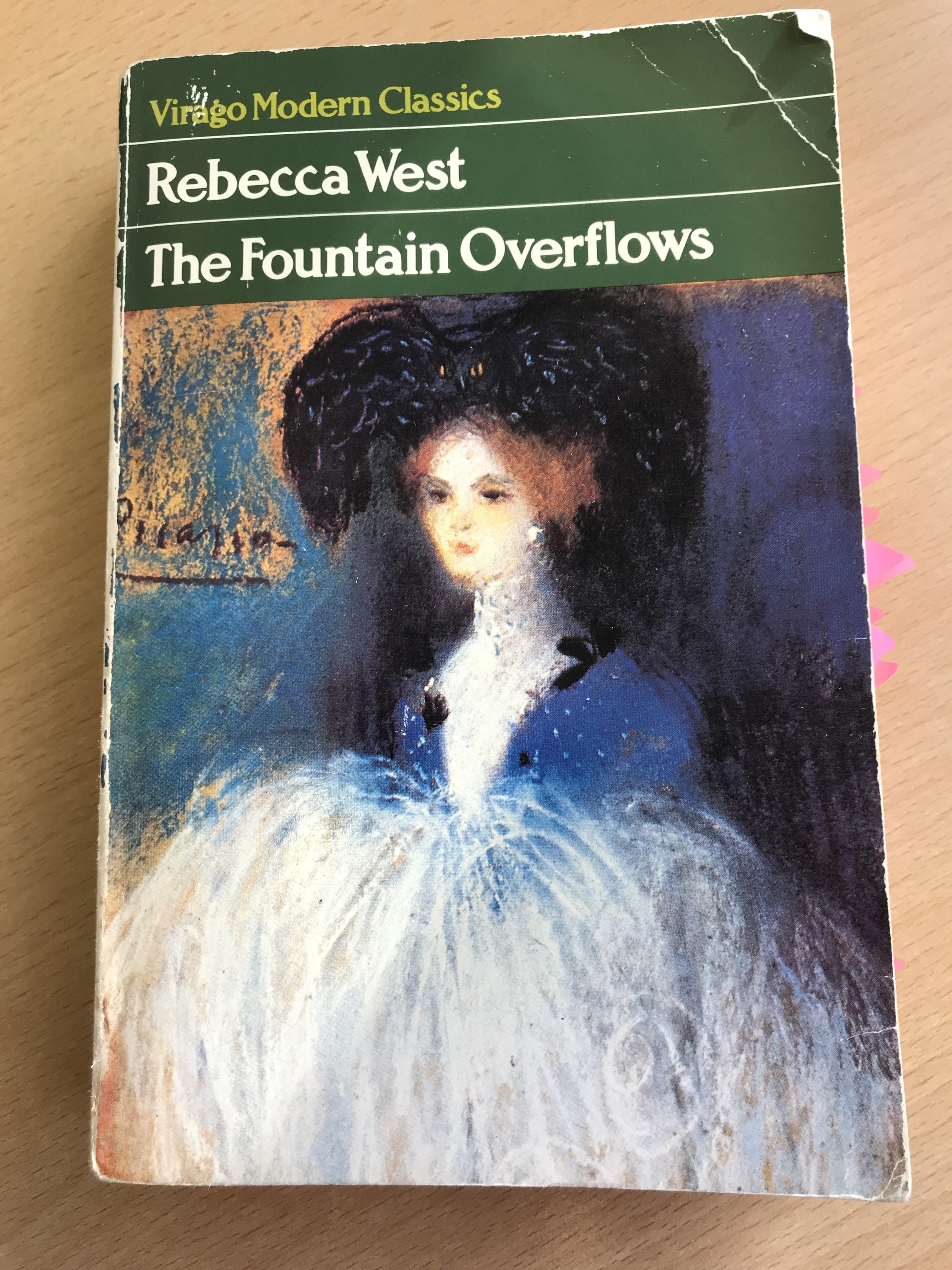
 “ ‘Any tragic scene in those days necessarily appeared grotesque, because of the clothes worn by the women […] Today she would have the right to look like that, plain and distraught and like a hen, but she was compelled by the mode of the day to make herself as absurd as a clown by wearing a hat the size of a tea-tray, which dipped and jerked and swayed as often as she did, which was perpetually.”

Hence the Virago cover:
All in all I greatly enjoyed meeting the idiosyncratic, independent-minded Aubrey family. The characters were wholly believable, the evocation of a lost time done without nostalgia, and West had plenty to say about wider Edwardian society. I’ll look forward to spending more time with the Aubreys through the two sequels.

“We had very often been sharply warned against sentimentality, and though we might have been able to define it only vaguely as the way one should not play Bach, we recognised it.”

And so it just remains for me to wish you all the festivities of your choosing and leave you with a non-Christmassy song (because you may well be sick of them by now) from a great Christmas film which I watched yesterday, Scrooged:

“I loved Mr. Darcy far more than any of my own husbands.” (Rumer Godden)

Today is Rumer Godden Day in Jane at Beyond Eden Rock’s Birthday Book of Underappreciated Lady Authors. I’m so grateful that this prompted me to read the two by Godden I had in the TBR, as she’s quickly become a new favourite.  Godden is such an accomplished writer; her books are so readable and her use of language is stunning.

Image from here

Firstly, Kingfishers Catch Fire (1953), which I started reading with some trepidation. I expected a novel about a 1950s English woman living in India to be filled with white entitlement and comic/exoticised portraits of the locals. Thankfully, Godden is far too sophisticated an author to do anything so crass, and the comic portrait is resolutely reserved for the clueless but well-meaning white foreigner, Sophie.

“To the Pundit, Sophie was precisely like any other European or American, only more friendly; the friendliness alarmed him. ‘These people are poor and simple…’ he began, but Sophie interrupted him.

‘We shall be poor and simple too,’ she said with shining eyes.

[…]

Sophie would not listen. Like many people there were some words about which she was sentimental; one of these was ‘peasant’. ‘Peasants are simple and honest and kindly and quiet,’ she said. ‘They don’t want what they don’t possess. They have the wisdom to stay simple. They don’t want to change.’”

This idealistic young woman crashes into Kashmir with her two children, estranged from her husband and determined to establish a life for herself. Yet the portrait of Sophie is a subtle one: she is oblivious to the needs of her children and to the cultural differences between her and her neighbours, but somehow not arrogant, just hopelessly naïve.

“Teresa could not count how many times they had moved, but each time the small ballast of hopes and plans they had collected was thrown overboard and everyone they had known was left behind.

Moo did not care. Like a little seed that is blown and can grow anywhere, on a rocky ledge, in a crack of earth, he lived a contained contented small life of his own no matter where he went. To Moo it did not matter but Teresa had roots, they were tender, soft and trailing…”

Poor Teresa. She is sensible and understands so much more than her adult parent. She also cares for Moo, who is probably on the autistic spectrum and in his own world.

In describing how Sophie and her children live in Kashmir, Godden adopts an interesting approach by having the story interjected with later reflections from Sophie and her family. So the narrative will be interrupted with comments like “‘But you were not qualified to teach Urdu,’ said Toby afterwards.” It’s not a technique I’ve seen before and it doesn’t jar as much as I would expect. The effect is to temper Sophie’s idealism and blind actions. It works to offset what sceptical readers (ie me) might be thinking: ‘but that’s just ridiculous, she’ll never make that work…’ etc. It keeps the story grounded even when the main protagonist ricochets from one ill-conceived action to the next.

Godden wrote Kingfishers Catch Fire based on her own experiences of India and her love of the land is obvious:

“There were no ceilings, only cross beams stuffed with dried furze as in most Kashmiri peasant houses. There was no glass in the windows, only hanging window shutters, no water system of course, no lighting, but it was a rarely beautiful little house. In summer it was hung with vines and honeysuckle and white-scented roses, and all around it were flowering trees….Above it all the mountain reared its head while below, lay the lake and its reflections and, far, the horizon of snow peaks.”

The plot is a deceptive one. I was enjoying what I thought was comic novel about the escapades of a fairly clueless woman; then suddenly things took a very dark turn and I found myself racing towards the end, desperate to know what happened and for things to work out well.

I loved the ending. This pithy comment on stealthy imperialism summed it up for me:

“The missionaries worked for the people but did not respect them. For all their love and zeal the wanted to bend them, bend them out of their own truth”

The message I took from Kingfishers Catch Fire was one of resolutely sticking to your own truth, whilst acknowledging and respecting other people’s. I just loved it.

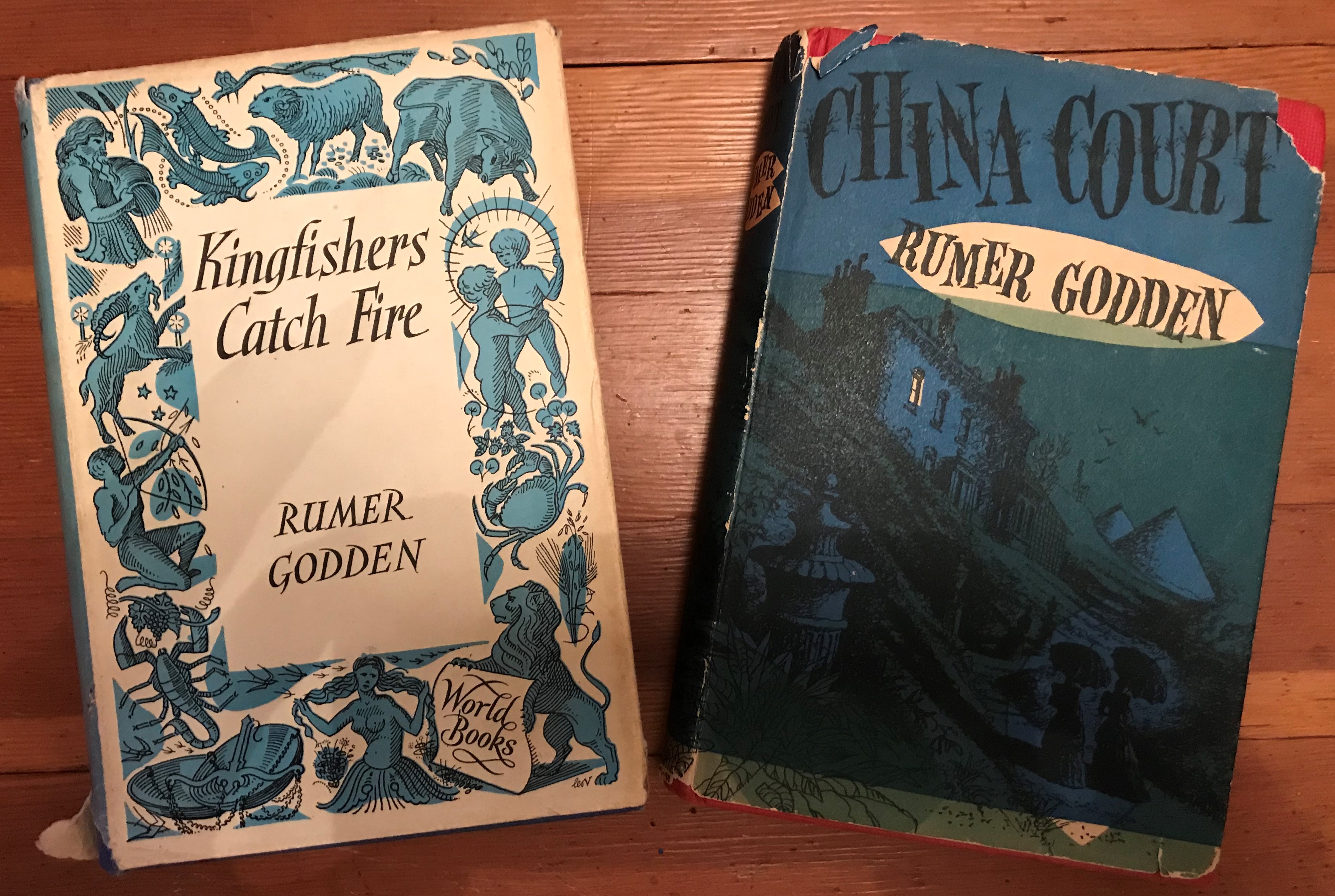
Behold my slightly battered, kitschy-covered editions:

Secondly, China Court (1961). This is another story of a dilapidated house and the woman who loves it, but otherwise very different to Kingfishers Catch Fire. The titular pile is the Victorian home of five generations of the Quin family set in the Cornish moors and built on the proceeds of china clay works.

“When one of the…rose bowls or vases is rung it gives off a sound, clear, like a chime, the ring of true porcelain, so China Court gives off the ring of a house, a true home.”

The story begins with the death of Mrs Quin, the matriarch who has resolutely stayed in China Court against all her family’s wishes (except her granddaughter) and looks at what happens after her death as her family besiege the house for the reading of the will.

The story moves back and forth across the generations. There is no indication when this will happen; scenes cut between the various family members, all in present tense. Again, this stylistic experiment doesn’t jar nearly as much as I would expect. Instead it captures a sense of the house holding all the members of the family at any one time, the echoes of their steps and their voices all layered upon one another.

“Homes must know a certain loneliness because all humans are lonely, shut away from one another, even in the act of talking, of loving. Adza cannot follow Eustace in his business deals and preoccupations as she cannot follow Mcleod the Second or Anne or Jared – no one can follow Eliza. Mr King Lee, kissing Damaris, has no inkling of the desolation he has brought her, just as Groundsel only half guesses Minna’s; Jared hides himself from Lady Patrick, and John Henry and Ripsie, in their long years together are always separated by Borowis

[…]

Loneliness can be good. Mrs Quin learns that in the long companionship of the years after Tracy goes, when she and Cecily are alone in the house; companionship of rooms and stairs, of windows and colours; in the gentle ticking away of the hours, the swinging pendulum of the grandfather clock. ‘I was happy,’ Mrs Quin could have said. Contented loneliness is rich because it takes the imprint of each thing it sees and hears and tastes”

This for me was the central theme of China Court: the value of everyday domesticity. The characters who recognise it are fulfilled and live rich lives that outwardly appear narrow but in reality connect with something fundamental that enables a wider kinship with others.

The portraits of the individuals run seamlessly and as the novel progresses they weave together for a complex depiction of family, and how histories are cyclical, building on what has gone before.

Mrs Quin is an avid gardener, and as in Kingfishers…there are beautiful descriptions of the natural world, but also of food and the various meals the family have taken together over the years.

“Now Cecily brought in saffron cake, buttered scones hot in a silver dish, brown bread and butter thin as wafers, quince jelly and strawberry jam from China Court quinces and strawberries; she had made shortbread, fruitcake and because Tracy likes them as a child, thin rolled ginger-snaps filled with cream.”

Gradually the family histories build towards a brilliant denouement in the present day of the novel. It’s dramatic but believable and once again I found myself racing towards the end. And the end is where I encountered my first reservation about Godden’s writing. To discuss it I’ll have to include a SPOILER so skip to the end of this paragraph if you don’t want to know. Here it is: an act of domestic violence takes place, an act which is quickly forgiven and leads to sex. I think it’s a dramatic device to shock a couple who aren’t communicating well (a recurring theme in the novel) towards honesty and resolution, but reading this almost 60 years after it was written was just horrible. I know from films of the time that slaps and spankings were freely given, but I’d be very surprised if this worked for modern readers.

This one incident aside, China Court is a wonderful portrait of a house and a family, beautifully evoked and fully realised with fondness but without sentimentality.

“ ‘We were truly kin,’ says Mrs Quin, and it is true that Tracy is like her grandmother in many ways; for instance, both, from the moment they first see it, are enslaved by China Court.”

To end, regular readers will know there are no depths to which I won’t sink in order to shoehorn in an 80s pop video. So please pardon the pun that has enabled my childhood hair icons to be this week’s choice:

“Don’t let people know the facts about the political and economic situation; divert their attention to giant pandas, channel swimmers, royal weddings and other soothing topics.” (George Orwell, I Have Tried to Tell the Truth: 1943-1944)

How depressing is it that Orwell not only hasn’t aged at all, but seems more pertinent than ever? Let’s distract ourselves from the dystopian nightmare we’re living with a few books… here is my contribution to the 1944 Club, hosted by Kaggsy at Kaggsy’s Bookish Ramblings and Simon at Stuck in a Book. Do join in!

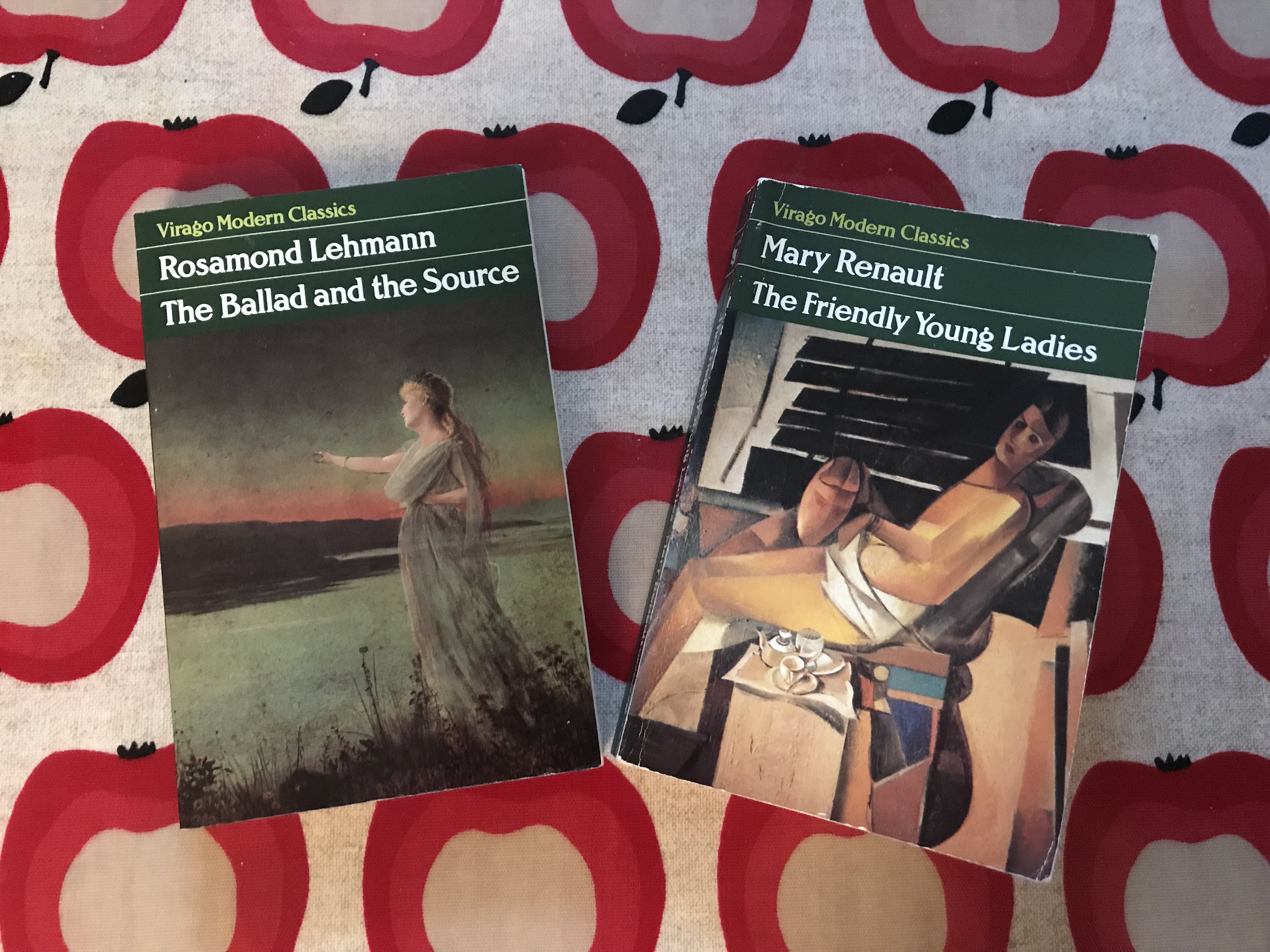
Firstly, The Ballad and the Source by Rosamond Lehmann. Told from the point of view of 10-year old Rebecca in the years just before World War I, it is the story of a captivating older woman, Sibyl Jardine and her extraordinary family. Sibyl was friends with Rebecca’s grandmother, and invites Rebecca and her siblings to pick primroses on her property. Rebecca is entranced by the charismatic Mrs Jardine from the start:

“It sounded strange to us that a person should so reveal her feelings: we did not say things like that in our family, though I dreamed of a life where such pregnant statements should lead on to drama and revelation.”

But Mrs Jardine’s magnetic nature comes at a price. People are manipulated by her, dominated by her, and subdued by her:

“Now that Mrs Jardine had gone, the electrifying meaning with which her presence always charged the air began to dissolve. The arrows of her words fell harmlessly out of the copper beech on to the grass around us, and we kicked them aside and drew together, an ordinary group of children going for a picnic.”

Yet because it is told from the point of view of a child, we never quite get to the core of Sibyl Jardine. She remains enigmatic, always slipping out of reach:

“Mrs Jardine, pausing at the end of the herbaceous border, mused. For the first time in her actual presence the sense pierced me directly: that she was wicked. A split second’s surmise. But when next moment I looked up at her, there was her profile lifted beautifully above me, serene and reassuring as a symbol in stone.”

The Ballad and the Source is an odd novel. The child’s point of view is not child-like; the events of Mrs Jardine’s life are melodramatic to say the least (abandoned children, incest, mental illness) and much of the novel is reported speech as Mrs Jardine and her maid Tilly tell Rebecca the life story which is wholly unsuited to a child’s understanding. It has also dated: regional accents sound stereotyped and the portrayal of mental illness is clumsy.

Yet the novel is beautifully written and highly readable. It demonstrates the high price paid by women for emancipation when they have no power. Ultimately what propelled me through the novel was the character of Sibyl Jardine. Like Rebecca, I found her complex and compelling, and I couldn’t wait to see where this intriguing woman took me next.

Secondly, The Friendly Young Ladies by Mary Renault. Set between the wars, it follows seventeen-year-old Elsie Lane as she leaves her Cornwall home to find her older sister Leo. Elsie’s parents are in a deeply toxic marriage and Elsie escapes into fantasy, trying to make herself invisible. As a result she is immature and naïve:

“She was a dim, unobtrusive girl. One might conjecture that she had been afraid to grow up, lest the change should attract attention to her […] The fact that she went nowhere, met nobody but her mother’s friends, and lived in a world of her own imagination had suspended her in the most awkward stage of adolescence for quite three superfluous years.”

It is a visit from locum doctor Peter which spurs her into action. His half-baked ideas about psychology means he seduces timid female patients to cheer them up, not noticing the heartbreak and disappointment he causes when he fails to follow thorough on the fantasies he has encouraged. He is not cruel or vindictive, but he is vain and self-centred:

“His dislike of hurting anyone was entirely genuine, as traits which people use for effect often are; and from this it followed that if anyone insisted on being hurt by him, he found the injury hard to forgive.”

Elsie thinks the drama of running away will bring her and Peter together. When she finds Leo, her sister is dressing boyishly, writing Westerns and living on a houseboat on the Thames outside London, with the lovely Helen. To the reader it is entirely obvious how Leo is living her life but Elsie never realises what her sister’s sexuality is. The Friendly Young Ladies is quite progressive in its portrayal of how sexuality is not fixed, and how being gay is not a source of torture and self-loathing (it was written as an antidote to The Well of Loneliness):

“Her way of life had always seemed to her natural and uncomplex, and obvious one, since there were too many women, for the more fortunate of the surplus to rearrange themselves; to invest it with drama or pathos would have been in her mind a sentimentality and a kind of cowardice.”

(Interestingly, my Virago edition, published in 1984, still referred to Mary Renault as emigrating to South Africa ‘with her close friend Julie Mullard’. I wouldn’t have expected such coy obfuscation from a progressive late-twentieth century publisher.)

Peter ends up visiting the houseboat and trying to seduce both Leo and Helen. He knows they are in a relationship, but his vanity knows no bounds:

“Eccentricity in women always boiled down to the same thing. She wanted a man.”

What ensues is a comedy but one that contains sadness and hurt. The delicate balance of relationships in the houseboat is upset and changed irrevocably by Elsie’s naïve blundering and Peter’s vain manipulations.

I really enjoyed The Friendly Young Ladies. Elsie and Peter are both infuriating, but also funny and fondly drawn. The relationships between the four and the neighbour Joe are shown as complex and subject as much to what is not said as what is voiced. The character studies are carefully drawn and wholly believable.

My edition of this novel included an Afterword by Mary Renault in which she observes:

“on re-reading this forty-year-old novel for the first time in about twenty years, what struck me most was the silliness of the ending.”

So, not a flawless novel, but very much a readable one.

To end, 1944 was the year my mother was born. It was a home birth (no NHS!) and my grandmother heard this song being whistled in the street outside the window. Mum’s a big Johnny Cash fan so this is the version I’ve plumped for:

“I am my own muse, the subject I know best.” (Frida Kahlo)

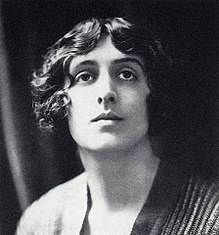
Last week I wrote about Orlando, Virginia Woolf’s love letter to Vita Sackville-West. Although she was Virginia’s muse, Vita was not a voiceless entity to be moulded by the artist, but an accomplished author in her own right. This week, I thought I’d look at the work of some famous muses: Vita, and also Zelda Fitzgerald.

Vita Sackville-West

All Passion Spent by Vita Sackville-West (1931) begins with the death of Henry, Lord Slane, former Prime Minister and Viceroy to India. Deborah, Lady Slane, who has been married for 70 years since the age of 17, seems to be bearing up remarkably well.

“Mother was a changeling, they had often said politely, in the bitter-sweet accents reserved for a family joke; but now in this emergency they found a new phrase: Mother is wonderful. It was the thing they were expected to say, so they said it, several times over, like a refrain coming periodically into their conversation and sweeping it upwards on to a higher level. Then it dropped again; became practical. Mother was wonderful, but what was to be done with Mother? Evidently she could not go on being wonderful for the rest of her life.”

Although she loved her husband, Lady Slane is released by his death. She did not want to be a political wife or a society hostess, or any of the other roles she had to adopt to support her husband. She had wanted to be a painter, but instead followed the Victorian ideal and got married. Her husband was happy for her to paint watercolours as a becoming hobby, but the idea of a professional artist wife was ridiculous:

“He was not to blame. He had only taken for granted the things he was entitled to take for granted, thereby ranging himself with the women and entering into the general conspiracy to defraud her of her chosen life.”

Aged 88, Lady Slane decides that the time has come to go her own way at last:

“I have considered the eyes of the world for so long that I think it is time I had a little holiday from them. If one is not to please oneself in old age, when is one to please oneself? There is so little time left!”

This means she will not live alternately with each of her offspring who are all fairly dreadful in their own way. Instead she will move to a small house in Hampstead with her French maid who has been with her for the whole of her marriage, and they will live quite simply. (Much to my relief, having read the horrors of the moving-between-adult-children option brilliantly portrayed in Monica Dickens’ The Winds of Heaven)

She ends up creating a little enclave of elderly men around her. Mr Bucktrout is her eccentric, paternalistic landlord; Mr Gosheron her decorator; and Mr FitzGeorge a man who has loved her from afar for years. They are all rather strange individuals, and all in sympathy with one another.

“But at Hampstead, thanks to Mr Bucktrout and Mr Gosheron, the proper atmosphere had been at last achieved. It was modest; there were no aides-de-camp, no princes, but though modest it was warm, and affectionate, and respectful, and vigilant, and just as it should be.”

Sackville-West has plenty to say in this novel, most obviously about the limited choices available to women, especially in regard to their professional lives:

“She supposed she that was not in love with Henry, but, even if she had been in love with him, she could see therein no reason for foregoing the whole of her own separate existence. Henry was in love with her but no-one proposed he should forego his.”

In this way, it has been seen as a fictional companion to A Room of One’s Own. However, it is also an appeal for allowing for different kinds of life and for respecting inner life as much as outward achievement. Lady Slane is ostensibly doing nothing, and wonders if the contemplative life is in fact running away from things. She decides it isn’t:

“for in contemplation (and also in pursuit of the one chosen avocation which she had to renounce) she could pierce to a happier life more truly than her children who reckoned things by their results and activities”

All Passion Spent is a wonderful novel that I thoroughly enjoyed. It’s beautifully written and has something to say, but it is never didactic. It is warm, witty, has fully-realised idiosyncratic characters and of course, Sackville-West’s sharp wit. A great read.

“For the first time in her life – no, for the first time since her marriage – she had nothing else to do. She could lie back against death and examine life. Meanwhile, the air was full of the sound of bees.”

Secondly, Zelda Fitzgerald’s only novel, Save Me the Waltz, written in a clinic in 6 weeks following a breakdown. It’s practically impossible to read this without thinking of Zelda’s life. She and her husband F Scott Fitzgerald were seen as emblematic of generation perdu and her husband labelled her ‘the First American Flapper’. Save Me the Waltz is barely disguised autobiography as Alabama Begg marries an artist, David Knight, and the celebrated couple move around Europe after the First World War. Sound at all familiar?

The novel was dismissed by critics on its release but has been reclaimed by some scholars in recent years who argue the novel is well-written and Zelda has been overshadowed by the acclaim granted her husband. I think I fall somewhere between these two camps. I thought Save Me the Waltz was desperately overwritten:

“the swing creaks of Austin’s porch, a luminous beetle swings ferociously over the clematis, insects swarm to the golden holocaust of all hall light. Shadows brush the Southern night like heavy, impregnated mops soaking its oblivion back into the black heat whence it evolved. Melancholic moon-vines trail dark, absorbent pads over the string trellises.”

There are loads of passages like this. Fitzgerald loves a simile and she layers image upon image without them really adding anything to one another. A few pages on is this:

“The lids of her mother’s blue eyes rose in weary circumflex as her sweet hands moved in charity through the necessities of her circumstance.”

At this point I was at page 29 and wondering if I should give up. As I say, it’s difficult to read this separate from Zelda’s legend but I’m pretty sure that even if I didn’t know about her, this writing would still strike me as coming from someone with something to prove, desperate to be a Good Writer.

But I’m glad I persevered. Fitzgerald seemed to get into her stride later into the novel; similes became more coherent, the use of Big Clever Words lessened and she got on with the story and some interesting observations:

“Alabama and David were proud of themselves and the baby, consciously affecting a vague bouffant casualness about the fifty thousand dollars they spent on two years’ worth of polish for life’s baroque façade. In reality, there is no materialist like the artist, asking back from life the double and the wastage and the cost on what he puts out in emotional usury.”

Alabama decides to train as a dancer as the Knight’s marriage starts to disintegrate. It’s hard not to read it as Zelda’s take on her relationship with Scott and it’s sad:

“They had thought they were perfect and opened their hearts to inflation but not to alteration.”

Of course the main interest in reading Save Me the Waltz is that it was written by Zelda Fitzgerald, and that  it is her life with Scott thinly-disguised. Yet I think it shows unfulfilled promise. It’s not a great novel but it has excellent moments. I felt if she had only had an editor take an artistic, nuturing interest in her, someone who would advise, guide and mentor, Zelda Fitzgerald could have become the accomplished writer she so clearly wanted to be.

“Alabama swung off in imitation of some walk she had once admired. ‘But I warn you’ she said, ‘I am only really myself when I’m somebody else whom I have endowed with these wonderful qualities from my imagination.”

To end, I recently saw a repeat of a documentary where Marianne Faithfull described becoming Mick Jagger’s muse as “not a high self-esteem choice”. She survived, she’s laughing and she’s still working, even if her voice these days is a bit of an acquired taste. Take it away Marianne:

“It is not possible to have perfection in life but it is possible to have perfection in a novel.” (Elizabeth Taylor)

Today is Elizabeth Taylor Day in Jane at Beyond Eden Rock’s Birthday Book of Underappreciated Lady Authors, which gave me a chance to read the last two novels I had of hers remaining in the TBR (thankfully I’ve not yet read all her work – roll on the end of the book-buying ban…).

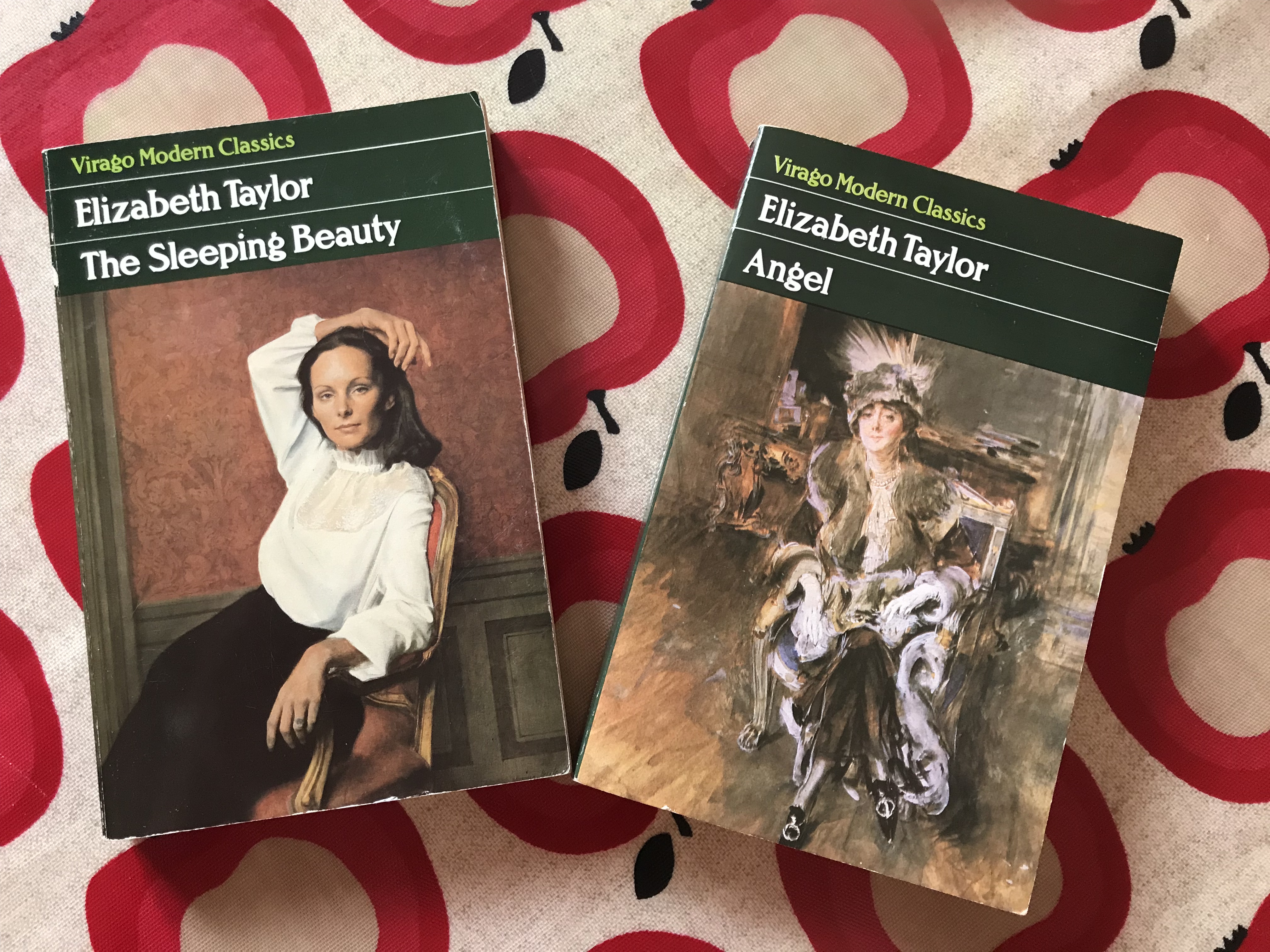
Firstly, The Sleeping Beauty (1953), which tells the story of Vinny, a man who is a reliable shoulder to cry on for all his female friends.

“It was his business to be loved – a mission created afresh with everyone he met – and he was always conscious of another’s coldness.”

When Isabella’s husband dies, he is down to visit her at her coastal home like a shot.

“ ‘You are welcome to follow me to the ends of the earth’ Vinny seemed to be assuring people when he was introduced.”

Vinny should be seen as a model of compassion, but instead Taylor’s sharp eye shows him as vain and very much driven by his own needs. Isabella’s son Laurence, courting a young nursemaid staying at a local B&B, doesn’t take to him as he thinks he has plans to marry Isabella. The thought crosses Isabella’s mind too, and she finds comfort in planning how she will turn him down. What neither of them know is that firstly, Vinny is already married (though separated) from his wife Rita “[who] had, in fact, a great distaste for the truth and was forever tidying it up or turning her back on it.” and secondly, that Vinny has fallen in love at first sight with Emily, who he saw on the beach.

“When they had gone from view, he turned back to the room, and found it dark now, and very small.”

Emily is a blank canvas in many ways, perfect for Vinny’s romantic sensibility.

 “Nearing fifty, Vinny felt more than ever the sweet disappointments only a romantic knows….the imperfectly remembered and the half-anticipated. Past and future to him were the realities; the present dull, meaningless.”

Emily has been in a car accident and her heart was broken when her lover subsequently dumped her, unable to cope with her changed appearance. She is still beautiful, but in a strange way, as Vinny’s mother observes:

“anything passive she abhorred, and Emily’s dead-white skin, her lack of expression, about which Vinny had found no words to forewarn her, no heart to explain or discuss, annoyed and repelled her. She could sense Emily’s life drifting by in an incurious desuetude.”

The Sleeping Beauty has a determinedly unromantic male lead, and a beauty whose awakening is for his benefit not hers. Taylor shows how we attempt to construct our lives around our desires and how that can cause pain rather than delight for ourselves and those we love. She is very funny (such as Isabella and her friend Evalie being avid racing gamblers, hiding this from her son, who is also betting and hiding it from his mother) but overall the tale is unsettling. If the romance will result in happily-ever-after for any of those concerned is left for the reader to decide.

“ ‘Oh, I am nothing without you,’ she said. ‘I should not know what to be. I feel as if you had invented me. I watch you inventing me, week after week.’”

Secondly, Angel (1957) a hilarious portrait of a writer supposedly based on the romantic novelist Marie Corelli. Angelica Deverell decides before she’s even left school that she’s going to be a romantic novelist. This is despite not liking love, or novels:

“Until now she had thought of love with bleak distaste. She wanted to dominate the world, not one person.”

“She had never cared much for books, because they did not seem to be about her”

Angel is one of the most rampant egotists ever committed to paper. She is a terrible writer without life experience, knowledge or taste to draw on, and yet she is hugely popular – her readers don’t care about her error-ridden purple prose. Her fame insulates her from the world and so she is able to continue her entirely ego-driven existence, never bothering to look beyond herself for anything. She is physically astigmatic but psychologically myopic to the point of blindness.

Maybe I’m lacking compassion but I didn’t find Angel remotely sympathetic. She is appalling. The pathos comes through her mother: baffled by her daughter, and yanked from her home by Angel’s material wealth. I found this passage heart-rending:

“At a time of her life when she needed the security of familiar things, these were put beyond her reach. It seemed to her she had wasted her years acquiring a skill which in the end was to be of no use to her: her weather-eye for a good drying day; her careful ear for judging the gentle singing sound of meat roasting in the oven; her touch for the freshness of bacon; and how, by smelling a cake, she could tell if it were baked: arts, which had taken so long to perfect, now fell into disuse. She would never again, she grieved, gather up a great fragrant line of washing in her arms to carry indoors.”

Amazingly, Angel does have people who care about her, repugnant as she is. Theo, her publisher, takes a paternalistic attitude and worries she will never get what she wants:

“Love, which calls for compliance, resilience, lavishness, would be a shock to her spirit, and upset to the rhythm of her days. She would never achieve it, he was sure. For all the love in her books, it would be beyond her in life.”

Nora is a devoted friend and lives with Angel for the majority of their lives, even during Angel’s marriage to Nora’s feckless brother Esme:

“ ‘I read one of your books.’ he said, sounding as if it were rather a surprising thing to do.

She blinked, jolted by what he had said. She always supposed that everyone had read all of her books and had them nearly by heart, that they thought about them endlessly and waited impatiently for the next one to appear.”

Her marriage is held together through Esme’s lies and Angel’s unrelenting capacity for self-delusion, despite the fact she doesn’t enjoy the honeymoon:

“Greece was especially disappointing. It was nothing like her novels.”

 Angel is an astonishing character study and the story of one writer’s life. What is most astounding is that the grotesque Angel is apparently not too far from real life; apart from the fact that she was probably gay and more interested in the esoteric, Marie Corelli seems to have been very much like Angel. Certainly like Corelli, Angel refuses to acknowledge her waning star following the First World War when people don’t want overwritten romances anymore.

Angel never has an epiphany, she remains resolutely vain, deluded and solipsistic until the end. The novel is a comi-tragedy, carefully balancing absurd excess with sharp-eyed psychological insight.

“She went to the Royal Garden Party in violet satin and ostrich feathers with purple-dyed chinchilla on her shoulders; amethysts encrusted her corsage and mauve orchids were sewn all over her skirt where they quickly wilted. Glances of astonishment she interpreted as admiration.”

 “Arrogant and absurd she had been and remained; she had warded off friendship and stayed lonely and made such fortifications within her own mind that truth could not pierce it”

Ultimately, Taylor treats Angel kindly:

“I am frightened, she suddenly thought. But there was nothing to be frightened of; not even poverty now. I have come such a long way, she told herself, and done all that I wanted and there is nothing to fear.”

In life and in fiction, I like people who walk to the beat of their own drum. Angel certainly does this. I think the reason I couldn’t stand her is because she is so utterly self-focussed. She has zero interest in other people or in the world. Taylor is such a skilled writer that her horrible main character does not detract from the joy of this novel. The comedy is gentle; although we laugh at Angel it is in disbelief rather than cruelty. There is also enough reality and pathos through the characters that surround her to ground the novel away from Angel’s delusions.

Elizabeth Taylor is such a wonderful writer. Any novel of hers is an absolute masterclass in astute, humane, witty style. The fact that she is an Underappreciated Lady Author is an absolute travesty.

To end, I saw a documentary recently about female singers and Annie Lennox was part of it, looking bloomin’ amazing in every shot. Here she is singing about an angel:

Novella a Day in May #29

It’s thanks to this mini-project that I finally read Eudora Welty, as I had two of her novellas in the TBR. I’m glad I did, as the latter of these two has definitely whetted my appetite for more of her work.

Eudora-Welty-1962

The Robber Bridegroom (1942, 185 pages)

I enjoyed this reworking of The Brothers Grimm tale which Welty sets in eighteenth century Mississippi. Clement Musgrove arrives back home:

“As his foot touched the shore, the sun sank into the river the colour of blood, and at once a wind sprang up and covered the sky with black, yellow, and green clouds the size of whales, which moved across the face of the moon.”

With this foreboding change in the weather, he finds himself sharing a room with real-life keelboater Mike Fink, and Jamie Lockhart, a gentleman robber. Lockhart saves Musgrove’s life, and so is invited back to his home, which he shares with his horrible wife, who predictably is wicked stepmother to the beautiful Rosamond. Rosamond isn’t perfect though:

“As for Rosamond, she did not mean to tell anything but the truth, but when she opened her mouth in answer to a question, the lies would simply fall out like diamonds and pearls.”

The tale unfolds along familiar lines, with theft, mistaken identity, illicit love and people thought to be dead when they’re not, all in the surrounds of a forest. While I thought The Robber Bridegroom was vividly told and entertaining, I wasn’t sure what Welty was really doing with the tale. Rosamond is given sexual agency which would be a departure for many fairytales; and it’s grounded in a historical reality which adds to the mythology around the Southern states pre-Civil War. It’s an interesting tale but I felt Welty could have done more with it, pushed it a bit further into something truly original but still grounded in fable.

“The only thing that could possibly keep her from being totally happy was that she had never seen her lover’s face. But then the heart cannot live without something to sorrow and be curious over.”

The Ponder Heart (1954, 132 pages)

This, however, I adored. It featured a truly idiosyncratic, distinctive narrator and was funny, unsettling and compulsively readable.

Edna Earle Ponder lives in Clay County, Mississippi, and is proud of being a Ponder and running the town hotel. She is telling the tale of her Uncle Daniel to a silent interlocutor.

“I don’t run the Beulah Hotel for nothing: I size people up: I’m sizing you up right now. People come here, pass through this book, in and out, over the years – and in the whole shooting-match, I don’t care from where or how far they’ve come, not one can hold a candle to Uncle Daniel for looks or manners. If he ever did thing to be sorry for, it’s more than he ever intended.”

Her Uncle Daniel dresses all in white and has a tendency to give away money. His father tries to get him committed; Daniel has a lovely time in the institution and his father ends up committed instead. Then there is an ill-fated marriage to the wonderfully monikered Teacake Magee.

“As for Uncle Daniel, he went right ahead, attracting love and friendship with the best will and the lightest heart in the world. He loved being happy! He loved happiness like I love tea.”

Teacake Magee proves impervious to Uncle Daniel’s charms after 2 months and they split up (we’re never quite sure why) and then Daniel marries Bonnie Dee without his family knowing.

“I wish you could have seen Bonnie Dee! I wish you could. I guess I’d known she was living, but I’d never given her a real good look. She was just now getting her breath. Baby yellow hair, downy – like one of those dandelion puffballs you can blow and tell the time by. And not a grain beneath. Now, Uncle Daniel may not have a whole lot of brains, but what’s there is Ponder, and no mistake about it. But poor little Bonnie Dee!”

And from this marriage the trouble starts. Welty builds her story expertly: you know something bad has happened, you don’t quite know what, by whom or to whom. As it is revealed, it is totally believable and an awful comic tragedy, told in the inimitable style of Edna Earle.

“I’m the go-between, that’s what I am, between my family and the world. I hardly ever get a word in for myself.”

She’s vain and arrogant about her position as a Ponder; she looks down on people and is racist; she’s appalling in lots of ways but Edna Earle spins a good yarn.

“What Uncle Daniel did was just bestow his [love] all around quick – men, women and children. Love! There’s always somebody wants it. Uncle Daniel knew that. He’s smart in way you aren’t, child.”

I was truly sorry to leave The Ponder Heart behind.

Novella a Day in May #27

Today I’m looking at two novellas by Willa Cather, which were my first encounters with this legendary author of frontier life.

Willa_Cather_ca._1912_wearing_necklace_from_Sarah_Orne_Jewett

Alexander’s Bridge (1912, 176 pages) was Willa Cather’s first novel, although she was already an established journalist, poet and short story writer.  Apparently she didn’t think much of this first attempt at long-form prose, but I thought it had much to recommend it.

Bartley Alexander is an engineer who, it will surprise you to learn, builds bridges.  He has a huge project happening in Canada, but it is when he is London on business that he runs into an old flame, Hilda. Although he is married, an affair begins. The focus is not the romance or betrayal, but rather Alexander’s futile attempt to recapture his youth that is the focus of Cather’s writing:

“Solitude, but not solitariness; for he walked shoulder to shoulder with a shadowy companion – not little Hilda Burgoyne, by any means, but someone vastly dearer to him than she had ever been – his own young self, the youth who had waited for him upon the steps of the British Museum that night, and who, though he had tried to pass so quietly, had known him and came down and linked an arm in his.

It was not until long afterwards that Alexander learned that for him this youth was the most dangerous of companions.”

I think had I known what this was about, I would have been put-off reading it. A deceitful man having a mid-life crisis is not a subject matter that I have a great deal of patience with. What engaged me was Cather’s beautiful writing and her psychological insight.  She also managed to bring an impressive depth to the story considering its short length.  Overall I was left with a sense of the sadness of lives wasted in a search for meaning when not knowing where to look.

“Something had broken loose in him of which he knew nothing except that it was sullen and powerful, and that it wrung and tortured him. Sometimes it came upon him softly, in enervating reveries. Sometimes it battered him like the canon rolling in the hold of the vessel. Always, now, it brought with it a sense of quickened life, of stimulating danger.”

I suspect if you’ve read some of Cather’s  classic work such as My Antonia or O, Pioneers! you might find this a disappointment. However, it left me eager to read more of her work to see how she developed into a writer so greatly loved.


A Lost Lady (1923, 178 pages) was where I went next. It tells the story of the beautiful Marian Forrester, a rich (at first) young woman married to the older Captain Forrester, living in the West in a town called Sweet Water:

“She never stopped to pin up a lock; she was attractive in dishabille and she knew it. She had been known to rush to the door in her dressing-gown, brush in her hand and her long black hair rippling over her shoulders, to welcome Cyrus Dalzell, president of the Colorado & Utah, and the great man had never felt more flattered. In his eyes, and in the eyes of the admiring middle-aged men who visited there, whatever Mrs Forrester chose to do was lady-like, because she did it.”

However, following crop failures, the town starts to go downhill. It is close to the Transcontinental railroad, but the trains start passing through. Captain Forrester has a lot of money sunk into the railroad and an idealised view of this capitalism:

“All our great West has been developed from such dreams; the homesteaders and the prospectors and the contractors. We dreamed the railroads across the mountains”

Niel Herbert, from whose viewpoint the story is mainly told (although it remains in third person) has a different view of these dreamers:

“The Old West had been settled by dreamers, great-hearted adventurers who were unpractical to the point of magnificence, a courteous brotherhood, strong in attack but weak in defence, who could conquer but could not hold. Now all the territory they had won was to be at the mercy of men like Ivy Peters, who had never dared anything, never risked anything… The space, the colour, the princely carelessness of the pioneer they would destroy and cut up into profitable bits, as the match factor splinters the primeval forest.”

Ivy Peters represents the move to a capitalist industrial economy and he is truly despicable. At the start of the story he is a young boy too, slightly older than Niel, and he commits an act of vindictive cruelty on a bird; it truly made me feel sick. As an adult he sexually blackmails Mrs Forrester. Niel witnesses this as he witnessed Marian’s affair with a man named Ellinger. The feeling this raises in Niel are complicated; he does not quite have a crush on the woman, it’s more that he idealises her as a representation of the pioneer spirit, and so when he feels she is debased, he is angry that she has let down this broader ideal.

“It was not a moral scruple she had outraged but an aesthetic ideal”

The presentation of Marian Forrester is intriguing. Her beauty mesmerises people and places her in the more elite society, but Cather shows that she is a woman of flesh and blood, with both sexual desires and a desire to live. She will do what it takes.

This meant that while I could not embrace the romanticised notion of the pioneer (I think we now know enough of what happened to First Nations Peoples during the period for any romanticism to have well and truly died –briefly touched upon in this story) I thought there was a great deal of interest around the role of women. Marian is a lost ‘lady’ but she is a woman who knows herself and knows that as a woman in this period she does not have the freedom or choices of men. They will use her, but she is not a victim, although she self-medicates with alcohol at times. She endures, and so as a representation of the west, and pioneer spirit, I think Cather chooses to personify how times change and are lost forever, but the only choice is to keep on.

 “It was what he most held against Mrs Forrester, that she was not willing to immolate herself, like the widow of all these great men, and die with the pioneer period to which she belonged; that she preferred life on any terms.”

It’s a bittersweet novella, and Cather packs huge themes into a small space. Truly impressive.

Novella a Day in May #26

Less than a week left of Novella a Day in May and I’m feeling quite giddy 😀 So much so that I’m upping my game for the last few days and looking at authors who seemed to favour the novella as they wrote more than one. Today: Nell Dunn.

Nell Dunn came from an aristocratic family, somewhat incongruously as the two novellas I’m going to look at portray working-class life. But Dunn wasn’t a class tourist; she left school at 14, moved to Battersea (now an expensive area of London capturing the overspill from the highly salubrious Chelsea, but in the 1960s before the slum clearances it was fairly dilapidated) and worked in a factory. Her writing always seems absolutely authentic.

Up the Junction (1963, 133 pages) is a series of sketches of life in 1960s south London for three young women, Lily, Sylvie and Rube, living in an area filled with the workers of the local factories.

“The sweet smell of cow-cake from Garton’s blows up the road with the violet smoke from the Power Station…Sylvie and I walk up the summer evening road to the Prodigal. An old lady in slippers comes out of the off licence with a zip bag weighing her sideways. From open windows the tellys call.”


1280px-Battersea_Power_Station_(6902827902)

Life is hard for these women, but it is also vibrant, eventful, and energetic. Dunn has an unflinching eye (there is a horrible episode detailing an illegal abortion) but she has affection for the people she portrays and although there is no sentimentality in her writing, there is sensitivity:

 “Ada opens the door crying: her little brother had burnt all her clothes. ‘He set fire to the pram where I keeps them…’ …In Ada’s room the floor is covered in clean newspaper…In the middle of it all stands the smouldering pram. Out in the passage ten pigeons fly about. ‘Aren’t they beauties? Aren’t they darlings?’ says her dad. ‘I have to keep the windows sealed in case one escapes.’”

Dunn effectively captures the voices of the area, humour sitting alongside poverty and desperation:

 “ ‘So I went along to tell his daughter. ‘He’s just dropped dead!’ Of course I didn’t tell her about the bacon puddin’. ‘What have you done with his clothes?’ she says. ‘You’re not havin’ them,’ I says, ‘what about me rent?’ So I takes them round to the rag man and I got twelve shillings and I buys meself a quarter of whisky and a packet of fags…I had a drop of whisky what me brother gave me last night and I meant to save the rest for Christmas and then I thought well I mightn’t be here for Christmas…’

Up the Junction is a fascinating insight into a life that in many ways has passed: the swinging sixties, the dominance of factory work, women seeking emancipation before the arrival of the Pill. At the same time it still has plenty to say about power relations on small and large scales and about human resilience. As a voice of working class women, it is unfortunately still a voice which remains rarely heard.

Up the Junction was adapted for TV in 1965 by Ken Loach (which you can see in its entirety on YouTube) and into a film in 1968. It also inspired this 1979 song by Squeeze:

Unlike Up the Junction, Poor Cow (1967, 141 pages) has an overarching narrative to it, detailing Joy’s attempts to survive as a young single mother when her criminal partners are in jail. The story begins with Joy going out for something to eat in her maternity gown, because her husband forgot to bring any of her clothes to the hospital [contains swearing]:

“Outside in the street a young woman passed pushing a pram, a fag hanging from her lip. ‘Now I look like that.’ She ate the dark brown cottage pie, mixing the mash in with her fork, a great relieving warmth filled her stomach and the sweet tea lifted her spirits. Above her head an ad with a lot of golden girls in bathing suits read COME ALIVE. YOU’RE IN THE PEPSI GENERATION.

‘Fuck that,’ she said as the snow fluttered thoughtlessly against the window pane. She put a penny in the Fortune Teller DON’T REGRET. TRY AGAIN.”

Joy’s life isn’t easy, but she doesn’t seem ground down by it. She gets on with what needs to be done and loves her son Jonny, even though she’s not happy with her husband, Tom.

“He didn’t really want to be happy, or be married like we was. He always wanted more out of life than what he had.”

When Tom’s sent to prison, Joy finds happiness with his friend Dave. However, Dave is also a burglar, and so their happiness is short-lived.

 “Joy was back in Fulham. She’d moved in with her Auntie Emm, who lived in one room, off the National Assistance, and pills.”

In Fulham she gets a job in a bar, and this leads to soft-porn modelling. Joy doesn’t feel degraded by this and refuses to follow a friend into prostitution (sort of…), but she does end up sleeping with quite a few men, discovering that she enjoys sex. I was surprised at how much sex there is in Poor Cow. It’s not detailed but it is referred to and I’d be interested to know if this was scandalous in 1967 or seen as just part of Swinging London?

Joy’s an interesting woman, who doesn’t really know what she wants. Part of her would like a settled life, another part of her acknowledges that all her bad choices were consciously made and perhaps more truly what she desired:

“I’d just like to be secure. You know, something out of life that everybody else’s got. When I’m walking down the road I see people happy, I want that, but when I come to think of it I can have it one day and I may not want it.”

Poor Cow somehow isn’t as depressing as it should be, despite the rather bleak existence of Joy and the nihilism of her lifestyle:

“that night Joy lay entangled in Dave’s arms and thought ‘Even if it’s only for six months that might be six months of happiness and anyway it’s six months of life got through.”

The narrative is mixed, switching between third-person, first-person and Joy’s letters to Dave. This works well, capturing the fragmentary nature of Joy’s life and her conflicted personality.

“ ‘I’ve got a lot to give up,’ thought Joy. She looked round the room. ‘At the same time I haven’t got a lot to give up.’”

Poor Cow shows all the conflict, confusion, freedom, constraint, joy and drudgery for a young woman at a point where a particular society is going through considerable change. It’s neither wholly happy or sad, but it felt wholly real.

Like Up the Junction, Poor Cow was also adapted into a film by Ken Loach, the same year it was published:

Novella a Day in May #21

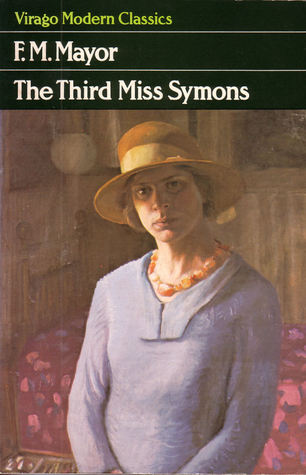
The Third Miss Symons – FM Mayor (1913, 144 pages)

FM Mayor tells the life story of Henrietta (Etta) Symons, from birth to death at the latter part of the nineteenth century. Despite doing this in such a short space, she manages an in-depth portrait of an unappealing woman.

“At five her life obtained its zenith. She became a very pretty, charming little girl […] When she was eight her zenith was past, and her plain stage began.  Her charm departed never to return.”

Her charm departs and what is left is a grumpy woman, ordinary and without any redeeming talents or qualities. FM Mayor is compassionate towards Etta, but clear-sighted and unsentimental.

“This was the problem: Why was it that people did not love her? – she to whom love was so much that if she did not have it, nothing else in the world was worth having.”

It’s certainly true that Henrietta is treated unfairly by people and experiences injustice, but it is also clear that if only she could be a little more pleasant to people, her life would be vastly improved. The Third Miss Symons is most definitely an example that you get back what you put out in life, and what Henrietta gets back is distance and indifference at best.

“She would have been astonished if she had known what an infinitesimal difference she made to their lives”

Yet it is not a depressing tale, although it certainly veers towards it at times. For a start, Mayor has taken a woman so easily disregarded in art, literature and society and given Henrietta her own story. She is the waspish spinster, the homemaker (for her parents and brothers), unmarried, childless, failure even in her attempts to do charitable good works. For centuries the judgement from society has been that such women have no value. Yet Mayor, in her concentration on Henrietta, insists that her value is recognised, and that there is acknowledgement of the society and culture that has contributed towards Henrietta’s frustrations.

“throughout her fairly long, dull life Henrietta was always cursed with her tidy little income.”

“Bad health is another resource for unoccupied women, and it certainly occurred to her as an occupation, but she realised that it and roving cannot be combined, and of the two she preferred roving.”

Henrietta can only really concentrate on her misery. If only she had a vocation, she would be different and her life would be different. But Mayor will not let Henrietta or the reader off so easy. Henrietta will remain unfulfilled.

“She was not one of those women whom nothing will satisfy but marriage; on the whole she did not care very much for men. She wanted what she had always wanted, something to love and something to love her.”

I couldn’t help thinking she should have become a dog breeder.

Mayor is entirely non-didactic and the portrait of Henrietta is unblinking, but the sadness is rescued from harshness by a good dose of humour.

“When in doubt, go abroad. She went abroad again for three months. Her companion was picked up from nowhere in particular, an odd woman like herself. They went to Italy. Neither of them cared in the smallest degree for sculpture, architecture, painting, archaeology, poetry, history, politics, scenery, language or foreigners.”

The Third Miss Symons is a compassionate, wise novel, psychologically astute and ultimately very moving. If you’d like to spend some time with grumpy, intractable Henrietta, and I highly recommend you do, you can read the novel at Project Gutenberg here.

Novella a Day in May #4

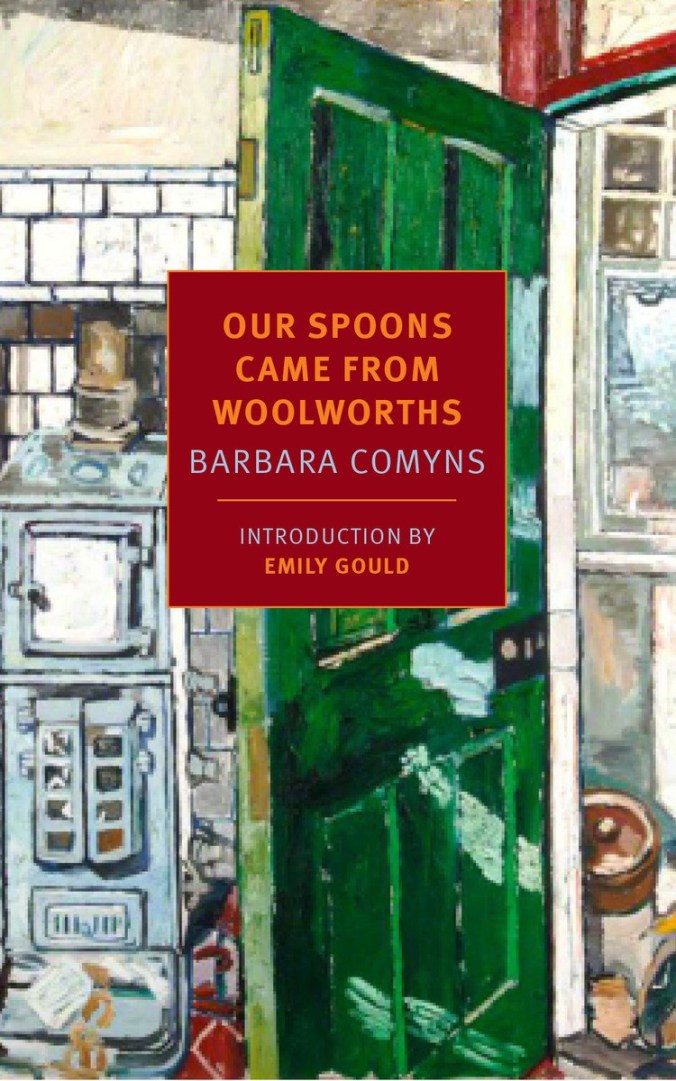
Our Spoons Came From Woolworths – Barbara Comyns (1950, 195 pages)

Our Spoons Came From Woolworths is the first Barbara Comyns I’ve read, attracted by the whimsical title and it being a Virago. I’m so glad I picked this up. Our Spoons Came From Woolworths was a compelling read, and not nearly as whimsical as I had assumed.

our_spoons_cover_image_2048x2048

The NYRB edition

It tells the story of Sophia’s marriage at a young age to Charles, an artist, in the 1930s. They are painfully naïve, and Charles especially has no idea about money:

“He said Eva had told all her relations about the coming baby, and they had asked him masses of questions about how he was going to support a wife and family. They had given him some money, though, four pounds in all. I was glad to hear this as we only had one golden guinea left in the dresser drawer, but my gladness did not last long, because it turned out he had already spent the money on some paints, brushes, books and an enormous walnut cake from Fullers.”

With the arrival of the baby, the poverty becomes even more pressing. Charles is monumentally selfish and self-absorbed, but not quite despicable. He’s just clueless and self-centred, and this means his actions are inadvertently cruel.  Although the situation is quite desperate, Comyns’ voice is matter-of-fact and never asks for sympathy.  There is a light, almost surreal humour present:

“Charles said he had borrowed some money to send telegrams to his relations saying we had a boy of six ounces. I told him it was six pounds not ounces, but he said a few pounds either way wouldn’t make any difference. But Charles’ telegrams caused a huge sensation, and his family was most disappointed when in due course they discovered we had quite a normal baby.”

But the humour always highlights the bigger picture, such as Charles’ disregard and disinterest in his children. While Comyns is unsentimental, this does not mean she is unaware of the power of her story. She has plenty to say about the role of women in interwar Britain and the hypocrisies that meant they were expected to marry and then make the best of it, with little means of support beyond their husbands. She also shows how this is bound up in sexual politics, with male infidelity so much more accepted than female, yet women deserving an equal right to happiness:

“Some time later, when I realised I had been unfaithful, I didn’t feel guilty or sad, I just felt awfully happy I had had this experience, which if I had remained ‘a good wife’ I would have missed, although, of course, I wouldn’t have known what I was missing. I felt quite bewildered. I had …been a kind of virgin all the time. I wondered if there were other women like this, but I knew so few women intimately it was difficult to tell.”

The story is also an indirect plea for a welfare state. What Sophia and her children endure would not be life-threatening after the end of the Second World War, with a social safety net established to protect them from absolute destitution and starvation.

But I worry now I’ve made Our Spoons Came From Woolworths sound very heavy, which it isn’t. Comyns knows how to say serious things with a lightness of touch that is quite remarkable.  You’re not left in any doubt as to Sophia’s desperation, but it remains a hopeful novel about human resilience. It’s generally thought to be thinly-disguised biography (Comyns was married to the painter John Pemberton between 1931-5 and had two children with him) and Comyns makes her point about these types of stories – concerning women and poverty – desperately needing to be heard at a time when no-one really wanted to listen, in deadpan comic style:

“This book does not seem to be growing very large although I have got to Chapter Nine. I think this is partly because there isn’t any conversation. I could just fill pages like this:

‘I am sure it is true,’ said Phyllida.

‘I cannot agree with you,’ answered Norman.

‘Oh, but I know I am right,’ she replied.

‘I beg to differ,’ said Norman sternly. That is the kind of stuff that appears in real people’s books. I know this will never be a real book that business men in trains will read, the kind of business men that wear stiff hats with curly brims and little breathing holes in the side. I wish I knew more about words.”

Although I understand from other bloggers that Comyns’ other novels are very different, I am now officially an ardent fan.

Image from here