Novella a Day in May #29

It’s thanks to this mini-project that I finally read Eudora Welty, as I had two of her novellas in the TBR. I’m glad I did, as the latter of these two has definitely whetted my appetite for more of her work.

Eudora-Welty-1962

The Robber Bridegroom (1942, 185 pages)

I enjoyed this reworking of The Brothers Grimm tale which Welty sets in eighteenth century Mississippi. Clement Musgrove arrives back home:

“As his foot touched the shore, the sun sank into the river the colour of blood, and at once a wind sprang up and covered the sky with black, yellow, and green clouds the size of whales, which moved across the face of the moon.”

With this foreboding change in the weather, he finds himself sharing a room with real-life keelboater Mike Fink, and Jamie Lockhart, a gentleman robber. Lockhart saves Musgrove’s life, and so is invited back to his home, which he shares with his horrible wife, who predictably is wicked stepmother to the beautiful Rosamond. Rosamond isn’t perfect though:

“As for Rosamond, she did not mean to tell anything but the truth, but when she opened her mouth in answer to a question, the lies would simply fall out like diamonds and pearls.”

The tale unfolds along familiar lines, with theft, mistaken identity, illicit love and people thought to be dead when they’re not, all in the surrounds of a forest. While I thought The Robber Bridegroom was vividly told and entertaining, I wasn’t sure what Welty was really doing with the tale. Rosamond is given sexual agency which would be a departure for many fairytales; and it’s grounded in a historical reality which adds to the mythology around the Southern states pre-Civil War. It’s an interesting tale but I felt Welty could have done more with it, pushed it a bit further into something truly original but still grounded in fable.

“The only thing that could possibly keep her from being totally happy was that she had never seen her lover’s face. But then the heart cannot live without something to sorrow and be curious over.”

The Ponder Heart (1954, 132 pages)

This, however, I adored. It featured a truly idiosyncratic, distinctive narrator and was funny, unsettling and compulsively readable.

Edna Earle Ponder lives in Clay County, Mississippi, and is proud of being a Ponder and running the town hotel. She is telling the tale of her Uncle Daniel to a silent interlocutor.

“I don’t run the Beulah Hotel for nothing: I size people up: I’m sizing you up right now. People come here, pass through this book, in and out, over the years – and in the whole shooting-match, I don’t care from where or how far they’ve come, not one can hold a candle to Uncle Daniel for looks or manners. If he ever did thing to be sorry for, it’s more than he ever intended.”

Her Uncle Daniel dresses all in white and has a tendency to give away money. His father tries to get him committed; Daniel has a lovely time in the institution and his father ends up committed instead. Then there is an ill-fated marriage to the wonderfully monikered Teacake Magee.

“As for Uncle Daniel, he went right ahead, attracting love and friendship with the best will and the lightest heart in the world. He loved being happy! He loved happiness like I love tea.”

Teacake Magee proves impervious to Uncle Daniel’s charms after 2 months and they split up (we’re never quite sure why) and then Daniel marries Bonnie Dee without his family knowing.

“I wish you could have seen Bonnie Dee! I wish you could. I guess I’d known she was living, but I’d never given her a real good look. She was just now getting her breath. Baby yellow hair, downy – like one of those dandelion puffballs you can blow and tell the time by. And not a grain beneath. Now, Uncle Daniel may not have a whole lot of brains, but what’s there is Ponder, and no mistake about it. But poor little Bonnie Dee!”

And from this marriage the trouble starts. Welty builds her story expertly: you know something bad has happened, you don’t quite know what, by whom or to whom. As it is revealed, it is totally believable and an awful comic tragedy, told in the inimitable style of Edna Earle.

“I’m the go-between, that’s what I am, between my family and the world. I hardly ever get a word in for myself.”

She’s vain and arrogant about her position as a Ponder; she looks down on people and is racist; she’s appalling in lots of ways but Edna Earle spins a good yarn.

“What Uncle Daniel did was just bestow his [love] all around quick – men, women and children. Love! There’s always somebody wants it. Uncle Daniel knew that. He’s smart in way you aren’t, child.”

I was truly sorry to leave The Ponder Heart behind.

Novella a Day in May #27

Today I’m looking at two novellas by Willa Cather, which were my first encounters with this legendary author of frontier life.

Willa_Cather_ca._1912_wearing_necklace_from_Sarah_Orne_Jewett

Alexander’s Bridge (1912, 176 pages) was Willa Cather’s first novel, although she was already an established journalist, poet and short story writer.  Apparently she didn’t think much of this first attempt at long-form prose, but I thought it had much to recommend it.

Bartley Alexander is an engineer who, it will surprise you to learn, builds bridges.  He has a huge project happening in Canada, but it is when he is London on business that he runs into an old flame, Hilda. Although he is married, an affair begins. The focus is not the romance or betrayal, but rather Alexander’s futile attempt to recapture his youth that is the focus of Cather’s writing:

“Solitude, but not solitariness; for he walked shoulder to shoulder with a shadowy companion – not little Hilda Burgoyne, by any means, but someone vastly dearer to him than she had ever been – his own young self, the youth who had waited for him upon the steps of the British Museum that night, and who, though he had tried to pass so quietly, had known him and came down and linked an arm in his.

It was not until long afterwards that Alexander learned that for him this youth was the most dangerous of companions.”

I think had I known what this was about, I would have been put-off reading it. A deceitful man having a mid-life crisis is not a subject matter that I have a great deal of patience with. What engaged me was Cather’s beautiful writing and her psychological insight.  She also managed to bring an impressive depth to the story considering its short length.  Overall I was left with a sense of the sadness of lives wasted in a search for meaning when not knowing where to look.

“Something had broken loose in him of which he knew nothing except that it was sullen and powerful, and that it wrung and tortured him. Sometimes it came upon him softly, in enervating reveries. Sometimes it battered him like the canon rolling in the hold of the vessel. Always, now, it brought with it a sense of quickened life, of stimulating danger.”

I suspect if you’ve read some of Cather’s  classic work such as My Antonia or O, Pioneers! you might find this a disappointment. However, it left me eager to read more of her work to see how she developed into a writer so greatly loved.


A Lost Lady (1923, 178 pages) was where I went next. It tells the story of the beautiful Marian Forrester, a rich (at first) young woman married to the older Captain Forrester, living in the West in a town called Sweet Water:

“She never stopped to pin up a lock; she was attractive in dishabille and she knew it. She had been known to rush to the door in her dressing-gown, brush in her hand and her long black hair rippling over her shoulders, to welcome Cyrus Dalzell, president of the Colorado & Utah, and the great man had never felt more flattered. In his eyes, and in the eyes of the admiring middle-aged men who visited there, whatever Mrs Forrester chose to do was lady-like, because she did it.”

However, following crop failures, the town starts to go downhill. It is close to the Transcontinental railroad, but the trains start passing through. Captain Forrester has a lot of money sunk into the railroad and an idealised view of this capitalism:

“All our great West has been developed from such dreams; the homesteaders and the prospectors and the contractors. We dreamed the railroads across the mountains”

Niel Herbert, from whose viewpoint the story is mainly told (although it remains in third person) has a different view of these dreamers:

“The Old West had been settled by dreamers, great-hearted adventurers who were unpractical to the point of magnificence, a courteous brotherhood, strong in attack but weak in defence, who could conquer but could not hold. Now all the territory they had won was to be at the mercy of men like Ivy Peters, who had never dared anything, never risked anything… The space, the colour, the princely carelessness of the pioneer they would destroy and cut up into profitable bits, as the match factor splinters the primeval forest.”

Ivy Peters represents the move to a capitalist industrial economy and he is truly despicable. At the start of the story he is a young boy too, slightly older than Niel, and he commits an act of vindictive cruelty on a bird; it truly made me feel sick. As an adult he sexually blackmails Mrs Forrester. Niel witnesses this as he witnessed Marian’s affair with a man named Ellinger. The feeling this raises in Niel are complicated; he does not quite have a crush on the woman, it’s more that he idealises her as a representation of the pioneer spirit, and so when he feels she is debased, he is angry that she has let down this broader ideal.

“It was not a moral scruple she had outraged but an aesthetic ideal”

The presentation of Marian Forrester is intriguing. Her beauty mesmerises people and places her in the more elite society, but Cather shows that she is a woman of flesh and blood, with both sexual desires and a desire to live. She will do what it takes.

This meant that while I could not embrace the romanticised notion of the pioneer (I think we now know enough of what happened to First Nations Peoples during the period for any romanticism to have well and truly died –briefly touched upon in this story) I thought there was a great deal of interest around the role of women. Marian is a lost ‘lady’ but she is a woman who knows herself and knows that as a woman in this period she does not have the freedom or choices of men. They will use her, but she is not a victim, although she self-medicates with alcohol at times. She endures, and so as a representation of the west, and pioneer spirit, I think Cather chooses to personify how times change and are lost forever, but the only choice is to keep on.

 “It was what he most held against Mrs Forrester, that she was not willing to immolate herself, like the widow of all these great men, and die with the pioneer period to which she belonged; that she preferred life on any terms.”

It’s a bittersweet novella, and Cather packs huge themes into a small space. Truly impressive.

Novella a Day in May #26

Less than a week left of Novella a Day in May and I’m feeling quite giddy 😀 So much so that I’m upping my game for the last few days and looking at authors who seemed to favour the novella as they wrote more than one. Today: Nell Dunn.

Nell Dunn came from an aristocratic family, somewhat incongruously as the two novellas I’m going to look at portray working-class life. But Dunn wasn’t a class tourist; she left school at 14, moved to Battersea (now an expensive area of London capturing the overspill from the highly salubrious Chelsea, but in the 1960s before the slum clearances it was fairly dilapidated) and worked in a factory. Her writing always seems absolutely authentic.

Up the Junction (1963, 133 pages) is a series of sketches of life in 1960s south London for three young women, Lily, Sylvie and Rube, living in an area filled with the workers of the local factories.

“The sweet smell of cow-cake from Garton’s blows up the road with the violet smoke from the Power Station…Sylvie and I walk up the summer evening road to the Prodigal. An old lady in slippers comes out of the off licence with a zip bag weighing her sideways. From open windows the tellys call.”


1280px-Battersea_Power_Station_(6902827902)

Life is hard for these women, but it is also vibrant, eventful, and energetic. Dunn has an unflinching eye (there is a horrible episode detailing an illegal abortion) but she has affection for the people she portrays and although there is no sentimentality in her writing, there is sensitivity:

 “Ada opens the door crying: her little brother had burnt all her clothes. ‘He set fire to the pram where I keeps them…’ …In Ada’s room the floor is covered in clean newspaper…In the middle of it all stands the smouldering pram. Out in the passage ten pigeons fly about. ‘Aren’t they beauties? Aren’t they darlings?’ says her dad. ‘I have to keep the windows sealed in case one escapes.’”

Dunn effectively captures the voices of the area, humour sitting alongside poverty and desperation:

 “ ‘So I went along to tell his daughter. ‘He’s just dropped dead!’ Of course I didn’t tell her about the bacon puddin’. ‘What have you done with his clothes?’ she says. ‘You’re not havin’ them,’ I says, ‘what about me rent?’ So I takes them round to the rag man and I got twelve shillings and I buys meself a quarter of whisky and a packet of fags…I had a drop of whisky what me brother gave me last night and I meant to save the rest for Christmas and then I thought well I mightn’t be here for Christmas…’

Up the Junction is a fascinating insight into a life that in many ways has passed: the swinging sixties, the dominance of factory work, women seeking emancipation before the arrival of the Pill. At the same time it still has plenty to say about power relations on small and large scales and about human resilience. As a voice of working class women, it is unfortunately still a voice which remains rarely heard.

Up the Junction was adapted for TV in 1965 by Ken Loach (which you can see in its entirety on YouTube) and into a film in 1968. It also inspired this 1979 song by Squeeze:

Unlike Up the Junction, Poor Cow (1967, 141 pages) has an overarching narrative to it, detailing Joy’s attempts to survive as a young single mother when her criminal partners are in jail. The story begins with Joy going out for something to eat in her maternity gown, because her husband forgot to bring any of her clothes to the hospital [contains swearing]:

“Outside in the street a young woman passed pushing a pram, a fag hanging from her lip. ‘Now I look like that.’ She ate the dark brown cottage pie, mixing the mash in with her fork, a great relieving warmth filled her stomach and the sweet tea lifted her spirits. Above her head an ad with a lot of golden girls in bathing suits read COME ALIVE. YOU’RE IN THE PEPSI GENERATION.

‘Fuck that,’ she said as the snow fluttered thoughtlessly against the window pane. She put a penny in the Fortune Teller DON’T REGRET. TRY AGAIN.”

Joy’s life isn’t easy, but she doesn’t seem ground down by it. She gets on with what needs to be done and loves her son Jonny, even though she’s not happy with her husband, Tom.

“He didn’t really want to be happy, or be married like we was. He always wanted more out of life than what he had.”

When Tom’s sent to prison, Joy finds happiness with his friend Dave. However, Dave is also a burglar, and so their happiness is short-lived.

 “Joy was back in Fulham. She’d moved in with her Auntie Emm, who lived in one room, off the National Assistance, and pills.”

In Fulham she gets a job in a bar, and this leads to soft-porn modelling. Joy doesn’t feel degraded by this and refuses to follow a friend into prostitution (sort of…), but she does end up sleeping with quite a few men, discovering that she enjoys sex. I was surprised at how much sex there is in Poor Cow. It’s not detailed but it is referred to and I’d be interested to know if this was scandalous in 1967 or seen as just part of Swinging London?

Joy’s an interesting woman, who doesn’t really know what she wants. Part of her would like a settled life, another part of her acknowledges that all her bad choices were consciously made and perhaps more truly what she desired:

“I’d just like to be secure. You know, something out of life that everybody else’s got. When I’m walking down the road I see people happy, I want that, but when I come to think of it I can have it one day and I may not want it.”

Poor Cow somehow isn’t as depressing as it should be, despite the rather bleak existence of Joy and the nihilism of her lifestyle:

“that night Joy lay entangled in Dave’s arms and thought ‘Even if it’s only for six months that might be six months of happiness and anyway it’s six months of life got through.”

The narrative is mixed, switching between third-person, first-person and Joy’s letters to Dave. This works well, capturing the fragmentary nature of Joy’s life and her conflicted personality.

“ ‘I’ve got a lot to give up,’ thought Joy. She looked round the room. ‘At the same time I haven’t got a lot to give up.’”

Poor Cow shows all the conflict, confusion, freedom, constraint, joy and drudgery for a young woman at a point where a particular society is going through considerable change. It’s neither wholly happy or sad, but it felt wholly real.

Like Up the Junction, Poor Cow was also adapted into a film by Ken Loach, the same year it was published:

Novella a Day in May #21

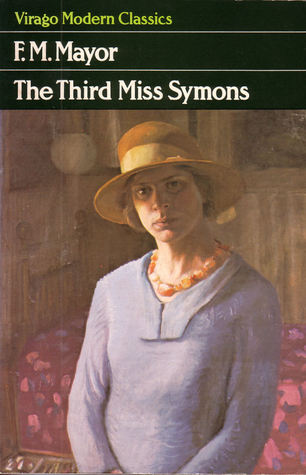
The Third Miss Symons – FM Mayor (1913, 144 pages)

FM Mayor tells the life story of Henrietta (Etta) Symons, from birth to death at the latter part of the nineteenth century. Despite doing this in such a short space, she manages an in-depth portrait of an unappealing woman.

“At five her life obtained its zenith. She became a very pretty, charming little girl […] When she was eight her zenith was past, and her plain stage began.  Her charm departed never to return.”

Her charm departs and what is left is a grumpy woman, ordinary and without any redeeming talents or qualities. FM Mayor is compassionate towards Etta, but clear-sighted and unsentimental.

“This was the problem: Why was it that people did not love her? – she to whom love was so much that if she did not have it, nothing else in the world was worth having.”

It’s certainly true that Henrietta is treated unfairly by people and experiences injustice, but it is also clear that if only she could be a little more pleasant to people, her life would be vastly improved. The Third Miss Symons is most definitely an example that you get back what you put out in life, and what Henrietta gets back is distance and indifference at best.

“She would have been astonished if she had known what an infinitesimal difference she made to their lives”

Yet it is not a depressing tale, although it certainly veers towards it at times. For a start, Mayor has taken a woman so easily disregarded in art, literature and society and given Henrietta her own story. She is the waspish spinster, the homemaker (for her parents and brothers), unmarried, childless, failure even in her attempts to do charitable good works. For centuries the judgement from society has been that such women have no value. Yet Mayor, in her concentration on Henrietta, insists that her value is recognised, and that there is acknowledgement of the society and culture that has contributed towards Henrietta’s frustrations.

“throughout her fairly long, dull life Henrietta was always cursed with her tidy little income.”

“Bad health is another resource for unoccupied women, and it certainly occurred to her as an occupation, but she realised that it and roving cannot be combined, and of the two she preferred roving.”

Henrietta can only really concentrate on her misery. If only she had a vocation, she would be different and her life would be different. But Mayor will not let Henrietta or the reader off so easy. Henrietta will remain unfulfilled.

“She was not one of those women whom nothing will satisfy but marriage; on the whole she did not care very much for men. She wanted what she had always wanted, something to love and something to love her.”

I couldn’t help thinking she should have become a dog breeder.

Mayor is entirely non-didactic and the portrait of Henrietta is unblinking, but the sadness is rescued from harshness by a good dose of humour.

“When in doubt, go abroad. She went abroad again for three months. Her companion was picked up from nowhere in particular, an odd woman like herself. They went to Italy. Neither of them cared in the smallest degree for sculpture, architecture, painting, archaeology, poetry, history, politics, scenery, language or foreigners.”

The Third Miss Symons is a compassionate, wise novel, psychologically astute and ultimately very moving. If you’d like to spend some time with grumpy, intractable Henrietta, and I highly recommend you do, you can read the novel at Project Gutenberg here.

Novella a Day in May #4

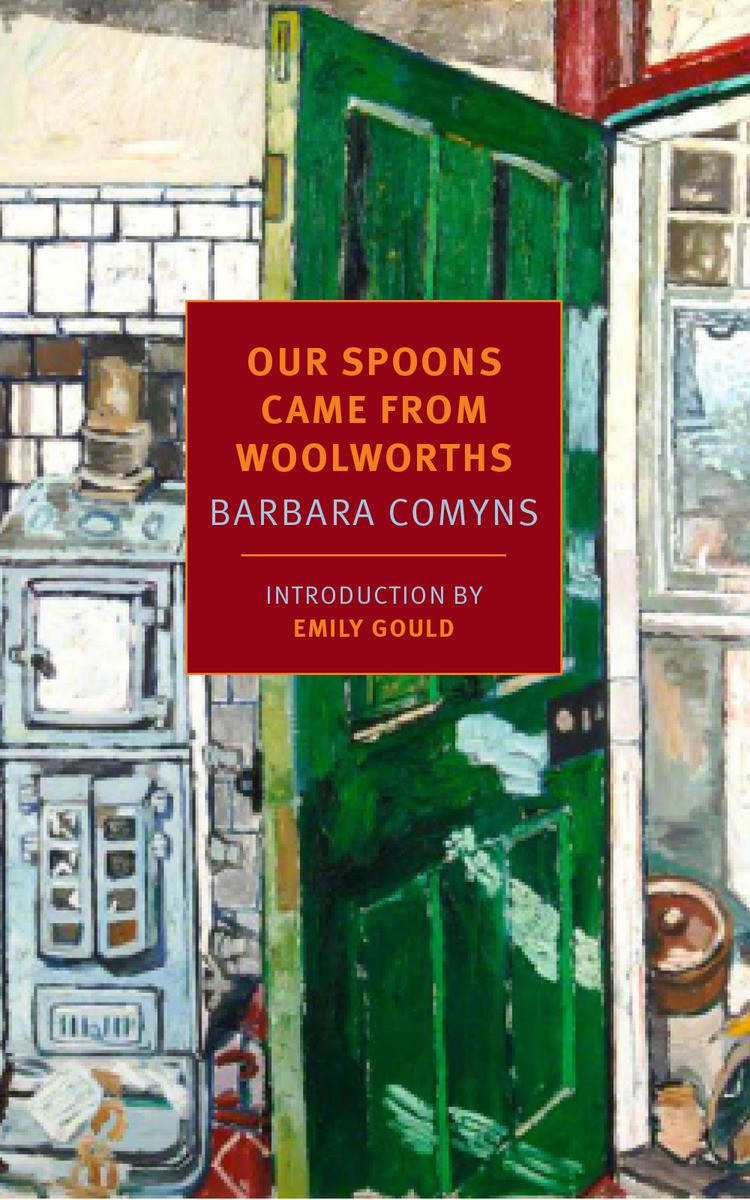
Our Spoons Came From Woolworths – Barbara Comyns (1950, 195 pages)

Our Spoons Came From Woolworths is the first Barbara Comyns I’ve read, attracted by the whimsical title and it being a Virago. I’m so glad I picked this up. Our Spoons Came From Woolworths was a compelling read, and not nearly as whimsical as I had assumed.

our_spoons_cover_image_2048x2048

The NYRB edition

It tells the story of Sophia’s marriage at a young age to Charles, an artist, in the 1930s. They are painfully naïve, and Charles especially has no idea about money:

“He said Eva had told all her relations about the coming baby, and they had asked him masses of questions about how he was going to support a wife and family. They had given him some money, though, four pounds in all. I was glad to hear this as we only had one golden guinea left in the dresser drawer, but my gladness did not last long, because it turned out he had already spent the money on some paints, brushes, books and an enormous walnut cake from Fullers.”

With the arrival of the baby, the poverty becomes even more pressing. Charles is monumentally selfish and self-absorbed, but not quite despicable. He’s just clueless and self-centred, and this means his actions are inadvertently cruel.  Although the situation is quite desperate, Comyns’ voice is matter-of-fact and never asks for sympathy.  There is a light, almost surreal humour present:

“Charles said he had borrowed some money to send telegrams to his relations saying we had a boy of six ounces. I told him it was six pounds not ounces, but he said a few pounds either way wouldn’t make any difference. But Charles’ telegrams caused a huge sensation, and his family was most disappointed when in due course they discovered we had quite a normal baby.”

But the humour always highlights the bigger picture, such as Charles’ disregard and disinterest in his children. While Comyns is unsentimental, this does not mean she is unaware of the power of her story. She has plenty to say about the role of women in interwar Britain and the hypocrisies that meant they were expected to marry and then make the best of it, with little means of support beyond their husbands. She also shows how this is bound up in sexual politics, with male infidelity so much more accepted than female, yet women deserving an equal right to happiness:

“Some time later, when I realised I had been unfaithful, I didn’t feel guilty or sad, I just felt awfully happy I had had this experience, which if I had remained ‘a good wife’ I would have missed, although, of course, I wouldn’t have known what I was missing. I felt quite bewildered. I had …been a kind of virgin all the time. I wondered if there were other women like this, but I knew so few women intimately it was difficult to tell.”

The story is also an indirect plea for a welfare state. What Sophia and her children endure would not be life-threatening after the end of the Second World War, with a social safety net established to protect them from absolute destitution and starvation.

But I worry now I’ve made Our Spoons Came From Woolworths sound very heavy, which it isn’t. Comyns knows how to say serious things with a lightness of touch that is quite remarkable.  You’re not left in any doubt as to Sophia’s desperation, but it remains a hopeful novel about human resilience. It’s generally thought to be thinly-disguised biography (Comyns was married to the painter John Pemberton between 1931-5 and had two children with him) and Comyns makes her point about these types of stories – concerning women and poverty – desperately needing to be heard at a time when no-one really wanted to listen, in deadpan comic style:

“This book does not seem to be growing very large although I have got to Chapter Nine. I think this is partly because there isn’t any conversation. I could just fill pages like this:

‘I am sure it is true,’ said Phyllida.

‘I cannot agree with you,’ answered Norman.

‘Oh, but I know I am right,’ she replied.

‘I beg to differ,’ said Norman sternly. That is the kind of stuff that appears in real people’s books. I know this will never be a real book that business men in trains will read, the kind of business men that wear stiff hats with curly brims and little breathing holes in the side. I wish I knew more about words.”

Although I understand from other bloggers that Comyns’ other novels are very different, I am now officially an ardent fan.

Image from here

Novella a Day in May #2

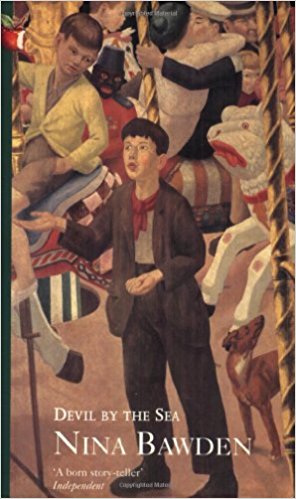
Devil by the Sea – Nina Bawden (1976, 192 pages)

When I was a child I loved Nina Bawden’s books, particularly The Peppermint Pig and Carrie’s War, which a read and re-read. For some reason though, I never picked up her novels for adults. Ali has been championing her writing over on her blog Heavenali, and this prompted me to dig Devil by the Sea out of the Virago TBR (yes, the TBR is so humungous now there are TBR sub-piles) and give it a read.

I’m happy to say that Bawden is just as wonderful writing for adults as she is for children. This creepy, tightly plotted tale is a compulsive read with plenty to say about human relationships – particularly those between adults and children – and the nature of feeling Other. It begins:

“The first time the children saw the Devil, he was sitting next to them in the second row of deckchairs in the bandstand. He was biting his nails.”

The children are Hilary and Peregrine. They are not happy, carefree children; Bawden would never be that patronising in her portrayal of young people. Instead, Hilary is jealous and angry, and can be petty. Peregrine is religious and anxious. They live in a seaside town all year round and it is holiday season. Their half-sister is having an affair with a vain married man who does not love her. Their father and step-mother are under-involved in the children’s lives. Their Auntie beachcombs and keeps the rotting fish she finds. Into all this comes a man they believe is the devil.

“The man turned and looked at them. A shadow crossed his face: like an animal, he seemed to shrink and cringe before the mockery Hilary had made of him […] He continued to watch her with a steady, careful stare. She fumbled in the pocket of her cotton dress. Her voice croaked with embarrassment.

‘Would you like a toffee?’

The man looked beyond her to Peregrine. Briefly, their eyes met. Peregrine could not look away, he was transfixed. The man’s eyes were dark and dull, dead eyes without any shine in them. They reflected nothing.”

A child with the unfortunate moniker of Poppet goes missing, and Hilary saw the man lead her away.

“Poppet’s picture was in the middle of the front page and Hilary looked at it with interest….She read the first few lines beneath the picture and a dark veil came down over her eyes. Her heart beat wildly in her throat. Something cold and evil menaced her from the shadowed corners and for a while she crouched quite still, as if afraid to wake a sleeping beast.”

The fact that this evidence is not easily voiced for the situation resolved is due to the misunderstanding and myth-making of children; the obliviousness and myopia of adults; the fear of everyone.

Despite being a gothic tale in many ways, Devil by the Sea is wholly believable. This is not least because Bawden is not interested in making her characters likable, but rather real, complex, flawed and fascinating. It is creepy and captivating and deeply unsettling. On the strength of this, I will definitely be reading more of Bawden’s adult fiction, not least because I was lucky enough to win The Birds on the Trees in Ali’s giveaway last year 🙂

“We’ll have to put a stop to this bookworming. No future in that.” (Molly Keane, Good Behaviour)

This is my final contribution to Reading Ireland Month 2018, hosted by Cathy at 746 Books and Raging Fluff. Do check out the posts from the month, it’s been great 😊

I had 2 Molly Keane novels in my substantial TBR, so this seemed a perfect opportunity to get to know an author so many seem to enjoy. I began with her first novel, the wonderfully titled The Knight of Cheerful Countenance (1926). Unbelievably, she wrote this at the age of 17 to supplement her dress allowance (!) and chose the pseudonym MJ Farrell to hide what she was doing from her friends, who were all huntin’ shootin’ fishin’ types. Molly Keane wrote the introduction to my Virago edition and it’s well worth a read, to hear tales of friends with uncles called Major Hyacinth Devereaux and the butler shrouding the parrot before morning prayers. I’d love to know if she ever met the Mitfords.

mw74333

Image from here

The plot of The Knight of Cheerful Countenance is slight: Allan comes to visit his Irish cousins, falls in love with one who loves another, while his other cousin falls in love with him. It’s full of horses and slightly less full of bloodsports, thankfully. There were about 2 passages I skipped because I just really don’t want to read about such things. And yet despite these unpromising qualities, I thoroughly enjoyed the novel.

In her introduction Keane fully acknowledges that the incredibly privileged, oblivious existence of her childhood and young adulthood is gone forever. The novel makes passing reference to the political situation of the time, but Allan and his cousins Ann and Sybil are walled up on an estate away from it all:

“Deeds of unbelievable foulness and treachery were still – judging by the newspapers – of almost daily occurrence in the land, but they seemed to leave untouched the district of Bungarvin. Yet wrecked police barracks and courthouses, country houses standing empty, and the charred walls of what had once been country houses, all went to show how little of a myth was the state of civil war in Ireland.”

As the title suggests, the novel is a romance and there is most certainly an escapist quality to it (the first publishers were Mills & Boon, although I think they published a wider range then than they do now).

“Dennys St Lawrence presented as good a picture of young manhood as one could wish to see on any glorious summer morning. With his bare dark head and his grey eyes, his handsome horse, and his easy seat in the saddle, he belonged to this Irish morning with complete entirety.”

This isn’t straight romance though. Keane views the events and the people with a fond, humorous eye:

“Silence, however, never reigned for long when Allan was anywhere about.

‘Jolly little successful what-not, what?’ he observed affably, by way of starting the conversation.”

The Knight of Cheerful Countenance is a short novel (272 pages) and so it doesn’t flag, and I would never have guessed it was written by a 17 year old. It’s not the most accomplished piece, but it’s not juvenilia either. I don’t really feel I’ve done it justice here. It’s very readable and good fun, and it certainly made me want to read more by Molly Keane.

Which is exactly what I did. Loving Without Tears (1951) was Keane’s tenth novel and she was also a successful dramatist by this time, so it is a much more sophisticated novel than her first. It is much darker than The Knight of Cheerful Countenance, centring around a wholly manipulative matriarch, the inappropriately monikered Angel, who bends her children, niece and faithful retainers to her will.

“Each worshipped her and each lamp should have its due portion of oil to feed that flame of worship, and from each she would obtain the maximum of that slave labour which is the expression of such a love.”

She is an absolute tyrant, all the more despicable because her tyranny is couched in expressions of maternal love and concern. But things are about to change. Her son Julian has returned from the war with a fiancée who is (shock!) American, and a woman of the world. She sees through Angel and will not be manipulated, unlike Angel’s daughter Slaney, who is oblivious to her mother trying to split her up from the man she loves:

“As a gardener tends nectarines, so did Angel minister anxiously to skin and hair and health of body. As well, she disciplined the beautiful body towards an excellence in the sports best calculated for its exhibition – a garlanded, shampooed young heifer, her looks a miracle, her thoughts unknown, Angel led her daughter by a ribbon towards the supreme sacrifice and glory of the right marriage.”

There’s also a niece, Tiddley, who Angel abuses despicably, bribing her to help with her plans to disrupt her children’s lives. The nanny Birdie, sees things as they are:

 “the love she’s pinching out from each of us, same as I’d disbud a rose”

Yet the brilliance of Keane’s writing means that while I desperately wanted everyone to wake-up to what Angel was up to, and for her to get her comeuppance, I didn’t want her punished too badly. Loving Without Tears is an astute psychological study of a woman who behaves appallingly, but it is done without heavy judgement and you are left to fill in some gaps as to why Angel behaves as she does. To some extent it is a comedy of manners; if only everyone can cast aside convention and have an honest conversation, everything will work out. So it is funny, but with a cynical undertone running through it which stops it being fluffy. I enjoyed watching it all play out pretty much as I expected (not a criticism, I enjoy Austen for the same reason) and the ending was entirely satisfying.

To end, a song about another famous Irish Molly:

“Live fully, live passionately, live disastrously. Let’s live, you and I, as none have ever lived before.” (Violet Trefusis to Vita Sackville-West, 1918)

Happy Valentine’s Day! And for those who are single (such as myself), console yourself that we don’t have to go to an overpriced, overcrowded restaurant to have our meal interrupted by tired-looking pushers of sad hothouse roses in buckets whilst couples around us try and hide their mutual disdain for one another as their relationships teeter on the brink of collapse under the pressure of meeting the impossible standards of commercially appropriated romantic love 😉

As I said, Happy Valentine’s Day everyone!

*fans self*

For Valentine’s Day I thought I’d look at two novels concerned with romantic love. A brief foray through my TBR and I struggled to find anything that showed it in a positive light, which says much about my reading tastes. I quickly abandoned that idea and instead I’ve picked 2 novels written by a famous couple, Violet Trefusis and Vita Sackville-West. They met when Violet was ten and Vita was twelve; four years later Violet confessed her love, but life events separated them. They both went on to marry men but continued their relationship, although they did eventually split up. They stayed in touch and remained warm towards each other. Violet is ‘Sasha’ in Orlando, Woolf’s love letter to Vita.


Firstly, Hunt the Slipper by Violet Trefusis (1937).

Nigel lives with his sensible horticulturist sister Molly in their lovely home in Bath. He likes the finer things in life and prides himself on his good taste. Trying to get out of a visit to meet Caroline, the new wife of a neighbour, he gives Molly the following reason regarding Caroline’s family:

“You can’t imagine what they’ve done to their Elizabethan home. I once lunched there years ago; it looked as if Christabel Pankhurst and d’Annunzio had set up house together. Tea-cups and tracts battled for supremacy with peacocks feathers and leopard skins. It was so alarming that I fled.”

However, he goes, and the meeting is not a success. Caroline is miserable in her marriage to Anthony, a man who:

“never tired of dressing her up in the family jewels, of draping her in old-fashioned stuffs. She was his favourite recreation, his most valued asset. He did not particularly care about women, except as part of a decorative scheme.”

She is offhand to Nigel, who is used to women falling for his middle-aged charms, and he is distinctly unimpressed.  However, when they meet in Paris, Caroline has changed. She is in love with someone nearer her own age, Melo. Her taste in men is pretty questionable:

“Melo was a martyr to snobbishness, as a nursemaid is martyr to corns. Apart from physical attraction, Caroline led to the Royal Enclosure, stalking in Scotland, Noel Coward first-nights. In short, to the negligently luxurious life of the British aristocracy.”

Needless to say, this cad breaks her heart, and she turns to Nigel for solace. At this point he falls in love with her, but Caroline remains indifferent.

“He did not suspect that by one of Love’s infallible ricochets she was behaving to him as Melo had behaved to her. Her cruelty was Melo’s legacy, her indifference to him was out of revenge for Melo’s indifference to her. Love passed from one to the other, furtive, unseizable, like the slipper in ‘Hunt the Slipper.’”

There follows a period whereby they both travel, narrowly missing each other in various European destinations, Nigel writing effusive, desperate letters and Caroline sending intermittent, controlled replies. However, slowly, Caroline’s feeling change.

“You’re a terrible hoarder, aren’t you? Is possessiveness quite the same thing as jealousy, I wonder? Funny I should have fallen prey to two ‘collectors’. A[nthony] respects his possessions, whereas you love and tyrannize yours.”

Hunt the Slipper is a slim novel (180 pages) and the short length works well – Caroline and Nigel are both quite selfish. I didn’t wholly dislike them, but nor did I have a great deal of sympathy for them beyond that of realising we’re all flawed human beings and we all need love. Also the hunting of the slipper – love being always just out of reach – could have got tedious but as it is the plotting remains tight. Hunt the Slipper is a witty, sparky novel which gently mocks British insularity, snobbery in all forms, and self-delusion. Trefusis doesn’t judge her characters harshly and so neither do we. She dramatizes in the most ordinary way the conflicts of a cosy routine life against one of passion and unpredictability and doesn’t offer any trite answers as to which will bring most happiness.

Secondly, Family History by Vita Sackville-West (1932).

Beautiful widow Evelyn Jarrold lives an undemanding life, financially well-off with her own flat in London and her son heir to her late husband’s industrial family fortune.

“Evelyn Jarrold was not a woman who questioned the established order of the civilised world. She was not stupid, but, in such matters, simply acquiescent.”

However, she meets Miles Vane-Merrick – also rich, part of the landowning classes, but (shock!) left-leaning – and he turns everything upside down.

“The total absence of ideas amongst the younger Jarrolds, their perpetual heavy banter which passed for wit, the limitations of their interests, their intolerance, their narrow-mindedness, all appeared insufferable to her now in contrast with Miles’ alertness and gaiety.”

He is fifteen years younger than she, and Sackville-West uses their passionate affair to highlight the enormous changes happening in interwar Britain. Evelyn is only 39 but compared to 25 year old Miles she is from a different era. Her friends dress for dinner, the women don’t work, the men snooze through Lords debates before supporting the Tories. Miles and his friends are concerned with new world order, welfare of workers, the women earn money and they talk late into the night.

“Would she ever turn round on the whole of her acquaintance, and in a moment of harshness send them all packing? She knew that the necessary harshness lurked somewhere within her; in fact, she was rather frightened of it.”

The difficulty is, then what would she do? Evelyn is jealous and possessive, but this may not just be temperament, it may be because she has little else to occupy her mind. Miles carries on at his work (politics, running his estate, writing his book) and loves her around this. She does nothing but wait for him to find time for her.

“Love and the woman were insufficient for an active mind, Love and the man, however, were all-too-sufficient for a starved heart and unoccupied mind, Miles learnt it, to his cost; Evelyn never learnt it, to hers.”

Sackville-West does not shy away from the weakness in her characters. Evelyn can be controlling, vain, and overly concerned regarding middle-class mores. While Miles may protest “Instinct makes me reactionary, reason makes me progressive.”, the fact that he’s also given to statements such as “I like women to be idle and decorative.” means he’s not that progressive. He’s self-centred and doesn’t ever seem to take an action that doesn’t suit him entirely. Despite the fact that people constantly refer to him as brilliant and the great hope for the country, I found him weak. One of Evelyn’s relatives is pithily described by Sackville-West thus:

 “She had not preserved her virginity for forty-five years without revealing the fact in every phrase and gesture. A practising Christian, she was packed with a virtuous complaisance and not one ounce of charity.”

However, by the time Miles announces that the best thing that could happen to this woman was for her to be raped, he’d lost me entirely.  Misogynistic pig.

So it says something for Sackville-West’s writing that the fact that I really couldn’t stand one of the characters did not put me off the novel at all. Family History is an intriguing way to explore and make personal the upheavals of the first part of the twentieth-century in Britain. Apparently it didn’t do well on release and was considered one of her lesser works, but I found it thought-provoking and entertaining. The ending genuinely moved me. But most of all, Sackville-West’s wit is an absolute delight. For this reason, I’ll finish with a few choice bon mots:

[On the British upper classes] “The standard of looks was amazing; they had the distinction and beauty of thoroughbred animals. The young men were as elegant as greyhounds, the young women coloured as a herbaceous border. What did it matter […]that those sleek heads contained no more brains than a greyhound’s?”

“Who ever went to Eton to be educated?”

“The icy wind, whipping, biting, brought a certain exhilaration. Discomforts that one need not necessarily endure, always do induce a certain exhilaration. Hence the perennial charm of picnics.”

To end, just to prove I’m not really an embittered cynic, here’s a sweet duet between a pioneering new wave icon and a banjo-playing frog:

“I think Isambard Kingdom Brunel would be a good chap to have supper with. Anyone who builds a railway and then builds a steamship when he gets to Bristol and can’t go any further must be a good chap.” (Fergus Henderson)

This week I’ll be briefly visiting the beautiful city of Bristol for work, so in preparation I’ve read 2 books by EH Young, who fictionalised Bristol as Radstowe throughout her novels.


bristol-2312860_960_720

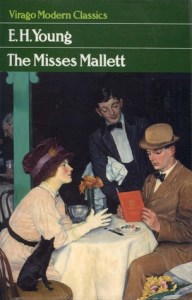
EH Young’s world is one of genteel middle-class, and at first I wasn’t sure The Misses Mallett (1922) was for me. The descriptions of the beauty of Radstowe were somewhat overblown, and I wondered if it was going to be clumsy Austen-lite. I’m pleased to say I was completely wrong. The Misses Mallet is acutely observed and Young’s characterisation is excellent. Those who people her world are complex, not always likable but always so believable.

Caroline and Sophia are elderly unmarried Mallet sisters who spend their days reliving past glories, which may not be exactly as Caroline remembers:

“ ‘And men like what they fear,’ Caroline added.

‘Yes dear,’ Sophia said, A natural flush appeared round the delicate dabs of rouge. She hoped she might be forgiven for her tender deceits. Those young men in white waistcoats had often laughed at Caroline rather than her wit; she was, as Sophia had shrinkingly divined, as often as not their butt, and dear Caroline had never known it; she must never know it, never know it.”

The elderly Miss Malletts are comically but fondly drawn, with their frills and lace, their make-up which doesn’t hide their age, Caroline’s mistaken belief that she is wordly, and their constant self-mythologising. Rose, their younger step-sister, is different:

“restraint and a love of danger lived together in her nature and these two qualities were fed by the position in which she found herself, nor would she have had the position changed. It supplied her with the emotion she had wanted. She had the privilege of feeling deeply and dangerously yet of preserving her pride.”

She is in love with Francis Sales, but realised it too late and he married another. As Young details above, this arrested love affair quite suits her. Sales’ wife is housebound in constant pain since a fall from a horse that she believes Rose engineered. They are locked in a co-dependent, vindictive relationship bound up in what has not been said, in blame and in guilt.

Yet overall the lives of the Misses Malletts are calm and routine.

“the Mallets did not criticise their actions or analyse their minds”

This all changes with the arrival of Henrietta, their young orphaned niece.

“the Mallets don’t marry, Henrietta. Look at us, as happy as the day is long, with all the fun and none of the trouble. We’re terrible flirts, Sophia and I. Rose is different, but at least she isn’t married. The three Miss Malletts of Nelson Lodge! Now there are four of us, and you must keep up our reputation.”

But Henrietta may not be quite so ready to adopt the Miss Mallett way of life. She also falls for Francis Sales, whilst being courted by the socially awkward Charles Batty:

“He was plain; he was getting bald; his trousers bagged; his socks wrinkled like concertinas; his comparative self-assurance was quite unjustified.”

What follows is a novel written with great lightness of touch, but it is the excellent characterisation that stops it being cosy or sentimental. It is a world that has passed, but it is a world that is fully realised and Young shows that it, and the people in it, can still be recognised and understood. The Misses Mallett, and those who surround them, will stay with me a long time.


Secondly, William which came 3 years after The Misses Mallett. I found the descriptive writing in this a lot more restrained and so I wonder if either 3 years saw the maturing of EH Young’s writing style, or if she was actually having a sly dig at purple prose romances in The Misses Mallett and I missed the pastiche. Either way, William is brilliantly written and was her most successful novel. It is primarily a character study of the titular man, a self-made shipping magnate.

“William Nesbitt had no yearnings for the sea: he had had enough of it in his youth, but the thought of it was always with him and would have been with him even if his business had not compelled him to constant communication with it; and the fact that it lay down there beyond the river and out of sight, was like the presence of a woman, still beautiful, whom he loved no longer with desire, but with knowledge, understanding and satisfaction.”

William is someone who life has treated well, and he has an affection for it:

“Life was interesting, a great adventure, enlivened by countless minor episodes. It was difficult to believe anybody could find it dull. Every personality was more or less of an excitement to him – Kate, Janet, Lydia, the captains of his ships, the clerks in his office, the ships themselves, the very gulls swooping for garbage in the river, cutting the air with wings like swords.”

However, although he has worked hard and continues to do so, he has never really been tested. This is about to change. One of his five children, his daughter Lydia, leaves her husband to live with her lover. The post-war times are a-changing, and William finds himself in opposition to his wife as they cope with the fallout. William finds he is able to love his children unconditionally. His affection for life is undiminished and expanded.

“ ‘I’ve told you Kate, we can’t have them as we want them. We’re lucky to have them as they are.’”

His wife on the other hand, is outraged at Lydia’s unconventional choice and becomes embittered as she realises she holds absolutely no power to change the situation.

“He had lived with her for nearly forty years, not deceiving himself into the belief of perfect union, but in accord, with humour, with much happiness, and now, in the face of first trouble, he had lost touch with her, as though his consort were only for smooth waters.”

William is a rich novel despite not being overly long (a good thing to my way of thinking). Once again, EH Young displays excellent characterisation and psychological insight, not only towards her main protagonist but also the characters of his wife and their children. There is sadness in the novel, with Kate’s moral rigidity causing her deep pain and William’s realisation that although his marriage is basically happy “He had missed ecstasy”. However, it is not a sad novel. Rather it captures the human impact of societal change and it does so without preaching, showing how both human beings and love endure. EH Young challenges the institution of marriage (she lived in a ménage a trois for many years) whilst also showing its advantages:

“‘There’s a great deal of humbug about marriage… and a forced loyalty is the devil. And if Oliver couldn’t hold Lydia by love, why should he hold her by law?’”

It is a testament to EH Young’s writing that while society has moved on to an extent that the central dilemma no longer exists, William remains a deeply moving and compelling novel.

These were my first two novels by EH Young and I’m already a huge fan. In this year of my book buying ban, I’m pleased to find I have 4 more of her novels in the TBR mountain (it’s this kind of excess which has led to the aforementioned ban); I’ll definitely be reading them soon.

To end, a band that named themselves after their home town near Bristol:

“Shut up, I’m having a rhetorical conversation!” (Max Bialystock, The Producers, 1968)

This my contribution to the 1968 Club, running this week and hosted by Karen at Kaggsy’s Bookish Ramblings and Simon at Stuck in a Book. Do join in!

Firstly, The Quest for Christa T by Christa Wolf (trans. Christopher Middleton). This is the story of Christa’s life, told from the point of view of a schoolfriend who becomes reacquainted with Christa before leukaemia cuts her life short. The opening paragraph captures the concerns of the novel- the impossibility of ever truly knowing another person, and the fallacy of ever trying to capture them in order to portray them to others:

“The quest for her: in the thought of her. And of the attempt to be oneself. She speaks of this in her diaries, which we have, on the loose manuscript pages that have been found, and between the lines of those letters of hers that are known to me. I must forget my memory of Christa T – that is what these documents have taught me.  Memory puts a deceptive colour on things.”

Christa is an enigma. She is self-contained but within that is a resistance; having survived Hitler’s Germany she doesn’t readily conform to East Germany’s strictures:

“she was always tall, and thin, until the last years, after she’d had children. So there she was, walking along in front, stalking head-in-the-air along the curb, and suddenly she put a rolled newspaper in her mouth and let go with a shout: HOOOHAAHOOO – something like that. She blew her trumpet and the off-duty sergeants and corporals of the local defense corps stopped and stared and shook their heads at her.”

This is a watershed moment for the narrator, the point at which she notices Christa and begins to acknowledge her wonder at her friend. However, while Christa is compelling, she also lives a life that is completely ordinary. She grows up, gets married, has children, and works as a teacher.

“Christa T lived strenuously even when she seemed lackadaisical; that ought to be attested, though the point here cannot be attested, though the point here cannot be to justify her…she didn’t attempt to escape from it all, as many people were starting to do in those years. When her name was called: “Christa T!” – she stood up and went and did what was expected of her.”

Despite this, the quest is not one that can be fulfilled – at the end we are in the position of the narrator in that we don’t know who Christa T is either. This is Christa’s final resistance: she conformed exactly how she was supposed to under Nazism and communism, and yet the state, her friends, and the readers of her story cannot box her in.

“There it is again, the language of her sketches, there her voice is heard again.  Yet it will eventually have to stop; the moment is coming where the voice fails, and it can’t be interrupted. Some details pass me by, while I anticipate the end.”

The Quest for Christa T is fragmentary and non-linear, yet it still manages to be a satisfying whole. It is a subtle, beautifully written novel which allows for the reader’s intelligence to find their own meaning. But don’t just take my word for it, take David Bowie’s: The Quest for Christa T was one of his 100 must-read books.

Secondly, the short story collection Tigers are Better-Looking by Jean Rhys, which features two collections, the first 8 stores collected under the titular tale, the last 9 printed from The Left Bank, originally published in 1927. The rest of The Left Bank stories were judged by Rhys to be too weak to merit republication. Surprisingly though, these were my favourite part of Tigers are Better-Looking. While I enjoyed the first selection of stories, I felt they weren’t as strong as Sleep It Off Lady, her final collection of short stories published 8 years after this, which I had greatly enjoyed. While The Left Bank stories are essentially sketches, I thought they had real verve so I’ll concentrate on this section. When read all together they give a wonderful sense of a particular city at a particular time. Rhys captures people with artful description:

Illusion “Miss Bruce was quite an old inhabitant of the Quarter […] one thought of her as a shining example of what character and training – British character and training – can do. After seven years in Paris she appeared utterly untouched, utterly unaffected, by anything hectic, slightly exotic or unwholesome. Going on all the time all round her were the cult of beauty and the worship of physical love: she just looked at her surroundings in her healthy, sensible way, and then dismissed them from her thoughts”

And she is equally adept at capturing relationships, such as that between a painter and ex-prostitute in Tea with an Artist:

“And then I remembered the way in which she had touched his cheek with her big hands. There was in that movement knowledge, and a certain sureness: as it were the ghost of a time when her business in life had been the consoling of men.”

Rhys often drew on her own life and there are certainly stories here that will be familiar to anyone who has read her work: depression and poverty in Hunger, the life she knew as a shop model in Mannequin, but she also broadens her gaze. There is a touching portrait of an old man and child in From a French Prison, a tragic love affair in La Grosse Fifi quite different from the dinginess and malaise that characterises the affairs she normally writes about.The longest story is Vienne, and here is where the shadow of war begins to loom over the Europe she has been portraying. A young couple, too sad to be Bright Young Things, desperately traverse the continent without quite understanding the danger, but knowing they must reach safety.

“We drank a still wine, sweetish, at dinner. It went to my head and again I could tell myself that my existence was a dream. After all it mattered very little where we went. Warsaw, London…London, Warsaw…..Words! Quite without the tremendous significance I had given them.”

I don’t think Tigers Are Better Looking is Rhys at her best, but there is still so much to enjoy in this collection, flashes of brilliance even when the stories aren’t as strong. She’s a wonderful writer and reading this has encouraged me to dig out the remaining novels of hers that I have yet to read.

To end, the UK number one this week in 1968. All together now: la, la, la, la, la, laaaaaaaaaa….